

Paper Menu >>
Journal Menu >>
 Vol.3, No.2, 93-98 (2011) doi:10.4236/health.2011.32017 C opyright © 2011 SciRes. Openly accessible at http://www.scirp.org/journal/HEALTH/ Health Assessment of the effectiveness of standardized infusion devices for healthcare management Shio Sugita1*, Hideko Aida2, A ya Okada3, Hiroyuki Kobayashi2 1Former Department of Nursing, Juntendo University Hospital, Tokyo, Japan; *Corresponding Author: [email protected] 2Department of H o spital Administration, Juntendo University School o f Medici ne, Toky o, Japan 3Department of Nurs i n g , Junte ndo University Nerima Hospital, Tokyo, Japa n Received 6 December 2010; revised 10 February 2011; accepted 15 February 2011. ABSTRACT Since standardization is an important safety measure in healthcare systems, it is essential to systematically assess the effects of introducing new and increasingly complex medical equip- ment, such as infusion dev ices. In this study, we compared the effects of standardized polyvinyl chloride (PVC)-free closed-system integrated infusion devices with conventional infusion de- vices. S pecifically, we assessed the s afe ty, work efficiency, user-friendliness, and cost effec- tiveness of these devices. Compared with con- ventional infusion devices, integrated PVC-free infusion devices were more expensive to pur- chase and dispose, but were safer and more user-friendly and efficient. Although it would be preferable to use standardized infusion devices in all hospital departments, their cost may limit their application to departments that use high-risk treatments, where they w ould be most beneficial. Keywords: Standardized Infusion Devices; Efficiency Assessment; Healthcare Ma nagement; Nursing Administration 1. INTRODUCTION The use of infusion devices is complex and diverse, due to not only differences in the pharmacological agents that are infused but also the material of infusion devices and their use with electronic medical equipment, which can lead to medical accidents. According to the Japan Council for Quality Health Care, 92 out of 1440 reports that were received from 204 medical institutions during 2008 involved “management-related items” and “the use of drains and tubes,” including extravasations of intravenous infusions [1]. In addition, some previous studies also have reported cases in which the combina- tion of tubes and drugs caused dissolution and elution of the highly toxic substance diethylhexyl phthalate (DEHP) [2-4] and lipid-soluble drugs that caused cracks at the connections of tubes, which caused leakage of the drug [5-7]. After receiving reports of these cases, all medical institutions in Japan have begun regulating the use of infusion devices according to the composition of the devices, such as polyvinyl chloride (PVC)-free, DEHP- free, or conventional materials. However, this regulatory process requires the medical staff to have extensive knowledge about the selection and handling of infusion devices, which depends on many factors, such as the intended purpose of infusion, drug, drip rate, and the patient’s condition. In a previous study, we analyzed the risks that are as- sociated with different pharmacological agents, infusion routes, catheter-related infections, and electronic equip- ment. Specifically, we selected PVC-free closed-system integrated infusion devices (hereafter referred to as standardized infusion devices) as the reference standard in our hospital and introduced these devices into the chemotherapy department, where strict control of the safety of injections is required. Then, to determine the effectiveness of these devices, we compared the time and cost that was required to prepare these devices with those of conventional devices, which consisted of a combination of an infusion set, a T-shaped stopcock, and an extension tube. The results showed that standardized infusion devices improved work efficiency. However, these devices were not as cost-effective as conventional devices due to the cost of materials and the weight of wastes [8]. In this study, we conducted a more comprehensive study to assess the effectiveness of standardized infusion devices, including their safety and user-friendliness. 2. SUBJECTS AND METHODS This study was conducted in accordance with the guidelines of our institutional review board.  S. Sugita et al. / Health 3 (2011) 93-98 Copyright © 2011 SciRes. Openly accessible at http://www.scirp.org/journal/HEALTH/ 94 2.1. Comparison of the Incidence of Adverse Events before and after the In- troduction of Standardized Infusion Devices The safety of standardized infusion devices was as- sessed by comparing the incidence of adverse events in the medicine department and in the chemotherapy de- partment. The study was conducted for 10 d before in- troducing the standardized infusion devices and for 10 d 2 months afterwards. A check sheet was used to record the number of patients who received an infusion every day and the number of adverse events that occurred. Then adverse events were checked: 1) “Leakage of drug solution due to loosening (unfastening) of the connector of the infusion device”, 2) “Leakage of drug solution due to loosening of the joint between the intravenous needle and the infusion device”, 3) “Attempts to disconnect the joint manually were unsuccessful”, 4) “There was a crack in the three-way stopcock”, 5) “The T-shaped stopcock and the protective cap became dirty”, 6) “The connector was no longer sterile after an infusion route was established”, 7) “No infusion set was available for the infusion pump that was used”, 8) “No infusion set was available for the type of pharmacological agent that was selected”. The incidence of adverse events was cal- culated as the number of adverse events that occurred per patient per day, and the number of adverse events was calculated as the number of days in the survey pe- riod divided by the number of patients. The incidence of adverse events before and after the introduction of stan- dardized infusion devices was compared by using Fisher ’s exact test. The level of significance was defined as 0.05. 2.2. Survey of User-Friendliness and Safety Between February 21, 2008, and March 5, 2008, an anonymous survey was conducted among 45 nurses who worked in the medicine department and chemotherapy department, where standardized infusion devices had been used for more than 3 months. The survey asked multiple-choice and yes/no questions about the user- friendliness and usefulness of standardized infusion de- vices, such as the ease of preparing the administration route and precautions that were needed to ensure sterile operation as well as free-response questions about the perceived advantages and desired improvements in standardized infusion devices. Specifically, the user- friendliness of standardized infusion devices was com- pared with conventional infusion devices by 5 categories: “better”, “slightly better”, “same”, “slightly worse” and “worse”. In addition, the usefulness of the all-in-one nature, PVC-free components, and lock-type system of standardized infusion devices and whether continued use was desired was determined by “yes”, “no”, or “neither yes nor no” responses. For ethical reasons, we conducted this survey anony- mously by allowing respondents to drop completed questionnaires into a collection bag during a 2 week pe- riod. Statistical analysis of the survey responses was performed by using Mann-Whitney U tests with JMP 6 data analysis software. The level of significance was defined as 0.05. 3. RESULTS 3.1. Comparison of the Incidence of Adverse Events before and after the In- troduction of Standardized Infusion Devices The incidence of adverse events before and after the introduction of standardized infusion devices is summa- rized in Table 1. One hundred forty-seven patients re- ceived infusions during the survey period before stan- dardization, while 389 patients received infusions after standardization. The incidence of 4 different adverse events decreased after the introduction of standardized infusion devices. First, the incidence of the adverse event “Leakage of drug solution due to loosening of the joint between the intravenous needle and the infusion device” decreased from 0.00204 events per patient per day before the introduction to 0 afterwards. Second, the incidence of the adverse event “Attempts to disconnect the joint manually were unsuccessful” decreased from 0.00272 events per patient per day before the introduc- tion to 0.00026 events per patient per day afterwards. Third, the incidence of the adverse event “The T-shaped stopcock and the protective cap became dirty” decreased from 0.00272 events per patient per day before the in- troduction to 0 afterwards. Fourth, the incidence of the adverse event “Leakage of drug solution due to loosen- ing (unfastening) of the connector of the infusion de- vice” decreased from 0.00068 events per patient per day before the introduction to 0.00026 events per patient per day after wards. No other adve rse events o ccurred before or after the introduction of standardized infusion de- vices. 3.2. Survey of User-Friendliness and Safety Forty-one out of 45 surveys were returned. Eleven out of the 13 questions about the convenience of infusion devices showed a statistically significant difference be- tween the standardized and conventional infusion de- vices, which indicated that the standardized infusion devices were very user-friendly (Figure 1). In addition, 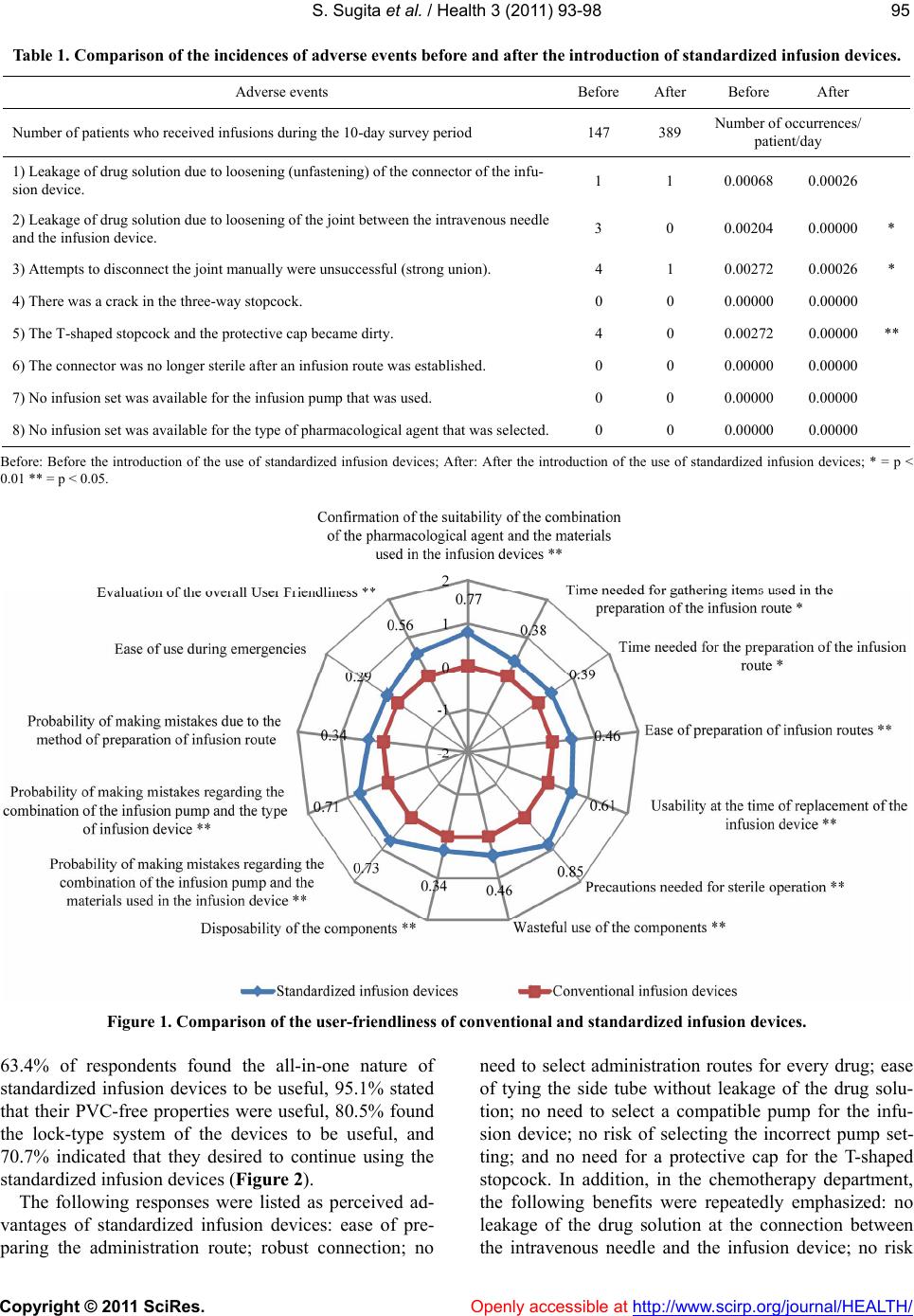 S. Sugita et al. / Health 3 (2011) 93-98 Copyright © 2011 SciRes. http://www.scirp.org/journal/HEALTH/ 9595 Table 1. Comparison of the incidences of adverse events before and after the introduction of standardized infusion devices. Adverse events Before After Before After Number of patients who received infusio ns during the 10-day survey period 147 389 Number of occurrences/ patient/day 1) Leakage of drug solution due to loosening (unfastening) of the connector of the in fu- sion device. 1 1 0.00068 0.00026 2) Leakage of drug solution due to loosening of the joint between the intravenous needle and the infusion device. 3 0 0.00204 0.00000* 3) Attempts to disconnect the joint manually were unsuccessful (strong union). 4 1 0.00272 0.00026* 4) There was a crack in t h e t h ree-way stopcock. 0 0 0.00000 0.00000 5) The T-shaped stopcock and the protective cap became dirty. 4 0 0.00272 0.00000** 6) The connector was no longer sterile after an infusion route was established. 0 0 0.00000 0.00000 7) No infusion set was available for the infusion pump that was used . 0 0 0.00000 0.00000 8) No infusion set was available for the type of pha rmacological agent that was selected.0 0 0.00000 0.00000 Before: Before the introduction of the use of standardized infusion devices; After: After the introduction of the use of standardized infusion devices; * = p < 0.01 ** = p < 0.05. Figure 1. Comparison of the user-friendliness of conventional and standardized infusion devices. 63.4% of respondents found the all-in-one nature of standardized infusion devices to be useful, 95.1% stated that their PVC-free properties were useful, 80.5% found the lock-type system of the devices to be useful, and 70.7% indicated that they desired to continue using the standardized infusion devices (Figure 2). The following responses were listed as perceived ad- vantages of standardized infusion devices: ease of pre- paring the administration route; robust connection; no need to select administration routes for every drug; ease of tying the side tube without leakage of the drug solu- tion; no need to select a compatible pump for the infu- sion device; no risk of selecting the incorrect pump set- ting; and no need for a protective cap for the T-shaped stopcock. In addition, in the chemotherapy department, the following benefits were repeatedly emphasized: no leakage of the drug solution at the connection between the intravenous needle and the infusion device; no risk Openly accessible at 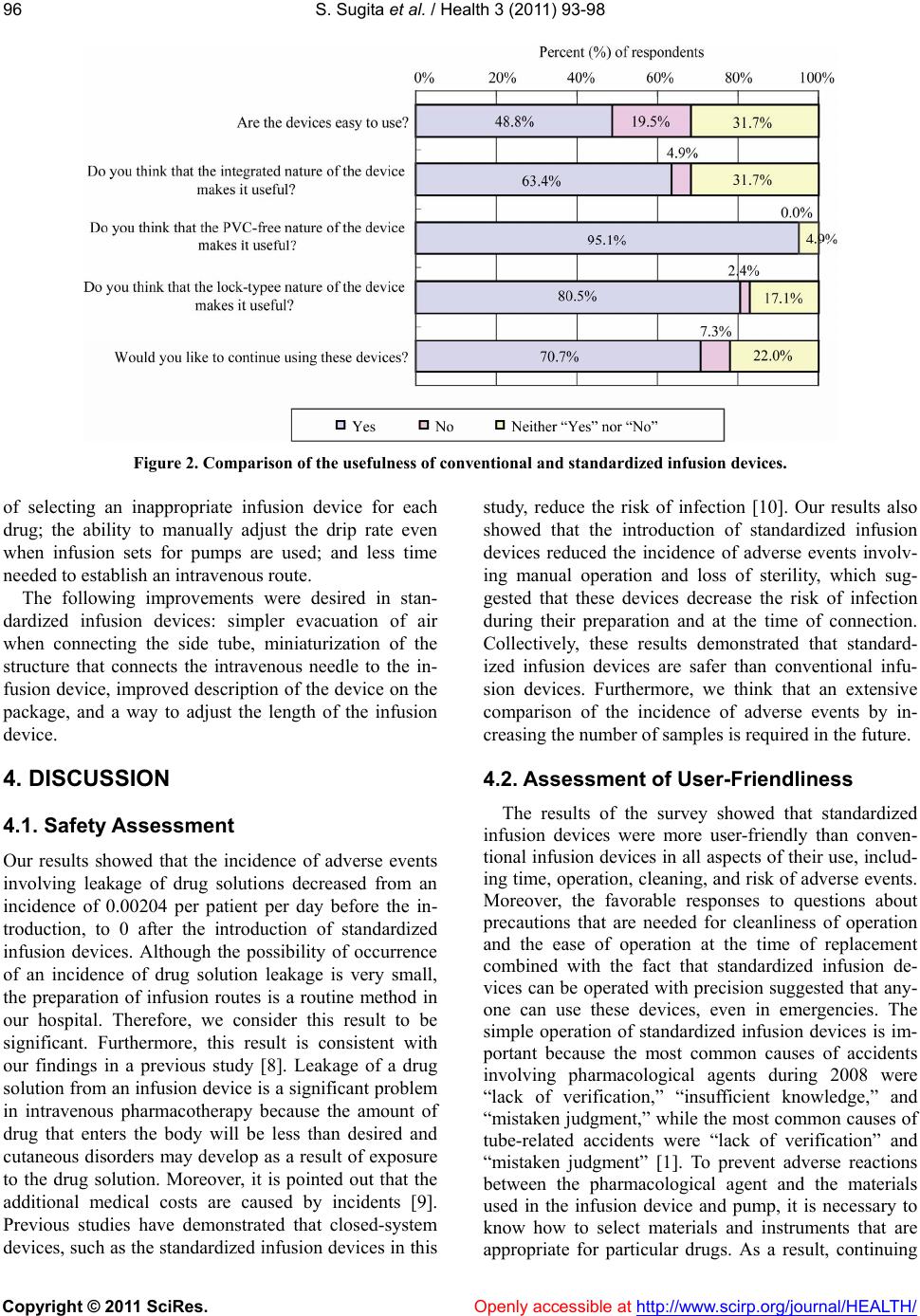 S. Sugita et al. / Health 3 (2011) 93-98 Copyright © 2011 SciRes. Openly accessible at http://www.scirp.org/journal/HEALTH/ 96 Figure 2. Comparison of the usefulness of conventional and standardized infusion devices. of selecting an inappropriate infusion device for each drug; the ability to manually adjust the drip rate even when infusion sets for pumps are used; and less time needed to establish an intravenous route. The following improvements were desired in stan- dardized infusion devices: simpler evacuation of air when connecting the side tube, miniaturization of the structure that connects the intravenous needle to the in- fusion device, improved description of the device on the package, and a way to adjust the length of the infusion device. 4. DISCUSSION 4.1. Safety Assessment Our results showed that the incidence of adverse events involving leakage of drug solutions decreased from an incidence of 0.00204 per patient per day before the in- troduction, to 0 after the introduction of standardized infusion devices. Although the possibility of occurrence of an incidence of drug solution leakage is very small, the preparation of infusion routes is a routine method in our hospital. Therefore, we consider this result to be significant. Furthermore, this result is consistent with our findings in a previous study [8]. Leakage of a drug solution from an infusion device is a significant problem in intravenous pharmacotherapy because the amount of drug that enters the body will be less than desired and cutaneous disorders may develop as a result of exposure to the drug solution. Moreover, it is pointed out that the additional medical costs are caused by incidents [9]. Previous studies have demonstrated that closed-system devices, such as the standardized infusion devices in this study, reduce the risk of infection [10]. Our results also showed that the introduction of standardized infusion devices reduced the incidence of adverse events involv- ing manual operation and loss of sterility, which sug- gested that these devices decrease the risk of infection during their preparation and at the time of connection. Collectively, these results demonstrated that standard- ized infusion devices are safer than conventional infu- sion devices. Furthermore, we think that an extensive comparison of the incidence of adverse events by in- creasing the number of samples is required in th e future. 4.2. Assessment of User-Friendliness The results of the survey showed that standardized infusion devices were more user-friendly than conven- tional infusion devices in all aspects of their use, includ- ing time, operation, cleaning, and risk of adverse events. Moreover, the favorable responses to questions about precautions that are needed for cleanliness of operation and the ease of operation at the time of replacement combined with the fact that standardized infusion de- vices can be operated with precision suggested that any- one can use these devices, even in emergencies. The simple operation of standardized infusion devices is im- portant because the most common causes of accidents involving pharmacological agents during 2008 were “lack of verification,” “insufficient knowledge,” and “mistaken judgment,” while the most commo n causes of tube-related accidents were “lack of verification” and “mistaken judgment” [1]. To prevent adverse reactions between the pharmacological agent and the materials used in the infusion device and pump, it is necessary to know how to select materials and instruments that are appropriate for particular drugs. As a result, continuing  S. Sugita et al. / Health 3 (2011) 93-98 Copyright © 2011 SciRes. Openly accessible at http://www.scirp.org/journal/HEALTH/ 9797 education about drugs and the properties of medical ma- terials is necessary. However, since standardized infu- sion devices are made with PVC-free components, it is not necessary to use a specific infusion device for spe- cific drugs. As a result, standardization not only simpli- fies the practice but also the educational requirements of infusion management. These conclusions are supported by the finding that most of the respondents in this study considered the physical characteristics of standardized infusion devices useful and desired to continue using them. Moreover, their free responses indicated that standardized infusion devices are safe, effective, and easy to use. 4.3. Assessment of Usability In addition to safety and user-friendliness, we also as- sessed the usefulness of standardized infusion devices in terms of their work efficiency and cost-effectiveness. In our previous study, we measured the work efficiency of infusion devices by measuring the time that was needed to prep are an in fusi on dev ice . We found th at th e pr epar a- tion time for standardized infusion devices (55.8 (12.0) s) (mean (SD) was shorter than that for conventional infu- sion devices (96.1 (22.4) s) (Figure 3). In the chemo- therapy department, the preparation time of conven tional and standardized infusion devices was (97.0 (22.0) mind-1) and (22.0 (3.0) mind-1), respectively. Thus, the introduction of standardized infusion devices improved the work efficiency of infusions by decreasing the time that was required to select different products for each drug [8]. In our previous study, we also determined the cost-effectiveness of infusion devices by performing a cost simulation of the purchase price of the devices, la- bor costs for improving their work efficiency, and the amount of medical waste they generated. We showed that the cost of conventional infusion devices was ¥280,405 (Japanese Yen) for central venous routes and ¥1,003,019 for peripheral venous routes. In addition, we predicted that the purchase price of standardized infu- sion devices is higher than that for conventional devices, despite the costs of medical waste disposal and labor associated with improving work efficiency (Table 2) [8]. As a result, although standardized infusion devices are more expensive than conventional infusion devices, the standardized devices are safer and more user-friendly and efficient. Ideally, standardized infusion devices should be used in all hospital departments; however, their higher cost may limit its introduction to depart- ments that use high-risk treatments, such as the chemo- therapy department, intensive care unit, and pediatric ward, where they would be most beneficial. Figure 3. Comparison of the time required to prepare a fluid infusion route using conventional and standardized infusion devices. (Sugita, S., et al. Evaluation of the cost effectiveness and work efficiency of the use of standardized infusion devices. Japanese Journal of Health Care Man- agement, 9(4), 2009). Table 2. Cost simulation. Price (Japanese Yen/device) Disposal costs (Japanese Yen/100 devices) Number (devices/ month) Price (Japanese Yen/month) Disposal costs (Japanese Yen/month) Total costs (Japanese Yen/month) Standardized- Conventional (Japanese Yen/month) Eliminated personnel costs (Japanese Yen/month) Predicted costs after the introduction of the use of the standardized type of devices (Japanese Yen/month) Conventional 1,510 597 750 1,132,5004,475 1,136,975 Central venous infusion Standardized 1,900 663 750 1,425,0004,974 1,429,974+292,999 -12,594 +280,405 Conventional 480 454 9000 4,320,00040,856 4,360,856 Peripheral venous infusion Standardized 600 438 9000 5,400,00039,438 5,439,438+1,078,582-75,563 +1003,019 Sugita, S., et al . Evaluat ion of the cost effectiveness and work efficiency of the use of standar dized i nfusion devices . Japanese Jo urnal of Health Care Manage- ent, 9(4), 2009. m  S. Sugita et al. / Health 3 (2011) 93-98 Copyright © 2011 SciRes. Openly accessible at http://www.scirp.org/journal/HEALTH/ 98 Due to the increasing complexity of drug regimens and drug-delivery devices, it is increasingly difficult to perform cost-benefit analyses of all new medical equip- ment. However, comprehensive assessments are impor- tant to effectively implement and manage health safety measures. In this study, we analyzed 4 different aspects of infusion devices, which are considered to be compre- hensive. Moreover, we consider that our future tasks are to introduce this study results to another hospital and then to be calculated based on the situation in that hos- pital. To enhance the safety of healthcare services, medical devices should be stand ardized. In addition, standardiza- tion should be applied at all medical institutions nation- wide. Furthermore, pharmaceutical and medical equip- ment companies should work with medical institutions to improve the safety of drug delivery systems to help develop safer and more effective medical care. 5. CONCLUDING REMARKS To determine the overall effectiveness of using stan- dardized infusion devices, we assessed their safety, work efficiency, user-friendliness, and cost-effectiveness. Our results showed that standardized infusion devices are more expensive than conventional infusion devices; however, standardized infusion devices are safer and more user-friendly and efficient. Ideally, standardized infusion devices should be used in all hospital depart- ments, but their higher costs may limit their use to de- partments that use high-risk treatments, where they would be most beneficial. This study highlights the ad- vantages of standardizing medical equipment, which is important for improving healthcare management and administration. REFERENCES [1] The Japan Council for Quality Health Care (2009) The Project to Collect Medical Near-Miss/Adverse Event In- formation. 16th Report, 24 March 2009, Division of Ad- verse Event Prevention. [2] Ministry of Health, Labour and Welfare of Japan (2002) Pharmaceuticals and medical devices safety information No. 182. http://www.mhlw.go.jp/houdou/2002/10/h1031-1a.html# 2 [3] Health Canada (2001) DEHP in medical devices: An exposure and toxicity assessment. http://www.hc-sc.gc.ca/dhp-mps/md-im/activit/sci-consul t/dehp/sapdehp_rep_gcsdehp_rap_2001-04-26-eng.php [4] U.S. Food and Drug Administration (2001) Safety As- sessment of Di(2-ethylhexyl)phthalate (DEHP) released from PVC medical devices. http://www.tracingpapers.org/article.php3?id_article=38 [5] Ministry of Health, Labour and Welfare of Japan (2003) Pharmaceuticals and medical devices safety information No.196. http://www.mhlw.go.jp/houdou/2003/12/h1225-4.html#g ai2 [6] Nakao, M., Yamanaka, S., Iwata, M., Nakashima, M. and Onji, I. (2003) The cracks of polycarbonate three-way stopcocks are enhanced by the lubricating action of fat emulsion of propofol. Japanese journal of anesthesiology, 52, 1243-1247. [7] Nakao, M., Yamanaka, S., Harada, A. and Onji, I. (2000) Cracks of polycarbonate three-way stopcock are caused by fat emulsion not by propofol. Japanese journal of an- esthesiology, 49, 802-805. [8] Sugita, S., Okada, A., Hori, S., Aida, H., Tamura, T., Suzuki, H., et al. (2009) Evaluation of the cost effective- ness and work efficiency of the use of standardized infu- sion devices. Japanese Journal of Health Care Manage- ment, 9, 519-523. [9] Kobayashi, M., Ikeda, S. and Muto, M. (2006) The Esti- mation of medical cost incurred by incidents and adverse events. Japanese Journal of Health Care and Social Welfare, 16, 85-96. [10] Yorioka, K., Oomaki, M., Sawa, H., Oie, S. and Kamiy a, A. (2005) Bacterial contamination of three-way stopcock and closed-type infusion device used in central venous catheter. Japanese Journal of Environmental Infections, 20, 272-274. |