

Paper Menu >>
Journal Menu >>
 Energy and Power Engineering, 2013, 5, 546-551 doi:10.4236/epe.2013.54B104 Published Online July 2013 (http://www.scirp.org/journal/epe) Analysis of the Electric Locomotives Neutral-section Passing Harmonic Resonance Xiaofeng Jiang, Zhengyou He, Haitao Hu, Yangfan Zhang School of Electrical Engineering, Southwest Jiaotong University, Chengdu, China Email: [email protected] Received April, 2013 ABSTRACT For the further analysis and suppression of the electric locomotives neutral-section passing overvoltage, on the basis of theoretical analysis of the neutral-section passing harmonic resonance conditions, this paper establishes simplified har- monic resonance simulation models of the electric locomotives neutral-section passing using MATLAB/Simulink, and makes the overvoltage simulation analysis of the existing electric locomotives neutral-section passing system in the event of a harmonic resonance. Results show that when the system harmonic resonance occurs, the operating overvolt- age of the neutral-section passing is serious intensified by the overvoltage of the harmonic resonance, which will make the voltage of the pantograph collector head exceeding 100 kV. This amplitude of the overvoltage will breakdown the air gap, which will be a serious threat to the safety operation of the electric railway. However, this kind of neu- tral-section passing overvoltage hasn’t cause the attention in the field and theoretical studies, which need more analysis and verification in the further study. Keywords: Neutral-section passing; Harmonic Resonance; Overvoltage; Equivalent Modeling; Simulation Analysis 1. Introduction Recently, the electric railways develop rapidly in China. With the high-speed, high-capacity and large-scale rail- way, the electric sectioning device based on the overlap- ping section with the advantages of hard-spot little and enterclose-smoothly is widely used in heterogeneous tractive power supply system. However, it exposes new problems in electric field at the same time of the applica- tion and popularization. While the locomotive passed by the electrical sectioning device, it has strong transient process such as overvoltage and overcurrent, and it brings security issues in electric railway. At present, in view of the electric locomotives neu- tral-section passing overvoltage research has been com- prehensive, and it conducts by two fields that the ex- perimental research and simulation study. In the field of experimental research, locomotive Department in Lan- zhou Railway Bureau organizes relevant units which sponsored Southwest Jiaotong University, China Railway First Survey and Design Institute and Zhuzhou Electric Locomotive Research Institute making field tests in the Lan-Xin Railway Wuwei to Jiayuguan Segment. The problem of over-voltage when the electric locomotive passed by the electrical sectioning device based on the overlapping section has been studied in [1]. In simulation study, the traction-locomotive system was divided into four transient processes by the physical process of the electric locomotives neutral-section passing, to establish equation of transient process, the voltage of the panto- graph collector head and the renewed arc in a transient process have been calculated respectively in [2]. Simula- tion model of electric locomotive neutral-section passing has been built with using Pspice in [3], which made si- mulation analysis of the electric locomotives neutral- section passing processes when the voltage working un- der different degrees of saturation and the neutral-section passing processes of the system which was added the disincentives. However, in present studies, few of them take the in- fluence of harmonic resonance into account, except the analysis of neutral-section passing overvoltage under the condition of ferroresonance in [4]. Because of the appli- cation of the electrical sectioning device based on the overlapping section, the length of neutral section is about 150-300 m, which increases the likelihood of parameter matching with resonance. In the case of parameter matching, resonance and serious harmonic amplification may occur when the system meets the condition of har- monic resonance. Because of the voltage distortion *This work is supported by High-Speed Railway Basic Research Fund Key Project (U1134205); National Natural Science Foundation o f China (51177139); Science & Technology Research and Development Key Project of Railway Ministry (2011J023-B). Copyright © 2013 SciRes. EPE 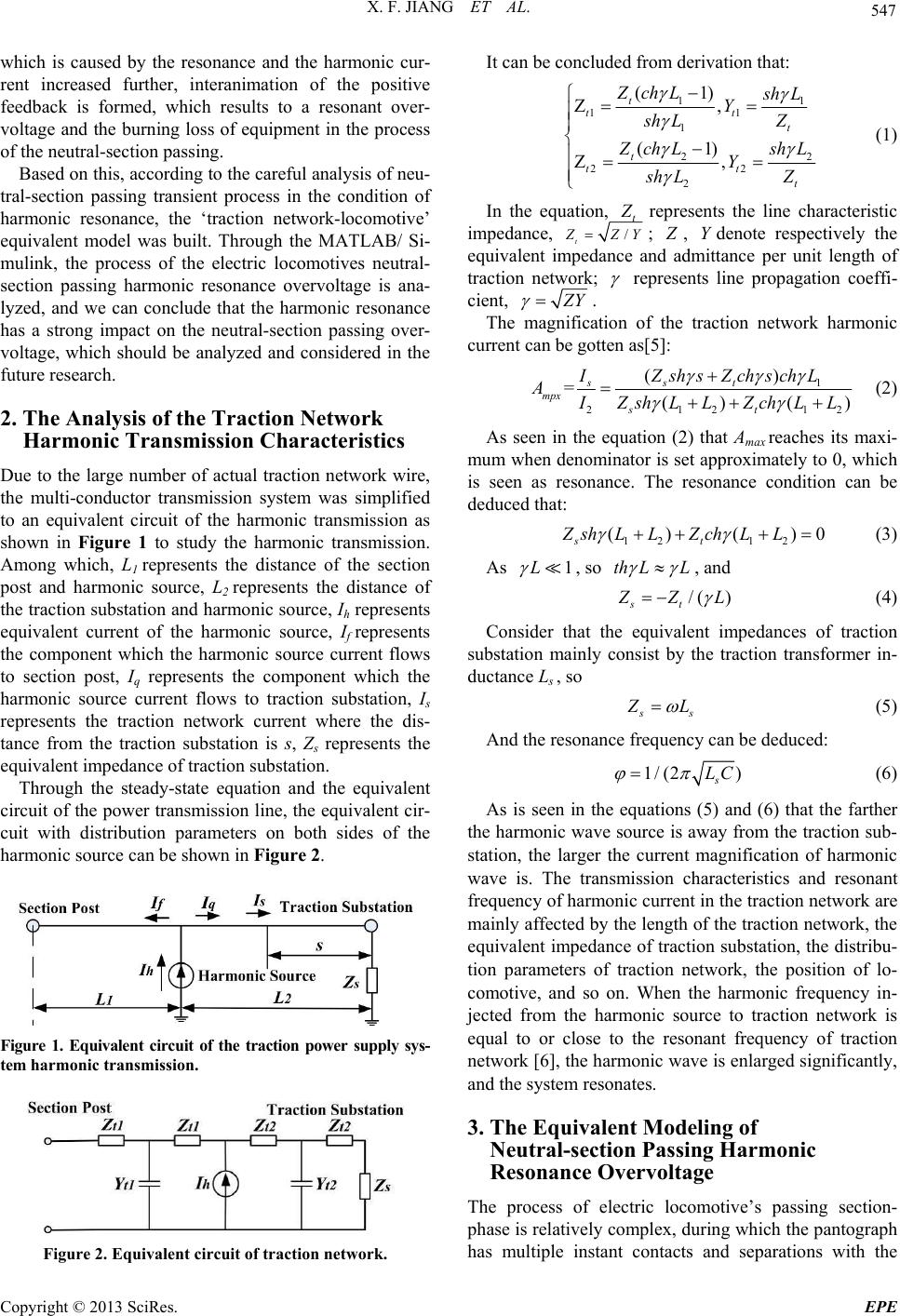 X. F. JIANG ET AL. 547 which is caused by the resonance and the harmonic cur- rent increased further, interanimation of the positive feedback is formed, which results to a resonant over- voltage and the burning loss of equipment in the process of the neutral-section passing. Based on this, according to the careful analysis of neu- tral-section passing transient process in the condition of harmonic resonance, the ‘traction network-locomotive’ equivalent model was built. Through the MATLAB/ Si- mulink, the process of the electric locomotives neutral- section passing harmonic resonance overvoltage is ana- lyzed, and we can conclude that the harmonic resonance has a strong impact on the neutral-section passing over- voltage, which should be analyzed and considered in the future research. 2. The Analysis of the Traction Network Harmonic Transmission Characteristics Due to the large number of actual traction network wire, the multi-conductor transmission system was simplified to an equivalent circuit of the harmonic transmission as shown in Figure 1 to study the harmonic transmission. Among which, L1 represents the distance of the section post and harmonic source, L2 represents the distance of the traction substation and harmonic source, Ih represents equivalent current of the harmonic source, If represents the component which the harmonic source current flows to section post, Iq represents the component which the harmonic source current flows to traction substation, Is represents the traction network current where the dis- tance from the traction substation is s, Zs represents the equivalent impedance of traction substation. Through the steady-state equation and the equivalent circuit of the power transmission line, the equivalent cir- cuit with distribution parameters on both sides of the harmonic source can be shown in Figure 2. Figure 1. Equivalent circuit of the traction power supply sys- tem harmonic transmission. Figure 2. Equivalent circuit of traction network. It can be concluded from derivation that: 11 11 1 22 22 2 (1) Z, (1) Z, t tt t t tt t ZchL s hL Y sh LZ ZchL s hL Y s hL Z (1) In the equation, t Z represents the line characteristic impedance, / t Z ZY; Z , denote respectively the equivalent impedance and admittance per unit length of traction network; Y represents line propagation coeffi- cient, Z Y . The magnification of the traction network harmonic current can be gotten as[5]: 1 2121 () =() () sst mpx st IZshsZchschL A 2 I ZshLLZchLL (2) As seen in the equation (2) that Amax reaches its maxi- mum when denominator is set approximately to 0, which is seen as resonance. The resonance condition can be deduced that: 12 12 () () st Zsh LLZch LL0 (3) As 1L , so th LL , and /( ) st Z ZL (4) Consider that the equivalent impedances of traction substation mainly consist by the traction transformer in- ductance Ls , so s s Z L (5) And the resonance frequency can be deduced: 1/(2 ) s LC (6) As is seen in the equations (5) and (6) that the farther the harmonic wave source is away from the traction sub- station, the larger the current magnification of harmonic wave is. The transmission characteristics and resonant frequency of harmonic current in the traction network are mainly affected by the length of the traction network, the equivalent impedance of traction substation, the distribu- tion parameters of traction network, the position of lo- comotive, and so on. When the harmonic frequency in- jected from the harmonic source to traction network is equal to or close to the resonant frequency of traction network [6], the harmonic wave is enlarged significantly, and the system resonates. 3. The Equivalent Modeling of Neutral-section Passing Harmonic Resonance Overvoltage The process of electric locomotive’s passing section- phase is relatively complex, during which the pantograph has multiple instant contacts and separations with the Copyright © 2013 SciRes. EPE 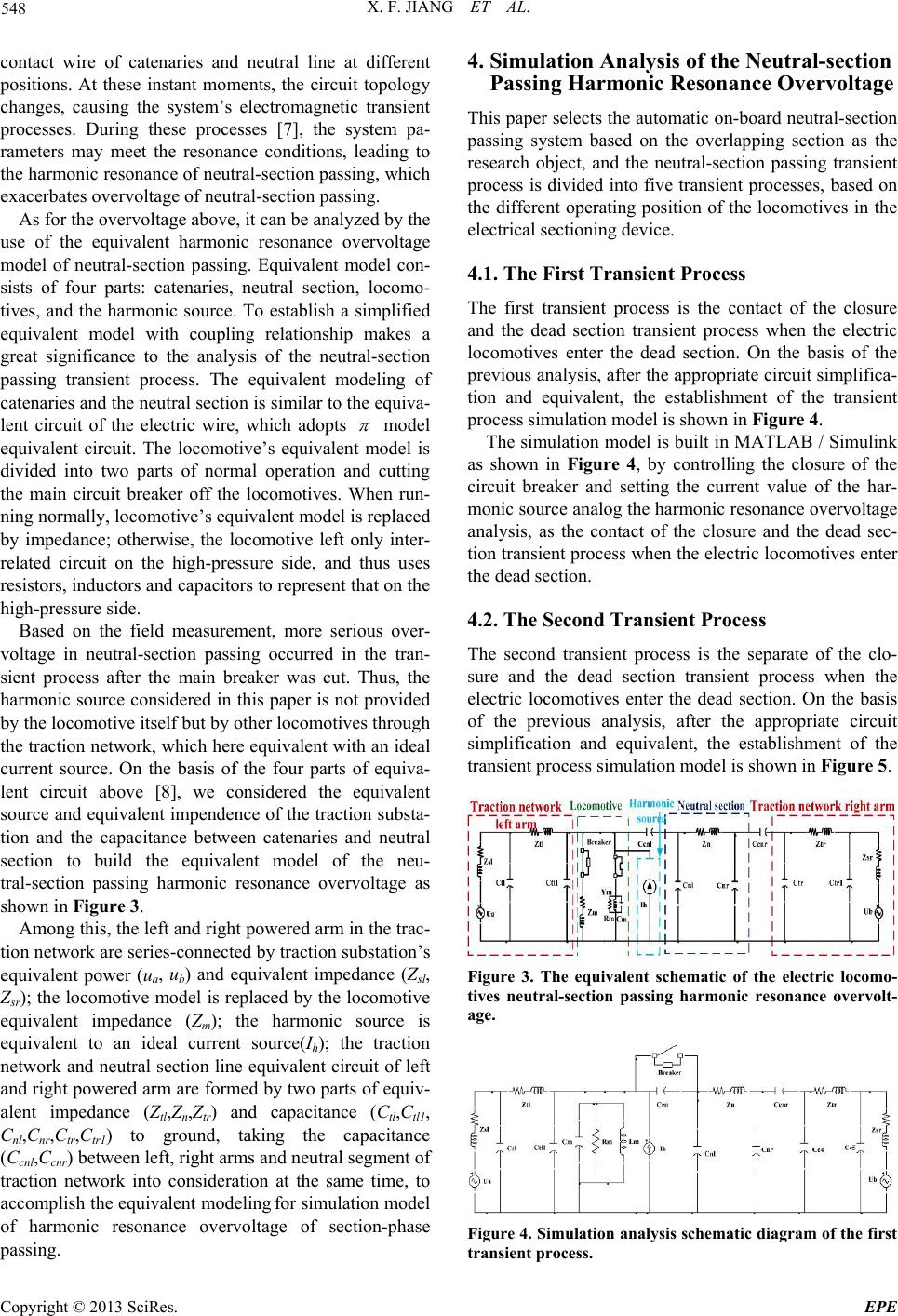 X. F. JIANG ET AL. 548 contact wire of catenaries and neutral line at different positions. At these instant moments, the circuit topology changes, causing the system’s electromagnetic transient processes. During these processes [7], the system pa- rameters may meet the resonance conditions, leading to the harmonic resonance of neutral-section passing, which exacerbates overvoltage of neutral-section passing. As for the overvoltage above, it can be analyzed by the use of the equivalent harmonic resonance overvoltage model of neutral-section passing. Equivalent model con- sists of four parts: catenaries, neutral section, locomo- tives, and the harmonic source. To establish a simplified equivalent model with coupling relationship makes a great significance to the analysis of the neutral-section passing transient process. The equivalent modeling of catenaries and the neutral section is similar to the equiva- lent circuit of the electric wire, which adopts model equivalent circuit. The locomotive’s equivalent model is divided into two parts of normal operation and cutting the main circuit breaker off the locomotives. When run- ning normally, locomotive’s equivalent model is replaced by impedance; otherwise, the locomotive left only inter- related circuit on the high-pressure side, and thus uses resistors, inductors and capacitors to represent that on the high-pressure side. Based on the field measurement, more serious over- voltage in neutral-section passing occurred in the tran- sient process after the main breaker was cut. Thus, the harmonic source considered in this paper is not provided by the locomotive itself but by other locomotives through the traction network, which here equivalent with an ideal current source. On the basis of the four parts of equiva- lent circuit above [8], we considered the equivalent source and equivalent impendence of the traction substa- tion and the capacitance between catenaries and neutral section to build the equivalent model of the neu- tral-section passing harmonic resonance overvoltage as shown in Figure 3. Among this, the left and right powered arm in the trac- tion network are series-connected by traction substation’s equivalent power (ua, ub) and equivalent impedance (Zsl, Zsr); the locomotive model is replaced by the locomotive equivalent impedance (Zm); the harmonic source is equivalent to an ideal current source(Ih); the traction network and neutral section line equivalent circuit of left and right powered arm are formed by two parts of equiv- alent impedance (Ztl,Zn,Ztr) and capacitance (Ctl,Ctl1, Cnl,Cnr,Ctr,Ctr1) to ground, taking the capacitance (Ccnl,Ccnr) between left, right arms and neutral segment of traction network into consideration at the same time, to accomplish the equivalent modeling for simulation model of harmonic resonance overvoltage of section-phase passing. 4. Simulation Analysis of the Neutral-section Passing Harmonic Resonance Overvoltage This paper selects the automatic on-board neutral-section passing system based on the overlapping section as the research object, and the neutral-section passing transient process is divided into five transient processes, based on the different operating position of the locomotives in the electrical sectioning device. 4.1. The First Transient Process The first transient process is the contact of the closure and the dead section transient process when the electric locomotives enter the dead section. On the basis of the previous analysis, after the appropriate circuit simplifica- tion and equivalent, the establishment of the transient process simulation model is shown in Figure 4. The simulation model is built in MATLAB / Simulink as shown in Figure 4, by controlling the closure of the circuit breaker and setting the current value of the har- monic source analog the harmonic resonance overvoltage analysis, as the contact of the closure and the dead sec- tion transient process when the electric locomotives enter the dead section. 4.2. The Second Transient Process The second transient process is the separate of the clo- sure and the dead section transient process when the electric locomotives enter the dead section. On the basis of the previous analysis, after the appropriate circuit simplification and equivalent, the establishment of the transient process simulation model is shown in Figure 5. Figure 3. The equivalent schematic of the electric locomo- tives neutral-section passing harmonic resonance overvolt- age. Figure 4. Simulation analysis schematic diagram of the first transient process. Copyright © 2013 SciRes. EPE 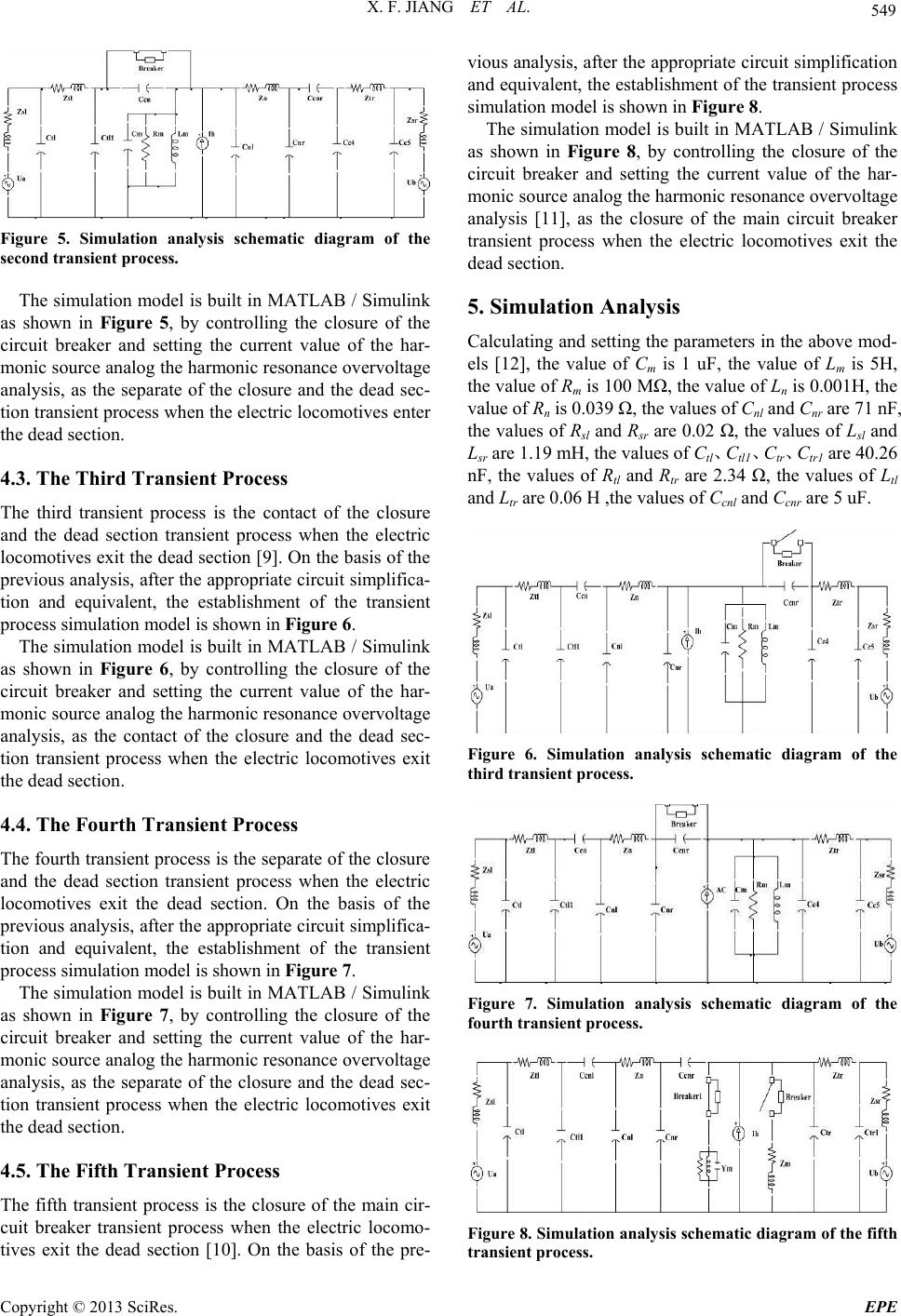 X. F. JIANG ET AL. 549 Figure 5. Simulation analysis schematic diagram of the second transient process. The simulation model is built in MATLAB / Simulink as shown in Figure 5, by controlling the closure of the circuit breaker and setting the current value of the har- monic source analog the harmonic resonance overvoltage analysis, as the separate of the closure and the dead sec- tion transient process when the electric locomotives enter the dead section. 4.3. The Third Transient Process The third transient process is the contact of the closure and the dead section transient process when the electric locomotives exit the dead section [9]. On the basis of the previous analysis, after the appropriate circuit simplifica- tion and equivalent, the establishment of the transient process simulation model is shown in Figure 6. The simulation model is built in MATLAB / Simulink as shown in Figure 6, by controlling the closure of the circuit breaker and setting the current value of the har- monic source analog the harmonic resonance overvoltage analysis, as the contact of the closure and the dead sec- tion transient process when the electric locomotives exit the dead section. 4.4. The Fourth Transient Process The fourth transient process is the separate of the closure and the dead section transient process when the electric locomotives exit the dead section. On the basis of the previous analysis, after the appropriate circuit simplifica- tion and equivalent, the establishment of the transient process simulation model is shown in Figure 7. The simulation model is built in MATLAB / Simulink as shown in Figure 7, by controlling the closure of the circuit breaker and setting the current value of the har- monic source analog the harmonic resonance overvoltage analysis, as the separate of the closure and the dead sec- tion transient process when the electric locomotives exit the dead section. 4.5. The Fifth Transient Process The fifth transient process is the closure of the main cir- cuit breaker transient process when the electric locomo- tives exit the dead section [10]. On the basis of the pre- vious analysis, after the appropriate circuit simplification and equivalent, the establishment of the transient process simulation model is shown in Figure 8. The simulation model is built in MATLAB / Simulink as shown in Figure 8, by controlling the closure of the circuit breaker and setting the current value of the har- monic source analog the harmonic resonance overvoltage analysis [11], as the closure of the main circuit breaker transient process when the electric locomotives exit the dead section. 5. Simulation Analysis Calculating and setting the parameters in the above mod- els [12], the value of Cm is 1 uF, the value of Lm is 5H, the value of Rm is 100 MΩ, the value of Ln is 0.001H, the value of Rn is 0.039 Ω, the values of Cnl and Cnr are 71 nF, the values of Rsl and Rsr are 0.02 Ω, the values of Lsl and Lsr are 1.19 mH, the values of Ctl、Ctl1、Ctr、Ctr1 are 40.26 nF, the values of Rtl and Rtr are 2.34 Ω, the values of Ltl and Ltr are 0.06 H ,the values of Ccnl and Ccnr are 5 uF. Figure 6. Simulation analysis schematic diagram of the third transient process. Figure 7. Simulation analysis schematic diagram of the fourth transient process. Figure 8. Simulation analysis schematic diagram of the fifth transient process. Copyright © 2013 SciRes. EPE 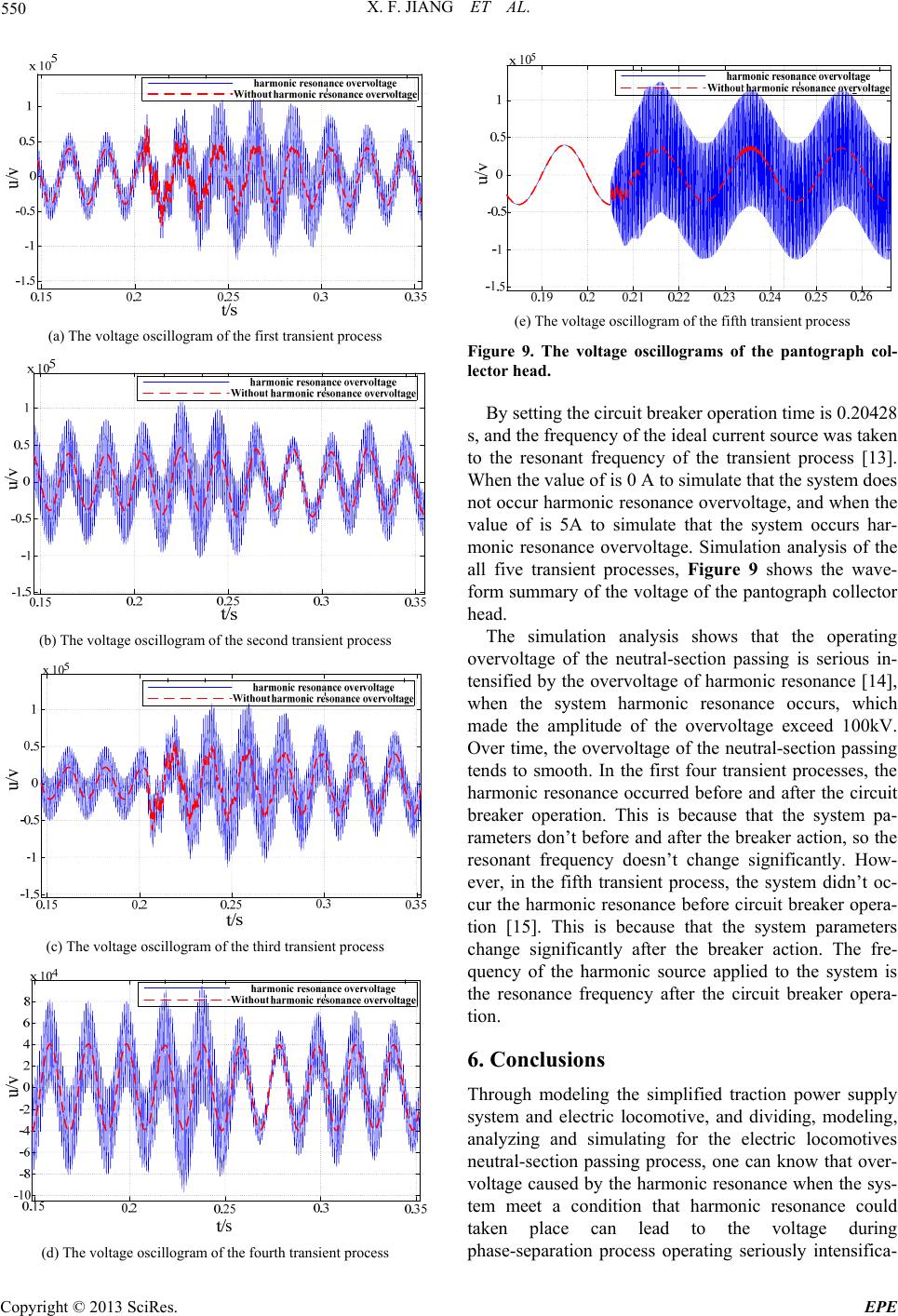 X. F. JIANG ET AL. 550 (a) The voltage oscillogram of the first transient process (b) The voltage oscillogram of the second transient process (c) The voltage oscillogram of the third transient process (d) The voltage oscillogram of the fourth transient process (e) The voltage oscillogram of the fifth transient process Figure 9. The voltage oscillograms of the pantograph col- lector head. By setting the circuit breaker operation time is 0.20428 s, and the frequency of the ideal current source was taken to the resonant frequency of the transient process [13]. When the value of is 0 A to simulate that the system does not occur harmonic resonance overvoltage, and when the value of is 5A to simulate that the system occurs har- monic resonance overvoltage. Simulation analysis of the all five transient processes, Figure 9 shows the wave- form summary of the voltage of the pantograph collector head. The simulation analysis shows that the operating overvoltage of the neutral-section passing is serious in- tensified by the overvoltage of harmonic resonance [14], when the system harmonic resonance occurs, which made the amplitude of the overvoltage exceed 100kV. Over time, the overvoltage of the neutral-section passing tends to smooth. In the first four transient processes, the harmonic resonance occurred before and after the circuit breaker operation. This is because that the system pa- rameters don’t before and after the breaker action, so the resonant frequency doesn’t change significantly. How- ever, in the fifth transient process, the system didn’t oc- cur the harmonic resonance before circuit breaker opera- tion [15]. This is because that the system parameters change significantly after the breaker action. The fre- quency of the harmonic source applied to the system is the resonance frequency after the circuit breaker opera- tion. 6. Conclusions Through modeling the simplified traction power supply system and electric locomotive, and dividing, modeling, analyzing and simulating for the electric locomotives neutral-section passing process, one can know that over- voltage caused by the harmonic resonance when the sys- tem meet a condition that harmonic resonance could taken place can lead to the voltage during phase-separation process operating seriously intensifica- Copyright © 2013 SciRes. EPE  X. F. JIANG ET AL. Copyright © 2013 SciRes. EPE 551 tion [16], which will make the voltage of the pantograph collector head exceeding 100 kV and penetrating the air gap and causing serious threats to the electric railway safety operation. However, this kind of neutral-section passing overvoltage hasn’t cause the attention in the field and theoretical studies, which need more analysis and verification in the further study. 7. Acknowledgements The authors would like to thank the High-Speed Railway Basic Research Fund Key Project (U1134205); National Natural Science Foundation of China (51177139); Sci- ence & Technology Research and Development Key Project of Railway Ministry (2011J023-B) for financial support. REFERENCES [1] Y. S. Gong, “Research of Over-voltages of Electric Lo- comotive Passing the Articulated Phase Insulator,” Jour- nal of the China Railway Society, Vol. 30, No. 4, 2008, pp. 103-107. [2] X. Y. Zhang, “Research on Overvoltage Mechanism and Prevention in the Network-Locomotive Coupling of the High Speed and Heavy Haul Railways,” ChengDu:South West JiaoTong University, 2009. [3] Y. S. Li, “Machanism Analysis on the Overvoltage of Articulated Phase Insulator,” ChengDu: South West JiaoTong University, 2008. [4] F. L. Zhou, Q. Z. Li, J. M. He, ect. “Research on Simula- tion, Practical Measurement and Mechanism of Locomo- tive Over-voltage and Passing Neutral-section Based on Probability,” Electric Drive for Locomotives, Vol. 6, 2008, pp. 13-16. [5] Z. Y. He, H. T. Hu, L. Fang, ect. “Research on the Har- monic in High-speed Railway Traction Power Supply System and Its Transmission Characteristic,” Proceedings of the CSEE, 2011,Vol. 31,No. 16, pp. 55-62. [6] Y. J. Liu, G. W. Chang, H. M. Huang. “Mayr’s Equa- tion-Based Model for Pantograph Arcof High-Speed Railway Traction System,” IEEE Transactions on Power Delivery, Vol. 25, No. 3, 2010, pp. 2025-2027. doi:10.1109/TPWRD.2009.2037521 [7] D. Ma, “Analysis of Over-voltage Transient State Process of De-energized Passage of Neutral Section Insulator,” ChengDu: South West JiaoTong University, 2008. [8] G. J. Li, X. Y. Feng, L. J. Wang, ect. “Research and Simulation on Auto-Passing Phase Separation Control Strategy of High-Speed EMU,” Transactions of China Electrotechnical Society, 2007, Vol. 22, No. 7, pp. 181-185. [9] J. M. Wen, B. T. Wang, Z. J. Fang, “Research and Using on Auto-Passing Phase Separation Control Strategy of High-Speed EMU,” Railway Standard Design, 2011, Vol. 4, pp. 104-108. [10] W. Q. Sun, S. X. Shan and G. F. Zheng, “Comparison between Home and Aboad of Automatic Passing Over of Neutral Section Device,” Electric Raileay, 2002, Vol. 2, pp. 12-16. [11] X. F. Ao, S. B. Liu, “Train Carried Automatic Conversion System for Passing through the OCS Phase Break,” Elec- tric Railway , 2006, Vol. 2, pp. 5-10. [12] N. Li, “Research on Electromagnetic Transient Process of Electric Locomotive System,” Beijing: Beijing Jiaotong univerisity, 2010. [13] X. Yan, “A Few Questions about Auto-Passing Phase Separation on Locomotives,” Electric Drive For Locomo- tives, 2004, Vol. 2, pp. 66-68. [14] X. L. Qin, “Electric Locomotive Passing Articulated Phase Insulator Overvoltage Analysis and Protection,” Beijing: Beijing Jiaotong univerisity, 2007. [15] G. J. Li, X. Y. Feng, L. J. Wang, ect. “Research and Simulation on Auto-Passing Phase Separation Control Strategy of High-Speed EMU,” Transactions of China Electrotechnical Society, 2007, Vol. 22, No. 7, pp. 181-185. [16] Z. G. Fang, “Application of Transient Over-voltage Sup- pression Technique for EMU Auto-passing the Neutral Section with On-board Switch Closed,” Railway Techni- cal Innovation, 2010, Vol. 1, pp. 44-46. |