

Paper Menu >>
Journal Menu >>
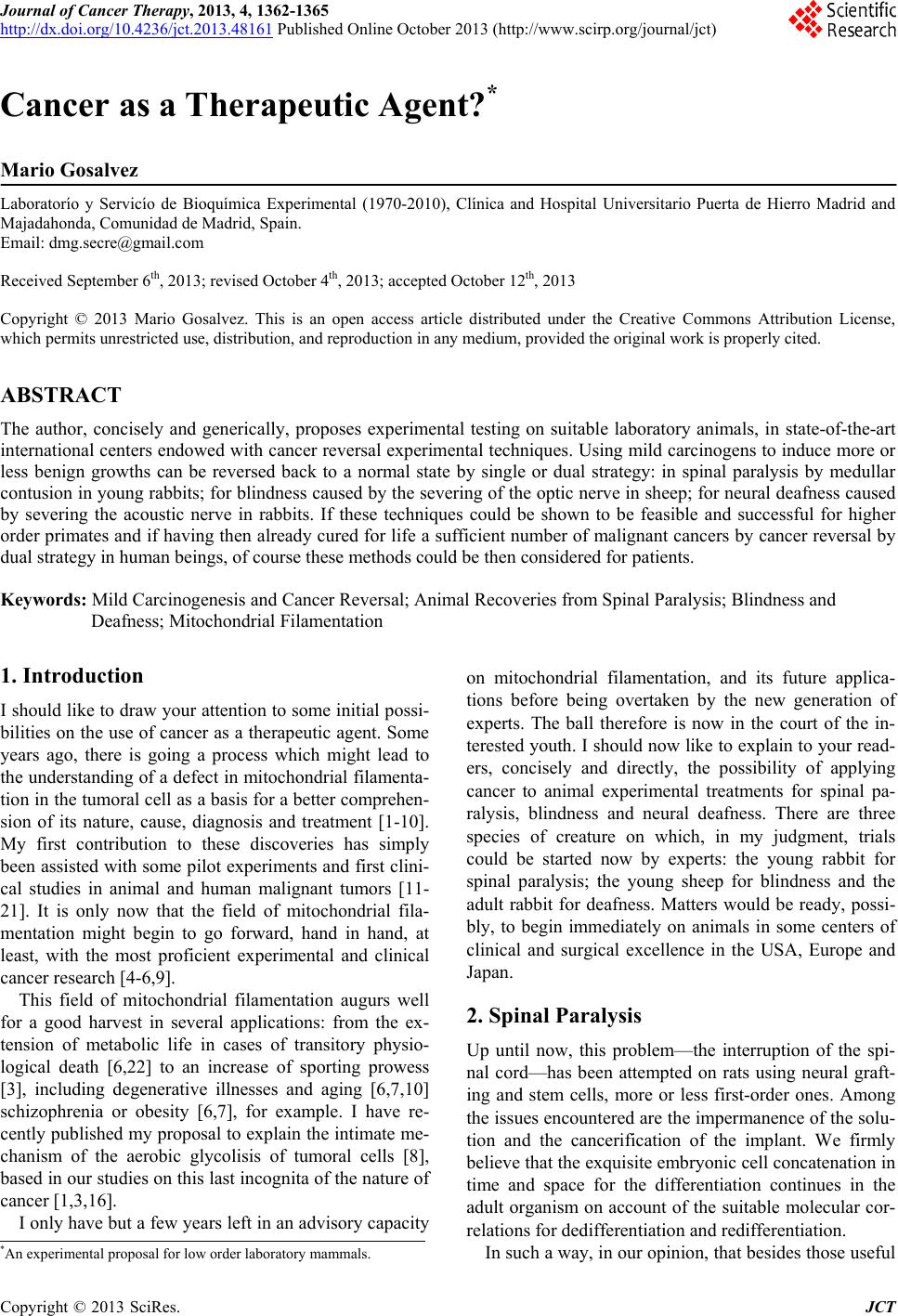 Journal of Cancer Therapy, 2013, 4, 1362-1365 http://dx.doi.org/10.4236/jct.2013.48161 Published Online October 2013 (http://www.scirp.org/journal/jct) Cancer as a Therapeutic Agent?* Mario Gosalvez Laboratorío y Servicío de Bioquímica Experimental (1970-2010), Clínica and Hospital Universitario Puerta de Hierro Madrid and Majadahonda, Comunidad de Madrid, Spain. Email: [email protected] Received September 6th, 2013; revised October 4th, 2013; accepted October 12th, 2013 Copyright © 2013 Mario Gosalvez. This is an open access article distributed under the Creative Commons Attribution License, which permits unrestricted use, distribution, and reproduction in any medium, provided the original work is properly cited. ABSTRACT The author, concisely and generically, proposes experimental testing on suitable laboratory animals, in state-of-the-art international centers endo wed with cancer reversal experimental techniques. Using mild carcinogens to induce more or less benign growths can be reversed back to a normal state by single or dual strategy: in spinal paralysis by medullar contusion in young rabbits; for blindness caused by the severing of the optic nerve in sheep; for neural deafness caused by severing the acoustic nerve in rabbits. If these techniques could be shown to be feasible and successful for higher order primates and if having then already cured for life a sufficient number of malignant cancers by cancer reversal by dual strategy in human beings, of course these methods could be then considered for patients. Keywords: Mild Carcinogenesis and Cancer Reversal; Animal Recoveries from Spinal Paralysis; Blindness and Deafness; Mitochondrial Filamentation 1. Introduction I should like to draw your atten tion to some initial possi- bilities on the use of cancer as a therap eutic agent. Some years ago, there is going a process which might lead to the understanding of a defect in mitochondrial filamenta- tion in the tumoral cell as a basis for a better comprehen- sion of its nature, cause, diagnosis and treatment [1-10]. My first contribution to these discoveries has simply been assisted with some pilot experiments and first clini- cal studies in animal and human malignant tumors [11- 21]. It is only now that the field of mitochondrial fila- mentation might begin to go forward, hand in hand, at least, with the most proficient experimental and clinical cancer research [4-6,9]. This field of mitochondrial filamentation augurs well for a good harvest in several applications: from the ex- tension of metabolic life in cases of transitory physio- logical death [6,22] to an increase of sporting prowess [3], including degenerative illnesses and aging [6,7,10] schizophrenia or obesity [6,7], for example. I have re- cently published my proposal to explain the in timate me- chanism of the aerobic glycolisis of tumoral cells [8], based in our studies on th is last in cognita of the n ature of cancer [1,3,16]. I only have but a few years left in an advisory capacity on mitochondrial filamentation, and its future applica- tions before being overtaken by the new generation of experts. The ball therefore is now in the court of the in- terested youth. I should now like to explain to your read- ers, concisely and directly, the possibility of applying cancer to animal experimental treatments for spinal pa- ralysis, blindness and neural deafness. There are three species of creature on which, in my judgment, trials could be started now by experts: the young rabbit for spinal paralysis; the young sheep for blindness and the adult rabbit for deafness. Matters would be ready, possi- bly, to begin immediately on animals in some centers of clinical and surgical excellence in the USA, Europe and Japan. 2. Spinal Paralysis Up until now, this problem—the interruption of the spi- nal cord—has been attempted on rats using neural graft- ing and stem cells, more or less first-order ones. Among the issues encountered are the impermanence of the solu- tion and the cancerification of the implant. We firmly believe that the exquisite embr yonic cell concatenatio n in time and space for the differentiation continues in the adult organism on account of the suitable molecular cor- relations for dedifferentiati on and re di f ferentiat i on. In such a way, in our opinion, that besides those useful *An experimental proposal for low order laboratory mammals. Copyright © 2013 SciRes. JCT 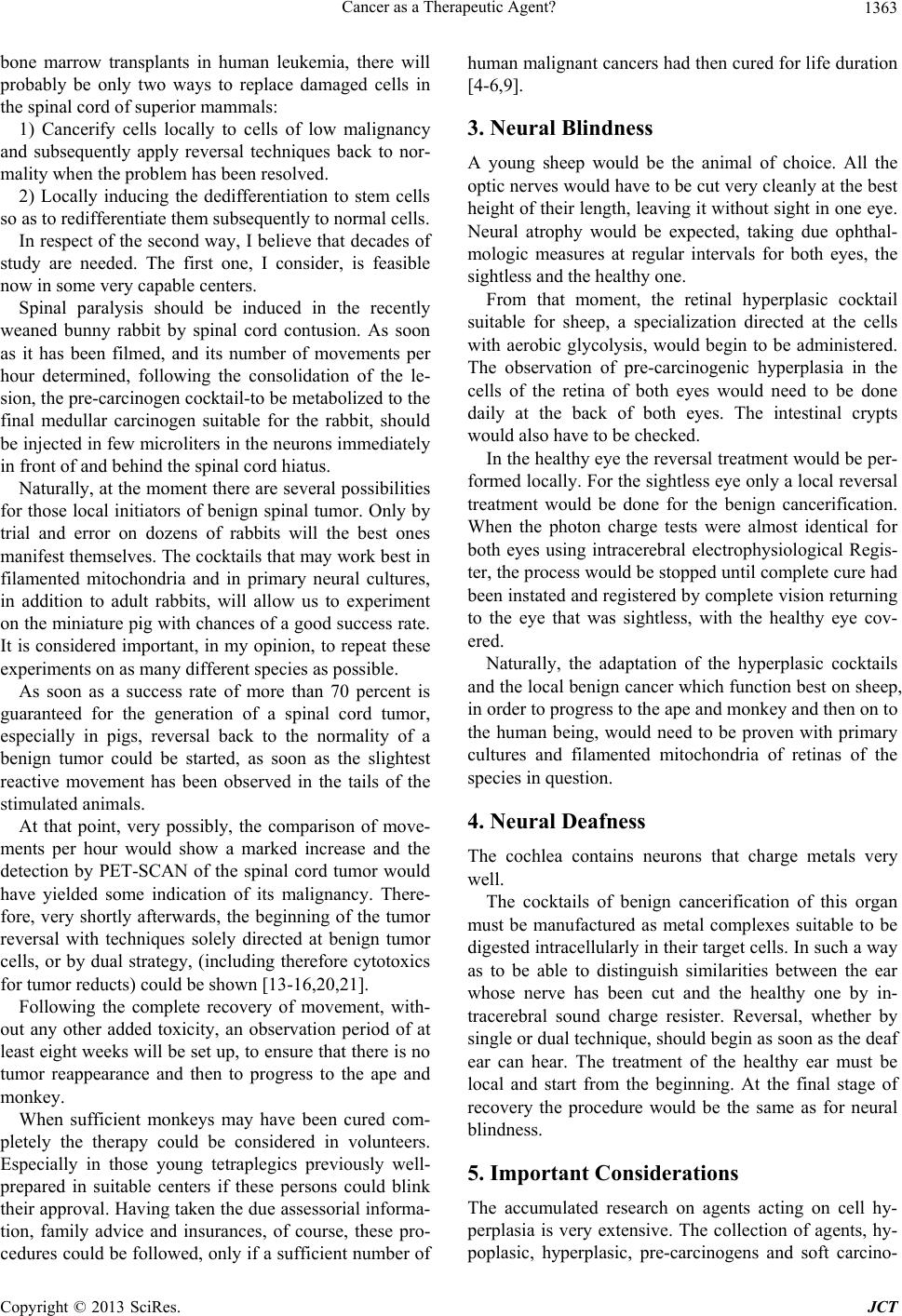 Cancer as a Therapeutic Agent ? 1363 bone marrow transplants in human leukemia, there will probably be only two ways to replace damaged cells in the spinal cord of superior mammals: 1) Cancerify cells locally to cells of low malignancy and subsequently apply reversal techniques back to nor- mality when the problem has been resolved. 2) Locally inducing the dedifferentiation to stem cells so as to redifferentiate them subsequently to normal cells. In respect of the second way, I believe that decades of study are needed. The first one, I consider, is feasible now in some very capable centers. Spinal paralysis should be induced in the recently weaned bunny rabbit by spinal cord contusion. As soon as it has been filmed, and its number of movements per hour determined, following the consolidation of the le- sion, the pre-carcinogen cocktail-to be metabo lized to the final medullar carcinogen suitable for the rabbit, should be injected in few microliters in the neurons immed iately in front of and behind the spinal cord hiatus. Naturally, at the moment there are several possibilities for those local initiators of benign spinal tumor. Only by trial and error on dozens of rabbits will the best ones manifest themselves. The cocktails that may work best in filamented mitochondria and in primary neural cultures, in addition to adult rabbits, will allow us to experiment on the miniature pig with chances of a good success rate. It is considered important, in my opinion, to repeat these experiments on as many different species as possible. As soon as a success rate of more than 70 percent is guaranteed for the generation of a spinal cord tumor, especially in pigs, reversal back to the normality of a benign tumor could be started, as soon as the slightest reactive movement has been observed in the tails of the stimulated animals. At that point, very possibly, the comparison of move- ments per hour would show a marked increase and the detection by PET-SCAN of the spinal cord tumor would have yielded some indication of its malignancy. There- fore, very shortly afterwards, the beginning of the tumor reversal with techniques solely directed at benign tumor cells, or by dual strategy, (including therefore cytotoxics for tumor reducts) could be shown [13-16,20,21]. Following the complete recovery of movement, with- out any other added toxicity, an observation period of at least eight weeks will be set up, to ensure that there is no tumor reappearance and then to progress to the ape and monkey. When sufficient monkeys may have been cured com- pletely the therapy could be considered in volunteers. Especially in those young tetraplegics previously well- prepared in suitable centers if these persons could blink their approval. Having tak en the due assessorial informa- tion, family advice and insurances, of course, these pro- cedures could be followed, only if a sufficient number of human malignant cancers had then cured for life duration [4-6,9]. 3. Neural Blindness A young sheep would be the animal of choice. All the optic nerves would have to be cut very cleanly at the best height of their length, leaving it without sight in one eye. Neural atrophy would be expected, taking due ophthal- mologic measures at regular intervals for both eyes, the sightless and the healthy one. From that moment, the retinal hyperplasic cocktail suitable for sheep, a specialization directed at the cells with aerobic glycolysis, would begin to be administered. The observation of pre-carcinogenic hyperplasia in the cells of the retina of both eyes would need to be done daily at the back of both eyes. The intestinal crypts would also have to be checked. In the healthy eye the reversal treatment would be per- formed locally. For the sightless eye only a local reversal treatment would be done for the benign cancerification. When the photon charge tests were almost identical for both eyes using intracerebral electrophysiological Regis- ter, the process would be stopped until co mplete cure had been instated and registered by complete vision returning to the eye that was sightless, with the healthy eye cov- ered. Naturally, the adaptation of the hyperplasic cocktails and the local benign cancer which function best on sheep, in order to progress to the ape and monkey and then on to the human being, would need to be proven with primary cultures and filamented mitochondria of retinas of the species in question. 4. Neural Deafness The cochlea contains neurons that charge metals very well. The cocktails of benign cancerification of this organ must be manufactured as metal complexes suitable to be digested intracellularly in their target cells. In such a way as to be able to distinguish similarities between the ear whose nerve has been cut and the healthy one by in- tracerebral sound charge resister. Reversal, whether by single or dual technique, should begin as soon as the deaf ear can hear. The treatment of the healthy ear must be local and start from the beginning. At the final stage of recovery the procedure would be the same as for neural blindness. 5. Important Considerations The accumulated research on agents acting on cell hy- perplasia is very extensive. The collection of agents, hy- poplasic, hyperplasic, pre-carcinogens and soft carcino- Copyright © 2013 SciRes. JCT 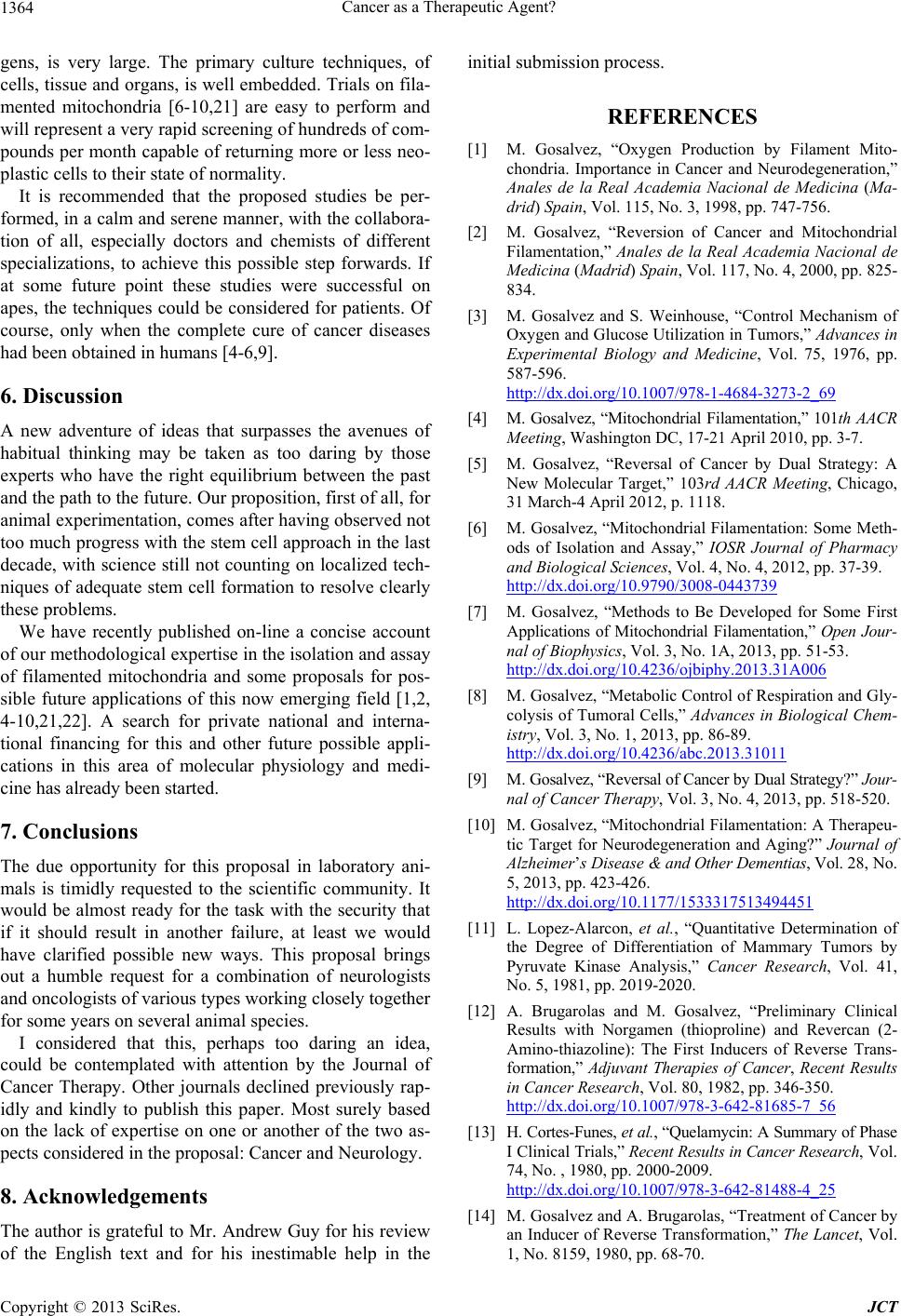 Cancer as a Therapeutic Agent ? 1364 gens, is very large. The primary culture techniques, of cells, tissue and organs, is well embedded. Trials on fila- mented mitochondria [6-10,21] are easy to perform and will represent a very rapid screen ing of hundred s of co m- pounds per month capable of returning more or less neo- plastic cells to their state of normality. It is recommended that the proposed studies be per- formed, in a calm and serene manner, with the collabora- tion of all, especially doctors and chemists of different specializations, to achieve this possible step forwards. If at some future point these studies were successful on apes, the techniques could be considered for patients. Of course, only when the complete cure of cancer diseases had been obtained in humans [4-6,9]. 6. Discussion A new adventure of ideas that surpasses the avenues of habitual thinking may be taken as too daring by those experts who have the right equilibrium between the past and the path to the fu ture. Our prop ositio n, first of all, fo r animal experimentation, comes after having observed not too much progress with the stem cell approach in the last decade, with science still not counting on localized tech- niques of adequate stem cell formation to resolve clearly these problems. We have recently published on-line a concise account of our methodological expertise in the isolation and assay of filamented mitochondria and some proposals for pos- sible future applications of this now emerging field [1,2, 4-10,21,22]. A search for private national and interna- tional financing for this and other future possible appli- cations in this area of molecular physiology and medi- cine has already been started. 7. Conclusions The due opportunity for this proposal in laboratory ani- mals is timidly requested to the scientific community. It would be almost ready for the task with the security that if it should result in another failure, at least we would have clarified possible new ways. This proposal brings out a humble request for a combination of neurologists and oncologists of various types working closely together for some years on several animal species. I considered that this, perhaps too daring an idea, could be contemplated with attention by the Journal of Cancer Therapy. Other journals declined previously rap- idly and kindly to publish this paper. Most surely based on the lack of expertise on one or another of the two as- pects considered in the proposal: Cancer and Neurolog y. 8. Acknowledgements The author is grateful to Mr. Andrew Guy for his review of the English text and for his inestimable help in the initial submission process. REFERENCES [1] M. Gosalvez, “Oxygen Production by Filament Mito- chondria. Importance in Cancer and Neurodegeneration,” Anales de la Real Academia Nacional de Medicina (Ma- drid) Spain, Vol. 115, No. 3, 1998, pp. 747-756. [2] M. Gosalvez, “Reversion of Cancer and Mitochondrial Filamentation,” Anales de la Real Academia Nacional de Medicina (Madrid) Spain, Vol. 117, No. 4, 2000, pp. 825- 834. [3] M. Gosalvez and S. Weinhouse, “Control Mechanism of Oxygen and Glucose Utilization in Tumors,” Advances in Experimental Biology and Medicine, Vol. 75, 1976, pp. 587-596. http://dx.doi.org/10.1007/978-1-4684-3273-2_69 [4] M. Gosalvez, “Mitochondrial Filamentation,” 101th AACR Meeting, Washington DC, 17-21 April 2010, pp. 3-7. [5] M. Gosalvez, “Reversal of Cancer by Dual Strategy: A New Molecular Target,” 103rd AACR Meeting, Chicago, 31 March-4 April 2012, p. 1118. [6] M. Gosalvez, “Mitochondrial Filamentation: Some Meth- ods of Isolation and Assay,” IOSR Journal of Pharmacy and Biological Sciences, Vol. 4, No. 4, 2012, pp. 37-39. http://dx.doi.org/10.9790/3008-0443739 [7] M. Gosalvez, “Methods to Be Developed for Some First Applications of Mitochondrial Filamentation,” Open Jour- nal of Biophysics, Vol. 3, No. 1A, 2013, pp. 51-53. http://dx.doi.org/10.4236/ojbiphy.2013.31A006 [8] M. Gosalvez, “Metabolic Control of Respiration and Gly- colysis of Tumoral Cells,” Advances in Biological Chem- istry, Vol. 3, No. 1, 2013, pp. 86-89. http://dx.doi.org/10.4236/abc.2013.31011 [9] M. Gosalvez, “Reversal of Cancer by Dual Strategy?” Jour- nal of Cancer Therapy, Vol. 3, No. 4, 2013, pp. 518-520. [10] M. Gosalvez, “Mitochondrial Filamentation: A Therapeu- tic Target for Neurodegeneration and Aging?” Journal of Alzheimer’s Di seas e & and Other Dementias, Vol. 28, No. 5, 2013, pp. 423-426. http://dx.doi.org/10.1177/1533317513494451 [11] L. Lopez-Alarcon, et al., “Quantitative Determination of the Degree of Differentiation of Mammary Tumors by Pyruvate Kinase Analysis,” Cancer Research, Vol. 41, No. 5, 1981, pp. 2019-2020. [12] A. Brugarolas and M. Gosalvez, “Preliminary Clinical Results with Norgamen (thioproline) and Revercan (2- Amino-thiazoline): The First Inducers of Reverse Trans- formation,” Adjuvant Therapies of Cancer, Recent Results in Cancer Research, Vol. 80, 1982, pp. 346-350. http://dx.doi.org/10.1007/978-3-642-81685-7_56 [13] H. Cortes- Funes, et al., “Que lamycin: A Summary of Phase I Clinical Trials,” Recent Results in Cancer Research, Vol. 74, No. , 1980, pp. 2000-2009. http://dx.doi.org/10.1007/978-3-642-81488-4_25 [14] M. Gosalvez and A. Brugarolas, “Treatment of Cancer by an Inducer of Reverse Transformation,” The Lancet, Vol. 1, No. 8159, 1980, pp. 68-70. Copyright © 2013 SciRes. JCT  Cancer as a Therapeutic Agent ? Copyright © 2013 SciRes. JCT 1365 [15] M. Gosalvez y Gosalvez, “Basis for Design of Pharma- cological Effectors Acting on Plasma Membrane Recep- tors,” Biochemical Society Transactions, Vol. 1, 1981, pp. 151-152. [16] M. Gosalvez, “The Zipper Mechanism,” Comercial Mal- var, Madrid, 1982. [17] M. Gosalvez, “Carcinogenesis with the Insecticide Rote- none,” Life Sciences, Vol. 32, No. 8, 1983, pp. 809-816. http://dx.doi.org/10.1016/0024-3205(83)90216-3 [18] M. Gosalvez, “Thioproline and the Reversal of Cancer,” The Lancet, Vol. 1, No. 8333, 1983, p. 1118. [19] M. Gosalvez, et al., “Spectral and Metabolic Characteris- tics of Mitochondrial Fractions Isolated from Rotenone Induced Tumours,” British Journal of Cancer, Vol. 36, No. 2, 1977, pp. 243-252. http://dx.doi.org/10.1038/bjc.1977.184 [20] M. Gosalvez, et al., “Treatment of Intravenous Leukemia 1210 Transplants with Tumor Modifiers. Redoubt Cyto- toxics and Minor Tranquilizers,” Aminoacids Chemistry, Biology and Medicine, Escom Sciences Publishers, Lei- den, 1990, pp. 704-711. [21] M. Gosalvez, “Cancer Reversal by Dual Strategy,” Edito- rial Gober, Madrid, 1992. [22] M. Gosalvez, “Extension of Metabolic Life. Abstract,” Proceedings of the 36th ISOTT Meeting, Sapporo, 3-7 August 2008, p. 52. |