

Paper Menu >>
Journal Menu >>
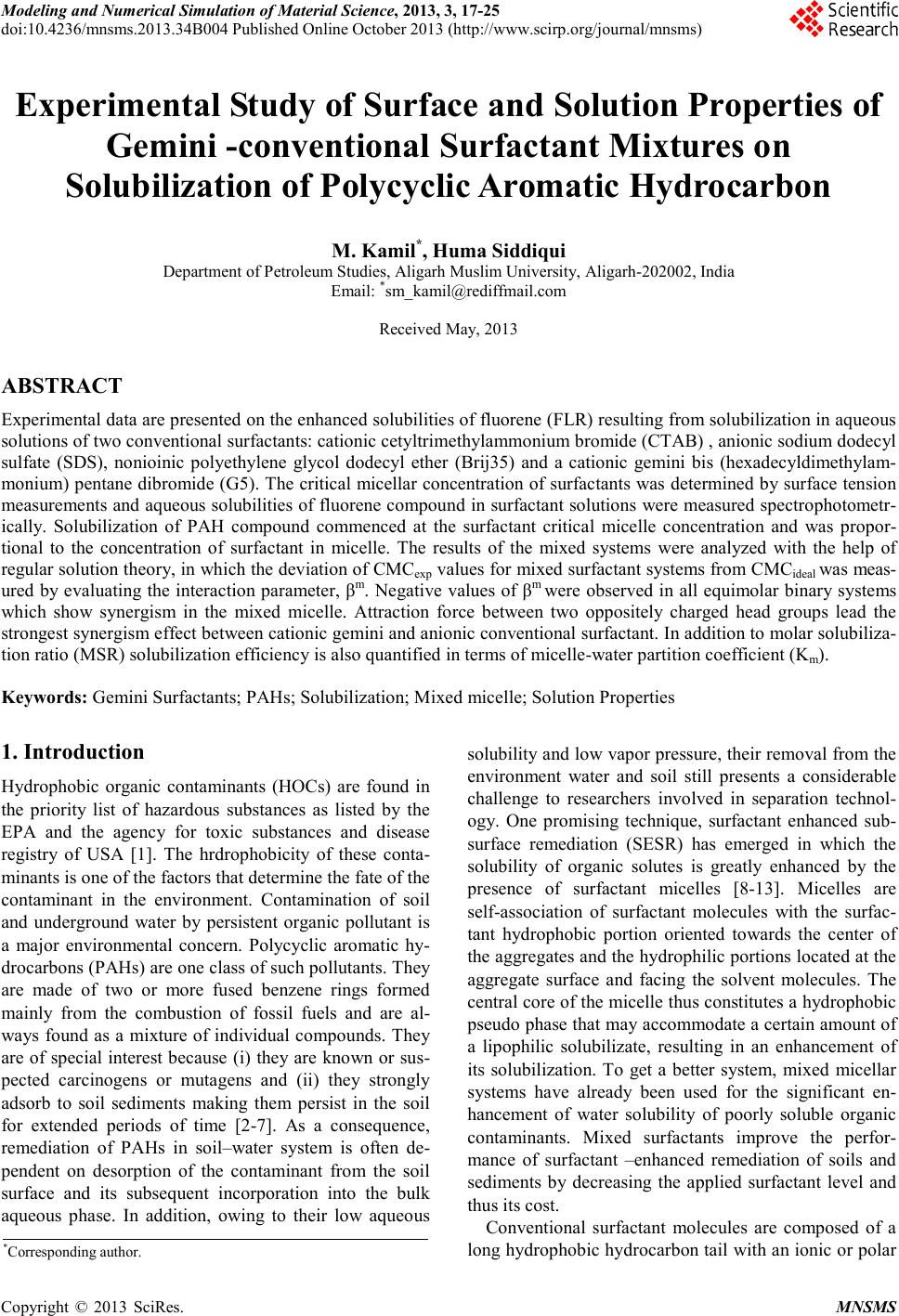 Modeling and Numerical Simulation of Material Science, 2013, 3, 17-25 doi:10.4236/mnsms.2013.34B004 Published Online October 2013 (http://www.scirp.org/journal/mnsms) Copyright © 2013 SciRes. MNSMS Experimental Study of Surface and Solution Properties of Gemini -conventional Surfactant Mixtures on Solubilization of Polycyclic Aromatic Hydrocarbon M. Kamil*, Huma Siddiqui Department of Petroleum Studies, Aligarh Muslim University, Aligarh-202002, India Email: *[email protected] Received May, 2013 ABSTRACT Experimental data are presented on the enhanced solubilities of fluorene (FLR) resulting from solubilization in aqueous solutions of t wo co nventio nal sur factan ts: catio nic cet yltri me thyla mmonium bromide (CTAB) , anionic sodium dodecyl sulfate (SDS), nonioinic polyethylene glycol dodecyl ether (Brij35) and a cationic gemini bis (hexadecyldimet hylam- monium) pentane dibromide (G5). The critical micellar concentration of surfactants was determined by surface tension meas urement s and aque ous sol ubilitie s of fluor ene co mpound in surfactant solutions were measured spectrophotometr- ically. Solubilization of PAH compound commenced at the surfactant critical micelle concentration and was propor- tional to the concentration of surfactant in micelle. The results of the mixed systems were analyzed with the help of regula r so luti on t heor y, in whi ch the d ev iatio n of CMC exp values for mixed sur facta nt s yst ems fr om C MCideal was mea s- ured by evaluating the interaction parameter, βm. Negative values of βm were observed in all equimolar binary systems which show synergism in the mixed micelle. Attraction force between two oppositely charged head groups lead the strongest synergism effect between cationic gemini and anionic conventional surfacta nt. I n ad dition to mola r sol ubiliz a- tion ratio (M SR) so lub iliz ation efficiency is also q uantified in terms of micelle-water partition co e fficient (Km). Keywords: Gemi ni Surfactants; PAH s; Solubil iz ation; Mixed micelle; Solution Prop e r ties 1. Introduction Hydrophobic organic contaminants (HOCs) are found in the priority list of hazardous substances as listed by the EPA and the agency for toxic substances and disease registry of USA [1]. The hrdrophobicity of these conta- minants is one of the factors that determine the fate of the contaminant in the environment. Contamination of soil and underground water by persistent organic pollutant is a major environmental concern. Polycyclic aromatic hy- drocarbons (PAHs) are one class of such pollutant s. T he y are made of two or more fused benzene rings formed mainly from the combustion of fossil fuels and are al- ways found as a mixture o f individual compounds. T hey are of special interest because (i) they are known or sus- pected carcinogens or mutagens and (ii) they strongly adsorb to soil sediments making them persist in the soil for extended periods of time [2-7]. As a consequence, remediation of PAHs in soil–water system is often de- pendent on desorption of the contaminant from the soil surface and its subsequent incorporation into the bulk aqueous phase. In addition, owing to their low aqueous solubility a nd low vap or pr essure, the ir removal from the environment water and soil still presents a considerable challenge to researchers involved in separation technol- ogy. One promising technique, surfactant enhanced sub- surface remediation (SESR) has emerged in which the solubility of organic solutes is greatly enhanced by the presence of surfactant micelles [8-13]. Micelles are self-association of surfactant molecules with the surfac- tant hydrophobic portion oriented towards the center of the aggregates a nd the h ydrophilic p ortions lo cated at the aggregate surface and facing the solvent molecules. The central core of the micelle thus constitutes a hydrophobic pseudo phase that may accommodate a certain amount of a lipophilic solubilizate, resulting in an enhancement of its solubilization. To get a better system, mixed micellar systems have already been used for the significant en- hancement of water solubility of poorly soluble organic contaminants. Mixed surfactants improve the perfor- mance of surfactant –enhanced remediation of soils and sediments by decreasing the applied surfactant level and thus its cost. Conventional surfactant molecules are composed of a long hydrophobic hydrocarbon tail with an ionic or polar *Corresponding author. 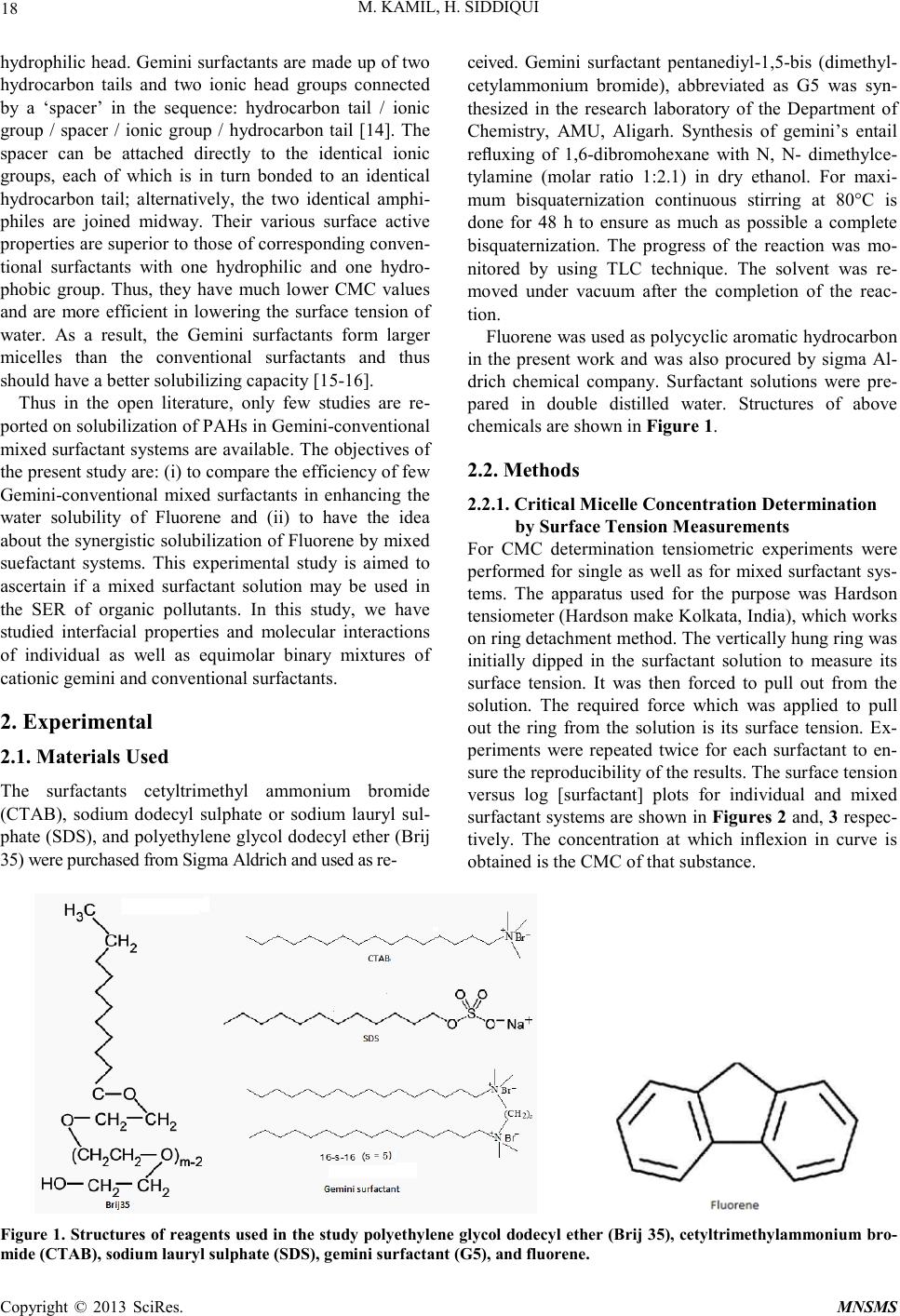 M. KAMIL, H. SIDDIQUI Copyright © 2013 SciRes. MNSMS 18 hydrophilic head. Gemini surfactants are made up of two hydrocarbon tails and two ionic head groups connected by a ‘spacer’ in the sequence: hydrocarbon tail / ionic group / spacer / ionic group / hydrocarbon tail [14]. The spacer can be attached directly to the identical ionic groups, each of which is in turn bonded to an identical hydrocarbon tail; alternatively, the two identical amphi- philes are joined midway. Their various surface active properties are superior to those of corresponding conven- tional surfactants with one hydrophilic and one hydro- phobic group. Thus, they have much lower CMC values and are more efficient in lowering the surface tension of water. As a result, the Gemini surfactants form larger micelles than the conventional surfactants and thus should have a better solubilizing capacity [15-16]. Thus in the open literature, only few studies are re- ported on solubilization of PAHs in Gemini-conventional mixed surfact ant s ystems are available. The objectives of the present study are: (i) to compare the efficiency of few Gemi ni-conventional mixed surfactants in enhancing the water solubility of Fluorene and (ii) to have the idea about the synergistic solubilizatio n of Fluorene by mixed suefactant systems. This experimental study is aimed to ascertain if a mixed surfactant solution may be used in the SER of organic pollutants. In this study, we have studied interfacial properties and molecular interactions of individual as well as equimolar binary mixtures of cati onic gemini and c onventional surfactants. 2. Experimental 2.1. Materials Used The surfactants cetyltrimethyl ammonium bromide (CTAB), sodium dodecyl sulphate or sodium lauryl sul- phate (SDS), and polyethylene glycol dodecyl ether ( Brij 35) were purch ased fr om S igma Al drich an d us ed as re- ceived. Gemini surfactant pentanediyl-1,5-bis (dimethyl- cetylammonium bromide), abbreviated as G5 was syn- thesized in the research laboratory of the Department of Chemistry, AMU, Aligarh. Synthesis of gemini’s entail refluxing of 1,6-dibromohexane with N, N- di methylce- tylamine (molar ratio 1:2.1) in dry ethanol. For maxi- mum bisquaternization continuous stirring at 80°C is done for 48 h to ensure as much as possible a complete bisquaternization. The progress of the reaction was mo- nitored by using TLC technique. The solvent was re- moved under vacuum after the completion of the reac- tion. Fluorene was used as polycyclic aromatic hydrocarbon in the present work and was also procured by sigma Al- drich chemical company. Surfactant solutions were pre- pared in double distilled water. Structures of above chemicals are shown in Figure 1. 2.2. Methods 2.2.1. Critical Micelle Concentration Determination by Surfa c e Te nsion Measureme nts For CMC determination tensiometric experiments were performed for single as well as for mixed surfactant sys- tems. The apparatus used for the purpose was Hardson tensiometer (Hardson make Kolkata, India), which works on ring detachment method. The vertically hung ring was initially dipped in the surfactant solution to measure its surface tension. It was then forced to pull out from the solution. The required force which was applied to pull out the ring from the solution is its surface tension. Ex- periments were repeated twice for each surfactant to en- sure the reproducibility of the results. The surface tension versus log [surfactant] plots for individual and mixed surfa ctant syste ms are s hown in Figures 2 and, 3 respec- tively. The concentration at which inflexion in curve is obtained is the CMC of that substance. Figure 1. Structures of reagents used in the stu dy polyethylen e glycol dodecyl ether (B rij 35), cetyltri methyla mmoni um bro- mide (CTAB), sodium lauryl sulphate (SDS), gemini sur factant ( G 5), and fl uorene. 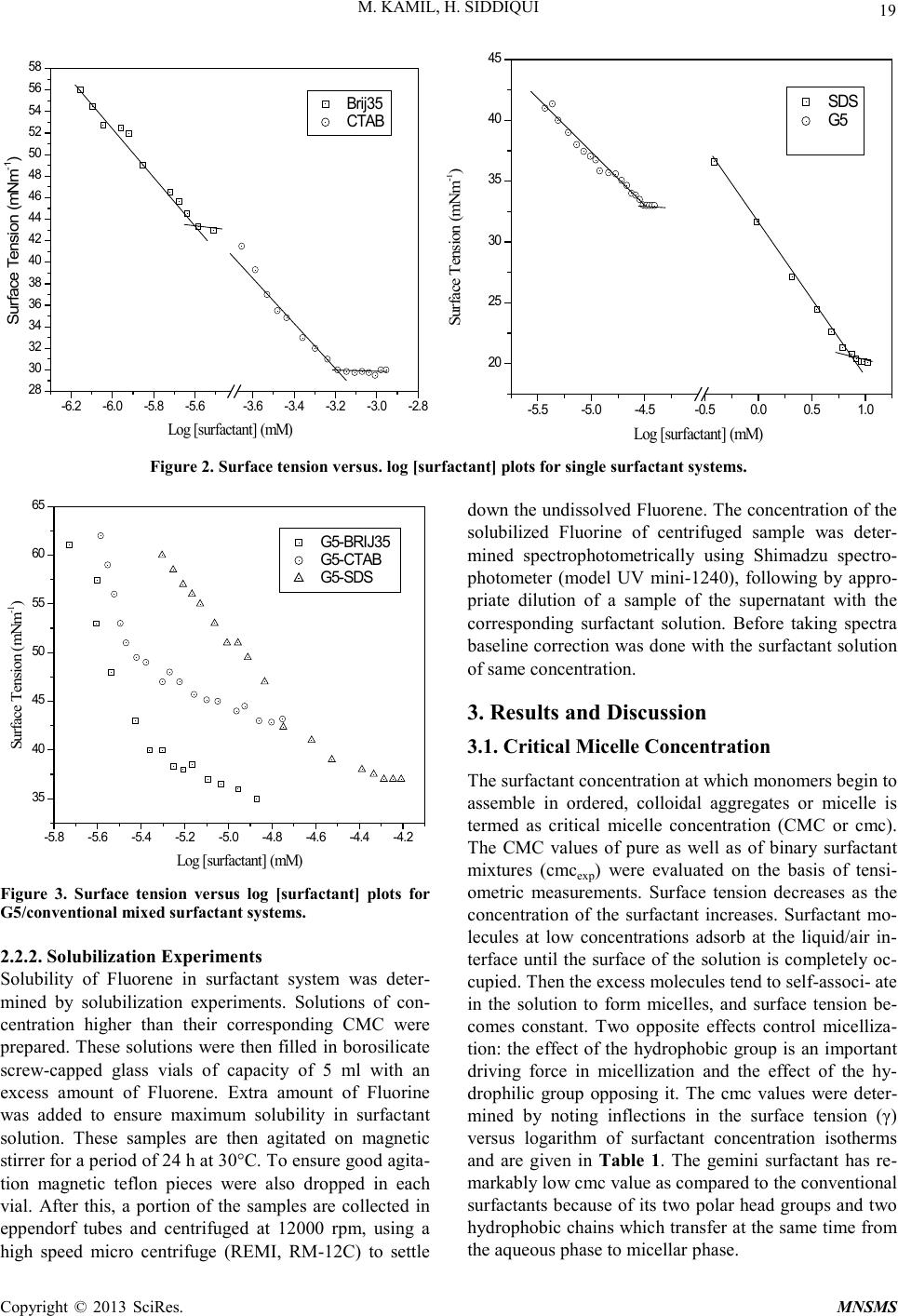 M. KAMIL, H. SIDDIQUI Copyright © 2013 SciRes. MNSMS 19 -6.2 -6.0 -5.8 -5.6-3.6 -3.4 -3.2 -3.0 -2.8 28 30 32 34 36 38 40 42 44 46 48 50 52 54 56 58 Log [surfactant] (mM) Surface Tension (mNm-1) Brij35 CTAB -5.5 -5.0 -4.5-0.50.00.51.0 20 25 30 35 40 45 Surface Tension (mN m -1) Log [surfactant] (mM ) SDS G5 Figure 2. Surface tension versus. log [surfactant] plots for single surfactant systems. -5.8 -5.6 -5.4 -5.2 -5.0 -4.8 -4.6 -4.4 -4.2 35 40 45 50 55 60 65 Surface Tension (mN m -1) Log [surfactant] (mM) G5-BR IJ35 G5-CTAB G5-SDS Figure 3. Surface tension versus log [surfactant] plots for G5/conventional mixed surfactant systems. 2.2.2. Solubilization Ex pe riment s Solubility of Fluorene in surfactant system was deter- mined by solubilization experiments. Solutions of con- centration higher than their corresponding CMC were prepared. These solutions were then filled in borosilicate screw-capped glass vials of capacity of 5 ml with an excess amount of Fluorene. Extra amount of Fluorine was added to ensure maximum solubility in surfactant solution. These samples are then agitated on magnetic stirrer for a period of 24 h at 30°C. To ensure good agita- tion magnetic teflon pieces were also dropped in each vial. After this, a portion of the samples are collected in eppendorf tubes and centrifuged at 12000 rpm, using a high speed micro centrifuge (REMI, RM-12C) to settle do wn the und issol ved F luore ne. T he co ncentr ation o f the solubilized Fluorine of centrifuged sample was deter- mined spectrophotometrically using Shimadzu spectro- photometer (model UV mini-1240), following by appro- priate dilution of a sample of the supernatant with the corresponding surfactant solution. Before taking spectra baseline correction was done with the surfactant solution of same concentration. 3. Results and Discussion 3.1. Critical Micelle Concentration The surfactant concentration at which monomers begin t o assemble in ordered, colloidal aggregates or micelle is termed as critical micelle concentration (CMC or cmc). The CMC values of pure as well as of binary surfactant mixtures (cmcexp) were evaluated on the basis of tensi- ometric measurements. Surface tension decreases as the concentration of the surfactant increases. Surfactant mo- lecules at low concentrations adsorb at the liquid/air in- terface until the surface of the solution is completely oc- cupied. Then the excess molecules tend to self-associ- ate in the solution to form micelles, and surface tension be- comes constant. Two opposite effects control micelliza- tion: the effect of the hydrophobic group is an important driving force in micellization and the effect of the hy- drophilic group opposing it. The cmc values were deter- mined by noting inflections in the surface tension (γ) versus logarithm of surfactant concentration isotherms and are given in Table 1. The gemini surfactant has re- markably low cmc value as compared to the co nventional surfactants because of its two polar head groups and two hydrophobic chains which transfer at the same time from the aqueous phase to micellar phase. 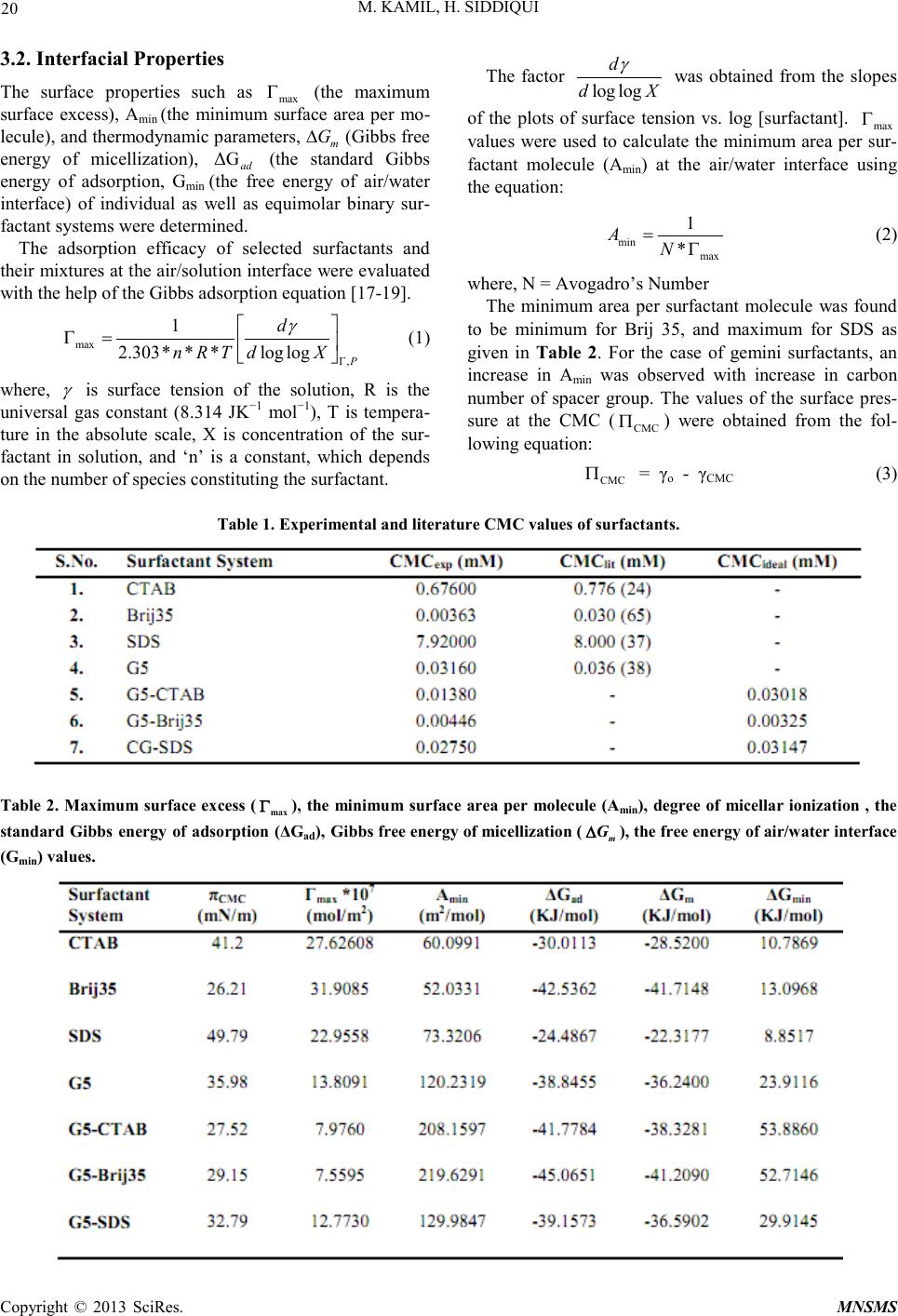 M. KAMIL, H. SIDDIQUI Copyright © 2013 SciRes. MNSMS 20 3.2. Inter facial P roper ti es The surface properties such as max Γ (the maximum surface excess), Amin (the minimum surface area per mo- lecule), and thermodynamic par ameters, m G∆ (Gibbs free energy of micellization), ΔGad (the standard Gibbs energy of adsorption, Gmin (the free energy of air/water interface) of individual as well as equimolar binary sur- factant systems were determined. The adsorption efficacy of selected surfactants and their mixtures at the air/solution interface were evaluated with the help of the Gibbs adsorption equation [17-19]. max , 1 2.303* **loglogP d nRTdX γ Γ Γ= (1) whe re , γ is surface tension of the solution, R is the universal gas constant (8.314 JK−1 mol−1), T is tempera- ture in the absolute scale, X is concentration of the sur- factant in solution, and ‘n’ is a constant, which depends on the number of species con stituting the surfactant. The factor loglog d dX γ was obtained from the slopes of the plots of surface tension vs. log [surfactant]. max Γ values were used to calculate the minimum area per sur- factant molecule (Amin) at the air/water interface using the equati on: min max 1 * AN =Γ (2) where, N = Avogadro’s Number The minimum area per surfactant molecule was found to be minimum for Brij 35, and maximum for SDS as given in Table 2. For the case of gemini surfactants, an increase in Amin was observed with increase in carbon number of spacer group. The values of the surface pres- sure at the CMC ( CMC Π ) were obtained from the fol- lowing equation: CMC Π = γ o - γCMC (3) Table 1. Experimental and literature CMC values of surfac tants. Table 2. Maximum surface excess ( Γ max ), the minimum surface area per molecule (Amin ), degree of micellar ionization , the standard Gibbs energy of adsorption (ΔGad), Gibbs free en ergy of micellization ( m G∆ ), the free energ y of air/w ater interface (Gmin) values. 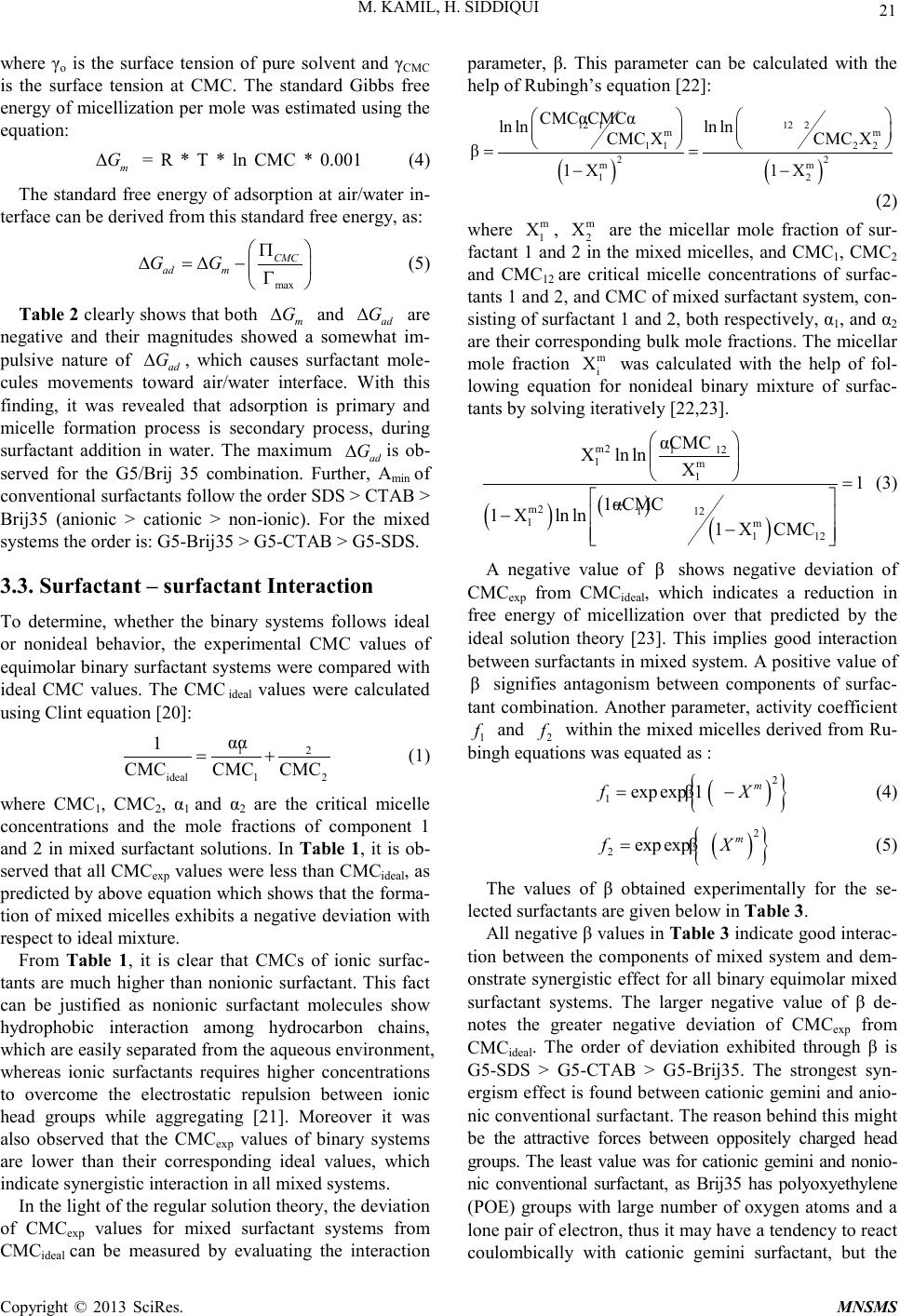 M. KAMIL, H. SIDDIQUI Copyright © 2013 SciRes. MNSMS 21 where γo is the surface tension of pure solvent and γCMC is the surface tension at CMC. The standard Gibbs free energy of micelliza tion per mole was estimated using the equation: m G∆ = R * T * ln CMC * 0.001 (4) The standard free energy of adsorption at air/water in- terface can be derived fro m this standard free energy, as: max CMC ad m GG Π ∆ =∆− Γ (5) Table 2 clearly shows that both m G ∆ and ad G ∆ are negative and their magnitudes showed a somewhat im- pulsive nature of ad G∆, which causes surfactant mole- cules movements toward air/water interface. With this finding, it was revealed that adsorption is primary and micelle formation process is secondary process, during surfactant addition in water. The maximum ad G∆is ob- served for the G5/Brij 35 combination. Further, Amin of conventi onal surfact ants follow the order S DS > CT AB > Brij35 (anionic > cationic > non-ionic). For the mixed systems the ord er is: G5-Brij35 > G5-CTAB > G5-SDS. 3.3. Surfactant – surfactant Interaction To determine, whether the binary systems follows ideal or nonideal behavior, the experimental CMC values of equimolar binary surfactant systems were compared with ideal CMC values. The CMC ideal values were calculated using Clint equation [20]: 12 ideal1 2 αα 1 CMCCMC CMC = + (1) where CMC1, CMC2, α1 and α2 are the critical micelle concentrations and the mole fractions of component 1 and 2 in mixed surfactant solutions. In Table 1, it is ob- served that all CMCexp values were less than CMCideal, as predicted by above equation which shows that the forma- tion of mixed micelles exhibits a negat ive deviation with respect to ideal mixture. From Table 1, it is clear that CMCs of ionic surfac- tants are muc h higher t han nonionic surfactant. This fact can be justified as nonionic surfactant molecules show hydrophobic interaction among hydrocarbon chains, which are easily separated from the aqueous environment, whereas ionic surfactants requires higher concentrations to overcome the electrostatic repulsion between ionic head groups while aggregating [21]. Moreover it was also observed that the CMCexp values of binary systems are lower than their corresponding ideal values, which indicate synergistic interaction in all mixed systems . In the light of the re gular sol utio n theor y, the deviatio n of CMCexp values for mixed surfactant systems from CMCideal can be measured by evaluating the interaction parameter, β. This parameter can be calculated with the help of Rubingh’s equation [22]: ( )( ) 12 1122 mm 112 2 22 mm 12 CMCαCMCα lnln lnln CMC XCMCX β1X 1X = = −− (2) where m 1 X , m 2 X are the micellar mole fraction of sur- factant 1 and 2 in the mixed micelles, and CMC1, CMC2 and CMC12 are critical micelle concentrations of surfac- tants 1 and 2, and C MC o f mi xed surfa cta nt s yste m, co n- sisting of surfactant 1 and 2, both respectively, α1, and α2 are their corresponding bulk mole fractions. The micellar mole fraction m i X was calculated with the help of fol- lowing equation for nonideal binary mixture of surfac- tants by solvin g iter a tively [22,23]. ( ) ( ) ( ) m2 1 12 1m 1 m2 1 12 1m 1 12 αCMC X lnlnX1 1αCMC 1 Xlnln1 XCMC = − − − (3) A negative value of β shows negative deviation of CMCexp from CMCid eal, which indicates a reduction in free energy of micellization over that predicted by the ideal solution theory [23]. This implies good interaction between sur facta nts in mi xed sys tem. A po sitive va lue o f β signifies antagonism between components of surfac- tant combination. Another parameter, activity coefficient 1 f and 2 f within t he mixed micelles derived from Ru- bingh equations was equated as : ( ) { } 2 1 expexpβ1 m fX= − (4) ( ) { } 2 2expexpβm fX= (5) The values of β obtained experimentally for the se- lected surfactants are given below in Table 3. All negative β value s in Ta ble 3 indicate good interac- tion between the components of mixed system and dem- onstrate synergistic effect for all binary equimolar mixed surfactant systems. The larger negative value of β de- notes the greater negative deviation of CMCexp from CMCideal. The order of deviation exhibited through β is G5-SDS > G5-CTAB > G5-Brij35. The strongest syn- ergis m effec t is fo und be twee n catio nic gemini and a nio- nic co n ve nti o nal surfa ctant. T he r ea so n behind t hi s mi g ht be the attractive forces between oppositely charged head groups. The least value was for cationic gemini and nonio- nic conventional surfactant, as Brij35 has polyoxyethylene (POE) groups with large number of oxygen atoms and a lone pair o f electro n, thus it ma y have a te ndency to react coulombically with cationic gemini surfactant, but the 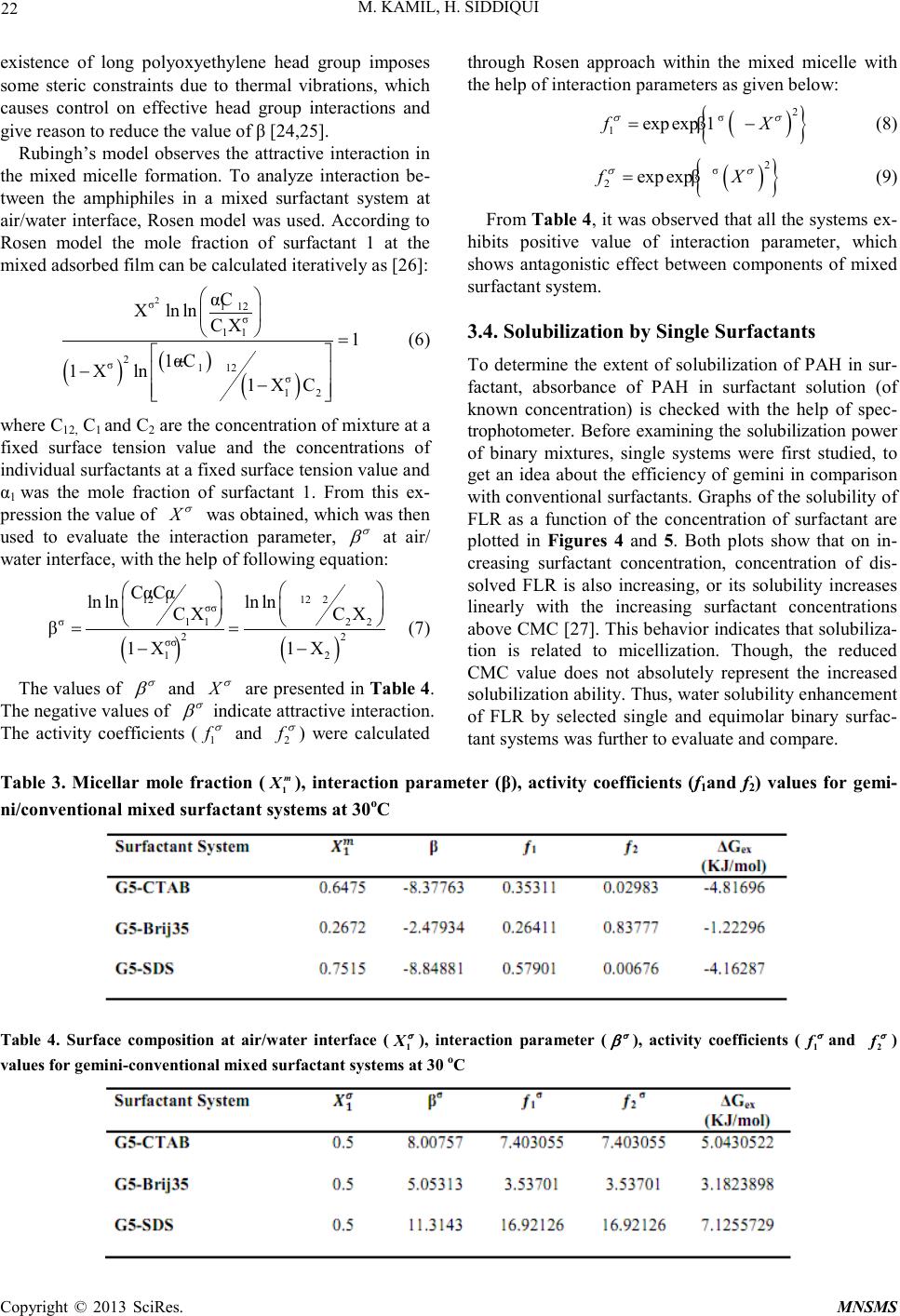 M. KAMIL, H. SIDDIQUI Copyright © 2013 SciRes. MNSMS 22 existence of long polyoxyethylene head group imposes some steric constraints due to thermal vibrations, which causes control on effective head group interactions and give reason to reduce the value of β [24,25]. Rubingh’s model observes the attractive interaction in the mixed micelle formation. To analyze interaction be- tween the amphiphiles in a mixed surfactant system at air/water interface, Rosen model was used. According to Rosen model the mole fraction of surfactant 1 at the mixed adsorbed film can be calculated iteratively as [26]: ( ) ( ) ( ) 2 σ1 12 σ 11 2 σ1 12 σ 12 αC Xlnln CX 1 1αC 1 Xln1X C = − − − (6) where C12, C1 a nd C2 are t he concentration of mixture at a fixed surface tension value and the concentrations of indivi d ua l s ur fac t ant s at a f ixe d sur fac e t e nsion value a nd α1 was the mole fraction of surfactant 1. From this ex- pre ssio n t he val ue o f X σ was obtained, which was then used to evaluate the interaction parameter, σ β at air/ water interface, with the help of following equation: ( )( ) 12 1122 σσ 112 2 σ 22 σσ 12 CαCα lnln lnln CX CX β1X 1X = = −− (7) The values o f σ β and X σ are presented in Ta ble 4. The negative values of σ β indicate attractive intera c tion. The activity coefficients ( 1 f σ and 2 f σ ) were calculated through Rosen approach within the mixed micelle with the help of interaction parameters as given below: ( ) { } 2 σ 1 expexpβ1fX σσ = − (8) ( ) { } 2 σ 2 expexpβfX σσ = (9) From Tab le 4, it was ob served that all the systems e x- hibits positive value of interaction parameter, which shows antagonistic effect between components of mixed surfactant s ystem. 3.4. Solubilization by Single Surfactants To determine the extent of solubilization of PAH in sur- factant, absorbance of PAH in surfactant solution (of known concentration) is checked with the help of spec- trophoto meter. Before examining the so lubilization power of binary mixtures, single systems were first studied, to get an idea about the efficiency of gemini in comparison with co nve ntiona l surfa ctant s. Gr aphs o f the sol ubili ty o f FLR as a function of the concentration of surfactant are plotted in Fig ures 4 and 5. Both plots show that on in- creasing surfactant concentration, concentration of dis- solved FLR is also increasing, or its solubility increases linearly with the increasing surfactant concentrations above CMC [27 ]. This behavio r indicates that sol ubiliza- tion is related to micellization. Though, the reduced CMC value does not absolutely represent the increased solubilizatio n abili t y. Thus, wa ter so lub i lit y enha nc e me nt of FLR by selected single and equimolar binary surfac- tant systems was further to evaluate and compare. Table 3. Micellar mole fraction ( m X1 ), interaction parameter (β), activity coefficients (f1and f2) values for gemi- ni/conventional mixed surfactant systems at 30oC Table 4. Surface composition at air/water interface ( X 1 σ ), interaction parameter ( σ β ), activity coefficients (f1 σ and f2 σ ) val ue s for gemini-conventional mixed surfactant systems at 30 oC 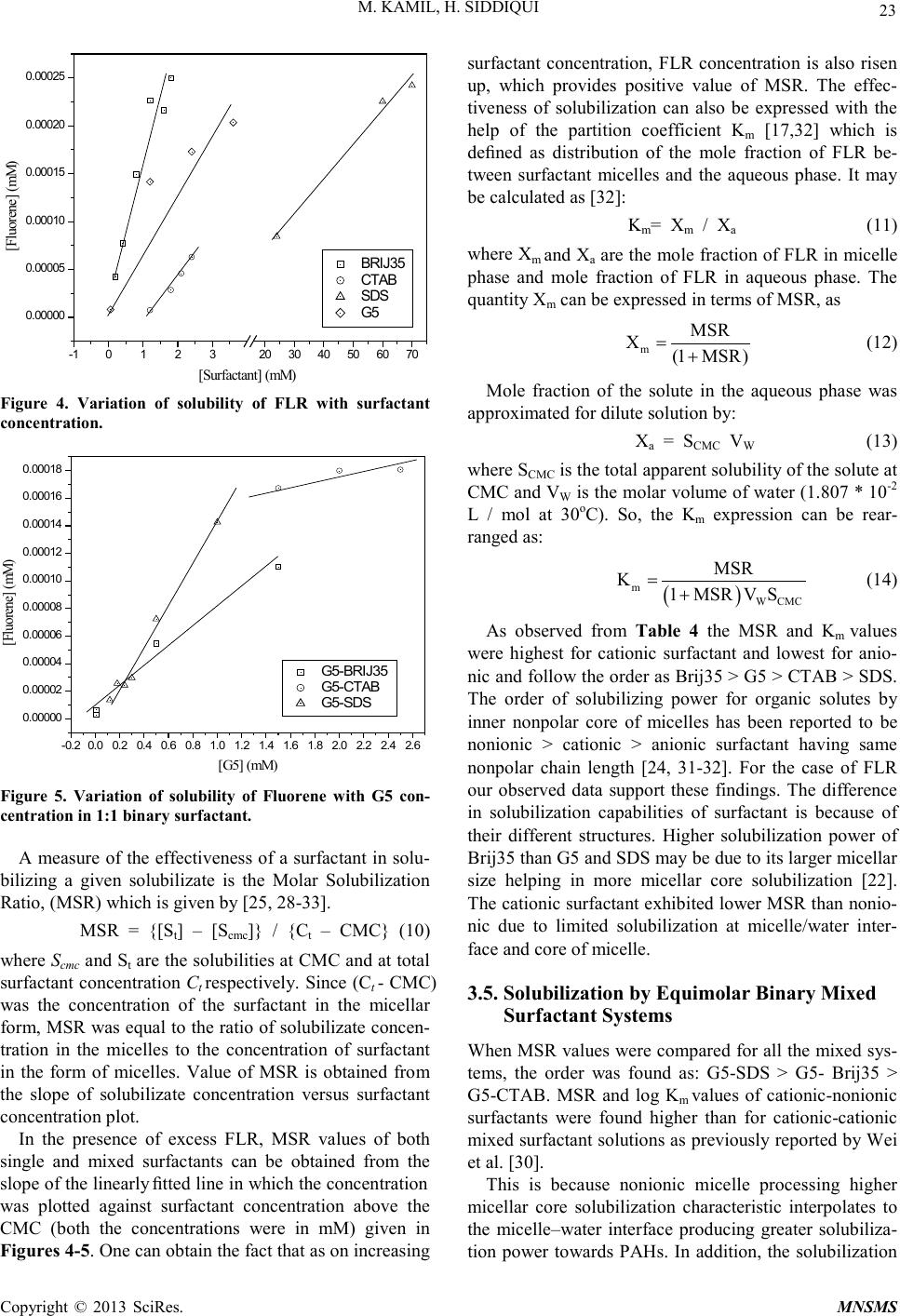 M. KAMIL, H. SIDDIQUI Copyright © 2013 SciRes. MNSMS 23 -1 0123 20 30 40 50 60 70 0.00000 0.00005 0.00010 0.00015 0.00020 0.00025 [Fluorene] (mM ) [Surfactant] (mM) BRIJ35 CTAB SDS G5 Figure 4. Variation of solubility of FLR with surfactant concent ration. -0.20.0 0.2 0.4 0.6 0.8 1.0 1.2 1.4 1.6 1.82.02.22.42.6 0.00000 0.00002 0.00004 0.00006 0.00008 0.00010 0.00012 0.00014 0.00016 0.00018 [Fluorene] (mM ) [G 5 ] (mM) G5-BR IJ35 G5-CTAB G5-SDS Figure 5. Variation of solubility of Fluorene with G5 con- centration in 1: 1 binary surfactant. A measure of the effectiveness of a surfactant in solu- bilizing a given solubilizate is the Molar Solubilization Ratio, ( MSR) which is given by [25, 28-33]. MSR = {[St] – [Scmc]} / {Ct – CMC} (10) where Scmc and St are the solub ilities at CMC a nd at total surfactant concentration Ct respectively. Since (Ct - CMC) was the concentration of the surfactant in the micellar form, MSR was equal to the ratio of solubilizate concen- tration in the micelles to the concentration of surfactant in the form of micelles. Value of MSR is obtained from the slope of solubilizate concentration versus surfactant concentration plot. In the presence of excess FLR, MSR values of both single and mixed surfactants can be obtained from the slope of the linearl y fitted line in which the concentration was plotted against surfactant concentration above the CMC (both the concentrations were in mM) given in Figures 4-5. One can obtain the fact that as on increasing surfactant concentration, FLR concentration is also risen up, which provides positive value of MSR. The effec- tiveness of solubilization can also be expressed with the help of the partition coefficient Km [17,32] which is defined as distribution of the mole fraction of FLR be- tween surfactant micelles and the aqueous phase. It may be calculated as [32]: Km= Xm / Xa (11) where Xm and Xa are the mole fraction of F LR in micelle phase and mole fraction of FLR in aqueous phase. The quantity Xm can be expressed in terms of MSR, as mMSR (R X1MS) =+ (12) Mole fraction of the solute in the aqueous phase was approximated for dilute solution by: Xa = SCMC VW (13) where SCMC is the total appa rent solubilit y of the sol ute at CMC and VW is the molar volume of water (1.807 * 10-2 L / mol at 30oC). So, the Km expression can be rear- ranged as: ( ) mW CMC MSR K1MSR V S =+ (14) As observed from Table 4 the MSR and Km values were highest for cationic surfactant and lowest for anio- nic and foll ow the o rder as Brij35 > G5 > CTAB > SDS. The order of solubilizing power for organic solutes by inner nonpolar core of micelles has been reported to be nonionic > cationic > anionic surfactant having same nonpolar chain length [24, 31-32]. For the case of FLR our observed data support these findings. The difference in solubilization capabilities of surfactant is because of their different structures. Higher solubilization power of Brij35 than G5 and SDS may b e due to its larger micellar size helping in more micellar core solubilization [22]. The cationic surfactant exhibited lower MSR than nonio- nic due to limited solubilization at micelle/water inter- face and core of micelle. 3.5. Solubilization by Equ imo lar B inar y Mix ed Surfactant Systems When MSR values were compared for all the mixed sys- tems, the order was found as: G5-SDS > G5- Brij35 > G5-CTAB. MSR and log Km values of cationic-nonionic surfactants were found higher than for cationic-cationic mixed surfactant solutions as previously reported by Wei et al. [30]. This is because nonionic micelle processing higher micellar core solubilization characteristic interpolates to the micelle–water interface producing greater solubiliza- tion power towards PAHs. In addition, the solubilization 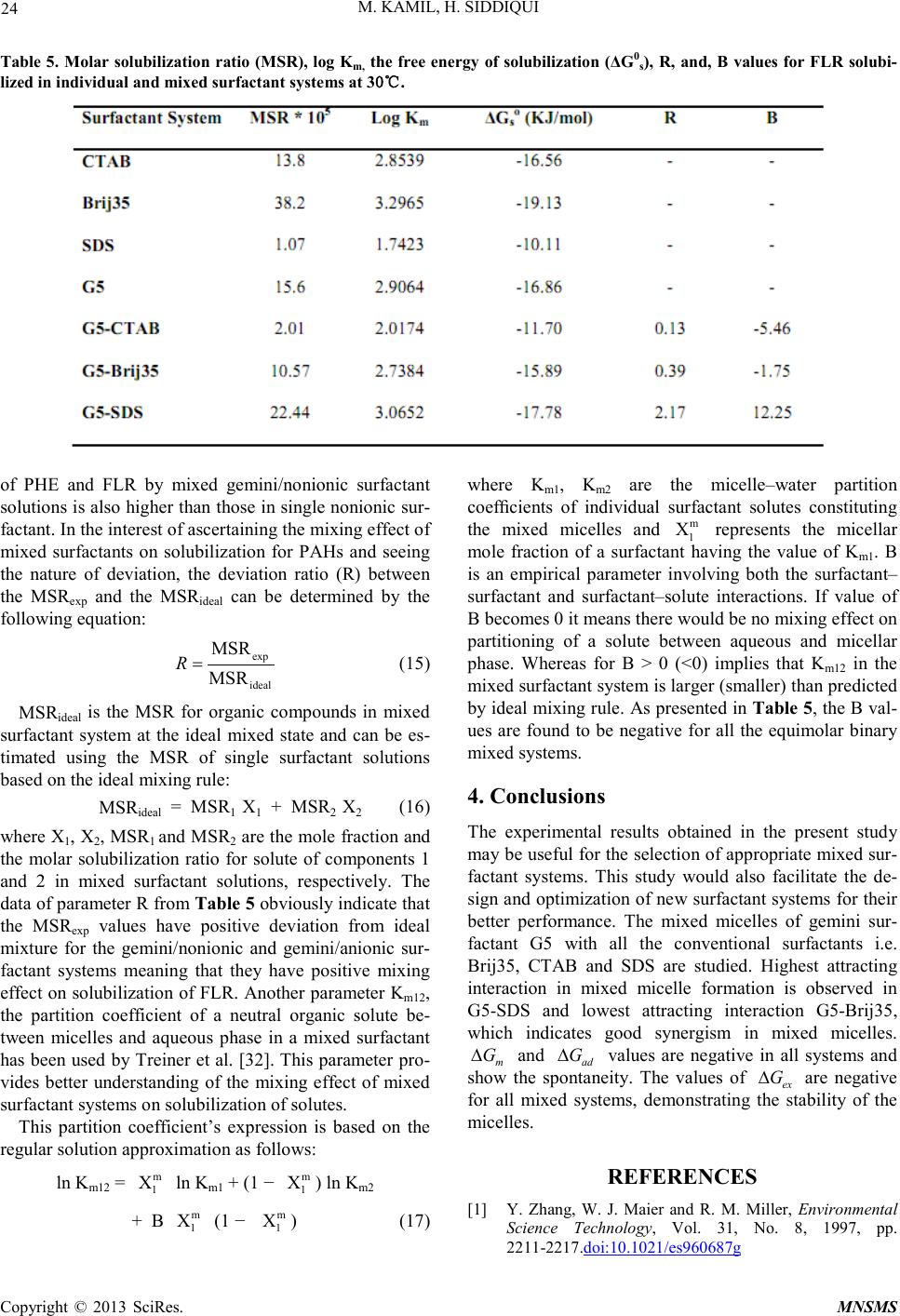 M. KAMIL, H. SIDDIQUI Copyright © 2013 SciRes. MNSMS 24 Table 5. Molar solubilization ratio (MSR), log Km, the free energy of solubilization (ΔG0s), R, and, B values for FLR sol ubi- lized in individual and mixed surfactant sys tems at 30℃. of PHE and FLR by mixed gemini/nonionic surfactant soluti ons i s also higher than those in si ngle no nionic sur- factant. In the intere st of ascertaining the mixing effect of mixed surfactants on solubilization for PAHs and seeing the nature of deviation, the deviation ratio (R) between the MSRexp and the MSRideal can be determined by the following equation: exp ideal MSR MSR R= (15) MSRideal is the MSR for organic compounds in mixed surfactant system at the ideal mixed state and can be es- timated using the MSR of single surfactant solutions based on the ideal mixing rule: MSRideal = MSR1 X1 + MSR2 X2 (16) where X1, X2, MSR1 and M SR2 are the mole fraction and the molar solubilization ratio for solute of components 1 and 2 in mixed surfactant solutions, respectively. The data of parameter R from Table 5 obviousl y indi cate tha t the MSRexp values have positive deviation from ideal mixture for the gemini/nonionic and gemini/anionic sur- factant systems meaning that they have positive mixing effect on solubilizatio n of FLR. Another parameter Km12, the partition coefficient of a neutral organic solute be- tween micelles and aqueous phase in a mixed surfactant has been used by Treiner et al. [32]. This parameter pro- vides better understanding of the mixing effect of mixed surfactant systems on solubilization of solutes. This partition coefficient’s expression is based on the regular solution approximation as follows: ln Km12 = m 1 X ln Km1 + (1 − m 1 X) ln Km2 + B m 1 X (1 − m 1 X) (17) where Km1, Km2 are the micelle–water partition coefficients of individual surfactant solutes constituting the mixed micelles and m 1 X represents the micellar mole fraction of a surfactant having the value of Km1. B is an empirical parameter involving both the surfactant– surfactant and surfactant–solute interactions. If value of B becomes 0 it means there would be no mi xing effe ct on partitioning of a solute between aqueous and micellar phase. Whereas for B > 0 (<0) implies that Km12 in the mixed surfactant system is larger (smaller) than predicted by idea l mi xing r ule. As p rese nted in Table 5 , the B val- ues are found to be negative for all the equimolar binary mixe d systems. 4. Conclusions The experimental results obtained in the present study may be useful for the selection of appropriate mixed sur- factant systems. This study would also facilitate the de- sign and optimization o f new surfactant s ystems for their better performance. The mixed micelles of gemini sur- factant G5 with all the conventional surfactants i.e. Brij35, CTAB and SDS are studied. Highest attracting interaction in mixed micelle formation is observed in G5-SDS and lowest attracting interaction G5-Brij35, which indicates good synergism in mixed micelles. m G∆ and ad G ∆ values are negative in all systems and show the spontaneity. The values of ex G∆ are negative for all mixed systems, demonstrating the stability of the micelles. REFERENCES [1] Y. Zhang, W. J. Maier and R. M. Miller, Environmental Science Technology, Vol. 31, No. 8, 1997, pp. 2211-2217.doi:10.1021/es960687g  M. KAMIL, H. SIDDIQUI Copyright © 2013 SciRes. MNSMS 25 [2] S. Laha and R. G. Guthy, Environmental Science Tech- nology, Vol. 25, 1991. [3] M. B. Gu and S. K. Chang, “Biosensors & Bioelectron- ics,” Vol. 16, No. 9-12, 2001, pp. 667-674. doi:10.1016/S0956-5663(01)00230-5 [4] A. Mohamed and S. M. Mahfoodh, “Colloids Surfaces A: Physicochemical and Engineering Aspects,” Vol. 287, No. 1-3, 2005, pp. 44-50. doi:10.1016/j.colsurfa.2006.03.036 [5] L. A. Bernard ez and S. Ghoshal, “Solubilization Kin etics for Polycyclic Aromatic Hydrocarbons Transferring from a Non -aqueous Phase Liquid to Non-ionic Surfactant So- lutions, Journal of Colloid Interface Science, Vol. 320, 2008, pp . 298-306. doi:10.1016/j.jcis.2007.12.035 [6] J. C. Dur, R. Rama, H. P arola and V. Chaplin, Hetero ge- neous dissolution of benzo(a)pyrene by surfactant solu- tions, Colloids and Surfaces A: Physi cochemical and En- gineering Aspects, Vol. 162, No. 1-3, 1999, pp. 249-257. doi:10.1016/S0927-7757(99)00244-7 [7] D. Grasso, K. S u b r a ma n iam, J . J. Pignatello , Y. Yan g and D. Ratte, Colloids and Surfaces A: Physicochemical and Engineering Aspects, Vol. 194, 2001, pp. 65-74.doi:10.1016/S0927-7757(01)00800-7 [8] C. K. Ahn, S. H. Woo and J. M. P ark, “Sel ective adsorp- tion of phenanthrene in nonionic-anionic surfactant,” Chemical Engineering Journal, Vol. 158, No. 2, 2010, pp. 115-119. doi:10.1016/j.cej.2009.12.014 [9] M. Pand a an d Kab ir -ud-din, J. Mol. Liq., Vol. 163, No. 2, 2001, pp . 93-98. doi:10.1016/j.molliq.2011.08.002 [10] M. Almgren, V. M. Garamus, L. Nordstierna, J. Luc-Blin and M. J. Stebe, Langmuir, Vol. 29, No. 36, 5355 (2010). doi:10.1021/la903764u [11] G. B. Ray, S.Ghosh and S. P. Moulik, J. Chem. Sci., 122, 109 (2010). doi:10.1007/s12039-010-0011-1 [12] D. Tikariha, K. K. Ghosh, N. Barbero, P. Quagliotto and S. Ghosh, Colloids and Surfaces A: Ph ysicochemical and Engineering Aspects, Vol. 381, No. 1-3, 2011, pp. 61-69. doi:10.1016/j.colsurfa.2011.03.027 [13] J. R. Akbar, R. Deubry, D. G. Marangoni and S. D. Wet- tig, J . Mol . Liq., 88, 3 21 (2010). [14] F. M. Menger and C. A. J. Littau, “Gemini-surfactants: synthesis and properties,” Journal of the American chem- ical society, Vol. 113, No. 4, 1991, pp. 1451-1452. doi:10.1021/ja00004a077 [15] B. S. Sek hon, Resona nc e , 42 , (2 004). [16] K. S. Sharma, C. Rodgers, R. M. Palepu and A. K. Rak- shit, Studies of Mixed Surfactant Solutions of Cationic Dimeric (Gemini) Surfactant with Nonionic Surfactant C12E6 in Aqueous Medium,” Journal of Colloid Interface Scien ce, Vol. 268, N o. 2, 2003, pp. 482-488. doi:10.1016/j.jcis.2003.07.038 [17] S. P. Moulik and S. Ghosh, “Surface Chemical and Mi- cellizati on Behaviou rs of Binary and Tern ary Mixtures of Amphiphiles (Triton X-100, Tween-80 and CTAB) in Aqueous Medium,” Journal of Molecu lar L iquids, Vol. 72, No. 1-3, 1997, pp. 145-161. doi.org/10.1016/S0167-7322(97)00036-6 [18] J. H. Clint, J. Chem. Soc F arad a y Trans., Vo l. 71, 197 4, p. 1327. [19] T. Joshi., J. Mata and P. Bahadur, “Micellization and Interaction of Anionic and Nonionic Mixed Surfactant Systems in Water,” Colloids and Surfaces A: Physico- chemical and Engineer ing Aspect s, 260, 209 (2005). doi.org/10.1016/j.colsurfa.2005.03.009 [20] D. N. Rubnigh, in: K. L. Mittal (Ed.)Solution Chemistry of Surfactants. Vol. 1, 1979, pp. 337-354. doi:10.1007/978-1-4615-7880-2_15 [21] K.J. Rao and S. Paria, Solubilization of Naphthalene in the Presence of Plant−Synthetic Mixed Surfactant Sys- tems,” Journal of Phy s ical Chemistry B, Vol. 113, 2009, p. 474.doi:10.1021/jp8071298 [22] M. J. Rosen, Surfactant an d Interfacial Ph enomena. Third ed., John Wiley & sons Inc .Public ation, 20 04. [23] M. Almgren, F. Grieser, J. K. Thoms, Journal of the American Chemical Society, Vol. 101, 1979, p. 279. doi:10.1021/ja00496a001 [24] J.L- Li, B.H. Chen, Chem. Eng. Sci., Vol. 118, 2002, p. 2825. [25] L. Zhu, Chemosphere, Vol. 53, 2003, p. 459. doi:10.1016/S0045-6535(03)00541-1 [26] O. Zheng, “Solubilization of Pyrene in Aqueous Micellar Solutions of Gemini Surfactants C12-s-C12⋅2B r,” Jour- nal of Colloid Interface Science, Vol. 300, No. 2, 2006, pp. 749-754.doi:10.1016/j.jcis.2006.04.033v [27] S. Paria, and P. K. Yuet, J. Am. Chem. Soc., Vol. 45, p. 3552, 2006. [28] D. A. Edwards, R. G. Luithy and Z. Liu, “Solubilization of P olycyclic Aro matic Hydro carbons in Micellar No nio- nic Surfactant Solutions,” Envir o nmental Science Technol, Vol. 25, No. 1, 19 91 , pp. 127-133. doi:10.1021/es00013a014 [29] S. Saito, “Solubilization Properties of Polymer-surfactant Complexes, ” Journal of Colloid and Interface Science, Vol. 24, No. 2, 19 67 , pp. 227-234. doi:10.1016/0021-9797(67)90225-1 [30] J. Wei, G. Haung and C. An, “Efficiency of Single and Mixed Gemini/conventional Micelles on Solubilization of Phenanthrene,” Journal of Chemical Engineering, Vol. 168, No. 1, 2011, pp. 201-207. doi:10.1016/j.cej.2010.12.063 [31] W. Zhou and L. Zhu, “Colloids and Surfaces A: Physi- cochemical and Engineering Aspects,” Colloids Surf. A: Physicochem and Engineering Aspects, Vol. 255, No. 1 -3, 2005, pp . 145-152.doi:10.1016/j.colsurfa.2004.12.039 [32] C. Triener, M. Nortz and C. Vaution, Langmuir, Vol. 6, 1990, p. 127. [33] W. J. Zhou and L. Z. Zhu, “Solubilization of pyrene by anionic–nonionic mixed surfactants,” Journal of Ha- zardous Materials, Vol. 109, No. 1-3, 2004, pp. 213-220. doi:10.1016/j.jhazmat.2004.03.018 |