

Paper Menu >>
Journal Menu >>
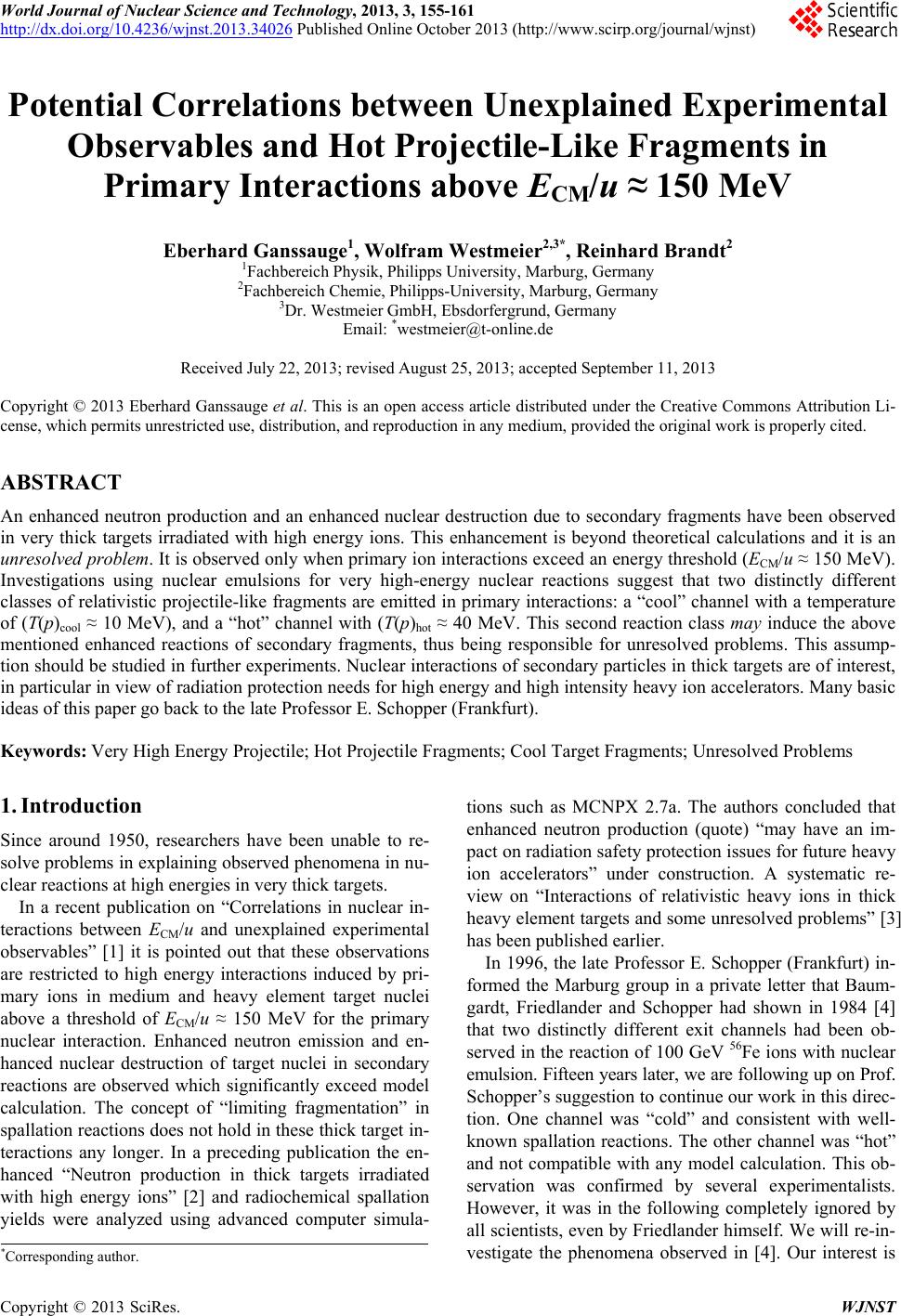 World Journal of Nuclear Science and Technology, 2013, 3, 155-161 http://dx.doi.org/10.4236/wjnst.2013.34026 Published Online October 2013 (http://www.scirp.org/journal/wjnst) Potential Correlations between Unexplained Experimental Observables and Hot Projectile-Like Fragments in Primary Interactions above ECM/u ≈ 150 MeV Eberhard Ganssauge1, Wolfram Westmeier2,3*, Reinhard Brandt2 1Fachbereich Physik, Philipps University, Marburg, Germany 2Fachbereich Chemie, Philipps-University, Marburg, Germany 3Dr. Westmeier GmbH, Ebsdorfergrund, Germany Email: *[email protected] Received July 22, 2013; revised August 25, 2013; accepted September 11, 2013 Copyright © 2013 Eberhard Ganssauge et al. This is an open access article distributed under the Creative Commons Attribution Li- cense, which permits unrestricted use, distribution, and reproduction in any medium, provided the original work is properly cited. ABSTRACT An enhanced neutron production and an enhanced nuclear destruction due to secondary fragments have been observed in very thick targets irradiated with high energy ions. This enhancement is beyond theoretical calculations and it is an unresolved problem. It is observed only when primary ion interactions exceed an energy threshold (ECM/u ≈ 150 MeV). Investigations using nuclear emulsions for very high-energy nuclear reactions suggest that two distinctly different classes of relativistic projectile-like fragments are emitted in primary interactions: a “cool” channel with a temperature of (T(p)cool ≈ 10 MeV), and a “hot” channel with (T(p)hot ≈ 40 MeV. This second reaction class may induce the above mentioned enhanced reactions of secondary fragments, thus being responsible for unresolved problems. This assump- tion should be studied in further experiments. Nuclear interactions of secondary particles in thick targets are of interest, in particular in view of radiation protection needs for high energy and high intensity heavy ion accelerators. Many basic ideas of this paper go back to the late Professor E. Schopper (Frankfurt). Keywords: Very High Energy Projectile; Hot Projectile Fragments; Cool Target Fragments; Unresolved Problems 1. Introduction Since around 1950, researchers have been unable to re- solve problems in explaining observed phenomena in nu- clear reactions at high energies in very thick targets. In a recent publication on “Correlations in nuclear in- teractions between ECM/u and unexplained experimental observables” [1] it is pointed out that these observations are restricted to high energy interactions induced by pri- mary ions in medium and heavy element target nuclei above a threshold of ECM/u ≈ 150 MeV for the primary nuclear interaction. Enhanced neutron emission and en- hanced nuclear destruction of target nuclei in secondary reactions are observed which significantly exceed model calculation. The concept of “limiting fragmentation” in spallation reactions does not hold in these thick target in- teractions any longer. In a preceding publication the en- hanced “Neutron production in thick targets irradiated with high energy ions” [2] and radiochemical spallation yields were analyzed using advanced computer simula- tions such as MCNPX 2.7a. The authors concluded that enhanced neutron production (quote) “may have an im- pact on radiation safety protection issues for future heavy ion accelerators” under construction. A systematic re- view on “Interactions of relativistic heavy ions in thick heavy element targets and some unresolved problems” [3] has been published earlier. In 1996, the late Professor E. Schopper (Frankfurt) in- formed the Marburg group in a private letter that Baum- gardt, Friedlander and Schopper had shown in 1984 [4] that two distinctly different exit channels had been ob- served in the reaction of 100 GeV 56Fe ions with nuclear emulsion. Fifteen years later, we are following up on Prof. Schopper’s suggestion to continue our work in this direc- tion. One channel was “cold” and consistent with well- known spallation reactions. The other channel was “hot” and not compatible with any model calculation. This ob- servation was confirmed by several experimentalists. However, it was in the following completely ignored by all scientists, even by Friedlander himself. We will re-in- vestigate the phenomena observed in [4]. Our interest is *Corresponding author. C opyright © 2013 SciRes. WJNST 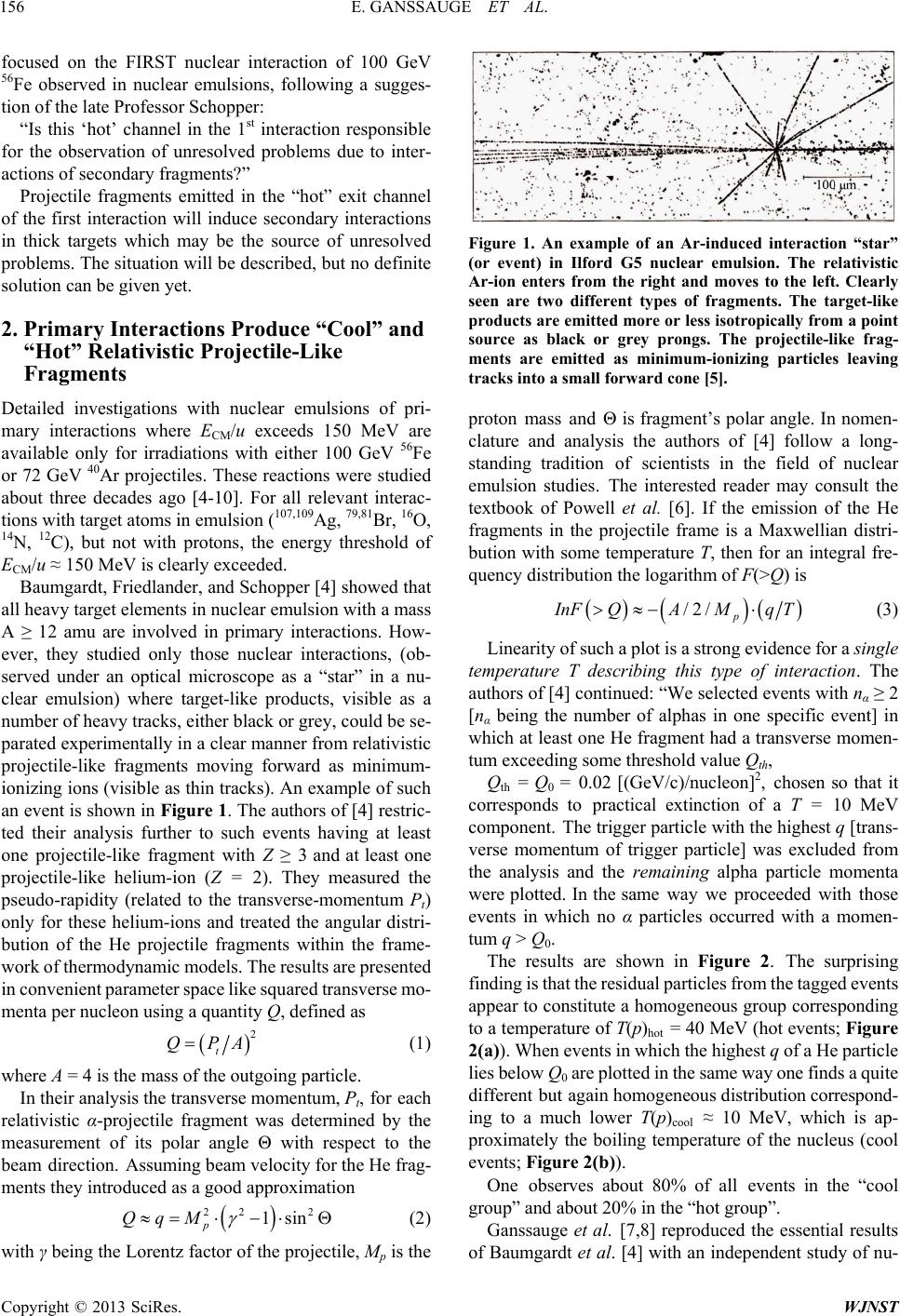 E. GANSSAUGE ET AL. 156 focused on the FIRST nuclear interaction of 100 GeV 56Fe observed in nuclear emulsions, following a sugges- tion of the late Professor Schopper: “Is this ‘hot’ channel in the 1st interaction responsible for the observation of unresolved problems due to inter- actions of secondary fragments?” Projectile fragments emitted in the “hot” exit channel of the first interaction will induce secondary interactions in thick targets which may be the source of unresolved problems. The situation will be described, but no definite solution can be given yet. 2. Primary Interactions Produce “Cool” and “Hot” Relativistic Projectile-Like Fragments Detailed investigations with nuclear emulsions of pri- mary interactions where ECM/u exceeds 150 MeV are available only for irradiations with either 100 GeV 56Fe or 72 GeV 40Ar projectiles. These reactions were studied about three decades ago [4-10]. For all relevant interac- tions with target atoms in emulsion (107,109Ag, 79,81Br, 16O, 14N, 12C), but not with protons, the energy threshold of ECM/u ≈ 150 MeV is clearly exceeded. Baumgardt, Friedlander, and Schopper [4] showed that all heavy target elements in nuclear emulsion with a mass A ≥ 12 amu are involved in primary interactions. How- ever, they studied only those nuclear interactions, (ob- served under an optical microscope as a “star” in a nu- clear emulsion) where target-like products, visible as a number of heavy tracks, either black or grey, could be se- parated experimentally in a clear manner from relativistic projectile-like fragments moving forward as minimum- ionizing ions (visible as thin tracks). An example of such an event is shown in Figure 1. The authors of [4] restric- ted their analysis further to such events having at least one projectile-like fragment with Z ≥ 3 and at least one projectile-like helium-ion (Z = 2). They measured the pseudo-rapidity (related to the transverse-momentum Pt) only for these helium-ions and treated the angular distri- bution of the He projectile fragments within the frame- work of thermodynamic models. The results are presented in convenient parameter space like squared transverse mo- menta per nucleon using a quantity Q, defined as 2 t QPA (1) where A = 4 is the mass of the outgoing particle. In their analysis the transverse momentum, Pt, for each relativistic α-projectile fragment was determined by the measurement of its polar angle Θ with respect to the beam direction. Assuming beam velocity for the He frag- ments they introduced as a good approximation 22 2 1sin p QqM (2) with γ being the Lorentz factor of the projectile, Mp is the Figure 1. An example of an Ar-induced interaction “star” (or event) in Ilford G5 nuclear emulsion. The relativistic Ar-ion enters from the right and moves to the left. Clearly seen are two different types of fragments. The target-like products are emitted more or less isotropically from a point source as black or grey prongs. The projectile-like frag- ments are emitted as minimum-ionizing particles leaving tracks into a small forward cone [5]. proton mass and Θ is fragment’s polar angle. In nomen- clature and analysis the authors of [4] follow a long- standing tradition of scientists in the field of nuclear emulsion studies. The interested reader may consult the textbook of Powell et al. [6]. If the emission of the He fragments in the projectile frame is a Maxwellian distri- bution with some temperature T, then for an integral fre- quency distribution the logarithm of F(>Q) is /2/ p I nFQAMq T (3) Linearity of such a plot is a strong evidence for a single temperature T describing this type of interaction. The authors of [4] continued: “We selected events with nα ≥ 2 [nα being the number of alphas in one specific event] in which at least one He fragment had a transverse momen- tum exceeding some threshold value Qth, Qth = Q0 = 0.02 [(GeV/c)/nucleon]2, chosen so that it corresponds to practical extinction of a T = 10 MeV component. The trigger particle with the highest q [trans- verse momentum of trigger particle] was excluded from the analysis and the remaining alpha particle momenta were plotted. In the same way we proceeded with those events in which no α particles occurred with a momen- tum q > Q0. The results are shown in Figure 2. The surprising finding is that the residual particles from the tagged events appear to constitute a homogeneous group corresponding to a temperature of T(p)hot = 40 MeV (hot events; Figure 2(a)). When events in which the highest q of a He particle lies below Q0 are plotted in the same way one finds a quite different but again homogeneous distribution correspond- ing to a much lower T(p)cool ≈ 10 MeV, which is ap- proximately the boiling temperature of the nucleus (cool events; Figure 2(b)). One observes about 80% of all events in the “cool group” and about 20% in the “hot group”. Ganssauge et al. [7,8] reproduced the essential results of Baumgardt et al. [4] with an independent study of nu- Copyright © 2013 SciRes. WJNST 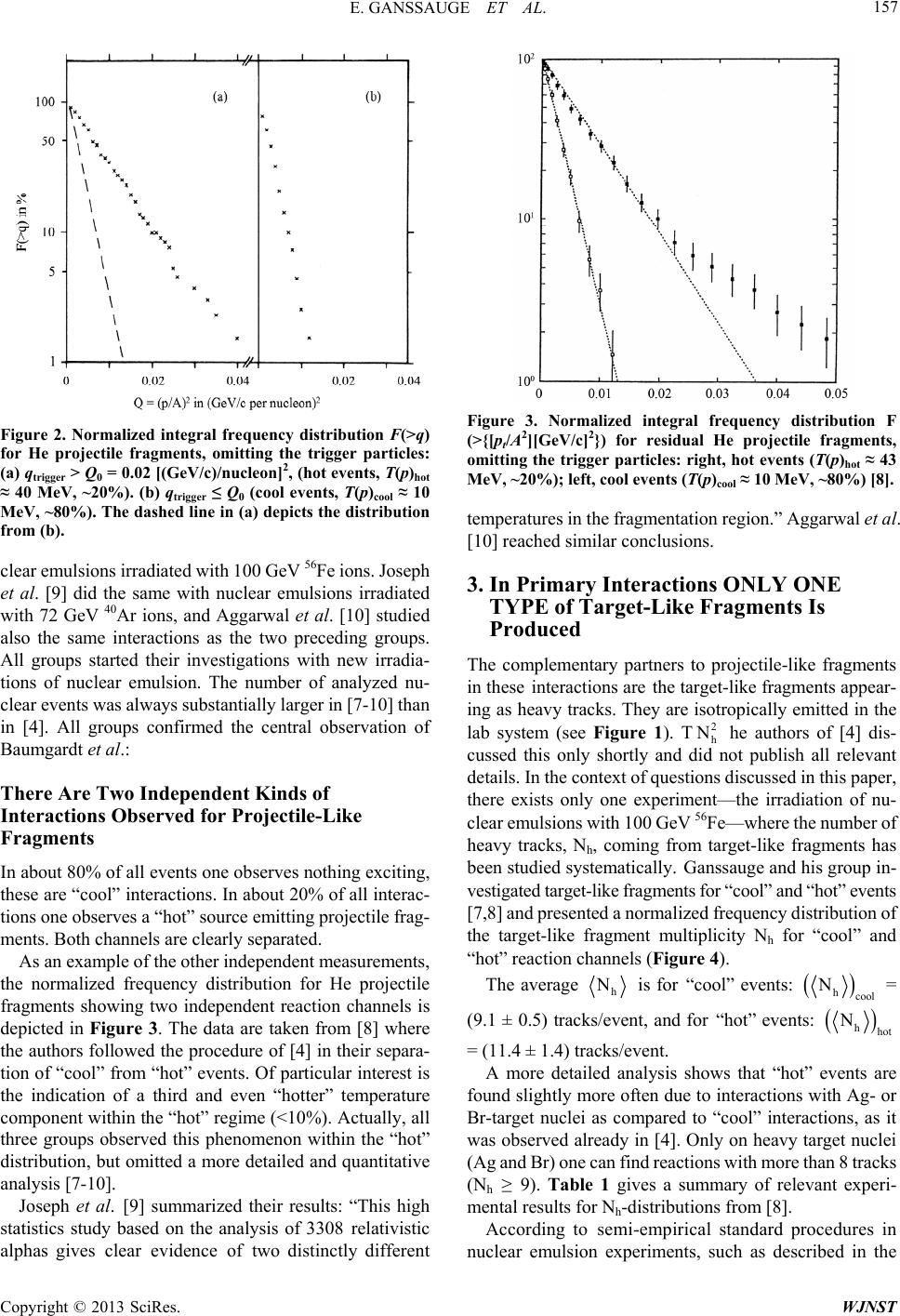 E. GANSSAUGE ET AL. 157 Figure 2. Normalized integral frequency distribution F(>q) for He projectile fragments, omitting the trigger particles: (a) qtrigger > Q0 = 0.02 [(GeV/c)/nucleon]2, (hot events, T(p)hot ≈ 40 MeV, ~20%). (b) qtrigger ≤ Q0 (cool events, T(p)cool ≈ 10 MeV, ~80%). The dashed line in (a) depicts the distribution from (b). clear emulsions irradiated with 100 GeV 56Fe ions. Joseph et al. [9] did the same with nuclear emulsions irradiated with 72 GeV 40Ar ions, and Aggarwal et al. [10] studied also the same interactions as the two preceding groups. All groups started their investigations with new irradia- tions of nuclear emulsion. The number of analyzed nu- clear events was always substantially larger in [7-10] than in [4]. All groups confirmed the central observation of Baumgardt et al.: There Are Two Independent Kinds of Interactions Observed for Projectile-Like Fragments In about 80% of all events one observes nothing exciting, these are “cool” interactions. In about 20% of all interac- tions one observes a “hot” source emitting projectile frag- ments. Both channels are clearly separated. As an example of the other independent measurements, the normalized frequency distribution for He projectile fragments showing two independent reaction channels is depicted in Figure 3. The data are taken from [8] where the authors followed the procedure of [4] in their separa- tion of “cool” from “hot” events. Of particular interest is the indication of a third and even “hotter” temperature component within the “hot” regime (<10%). Actually, all three groups observed this phenomenon within the “hot” distribution, but omitted a more detailed and quantitative analysis [7-10]. Joseph et al. [9] summarized their results: “This high statistics study based on the analysis of 3308 relativistic alphas gives clear evidence of two distinctly different Figure 3. Normalized integral frequency distribution F (>{[pt/A2][GeV/c]2}) for residual He projectile fragments, omitting the trigger particles: right, hot events (T(p)hot ≈ 43 MeV, ~20%); left, cool events (T(p)cool ≈ 10 MeV, ~80%) [8]. temperatures in the fragmentation region.” Aggarwal et al. [10] reached similar conclusions. 3. In Primary Interactions ONLY ONE TYPE of Target-Like Fragments Is Produced The complementary partners to projectile-like fragments in these interactions are the target-like fragments appear- ing as heavy tracks. They are isotropically emitted in the lab system (see Figure 1). T he authors of [4] dis- cussed this only shortly and did not publish all relevant details. In the context of questions discussed in this paper, there exists only one experiment—the irradiation of nu- clear emulsions with 100 GeV 56Fe—where the number of heavy tracks, Nh, coming from target-like fragments has been studied systematically. Ganssauge and his group in- vestigated target-like fragments for “cool” and “hot” events [7,8] and presented a normalized frequency distribution of the target-like fragment multiplicity Nh for “cool” and “hot” reaction channels (Figure 4). 2 h N The average h N is for “cool” events: hcool N = (9.1 ± 0.5) tracks/event, and for “hot” events: hhot N = (11.4 ± 1.4) tracks/event. A more detailed analysis shows that “hot” events are found slightly more often due to interactions with Ag- or Br-target nuclei as compared to “cool” interactions, as it was observed already in [4]. Only on heavy target nuclei (Ag and Br) one can find reactions with more than 8 tracks (Nh ≥ 9). Table 1 gives a summary of relevant experi- mental results for Nh-distributions from [8]. According to semi-empirical standard procedures in uclear emulsion experiments, such as described in the n Copyright © 2013 SciRes. WJNST 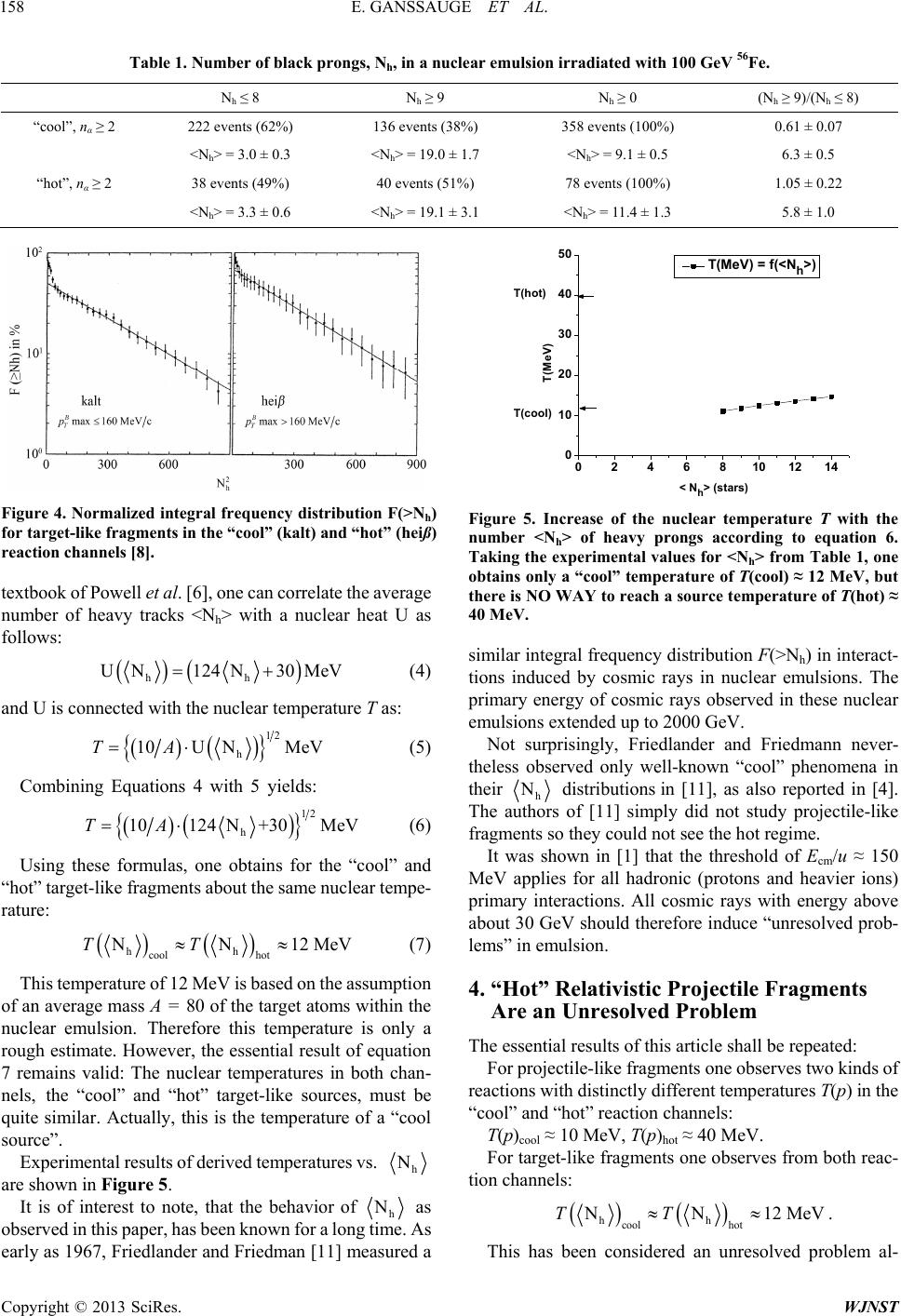 E. GANSSAUGE ET AL. Copyright © 2013 SciRes. WJNST 158 Table 1. Number of black prongs, Nh, in a nuclear emulsion irradiated with 100 GeV 56Fe. N h ≤ 8 Nh ≥ 9 Nh ≥ 0 (Nh ≥ 9)/(Nh ≤ 8) “cool”, nα ≥ 2 222 events (62%) 136 events (38%) 358 events (100%) 0.61 ± 0.07 <Nh> = 3.0 ± 0.3 <Nh> = 19.0 ± 1.7 <Nh> = 9.1 ± 0.5 6.3 ± 0.5 “hot”, nα ≥ 2 38 events (49%) 40 events (51%) 78 events (100%) 1.05 ± 0.22 <Nh> = 3.3 ± 0.6 <Nh> = 19.1 ± 3.1 <Nh> = 11.4 ± 1.3 5.8 ± 1.0 02468101214 0 10 20 30 40 50 T(MeV) < N h > (stars) T(MeV) = f(<N h >) T(cool) T(hot) Figure 4. Normalized integral frequency distribution F(>Nh) for target-like fragments in the “cool” (kalt) and “hot” (heiß) reaction channels [8]. Figure 5. Increase of the nuclear temperature T with the number <Nh> of heavy prongs according to equation 6. Taking the experimental values for <Nh> from Table 1, one obtains only a “cool” temperature of T(cool) ≈ 12 MeV, but there is NO WAY to reach a source temperature of T(hot) ≈ 40 MeV. textbook of Powell et al. [6], one can correlate the average number of heavy tracks <Nh> with a nuclear heat U as follows: similar integral frequency distribution F(>Nh) in interact- tions induced by cosmic rays in nuclear emulsions. The primary energy of cosmic rays observed in these nuclear emulsions extended up to 2000 GeV. hh UN124 N30 MeV (4) and U is connected with the nuclear temperature T as: 12 h 10U NMeVTA (5) Combining Equations 4 with 5 yields: 12 h 10124 N+30MeVTA (6) Not surprisingly, Friedlander and Friedmann never- theless observed only well-known “cool” phenomena in their h N distributions in [11], as also reported in [4]. The authors of [11] simply did not study projectile-like fragments so they could not see the hot regime. It was shown in [1] that the threshold of Ecm/u ≈ 150 MeV applies for all hadronic (protons and heavier ions) primary interactions. All cosmic rays with energy above about 30 GeV should therefore induce “unresolved prob- lems” in emulsion. Using these formulas, one obtains for the “cool” and “hot” target-like fragments about the same nuclear tempe- rature: hh cool hot N N12 MeVTT (7) This temperature of 12 MeV is based on the assumption of an average mass A = 80 of the target atoms within the nuclear emulsion. Therefore this temperature is only a rough estimate. However, the essential result of equation 7 remains valid: The nuclear temperatures in both chan- nels, the “cool” and “hot” target-like sources, must be quite similar. Actually, this is the temperature of a “cool source”. 4. “Hot” Relativistic Projectile Fragments Are an Unresolved Problem The essential results of this article shall be repeated: For projectile-like fragments one observes two kinds of reactions with distinctly different temperatures T(p) in the “cool” and “hot” reaction channels: T(p)cool ≈ 10 MeV, T(p)hot ≈ 40 MeV. For target-like fragments one observes from both reac- tion channels: Experimental results of derived temperatures vs. h N are shown in Figure 5. hh cool hot N N12 MTT It is of interest to note, that the behavior of h N as observed in this paper, has been known for a long time. As early as 1967, Friedlander and Friedman [11] measured a eV . This has been considered an unresolved problem al- 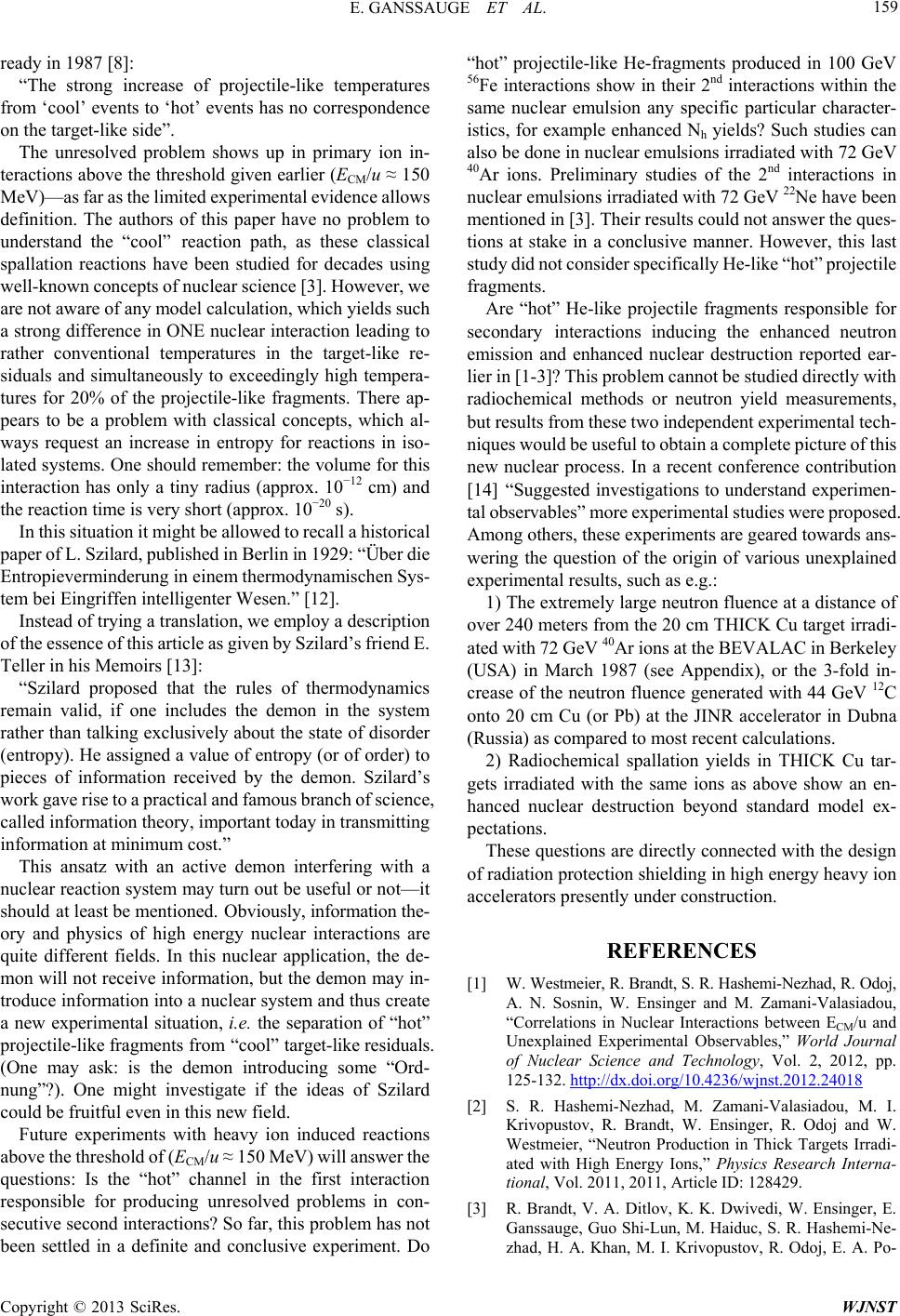 E. GANSSAUGE ET AL. 159 ready in 1987 [8]: “The strong increase of projectile-like temperatures from ‘cool’ events to ‘hot’ events has no correspondence on the target-like side”. The unresolved problem shows up in primary ion in- teractions above the threshold given earlier (ECM/u ≈ 150 MeV)—as far as the limited experimental evidence allows definition. The authors of this paper have no problem to understand the “cool” reaction path, as these classical spallation reactions have been studied for decades using well-known concepts of nuclear science [3]. However, we are not aware of any model calculation, which yields such a strong difference in ONE nuclear interaction leading to rather conventional temperatures in the target-like re- siduals and simultaneously to exceedingly high tempera- tures for 20% of the projectile-like fragments. There ap- pears to be a problem with classical concepts, which al- ways request an increase in entropy for reactions in iso- lated systems. One should remember: the volume for this interaction has only a tiny radius (approx. 10−12 cm) and the reaction time is very short (approx. 10−20 s). In this situation it might be allowed to recall a historical paper of L. Szilard, published in Berlin in 1929: “Über die Entropieverminderung in einem thermodynamischen Sys- tem bei Eingriffen intelligenter Wesen.” [12]. Instead of trying a translation, we employ a description of the essence of this article as given by Szilard’s friend E. Teller in his Memoirs [13]: “Szilard proposed that the rules of thermodynamics remain valid, if one includes the demon in the system rather than talking exclusively about the state of disorder (entropy). He assigned a value of entropy (or of order) to pieces of information received by the demon. Szilard’s work gave rise to a practical and famous branch of science, called information theory, important today in transmitting information at minimum cost.” This ansatz with an active demon interfering with a nuclear reaction system may turn out be useful or not—it should at least be mentioned. Obviously, information the- ory and physics of high energy nuclear interactions are quite different fields. In this nuclear application, the de- mon will not receive information, but the demon may in- troduce information into a nuclear system and thus create a new experimental situation, i.e. the separation of “hot” projectile-like fragments from “cool” target-like residuals. (One may ask: is the demon introducing some “Ord- nung”?). One might investigate if the ideas of Szilard could be fruitful even in this new field. Future experiments with heavy ion induced reactions above the threshold of (ECM/u ≈ 150 MeV) will answer the questions: Is the “hot” channel in the first interaction responsible for producing unresolved problems in con- secutive second interactions? So far, this problem has not been settled in a definite and conclusive experiment. Do “hot” projectile-like He-fragments produced in 100 GeV 56Fe interactions show in their 2nd interactions within the same nuclear emulsion any specific particular character- istics, for example enhanced Nh yields? Such studies can also be done in nuclear emulsions irradiated with 72 GeV 40Ar ions. Preliminary studies of the 2nd interactions in nuclear emulsions irradiated with 72 GeV 22Ne have been mentioned in [3]. Their results could not answer the ques- tions at stake in a conclusive manner. However, this last study did not consider specifically He-like “hot” projectile fragments. Are “hot” He-like projectile fragments responsible for secondary interactions inducing the enhanced neutron emission and enhanced nuclear destruction reported ear- lier in [1-3]? This problem cannot be studied directly with radiochemical methods or neutron yield measurements, but results from these two independent experimental tech- niques would be useful to obtain a complete picture of this new nuclear process. In a recent conference contribution [14] “Suggested investigations to understand experimen- tal observables” more experimental studies were proposed. Among others, these experiments are geared towards ans- wering the question of the origin of various unexplained experimental results, such as e.g.: 1) The extremely large neutron fluence at a distance of over 240 meters from the 20 cm THICK Cu target irradi- ated with 72 GeV 40Ar ions at the BEVALAC in Berkeley (USA) in March 1987 (see Appendix), or the 3-fold in- crease of the neutron fluence generated with 44 GeV 12C onto 20 cm Cu (or Pb) at the JINR accelerator in Dubna (Russia) as compared to most recent calculations. 2) Radiochemical spallation yields in THICK Cu tar- gets irradiated with the same ions as above show an en- hanced nuclear destruction beyond standard model ex- pectations. These questions are directly connected with the design of radiation protection shielding in high energy heavy ion accelerators presently under construction. REFERENCES [1] W. Westmeier, R. Brandt, S. R. Hashemi-Nezhad, R. Odoj, A. N. Sosnin, W. Ensinger and M. Zamani-Valasiadou, “Correlations in Nuclear Interactions between ECM/u and Unexplained Experimental Observables,” World Journal of Nuclear Science and Technology, Vol. 2, 2012, pp. 125-132. http://dx.doi.org/10.4236/wjnst.2012.24018 [2] S. R. Hashemi-Nezhad, M. Zamani-Valasiadou, M. I. Krivopustov, R. Brandt, W. Ensinger, R. Odoj and W. Westmeier, “Neutron Production in Thick Targets Irradi- ated with High Energy Ions,” Physics Research Interna- tional, Vol. 2011, 2011, Article ID: 128429. [3] R. Brandt, V. A. Ditlov, K. K. Dwivedi, W. Ensinger, E. Ganssauge, Guo Shi-Lun, M. Haiduc, S. R. Hashemi-Ne- zhad, H. A. Khan, M. I. Krivopustov, R. Odoj, E. A. Po- Copyright © 2013 SciRes. WJNST  E. GANSSAUGE ET AL. Copyright © 2013 SciRes. WJNST 160 zharova, V. A. Smirnitzki, A. N. Sosnin, W. Westmeier and M. Zamani-Valasiadou, “Interactions of Relativistic Heavy Ions in Thick Heavy Element Targets and Some Unresolved Problems,” Physics of Particles and Nuclei, Vol. 39, No. 2, 2008, pp. 259-285. [4] H. G. Baumgardt, E. M. Friedlander and E. Schopper, “Evidence for Two Different Reaction Mechanism in Re- lativistic Heavy-Ions Collisions,” Journal of Physics G: Nuclear and Particle Physics, Vol. 7, 1981, pp. L175- L181. http://dx.doi.org/10.1088/0305-4616/7/8/004 [5] E. Ganssauge, “Anomalons,” Proceedings of Internatio- nal School of Physics “Enrico Fermi,” Nuclear Structure and Heavy-Ion Dynamics, North-Holland Publications, 1984, pp. 551-582. [6] C. F. Powell, P. H. Fowler and D. H. Perkins, “The Study of Elementary Particles by the Photographic Method. An Account of the Principal Techniques and Discoveries Il- lustrated by an Atlas of Photomicrographs,” Pergamon Press Ltd., London, New York, 1959. [7] E. Ganssauge, H. Kallies, B. Dressel, Ch. Müller and W. Schulz, “Two Distinct Classes of Alpha Particles and a Possible Correlation of Anomalously Short Mean Free Path with the Cold Component,” Journal of Physics G: Nuclear and Particle Physics, Vol. 11, 1985, pp. L139- L142. http://dx.doi.org/10.1088/0305-4616/11/8/004 [8] H. Kallies, “Zum Verhalten von Projektilfragmenten der Ladung Z = 2 bei Relativistischen Kern-Kern-Stössen in Kernspuremulsionen,” PhD Thesis, Fachbereich Physik, Philipps-Universität, Marburg, 1987 (unpublished). [9] R. R. Joseph, I. D. Ojha, S. K. Tulit, V. S. Bhatia, M. Kaur, I. S. Mittra, S. S. Sahota, K. B. Bhalla, A. Bharti, S. Moo- kerjee, S. Kitroo and N. K. Rao, “Two Source Emission of Relativistic Alpha-Particles in 40Ar-Emulsion Colli- sions,” Journal of Physics G: Nuclear and Particle Phys- ics, Vol. 15, 1989, pp. 1805-1814. http://dx.doi.org/10.1088/0954-3899/15/12/007 [10] M. M. Aggarwal, K. B. Bhalla, G. Das and P. L. Jain, “An- gular Distributions of Relativistic Alpha Particles in Hea- vy-Ion Collisions,” Physical Review C, Vol. 27, 1983, pp. 640-649. http://dx.doi.org/10.1103/PhysRevC.27.640 [11] E. M. Friedlander and A. Friedmann, “Frequency Distri- butions of Heavy Prongs from High-Energy Stars in Nu- clear Emulsions,” Nuovo Cimento A, Vol. 52, 1967, pp. 912-917. http://dx.doi.org/10.1007/BF02738852 [12] L. Szilard, “Über die Entropieverminderung in Einem Thermodynamischen System bei Eingriffen Intelligenter Wesen,” Zeitschrift für Physik, Vol. 53, 1929, pp. 840- 866. http://dx.doi.org/10.1007/BF01341281 [13] E. Teller, “Memoires (a Twentieth Century Journey in Sci- ence and Politics),” Perseus Publishing, 2001, Lib. of Con- gress, p. 111. [14] W. Westmeier, R. Brandt and S. Tyutyunnikov, “Suggest- ed Investigations Concerning Unresolved Experimental Observations,” XXI International Baldin Seminar on High Energy Physics Problems, 10-15 September 2012, Dubna. 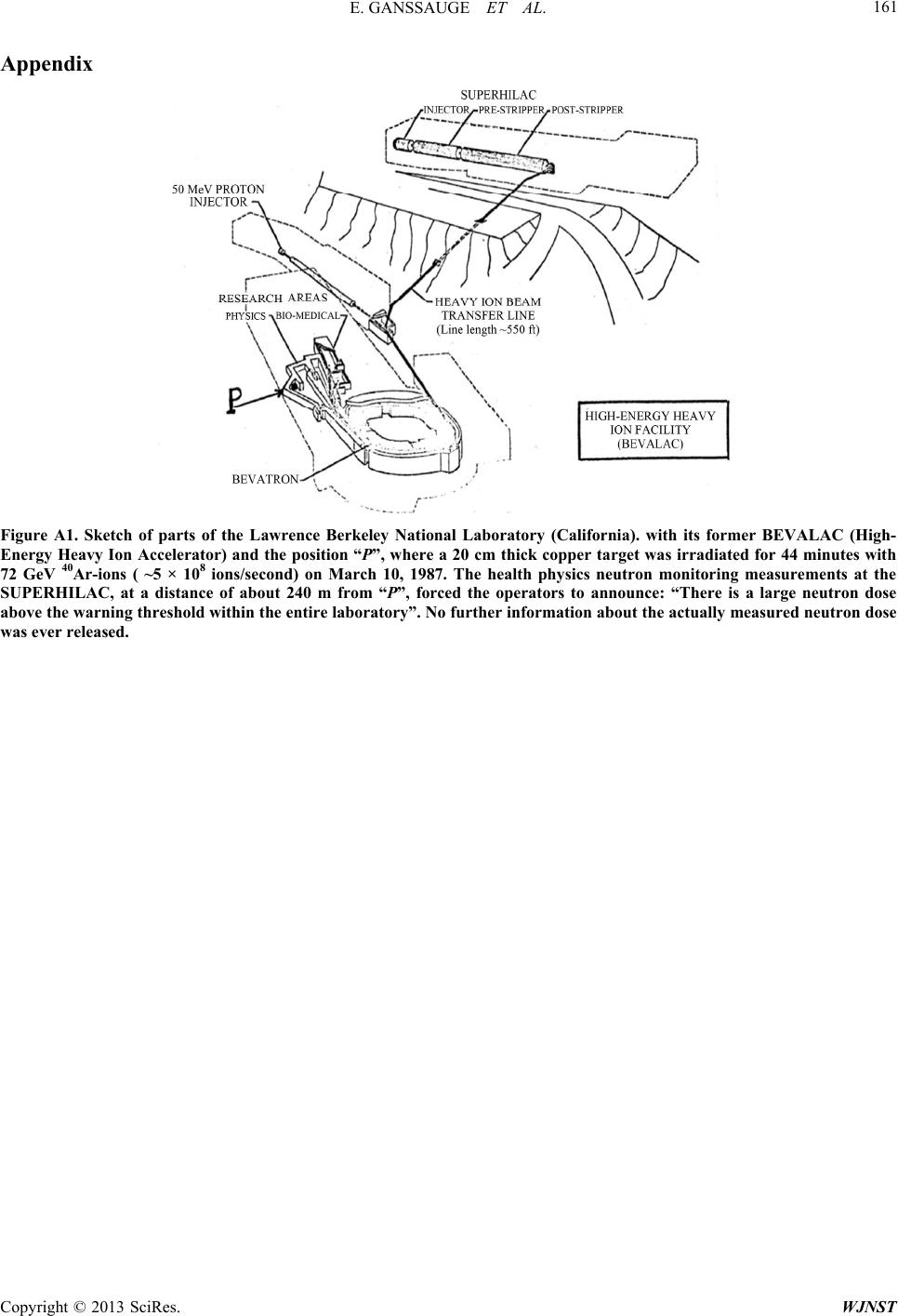 E. GANSSAUGE ET AL. 161 Appendix Figure A1. Sketch of parts of the Lawrence Berkeley National Laboratory (California). with its former BEVALAC (High- Energy Heavy Ion Accelerator) and the position “P”, where a 20 cm thick copper target was irradiated for 44 minutes with 72 GeV 40Ar-ions ( ~5 × 10⁸ ions/second) on March 10, 1987. The health physics neutron monitoring measurements at the SUPERHILAC, at a distance of about 240 m from “P”, forced the operators to announce: “There is a large neutron dose above the warning threshold within the entire laboratory”. No further information about the actually measured neutron dose was ever released. Copyright © 2013 SciRes. WJNST |