

Paper Menu >>
Journal Menu >>
 Advances in Chemical Engineering and Science, 2013, 3, 15-19 doi:10.4236/aces.2013.34B003 Published Online October 2013 (http://www.scirp.org/journal/aces) Effect of Cu Loading to Catalytic Selective CO Oxidation of CuO/CeO2 –Co3O4 P. Aunbamrung, A. Wongkaew Department of Chemical Engineering, Faculty of Engineering, Burapha University, Chonburi, Thailand Email: [email protected] Received May, 2013 ABSTRACT This work studied CuO/CeO2-Co3O4 with wt% Ce:Co ratio 95:5 for selective CO oxidation with effect of wt% Cu loading. The catalysts were prepared by co-precipitation. Characterizations of catalysts were carried out by XRD and BET techniques. The results showed a good dispersion of CuO for 5 wt% Cu loading catalysts and showed high specific surface area of catalyst. For selective CO oxidation, both 5CuO and 30CuO catalysts could remove completely CO in the presence of excess hydrogen at 423 K and 20CuO could eliminate CO completely at 443 K. Moreover, considering the selectivity to CO oxidation, the 5CuO catalyst has shown the highest selectivity of 85% while the 30CuO catalyst obtains the selectivity of 65% at the reaction temperature of 423 K. Keywords: Selective CO Oxidation; CuO/CeO2 –Co3O4; Cu Loading; Ce:Co Ratio; Co-precipitation 1. Introduction Proton-exchange membrane fuel cell (PEMFC) has interest with automotive and residential application because of low operating temperature, high power density and rapid start up. Hydrogen is an ideal fuel for PEMFC. In many practical cases hydrogen can be produced by steam reforming, following by water gas shift reaction [1]. The presence of 1vol%CO in hydrogen steam gas poisons to Pt-anode of PEMFC [2]. Among the different methods for removal CO, selective CO oxidation reaction is the preferred methods because this method used oxygen for CO oxidation and high efficiency for remove CO [3]. An efficiency of catalyst for reaction must be active and selective to avoid parallel H2 oxidation. In the recent year, the CuO-CeO2 catalyst has been proposed as a promising catalyst due to its low cost and high catalytic performance when compared with gold or platinum catalysts [4,5]. The cobalt-based catalyst has been reported shown good activity, selectivity at low temperature and H2O resistance [6]. A large number of studies catalyst preparations, the co-precipitation method are the preferred method to high specific surface area of catalyst and high activity for CO oxidation [7]. In this study, The CuO-CeO2 catalysts promoted with Co3O4 were prepared by co-precipitation with different wt% Cu loading and define wt% Ce:Co ratio 95:5. The characterizations of catalyst were carried out by BET and XRD techniques, in order to correlate catalyst properties to catalytic performance. The performances of catalysts were tested by selective CO oxidation. 2. Experimental 2.1. Catalysts Preparation The catalysts CuO/CeO2-Co3O4 with wt % Ce/Co ratio of 95:5 were prepared by co-precipitation. Aqueous solutions of Cu(NO3)2·3H2O, Ce(NO3)3·6H2O and Co(NO3)2·6H2O were mixed. Aqueous Na2O3 0.1 M used as a precipitat- ing agent was added drop-wise until a pH of 9 was at- tained. The resulting precipitate was aged at room tem- perature for 2 h, then filtered, washed several times with deionize water and dried at 110℃ overnight. The ob- tained samples were calcined at 500℃ for 5 h. The pre- pared catalysts were denoted as XCuO. The X shows the wt% Cu loading 2.2. Catalyst Characterization All catalyst powders were characterized for their surface area, average pore diameter and average crystal-liter sizes. Specific surface area (SBET) of catalysts was deter- mined with adsorption-desorption isotherms of N2 at 77 K using Autosorption-1C from Quantachrome. Prior to N2-physical adsorption measurement, catalysts were de- gassed under N2 gas purged at 473 K for 12 h. The ad- sorption isotherms were tested at 10-5< <1.0. Using the nitrogen adsorption isotherm, BET equation was used for calculation of specific surface area using values between 0.05 and 0.30. X-ray diffraction measurement was made Copyright © 2013 SciRes. ACES 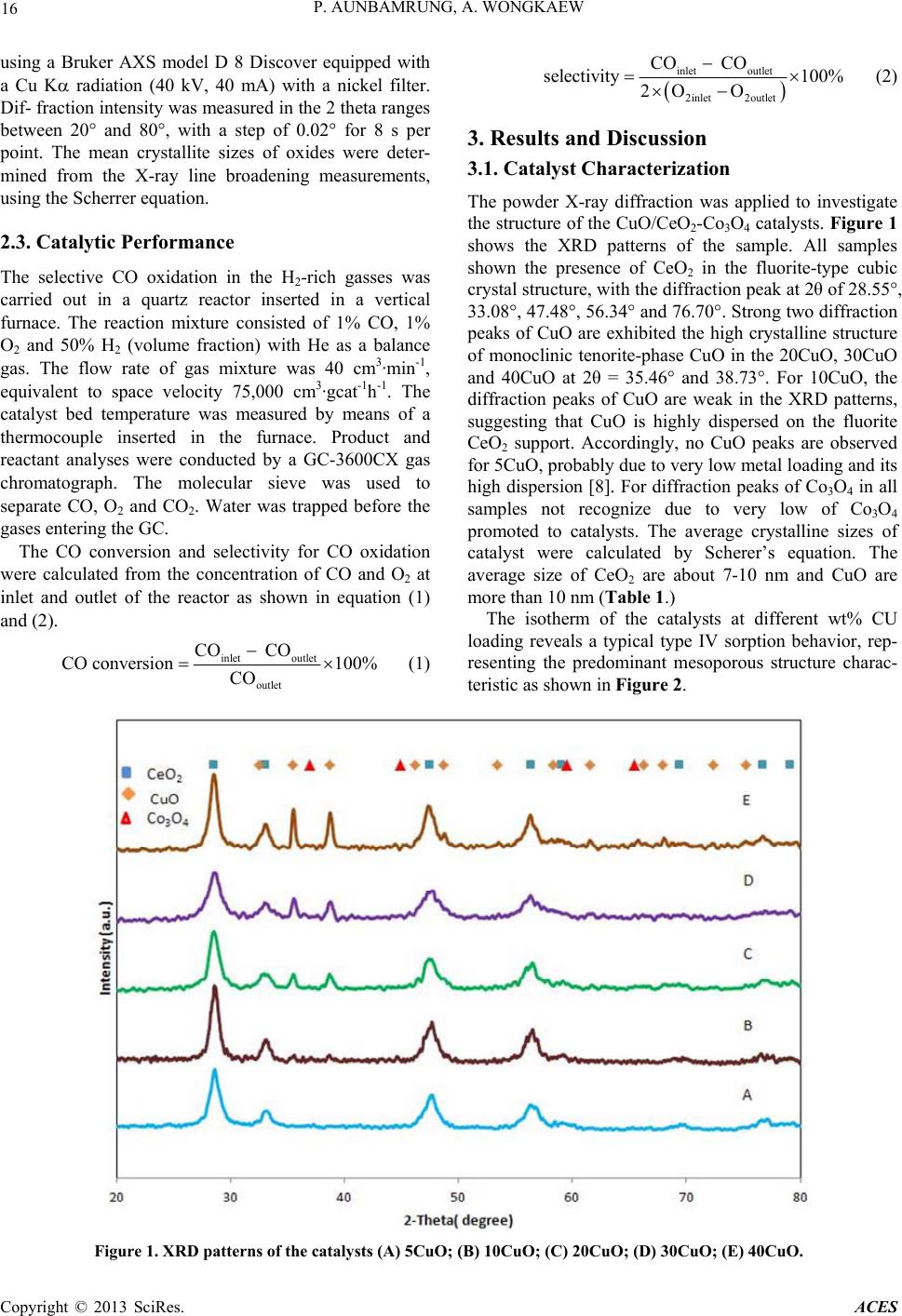 P. AUNBAMRUNG, A. WONGKAEW 16 using a Bruker AXS model D 8 Discover equipped with a Cu K radiation (40 kV, 40 mA) with a nickel filter. Dif- fraction intensity was measured in the 2 theta ranges between 20 and 80, with a step of 0.02 for 8 s per point. The mean crystallite sizes of oxides were deter- mined from the X-ray line broadening measurements, using the Scherrer equation. 2.3. Catalytic Performance The selective CO oxidation in the H2-rich gasses was carried out in a quartz reactor inserted in a vertical furnace. The reaction mixture consisted of 1% CO, 1% O2 and 50% H2 (volume fraction) with He as a balance gas. The flow rate of gas mixture was 40 cm3·min-1, equivalent to space velocity 75,000 cm3·gcat-1h-1. The catalyst bed temperature was measured by means of a thermocouple inserted in the furnace. Product and reactant analyses were conducted by a GC-3600CX gas chromatograph. The molecular sieve was used to separate CO, O2 and CO2. Water was trapped before the gases entering the GC. The CO conversion and selectivity for CO oxidation were calculated from the concentration of CO and O2 at inlet and outlet of the reactor as shown in equation (1) and (2). inlet outlet outlet CO CO CO conversion100% CO (1) inlet outlet 2inlet 2outlet CO CO selectivity 100% 2O O (2) 3. Results and Discussion 3.1. Catalyst Characterization The powder X-ray diffraction was applied to investigate the structure of the CuO/CeO2-Co3O4 catalysts. Figure 1 shows the XRD patterns of the sample. All samples shown the presence of CeO2 in the fluorite-type cubic crystal structure, with the diffraction peak at 2θ of 28.55°, 33.08°, 47.48°, 56.34° and 76.70°. Strong two diffraction peaks of CuO are exhibited the high crystalline structure of monoclinic tenorite-phase CuO in the 20CuO, 30CuO and 40CuO at 2θ = 35.46° and 38.73°. For 10CuO, the diffraction peaks of CuO are weak in the XRD patterns, suggesting that CuO is highly dispersed on the fluorite CeO2 support. Accordingly, no CuO peaks are observed for 5CuO, probably due to very low metal loading and its high dispersion [8]. For diffraction peaks of Co3O4 in all samples not recognize due to very low of Co3O4 promoted to catalysts. The average crystalline sizes of catalyst were calculated by Scherer’s equation. The average size of CeO2 are about 7-10 nm and CuO are more than 10 nm (Table 1.) The isotherm of the catalysts at different wt% CU loading reveals a typical type IV sorption behavior, rep- resenting the predominant mesoporous structure charac- teristic as shown in Figure 2. Figure 1. XRD patterns of the catalysts (A) 5CuO; (B) 10CuO; (C) 20CuO; (D) 30CuO; (E) 40CuO. Copyright © 2013 SciRes. ACES 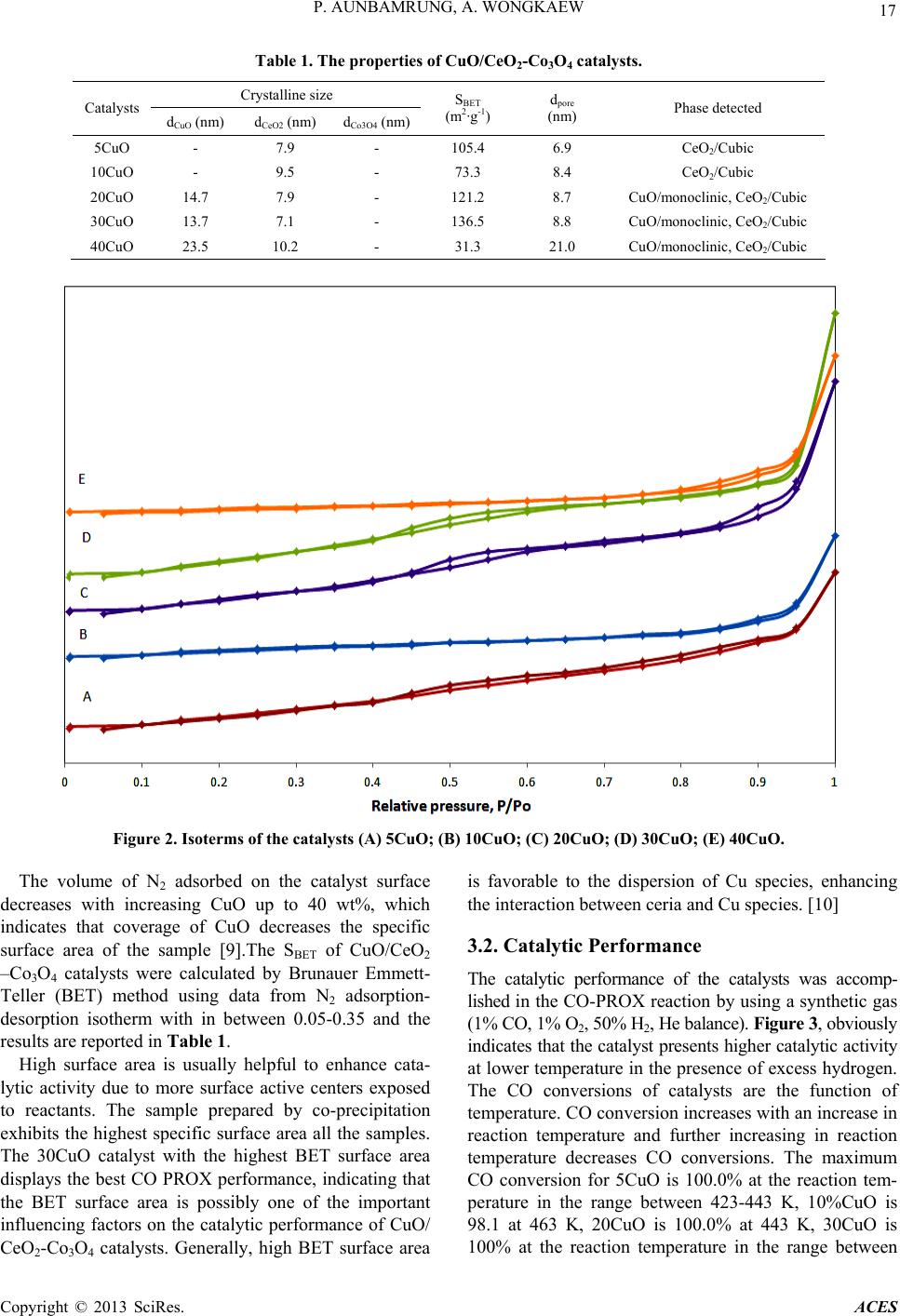 P. AUNBAMRUNG, A. WONGKAEW 17 Table 1. The properties of CuO/CeO2-Co3O4 catalysts. Crystalline size Catalysts dCuO (nm)dCeO2 (nm) dCo3O4 (nm) SBET (m2·g-1) dpore (nm) Phase detected 5CuO - 7.9 - 105.4 6.9 CeO2/Cubic 10CuO - 9.5 - 73.3 8.4 CeO2/Cubic 20CuO 14.7 7.9 - 121.2 8.7 CuO/monoclinic, CeO2/Cubic 30CuO 13.7 7.1 - 136.5 8.8 CuO/monoclinic, CeO2/Cubic 40CuO 23.5 10.2 - 31.3 21.0 CuO/monoclinic, CeO2/Cubic Figure 2. Isoterms of the catalysts (A) 5CuO; (B) 10CuO; (C) 20CuO; (D) 30CuO; (E) 40CuO. The volume of N2 adsorbed on the catalyst surface decreases with increasing CuO up to 40 wt%, which indicates that coverage of CuO decreases the specific surface area of the sample [9].The SBET of CuO/CeO2 –Co3O4 catalysts were calculated by Brunauer Emmett- Teller (BET) method using data from N2 adsorption- desorption isotherm with in between 0.05-0.35 and the results are reported in Table 1. High surface area is usually helpful to enhance cata- lytic activity due to more surface active centers exposed to reactants. The sample prepared by co-precipitation exhibits the highest specific surface area all the samples. The 30CuO catalyst with the highest BET surface area displays the best CO PROX performance, indicating that the BET surface area is possibly one of the important influencing factors on the catalytic performance of CuO/ CeO2-Co3O4 catalysts. Generally, high BET surface area is favorable to the dispersion of Cu species, enhancing the interaction between ceria and Cu species. [10] 3.2. Catalytic Performance The catalytic performance of the catalysts was accomp- lished in the CO-PROX reaction by using a synthetic gas (1% CO, 1% O2, 50% H2, He balance). Figure 3, obviously indicates that the catalyst presents higher catalytic activity at lower temperature in the presence of excess hydrogen. The CO conversions of catalysts are the function of temperature. CO conversion increases with an increase in reaction temperature and further increasing in reaction temperature decreases CO conversions. The maximum CO conversion for 5CuO is 100.0% at the reaction tem- perature in the range between 423-443 K, 10%CuO is 98.1 at 463 K, 20CuO is 100.0% at 443 K, 30CuO is 100% at the reaction temperature in the range between Copyright © 2013 SciRes. ACES 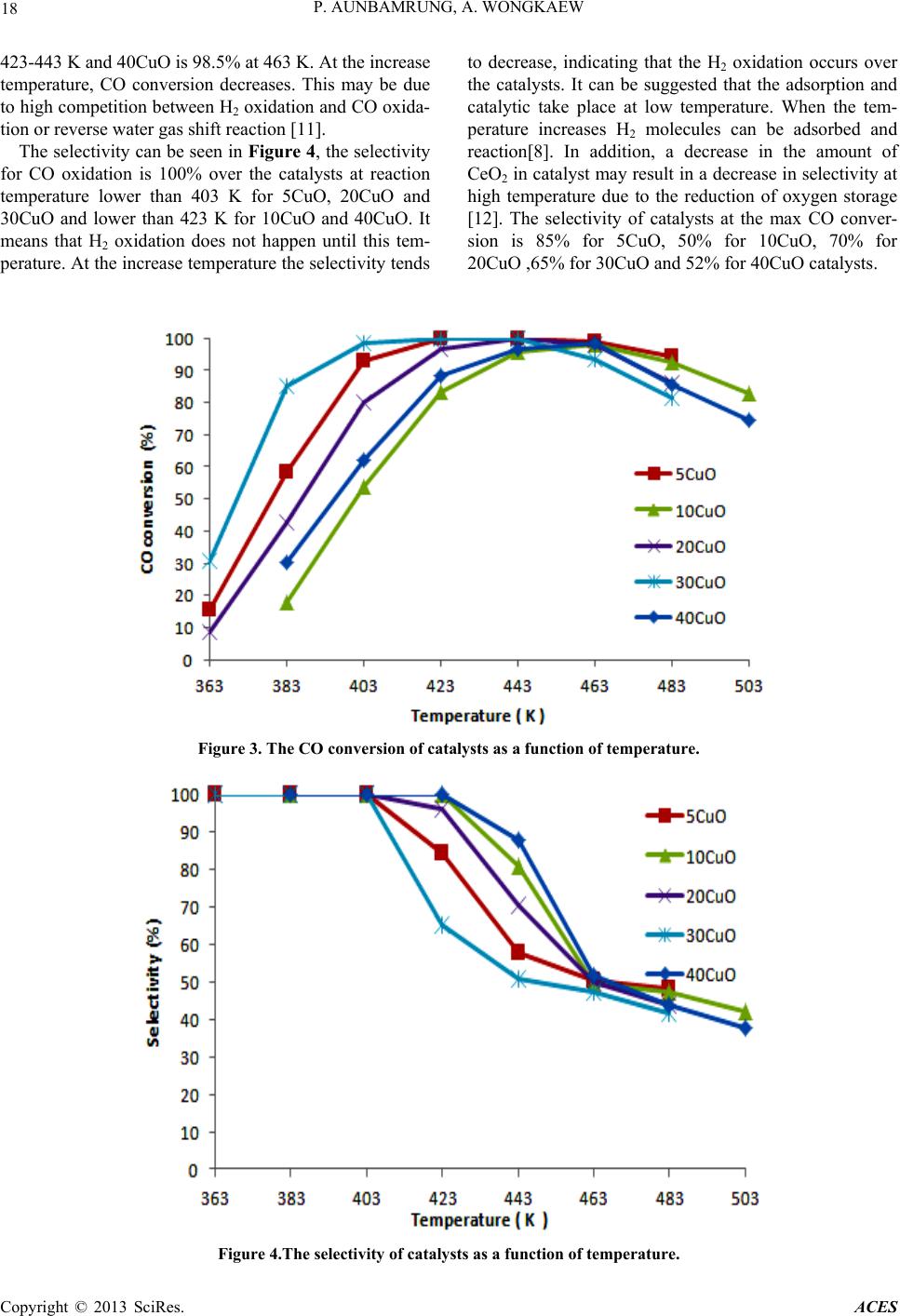 P. AUNBAMRUNG, A. WONGKAEW 18 423-443 K and 40CuO is 98.5% at 463 K. At the increase temperature, CO conversion decreases. This may be due to high competition between H2 oxidation and CO oxida- tion or reverse water gas shift reaction [11]. The selectivity can be seen in Figure 4, the selectivity for CO oxidation is 100% over the catalysts at reaction temperature lower than 403 K for 5CuO, 20CuO and 30CuO and lower than 423 K for 10CuO and 40CuO. It means that H2 oxidation does not happen until this tem- perature. At the increase temperature the selectivity tends to decrease, indicating that the H2 oxidation occurs over the catalysts. It can be suggested that the adsorption and catalytic take place at low temperature. When the tem- perature increases H2 molecules can be adsorbed and reaction[8]. In addition, a decrease in the amount of CeO2 in catalyst may result in a decrease in selectivity at high temperature due to the reduction of oxygen storage [12]. The selectivity of catalysts at the max CO conver- sion is 85% for 5CuO, 50% for 10CuO, 70% for 20CuO ,65% for 30CuO and 52% for 40CuO catalysts. Figure 3. The CO conversion of catalysts as a function of temperature. Figure 4.The selectivity of catalysts as a function of temperature. Copyright © 2013 SciRes. ACES  P. AUNBAMRUNG, A. WONGKAEW 19 It can also be concluded that, the wt% Cu loading has an effect on selective CO oxidation. Adding more CuO increases activity and CO removal at low temperature. For CO oxidation, the catalysts activity in presence of excess hydrogen is as follows, 30CuO >20CuO >40CuO >10CuO. In contrast, when comparing the selectivity at the maximum CO conversion, the activity of catalyst is as follows; 20CuO >30CuO >40CuO >10CuO. The 5CuO catalyst show the highest activity with 100% CO conversion and 85% selectivity for removal CO in H2-rich gas. A good dispersion of CuO in catalyst made to easily adsorb CO and activity with O2 rapidly. Includ- ing the appropriate amount of cobalt oxide to promote efficient catalysis of CuO and high specific surface area. 4. Conclusions The CuO/CeO2-Co3O4 catalysts were prepared by co- precipitation method and characterized by the XRD and BET techniques. XRD measurements show that the cata- lysts are composed of monoclinic CuO and cubic fluorite CeO2. BET shows the large surface area and small aver- age pore size diameter. The performance of catalyst sug- gest the 5CuO shows the best activity at low temperature and shows high selective CO oxidation when the CO conversion reach to 100%. The performance of catalysts verifies that complete in the CO-PROX system. 5. Acknowledgements This research was supported by Burapha University (NRCT 2555) under the contract # 48/2555. REFERENCES [1] O. Bicakova and P. Straka, “Production of Hydrogen from Renewable Resource and its Effectiveness,” International Journal of Hydrogen Energy, Vol. 33, 2008, pp. 1335-1344. [2] Z. Nada and L. Xianguo, “Transient of Carbon Monoxide Poisoning and Oxygen Bleeding in a PEM Fuel Cell Anode Catalyst Layer,” International Journal of Hydrogen Energy, Vol. 33, 2008, pp. 1335-1344. [3] A. Mishra and R. Prasad, “A Review on Preferential Oxidation of Carbon Monoxide in Hydrogen Rich Gas,” Bulletin of Chemical Reaction Engineering & Catalysis, Vol. 6, No. 1, 2011, pp. 1-14. [4] G. Avgouropoulos, T. Ioannides, C. Papadopoulou, J. Batista, S. Hocevar and H. K. Matralis, “A Comparative Study of Pt/γ-Al2O3, Au/α-Fe2O3 and CuO–CeO2 Catalysts for the Selective Oxidation of Carbon Monoxide in Excess Hydrogen,” Catalysis Today, Vol. 75, 2002, pp. 157-167. doi:10.1016/S0920-5861(02)00058-5 [5] S. Salvatore, C. Carmelo, P. M. Riccobenea, P. Giacomo and P. Alessandro, “Selective Oxidation of CO in H2-rich Stream over Au/CeO2 and Cu/CeO2 Catalysts: An Insight on the Effect of Preparationmethod and Catalyst Pretreatment,” Applied Catalysis A: General, Vol. 417- 418, 2012, pp. 66-75. [6] M. Kang, M. W. song and C. H. Lee, “Catalytic Carbon Monoxide Oxidation over CoOx/CeO2 Composite Cata- lysts,” Applied Catalysis A: General, Vol. 255, 2003, pp. 143-156. doi:10.1016/S0926-860X(03)00324-7 [7] Z. Liu, R. Zhou and X. Zheng, “Influence of Preparation Methods on CuO-CeO2 Catalysts in the Preferential Oxi- dation of CO in Excess Hydrogen,” Journal of National Gas Chemistry, Vol. 17, 2008, pp. 125-129. [8] J. L. Ayastuy, E. Fernandez-Puertas, M. P. Gon- zalez-Marcos and M. A. Guitierrez-Ortiz, “Transition metal Promoters in CuO/CeO2 Catalysts for CO Removal from Hydrogenstreams,” International Journal of Hy- drogen Energy, Vol. 37, 2012, pp. 7385-7397. doi:10.1016/j.ijhydene.2012.02.007 [9] S. Christopher, H. Nair and D. Chelsey, “Study of Active Sites and Mechanism Responsible for Highly Selective CO Oxidation in H2 Rich Atmospheres on a Mixed Cu and Ce Oxide Catalyst,” Journal of Catalysis, Vol. 266, 2009, pp. 308-319. doi:10.1016/j.jcat.2009.06.021 [10] M. Meng, Y. Liu, W. L. Z.Sun, L. Zhang and X. Wang, “Synthesis of Highly-dispersed CuO-CeO2 Catalyst Through a Chemisorption-hydrolysis Route for CO Pref- erential Oxidation in H2-rich Stream,” International Journal of Hydrogen Energy, Vol. 37, 2012, pp. 14133-14142. doi:10.1016/j.ijhydene.2012.07.075 [11] J. W. Park, J. H. Joeng, W. L. Yoon, C. S. Kim, D. K. Lee, Y. K. park and Y. W. Rhee, “Selective Oxidation of CO in Hydrogen-rich Stream over Cu-Ce Catalyst Pro- moted with Transition Metal,” International Journal of Hydrogen Energy, Vol. 30, 2005, pp. 209-220. doi:10.1016/j.ijhydene.2004.04.016 [12] S. Chang, M. Li, Q. Hua, L. Zhang, Y. Ma, B. Ye and W. Huang, “Shape-dependent Interplay between Oxygen Vacancies and Ag–CeO2 Interaction inAg/CeO2 Catalyst s and Their Influence on the Catalytic Activity,” Journal of Catalysis, Vol. 293, Vol. 30, 2012, pp. 195-200. Copyright © 2013 SciRes. ACES |