

Paper Menu >>
Journal Menu >>
 Advances in Chemical Engineering and Science, 2013, 3, 7-14 doi:10.4236/aces.2013.34B002 Published Online October 2013 (http://www.scirp.org/journal/aces) Removal of Carbon Monoxide from Hydrogen-rich Fuels over CeO2-pro mot ed P t/Al2O3 Akkarat Wongkaew1*, Pichet Limsuwan2 1Department of Chemical Engineering, Faculty of Engineering, Burapha University, Chonburi, Thailand 2Department of Physics, Faculty of Science, King Mongkut’s University of Technology Thonburi, Bangkok, Thailand Email: [email protected] Received May, 2013 ABSTRACT A comparative study of catalytic CO oxidation and selective CO oxidation over Pt/Al2O3 and CeO2-promoted Pt/Al2O3 catalysts has been investigated for the removal of a trace amount of CO from the reformed gas. The catalysts were pre- pared by sol gel and incipient wetness impregnation. CO oxidation and selective CO oxidation were carried out with a 5%Pt/Al2O3 and a 5%Pt/15%CeO2/Al2O3. The presence of 15%CeO2 in the 5%Pt/Al2O3 dramatically improves the ac- tivities to CO oxidation and selective CO oxidation at low temperature (<180℃). FTIR results indicate that CO could react with lattice oxygen from ceria and release CO2 as a product. Low space velocity would obtain high CO conversion at low temperatures while high space velocity would obtain high CO conversion at high temperatures. The results also show that a 5%Pt/15%CeO2/Al2O3 can completely oxidize 1% CO at 180℃ with selectivity of 52% and space velocity of 70,000 cm3·g-1·h-1. Under the realistic gas feed with 1%O2, this catalyst is very stable and retains its activity and se- lectivity at 180℃ during 72 h. Keywords: CO Oxidation; CeO2-Pt/alumina; CO Adsorption; Selective CO Oxidation; Fuel Processing 1. Introduction The polymer-electrolyte-membrane fuel cell (PEMFC) has been attracting significant attention in several appli- cations including electric vehicles and residential power- generations. This is because of its many attractive fea- tures such as high power density, rapid start-up, and high efficiency [1, 2]. As the PEMFCs utilize hydrogen gas as a fuel and since hydrogen can be produced by means of a fuel reformer followed by water gas shift reaction for further conversion of CO to H2, carbon monoxide is al- ways present in the hydrogen stream. Generally, catalytic steam reforming of methanol or partial oxidation of gasoline followed by water gas shift reaction will pro- duce a gas stream with 40%-75% H2, 15%-20% CO2, ~10% H2O, 0-25% N2 and 0.5%-1.0% CO. This amount of CO contained in the reformed gas is high enough to poison the Pt anode of PEM fuel cells and in turn dra- matically degrades the fuel cell potential and energy conversion efficiency [3, 4]. Experimentally, it has been found that the tolerable level of CO without harmful ef- fects is about 10 ppm [5]. This means the 0.5%-1.0% CO needs to be reduced to 10 ppm or less in order to increase the use of proton exchange membrane (PEM) fuel cells running with on-board generated hydrogen. The most economical and straightforward technique for this pur- pose is selective catalytic oxidation of CO in the H2-rich reformed gas using O2 or preferential oxidation (PROX). This method needs a suitable catalyst to enhance the CO oxidation reaction with minimal oxidation of hydrogen which is the desired fuel. The crucial requirement for the PROX re- actor is a high CO conversion with high selec- tivity. A number of catalysts have been investigated for the PROX reaction [6-10]. Noble metals supported on alumina such as Pt, Au, Ru and Pd, have been proposed as ideal catalysts for PROX reaction, especially Pt/Al2O3, Pt/ Fe2O3/ Al2O3, Pt/CeO2, Pt/CeO2_ZrO2, Pt/zeolite [11-13]. An improvement in the selectivity at low tem- peratures is needed. Oxidation of CO on alu- mina-supported Pt catalysts is known to take place via the Langmuir-Hinshel- wood mechanism. Kahlich et al. [14] studied the kinetics of selective CO oxidation in H2-rich gas on Pt/Al2O3 and observed that CO conversion never reached 100% for a 0.5%Pt/Al2O3. The maximum CO conversion was ~80% at temperatures as high as 250 ℃. Other studies reported that CO conversion occurred in the reaction temperature range of 200℃-250℃ [15] or else needed high oxygen concentration for complete elimination of CO, corresponding to lower selectivity. We have previously [16] investigated the catalytic activ- ity of 2%Pt/Al2O3, which was prepared by the sol-gel method, in selective CO oxidation reaction under the Copyright © 2013 SciRes. ACES 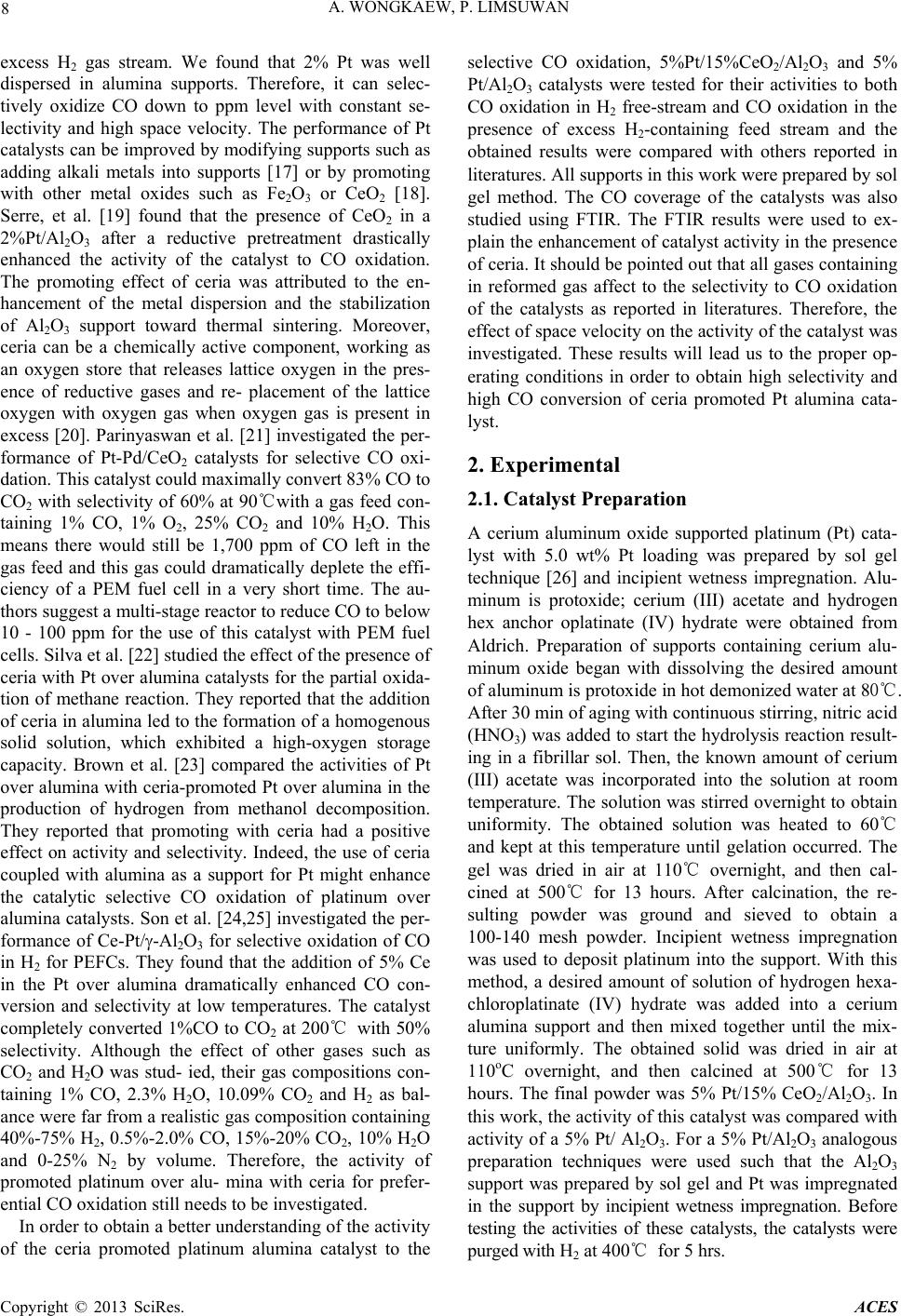 A. WONGKAEW, P. LIMSUWAN 8 excess H2 gas stream. We found that 2% Pt was well dispersed in alumina supports. Therefore, it can selec- tively oxidize CO down to ppm level with constant se- lectivity and high space velocity. The performance of Pt catalysts can be improved by modifying supports such as adding alkali metals into supports [17] or by promoting with other metal oxides such as Fe2O3 or CeO2 [18]. Serre, et al. [19] found that the presence of CeO2 in a 2%Pt/Al2O3 after a reductive pretreatment drastically enhanced the activity of the catalyst to CO oxidation. The promoting effect of ceria was attributed to the en- hancement of the metal dispersion and the stabilization of Al2O3 support toward thermal sintering. Moreover, ceria can be a chemically active component, working as an oxygen store that releases lattice oxygen in the pres- ence of reductive gases and re- placement of the lattice oxygen with oxygen gas when oxygen gas is present in excess [20]. Parinyaswan et al. [21] investigated the per- formance of Pt-Pd/CeO2 catalysts for selective CO oxi- dation. This catalyst could maximally convert 83% CO to CO2 with selectivity of 60% at 90℃with a gas feed con- taining 1% CO, 1% O2, 25% CO2 and 10% H2O. This means there would still be 1,700 ppm of CO left in the gas feed and this gas could dramatically deplete the effi- ciency of a PEM fuel cell in a very short time. The au- thors suggest a multi-stage reactor to reduce CO to below 10 - 100 ppm for the use of this catalyst with PEM fuel cells. Silva et al. [22] studied the effect of the presence of ceria with Pt over alumina catalysts for the partial oxida- tion of methane reaction. They reported that the addition of ceria in alumina led to the formation of a homogenous solid solution, which exhibited a high-oxygen storage capacity. Brown et al. [23] compared the activities of Pt over alumina with ceria-promoted Pt over alumina in the production of hydrogen from methanol decomposition. They reported that promoting with ceria had a positive effect on activity and selectivity. Indeed, the use of ceria coupled with alumina as a support for Pt might enhance the catalytic selective CO oxidation of platinum over alumina catalysts. Son et al. [24,25] investigated the per- formance of Ce-Pt/-Al2O3 for selective oxidation of CO in H2 for PEFCs. They found that the addition of 5% Ce in the Pt over alumina dramatically enhanced CO con- version and selectivity at low temperatures. The catalyst completely converted 1%CO to CO2 at 200℃ with 50% selectivity. Although the effect of other gases such as CO2 and H2O was stud- ied, their gas compositions con- taining 1% CO, 2.3% H2O, 10.09% CO2 and H2 as bal- ance were far from a realistic gas composition containing 40%-75% H2, 0.5%-2.0% CO, 15%-20% CO2, 10% H2O and 0-25% N2 by volume. Therefore, the activity of promoted platinum over alu- mina with ceria for prefer- ential CO oxidation still needs to be investigated. In order to obtain a better understanding of the activity of the ceria promoted platinum alumina catalyst to the selective CO oxidation, 5%Pt/15%CeO2/Al2O3 and 5% Pt/Al2O3 catalysts were tested for their activities to both CO oxidation in H2 free-stream and CO oxidation in the presence of excess H2-containing feed stream and the obtained results were compared with others reported in literatures. All supports in this work were prepared by sol gel method. The CO coverage of the catalysts was also studied using FTIR. The FTIR results were used to ex- plain the enhancement of catalyst activity in the presence of ceria. It should be pointed out that all gases containing in reformed gas affect to the selectivity to CO oxidation of the catalysts as reported in literatures. Therefore, the effect of space velocity on the activity of the catalyst was investigated. These results will lead us to the proper op- erating conditions in order to obtain high selectivity and high CO conversion of ceria promoted Pt alumina cata- lyst. 2. Experimental 2.1. Catalyst Preparation A cerium aluminum oxide supported platinum (Pt) cata- lyst with 5.0 wt% Pt loading was prepared by sol gel technique [26] and incipient wetness impregnation. Alu- minum is protoxide; cerium (III) acetate and hydrogen hex anchor oplatinate (IV) hydrate were obtained from Aldrich. Preparation of supports containing cerium alu- minum oxide began with dissolving the desired amount of aluminum is protoxide in hot demonized water at 80℃. After 30 min of aging with continuous stirring, nitric acid (HNO3) was added to start the hydrolysis reaction result- ing in a fibrillar sol. Then, the known amount of cerium (III) acetate was incorporated into the solution at room temperature. The solution was stirred overnight to obtain uniformity. The obtained solution was heated to 60℃ and kept at this temperature until gelation occurred. The gel was dried in air at 110℃ overnight, and then cal- cined at 500℃ for 13 hours. After calcination, the re- sulting powder was ground and sieved to obtain a 100-140 mesh powder. Incipient wetness impregnation was used to deposit platinum into the support. With this method, a desired amount of solution of hydrogen hexa- chloroplatinate (IV) hydrate was added into a cerium alumina support and then mixed together until the mix- ture uniformly. The obtained solid was dried in air at 110oC overnight, and then calcined at 500℃ for 13 hours. The final powder was 5% Pt/15% CeO2/Al2O3. In this work, the activity of this catalyst was compared with activity of a 5% Pt/ Al2O3. For a 5% Pt/Al2O3 analogous preparation techniques were used such that the Al2O3 support was prepared by sol gel and Pt was impregnated in the support by incipient wetness impregnation. Before testing the activities of these catalysts, the catalysts were purged with H2 at 400℃ for 5 hrs. Copyright © 2013 SciRes. ACES 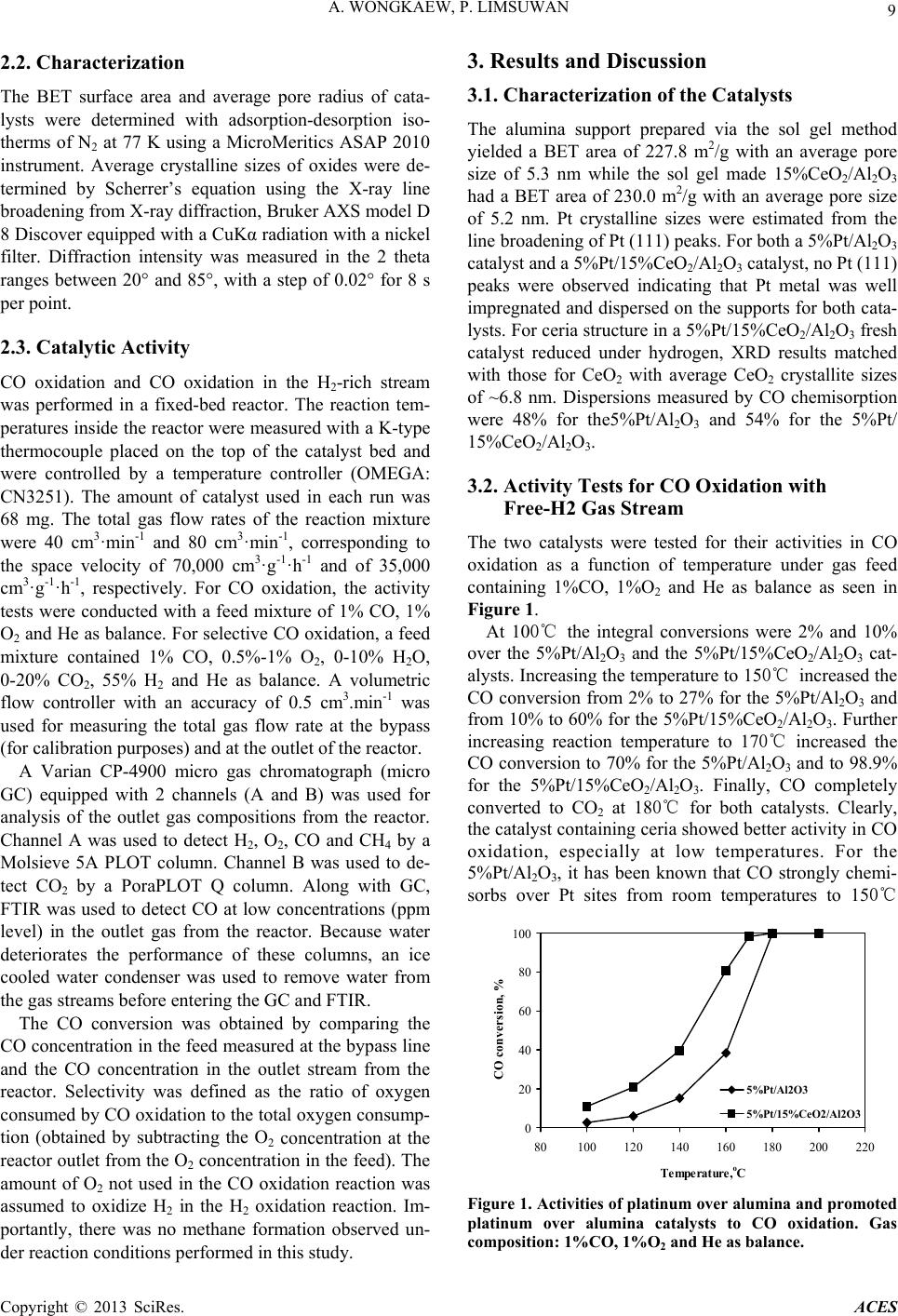 A. WONGKAEW, P. LIMSUWAN 9 2.2. Characterization The BET surface area and average pore radius of cata- lysts were determined with adsorption-desorption iso- therms of N2 at 77 K using a MicroMeritics ASAP 2010 instrument. Average crystalline sizes of oxides were de- termined by Scherrer’s equation using the X-ray line broadening from X-ray diffraction, Bruker AXS model D 8 Discover equipped with a CuKα radiation with a nickel filter. Diffraction intensity was measured in the 2 theta ranges between 20° and 85°, with a step of 0.02° for 8 s per point. 2.3. Catalytic Activity CO oxidation and CO oxidation in the H2-rich stream was performed in a fixed-bed reactor. The reaction tem- peratures inside the reactor were measured with a K-type thermocouple placed on the top of the catalyst bed and were controlled by a temperature controller (OMEGA: CN3251). The amount of catalyst used in each run was 68 mg. The total gas flow rates of the reaction mixture were 40 cm3·min-1 and 80 cm3·min-1, corresponding to the space velocity of 70,000 cm3·g-1·h-1 and of 35,000 cm3·g-1·h-1, respectively. For CO oxidation, the activity tests were conducted with a feed mixture of 1% CO, 1% O2 and He as balance. For selective CO oxidation, a feed mixture contained 1% CO, 0.5%-1% O2, 0-10% H2O, 0-20% CO2, 55% H2 and He as balance. A volumetric flow controller with an accuracy of 0.5 cm3.min-1 was used for measuring the total gas flow rate at the bypass (for calibration purposes) and at the outlet of the reactor. A Varian CP-4900 micro gas chromatograph (micro GC) equipped with 2 channels (A and B) was used for analysis of the outlet gas compositions from the reactor. Channel A was used to detect H2, O2, CO and CH4 by a Molsieve 5A PLOT column. Channel B was used to de- tect CO2 by a PoraPLOT Q column. Along with GC, FTIR was used to detect CO at low concentrations (ppm level) in the outlet gas from the reactor. Because water deteriorates the performance of these columns, an ice cooled water condenser was used to remove water from the gas streams before entering the GC and FTIR. The CO conversion was obtained by comparing the CO concentration in the feed measured at the bypass line and the CO concentration in the outlet stream from the reactor. Selectivity was defined as the ratio of oxygen consumed by CO oxidation to the total oxygen consump- tion (obtained by subtracting the O2 concentration at the reactor outlet from the O2 concentration in the feed). The amount of O2 not used in the CO oxidation reaction was assumed to oxidize H2 in the H2 oxidation reaction. Im- portantly, there was no methane formation observed un- der reaction conditions performed in this study. 3. Results and Discussion 3.1. Characterization of the Catalysts The alumina support prepared via the sol gel method yielded a BET area of 227.8 m2/g with an average pore size of 5.3 nm while the sol gel made 15%CeO2/Al2O3 had a BET area of 230.0 m2/g with an average pore size of 5.2 nm. Pt crystalline sizes were estimated from the line broadening of Pt (111) peaks. For both a 5%Pt/Al2O3 catalyst and a 5%Pt/15%CeO2/Al2O3 catalyst, no Pt (111) peaks were observed indicating that Pt metal was well impregnated and dispersed on the supports for both cata- lysts. For ceria structure in a 5%Pt/15%CeO2/Al2O3 fresh catalyst reduced under hydrogen, XRD results matched with those for CeO2 with average CeO2 crystallite sizes of ~6.8 nm. Dispersions measured by CO chemisorption were 48% for the5%Pt/Al2O3 and 54% for the 5%Pt/ 15%CeO2/Al2O3. 3.2. Activity Tests for CO Oxidation with Free-H2 Gas Stream The two catalysts were tested for their activities in CO oxidation as a function of temperature under gas feed containing 1%CO, 1%O2 and He as balance as seen in Figure 1. At 100℃ the integral conversions were 2% and 10% over the 5%Pt/Al2O3 and the 5%Pt/15%CeO2/Al2O3 cat- alysts. Increasing the temperature to 150℃ increased the CO conversion from 2% to 27% for the 5%Pt/Al2O3 and from 10% to 60% for the 5%Pt/15%CeO2/Al2O3. Further increasing reaction temperature to 170℃ increased the CO conversion to 70% for the 5%Pt/Al2O3 and to 98.9% for the 5%Pt/15%CeO2/Al2O3. Finally, CO completely converted to CO2 at 180℃ for both catalysts. Clearly, the catalyst containing ceria showed better activity in CO oxidation, especially at low temperatures. For the 5%Pt/Al2O3, it has been known that CO strongly chemi- sorbs over Pt sites from room temperatures to 150℃ 0 20 40 60 80 100 80100 120 140 160 180 200 220 Temperature, o C CO conversion, % 5%Pt/Al2O3 5%Pt/15%CeO2/Al2O3 Figure 1. Activities of platinum over alumina and promoted platinum over alumina catalysts to CO oxidation. Gas composition: 1%CO, 1%O2 and He as balance. Copyright © 2013 SciRes. ACES 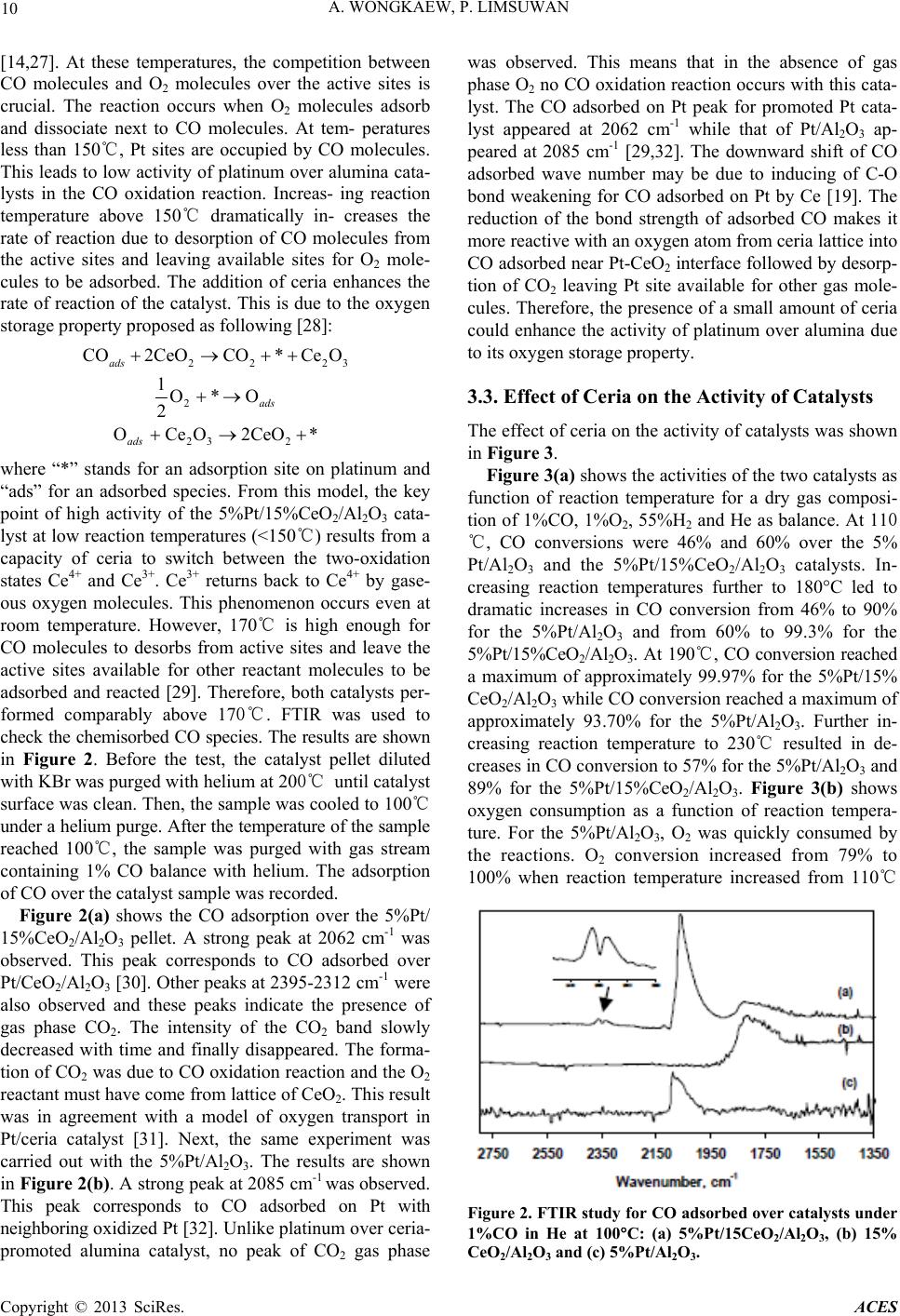 A. WONGKAEW, P. LIMSUWAN 10 [14,27]. At these temperatures, the competition between CO molecules and O2 molecules over the active sites is crucial. The reaction occurs when O2 molecules adsorb and dissociate next to CO molecules. At tem- peratures less than 150℃, Pt sites are occupied by CO molecules. This leads to low activity of platinum over alumina cata- lysts in the CO oxidation reaction. Increas- ing reaction temperature above 150℃ dramatically in- creases the rate of reaction due to desorption of CO molecules from the active sites and leaving available sites for O2 mole- cules to be adsorbed. The addition of ceria enhances the rate of reaction of the catalyst. This is due to the oxygen storage property proposed as following [28]: 22 2 2 23 2 CO2CeOCO*Ce O 1O*O 2 OCeO2CeO* ads ads ads 3 where “*” stands for an adsorption site on platinum and “ads” for an adsorbed species. From this model, the key point of high activity of the 5%Pt/15%CeO2/Al2O3 cata- lyst at low reaction temperatures (<150℃) results from a capacity of ceria to switch between the two-oxidation states Ce4+ and Ce3+. Ce3+ returns back to Ce4+ by gase- ous oxygen molecules. This phenomenon occurs even at room temperature. However, 170℃ is high enough for CO molecules to desorbs from active sites and leave the active sites available for other reactant molecules to be adsorbed and reacted [29]. Therefore, both catalysts per- formed comparably above 170℃. FTIR was used to check the chemisorbed CO species. The results are shown in Figure 2. Before the test, the catalyst pellet diluted with KBr was purged with helium at 200℃ until catalyst surface was clean. Then, the sample was cooled to 100℃ under a helium purge. After the temperature of the sample reached 100℃, the sample was purged with gas stream containing 1% CO balance with helium. The adsorption of CO over the catalyst sample was recorded. Figure 2(a) shows the CO adsorption over the 5%Pt/ 15%CeO2/Al2O3 pellet. A strong peak at 2062 cm-1 was observed. This peak corresponds to CO adsorbed over Pt/CeO2/Al2O3 [30]. Other peaks at 2395-2312 cm-1 were also observed and these peaks indicate the presence of gas phase CO2. The intensity of the CO2 band slowly decreased with time and finally disappeared. The forma- tion of CO2 was due to CO oxidation reaction and the O2 reactant must have come from lattice of CeO2. This result was in agreement with a model of oxygen transport in Pt/ceria catalyst [31]. Next, the same experiment was carried out with the 5%Pt/Al2O3. The results are shown in Figure 2(b). A strong peak at 2085 cm-1 was observed. This peak corresponds to CO adsorbed on Pt with neighboring oxidized Pt [32]. Unlike platinum over ceria- promoted alumina catalyst, no peak of CO2 gas phase was observed. This means that in the absence of gas phase O2 no CO oxidation reaction occurs with this cata- lyst. The CO adsorbed on Pt peak for promoted Pt cata- lyst appeared at 2062 cm-1 while that of Pt/Al2O3 ap- peared at 2085 cm-1 [29,32]. The downward shift of CO adsorbed wave number may be due to inducing of C-O bond weakening for CO adsorbed on Pt by Ce [19]. The reduction of the bond strength of adsorbed CO makes it more reactive with an oxygen atom from ceria lattice into CO adsorbed near Pt-CeO2 interface followed by desorp- tion of CO2 leaving Pt site available for other gas mole- cules. Therefore, the presence of a small amount of ceria could enhance the activity of platinum over alumina due to its oxygen storage property. 3.3. Effect of Ceria on the Activity of Catalysts The effect of ceria on the activity of catalysts was shown in Figure 3. Figure 3(a) shows the activities of the two catalysts as function of reaction temperature for a dry gas composi- tion of 1%CO, 1%O2, 55%H2 and He as balance. At 110 ℃, CO conversions were 46% and 60% over the 5% Pt/Al2O3 and the 5%Pt/15%CeO2/Al2O3 catalysts. In- creasing reaction temperatures further to 180C led to dramatic increases in CO conversion from 46% to 90% for the 5%Pt/Al2O3 and from 60% to 99.3% for the 5%Pt/15%CeO2/Al2O3. At 190℃, CO conversion reached a maximum of approximately 99.97% for the 5%Pt/15% CeO2/Al2O3 while CO conversion reached a maximum of approximately 93.70% for the 5%Pt/Al2O3. Further in- creasing reaction temperature to 230℃ resulted in de- creases in CO conversion to 57% for the 5%Pt/Al2O3 and 89% for the 5%Pt/15%CeO2/Al2O3. Figure 3(b) shows oxygen consumption as a function of reaction tempera- ture. For the 5%Pt/Al2O3, O2 was quickly consumed by the reactions. O2 conversion increased from 79% to 100% when reaction temperature increased from 110℃ Figure 2. FTIR study for CO adsorbe d over catalysts under 1%CO in He at 100C: (a) 5%Pt/15CeO2/Al2O3, (b) 15% CeO2/Al2O3 and (c) 5%Pt/Al2O3. Copyright © 2013 SciRes. ACES 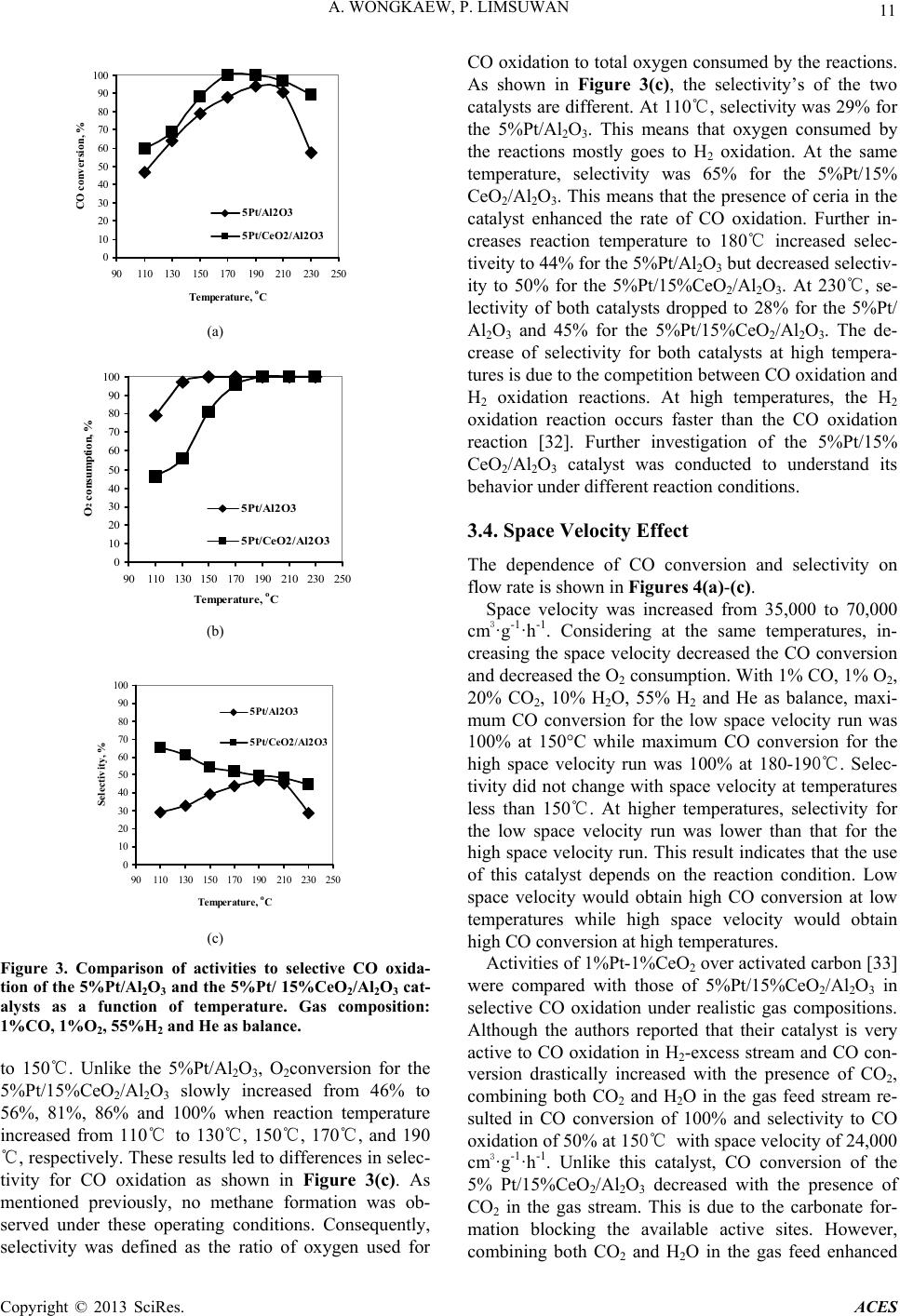 A. WONGKAEW, P. LIMSUWAN 11 0 10 20 30 40 50 60 70 80 90 100 90110 130150 170190 210230 250 Temperature, o C C O conversion, % 5Pt/Al2O3 5Pt/CeO2/Al2O3 (a) 0 10 20 30 40 50 60 70 80 90 100 90110 130150 170 190 210230 250 Temperature, o C O 2 consumption, % 5Pt/Al2O3 5Pt/CeO2/Al2O3 (b) 0 10 20 30 40 50 60 70 80 90 100 90110130 150 170 190210 230 250 Temper ature, o C S electivity, % 5Pt/Al2O3 5 Pt/CeO2/Al2O3 (c) Figure 3. Comparison of activities to selective CO oxida- tion of the 5%Pt/Al2O3 and the 5%Pt/ 15%CeO2/Al2O3 cat- alysts as a function of temperature. Gas composition: 1%CO, 1%O2, 55%H2 and He as balance. to 150℃. Unlike the 5%Pt/Al2O3, O2conversion for the 5%Pt/15%CeO2/Al2O3 slowly increased from 46% to 56%, 81%, 86% and 100% when reaction temperature increased from 110℃ to 130℃, 150℃, 170℃, and 190 ℃, respectively. These results led to differences in selec- tivity for CO oxidation as shown in Figure 3(c). As mentioned previously, no methane formation was ob- served under these operating conditions. Consequently, selectivity was defined as the ratio of oxygen used for CO oxidation to total oxygen consumed by the reactions. As shown in Figure 3(c), the selectivity’s of the two catalysts are different. At 110℃, selectivity was 29% for the 5%Pt/Al2O3. This means that oxygen consumed by the reactions mostly goes to H2 oxidation. At the same temperature, selectivity was 65% for the 5%Pt/15% CeO2/Al2O3. This means that the presence of ceria in the catalyst enhanced the rate of CO oxidation. Further in- creases reaction temperature to 180℃ increased selec- tiveity to 44% for the 5%Pt/Al2O3 but decreased selectiv- ity to 50% for the 5%Pt/15%CeO2/Al2O3. At 230℃, se- lectivity of both catalysts dropped to 28% for the 5%Pt/ Al2O3 and 45% for the 5%Pt/15%CeO2/Al2O3. The de- crease of selectivity for both catalysts at high tempera- tures is due to the competition between CO oxidation and H2 oxidation reactions. At high temperatures, the H2 oxidation reaction occurs faster than the CO oxidation reaction [32]. Further investigation of the 5%Pt/15% CeO2/Al2O3 catalyst was conducted to understand its behavior under different reaction conditions. 3.4. Space Velocity Effect The dependence of CO conversion and selectivity on flow rate is shown in Figures 4(a)-(c). Space velocity was increased from 35,000 to 70,000 cm3·g-1·h-1. Considering at the same temperatures, in- creasing the space velocity decreased the CO conversion and decreased the O2 consumption. With 1% CO, 1% O2, 20% CO2, 10% H2O, 55% H2 and He as balance, maxi- mum CO conversion for the low space velocity run was 100% at 150C while maximum CO conversion for the high space velocity run was 100% at 180-190℃. Selec- tivity did not change with space velocity at temperatures less than 150℃. At higher temperatures, selectivity for the low space velocity run was lower than that for the high space velocity run. This result indicates that the use of this catalyst depends on the reaction condition. Low space velocity would obtain high CO conversion at low temperatures while high space velocity would obtain high CO conversion at high temperatures. Activities of 1%Pt-1%CeO2 over activated carbon [33] were compared with those of 5%Pt/15%CeO2/Al2O3 in selective CO oxidation under realistic gas compositions. Although the authors reported that their catalyst is very active to CO oxidation in H2-excess stream and CO con- version drastically increased with the presence of CO2, combining both CO2 and H2O in the gas feed stream re- sulted in CO conversion of 100% and selectivity to CO oxidation of 50% at 150℃ with space velocity of 24,000 cm3·g-1·h-1. Unlike this catalyst, CO conversion of the 5% Pt/15%CeO2/Al2O3 decreased with the presence of CO2 in the gas stream. This is due to the carbonate for- mation blocking the available active sites. However, combining both CO2 and H2O in the gas feed enhanced Copyright © 2013 SciRes. ACES 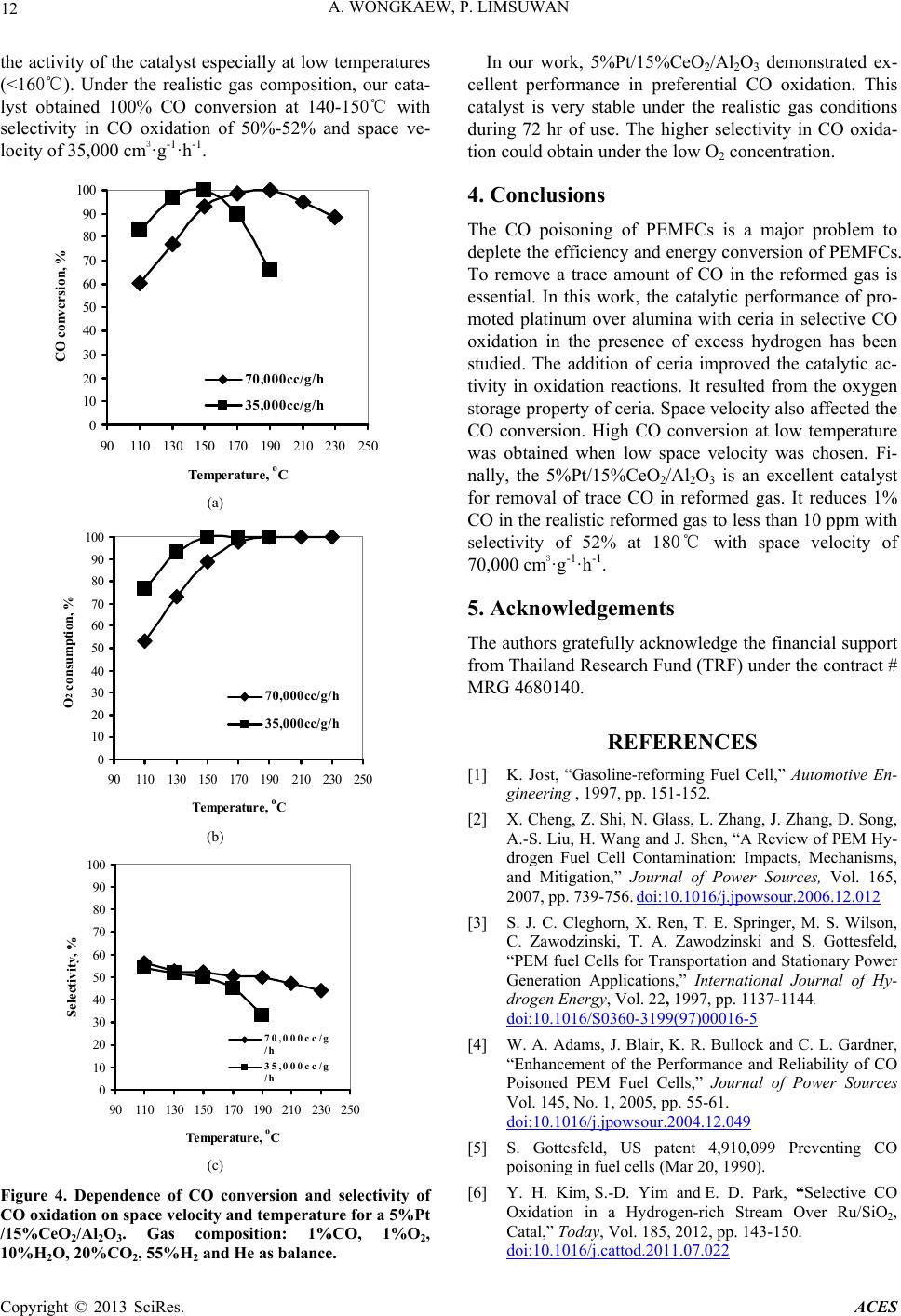 A. WONGKAEW, P. LIMSUWAN 12 the activity of the catalyst especially at low temperatures (<160℃). Under the realistic gas composition, our cata- lyst obtained 100% CO conversion at 140-150℃ with selectivity in CO oxidation of 50%-52% and space ve- locity of 35,000 cm3·g-1·h-1. 0 10 20 30 40 50 60 70 80 90 100 90110130150 170 190 210230 250 Temperature, o C CO conversion, % 70,000cc/g/h 35,000cc/g/h (a) 0 10 20 30 40 50 60 70 80 90 100 90110130 150170190 210230250 Temperature, o C O 2 consumption, % 70,000cc/g/h 35,000cc/g/h (b) 0 10 20 30 40 50 60 70 80 90 100 90110130 150170 190210 230 250 Temperature, o C S elec t ivit y, % 70,000cc/g /h 35,000cc/g /h (c) Figure 4. Dependence of CO conversion and selectivity of CO oxidation on space velocity and temperature for a 5%Pt /15%CeO2/Al2O3. Gas composition: 1%CO, 1%O2, 10%H2O, 20%CO2, 55%H2 and He as balance. In our work, 5%Pt/15%CeO2/Al2O3 demonstrated ex- cellent performance in preferential CO oxidation. This catalyst is very stable under the realistic gas conditions during 72 hr of use. The higher selectivity in CO oxida- tion could obtain under the low O2 concentration. 4. Conclusions The CO poisoning of PEMFCs is a major problem to deplete the efficiency and energy conversion of PEMFCs. To remove a trace amount of CO in the reformed gas is essential. In this work, the catalytic performance of pro- moted platinum over alumina with ceria in selective CO oxidation in the presence of excess hydrogen has been studied. The addition of ceria improved the catalytic ac- tivity in oxidation reactions. It resulted from the oxygen storage property of ceria. Space velocity also affected the CO conversion. High CO conversion at low temperature was obtained when low space velocity was chosen. Fi- nally, the 5%Pt/15%CeO2/A l2O3 is an excellent catalyst for removal of trace CO in reformed gas. It reduces 1% CO in the realistic reformed gas to less than 10 ppm with selectivity of 52% at 180℃ with space velocity of 70,000 cm3·g-1·h-1. 5. Acknowledgements The authors gratefully acknowledge the financial support from Thailand Research Fund (TRF) under the contract # MRG 4680140. REFERENCES [1] K. Jost, “Gasoline-reforming Fuel Cell,” Automotive En- gineering , 1997, pp. 151-152. [2] X. Cheng, Z. Shi, N. Glass, L. Zhang, J. Zhang, D. Song, A.-S. Liu, H. Wang and J. Shen, “A Review of PEM Hy- drogen Fuel Cell Contamination: Impacts, Mechanisms, and Mitigation,” Journal of Power Sources, Vol. 165, 2007, pp. 739-756. doi:10.1016/j.jpowsour.2006.12.012 [3] S. J. C. Cleghorn, X. Ren, T. E. Springer, M. S. Wilson, C. Zawodzinski, T. A. Zawodzinski and S. Gottesfeld, “PEM fuel Cells for Transportation and Stationary Power Generation Applications,” International Journal of Hy- drogen Energy, Vol. 22, 1997, pp. 1137-1144. doi:10.1016/S0360-3199(97)00016-5 [4] W. A. Adams, J. Blair, K. R. Bullock and C. L. Gardner, “Enhancement of the Performance and Reliability of CO Poisoned PEM Fuel Cells,” Journal of Power Sources Vol. 145, No. 1, 2005, pp. 55-61. doi:10.1016/j.jpowsour.2004.12.049 [5] S. Gottesfeld, US patent 4,910,099 Preventing CO poisoning in fuel cells (Mar 20, 1990). [6] Y. H. Kim, S.-D. Yim and E. D. Park, “Selective CO Oxidation in a Hydrogen-rich Stream Over Ru/SiO2, Catal,” Today, Vol. 185, 2012, pp. 143-150. doi:10.1016/j.cattod.2011.07.022 Copyright © 2013 SciRes. ACES 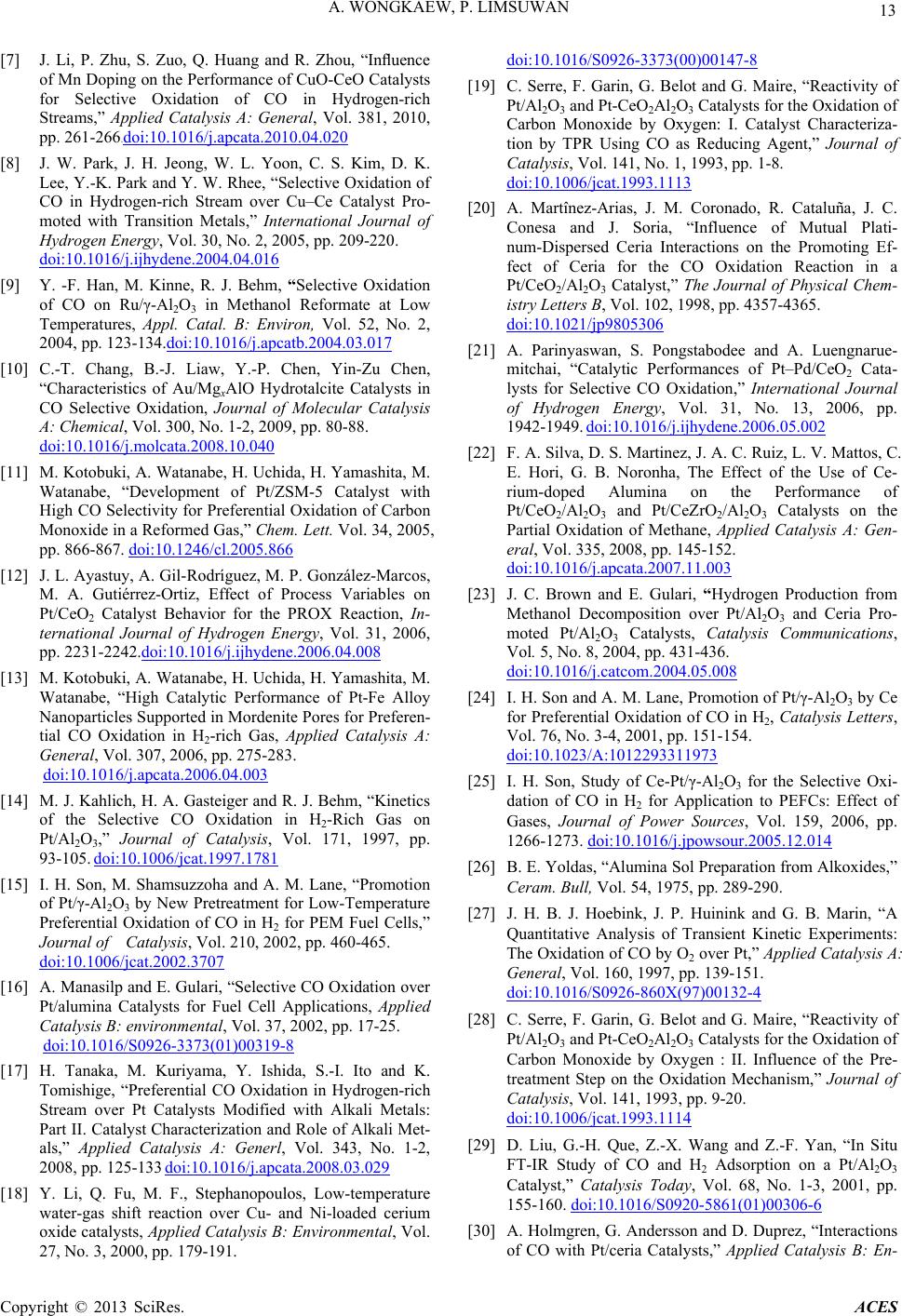 A. WONGKAEW, P. LIMSUWAN 13 [7] J. Li, P. Zhu, S. Zuo, Q. Huang and R. Zhou, “Influence of Mn Doping on the Performance of CuO-CeO Catalysts for Selective Oxidation of CO in Hydrogen-rich Streams,” Applied Catalysis A: General, Vol. 381, 2010, pp. 261-266.doi:10.1016/j.apcata.2010.04.020 [8] J. W. Park, J. H. Jeong, W. L. Yoon, C. S. Kim, D. K. Lee, Y.-K. Park and Y. W. Rhee, “Selective Oxidation of CO in Hydrogen-rich Stream over Cu–Ce Catalyst Pro- moted with Transition Metals,” International Journal of Hydrogen Energy, Vol. 30, No. 2, 2005, pp. 209-220. doi:10.1016/j.ijhydene.2004.04.016 [9] Y. -F. Han, M. Kinne, R. J. Behm, “Selective Oxidation of CO on Ru/γ-Al2O3 in Methanol Reformate at Low Temperatures, Appl. Catal. B: Environ, Vol. 52, No. 2, 2004, pp. 123-134.doi:10.1016/j.apcatb.2004.03.017 [10] C.-T. Chang, B.-J. Liaw, Y.-P. Chen, Yin-Zu Chen, “Characteristics of Au/MgxAlO Hydrotalcite Catalysts in CO Selective Oxidation, Journal of Molecular Catalysis A: Chemical, Vol. 300, No. 1-2, 2009, pp. 80-88. doi:10.1016/j.molcata.2008.10.040 [11] M. Kotobuki, A. Watanabe, H. Uchida, H. Yamashita, M. Watanabe, “Development of Pt/ZSM-5 Catalyst with High CO Selectivity for Preferential Oxidation of Carbon Monoxide in a Reformed Gas,” Chem. Lett. Vol. 34, 2005, pp. 866-867. doi:10.1246/cl.2005.866 [12] J. L. Ayastuy, A. Gil-Rodríguez, M. P. González-Marcos, M. A. Gutiérrez-Ortiz, Effect of Process Variables on Pt/CeO2 Catalyst Behavior for the PROX Reaction, In- ternational Journal of Hydrogen Energy, Vol. 31, 2006, pp. 2231-2242.doi:10.1016/j.ijhydene.2006.04.008 [13] M. Kotobuki, A. Watanabe, H. Uchida, H. Yamashita, M. Watanabe, “High Catalytic Performance of Pt-Fe Alloy Nanoparticles Supported in Mordenite Pores for Preferen- tial CO Oxidation in H2-rich Gas, Applied Catalysis A: General, Vol. 307, 2006, pp. 275-283. doi:10.1016/j.apcata.2006.04.003 [14] M. J. Kahlich, H. A. Gasteiger and R. J. Behm, “Kinetics of the Selective CO Oxidation in H2-Rich Gas on Pt/Al2O3,” Journal of Catalysis, Vol. 171, 1997, pp. 93-105. doi:10.1006/jcat.1997.1781 [15] I. H. Son, M. Shamsuzzoha and A. M. Lane, “Promotion of Pt/γ-Al2O3 by New Pretreatment for Low-Temperature Preferential Oxidation of CO in H2 for PEM Fuel Cells,” Journal of Catalysis, Vol. 210, 2002, pp. 460-465. doi:10.1006/jcat.2002.3707 [16] A. Manasilp and E. Gulari, “Selective CO Oxidation over Pt/alumina Catalysts for Fuel Cell Applications, Applied Catalysis B: environme nt a l , Vol. 37, 2002, pp. 17-25. doi:10.1016/S0926-3373(01)00319-8 [17] H. Tanaka, M. Kuriyama, Y. Ishida, S.-I. Ito and K. Tomishige, “Preferential CO Oxidation in Hydrogen-rich Stream over Pt Catalysts Modified with Alkali Metals: Part II. Catalyst Characterization and Role of Alkali Met- als,” Applied Catalysis A: Generl, Vol. 343, No. 1-2, 2008, pp. 125-133 doi:10.1016/j.apcata.2008.03.029 [18] Y. Li, Q. Fu, M. F., Stephanopoulos, Low-temperature water-gas shift reaction over Cu- and Ni-loaded cerium oxide catalysts, Applied Catalysis B: Environmental, Vol. 27, No. 3, 2000, pp. 179-191. doi:10.1016/S0926-3373(00)00147-8 [19] C. Serre, F. Garin, G. Belot and G. Maire, “Reactivity of Pt/Al2O3 and Pt-CeO2Al2O3 Catalysts for the Oxidation of Carbon Monoxide by Oxygen: I. Catalyst Characteriza- tion by TPR Using CO as Reducing Agent,” Journal of Catalysis, Vol. 141, No. 1, 1993, pp. 1-8. doi:10.1006/jcat.1993.1113 [20] A. Martînez-Arias, J. M. Coronado, R. Cataluña, J. C. Conesa and J. Soria, “Influence of Mutual Plati- num-Dispersed Ceria Interactions on the Promoting Ef- fect of Ceria for the CO Oxidation Reaction in a Pt/CeO2/Al2O3 Catalyst,” The Journal of Physical Chem- istry Letters B, Vol. 102, 1998, pp. 4357-4365. doi:10.1021/jp9805306 [21] A. Parinyaswan, S. Pongstabodee and A. Luengnarue- mitchai, “Catalytic Performances of Pt–Pd/CeO2 Cata- lysts for Selective CO Oxidation,” International Journal of Hydrogen Energy, Vol. 31, No. 13, 2006, pp. 1942-1949. doi:10.1016/j.ijhydene.2006.05.002 [22] F. A. Silva, D. S. Martinez, J. A. C. Ruiz, L. V. Mattos, C. E. Hori, G. B. Noronha, The Effect of the Use of Ce- rium-doped Alumina on the Performance of Pt/CeO2/Al2O3 and Pt/CeZrO2/Al2O3 Catalysts on the Partial Oxidation of Methane, Applied Catalysis A: Gen- eral, Vol. 335, 2008, pp. 145-152. doi:10.1016/j.apcata.2007.11.003 [23] J. C. Brown and E. Gulari, “Hydrogen Production from Methanol Decomposition over Pt/Al2O3 and Ceria Pro- moted Pt/Al2O3 Catalysts, Catalysis Communications, Vol. 5, No. 8, 2004, pp. 431-436. doi:10.1016/j.catcom.2004.05.008 [24] I. H. Son and A. M. Lane, Promotion of Pt/γ-Al2O3 by Ce for Preferential Oxidation of CO in H2, Catalysis Letters, Vol. 76, No. 3-4, 2001, pp. 151-154. doi:10.1023/A:1012293311973 [25] I. H. Son, Study of Ce-Pt/γ-Al2O3 for the Selective Oxi- dation of CO in H2 for Application to PEFCs: Effect of Gases, Journal of Power Sources, Vol. 159, 2006, pp. 1266-1273. doi:10.1016/j.jpowsour.2005.12.014 [26] B. E. Yoldas, “Alumina Sol Preparation from Alkoxides,” Ceram. Bull, Vol. 54, 1975, pp. 289-290. [27] J. H. B. J. Hoebink, J. P. Huinink and G. B. Marin, “A Quantitative Analysis of Transient Kinetic Experiments: The Oxidation of CO by O2 over Pt,” Applied Catalysis A: General, Vol. 160, 1997, pp. 139-151. doi:10.1016/S0926-860X(97)00132-4 [28] C. Serre, F. Garin, G. Belot and G. Maire, “Reactivity of Pt/Al2O3 and Pt-CeO2Al2O3 Catalysts for the Oxidation of Carbon Monoxide by Oxygen : II. Influence of the Pre- treatment Step on the Oxidation Mechanism,” Journal of Catalysis, Vol. 141, 1993, pp. 9-20. doi:10.1006/jcat.1993.1114 [29] D. Liu, G.-H. Que, Z.-X. Wang and Z.-F. Yan, “In Situ FT-IR Study of CO and H2 Adsorption on a Pt/Al2O3 Catalyst,” Catalysis Today, Vol. 68, No. 1-3, 2001, pp. 155-160. doi:10.1016/S0920-5861(01)00306-6 [30] A. Holmgren, G. Andersson and D. Duprez, “Interactions of CO with Pt/ceria Catalysts,” Applied Catalysis B: En- Copyright © 2013 SciRes. ACES  A. WONGKAEW, P. LIMSUWAN Copyright © 2013 SciRes. ACES 14 vironmental, Vol. 22, No. 3, 1999, pp. 215-230. doi:10.1016/S0926-3373(99)00047-8 [31] A. Holmgren, D. Duprez, B. Andersson, “A Model of Oxygen Transport in Pt/Ceria Catalysts from Isotope Ex- change,” Journal of Catalysis, Vol. 182, No. 2, 1999, pp. 441-448.doi:10.1006/jcat.1998.2334 [32] J. L. Ayastuy, M. P. González-Marcos, A. Gil-Rodríguez, J. R. González-Velasco, M. A. Gutiérrez-Ortiz, “Selective CO Oxidation over CeXZr1−XO2-supported Pt Catalysts, Catalysis Today, Vol. 116, 2006, pp. 391-399. doi:10.1016/j.cattod.2006.05.074 [33] E. Simsek, S. Ozkara, A. E. Aksoylu and Z. I. Onsan, “Preferential CO Oxidation over Activated Carbon Sup- ported Catalysts in H2-rich Gas Streams Containing CO2 and H2O, Applied Catalysis A: General, Vol. 316, No. 2, 2007, pp. 169-174 doi:10.1016/j.apcata.2006.09.001 |