

Paper Menu >>
Journal Menu >>
 Journal of Cancer Therapy, 2013, 4, 1330-1334 http://dx.doi.org/10.4236/jct.2013.48157 Published Online October 2013 (http://www.scirp.org/journal/jct) The Role of Work in Breast Cancer Patients Manuela Pennisi1, Giuseppe Chisari2, Marco Vacante3, Francesco Lucca3, Salvatore Spitaleri3, Giulia Malaguarnera4*, Giuseppe Grosso4, Filippo Drago4, Vito Catania5, Alfre d o Conso li5, Mariano Malaguarnera3 1Department of Neurosciences, University of Catania, Catania, Italy; 2Department of Biomedical Sciences, University of Catania, Catania, Italy; 3Research Center “The Great Senescence”, University of Catania, Catania, Italy; 4International PhD Programme in Neuropharmacology, University of Catania, Catania, Italy; 5Department of General Surgery, University of Catania, Catania, Italy. Email: *[email protected] Received June 10th, 2013; revised July 9th, 2013; accepted July 17th, 2013 Copyright © 2013 Manuela Pennisi et al. This is an open access article distributed under the Creative Commons Attribution License, which permits unrestricted use, distribution, and reproduction in any medium, provided the original work is properly cited. ABSTRACT Background: Since the survival rates of cancer have increased considerably, the long-term side effects of cancer and cancer-related treatments may impact survivors’ capability to regain normal lives. The aim of this study was to evaluate the effects of the breast cancer on the job satisfaction and the quality of life. Methods: We enrolled 130 women di- vided into four groups: 1) 40 breast cancer survivors (aged 39 - 50); 2) 44 women diagnosed with breast cancer (aged 35 - 49); 3) 46 women in good health status (aged 37 - 48). Job satisfaction was measured with the Warr-Cook-Wall (WCW) Job satisfaction scale that measures overall job satisfaction and satisfaction with nine aspects of work. Results: Compared to healthy subjects, breast cancer survivors reported a poorer number of hours of work (p < 0.05) and a sig- nificant amount of variety in job (p < 0.01), opportunity to use abilities (p < 0.001), income (p < 0.01). Compared to patients with breast cancer at diagnosis, breast cancer survivors reported a significant amount of variety in job (p < 0.05), opportunity to use abilities (p < 0.05), amount of responsibility (p < 0.05), income (p < 0.05). In our study, the comparison between breast cancer survivors, breast cancer at diagnosis, and healthy subjects does not differ signifi- cantly in overall job satisfaction. Conclusions: Understanding the job problems associated with cancer can provide relevant information regarding potential treatment and psychological support in breast cancer survivors. Keywords: Breast Cancer; Job Satisfaction; Quality of Life; Cancer Survivors; Work; Absenteeism; Presenteeism 1. Introduction Breast cancer is the most common malignancy in women with annual incidence rates ranging from 11.8 per 100,000 in eastern China to 86.3 per 100,000 in North America [1]. Early screening for breast cancer saves pa- tient’s breasts and improves their chances and full recov- ery [2]. Compared with women of similar age without a history of cancer, a slightly higher proportion of breast cancer survivors reduced work ability [3] or work per- formance. The prolonged work absenteeism has a rele- vant economic impact on the patient and her family. These outcomes can regrettably lead to a cascade of problems for the survivor, the workplace and the society [4]. Even in patients who have node-negative breast can- cer and are considered to be at low risk, the 10-year re- currence rate following exclusive local therapy is 15% - 45%, while in patients with node-positive disease, the rate reaches levels as high as 25% - 90% [5]. Survivors may have ongoing emotional problems due to fears of recurrence or death and changes in social relationships [6]. Various studies demonstrated that exercise and physical activity can improve many of the symptoms and health problems experienced by breast cancer survivors [7,8]. The aim of this study was to evaluate the work- directed intervention on work productivity, on job satis- faction and consequently on absenteeism and presentee- ism. 2. Methods All eligible subjects to participate in this study were women, presenting for initial breast tumor evaluation at Cannizzaro Hospital from January 2008 to December 2010. Questionnaires were used to determine partici- pants’ demographic (age, education and marital status) and health information (non-cancer medical history, cancer disease stage at diagnosis, recurrence, cancer *Corresponding author. Copyright © 2013 SciRes. JCT 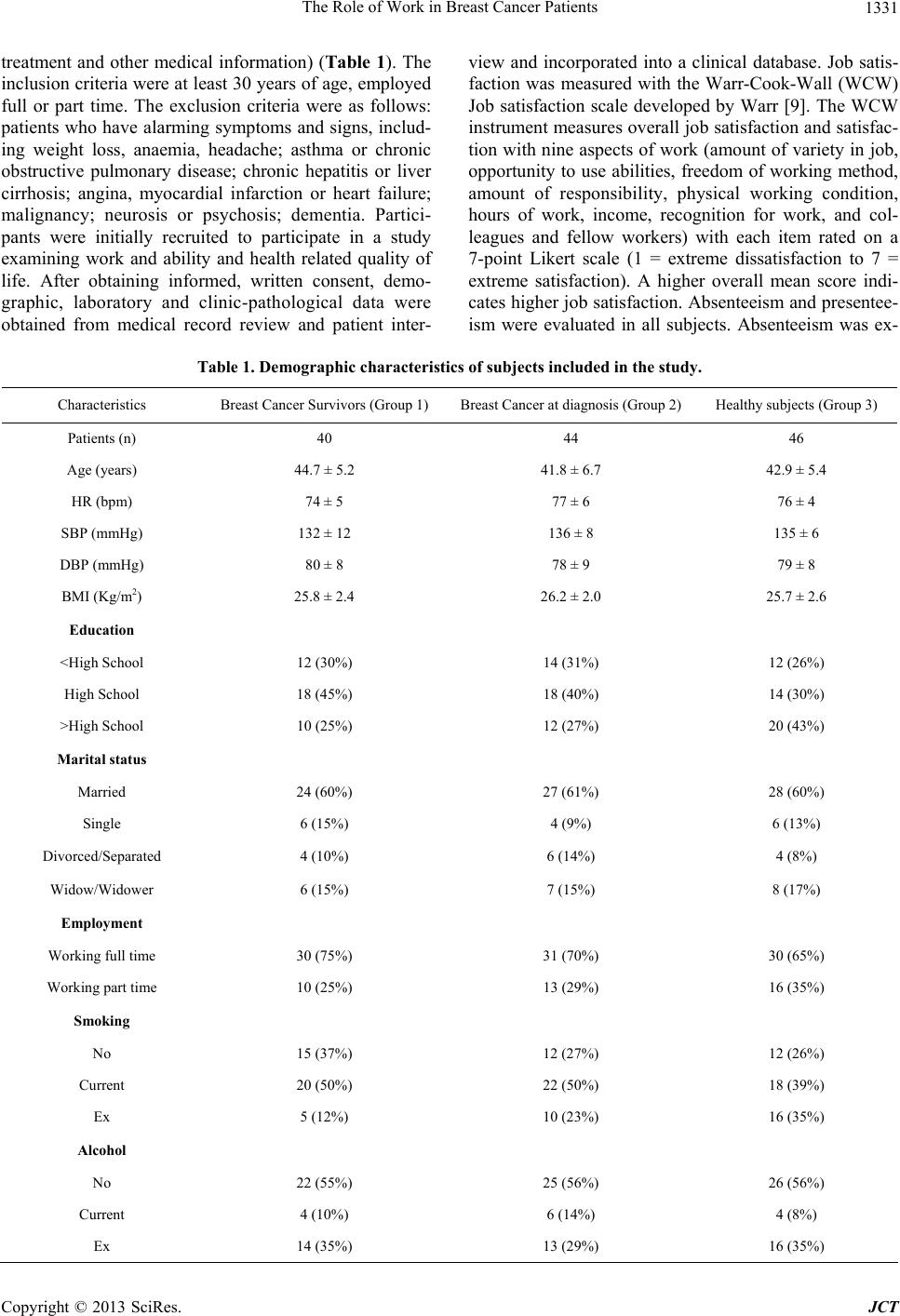 The Role of Work in Breast Cancer Patients 1331 treatment and other medical information) (Table 1). The inclusion criteria were at least 30 years of age, employed full or part time. The exclusion criteria were as follows: patients who have alarming symptoms and signs, includ- ing weight loss, anaemia, headache; asthma or chronic obstructive pulmonary disease; chronic hepatitis or liver cirrhosis; angina, myocardial infarction or heart failure; malignancy; neurosis or psychosis; dementia. Partici- pants were initially recruited to participate in a study examining work and ability and health related quality of life. After obtaining informed, written consent, demo- graphic, laboratory and clinic-pathological data were obtained from medical record review and patient inter- view and incorporated into a clinical database. Job satis- faction was measured with the Warr-Cook-Wall (WCW) Job satisfaction scale developed by Warr [9]. The WCW instrument measures overall job satisfaction and satisfac- tion with nine aspects of work (amount of variety in job, opportunity to use abilities, freedom of working method, amount of responsibility, physical working condition, hours of work, income, recognition for work, and col- leagues and fellow workers) with each item rated on a 7-point Likert scale (1 = extreme dissatisfaction to 7 = extreme satisfaction). A higher overall mean score indi- cates higher job satisfaction. Absenteeism and presentee- ism were evaluated in all subjects. Absenteeism was ex- Table 1. Demographic char ac teristics of subjects include d in the study. Characteristics Breast Cancer Survivors (Group 1) Breast Cancer at diagnosis (Group 2) Healthy subjects (Group 3) Patients (n) 40 44 46 Age (years) 44.7 ± 5.2 41.8 ± 6.7 42.9 ± 5.4 HR (bpm) 74 ± 5 77 ± 6 76 ± 4 SBP (mmHg) 132 ± 12 136 ± 8 135 ± 6 DBP (mmHg) 80 ± 8 78 ± 9 79 ± 8 BMI (Kg/m2) 25.8 ± 2.4 26.2 ± 2.0 25.7 ± 2.6 Education <High School 12 (30%) 14 (31%) 12 (26%) High School 18 (45%) 18 (40%) 14 (30%) >High School 10 (25%) 12 (27%) 20 (43%) Marital status Married 24 (60%) 27 (61%) 28 (60%) Single 6 (15%) 4 (9%) 6 (13%) Divorced/Separated 4 (10%) 6 (14%) 4 (8%) Widow/Widower 6 (15%) 7 (15%) 8 (17%) Employment Working full time 30 (75%) 31 (70%) 30 (65%) Working part time 10 (25%) 13 (29%) 16 (35%) Smoking No 15 (37%) 12 (27%) 12 (26%) Current 20 (50%) 22 (50%) 18 (39%) Ex 5 (12%) 10 (23%) 16 (35%) Alcohol No 22 (55%) 25 (56%) 26 (56%) Current 4 (10%) 6 (14%) 4 (8%) Ex 14 (35%) 13 (29%) 16 (35%) Copyright © 2013 SciRes. JCT 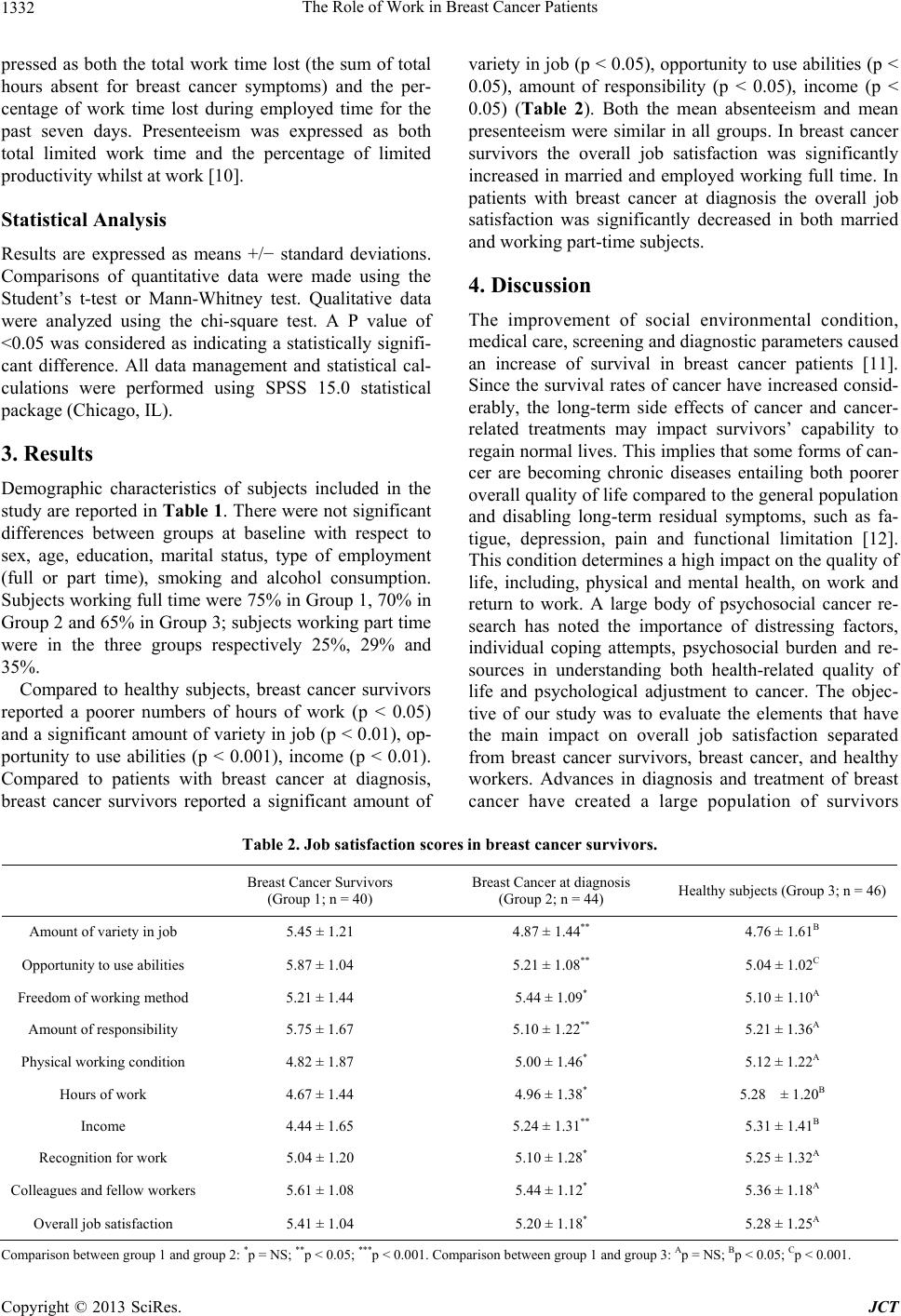 The Role of Work in Breast Cancer Patients 1332 pressed as both the total work time lost (the sum of total hours absent for breast cancer symptoms) and the per- centage of work time lost during employed time for the past seven days. Presenteeism was expressed as both total limited work time and the percentage of limited productivity whilst at work [10]. Statistical Analysis Results are expressed as means +/− standard deviations. Comparisons of quantitative data were made using the Student’s t-test or Mann-Whitney test. Qualitative data were analyzed using the chi-square test. A P value of <0.05 was considered as indicating a statistically signifi- cant difference. All data management and statistical cal- culations were performed using SPSS 15.0 statistical package (Chicago, IL). 3. Results Demographic characteristics of subjects included in the study are reported in Table 1. There were not significant differences between groups at baseline with respect to sex, age, education, marital status, type of employment (full or part time), smoking and alcohol consumption. Subjects working full time were 75% in Group 1, 70% in Group 2 and 65% in Group 3; subjects working part time were in the three groups respectively 25%, 29% and 35%. Compared to healthy subjects, breast cancer survivors reported a poorer numbers of hours of work (p < 0.05) and a significant amount of variety in job (p < 0.01), op- portunity to use abilities (p < 0.001), income (p < 0.01). Compared to patients with breast cancer at diagnosis, breast cancer survivors reported a significant amount of variety in job (p < 0.05), opportunity to use abilities (p < 0.05), amount of responsibility (p < 0.05), income (p < 0.05) (Table 2). Both the mean absenteeism and mean presenteeism were similar in all groups. In breast cancer survivors the overall job satisfaction was significantly increased in married and employed working full time. In patients with breast cancer at diagnosis the overall job satisfaction was significantly decreased in both married and working part-time subjects. 4. Discussion The improvement of social environmental condition, medical care, screening and diagnostic parameters caused an increase of survival in breast cancer patients [11]. Since the survival rates of cancer have increased consid- erably, the long-term side effects of cancer and cancer- related treatments may impact survivors’ capability to regain normal lives. This implies that some forms of can- cer are becoming chronic diseases entailing both poorer overall quality of life compared to the general population and disabling long-term residual symptoms, such as fa- tigue, depression, pain and functional limitation [12]. This condition determines a high impact on the quality of life, including, physical and mental health, on work and return to work. A large body of psychosocial cancer re- search has noted the importance of distressing factors, individual coping attempts, psychosocial burden and re- sources in understanding both health-related quality of life and psychological adjustment to cancer. The objec- tive of our study was to evaluate the elements that have the main impact on overall job satisfaction separated from breast cancer survivors, breast cancer, and healthy workers. Advances in diagnosis and treatment of breast cancer have created a large population of survivors Table 2. Job satisfaction scores in breast cancer survivors. Breast Cancer Survivors (Group 1; n = 40) Breast Cancer at diagnosis (Group 2; n = 44) Healthy subjects (Group 3; n = 46) Amount of variety in job 5.45 ± 1.21 4.87 ± 1.44** 4.76 ± 1.61B Opportunity to use abilities 5.87 ± 1.04 5.21 ± 1.08** 5.04 ± 1.02C Freedom of working method 5.21 ± 1.44 5.44 ± 1.09* 5.10 ± 1.10A Amount of responsibility 5.75 ± 1.67 5.10 ± 1.22** 5.21 ± 1.36A Physical working condition 4.82 ± 1.87 5.00 ± 1.46* 5.12 ± 1.22A Hours of work 4.67 ± 1.44 4.96 ± 1.38* 5.28 ± 1.20B Income 4.44 ± 1.65 5.24 ± 1.31** 5.31 ± 1.41B Recognition for work 5.04 ± 1.20 5.10 ± 1.28* 5.25 ± 1.32A Colleagues and fellow workers 5.61 ± 1.08 5.44 ± 1.12* 5.36 ± 1.18A Overall job satisfaction 5.41 ± 1.04 5.20 ± 1.18* 5.28 ± 1.25A Comparison between group 1 and group 2: *p = NS; **p < 0.05; ***p < 0.001. Comparison between group 1 and group 3: Ap = NS; Bp < 0.05; Cp < 0.001. Copyright © 2013 SciRes. JCT  The Role of Work in Breast Cancer Patients 1333 requiring long-term follow-up care [1,2]. The risk of dis- ease recurrence peaks during the first 5 years after pri- mary therapy, but may continue for up to 30 years after that. Work plays an important role in the psychological treatment for many patients. As a result, breast cancer is increasingly viewed as a chronic illness [9-11]. Our cul- ture continues to perpetuate the healthy subject view that an individual with cancer is somehow now defective. Work intervention has been found to have significant positive effects on functional capacity and physical func- tioning, fatigue, body image, psychological adjustment, sleep problems and overall health and quality of life [12- 16]. In our study, the comparison between breast cancer survivors, breast cancer at diagnosis, and healthy subjects does not differ significantly in overall job satisfaction. Job satisfaction was often stated as a strong motivator for social status and for social contacts. Changes in the life of the person with cancer (e.g. being away from work or not being able to do the usual roles at home) may affect the person’s self-esteem [2]. Yet employers continue to perceive cancer survivors as poor risks for advancement and cancer survivors are at high risk for job loss. A limi- tation of this study was the small number of included subjects. Understanding job problems associated with cancer can provide relevant information regarding poten- tial treatment and psychological support in breast cancer survivors. More systematic investigation is needed vary- ing the dimensions of activity explored in this study. 5. Acknowledgements GM was supported by the International PhD programme in Neuropharmacology, University of Catania. The au- thors declare that they have no competing interests. REFERENCES [1] D. M. Parkin, F. Bray, J. Ferlay and P. Pisani, “Global Cancer Statistics, 2002,” CA: A Cancer Journal for Cli- nicians, Vol. 55, No. 2, 2005, pp. 74-108. http://dx.doi.org/10.3322/canjclin.55.2.74 [2] L. L. Humphrey, M. Helfand, B. K. Chan and S. H. Woolf, “Breast Cancer Screening: A Summary of the Evi- dence for the US Preventive Services Task Force,” An- nals of Internal Medicine, Vol. 137, No. 5, 2002, pp. 347- 360. http://dx.doi.org/10.7326/0003-4819-137-5_Part_1-20020 9030-00012 [3] C. J. Bradley, D. Neumark, H. L. Bednarek and M. Schenk, “Short-Term Effects of Breast Cancer on Labor Market Attachment: Results from a Longitudinal Study,” Journal of Health Economics, Vol. 24, No. 1, 2005, pp. 137-160. http://dx.doi.org/10.1016/j.jhealeco.2004.07.003 [4] C. Messner and D. Patterson, “The Challenge of Cancer in the Workplace,” Cancer Practice, Vol. 9, No. 1, 2001, pp. 50-51. http://dx.doi.org/10.1046/j.1523-5394.2001.91009.x [5] I. A. Olivotto, C. D. Bajdik, P. M. Ravdin, C. H. Speers, A. J. Coldman, B. D. Norris, G. J. Davis, S. K. Chia and K. A. Gelmon, “Population-Based Validation of the Prog- nostic Model ADJUVANT! for Early Breast Cancer,” Journal of Clinical Oncology, Vol. 23, No. 12, 2005, pp. 2716-2725. http://dx.doi.org/10.1200/JCO.2005.06.178 [6] N. K. Aaronson, “Methodologic Issues in Assessing the Quality of Life of Cancer Patients,” Cancer, Vol. 67, Suppl. 3, 1991, pp. 844-850. http://dx.doi.org/10.1002/1097-0142(19910201)67:3+<84 4::AID-CNCR2820671416>3.0.CO;2-B [7] V. Mock, K. H. Dow, C. J. Meares, P. M. Grimm, J. A. Dienemann, M. E. Haisfield-Wolfe, W. Quitasol, S. Mi- tchell, A. Chakravarthy and I. Gage, “Effects of Exercise on Fatigue, Physical Functioning, and Emotional Distress during Radiation Therapy for Breast Cancer,” Oncology Nursing Forum, Vol. 24, No. 6, 1997, pp. 991-1000. [8] A. J. Daley, H. Crank, N. Mutrie, J. M. Saxton and R. Coleman, “Determinants of Adherence to Exercise in Women Treated for Breast Cancer,” European Journal of Oncology Nursing, Vol. 11, No. 5, 2007, pp. 392-399. http://dx.doi.org/10.1016/j.ejon.2007.03.001 [9] P. Warr, J. Cook and T. Wall, “Scales for the Measure- ment of Some Work Attitudes and Aspects of Psycho- logical Well-Being,” Journal of Occupational P s yc ho lo gy , Vol. 52, No. 2, 1979, pp. 129-148. http://dx.doi.org/10.1111/j.2044-8325.1979.tb00448.x [10] M. C. Reilly, K. L. Gooch, R. L. Wong, H. Kupper and D. van der Heijde, “Validity, Reliability and Responsiveness of the Work Productivity and Activity Impairment Ques- tionnaire in Ankylosing Spondylitis,” Rheumatology (Ox- ford), Vol. 49, No. 4, 2010, pp. 812-819. [11] M. Vacante, V. D’Agata, M. Motta, G. Malaguarnera, A. Biondi, F. Basile, M. Malaguarnera, C. Gagliano, F. Drago and S. Salamone, “Centenarians and Supercentenarians: A Black Swan. Emerging Social, Medical and Surgical Problems,” BMC Surgery, Vol. 12, Suppl. 1, 2012, p. S36. http://dx.doi.org/10.1186/1471-2482-12-S1-S36 [12] P. Frazzetto, M. Vacante, M. Malaguarnera, E. Vinci, F. Catalano, E. Cataudella, F. Drago, G. Malaguarnera, F. Basile and A. Biondi, “Depression in Older Breast Cancer Survivors,” BMC Surgery, Vol. 12, Suppl. 1, 2012, p. S14. http://dx.doi.org/10.1186/1471-2482-12-S1-S14 [13] V. S. Helgeson, “Recent Advances in Psychosocial Onco- logy,” Journal of Consulting and Clinical Psychology, Vol. 73, No. 2, 2005, pp. 268-271. http://dx.doi.org/10.1037/0022-006X.73.2.268 [14] V. S. Helgeson and P. L. Tomich, “Surviving Cancer: A Comparison of 5-Year Disease-Free Breast Cancer Sur- vivors with Healthy Women,” Psycho-Oncology, Vol. 14, No. 4, 2005, pp. 307-317. http://dx.doi.org/10.1002/pon.848 [15] S. Moulder and G. N. Hortobagyi, “Advances in the Treatment of Breast Cancer,” Clinical Pharmacology & Therapeutics, Vol. 83, 2008, pp. 26-36. http://dx.doi.org/10.1038/sj.clpt.6100449 [16] F. C. Dimeo, F. Thomas, C. Raabe-Menssen, F. Pröpper and M. Mathias, “Effect of Aerobic Exercise and Relaxa- Copyright © 2013 SciRes. JCT  The Role of Work in Breast Cancer Patients 1334 tion Training on Fatigue and Physical Performance of Cancer Patients after Surgery. A Randomised Controlled Trial,” Supportive Care in Cancer, Vol. 12, No. 11, 2004, pp. 774-779. http://dx.doi.org/10.1007/s00520-004-0676-4 Copyright © 2013 SciRes. JCT |