

Paper Menu >>
Journal Menu >>
 Engineering, 2013, 5, 38-41 http://dx.doi.org/10.4236/eng.2013.510B008 Published Online October 2013 (http://www.scirp.org/journal/eng) Copyright © 2013 SciRes. ENG An Integrated Analysis Method for miRN A, lncRNA and mRNA Profiles Based on Their Functional and Positional Relationships* Li Guo, Sheng Yang, Yang Zhao, Hui Zhang, Qian Wu, Feng Chen# Department of Epidemiology and Biostatistics and Ministry of Education Key Lab for Modern Toxicology, School of Public Health, Nanjing Medical University, Nanjing, China Email: l [email protected], #[email protected] Received October 2012 ABSTRACT ncRNAs have been identified as potential regulatory molecules and have multiple biological roles. Aberrant expression of specific ncRNAs contributes to multiple biological processes and many human diseases. Herein, we simultaneously profiled miRNA, lncRNA and mRNA in human HepG2 and L02 cells applying high-throughput sequen cing and micro- array technologies. Abnormal miRNA, lncRNA and mRNA profiles were assessed through fold change filtering. A cross-platform integrated analysis method was developed to analyze differentially expressed miRNA, lncRNA and mRNA profiles. miRNA-mRNA interaction was analyzed according to their functional relationships. Target mRNAs of aberrantly expressed miRNAs were obtained from experimentally validated datasets or predicted using some programs. Generally, multiple target mRN As were involved, and they have versatile roles by functional enrichment analysis. Ac- cording to actual expression datasets in the study, compared to deregulated miRNAs, these theoretical target mRNAs showed various expression patterns. The consistent or inconsistent expression was mainly derived from complex, mul- tiple, flexible and alternative regulatory relationships between miRNA and mRNA. Further, miRNA/mRNA and lncRNA were completely surveyed based on their location distributions on human chromosomes. Many miRNA- lncRNA and mRNA-lncRNA pairs always were located on the same strand or different strands in the specific genomic region. Due to the location distributions, they might have partly or completely overlapped regions or they could be re- verse complementarily binding. These miRNA/mRNA-lncRNA pairs showed consistent or inconsistent expression pat- terns, although they might have functional relationships through reverse complementarily binding events. Moreover, we also detected and analyzed various isomiRs from a given miRNA locus, including those isomiRs with 3’ additional non-template nucleotides. These isomiRs, esp ecially for those 5’ isomiRs with the new “seed sequences” through “seed shifting” events, maybe have potential biological roles as well as isomiR repertoire and their expression patterns. The integrative analysis provides potential functional relationships between miRNA, lncRNA and mRNA across different datasets. The complex and various expression patterns suggest a robust regulatory network across different regulatory molecules and their targets. Keywords: ncRNA; mRN A ; Profile; Integrative Analysis 1. Introduction As important players of gene regulation, non-coding RNAs (ncRNAs), h ave attracted considerable interests in many fields. Different lines of evidence suggest that ncRNAs play an important role in multiple biological processes and contribute to occurrence and development of many human diseases, including microRNAs (miR- NAs) and long non-coding RNAs (lncRNAs). miRNAs contribute to biological processes by targeting mRNAs through conserved complementarily to the seed (nucleo- tides 2 - 8) of the miRNA [1]. Similarly, lncRNAs have a broad range of biological roles in regulation of expres- sion of genes and chromosomes. As potential regulators, they contribute to various basic cellular functions, such as cell proliferation, differentiation, death and tumorige- nesis [2]. Concerning the potential relationships between differ- ent molecules, especially for their contributions to com- plex regulation network in multiple biological processes, cross-platform analysis has been a new hot focus. How- *The work was supported by National Natural Science Foundation of China (No. 81072389 and 81102182), Jiangsu Planned Projects for Postdoctoral Research Funds (No. 1201022B), and the Priority Aca- demic Program Development of Jiangsu Higher Education Institutions (PAPD). #Correspondi ng author. 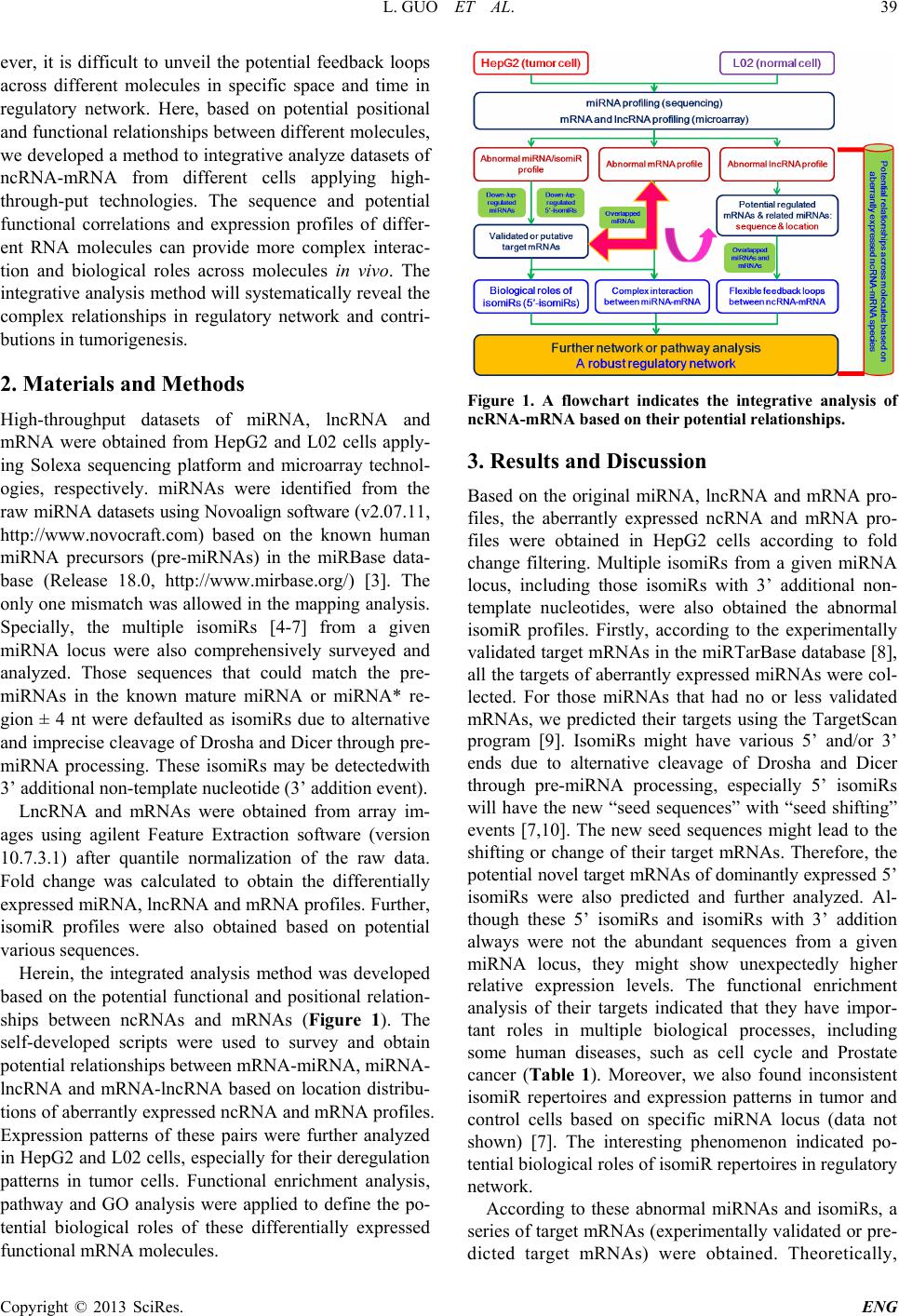 L. GUO ET AL. Copyright © 2013 SciRes. ENG 39 ever, it is difficult to unveil the potential feedback loops across different molecules in specific space and time in regulatory network. Here, based on potential positional and functional relationships between differ ent molecules, we developed a method to integrative analyze datasets of ncRNA-mRNA from different cells applying high- through-put technologies. The sequence and potential functional correlations and expression profiles of differ- ent RNA molecules can provide more complex interac- tion and biological roles across molecules in vivo. The integrative analysis method will systematically rev eal the complex relationships in regulatory network and contri- butions in tumorigenesis. 2. Materials and Methods High-throughput datasets of miRNA, lncRNA and mRNA were obtained from HepG2 and L02 cells apply- ing Solexa sequencing platform and microarray technol- ogies, respectively. miRNAs were identified from the raw miRNA datasets using Novoalign software (v2.07.11, http://www.novocraft.com) based on the known human miRNA precursors (pre-miRNAs) in the miRBase data- base (Release 18.0, http://www.mirbase.org/ ) [3]. The only one mismatch was allowed in the mapping analysis. Specially, the multiple isomiRs [4-7] from a given miRNA locus were also comprehensively surveyed and analyzed. Those sequences that could match the pre- miRNAs in the known mature miRNA or miRNA* re- gion ± 4 nt were defaulted as isomiRs due to alternative and imprecise cleavage of Drosha and Dicer through pre- miRNA processing. These isomiRs may be detectedwith 3’ additional non-template nucleotide (3’ addition event). LncRNA and mRNAs were obtained from array im- ages using agilent Feature Extraction software (version 10.7.3.1) after quantile normalization of the raw data. Fold change was calculated to obtain the differentially expressed miRNA, lncRNA and mRNA profiles. Further, isomiR profiles were also obtained based on potential various sequences. Herein, the integrated analysis method was developed based on the potential functional and positional relation- ships between ncRNAs and mRNAs (Figure 1). The self-developed scripts were used to survey and obtain potential relationships between mRNA -mi RN A, miRNA- lncRNA and mRNA-lncRNA based on location distribu- tions of aberrantly expressed ncRNA and mRNA profiles. Expression patterns of these pairs were further analyzed in HepG2 and L02 cells, especially for their deregulation patterns in tumor cells. Functional enrichment analysis, pathway and GO analysis were applied to define the po- tential biological roles of these differentially expressed functional mRNA molecules. Figure 1. A flowchart indicates the integrative analysis of ncRNA-mRNA based on their potential relationships. 3. Results and Discussion Based on the original miRNA, lncRNA and mRNA pro- files, the aberrantly expressed ncRNA and mRNA pro- files were obtained in HepG2 cells according to fold change filtering. Multiple isomiRs from a given miRNA locus, including those isomiRs with 3’ additional non- template nucleotides, were also obtained the abnormal isomiR profiles. Firstly, according to the experimentally validated target mRNAs in the miRTarBase d atabase [8], all the targets of aberrantly expressed miRNA s were col- lected. For those miRNAs that had no or less validated mRNAs, we predicted their targets using the TargetScan program [9]. IsomiRs might have various 5’ and/or 3’ ends due to alternative cleav age of Drosha and Dicer through pre-miRNA processing, especially 5’ isomiRs will have the new “seed sequences” with “seed shifting” events [7,10]. The new seed sequences might lead to the shifting or change of their target mRNAs. Therefore, the potential novel target mRNAs of dominantly expressed 5’ isomiRs were also predicted and further analyzed. Al- though these 5’ isomiRs and isomiRs with 3’ addition always were not the abundant sequences from a given miRNA locus, they might show unexpectedly higher relative expression levels. The functional enrichment analysis of their targets indicated that they have impor- tant roles in multiple biological processes, including some human diseases, such as cell cycle and Prostate cancer (Table 1). Moreover, we also found inconsistent isomiR repertoires and expression patterns in tumor and control cells based on specific miRNA locus (data not shown) [7]. The interesting phenomenon indicated po- tential biological roles of isomiR repertoires in regulatory network. According to these abnormal miRNAs and isomiRs, a series of target mRNAs (experimentally validated or pre - dicted target mRNAs) were obtained. Theoretically, 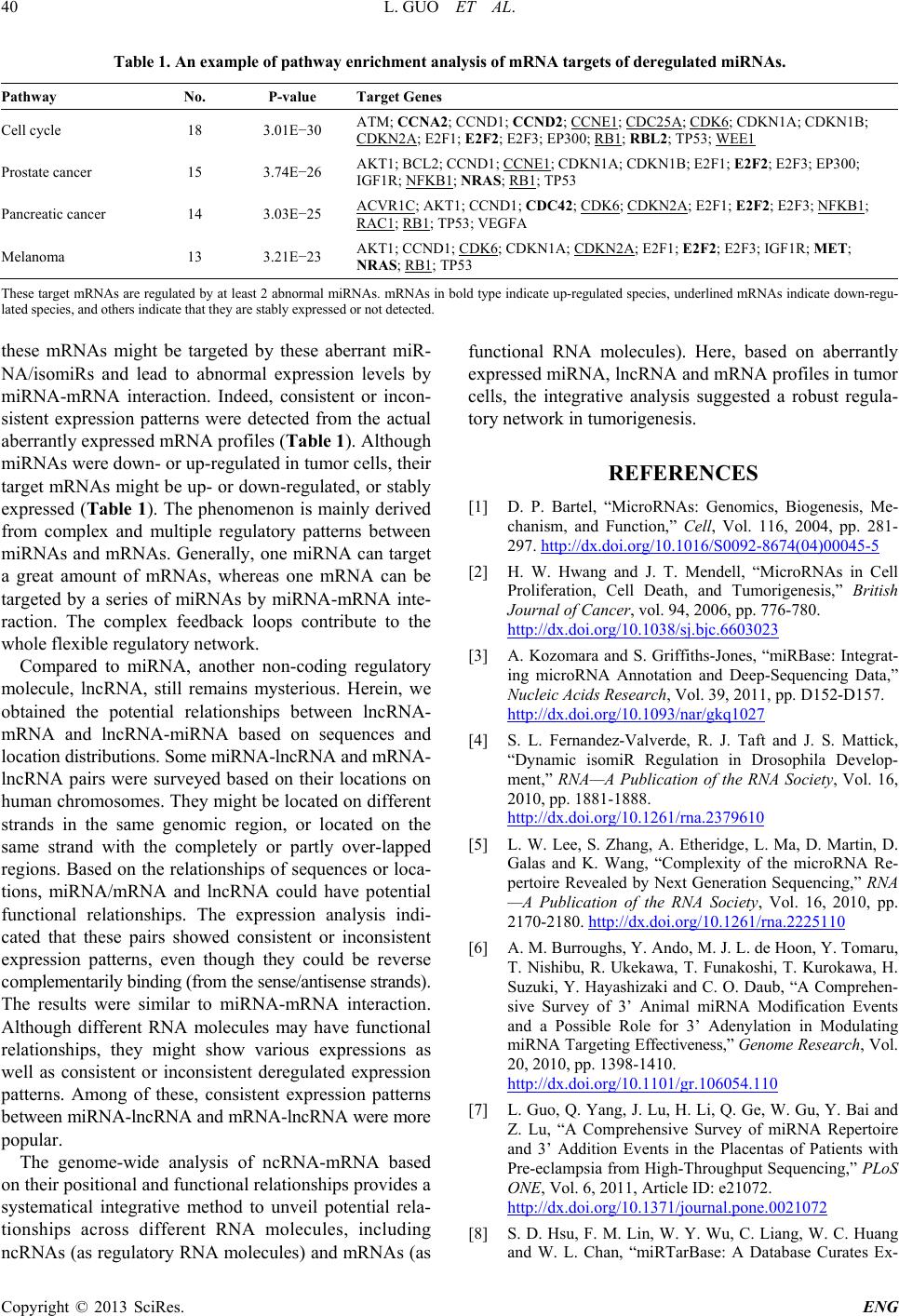 L. GUO ET AL. Copyright © 2013 SciRes. ENG 40 Table 1. An example of pathway enrichment analysis of mRNA targets of deregulated miRNAs. Pathway No. P-value Target Genes Cell cycle 18 3.01E−30 ATM; CCNA2; CCND1; CCND2; CCNE1; CDC25A; CDK6; CDKN1A; CDKN1B; CDKN2A; E2F1; E2F2; E2F3; EP300; RB1; RBL2; TP53; WEE1 Prostate cancer 15 3.74E−26 AKT1; BCL2; CCND1; CCNE1; CDKN1A; CDKN1B; E2F1; E2F2; E2F3; EP300; IGF1R; NFKB1; NRAS; RB1 Pancreatic cancer ; TP53 14 3.03E−25 ACVR1C; AKT1; CCND1; CDC42; CDK6; CDKN2A; E2F1; E2 F2; E2F3; NFKB1; RAC1; RB1 Melanoma ; TP53; VEGFA 13 3.21E−23 AKT1; CCND1; CDK6; CDKN1A; CDKN2A; E2F1; E2F2; E2 F 3; IGF1R; MET; NRAS; RB1; TP53 These target mRNAs are regulated by at least 2 abnormal miRNAs. mRNAs in bold type indicate up-regulated speci es, underlined mRNAs indicate down-regu- lated species, and others indicate that they are sta bly e xpre ssed or not de te c ted. these mRNAs might be targeted by these aberrant miR- NA/isomiRs and lead to abnormal expression levels by miRNA-mRNA interaction. Indeed, consistent or incon- sistent expression patterns were detected from the actu al aberrantly expressed mRNA profiles (Table 1). Although miRNAs were down- or up-regulated in tumor cells, their target mRNAs might be up- or down-regulated, or stably expressed (Table 1). The pheno menon is mainly derived from complex and multiple regulatory patterns between miRNAs and mRNAs. Generally, on e miRNA can target a great amount of mRNAs, whereas one mRNA can be targeted by a series of miRNAs by miRNA-mRNA inte- raction. The complex feedback loops contribute to the whole flexible regulatory network. Compared to miRNA, another non-coding regulatory molecule, lncRNA, still remains mysterious. Herein, we obtained the potential relationships between lncRNA- mRNA and lncRNA-miRNA based on sequences and location distr ib utio ns. Some miRNA-lncRNA and mRNA- lncRNA pairs were surveyed based on their locations on human chromosomes. They might be located on different strands in the same genomic region, or located on the same strand with the completely or partly over-lapped regions. Based on the relationships of sequences or loca- tions, miRNA/mRNA and lncRNA could have potential functional relationships. The expression analysis indi- cated that these pairs showed consistent or inconsistent expression patterns, even though they could be reverse complementarily binding (from the sense/antisense strands). The results were similar to miRNA-mRNA interaction. Although different RNA molecules may have functional relationships, they might show various expressions as well as consistent or inconsistent deregulated expression patterns. Among of these, consistent expression patterns between miRNA-lncRNA and mRN A-lncRNA were more popular. The genome-wide analysis of ncRNA-mRNA based on their positional and functional relationships provides a systematical integrative method to unveil potential rela- tionships across different RNA molecules, including ncRNAs (as regulatory RNA molecules) and mRNAs (as functional RNA molecules). Here, based on aberrantly expressed miRNA, lncRNA and mRNA profiles in tumor cells, the integrative analysis suggested a robust regula- tory network in tumorigenesis. REFERENCES [1] D. P. Bartel, “MicroRNAs: Genomics, Bi oge nesis, Me- chanism, and Function,” Cell, Vol. 116, 2004, pp. 281- 297. http://dx.doi.org/10.1016/S0092-8674(04)00045-5 [2] H. W. Hwang and J. T. Mendell, “MicroRNAs in Cell Proliferation, Cell Death, and Tumorigenesis,” British Journal of Cancer, vol. 94, 2006, pp. 776-780. http://dx.doi.org/10.1038/sj.bjc.6603023 [3] A. Kozomara and S. Griffiths-Jones, “miRBase: Integrat- ing microRNA Annotation and Deep-Sequencing Data,” Nucleic Acids Research, Vol. 39, 2011, pp. D152-D157. http://dx.doi.org/10.1093/nar/gkq1027 [4] S. L. Fernandez-Valverde, R. J. Taft and J. S. Mattick, “Dynamic isomiR Regulation in Drosophila Develop- ment,” RNA—A Publication of the RNA Society, Vol. 16, 2010, pp. 1881-1888. http://dx.doi.org/10.1261/rna.2379610 [5] L. W. Lee, S. Zhang, A. Etheridge, L. Ma, D. Martin, D. Galas and K. Wang, “Complexity of the microRNA Re- pertoire Revealed by Next Generation Sequencing,” RNA —A Publication of the RNA Society, Vol. 16, 2010, pp. 2170-2180. http://dx.doi.org/10.1261/rna.2225110 [6] A. M. Burroughs, Y. Ando, M. J. L. de Hoon, Y. Tomaru, T. Nishibu, R. Ukekawa, T. Funakoshi, T. Kurokawa, H. Suzuki, Y. Hayashizaki and C. O. Daub, “A Comprehen- sive Survey of 3’ Animal miRNA Modification Events and a Possible Role for 3’ Adenylation in Modulating miRNA T argeting Effectiveness,” Geno me Research, Vol. 20, 2010, pp. 1398-1410. http://dx.doi.org/10.1101/gr.106054.110 [7] L. Guo, Q. Yang, J. Lu, H. Li, Q. Ge, W. Gu, Y . Bai and Z. Lu, “A Comprehensive Survey of miRNA Repertoire and 3’ Addition Events in the Placentas of Patients with Pre-eclampsia from High-Throughput Sequencing,” PLoS ONE, Vol. 6, 2011, Article I D : e21072. http://dx.doi.org/10.1371/journal.pone.0021072 [8] S. D. Hsu, F. M. Lin, W. Y. Wu, C. Liang, W. C. Huang and W. L. Chan, “miRTarBase: A Database Curates Ex-  L. GUO ET AL. Copyright © 2013 SciRes. ENG 41 perimentally Validated microRNA-Target Interactions,” Nucleic Acids Research, Vol. 39, 2011, pp. D163-D169. http://dx.doi.org/10.1093/nar/gkq1107 [9] B. P. Lewis, I. H. Shih, M. W. Jones-Rhoades, D. P. Bar- tel and C. B. Burge, “Prediction of Mammalian micro- RNA Targets,” Cell, Vol. 115, 2003, pp. 787-798. http://dx.doi.org/10.1016/S0092-8674(03)01018-3 [10] L. Guo, H. Li, J. Lu, Q. Yang, Q. Ge, W. Gu, Y. Ba i and Z. Lu, “Tracking miRNA Precursor Metabolic Products and Processing Sites through Completely Analyz ing High- Throughput Sequencing Data,” Molecular Biology Re- ports, Vol. 39, 2012, pp. 2031-2038. http://dx.doi.org/10.1007/s11033-011-0950-8 |