

Paper Menu >>
Journal Menu >>
 International Journal of Clinical Medicine, 2013, 4, 417-420 http://dx.doi.org/10.4236/ijcm.2013.410075 Published Online October 2013 (http://www.scirp.org/journal/ijcm) Acute and Severe Hypercalcemia in a Near-Drowning Victim Tomoaki Takata1,2*, Akihisa Nakaoka1, Kazuhiro Kato1, Takeaki Fukui2, Satoko Maeta2, Chishio Munemura2, Yoshikazu Murawaki2 1Department of Internal Medicine, Sanin Rosai Hospital, Yonago, Japan; 2Division of Medicine and Clinical Science, Tottori Univer- sity School of Medicine, Yonago, Japan. Email: *[email protected] Received August 14th, 2013; revised September 12th, 2013; accepted September 29th, 2013 Copyright © 2013 Tomoaki Takata et al. This is an open access article distributed under the Creative Commons Attribution License, which permits unrestricted use, distribution, and reproduction in any medium, provided the original work is properly cited. ABSTRACT An 80-year-old male was admitted to our hospital because of near-drowning in a hot spring. Besides hypoxia, serum calcium was extremely high at 15.5 mg/dL on admission. After the treatment with normal saline infusion, furosemide and calcitonin, the hypercalcemia was transient and didn’t recur during the course. The hot spring water contained much calcium, so his hypercalcemia was considered to be a result of calcium absorption mainly through the alveoli. In this case, we revealed that serum calcium rose within a short time after drowning, suggesting the necessity to measure the calcium concentration of the drowning fluid in a near-drowning victim. Keywords: Hypercalcemia; Drowning; Hot Spring 1. Introduction Drowning is a life-threatening accident and care of hy- poxia is the mainstay of therapy. The constitution of the aspirated water has rarely been considered to be impor- tant, except for the difference between sea-water and fresh water. Electrolyte disability in near-drowning vic- tim has been a rare complication and has been considered to seldom need treatment. On the other hand, there are a few cases of lethal hypercalcemia complicating a near- drowning in unusual circumstances such as in the Dead Sea [1]. We report a case of severe hypercalcemia com- plicating a near-drowning in a hot spring. 2. Case Report An 80-year-old male was admitted to our hospital. He has a past history of hypertension and ventriculoperito- neal shunt after subarachnoid hemorrhage. His regular medications were famotidine, olmesartan, and amlodip- ine. He was found drowning in a hot spring. He was breathing by himself when rescued and transferred to our hospital 22 minutes later. When arriving, he was conscious but disoriented. His body weight was 65 kg. His body temperature was 38.6˚C, the pulse rate was 122 beat per minute and regu- lar, blood pressure was 206/110 mmHg, and his satura- tion of oxygen was 88% while receiving 15 L/min oxy- gen by reservoir mask. His skin was wet. Auscultation of the chest revealed coarse crackles at both lungs. No neu- rologic dysfunction was seen. An electrocardiograph, chest radiograph, and blood tests were performed at the emergency room. The elec- trocardiograph revealed heart rate of 115 beat per minute with multiple premature ventricular contraction and pre- mature atrial contraction. The QT interval corrected for heart rate was 0.404 second. The chest radiograph showed bilateral congestion (Figure 1). Laboratory data (Table 1) of the blood revealed white blood count of 9800/μL, neutrophil of 32.7%, hematocrit of 42.8%, he- moglobin of 14.3 g/dL, platelet of 316 × 103/μL, sodium of 137 mEq/L, potassium of 3.7 mEq/L, chloride of 104 mEq/L, calcium (Ca) of 15.5 mg/dL, phosphorus of 4.0 mg/dL, blood urea nitrogen of 15.5 mg/dL, creatinine (Cr) of 0.95 mg/dL, total protein of 7.8 g/dL, albumin of 4.3 g/dL, asparate aminotransferase of 29 IU/L, alanine aminotransferase of 15 IU/L, lactate dehydrogenase of 266 IU/L, creatine kinase of 138 IU/L, and blood glucose of 150 mg/dL. Arterial blood gas analysis without re- ceiving any oxygen revealed pH of 7.289, pCO2 of 55.0 mmHg, pO2 of 27.2 mmHg, 3 of 25.5 mmol/L, BE of −1.6 mmol/L, ionized Ca of 3.94 mEq/L, and HCO *Corresponding autho r . Copyright © 2013 SciRes. IJCM 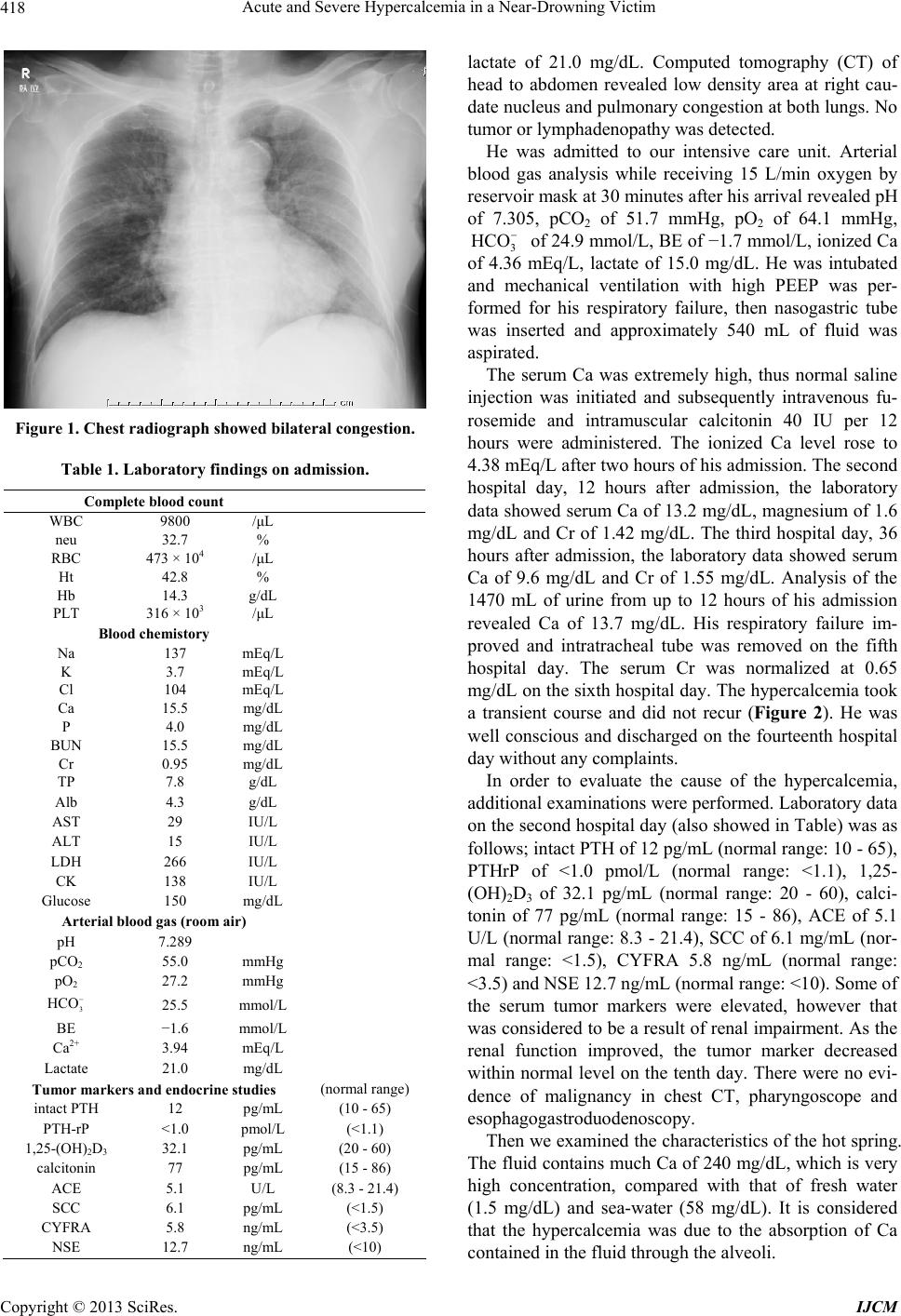 Acute and Severe Hypercalcemia in a Near-Drowning Victim 418 Figure 1. Chest radiograph showed bilateral congestion. Table 1. Laboratory findings on admission. Complete blood count WBC 9800 /μL neu 32.7 % RBC 473 × 104 /μL Ht 42.8 % Hb 14.3 g/dL PLT 316 × 103 /μL Blood chemistory Na 137 mEq/L K 3.7 mEq/L Cl 104 mEq/L Ca 15.5 mg/dL P 4.0 mg/dL BUN 15.5 mg/dL Cr 0.95 mg/dL TP 7.8 g/dL Alb 4.3 g/dL AST 29 IU/L ALT 15 IU/L LDH 266 IU/L CK 138 IU/L Glucose 150 mg/dL Arterial blood gas (room air) pH 7.289 pCO2 55.0 mmHg pO2 27.2 mmHg 3 HCO 25.5 mmol/L BE −1.6 mmol/L Ca2+ 3.94 mEq/L Lactate 21.0 mg/dL Tumor markers and endocrine studies (normal range) intact PTH 12 pg/mL (10 - 65) PTH-rP <1.0 pmol/L (<1.1) 1,25-(OH)2D3 32.1 pg/mL (20 - 60) calcitonin 77 pg/mL (15 - 86) ACE 5.1 U/L (8.3 - 21.4) SCC 6.1 pg/mL (<1.5) CYFRA 5.8 ng/mL (<3.5) NSE 12.7 ng/mL (<10) lactate of 21.0 mg/dL. Computed tomography (CT) of head to abdomen revealed low density area at right cau- date nucleus and pulmonary congestion at both lungs. No tumor or lymphadenopathy was detected. He was admitted to our intensive care unit. Arterial blood gas analysis while receiving 15 L/min oxygen by reservoir mask at 30 minutes after his arrival revealed pH of 7.305, pCO2 of 51.7 mmHg, pO2 of 64.1 mmHg, 3 HCO of 24.9 mmol/L, BE of −1.7 mmol/L, ionized Ca of 4.36 mEq/L, lactate of 15.0 mg/dL. He was intubated and mechanical ventilation with high PEEP was per- formed for his respiratory failure, then nasogastric tube was inserted and approximately 540 mL of fluid was aspirated. The serum Ca was extremely high, thus normal saline injection was initiated and subsequently intravenous fu- rosemide and intramuscular calcitonin 40 IU per 12 hours were administered. The ionized Ca level rose to 4.38 mEq/L after two hours of his admission. The second hospital day, 12 hours after admission, the laboratory data showed serum Ca of 13.2 mg/dL, magnesium of 1.6 mg/dL and Cr of 1.42 mg/dL. The third hospital day, 36 hours after admission, the laboratory data showed serum Ca of 9.6 mg/dL and Cr of 1.55 mg/dL. Analysis of the 1470 mL of urine from up to 12 hours of his admission revealed Ca of 13.7 mg/dL. His respiratory failure im- proved and intratracheal tube was removed on the fifth hospital day. The serum Cr was normalized at 0.65 mg/dL on the sixth hospital day. The hypercalcemia took a transient course and did not recur (Figure 2). He was well conscious and discharged on the fourteenth hospital day without any complaints. In order to evaluate the cause of the hypercalcemia, additional examinations were performed. Laboratory data on the second hospital day (also showed in Table) was as follows; intact PTH of 12 pg/mL (normal range: 10 - 65), PTHrP of <1.0 pmol/L (normal range: <1.1), 1,25- (OH)2D3 of 32.1 pg/mL (normal range: 20 - 60), calci- tonin of 77 pg/mL (normal range: 15 - 86), ACE of 5.1 U/L (normal range: 8.3 - 21.4), SCC of 6.1 mg/mL (nor- mal range: <1.5), CYFRA 5.8 ng/mL (normal range: <3.5) and NSE 12.7 ng/mL (normal range: <10). Some of the serum tumor markers were elevated, however that was considered to be a result of renal impairment. As the renal function improved, the tumor marker decreased within normal level on the tenth day. There were no evi- dence of malignancy in chest CT, pharyngoscope and esophagogastroduodenoscopy. Then we examined the characteristics of the hot spring. The fluid contains much Ca of 240 mg/dL, which is very high concentration, compared with that of fresh water (1.5 mg/dL) and sea-water (58 mg/dL). It is considered that the hypercalcemia was due to the absorption of Ca contained in the fluid through the alveoli. Copyright © 2013 SciRes. IJCM 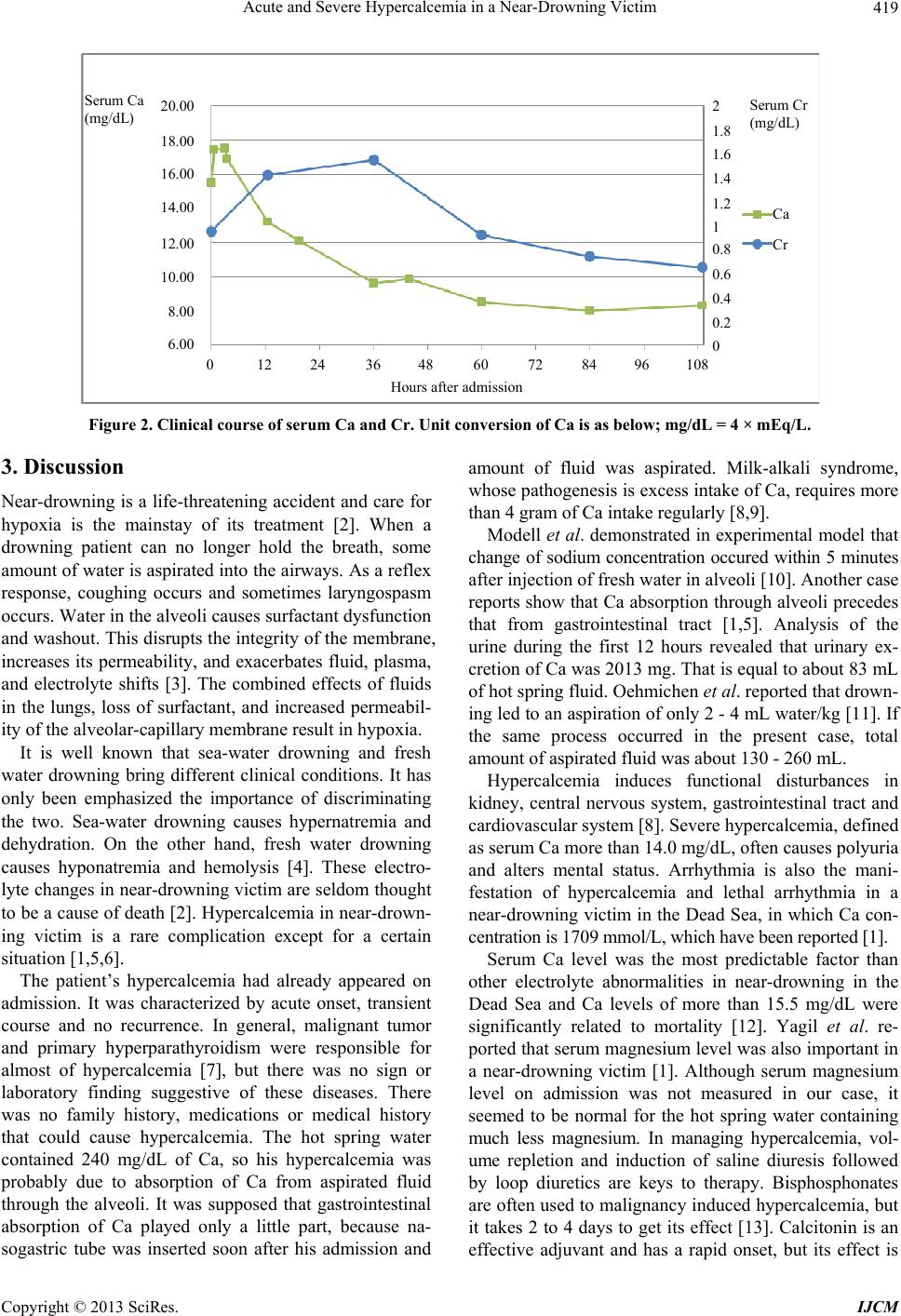 Acute and Severe Hypercalcemia in a Near-Drowning Victim Copyright © 2013 SciRes. IJCM 419 Hours after admission Serum Ca (mg/dL) Serum Cr (mg/dL) 2 1.8 1.6 1.4 1.2 1 0.8 0.6 0.4 0.2 0 Ca Cr 108 96847260483624 12 0 6.00 8.00 10.00 12.00 14.00 16.00 18.00 20.00 Figure 2. Clinical course of serum Ca and Cr. Unit conversion of Ca is as below; mg/dL = 4 × mEq/L. 3. Discussion Near-drowning is a life-threatening accident and care for hypoxia is the mainstay of its treatment [2]. When a drowning patient can no longer hold the breath, some amount of water is aspirated into the airways. As a reflex response, coughing occurs and sometimes laryngospasm occurs. Water in the alveoli causes surfactant dysfunction and washout. This disrupts the integrity of the membrane, increases its permeability, and exacerbates fluid, plasma, and electrolyte shifts [3]. The combined effects of fluids in the lungs, loss of surfactant, and increased permeabil- ity of the alveolar-capillary membrane result in hypoxia. It is well known that sea-water drowning and fresh water drowning bring different clinical conditions. It has only been emphasized the importance of discriminating the two. Sea-water drowning causes hypernatremia and dehydration. On the other hand, fresh water drowning causes hyponatremia and hemolysis [4]. These electro- lyte changes in near-drowning victim are seldom thought to be a cause of death [2]. Hypercalcemia in near-drown- ing victim is a rare complication except for a certain situation [1,5,6]. The patient’s hypercalcemia had already appeared on admission. It was characterized by acute onset, transient course and no recurrence. In general, malignant tumor and primary hyperparathyroidism were responsible for almost of hypercalcemia [7], but there was no sign or laboratory finding suggestive of these diseases. There was no family history, medications or medical history that could cause hypercalcemia. The hot spring water contained 240 mg/dL of Ca, so his hypercalcemia was probably due to absorption of Ca from aspirated fluid through the alveoli. It was supposed that gastrointestinal absorption of Ca played only a little part, because na- sogastric tube was inserted soon after his admission and amount of fluid was aspirated. Milk-alkali syndrome, whose pathogenesis is excess intake of Ca, requires more than 4 gram of Ca intake regularly [8,9]. Modell et al. demonstrated in experimental model that change of sodium concentration occured within 5 minutes after injection of fresh water in alveoli [10]. Another case reports show that Ca absorption through alveoli precedes that from gastrointestinal tract [1,5]. Analysis of the urine during the first 12 hours revealed that urinary ex- cretion of Ca was 2013 mg. That is equal to about 83 mL of hot spring fluid. Oehmichen et al. reported that drown- ing led to an aspiration of only 2 - 4 mL water/kg [11]. If the same process occurred in the present case, total amount of aspirated fluid was about 130 - 260 mL. Hypercalcemia induces functional disturbances in kidney, central nervous system, gastrointestinal tract and cardiovascular system [8]. Severe hypercalcemia, defined as serum Ca more than 14.0 mg/dL, often causes polyuria and alters mental status. Arrhythmia is also the mani- festation of hypercalcemia and lethal arrhythmia in a near-drowning victim in the Dead Sea, in which Ca con- centration is 1709 mmol/L, which have been reported [1]. Serum Ca level was the most predictable factor than other electrolyte abnormalities in near-drowning in the Dead Sea and Ca levels of more than 15.5 mg/dL were significantly related to mortality [12]. Yagil et al. re- ported that serum magnesium level was also important in a near-drowning victim [1]. Although serum magnesium level on admission was not measured in our case, it seemed to be normal for the hot spring water containing much less magnesium. In managing hypercalcemia, vol- ume repletion and induction of saline diuresis followed by loop diuretics are keys to therapy. Bisphosphonates are often used to malignancy induced hypercalcemia, but it takes 2 to 4 days to get its effect [13]. Calcitonin is an effective adjuvant and has a rapid onset, but its effect is  Acute and Severe Hypercalcemia in a Near-Drowning Victim 420 transient and limited. It is difficult to know the exact reason of renal impairment in the present case, but hy- percalcemia could have affected the renal function. The renal function improved as the serum Ca was normalized. Here we report a case of acute and severe hypercalce- mia in a near-drowning victim in hot spring due to the excessive Ca absorption mainly through the alveoli. REFERENCES [1] Y. Yagil, R. Stalnikowicz, J. Michaeli and P. Mogle, “Near-Drowning in the Dead Sea,” Archives of Internal Medicine, Vol. 145, No. 1, 1985, pp. 50-53. http://dx.doi.org/10.1001/archinte.1985.00360010070009 [2] J. H. Modell, “Drowning and Near-Drowning,” In: A. S. Fouci and E. Braunwald, Eds., Principles of Internal Me- dicine, McGraw-Hill, Inc., New York, 1998, pp. 2555- 2557. [3] D. Szpilman, J. J. M. L. Bierens, A. J. Handley and J. P. Orlowski, “Drowning,” New England Journal of Medi- cine, Vol. 366, No. 22, 2012, pp. 2102-2110. http://dx.doi.org/10.1056/NEJMra1013317 [4] “Drowning,” Lancet, Vol. 292, No. 7565, 1968, pp. 441- 442. http://dx.doi.org/10.1016/S0140-6736(68)90475-3 [5] R. E. Fromm, “Hypercalcemia Complicating an Industrial Near-Drowning,” Annals of Emergency Medicine, Vol. 20, No. 6. 1991, pp. 669-671. http://dx.doi.org/10.1016/S0196-0644(05)82392-3 [6] T. Machi, T. Nakazawa, Y. Nakamura, K. Okeie, Y. Ho- rita, H. Hirai, H. Miyamori, Y. Saito and S. Kitagawa, “Severe Hypercalcemia and Polyuria in a Near-Drowning Victim,” Internal Medicine, Vol. 34, No. 9, 1995, pp. 868-871. http://dx.doi.org/10.2169/internalmedicine.34.868 [7] R. Ziegler, “Hypercalcemic Crisis,” Journal of the Ameri- can Society of Nephrology, Vol. 12, 2001, pp. S3-S9. [8] M. J. Smogorzewski, R. K. Rude and A. S. L. Yu, “Dis- orders of Calcium, Magnesium, and Phosphate Balance,” In: B. M. Brenner, Ed., The Kidney, Saunders Inc., 2007, p. 697. [9] B. I. Medarov, “Milk-Alkali Syndrome,” Mayo Clinic Pro- ceedings, Vol. 84, No. 3, 2009, pp. 261-267. http://dx.doi.org/10.4065/84.3.261 [10] J. H. Modell, M. Gaub, F. Moya, B. Vestal, H. Swarz, “Physiologic Effects of Near Drowning with Chlorinated Fresh Water, Distilled Water and Isotonic Saline,” Anes- theology, Vol. 27, No. 1, 1966, pp. 33-41. [11] M. Oehmichen, R. Hennig and C. Meissner, “Near-Drown- ing and Clinical Laboratory Changes,” Legal Medicine, Vol. 10, No. 1, 2008, pp. 1-5. http://dx.doi.org/10.1016/j.legalmed.2007.05.007 [12] A. Porath, M. Mosseri, I. Harman, I. Ovsyshcher and A. Keynan, “Dead Sea Water Poisoning,” Annals of Emer- gency Medicine, Vol. 18, No. 2, 1989, pp. 187-191. http://dx.doi.org/10.1016/S0196-0644(89)80112-X [13] A. F. Stewart, “Hypercalcemia Associated with Cancer,” New England Journal of Medicine, Vol. 352, No. 4, 2005, pp. 373-379. http://dx.doi.org/10.1056/NEJMcp042806 Copyright © 2013 SciRes. IJCM |