

Paper Menu >>
Journal Menu >>
 Engineering, 2013, 5, 7-11 http://dx.doi.org/10.4236/eng.2013.510B002 Published Online October 2013 (http://www.scirp.org/journal/eng) Copyright © 2013 SciRes. ENG Treatment Principles of Obesity with Chinese Herbal Medicine: Literature Analysis by Text Mining Yunyu Huang1*, Lianjie Wang1*, Shidong Wang1, Feng Cai2, Guang Zheng3, Aiping Lu2,4, Xiuchen Yu1#, Miao Jiang2# 1Beijing Dongzhimen Hospital affiliated to Beijing University of Chinese Medic i ne, Beijing, China 2Institute of Basic Research in Clinical Medi c ine, China Academy of Chinese Medical Sciences, Beijing, China 3School of Information Science-Engineering, Lanzhou University, Lanzhou, China 4Hong Kong Baptist University School of Chinese Medicine, Kowloon, Hong Kong, China Email: #[email protected], #miao_jm@126.com Received September 2012 ABSTRACT Obesity represents a social health prob lem worldwide, associated with serious health r i sk s and increased mortality. The prevalence of obesity is reported to be increasing in both developed and developing countries. Obesity is associated with a significant range of comorbidities and is linked with increases in mortality, thus the treatment of obesity is very important. Chinese herbal medicine (CHM) has been used for we ight management both in China and in western coun- tries for many years, the effectiveness and safety of CHMs in obesity have been prov ed. Yet the principles of treating obesity with CHMs are hard to manage due to the complexity of TCM theory. In this study, a novel text mining method was developed based on a comprehensive collection of literatures in order to explore th e treatment principles more in- tuitively. Networks of TCM patterns and CHMs w hich are most frequently used in obesity treatment are built-up and analyzed, two major principles are explor ed in treating obesity: one is resolving phlegm and dampness, the other is clearing heat and reinforcing deficiency. These findings might guide the clinicians in treatment of obesity. Keywords: Obesity; Chinese Herbal Medicine; Pattern; Traditional Chinese Medicine; Te x t Mining 1. Introduction Obesity [defined as a body mass index (BMI) ≥ 30 kg/m2] represents a considerable worldwide health problem, associated with serious health risks and increased mortal- ity. The prevalence of obesity is reported to be increasing worldwide [1]. At present, 35.5% among adult men and 35.8% among adult women in the United States are con- side red to be obese [2], in England the prevalence of ob- esity is reported to have increased between 1993 and 2004 from 13.6% to 24.0% among men and from 16.9% to 24.4% among women. Some minority groups, such as Hispanic and African Americans, have higher overweight and obesity rate s t han th e white population [3]. In line with the global trend, the rate of obesity in China con- tinues to i ncreas e , overweight and obesity also pose a challenge to public health in China. According to Ch i - nese definition, 303 million Chinese are over-weight (body mass index, BMI ≥ 24 kg/m2). Among them, 73 million are clinically obese (BMI ≥ 28 kg/m2) [4]. Obesity is associated with a significant r ange of com- orbidities and is linked with increases in mortality, w hich is usually the result of the combination of genetic factors and an inappropriate lif e style, characterized by inade- quate nutrition and lack of regu l ar physical activity. It is closely associated with the development of type 2 di- abetes, hypertension, dyslipidemia, and cardiovascular disease, among other medical problems [5]. Expert panels spons or e d by both the World Health Organization and the National Institutes of Health have recommended that obese adults, as well as those who are overweight and have comorbid conditions, lose 10% of their initial weight [6,7]. A comprehensive program of lifestyle modification is conside r ed the first option for achieving this goal [7]. Lifestyle modification, also re- ferred to as behavioral we ight control, includes 3 primary components: diet, exercise, and behavior therapy [8]. For obese patients who cannot achieve or maintain a healthy weight by non-pharmacological means, drug therapy is recommended in combination with non-ph a r- macological interventions such as dietary modifications and exercise [9]. Yet the costs are high. Compared with lifestyle advice, the mean incremental cost-effectiveness ratio for orlistat (sibutramine, rimonabant) ranged be- tween £970 (£6941, £9303) and £59,174 (£10,042, *Equal contributions to this work. #Correspondi ng author. 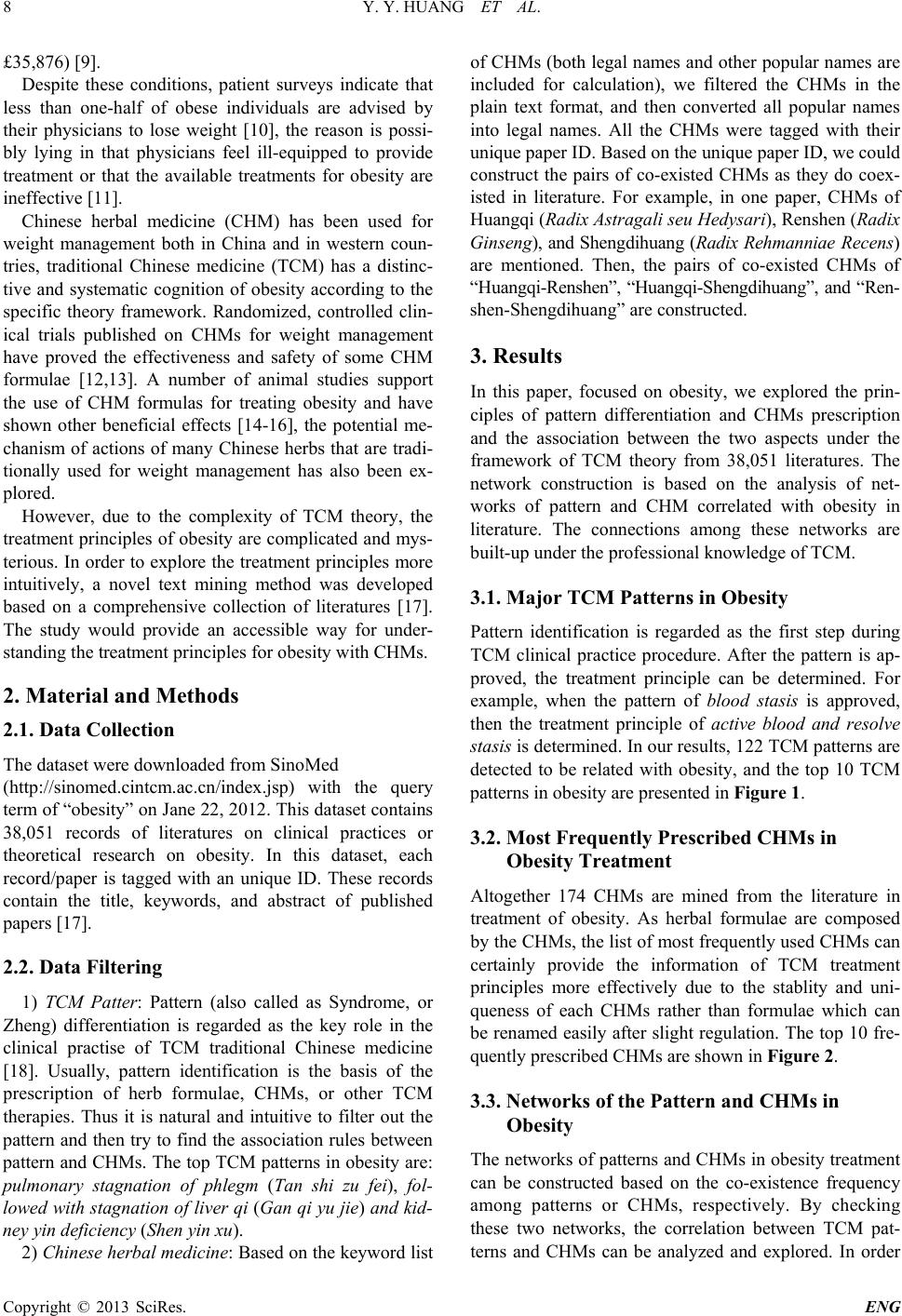 Y. Y. HUANG ET AL. Copyright © 2013 SciRes. ENG 8 £35,876) [9]. Despite these conditions, patient surveys indicate that less than one-half of obese individuals are advised by their physicians to lose weight [10], the reason is possi- bly lying in that physicians feel ill-equipped to provide treatment or that the available treatments for obesity are ineffective [11]. Chinese herb al medicine (CHM) has been used for weight management both in China an d in western co un- tries, traditional Chinese medicine (TCM) has a distinc- tive and systematic cognition of obesity according to the specific theory framework. Randomized, controlled clin- ical trials published on CHMs for weight management have proved the effectiveness and safe t y of some CHM formulae [12,13]. A number of animal studies support the use of CHM formulas for treating obesity and have shown other beneficial effects [14-16], the potential me- chanism of actions of many Chinese herbs that are tradi- tionally used for weight management has also b een ex- plored. Howeve r , due to the complexity of TCM theory, the treatment principles of obesity are complicated a nd mys- terious. In order to exp lore the treatment principles more intuitively, a novel text minin g method was developed based on a comprehensive collection of literatures [17]. The study would provide an accessible way for under- standing the treatment principles for obesity with CHM s. 2. Material and Methods 2.1. Data Collection The dataset were downloaded from SinoMed (http://sinomed.cintcm.ac.cn/index.j sp) with the query term of “obes ity” on Jane 22, 2012. Thi s dataset contains 38,051 recor d s of litera tures on clinical practices or theoretical research on obesity. In th is dataset, each record/paper is tagged with an unique ID. These recor ds contain the title, keywords, and abstract of published papers [17]. 2.2. Data Filtering 1) TCM Patter: Pattern (also called as Syndrome, or Zheng) differentiation is regar ded as the key ro le in the clinical practise of TCM traditional Chinese medicine [18]. Usually, pattern identification is the basis of the prescription of herb formulae, CHMs, or other TCM therapies. Thus it is natural and intuitive to filter out the pattern and then tr y to find the association rules b etw een pattern and CHMs. The top TCM patterns in obesity are: pulmonary stagnation of phlegm (Tan shi zu fei), fol- lowed with stagnation of liver qi (Gan qi yu jie) and kid- ney yin deficiency (Shen yin xu). 2) Chinese herbal medicine: Based on the keyword list of CHMs (b oth legal names and other popular names are included for calculation), we filtered the CHMs in the plain text format, and then co nv erted a ll popular names into legal names. All the CHMs were tagged with th eir unique paper ID. Based on the unique paper ID, we could construct the pairs of co-existed CHMs as they do coe x - isted in literature. F or example, in one paper, CHMs of Huangqi (Radix Astragali seu Hedysari), Rens hen (Radix Ginseng), and Shengdihuang (Radix Rehmanniae Recens) are mentioned. Then, the pairs of co-existed CHMs of “Huangqi-Renshen”, “Huangqi-Shengdihuang”, and “Ren - shen -Shengdihuang” are constructed. 3. Results In this paper, fo cused on obesity, we explo red the prin- ciples of pattern diffe rentiation and CHMs prescription and the association between the two aspects under the framework of TCM theory from 38,051 literatures. Th e network con s truction is based on the analysis of net- works of pattern and CHM correlated with obesity in literature. The conn ections a mong thes e networks are built-up under the professional knowledge of TCM. 3.1. Major TCM Patterns in Obesity Pattern identification is regarded as the first step during TCM clinical practice procedure. After the pattern is ap- proved, the treatment principle can be determined. For example, when the pattern of blood stasis is approved, then the treatment principle of active blood and resolve stasis is determined. In our results, 122 TCM patterns are detected to be related with obesity, and the top 10 TCM patterns in obesity are presented in Figure 1. 3.2. Most Frequently Prescribed CHMs in Obesity Treatment Altogether 174 CHMs are mined from the literature in treatment of obesity. As herbal formulae are composed by the CHMs, the list of mos t frequently used CH M s can certainly provide the information of TCM treatment principles more effectively due to the stablity and uni- queness of each CHMs rather than formulae which can be renamed easily after slight regulation. The top 10 fre- quently prescribed CHMs are shown in Figure 2. 3.3. Networks of the Pattern and CHMs in Obesity The networks of patterns and CHMs in obesity treatment can be constructed based on the co-existence frequency among patterns or CHMs, respectively. By checking these two networks, the correlation between TCM pat- terns and CHMs can be analyzed and explored. In order 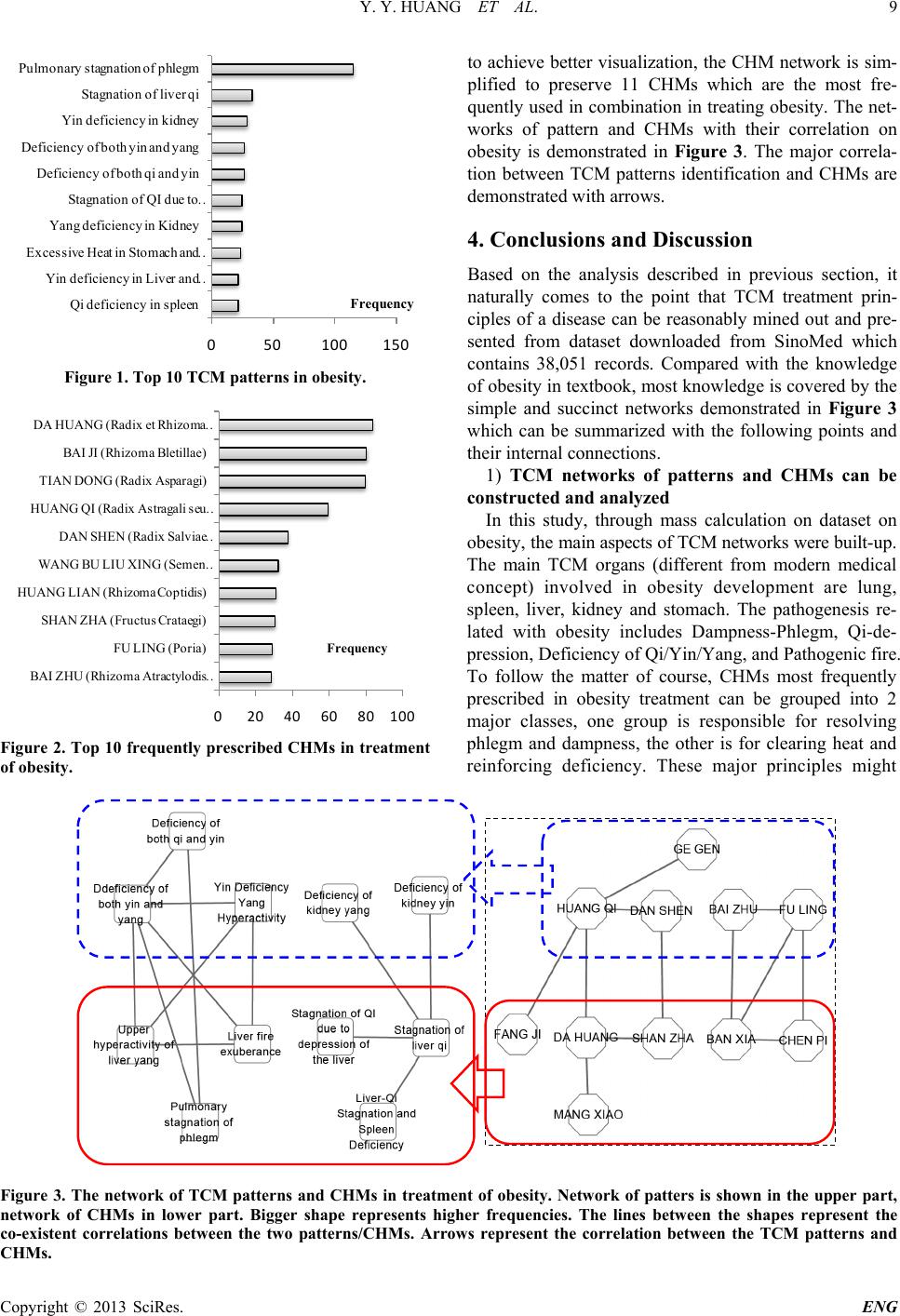 Y. Y. HUANG ET AL. Copyright © 2013 SciRes. ENG 9 Figure 1. Top 10 TCM patterns in obesity. Figure 2. Top 10 frequently prescribed CHMs in treatment of obesity. to achieve better visualization, the CHM network is sim- plified to preserve 11 CHMs which are the most fre- quently used in combination in treating obesity. The net- works of pattern and CHMs with their correlation on obesity is demonstrated in Figure 3. The major correla- tion between TCM patterns identification and CHMs are demonstrated with arrows. 4. Conclusions and Discussion Based on the analysis described in previous section, it naturally comes to the point that TCM treatment prin- ciples of a disease can be reasonably mined out and pre- sented from dataset downloaded from SinoMed which contains 38,051 records. Compared with th e knowledge of obesity in textbook, most knowledge is covered by the si mple and succinct networks demonstrated in Figure 3 which can be summarized with the following points and their internal connections. 1) TCM networks of patterns and CHMs can be constructed and analyzed In this study, through mass calculation on dataset on obesity, the main aspects of TCM networks were built-up. The main TCM organs (different from modern medical concept) involved in ob esit y development are lung, spleen, liver, kidney and stomach. The pathogenesis re- lated with obesity includes Dampness-Phlegm, Qi-de- pression, Deficiency of Qi/Yin/Yang, and Pathogenic fire. To follow the matter of course, CHMs most frequ ently pre s cribed in obesity treatment can be grouped into 2 major classes, one group is responsible for resolving phlegm and dampness, the other is for clearing heat and reinforcing deficiency. These major principles might Figure 3. The network of TCM patterns and CHMs in treatment of obesity. Network of patters is shown in the upper part, network of CHMs in lower part. Bigger shape represents higher frequencies. The lines between the shapes represent the co-existent correlations between the two patterns/CHMs. Arrows represent the correlation between the TCM patterns and CHMs. 050100 150 Qi deficiency in splee n Y in de fi ci e ncy i n Li ver a nd … Excessiv e Hea t in Stoma ch an d … Yang deficiency in Kidn ey S t ag na t ion of QI due t o … D efi c ie ncy of bot h qi and yin D efi c ie ncy of bot h yi n a nd yang Y in de fi ci e ncy i n ki d ney S t ag na t ion of li ve r qi P ul monary st ag nat i o n of ph l egm Frequency 020 40 60 80100 BAI ZHU (Rhizoma Atra ctylodis … FU LING (Poria) SHAN ZHA (Fructus C ratae g i) HUANG LIAN (R hizoma C optid is ) W ANG BU LIU XING (Semen … DAN SHEN (Radix Salviae … HUANG QI (Radix Astr ag ali se u … TIAN DONG (R adix Asp aragi ) BAI JI (Rhizoma Bletillae) DA HUANG (Radix et Rhizoma … Frequency 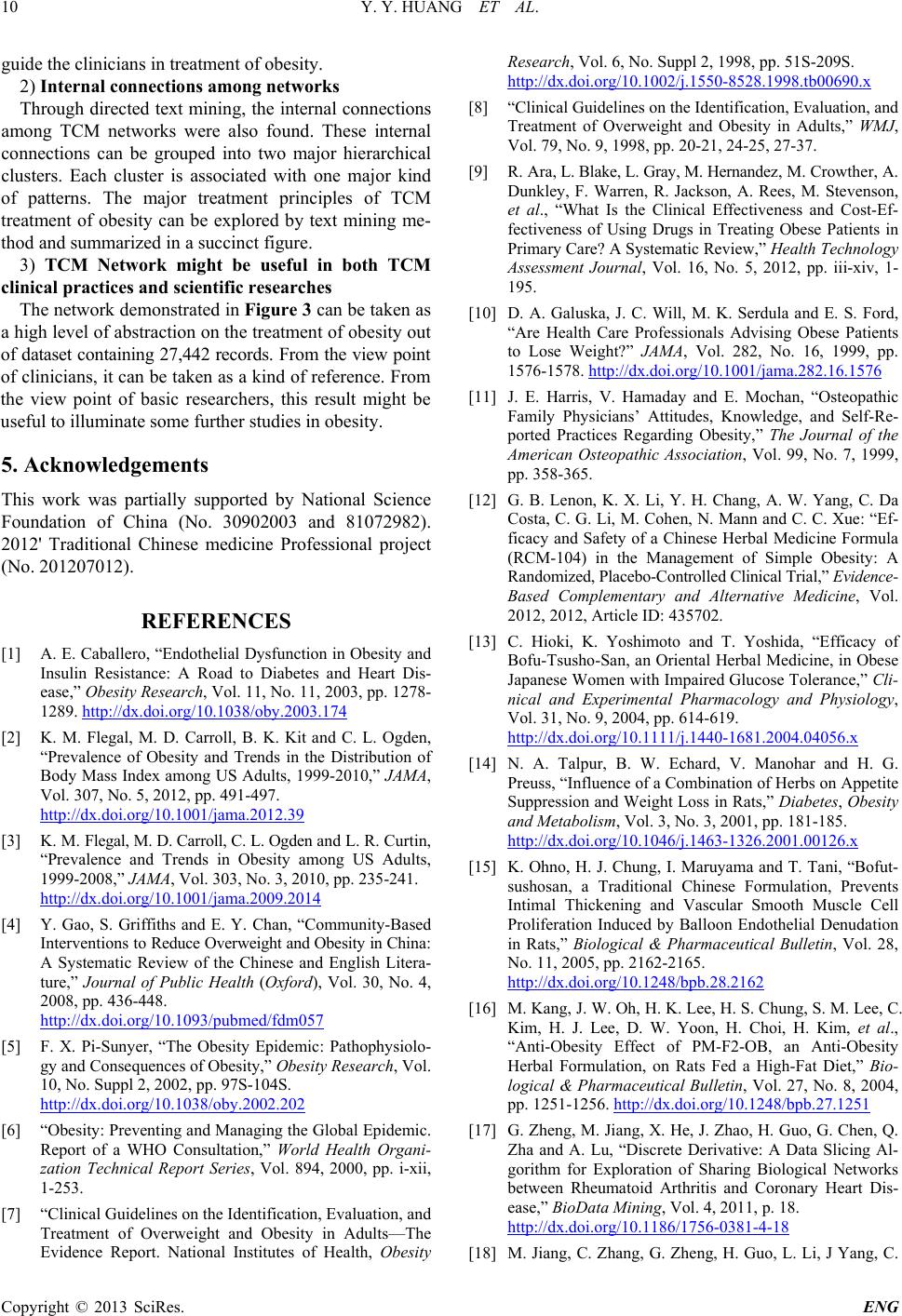 Y. Y. HUANG ET AL. Copyright © 2013 SciRes. ENG 10 guide the clinicians in treatment of obesity. 2) Internal connections among networks Through directed text mining, the internal connections among TCM networks were also found. These internal connections can be group e d into two major hierarchical clusters. Each cluster is associated with one major kind of patterns. The major treatment principles of TCM treatment of obesity can be explored by text mining me- thod and summarized in a succinct figure. 3) TCM Network might be useful in both TCM clinical practices and scientific researches The ne tw ork demonstrated in Figure 3 can be tak en as a high level of abstraction on the treatment of obesity out of dataset containing 27,442 recor ds. From the view point of clinicians, it can be tak e n as a kind of refer e nce. F rom the view point of basic researchers, this re sult might be useful to illuminate some further studies in obesity. 5. Acknowledgements This work was partially su pported by National Science Foundation of China (No. 30902003 and 81072982). 2012' Traditional Chinese medicine Professional project (No. 201207012). REFERENCES [1] A. E. Caballero, “Endothelial Dysfunction in Obesity and Insulin Resistance: A Road to Diabetes and Heart Dis- ease,” Obesity Research, Vol. 11, No. 11, 2003, pp. 1278- 1289. http://dx.doi.org/10.1038/oby.2003.174 [2] K. M. Flegal, M. D. Carroll, B. K. Kit and C. L. Ogden, “Prevalence of Obesity and Trends in the Distribution of Body Mass Index among US Adults, 1999-2010,” JA MA, Vol. 307, No. 5, 2012, pp. 491-497. http://dx.doi.org/10.1001/jama.2012.39 [3] K. M. Flegal, M. D. Carroll, C. L. Ogden and L. R. Curtin, “Prevalence and Trends in Obesity among US Adults, 1999-2008,” JAMA, Vol. 303, No. 3, 2010, pp. 235-241. http://dx.doi.org/10.1001/jama.2009.2014 [4] Y. Gao, S. Griffiths and E. Y. Chan, “Community-Based Interventions to Reduce Overwei ght and Obesity in China: A Systematic Review of the Chinese and English Litera- ture,” Journal of Public Health (Oxford), Vol. 30, No. 4, 2008, pp. 436-448. http://dx.doi.org/10.1093/pubmed/fdm057 [5] F. X. Pi-Sunyer, “The Obesity Epidemic: Pathophysiolo- gy and Consequences of Obesity,” Obesity Research, Vol. 10, No. Suppl 2, 2002, pp. 97S-104S. http://dx.doi.org/10.1038/oby.2002.202 [6] “Obesity: Preventing and Managing the Global Epidemic. Report of a WHO Consultation,” World Health Organi- zation Technical Report Series, Vol. 894, 2000, pp. i-xii, 1-253. [7] “Clinical Guidelines on the Identification, Evaluation, and Treatment of Overweight and Obesity in Adults—The Evidence Report. National Institutes of Health, Obesity Research, Vol. 6, No. Suppl 2, 1998, pp. 51S-209S. http://dx.doi.org/10.1002/j.1550-8528.1998.tb00690.x [8] “Clinical Guidelines on the Identification, Evaluation, and Treatment of Overweight and Obesity in Adults,” WMJ, Vol. 79, No. 9, 1998, pp. 20-21, 24-25, 27-37. [9] R. Ara, L. Blake, L. Gray, M. Hernandez, M. Crowther, A. Dunkley, F. Warren, R. Jackson, A. R ees, M. Stevenson, et al., “What Is the Clinical Effectiveness and Cost-Ef- fectiveness of Using Drugs in Treating Obese Patients in Primary Care? A Systematic Review,” Health Technology Assessment Journal, Vol. 16, No. 5, 2012, pp. iii-xiv, 1- 195. [10] D. A. Galuska, J. C. Will, M. K. Serdula and E. S. Ford, “Are Health Care Professionals Advising Obese Patients to Lose Weight?” JAMA, Vol. 282, No. 16, 1999, pp. 1576-1578. http://dx.doi.org/10.1001/jama.282.16.1576 [11] J. E. Harris, V. Hamaday and E. Mochan, “Osteopathic Family Physicians ’ Attitudes, Knowledge, and Self-Re- ported Practices Regarding Obesity,” The Journal of the American Osteopathic Association, Vol. 99, No . 7, 1999, pp. 358-365. [12] G. B. Lenon, K. X. Li, Y. H. Chang, A. W. Yang, C. Da Costa, C. G. Li, M. Cohen, N. Mann and C. C. Xue: “Ef- ficacy and Safety of a Chinese Herbal Medicine Formula (RCM-104) in the Management of Simple Obesity: A Randomized, Placebo-C ontro lled Clinical Trial,” Evidence- Based Complementary and Alternative Medicine, Vol. 2012, 2012, Article ID: 435702. [13] C. Hioki, K. Yoshimoto and T. Yoshida, “Efficacy of Bofu-Tsusho-San, an Oriental Herbal Medicine, in Obese Japanese Women with Impaired Glucose Tolerance,” Cli- nical and Experimental Pharmacology and Physiology, Vol. 31, No. 9, 2004, pp. 614-619. http://dx.doi.org/10.1111/j.1440-1681.2004.04056.x [14] N. A. Talpur, B. W. Echard, V. Manohar and H. G. Preuss, “Influence of a Combination of Herbs on Appetite Suppression and Weight Loss in Rats,” Diabetes, Obesity and Metabolism, Vol. 3, No. 3, 2001, pp. 181-185. http://dx.doi.org/10.1046/j.1463-1326.2001.00126.x [15] K. Ohno, H. J. Chung, I. Maruyama and T. Tani, “Bofut- sushosan, a Traditional Chinese Formulation, Prevents Intimal Thickening and Vascular Smooth Muscle Cell Proliferation Induced by Balloon Endothelial Denudation in Rats,” Biological & Pharmaceutical Bulletin, Vol. 28, No. 11, 2005, pp. 2162-2165. http://dx.doi.org/10.1248/bpb.28.2162 [16] M. Kang, J. W. Oh, H. K. Lee, H. S. Chung, S. M. Lee, C. Kim, H. J. Lee, D. W. Yoon, H. Choi, H. Kim, et al., “Anti-Obesity Effect of PM-F2-OB, an Ant i -Obesity Herbal Formulation, on Rats Fed a High-Fat Diet,” Bio- logical & Pharmaceutical Bulletin, Vol. 27, No. 8, 2004, pp. 1251-1256. http://dx.doi.org/10.1248/bpb.27.1251 [17] G. Zheng, M. Jiang, X. He, J. Zhao, H. Guo, G. Chen, Q. Zha and A. Lu, “Discrete Derivative: A Data Slicing Al- gorithm for Exploration of Sharing Biological Networks between Rheumatoid Arthritis and Coronary Heart Dis- ease,” BioData Mining, Vol. 4, 2011, p. 18. http://dx.doi.org/10.1186/1756-0381-4-18 [18] M. Jiang, C. Zhang, G. Zheng, H. Guo, L. Li, J Yang, C.  Y. Y. HUANG ET AL. Copyright © 2013 SciRes. ENG 11 Lu, W. Jia and A. Lu, “Traditional Chinese Medicine Zheng in the Era of Evidence-Based Medicine: A Litera- ture Analysi s,” Evidence-Based Complementary and Al- ternative Medicine, Vol. 2012, 2012, Artic le ID: 409568. |