

Paper Menu >>
Journal Menu >>
 Open Journal of Leadership 2013. Vol.2, No.4, 78-81 Published Online December 2013 in SciRes (http://www.scirp.org/journal/ojl) http://dx.doi.org/10.4236/ojl.2013.24011 Open Access 78 On Leadership and It’s Marketing* Jinzhang Gao School of Business Administra tion of Zhengzhou Institute of Aeronautical Industry Manag ement, Zhengzhou, China Email: [email protected] Received August 2nd, 2013; revised September 5th, 2013; accepted September 15th, 2013 Copyright © 2013 Jinzhang Gao. This is an open access article distributed under the Creative Commons Attri- bution License, which permits unrestricted use, distribution, and reproduction in any medium, provided the original work is properly cited. Leadership is a kind of scarce resources and a determinable factor in an organization. Effective leadership is one of the key factors in its growth, change and regeneration whereas currently, leaders in some or- ganizations do not have the leadership in match with their development and leadership resource is out of proportion of the highly-developed economy which prevents organizations from developing. Leadership is a leader’s most significant peculiarity and his developing in leadership contributes most greatly to the organization. Effective leadership depends on leadership marketing as well as the cultivating and devel- oping. Based on marketing researches, this paper mainly studies individual leadership, group leadership and organizational leadership so as to lead to more researches and studies. Keywords: Lead; Leadership; Leadership Marketing Introduction Why enterprises in current China lasting for generations are scarce and some in great success are like a flash in the pan? One important reason is the lack of leaders owning effective leadership skills (Dean & Tjosvold, 2004). Leadership is a rare resource and if one wants to make his leadership effective, he must value his leadership marketing, and this is of key impor- tance. In this text, on the basis of some marketing researches, the author will discuss the leadership marketing from individual, group and organizational layers. Lead Definition Lead has many meanings in Chinese, and it can be both a noun and a verb. Lead in noun means a person who leads an organization and holds leading posts and carries out the leading process. For instance, Bass and Stogdill (Bass & Stogdill, 1990) defines it as “Leadership is an interaction between two or more members of a group that often involves a structuring or re- structuring of the situation and the perceptions and expectations of members.” Lead as a verb means the leading activity, the dynamic process where a leader and his or her followers inter- act with certain contexts. As an initiative scholar in studies on leadership, Stogdill (Stogdill, 1974) defines it “an activity in- fluencing an organizational group and a process that makes it move to an expected goal and achievement.” Lead studied in this paper is a noun. Function of Le ade r As it is said that trains run fast with the front entirely. Here, the front is the leader in a modern organization. A leader’s role is like a head of a train. The front works wrongly, the whole train can not work well meanwhile the front cannot work well if the train works wrongly. If both are all right, but run in wrong rail, it will be much farer than the destination with higher speed. Leadership Concept Everyone has leadership but it is different in different people (Mowles, 2009). In this paper, the leading capacity is to be studied. In our country, leadership is a new concept introduced with intellectual economy development and intellectual man- aging revolution. In a sense, there are definitions of leadership so long as one wants to define it. However, studying the rela- tive literature researches at home and abroad, the author found scholars define it on different emphasis. They can be included as follows: On theory of capability—It gives emphasis on a leader’s per- sonality and holds that a leader has the ability to influence his or her followers to realize the organizational goals (Dehoogh & Den Hartog, 2008). On theory of behavior—It values the behavioral process of leadership that influences all members and holds that leadership is the combination of a series of behaviors that a leader influ- ences his or her followers to work hard willingly for their shared goals (Pearce, Manz, & Sims Jr., 2008). On theory of holism—It gives emphasis on the overall force of leaders at all levels and believes that leadership is a driving force to stimulate all members to realize their shared goals (Uhl-Bien, Marion, & McKelvey, 2007). In this paper, it is believed that leadership is a join force of a leader’s power and authority. It is a force, but not a capability or behavior. *Supported by the Henan Province Science and Technique Foundation: Research on Leadership Marketing of Enterprise in Henan Province N o. 122400440096. 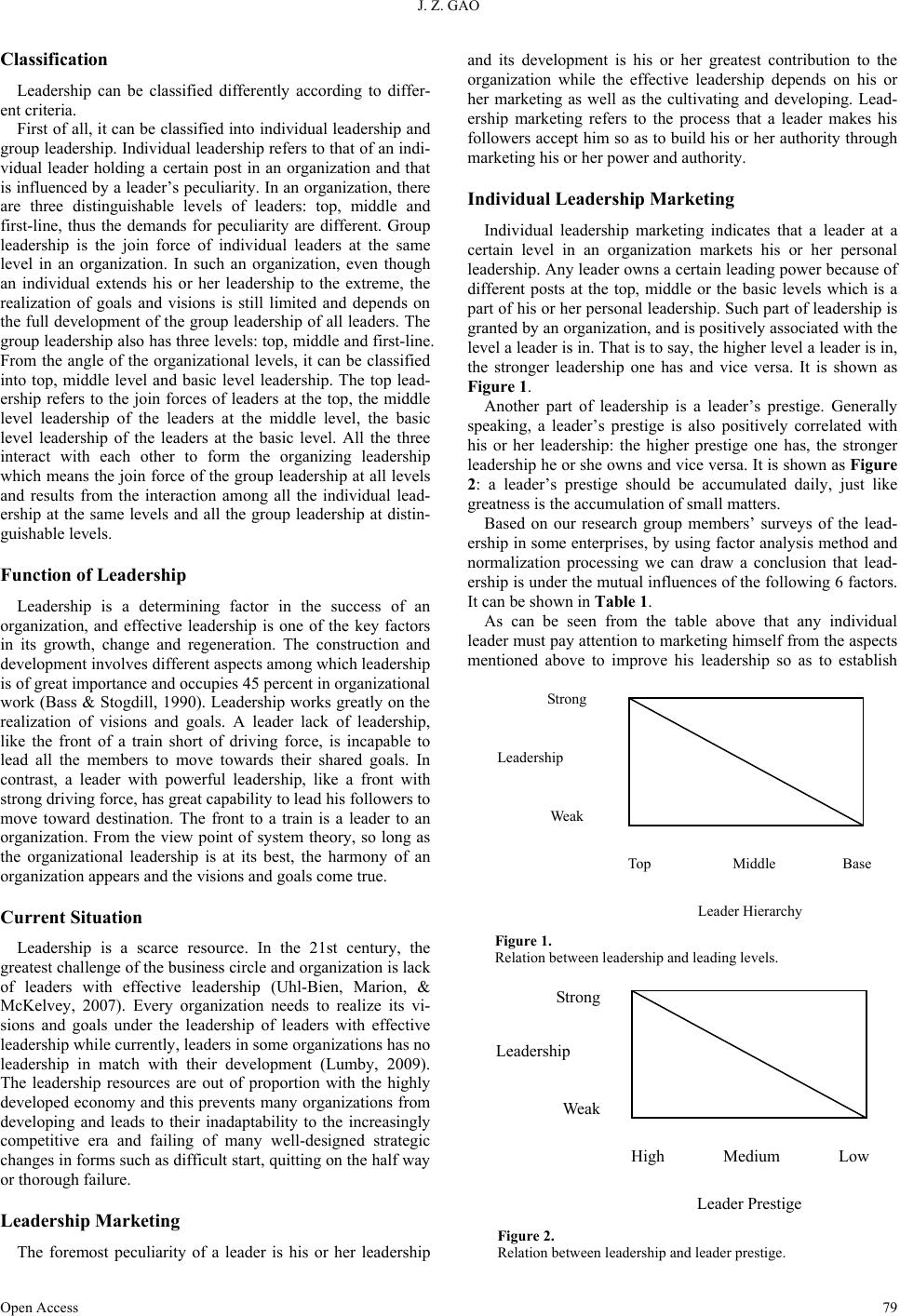 J. Z. GAO Classification Leadership can be classified differently according to differ- ent criteria. First of all, it can be classified into individual leadership and group leadership. Individual leadership refers to that of an indi- vidual leader holding a certain post in an organization and that is influenced by a leader’s peculiarity. In an organization, there are three distinguishable levels of leaders: top, middle and first-line, thus the demands for peculiarity are different. Group leadership is the join force of individual leaders at the same level in an organization. In such an organization, even though an individual extends his or her leadership to the extreme, the realization of goals and visions is still limited and depends on the full development of the group leadership of all leaders. The group leadership also has three levels: top, middle and first-line. From the angle of the organizational levels, it can be classified into top, middle level and basic level leadership. The top lead- ership refers to the join forces of leaders at the top, the middle level leadership of the leaders at the middle level, the basic level leadership of the leaders at the basic level. All the three interact with each other to form the organizing leadership which means the join force of the group leadership at all levels and results from the interaction among all the individual lead- ership at the same levels and all the group leadership at distin- guishable levels. Function of Le ad ership Leadership is a determining factor in the success of an organization, and effective leadership is one of the key factors in its growth, change and regeneration. The construction and development involves different aspects among which leadership is of great importance and occupies 45 percent in organizational work (Bass & Stogdill, 1990). Leadership works greatly on the realization of visions and goals. A leader lack of leadership, like the front of a train short of driving force, is incapable to lead all the members to move towards their shared goals. In contrast, a leader with powerful leadership, like a front with strong driving force, has great capability to lead his followers to move toward destination. The front to a train is a leader to an organization. From the view point of system theory, so long as the organizational leadership is at its best, the harmony of an organization appears and the visions and goals come true. Current Situation Leadership is a scarce resource. In the 21st century, the greatest challenge of the business circle and organization is lack of leaders with effective leadership (Uhl-Bien, Marion, & McKelvey, 2007). Every organization needs to realize its vi- sions and goals under the leadership of leaders with effective leadership while currently, leaders in some organizations has no leadership in match with their development (Lumby, 2009). The leadership resources are out of proportion with the highly developed economy and this prevents many organizations from developing and leads to their inadaptability to the increasingly competitive era and failing of many well-designed strategic changes in forms such as difficult start, quitting on the half way or thorough failure. Leadership Marketing The foremost peculiarity of a leader is his or her leadership and its development is his or her greatest contribution to the organization while the effective leadership depends on his or her marketing as well as the cultivating and developing. Lead- ership marketing refers to the process that a leader makes his followers accept him so as to build his or her authority through marketing his or her power and authority. Individual Leadership Marketing Individual leadership marketing indicates that a leader at a certain level in an organization markets his or her personal leadership. Any leader owns a certain leading power because of different posts at the top, middle or the basic levels which is a part of his or her personal leadership. Such part of leadership is granted by an organization, and is positively associated with the level a leader is in. That is to say, the higher level a leader is in, the stronger leadership one has and vice versa. It is shown as Figure 1. Another part of leadership is a leader’s prestige. Generally speaking, a leader’s prestige is also positively correlated with his or her leadership: the higher prestige one has, the stronger leadership he or she owns and vice versa. It is shown as Figure 2: a leader’s prestige should be accumulated daily, just like greatness is the accumulation of small matters. Based on our research group members’ surveys of the lead- ership in some enterprises, by using factor analysis method and normalization processing we can draw a conclusion that lead- ership is under the mutual influences of the following 6 factors. It can be shown in Table 1. As can be seen from the table above that any individual leader must pay attention to marketing himself from the aspects mentioned above to improve his leadership so as to establish Strong Weak Leadership Top Middle Base Leader Hierarchy Figure 1. Relation between leadership and leading levels. Strong Weak Leadership High Medium Low Leader Prestige Figure 2. Relation between leadership and leader p r estige. Open Access 79 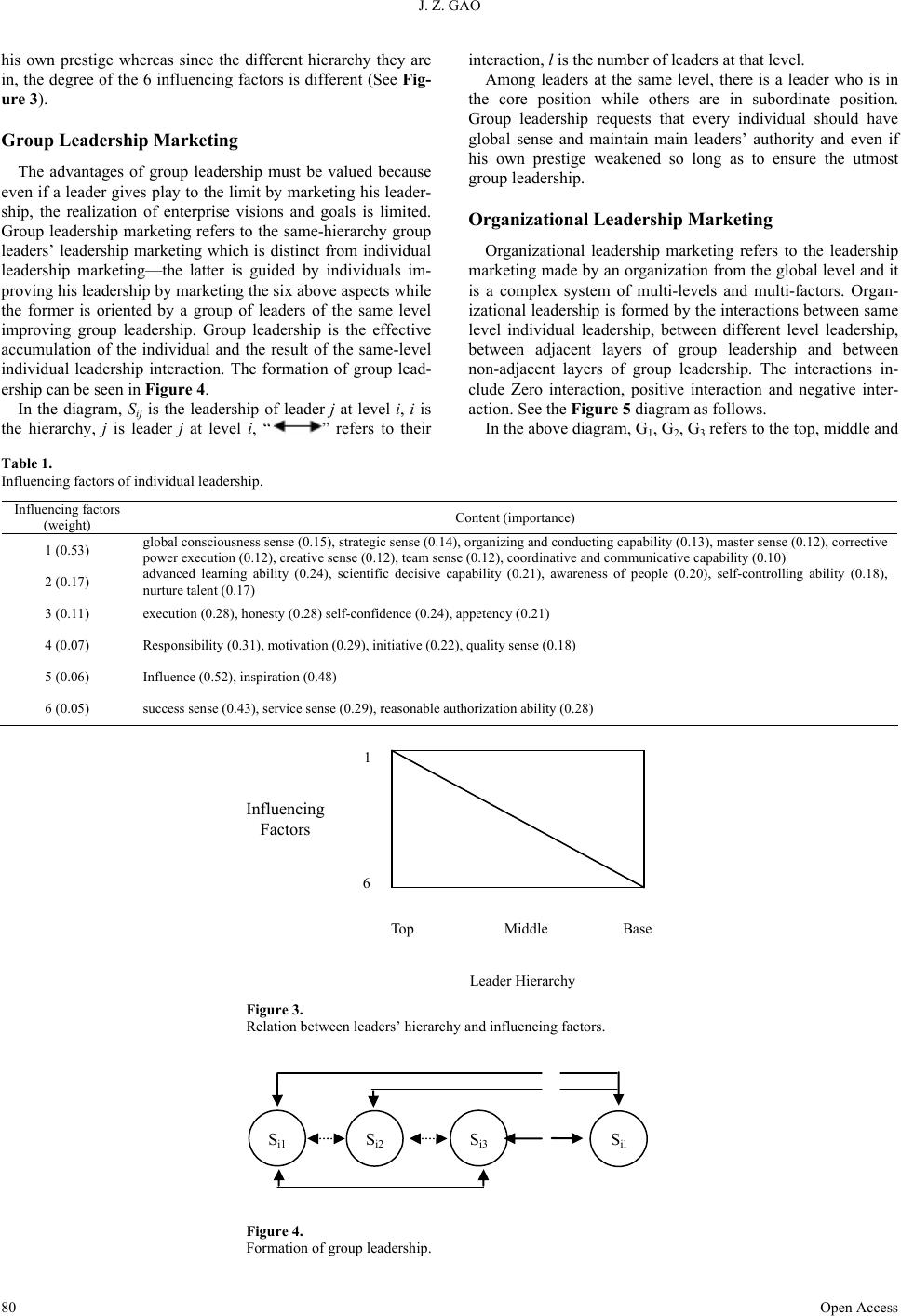 J. Z. GAO Open Access 80 interaction, l is the number of leaders at that level. his own prestige whereas since the different hierarchy they are in, the degree of the 6 influencing factors is different (See Fig- ure 3). Among leaders at the same level, there is a leader who is in the core position while others are in subordinate position. Group leadership requests that every individual should have global sense and maintain main leaders’ authority and even if his own prestige weakened so long as to ensure the utmost group leadership. Group Leadership Marketing The advantages of group leadership must be valued because even if a leader gives play to the limit by marketing his leader- ship, the realization of enterprise visions and goals is limited. Group leadership marketing refers to the same-hierarchy group leaders’ leadership marketing which is distinct from individual leadership marketing—the latter is guided by individuals im- proving his leadership by marketing the six above aspects while the former is oriented by a group of leaders of the same level improving group leadership. Group leadership is the effective accumulation of the individual and the result of the same-level individual leadership interaction. The formation of group lead- ership can be seen i n Figure 4. Organizational Leadership Marketing Organizational leadership marketing refers to the leadership marketing made by an organization from the global level and it is a complex system of multi-levels and multi-factors. Organ- izational leadership is formed by the interactions between same level individual leadership, between different level leadership, between adjacent layers of group leadership and between non-adjacent layers of group leadership. The interactions in- clude Zero interaction, positive interaction and negative inter- action. See the Figure 5 diagram as follows . In the diagram, Sij is the leadership of leader j at level i, i is the hierarchy, j is leader j at level i, “” refers to their In the above diagram, G1, G2, G3 refers to the top, middle and Table 1. Influencing factors of individual leadership. Influencing factors (weight) Content (importance) 1 (0.53) global consciousness sense (0.15), strategic sense (0.14), organizing and conducting capability (0.13), master sense (0.12), corrective power execution (0.12), creative sense (0.12), team sense (0.12), coordinative and communicative capability (0.10) 2 (0.17) advanced learning ability (0.24), scientific decisive capability (0.21), awareness of people (0.20), self-controlling ability (0.18), nurture talent (0.17) 3 (0.11) execution (0.28), honesty (0.28) self-confidence (0.24), appetency (0 .21) 4 (0.07) Responsibility (0.31), motivation (0.29), initiative (0.22), quality sense (0.18) 5 (0.06) Influence (0.52), inspiration ( 0.48) 6 (0.05) success sense (0.43), servic e sense (0. 29), reason able autho rization ability (0.28) Influencing Factors Top Middle Base Leader Hi erarchy 1 6 Figure 3. Relation between leaders’ hierarc hy and in fluencing factors. S i1 S i2 S il S i3 Figure 4. Formation of group leadership.  J. Z. GAO Figure 5. Formation of organizational leadership. basic level group leadership. Among the different layers, the top is in the core position, the middle layer in the central posi- tion and the basic level in the subordinate position. According to system theory—when the local is optimal, the global is not necessarily optimal while the local is necessarily optimal when the global is optimal, organizational leadership marketing re- quests that the middle-layer leaders must maintain the top lead- ers’ authority and the basic level must maintain that of the mid- dle-layer ones so as to establish a harmonious and effective organization to develop faster and better. Conclusion Leadership is the trait that the leader must have. Whether or not the leadership is effective depends on leadership market- ing for leader. Leadership marketing includes power marketing and authority marketing. Power with leader hierarchy is posi- tively correlated relationship; leadership with leader prestige is like this too. We have much work to do for deep research on the above problems. REFERENCES Bass, B. M., & Stogdill, R. (1990). Handbook of leadership: Research & managerial applications. New York: The Free Press. Dean, W., & Tjosvold, D. (2004). Leadership in Chinese enterprise. Shanghai: Shanghai Far-East Press. Dehoogh, A., & Den Hartog, D. (2008). Ethical and despotic leadership, relationships with leader’s social responsibility, top management team effectiveness and subordinates’ optimism: A multi-method study. The Leadership Quarterly, 19, 297-311. http://dx.doi.org/10.1016/j.leaqua.2008.03.002 Lumby, J. (2009). Collective leadership of local school systems power, autonomy and ethics. Educational Management, Administration & Leadership, 37, 310-328. http://dx.doi.org/10.1177/1741143209102782 Mowles, C. (2009). Consultancy as temporary leadership: Negotiating power in everyday practice. International Journal of Learning and Change, 3, 281-293. http://dx.doi.org/10.1504/IJLC.2009.024693 Pearce, C., Manz, C., & Sims Jr., H. (2008). The roles of vertical and shared leadership in the enactment of executive corruption: Implica- tions for research and practice. The Leadership Quarterly, 19, 353- 359. http://dx.doi.org/10.1016/j.leaqua.2008.03.007 Stogdill, R. (1974). Handbook of leadership: A survey of theory and research. New York: The Free Pres s. Uhl-Bien, M., Marion, R., & McKelvey, B. (2007). Complexity lead- ership theory: Shifting leadership from the industrial age to the knowledge era. The Leadership Quarterly, 18, 298-318. http://dx.doi.org/10.1016/j.leaqua.2007.04.002 Open Access 81 |