

Paper Menu >>
Journal Menu >>
 Journal of Cancer Therapy, 2013, 4, 22-29 http://dx.doi.org/10.4236/jct.2013.49A2004 Published Online October 2013 (http://www.scirp.org/journal/jct) Treatment Efficacy of Targeted Therapies for Metastatic Renal Cell Carcinoma—A Review after Seven Years of Experience Hartmut Kirchner1, Axel Heidenreich2, Bernhard Brehmer2* 1Department of Oncology, Siloah Hospital, Hannover, Germany; 2Department of Urology, RWTH Aachen University, Aachen, Ger- many. Email: *[email protected] Received July 12th, 2013; revised August 10th, 2013; accepted August 18th, 2013 Copyright © 2013 Hartmut Kirchner et al. This is an open access article distributed under the Creative Commons Attribution License, which permits unrestricted use, distribution, and reproduction in any medium, provided the original work is properly cited. ABSTRACT Renal cell carcinoma (RCC) is the 10th leading cause of deaths from cancer in the Western world. During the last two decades this type of malignancy was difficult to treat with limited treatment options using cytokines like interferon al- pha (IFN) or interleukin-2 (IL-2). The development of targeted therapies that interfere with specific pathways of tumor angiogenesis and proliferation has profoundly changed this situation and improved the prognosis for patients diagnosed with metasatic renal cell carcinoma (mRCC) considerably. To date, seven targeted therapies have been approved for the first- and second-line treatment of metastatic renal cell carcino ma. In addition, recent data suggest that sequential treat- ment with these modern drugs is feasable and effective and leads to extended overall survival compared to historical data. As more progress is being made, the variety of therapeutic options makes it challenging in clinical practice to choose the best treatment option for the individual mRCC patient. This review revisits results from the pivotal trials of currently approved therapeutic agents (in chronological order of their approval) in context with latest results from cur- rent clinical trials. Keywords: Kidney Cancer; Systemic Therapy; Review 1. Introduction Renal cell carcinoma (RCC) is a malignancy whose glo- bal incidence has been steadily increasing over the past decades. One third of patients present with advanced stages of disease, and another third develop metastases in the follow-up. This leads to the high mortality-to-inci- dence ratio [1,2]. Until recently, the prognosis for most patients diag- nosed with mRCC was poor. Because mRCC is widely resistant to chemotherapy, systemic treatment options were restricted to immune modulation with cytokines that resulted in rather low response rates combined with high toxicity. This situ ation chang ed with the approval of sorafenib and sunitinib, the first targeted therapies for the treatment of mRCC in 2006. To date, seven new drugs for the treatment of mRCC patients are available (Ta ble 1). Since their introduction, targeted therapies prolonged significantly the median overall survival time of mRCC patients. They have established a promising new treat- ment paradigm by interfering with specific pathways of tumor angiogenesis and pro liferation. These agents typically exert their therapeutic effects either by inhibiting angiogenetic signalling cascades me- diated by vascular endothelial growth factor receptors (VEGFR) or by blocking the mammalian target of rapa- mycin (mTOR), an important downstream switchboard of intracellular communication. The first group com- prises the monoclonal antibody bevacizumab and the receptor tyrosine kinase inhibitors (TKIs) sorafenib, sunitinib, pazopanib and axitinib. The mTOR inhibitors temsirolimus and everolimus belong to the second group [3,4]. 2. Approved Targeted Therapies 2.1. Sorafenib In the prospective randomized phase 3 TARGET trial 903 patients who had previously been treated with cyto- kines were randomly assigned to receive either sorafenib *Corresponding a uthor. Copyright © 2013 SciRes. JCT 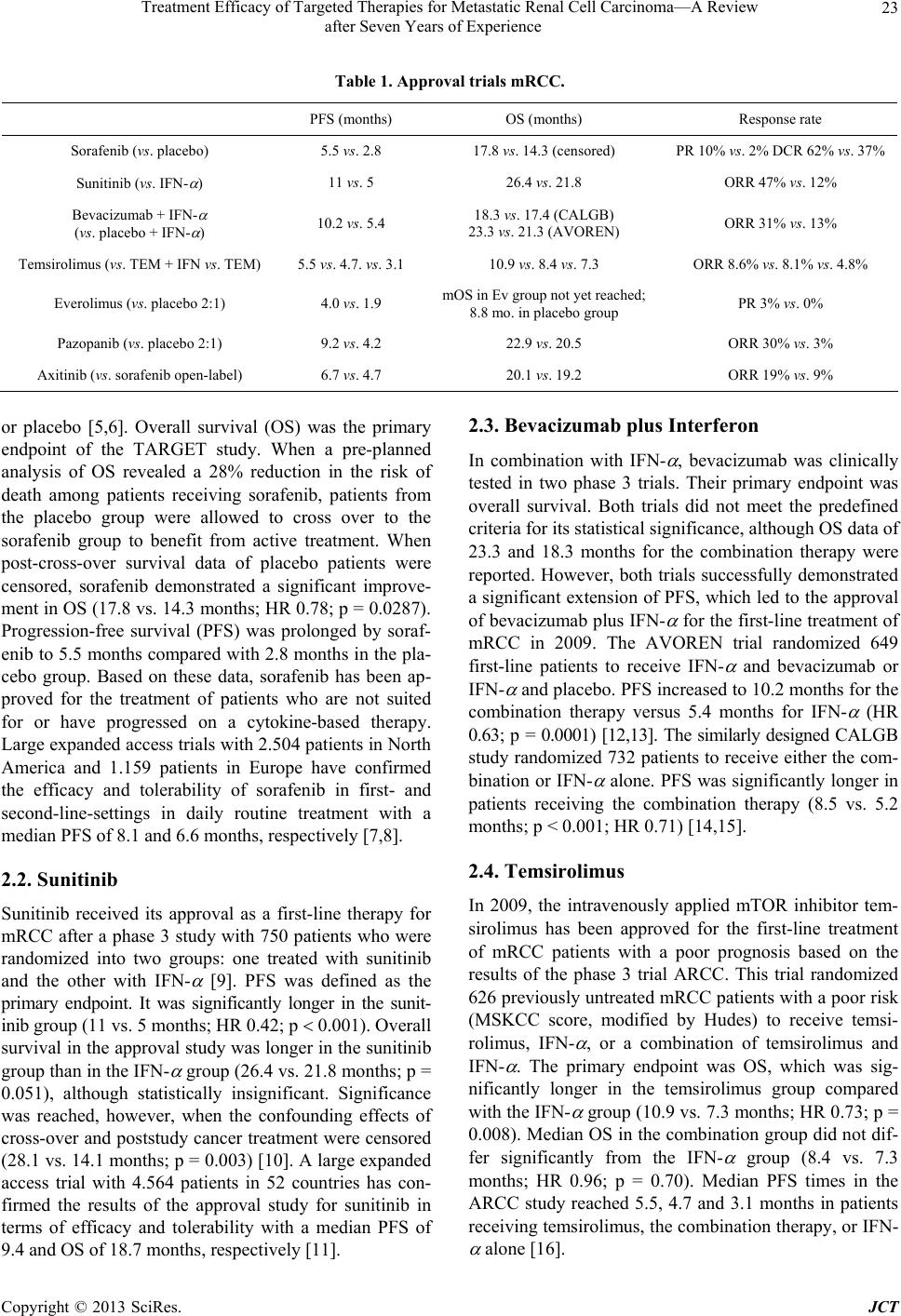 Treatment Effi cacy of Targeted Therapies for Metastatic Renal Cell Carcinoma—A Review after Seven Years of Experience 23 Table 1. Approval trials mRCC. PFS (months) OS (months) Response rate Sorafenib (vs. p la ce bo ) 5.5 vs. 2.8 17.8 vs. 14.3 (censo red) PR 10% vs. 2% DCR 62% vs. 37% Sunitinib (vs. IFN- ) 11 vs. 5 26.4 vs. 21. 8 ORR 47% vs. 12% Bevacizumab + IFN- (vs. placebo + IFN- ) 10.2 vs. 5.4 18.3 vs. 17.4 ( C A L G B ) 23.3 vs. 21.3 (AVOREN) ORR 31% vs. 13% Temsirolimus (vs. TEM + IFN vs. TEM) 5.5 vs. 4.7. vs. 3.1 10.9 vs. 8.4 vs. 7.3 ORR 8.6% vs. 8.1% vs. 4.8% Everolimus (vs. placebo 2:1) 4.0 vs. 1.9 mOS in Ev group not yet reached; 8.8 mo. in placebo gro u p PR 3% vs. 0% Pazopanib (vs. pl ac eb o 2: 1) 9.2 vs. 4.2 22.9 vs. 20.5 ORR 30% vs. 3% Axitinib (vs. s orafenib open-label ) 6.7 vs. 4.7 20.1 vs. 19.2 ORR 19% vs. 9% or placebo [5,6]. Overall survival (OS) was the primary endpoint of the TARGET study. When a pre-planned analysis of OS revealed a 28% reduction in the risk of death among patients receiving sorafenib, patients from the placebo group were allowed to cross over to the sorafenib group to benefit from active treatment. When post-cross-over survival data of placebo patients were censored, sorafenib demonstrated a significant improve- ment in OS (17.8 vs. 14.3 months; HR 0.78; p = 0.0287). Progression-free survival (PFS) was prolonged by soraf- enib to 5.5 months compared with 2.8 months in the pla- cebo group. Based on these data, sorafenib has been ap- proved for the treatment of patients who are not suited for or have progressed on a cytokine-based therapy. Large expanded access trials with 2.504 patients in North America and 1.159 patients in Europe have confirmed the efficacy and tolerability of sorafenib in first- and second-line-settings in daily routine treatment with a median PFS of 8.1 and 6.6 months, respectively [7,8]. 2.2. Sunitinib Sunitinib received its approval as a first-line therapy for mRCC after a phase 3 study with 750 patients who were randomized into two groups: one treated with sunitinib and the other with IFN- [9]. PFS was defined as the primary endpoint. It was significantly longer in the sunit- inib group (11 vs. 5 months; HR 0.42; p 0.001). Overall survival in the appro val study was longer in the sunitinib group than in th e IFN- group (26.4 vs. 21.8 months; p = 0.051), although statistically insignificant. Significance was reached, however, when the confounding effects of cross-over and poststudy cancer treatment were censored (28.1 vs. 14.1 months; p = 0.003) [10]. A large expanded access trial with 4.564 patients in 52 countries has con- firmed the results of the approval study for sunitinib in terms of efficacy and tolerability with a median PFS of 9.4 and OS of 18.7 months, respectively [11]. 2.3. Bevacizumab plus Interferon In combination with IFN- , bevacizumab was clinically tested in two phase 3 trials. Their primary endpoint was overall survival. Both trials did not meet the predefined criteria for its statistical significance, although OS data of 23.3 and 18.3 months for the combination therapy were reported. However, both trials successfully demonstrated a significant extension of PFS, which led to the approval of bevacizumab plus IFN- for the first-line treatment of mRCC in 2009. The AVOREN trial randomized 649 first-line patients to receive IFN- and bevacizumab or IFN- and placebo. PFS increased to 10.2 months for the combination therapy versus 5.4 months for IFN- (HR 0.63; p = 0.0001) [12,13]. The similarly designed CALG B study randomized 732 patients to receive either the com- bination or IFN- alone. PFS was significantly longer in patients receiving the combination therapy (8.5 vs. 5.2 months; p < 0.001; HR 0.71) [14,15]. 2.4. Temsirolimus In 2009, the intravenously applied mTOR inhibitor tem- sirolimus has been approved for the first-line treatment of mRCC patients with a poor prognosis based on the results of the phase 3 trial ARCC. This trial randomized 626 previously untreated mRCC patients with a poor risk (MSKCC score, modified by Hudes) to receive temsi- rolimus, IFN- , or a combination of temsirolimus and IFN- . The primary endpoint was OS, which was sig- nificantly longer in the temsirolimus group compared with the IFN- group (10.9 vs. 7.3 months; HR 0.73; p = 0.008). Median OS in the combination group did not dif- fer significantly from the IFN- group (8.4 vs. 7.3 months; HR 0.96; p = 0.70). Median PFS times in the ARCC study reached 5.5, 4.7 and 3.1 months in patients receiving temsirolimus, the combination therapy, or IFN- alone [16]. Copyright © 2013 SciRes. JCT 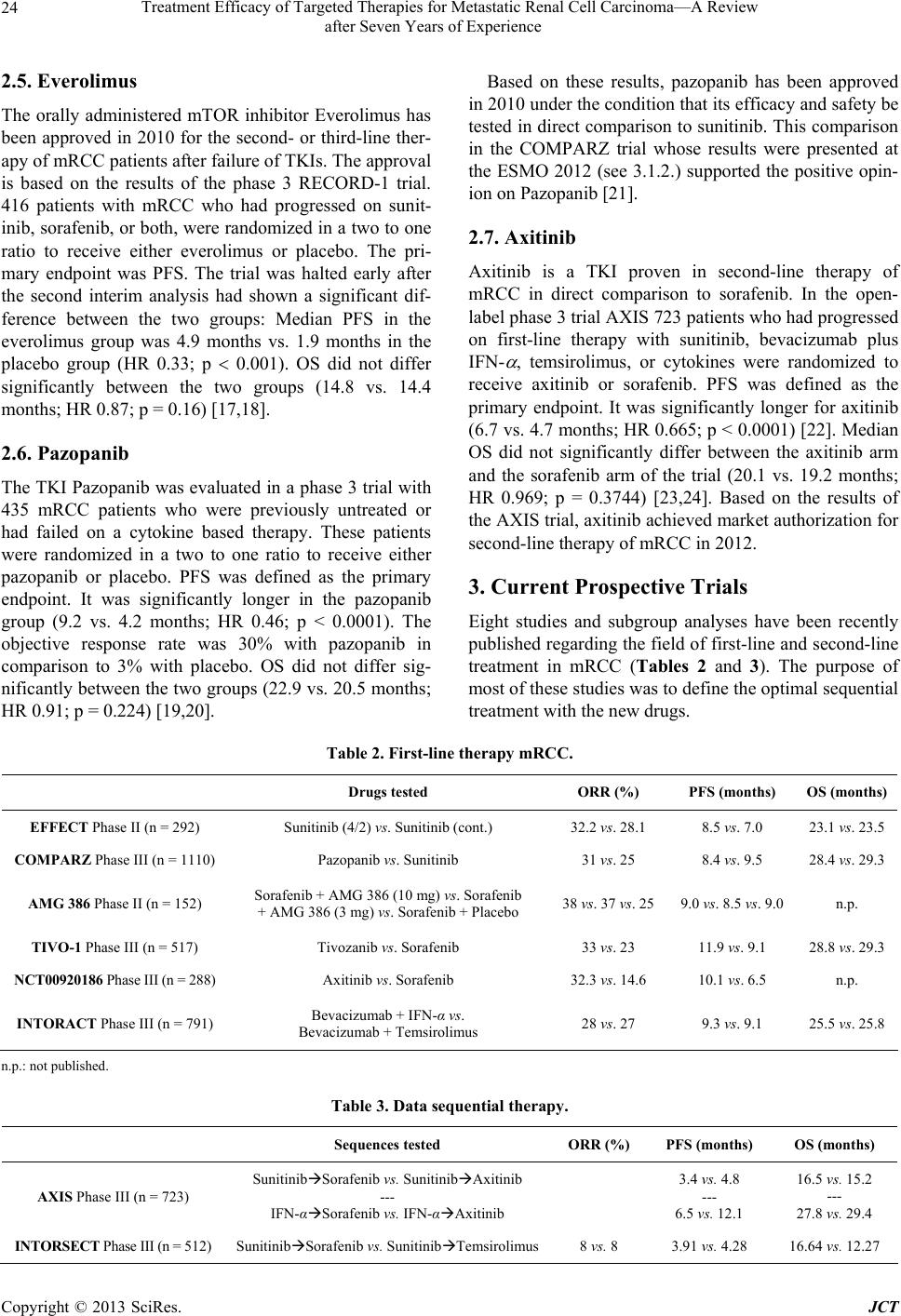 Treatment Effi cacy of Targeted Therapies for Metastatic Renal Cell Carcinoma—A Review after Seven Years of Experience 24 2.5. Everolimus The orally administered mTOR inhibitor Everolimus has been approved in 2010 for the second- or third-line ther- apy of mRCC patients after failure of TKIs. The approval is based on the results of the phase 3 RECORD-1 trial. 416 patients with mRCC who had progressed on sunit- inib, sorafenib, or both, were randomized in a two to one ratio to receive either everolimus or placebo. The pri- mary endpoint was PFS. The trial was halted early after the second interim analysis had shown a significant dif- ference between the two groups: Median PFS in the everolimus group was 4.9 months vs. 1.9 months in the placebo group (HR 0.33; p 0.001). OS did not differ significantly between the two groups (14.8 vs. 14.4 months; HR 0.87; p = 0.16) [17,18]. 2.6. Pazopanib The TKI Pazopanib was evaluated in a phase 3 trial with 435 mRCC patients who were previously untreated or had failed on a cytokine based therapy. These patients were randomized in a two to one ratio to receive either pazopanib or placebo. PFS was defined as the primary endpoint. It was significantly longer in the pazopanib group (9.2 vs. 4.2 months; HR 0.46; p < 0.0001). The objective response rate was 30% with pazopanib in comparison to 3% with placebo. OS did not differ sig- nificantly between the two groups (22.9 vs. 20.5 months; HR 0.91; p = 0.224) [19,20]. Based on these results, pazopanib has been approved in 2010 under the condition that its efficacy and safety be tested in direct comparison to sunitinib. This comparison in the COMPARZ trial whose results were presented at the ESMO 2012 (see 3.1.2.) supported the positive opin- ion on Pazopanib [21] . 2.7. Axitinib Axitinib is a TKI proven in second-line therapy of mRCC in direct comparison to sorafenib. In the open- label phase 3 trial AXIS 723 patients who had progressed on first-line therapy with sunitinib, bevacizumab plus IFN- , temsirolimus, or cytokines were randomized to receive axitinib or sorafenib. PFS was defined as the primary endpoint. It was significantly longer for axitinib (6.7 vs. 4.7 months; HR 0.665; p < 0.0001) [22]. Median OS did not significantly differ between the axitinib arm and the sorafenib arm of the trial (20.1 vs. 19.2 months; HR 0.969; p = 0.3744) [23,24]. Based on the results of the AXIS trial, axitinib achieve d market authorization for second-line therapy of mRCC in 2012. 3. Current Prospective Trials Eight studies and subgroup analyses have been recently published regarding the field of first-line and second-line treatment in mRCC (Tables 2 and 3). The purpose of most of these studies was to define the optimal sequ ential treatment with the new drugs. Table 2. First-line therapy mRCC. Drugs tested ORR (%) PFS (months) OS (months) EFFECT Phase II (n = 292) Sunitinib (4/2) vs. Sunitinib (cont.) 32.2 vs. 28.1 8.5 vs. 7.0 23.1 vs. 23.5 COMPARZ Phase III (n = 1110) Pazopanib vs. Sunitinib 31 vs. 25 8.4 vs. 9.5 28.4 vs. 29.3 AMG 386 Phase II (n = 152) Sorafenib + AMG 386 (10 mg) vs. Sorafenib + AMG 386 (3 mg) vs. Sorafenib + Placebo 38 vs. 37 vs. 259.0 vs. 8.5 vs. 9.0 n.p. TIVO-1 Phase III (n = 517) Tivozanib vs. Sorafenib 33 vs. 23 11.9 vs. 9.1 28.8 vs. 29.3 NCT00920186 Phase III (n = 288) Axitinib vs. Sorafenib 32.3 vs. 14.6 10.1 vs. 6.5 n.p. INTORACT Phase III (n = 791) Bevacizumab + IFN-α vs. Bevacizumab + Temsirolimus 28 vs. 27 9.3 vs. 9.1 25.5 vs. 25.8 n.p.: not published. Table 3. Data sequential therapy. Sequences tested ORR (%) PFS (months) OS (months) AXIS Phase III (n = 723) SunitinibSorafenib vs. SunitinibAxitinib --- IFN-αSorafenib vs. IFN-αAxitinib 3.4 vs. 4.8 --- 6.5 vs. 12.1 16.5 vs. 15.2 --- 27.8 vs. 29.4 INTORSE CT Phase III (n = 512) SunitinibSorafenib vs. SunitinibTemsirolimus8 vs. 8 3.91 vs. 4.28 16.64 vs. 12.27 Copyright © 2013 SciRes. JCT  Treatment Effi cacy of Targeted Therapies for Metastatic Renal Cell Carcinoma—A Review after Seven Years of Experience 25 3.1. First-Line Therapies 3.1.1. EFFECT The approved dosing schedule of sunitinib calls for four weeks on treatment (50 mg per day) followed by two weeks off treatment. A continuous daily dosing of 37.5 mg sunitinib has shown antitumor activity, too. In the phase 2 EFFECT trial, 292 previously untreated mRCC patients were randomized to receive sunitinib in one of both schedules in order to compare their safety and effi- cacy. Time to tumor progression (TTP) was defined as the primary endpoint. While there was a trend towards an inferior TTP and PFS (estimated as a sensitivity analysis for TTP) with contin u ou s dosing, both param e t ers did not differ significantly between the treatment groups. Median PFS reached 8.5 months on schedule 4 weeks on/2 weeks off compared with 7.0 months on co ntinuous dosing (HR 0.77; p = 0.070). Kaplan Meier estimates of OS sug- gested a slight yet insignificant advantage for continuous dosing (23.1 vs. 23.5 months; HR 1.09; p = 0.615). In their conclusion, the study investigators recommend to adhere to the approv ed sunitinib dose and schedule [25]. 3.1.2. CO MPARZ The open-label phase 3 COMPARZ was a head-to-head analysis between pazopanib and sunitinib in first-line treatment of mRCC. 1110 patients were randomized to receive pazopanib on a continuous schedule or sunitinib on the 4 weeks on/2 weeks off schedule. PFS as the pri- mary endpoint showed no statistical significant superior- ity for either of the two treatments (8.4 months for pa- zopanib vs. 9.5 months for sunitinib). An in terim analysis revealed a median OS of 28.4 months in the pazopanib group compared with 29.3 months in the sunitinib group (HR 0.908; p = 0.275). Both treatments elicited similar objective respon se rates with 31% an d 25%, resp ectively. In conclusion, COMPARZ has proven the non-inferiority of pazopanib’s efficacy compared with sunitinib [21]. 3.1.3. AM G 3 86 AMG 386 is an investigational biological drug, a pepti- body, whose antitumor activity was tested in a double- blind phase 2 trial in comparison with sorafenib. 152 previously untreated patients were randomized to receive sorafenib daily plus AMG 386 at 10 mg/kg (group A ), or sorafenib p lus AMG 386 at 3 mg/kg (grou p B), or soraf- enib plus placebo (group C) once weekly. Median PFS did not differ significantly between the three groups and reached 9.0, 8.5 and 9.0 months, respectively. The objec- tive response rate was 38%, 37%, and 25%, respectively [26]. 3.1.4. TIVO-1 Tivozanib is an investigational TKI that has been evalu- ated in direct comparison to sorafenib as a first-line treatment for mRCC. In the phase 3 TIVO-1 trial 517 patients were randomized to receive either tivozanib or sorafenib. First results demonstrate a significant longer PFS in the tivozanib group (11.9 vs. 9.1 months; HR 0.797; p = 0.042). In treatment-naïve patients (70% of total study population) median PFS in the tivozanib group reached 12.7 months versus 9.1 months in the sorafenib group (HR 0.756; p = 0.037). The objective response rate for tivozanib was 33% compared with 23% for sorafenib (p = 0.014) [27]. While median PFS dif- fered considerably in patients with an ECOG 0 perform- ance status (14.8 months in the tivozanib versus 9.1 months in the sorafenib group; HR 0.617; p = 0.004), it was almost equal in ECOG 1 patients (9.1 vs. 9.0 months; HR 0.920; p = 0.588). A similar observation emerged from a subgroup analysis according to the MSKCC score. For patients with a favorable risk, median PFS was 16.7 versus 10.7 months (HR 0.590; p = 0.018), while it reached 9.4 versus 7.4 months (HR 0.786; p = 0.076) for intermediate risk patients [28]. Median OS data showed no significant difference between both arms (29.3 vs. 28.8 months; HR 1.25; p = 0.105) [29]. 3.1.5. NCT 00920186 In a first-line comparison b etween axitinib and so rafenib, 288 previously untreated mRCC patients were random- ized at a 2:1 ratio to receive either of the two drugs. Me- dian PFS was 10.1 months in the axitinib versus 6.5 months in the sorafenib group (stratified HR 0.77; 1- sided p = 0.038). In contrast, in ECOG 1 patients, both treatments yielded a similar PFS of 6.5 and 6.4 months, respectively. Overall, the study did not reach its primary endpoint, which had called for a hazard ratio of under 0.56 and a 1-sided p of 0.02 5 [30]. 3.1.6. INTORACT The phase 3 trial INTORACT compared bevacizumab plus interferon with bevacizumab plus temsirolimus as a first-line treatment for mRCC. 791 patients, predomi- nantly with clear cell histology, were randomized to re- ceive one of the two combination therapies. No superior- ity for the combination with temsirolimus could be dem- onstrated. Patients receiving bevacizumab plus IFN- showed a median progression-survival time of 9.3 mon t h s , a median OS time of 25.5 months, and an objective re- sponse rate of 28% compared with 9.1 months, 25.8 months, and 27% in the group that received the combina- tion with temsirolimus [31]. 3.2. Sequential Therapies None of the new drugs available is able to completely block all angiogen ic or proliferative signalling pathways. Copyright © 2013 SciRes. JCT  Treatment Effi cacy of Targeted Therapies for Metastatic Renal Cell Carcinoma—A Review after Seven Years of Experience 26 Ultimately, tumor cells will adapt to this incomplete in- hibition and develop resistance. Yet because there is no absolute cross-resistance between TKIs such as sorafenib and sunitinib, as retrospective studies suggest, sequential therapies have the potential to prolong the life of mRCC patients. This assumption is confirmed by data from cur- rent prospective trials. 3.2.1. AXIS The AXIS trial compared axitinib and sorafenib in a second-line setting. Stratification of the overall study population by prior first-line treatment allowed for sub- group analyses of different therapeutic sequences. In fact, AXIS was the first prospective phase 3 trial proving a benefit for TKI-TKI treatment sequences. Second-line PFS in patients with a previous sunitinib regimen was longer in the axitin ib than in the sorafenib group (4.8 vs . 3.4 months; HR 0.741; p = 0.0107). Yet second-line me- dian OS was shorter for patients treated with a sunit- inib-axitinib sequence than for those receiving sorafenib after sunitinib, although with no statistical significance (15.2 vs. 16.5 months; HR 0.997; p = 0.4902). The ob- jective response rate in the second line treatment was 19% in the axitinib and in 9% the sorafenib arm. The patients treated with cytokines prior to TKI showed the longest PFS (12.1 months for axitinib; and 6.5 months for sorafenib; HR 0.464; p < 0.0001) [22]. Their median OS reached 29.4 months in the axitinib and 27.8 months in the sorafenib group (HR 0.813; p = 0.1435). While axitinib’s efficacy was superior to sorafenib as a sec- ond-line treatment in most subgroups, sorafenib patients with an intermediate prognosis according to the MSKCC risk score had a clear advantage in OS (23.9 vs. 18.8 months) [ 2 3,24]. 3.2.2. INTORSECT The INTORSECT trial was another second phase 3 trial prospectively proving the efficacy of sequential TKI therapies. Its primary objective was to compare safety and efficacy of temsirolimus and sorafenib in a second- line setting for mRCC patients after failure on prior sunitinib. 512 patients were randomized to receive either temsirolimus or sorafenib. Patients in both groups ex- perienced a prolongation of their PFS time, slightly longer yet with no statistical significance in the temsi- rolimus group (4.28 vs. 3.91 months; HR 0.87; p = 0.193). The OS, however, was significantly shorter in the temsirolimus than in the sorafenib group (12.27 vs. 16.64 months; HR: 1.31; p = 0.014) [32]. 4. Comment Sorafenib and sunitinib have been the first targeted therapies for the treatment of mRCC, and their safety and efficacy has extensively been evaluated and confirmed since their approval by the FDA in December 2005 and January 2006, respectively. While sunitinib was initially regarded as the standard systemic therapy for treatment- naïve mRCC patients, sorafenib was also approved as a first-line treatment only for those patients who do not tolerate a cytokine-based therapy. It is noteworthy that both the TIVO-1 and the AMG 386 trial reported a much longer median PFS for first-line Sorafenib treatment (9.1 and 9.0 months, respectively) compared to the presented data from Escudier et al. with PFS of 5.7 months [33]. Sorafenib appears to exert its optimal efficacy in patients with an intermediate prognosis and/or limited perform- ance status [23,24,28,30]. Sunitinib, on the other hand, showed a shorter PFS in the EFFECT and the COM- PARZ trials than in the phase III approval trial (8.5 and 9.5 months, respectively, vs. 11 months) [9,21,25]. The longest median PFS reported to date in treatment-naïve mRCC patients has been reache d with 12.7 months in the TIVO-1 trial by tivozanib in direct comparison to soraf- enib [27]. The extended PFS upon treatment with the new TKIs is certainly a breakthrough in the management of mRCC. Even if it is probably true, though, that PFS can be re- garded as a surrogate marker for OS, it is questionable whether a linear correlation between both parameters exists [34]. With the exception of sorafenib, all phase 3 trials for the currently approved TKIs did define PFS as their primary endpoint. This shortened the time to regis- tration and avoid ed the risk o f missing OS as th e primary endpoint—like Sorafenib initially did in its pioneering TARGET trial. Because it turned out in the interim analysis that the disease was controlled significantly by sorafenib, patients from the placebo group were allowed to cross over to the verum group. This crossover of 48% confounded the trial data and subsequently made it im- possible to determine a statistically significant advantage in OS for sorafenib on an intention-to-treat basis. The phase III trial ARCC with the mTOR inhibitor temsi- rolimus was the only mRCC approval study so far that succeeded in meeting OS as the primary endpoint with- out censoring data [16]. It is remarkable that the head-to-head comparison of temsirolimus and sorafenib in a second-line setting re- vealed a significant longer OS in t he sorafenib group [32]. Crossover effects are not the only confounding source for the correct determination of OS; post-study tumor treatments also play an important role in this respect. In case of the approval study for su nitinib it was possible to analyze the subgroups of patients with no post-study cancer treatment separately and thus to calculate a sig- nificant OS compared with the IFN- group (28.1 vs. 14.1 months) [10]. Similar OS data were presented in the interim analysis of the COMPARZ trial with sunitinib in Copyright © 2013 SciRes. JCT  Treatment Effi cacy of Targeted Therapies for Metastatic Renal Cell Carcinoma—A Review after Seven Years of Experience 27 a first-line setting is estimated to reach 29.3 months compared with 28.4 months for Pazopanib [21]. Also in the AXIS trial comparing axitinib and sorafenib as sec- ond-line therapies in patients previously treated with cy- tokines the OS was 29.4 and 27.8 months, respectively [22]. Sequential therapies with the new drugs may permit mRCC patients to survive even longer, but the optimal sequence is still unknown. In several retrospective stud- ies the question of optimal TKI sequencing was investi- gated [35-40]. In a study with 90 patients at four French academic centers Sablin et al. reported a significant dif- ference in OS between the Sor-Sun and the Sun-Sor group of patients (135 vs. 82 weeks; HR 0.49; p = 0.04) [35]. In a meta-analysis of Sablin’s and 21 further studies Stenner et al. conclude that the Sor-Sun sequence trans- lates into a longer overall PFS than the Sun-Sor seq uence [38]. Calvani supposes that the higher affinity of sunit- inib for certain receptor kinases may lead to an overcome of drug resistance emerging after initial first-line treat- ment [37. In first-line treatment this potency might in- duce an aggressive tumor phenotype and make first-line sunitinib an independent predictor of inferior OS in se- quential therapies. Yet subgroup analyses of the RE- CORD-1 study send mixed messages in this regard: The group who received sorafenib prior to everolimus as only previous TKI experienced a longer PFS than the one who received sunitinib (5.9 and 3.9 months, respectively). With a HR of 1.97 it was discussed that sunitinib pre- treatment could be a negative prognostic factor for OS (p < 0.001) [18]. 5. Conclusion In spite of these data the optimal sequence of targeted therapies remains unclear. As the European Association of Urology emphasizes in its current guidelines on renal cell carcinoma, no recommendations in this regard can be given yet, although it suggests levels of evidence for each targeted therapy. Second-line options after prior TKI are axitinib, sorafenib and everolimus. The only mentioned third-line therapy is everolimus [41]. Further randomized trials are needed to evaluate sequential the- rapies for mRCC, especially those in which alternative sequences are evaluated in a head-to-head comparison. The results of the currently ongoing prospective SWIT CH study that randomizes 355 treatment-naïve patients to receive a sequence of sorafenib followed by sunitinib or vice versa are expected to shed a clearer light on what is the optimal TKI-TKI sequence [42]. REFERENCES [1] N. J. Vogelzang and W. M. Stadler, “Kidney Cancer,” Lancet, Vol. 352, No. 9141, 1998, pp. 1691-1696. http://dx.doi.org/10.1016/S0140-6736(98)01041-1 [2] B. Ljungberg, “Prognostic Factors in Renal Cell Carci- noma,” Scandinavian Journal of Surgery, Vol. 93, 2004, pp. 118-125. [3] S. Waalkes, A. J. Schrader and M. A. Kuczyk, “Current Treatment Options for Disseminated Renal Cell Carci- noma,” European Urology Supplements, Vol. 11, No. 3, 2012, pp. 73-78. http://dx.doi.org/10.1016/j.eursup.2012.04.001 [4] Y. G. Najjar and B. I. Rini, “Novel Agents in Renal Car- cinoma: A Reality Check,” Therapeutic Advances in Me- dical, Vol. 4, No. 4, 2012, pp. 183-194. http://dx.doi.org/10.1177/1758834012443725 [5] B. Escudier, T. Eisen, W. M. Stadler, et al., “Sorafenib in Advanced Clear-Cell Renal-Cell Carcinoma,” The New England Journal of Medicine, Vol. 356, 2007, pp. 125- 134. http://dx.doi.org/10.1056/NEJMoa060655 [6] B. Escudier, T. Eisen, W. M. Stadler, et al., “Sorafenib for Treatment of Renal Cell Carcinoma: Final Efficacy and Safety Results of the Phase III Treatment Approaches in Renal Cancer Global Evaluation Trial,” Journal of Clinical Oncology, Vol. 27, No. 20, 2009, pp. 3312-3318. http://dx.doi.org/10.1200/JCO.2008.19.5511 [7] W. M. Stadler, R. A. Figlin, D. F. McDermott, et al., “Safety and Efficacy Results of the Advanced Renal Cell Carcinoma Sorafenib Expanded Access Program in North America,” Cancer, Vol. 116, No. 5, 2010, pp. 1272-1280. http://dx.doi.org/10.1002/cncr.24864 [8] J. Beck, G. Procopio, E. Bajetta, et al., “Final Results of the European Advanced Renal Cell Carcinoma Sorafenib (EU-ARCCS) Expanded-Access Study: A Large Open- Label Study in Diverse Community Settings,” Annals of Oncology, Vol. 22, No. 8, 2011, pp. 1812-1823. http://dx.doi.org/10.1093/annonc/mdq651 [9] R. J. Motzer, T. E. Hutson, P. Tomczak, et al., “Sunitinib versus Interferon Alfa in Metastatic Renal-Cell Carci- noma,” The New England Journal of Medicine, Vol. 356, 2007, pp. 115-124. http://dx.doi.org/10.1056/NEJMoa065044 [10] R. J. Motzer, T. E. Hutson, P. Tomczak, et al., “Overall Survival and Updated Results for Sunitinib Compared with Interferon Alfa in Patients with Metastatic Renal Cell Carcinoma,” Journal of Clinical Oncology, Vol. 27, No. 22, 2009, pp. 3584-3590. http://dx.doi.org/10.1200/JCO.2008.20.1293 [11] L. Gore, R. Bukowski and C. Porta, “Sunitinib Global Expanded-Access Trial in Metastatic Renal Cell Carci- noma (Mrcc)—Final Results,” Annals of Oncology, Vol. 23, 2012, p. 820. [12] B. Escudier, A. Pluzanska, P. Koralewski, et al., “Bevaci- zumab plus Interferon Alfa-2a for Treatment of Metas- tatic Renal Cell Carcinoma: A Randomised, Double- Blind Phase III Trial,” Lancet, Vol. 370, No. 9605, 2007, pp. 2103-2111. http://dx.doi.org/10.1016/S0140-6736(07)61904-7 [13] B. Escudier, J. Bellmunt, S. Negrier, et al., “Phase III Trial of Bevacizumab plus Interferon Alfa-2a in Patients Copyright © 2013 SciRes. JCT  Treatment Effi cacy of Targeted Therapies for Metastatic Renal Cell Carcinoma—A Review after Seven Years of Experience 28 with Metastatic Renal Cell Carcinoma (AVOREN): Final Analysis of Overall Survival,” Journal of Clinical On- cology, Vol. 28, No. 13, 2010, pp. 2144-2150. http://dx.doi.org/10.1200/JCO.2009.26.7849 [14] B. I. Rini, S. Halabi, J. E. Rosenberg, et al., “Bevacizu- mab plus Interferon Alfa Compared with Interferon Alfa Monotherapy in Patients with Metastatic Renal Cell Car- cinoma: CALGB 90206,” Journal of Clinical Oncology, Vol. 26, No. 33, 2008, pp. 5422-5428. http://dx.doi.org/10.1200/JCO.2008.16.9847 [15] B. I. Rini, S. Halabi, J. E. Rosenberg, et al., “Phase III Trial of Bevacizumab plus Interferon Alfa versus Inter- feron Alfa Monotherapy in Patients with Metastatic Renal Cell Carcinoma: Final Results of CALGB 90206,” Jour- nal of Clinical Oncology, Vol. 28, No. 13, 2010, pp. 2137-2143. http://dx.doi.org/10.1200/JCO.2009.26.5561 [16] G. Hudes, M. Carducci, P. Tomczak, et al., “Temsiroli- mus, Interferon Alfa, or Both for Advanced Renal-Cell Carcinoma,” The New England Journal of Medicine, Vol. 356, 2007, pp. 2271-2281. http://dx.doi.org/10.1056/NEJMoa066838 [17] R. J. Motzer, B. Escudier, S. Oudard, et al., “Efficacy of Everolimus in Advanced Renal Cell Carcinoma: A Dou- ble-Blind, Randomised, Placebo-Controlled Phase III Tri a l, ” Lancet, Vol. 372, No. 9637, 2008, pp. 449-456. http://dx.doi.org/10.1016/S0140-6736(08)61039-9 [18] R. J. Motzer, B. Escudier, S. Oudard, et al., “Phase 3 Trial of Everolimus for Met astatic Re nal Cell Carcinoma : Final Results and Analysis of Prognostic Factors,” Can- cer, Vol. 116, No. 18, 2010, pp. 4256-4265. http://dx.doi.org/10.1002/cncr.25219 [19] C. N. Sternberg, I. D. Davis, J. Mardiak, et al., “Pazo- panib in Locally Advanced or Metastatic Renal Cell Car- cinoma: Results of a Randomized Phase III Trial,” Jour- nal of Clinical Oncology, Vol. 28, No. 6, 2010, pp. 1061- 1068. http://dx.doi.org/10.1200/JCO.2009.23.9764 [20] C. N. Sternberg, R. E. Hawkins, J. Wagstaff, et al., “A Randomised, Double-Blind Phase III Study of Pazopanib in Patients with Advanced and/or Metastatic Renal Cell Carcinoma: Final Overall Survival Results and Safety Update,” European Journal of Cancer, Vol. 49, No. 6, 2013, pp. 1287-1296. http://dx.doi.org/10.1016/j.ejca.2012.12.010 [21] R. Motzer, T. E. Hutson and J. Reeves, “Randomized, Open Label, Phase III Trial of Pazopanib versus Sunitinib in First-Line Treatment of Patients with Metastatic Renal Cell Carcinoma (mRCC): Results of the COMPARZ Trial,” Annals of Oncology, Vol. 23, 2012, Article ID: LBA8. [22] B. I. Rini, B. Escudier, P. Tomczak, et al., “Comparative Effectiveness of Axitinib versus Sorafenib in Advanced Renal Cell Carcinoma (AXIS): A Randomised Phase 3 Trial,” Lancet, Vol. 378, No. 9807, 2011, pp. 1931-1939. http://dx.doi.org/10.1016/S0140-6736(11)61613-9 [23] R. Motzer, B. Escudier and P. Tomczak, “Axitinib vs Sorafenib for Advanced Renal Cell Carcinoma: Phase III Overall Survival Results and Analysis of Prognostic Fac- tors,” Annals of Oncology, Vol. 23, 2012. [24] R. J. Motzer, B. Escudier, P. Tomczak, et al., “Axitinib versus Sorafenib as Second-Line Treatment for Advanced Renal Cell Carcinoma: Overall Survival Analysis and Up- dated Results from a Randomised Phase 3 Trial,” Lancet Oncology, Vol. 14, No. 6, 2013, pp. 552-562. http://dx.doi.org/10.1016/S1470-2045(13)70093-7 [25] R. J. Motzer, T. E. Hutson, M. R. Olsen, et al., “Ran- domized Phase II Trial of Sunitinib on an Intermittent versus Continuous Dosing Schedule as First-Line Ther- apy for Advanced Renal Cell Carcinoma,” Journal of Clinical Oncology, Vol. 30, No. 12, 2012, pp. 1371-1377. http://dx.doi.org/10.1200/JCO.2011.36.4133 [26] B. Rini, C. Szczylik, N. M. Tannir, et al., “AMG 386 in Combination with Sorafenib in Patients with Metastatic Clear Cell Carcinoma of the Kidney: A Randomized, Double-Blind, Placebo-Controlled, Phase 2 Study,” Can- cer, Vol. 118, No. 24, 2012, pp. 6152-6161. http://dx.doi.org/10.1002/cncr.27632 [27] R. Motzer, D. Nosov and T. Eisen, “Tivozanib versus Sorafenib as Initial Targeted Therapy for Patients with Advanced Renal Cell Carcinoma: Results from a Phase III Randomized, Open-Label, Multicenter Trial,” Journal of Clinical Oncology, Vol. 30, 2012. [28] T. E. Hutson, D. Nosov and T. Eisen, “Subgroup Analy- ses of a Phase III Trial Comparing Tivozanib Hydrochlo- ride versus Sorafenib as Initial Targeted Therapy for Pa- tients (pts) with Metastatic Renal Cell Carcinoma (mRCC),” Journal of Clinical Oncology, Vol. 31, 2013. [29] R. Motzer, T. Eisen and T. E. Hutson, “Overall Survival Results from a Phase III Study of Tivozanib Hydrochlo- ride versus Sorafenib in Patients with Renal Cell Carci- noma,” Journal of Clinical Oncology, Vol. 31, 2013. [30] T. E. Hutson, J. Gallardo and V. Lesovoy, “Axitinib ver- sus Sorafenib as First-Line Therapy in Patients with Me- tastatic Renal Cell Carcinoma (mRCC),” Journal of Cli- nical Oncology, Vol. 31, 2013. [31] B. Rini, J. Bellmunt and J. Clancy, “Randomized Phase IIIb Trial of Temsirolimus and Bevacizumab versus In- terferon and Bevacizumab in Metastatic Renal Cell Car- cinoma: Results from INTORACT,” ESMO, 2012, Article ID: LBA1487. [32] T. E. Hutson, B. Escudier and E. Esteban, “Temsirolimus vs Sorafenib as Second Line Therapy in Metastatic Renal Cell Carcinoma: Results from the INTORSECT Trial,” Annals of Oncology, Vol. 23, 2012, Article ID: LBA22. [33] B. Escudier, C. Szczylik, T. E. Hutson, et al., “Random- ized Phase II Trial of First-Line Treatment with Sorafenib versus Interferon Alfa-2a in Patients with Metastatic Re- nal Cell Carcinoma,” Journal of Clinical Oncology, Vol. 27, No. 8, 2009, pp. 1280-1289. http://dx.doi.org/10.1200/JCO.2008.19.3342 [34] G. Procopio, E. Verzoni and F. de Braud, “Targeted The- rapies and Survival: What We Can Learn from Studies in Advanced Renal Cell Carcinoma,” Oncology, Vol. 84, No. 1, 2013, pp. 39-42. http://dx.doi.org/10.1159/000342768 [35] M. P. Sablin, S. Negrier, A. Ravaud, et al., “Sequential Sorafenib and Sunitinib for Renal Cell Carcinoma,” Jour- nal of Urology, Vol. 182, 2009, pp. 29-34. http://dx.doi.org/10.1016/j.juro.2009.02.119 Copyright © 2013 SciRes. JCT  Treatment Effi cacy of Targeted Therapies for Metastatic Renal Cell Carcinoma—A Review after Seven Years of Experience Copyright © 2013 SciRes. JCT 29 [36] V. Grunwald, C. Seidel, M. Fenner, et al., “Treatment of Everolimus-Resistant Metastatic Renal Cell Carcinoma with VEGF-Targeted Therapies,” British Journal of Can- cer, Vol. 105, 2011, pp. 1635-1639. http://dx.doi.org/10.1038/bjc.2011.389 [37] N. Calvani, F. Morelli, S. Leo, et al., “Sequential Use of Sorafenib and Sunitinib in Advanced Renal Cell Carci- noma: Does the Order of Sequencing Matter?” Medical Oncology, Vol. 29, No. 3, 2012, pp. 1908-1913. http://dx.doi.org/10.1007/s12032-011-0048-0 [38] F. Stenner, R. Chastonay, H. Liewen, et al., “A Pooled Analysis of Sequential Therapies with Sorafenib and Su- nitinib in Metastatic Renal Cell Carcinoma,” Oncology, Vol. 82, 2012, pp. 333-340. http://dx.doi.org/10.1159/000338001 [39] A. Ambring, I. Bjorholt, E. Lesen, et al., “Treatment with Sorafenib and Sunitinib in Renal Cell Cancer: A Swedish Register-Based Study,” Medical Oncology, Vol. 30, 2013, p. 331. http://dx.doi.org/10.1007/s12032-012-0331-8 [40] C. Porta, G. Procopio, G. Carteni, et al., “Sequential Use of Sorafenib and Sunitinib in Advanced Renal-Cell Car- cinoma (RCC): An Italian Multicentre Retrospective Ana- lysis of 189 Patient Cases,” BJU Internatioanl, Vol. 108, No. 8b, 2011, pp. E250-E257. http://dx.doi.org/10.1111/j.1464-410X.2011.10186.x [41] B. Ljungberg, K. Bensalah and A. Bex, “Guidelines on Renal Cell Carcinoma,” European Association of Urology, 2013. [42] SWITCH-I: Sequential Study to Treat Renal Cell Carci- noma. http://clinicaltrials.gov/ct2/show/NCT00732914?term=N CT00732914&rank=1 |