

Paper Menu >>
Journal Menu >>
 Energy and Power Engineering, 2013, 5, 448-453 doi:10.4236/epe.2013.54B086 Published Online July 2013 (http://www.scirp.org/journal/epe) Research on the Influence Factors and Coordinated Control Strategies between Unit and Grid for Isolated Power System Ge Jin1, Xiaomei Chen2, Yongxin Feng1, Shaoxiang Deng1, Hanting Yan2, Ze x iang Cai2 1Electric Power Research Institute, Guangdong Power Grid, Guangzhou, China 2School of Electric Power, South China University of Technology, Guangzhou, China Email: [email protected] Received March, 2013 ABSTRACT As the existing coordinated control strategies between grid and unit have limitations in isolated power system, this pa- per introduces new coordinated control strategies which can improve the stability of isolated system operation. This paper analyzes the power grid side and unit side influence factors on the isolated power system. The dynamic models which are suitable for islanding operation are applied to simulate and analyze the stability and dynamic characteristics of the isolated power system under the conditions of different load disturbances and governor parameters. With consid- ering the differences of frequency characteristics between the interconnected and isolated power system, the adjusting and optimization methods of under frequency load shedding are proposed to meet the frequency stability requirements simultaneously in the two cases. Not only proper control strategies of the power plant but the settings of their parame- ters are suggested to improve the operation stability of the isolated power system. To confirm the correctness and effec- tiveness of the method mentioned above, the isolated system operation test was conducted under the real power system condition, and the results show that the proposed coordinated control strategies can greatly improve stability of the iso- lated power system. Keywords: Isolated Power System; Coordinated Control Strategies; Under Frequency Load Shedding; Dynamic Frequency Characteristics; Speed Governor Parameter Settings 1. Introduction With the cross-regional interconnection of power system and the continuous expansion of power grid, the connec- tions between systems at all levels are becoming closer and closer. And the single fault of power system, extreme weather or manual operation errors may possibly cause large area blackout accidents, and even cause the crash of power system. After that blackout, the power system is forced to take black start which is a self-help means after the power system accident and produces huge economic loss. However, when the large-scale power system fault occurs, we can take reservations and reasonable meas- ures for the local power system, and keep isolated system operation stable. This can not only ensure the power sup- ply for important load of the city, but also be helpful to restoration of the whole system which can reduce the economic loss. In recent years, many countries around the world have occurred many largely influenced blackout accidents, such as the America and Canada blackout accident in 2003. In these accidents, a large number of regional grids which have the isolated system operation condition fail to make a full use of the coordinated control ability due to lack of effective coordinated control measures for the isolated system operation. And this leads to the unit trip- ping and the power lose of those areas [1-3]. There are some problems in research of possible risks grasp and control strategies for practical isolated power system operation. Firstly the characteristics and relevant coordinated control strategies of most power plants have not been considered for isolated system operation [4-7]. Then the stable operation of the power plant depends more on the major power system than the isolated power system as the effective power support. With these problems, this paper analyzes the influence factors on the isolated system. Dynamic models which are suitable for the isolated power system are used to analyze the stability of frequency response under the different conditions such as load disturbances, speed governor parameters and logical control conditions. Op- timization method of the under frequency load shedding is proposed to meet the frequency stability requirements Copyright © 2013 SciRes. EPE 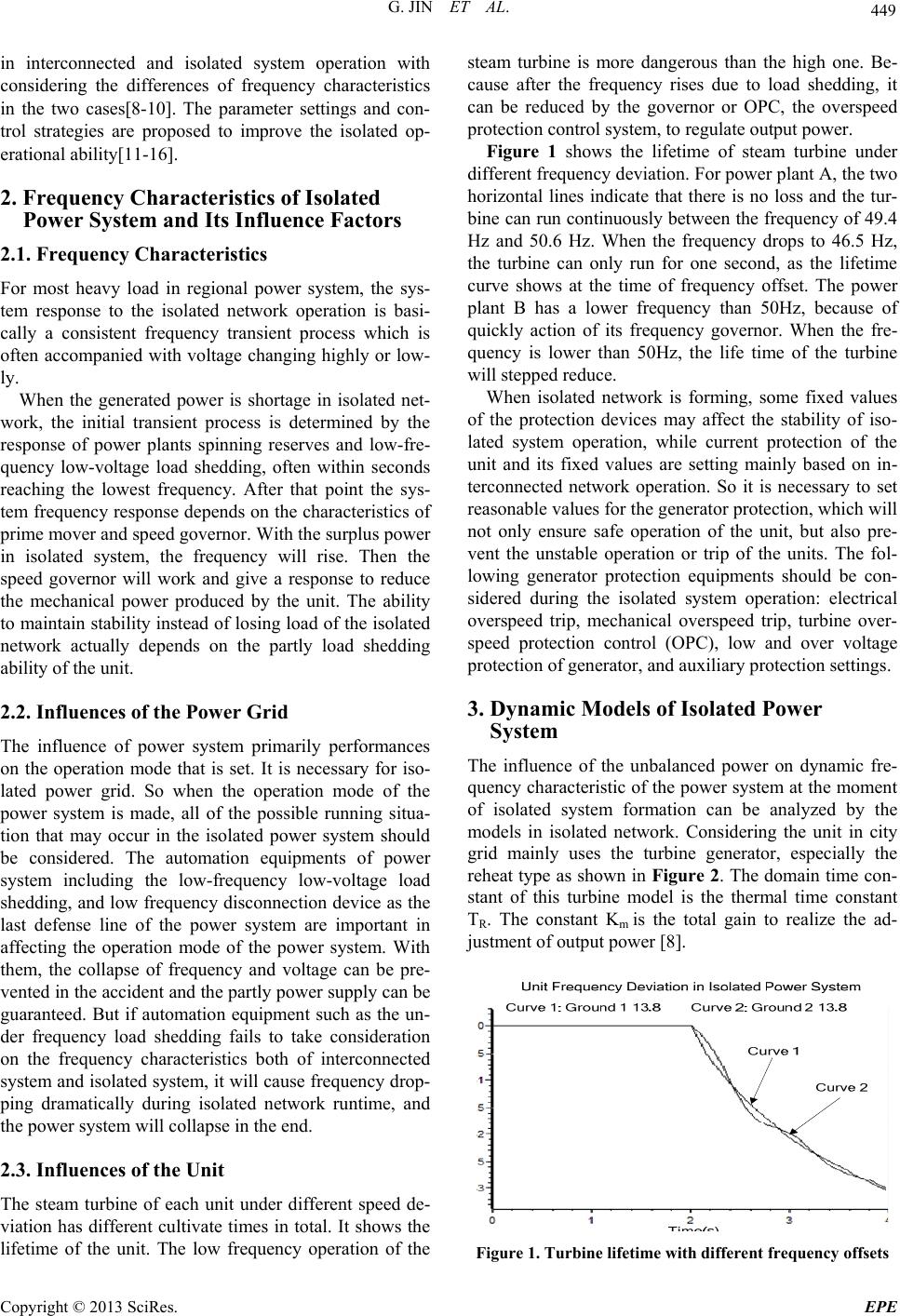 G. JIN ET AL. 449 in interconnected and isolated system operation with considering the differences of frequency characteristics in the two cases[8-10]. The parameter settings and con- trol strategies are proposed to improve the isolated op- erational ability[11-16]. 2. Frequency Characteristics of Isolated Power System and Its Influence Factors 2.1. Frequency Characteristics For most heavy load in regional power system, the sys- tem response to the isolated network operation is basi- cally a consistent frequency transient process which is often accompanied with voltage changing highly or low- ly. When the generated power is shortage in isolated net- work, the initial transient process is determined by the response of power plants spinning reserves and low-fre- quency low-voltage load shedding, often within seconds reaching the lowest frequency. After that point the sys- tem frequency response depends on the characteristics of prime mover and speed governor. With the surplus power in isolated system, the frequency will rise. Then the speed governor will work and give a response to reduce the mechanical power produced by the unit. The ability to maintain stability instead of losing load of the isolated network actually depends on the partly load shedding ability of the unit. 2.2. Influences of the Power Grid The influence of power system primarily performances on the operation mode that is set. It is necessary for iso- lated power grid. So when the operation mode of the power system is made, all of the possible running situa- tion that may occur in the isolated power system should be considered. The automation equipments of power system including the low-frequency low-voltage load shedding, and low frequency disconnection device as the last defense line of the power system are important in affecting the operation mode of the power system. With them, the collapse of frequency and voltage can be pre- vented in the accident and the partly power supply can be guaranteed. But if automation equipment such as the un- der frequency load shedding fails to take consideration on the frequency characteristics both of interconnected system and isolated system, it will cause frequency drop- ping dramatically during isolated network runtime, and the power system will collapse in the end. 2.3. Influences of the Unit The steam turbine of each unit under different speed de- viation has different cultivate times in total. It shows the lifetime of the unit. The low frequency operation of the steam turbine is more dangerous than the high one. Be- cause after the frequency rises due to load shedding, it can be reduced by the governor or OPC, the overspeed protection control system, to regulate output power. Figure 1 shows the lifetime of steam turbine under different frequency deviation. For power plant A, the two horizontal lines indicate that there is no loss and the tur- bine can run continuously between the frequency of 49.4 Hz and 50.6 Hz. When the frequency drops to 46.5 Hz, the turbine can only run for one second, as the lifetime curve shows at the time of frequency offset. The power plant B has a lower frequency than 50Hz, because of quickly action of its frequency governor. When the fre- quency is lower than 50Hz, the life time of the turbine will stepped reduce. When isolated network is forming, some fixed values of the protection devices may affect the stability of iso- lated system operation, while current protection of the unit and its fixed values are setting mainly based on in- terconnected network operation. So it is necessary to set reasonable values for the generator protection, which will not only ensure safe operation of the unit, but also pre- vent the unstable operation or trip of the units. The fol- lowing generator protection equipments should be con- sidered during the isolated system operation: electrical overspeed trip, mechanical overspeed trip, turbine over- speed protection control (OPC), low and over voltage protection of generator, and auxiliary protection settings. 3. Dynamic Models of Isolated Power System The influence of the unbalanced power on dynamic fre- quency characteristic of the power system at the moment of isolated system formation can be analyzed by the models in isolated network. Considering the unit in city grid mainly uses the turbine generator, especially the reheat type as shown in Figure 2. The domain time con- stant of this turbine model is the thermal time constant TR. The constant Km is the total gain to realize the ad- justment of output power [8]. Figure 1. Turbine lifetime with different frequency offsets Copyright © 2013 SciRes. EPE 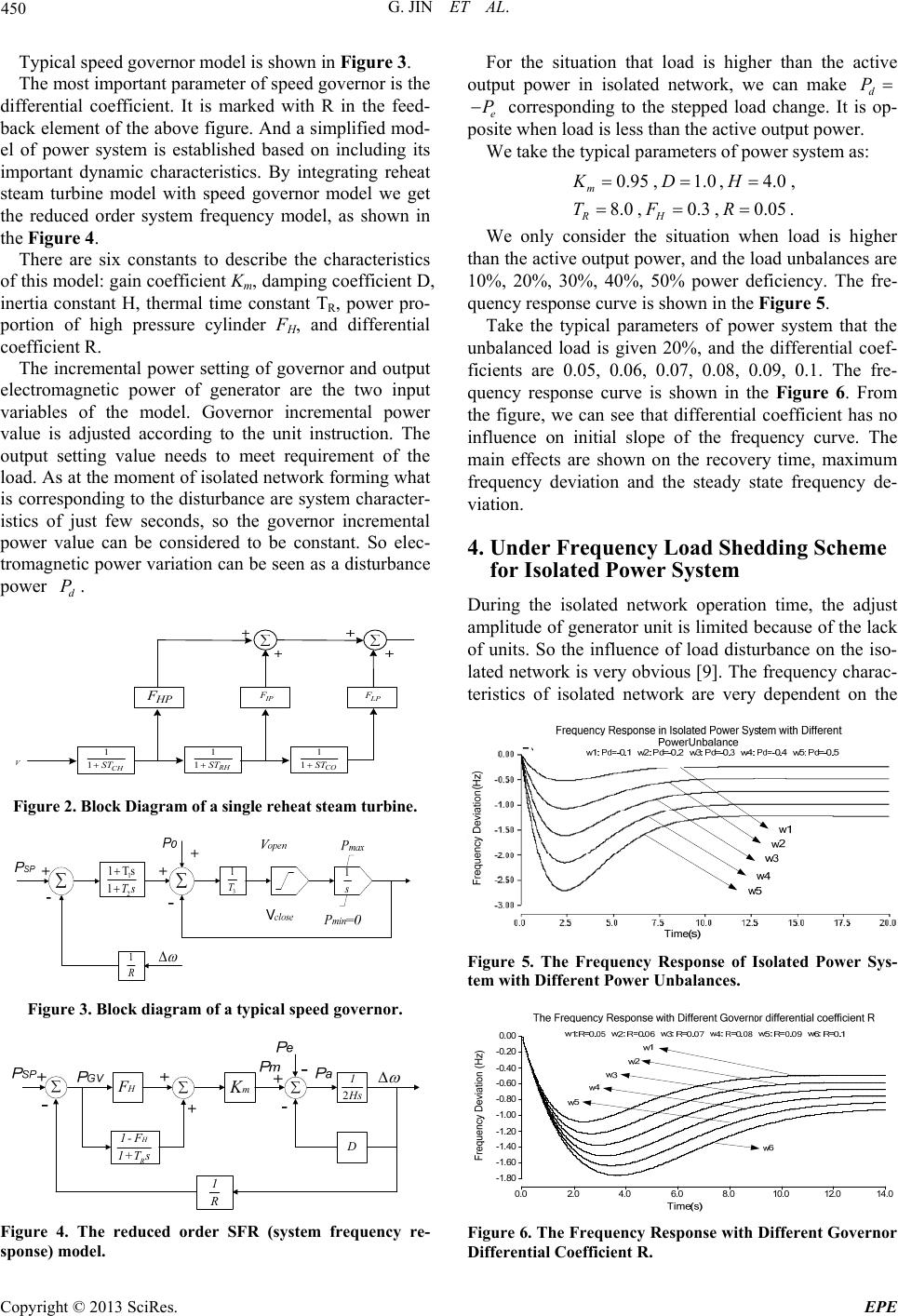 G. JIN ET AL. 450 Typical speed governor model is shown in Figur e 3. The most important parameter of speed governor is the differential coefficient. It is marked with R in the feed- back element of the above figure. And a simplified mod- el of power system is established based on including its important dynamic characteristics. By integrating reheat steam turbine model with speed governor model we get the reduced order system frequency model, as shown in the Figure 4. There are six constants to describe the characteristics of this model: gain coefficient Km, damping coefficient D, inertia constant H, thermal time constant TR, power pro- portion of high pressure cylinder FH, and differential coefficient R. The incremental power setting of governor and output electromagnetic power of generator are the two input variables of the model. Governor incremental power value is adjusted according to the unit instruction. The output setting value needs to meet requirement of the load. As at the moment of isolated network forming what is corresponding to the disturbance are system character- istics of just few seconds, so the governor incremental power value can be considered to be constant. So elec- tromagnetic power variation can be seen as a disturbance power . d P 1 1 CH ST V 1 1 RH ST 1 1 CO ST I P F L P F H P F Figure 2. Block Diagram of a single reh eat s team turbine. 1 2 1Ts 1Ts 3 1 T 1 R 1 s Figure 3. Block diagram of a typical speed governor. H R 1-F 1+T s H F m K D 2 1 Hs 1 R Figure 4. The reduced order SFR (system frequency re- sponse) model. For the situation that load is higher than the active output power in isolated network, we can make d P e P corresponding to the stepped load change. It is op- posite when load is less than the active output power. We take the typical parameters of power system as: 0.95 m K , ,, 1.0D4.0H 8.0 R T ,0.3 H F ,. 0.05R We only consider the situation when load is higher than the active output power, and the load unbalances are 10%, 20%, 30%, 40%, 50% power deficiency. The fre- quency response curve is shown in the Figure 5. Take the typical parameters of power system that the unbalanced load is given 20%, and the differential coef- ficients are 0.05, 0.06, 0.07, 0.08, 0.09, 0.1. The fre- quency response curve is shown in the Figure 6. From the figure, we can see that differential coefficient has no influence on initial slope of the frequency curve. The main effects are shown on the recovery time, maximum frequency deviation and the steady state frequency de- viation. 4. Under Frequency Load Shedding Scheme for Isolated Power System During the isolated network operation time, the adjust amplitude of generator unit is limited because of the lack of units. So the influence of load disturbance on the iso- lated network is very obvious [9]. The frequency charac- teristics of isolated network are very dependent on the Figure 5. The Frequency Response of Isolated Power Sys- tem with Different Power Unbalances. Main : Gra p hs 0.0 2.0 4.0 6.0 8.0 10.0 12.0 14.0 -1.80 -1.60 -1.40 -1.20 -1.00 -0.80 -0.60 -0.40 -0.20 0.00 频率偏差 (Hz) ω1(R=0.05) ω2(R=0.06) ω3(R=0.07) ω4(R=0.08) ω5(R=0.09) ω5(R=0.1) Figure 6. The Frequency Response with Different Governor Differential Coefficient R. Copyright © 2013 SciRes. EPE 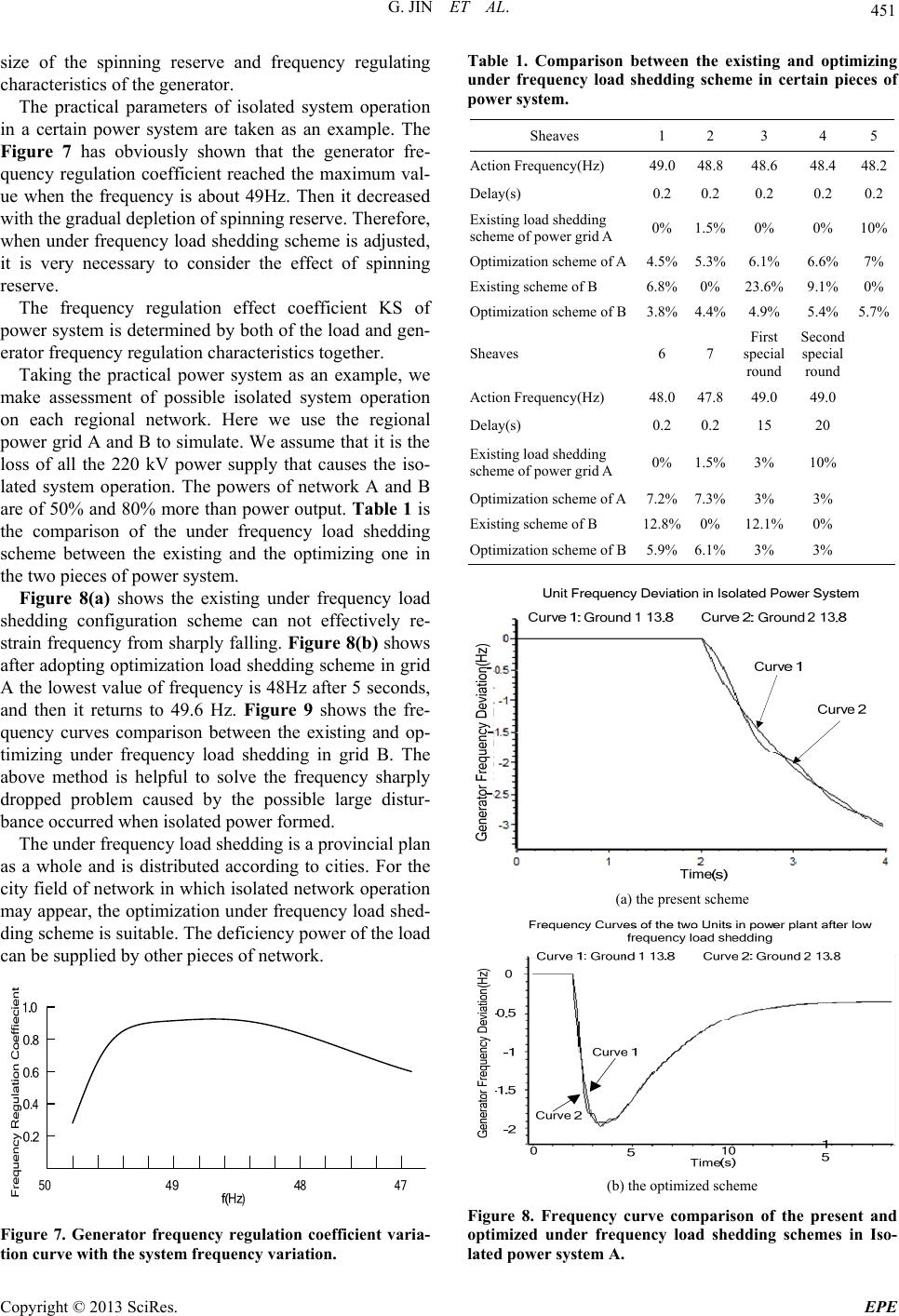 G. JIN ET AL. 451 size of the spinning reserve and frequency regulating characteristics of the generator. The practical parameters of isolated system operation in a certain power system are taken as an example. The Figure 7 has obviously shown that the generator fre- quency regulation coefficient reached the maximum val- ue when the frequency is about 49Hz. Then it decreased with the gradual depletion of spinning reserve. Therefore, when under frequency load shedding scheme is adjusted, it is very necessary to consider the effect of spinning reserve. The frequency regulation effect coefficient KS of power system is determined by both of the load and gen- erator frequency regulation characteristics together. Taking the practical power system as an example, we make assessment of possible isolated system operation on each regional network. Here we use the regional power grid A and B to simulate. We assume that it is the loss of all the 220 kV power supply that causes the iso- lated system operation. The powers of network A and B are of 50% and 80% more than power output. Table 1 is the comparison of the under frequency load shedding scheme between the existing and the optimizing one in the two pieces of power system. Figure 8(a) shows the existing under frequency load shedding configuration scheme can not effectively re- strain frequency from sharply falling. Figure 8( b) shows after adopting optimization load shedding scheme in grid A the lowest value of frequency is 48Hz after 5 seconds, and then it returns to 49.6 Hz. Figure 9 shows the fre- quency curves comparison between the existing and op- timizing under frequency load shedding in grid B. The above method is helpful to solve the frequency sharply dropped problem caused by the possible large distur- bance occurred when isolated power formed. The under frequency load shedding is a provincial plan as a whole and is distributed according to cities. For the city field of network in which isolated network operation may appear, the optimization under frequency load shed- ding scheme is suitable. The deficiency power of the load can be supplied by other pieces of network. Figure 7. Generator frequency regulation coefficient varia- tion curve with the system frequency variation. Table 1. Comparison between the existing and optimizing under frequency load shedding scheme in certain pieces of power system. Sheaves 1 2 3 4 5 Action Frequency(Hz) 49.048.8 48.6 48.4 48.2 Delay(s) 0.20.2 0.2 0.2 0.2 Existing load shedding scheme of power grid A 0% 1.5% 0% 0% 10% Optimization scheme of A4.5% 5.3% 6.1% 6.6%7% Existing scheme of B 6.8% 0% 23.6% 9.1% 0% Optimization scheme of B3.8% 4.4% 4.9% 5.4%5.7% Sheaves 6 7 First special round Second special round Action Frequency(Hz) 48.047.8 49.0 49.0 Delay(s) 0.20.2 15 20 Existing load shedding scheme of power grid A 0% 1.5% 3% 10% Optimization scheme of A7.2% 7.3% 3% 3% Existing scheme of B 12.8% 0% 12.1% 0% Optimization scheme of B5.9% 6.1% 3% 3% (a) the present scheme (b) the optimized scheme Figure 8. Frequency curve comparison of the present and optimized under frequency load shedding schemes in Iso- lated power system A. Copyright © 2013 SciRes. EPE 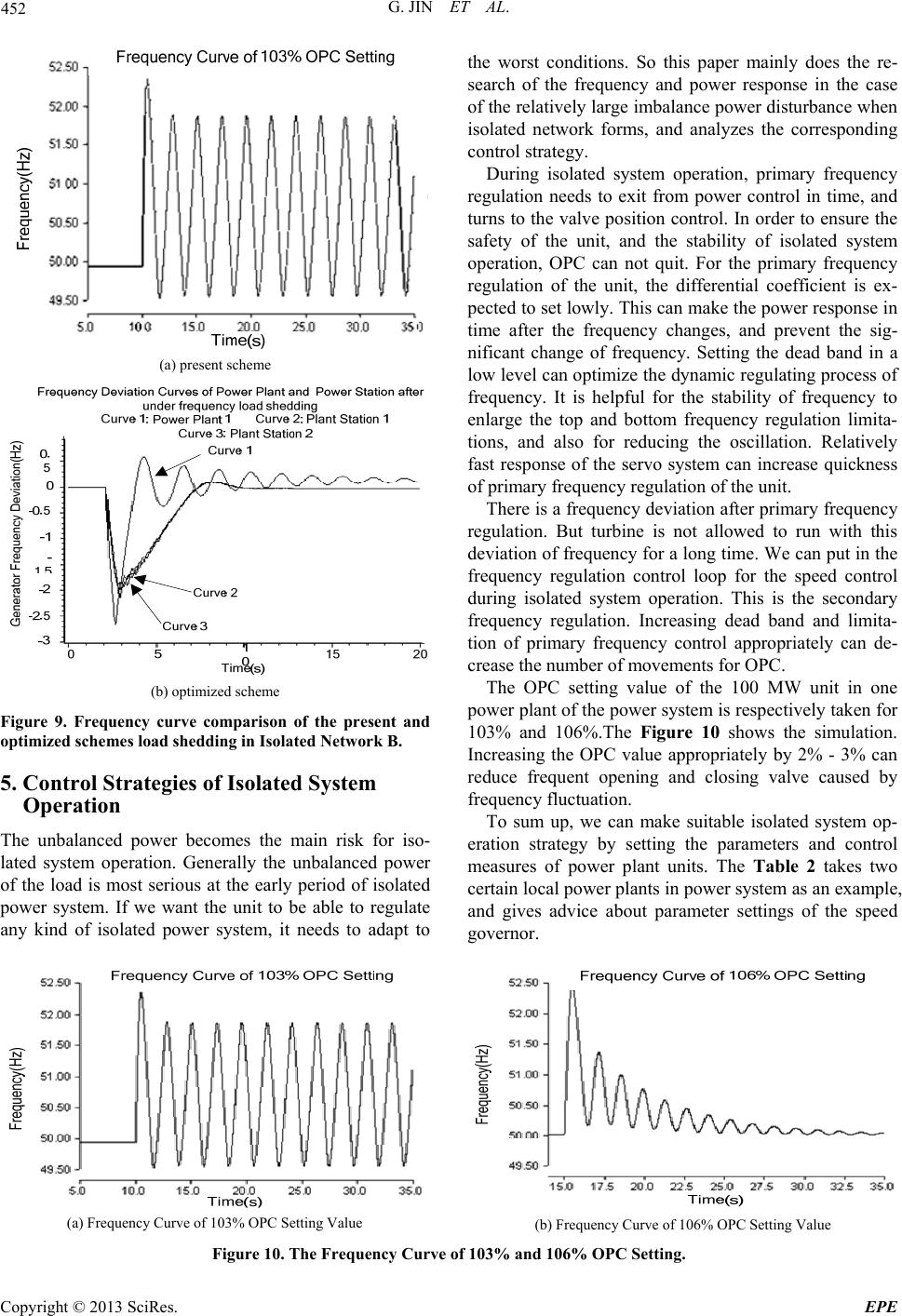 G. JIN ET AL. Copyright © 2013 SciRes. EPE 452 the worst conditions. So this paper mainly does the re- search of the frequency and power response in the case of the relatively large imbalance power disturbance when isolated network forms, and analyzes the corresponding control strategy. During isolated system operation, primary frequency regulation needs to exit from power control in time, and turns to the valve position control. In order to ensure the safety of the unit, and the stability of isolated system operation, OPC can not quit. For the primary frequency regulation of the unit, the differential coefficient is ex- pected to set lowly. This can make the power response in time after the frequency changes, and prevent the sig- nificant change of frequency. Setting the dead band in a low level can optimize the dynamic regulating process of frequency. It is helpful for the stability of frequency to enlarge the top and bottom frequency regulation limita- tions, and also for reducing the oscillation. Relatively fast response of the servo system can increase quickness of primary frequency regulation of the unit. (a) present scheme There is a frequency deviation after primary frequency regulation. But turbine is not allowed to run with this deviation of frequency for a long time. We can put in the frequency regulation control loop for the speed control during isolated system operation. This is the secondary frequency regulation. Increasing dead band and limita- tion of primary frequency control appropriately can de- crease the number of movements for OPC. The OPC setting value of the 100 MW unit in one power plant of the power system is respectively taken for 103% and 106%.The Figure 10 shows the simulation. Increasing the OPC value appropriately by 2% - 3% can reduce frequent opening and closing valve caused by frequency fluctuation. (b) optimized scheme Figure 9. Frequency curve comparison of the present and optimized schemes load shedding in Isolated Network B. 5. Control Strategies of Isolated System Operation To sum up, we can make suitable isolated system op- eration strategy by setting the parameters and control measures of power plant units. The Table 2 takes two certain local power plants in power system as an example, and gives advice about parameter settings of the speed governor. The unbalanced power becomes the main risk for iso- lated system operation. Generally the unbalanced power of the load is most serious at the early period of isolated power system. If we want the unit to be able to regulate any kind of isolated power system, it needs to adapt to (a) Frequency Curve of 103% OPC Setting Value (b) Frequency Curve of 106% OPC Setting Value Figure 10. The Frequency Curve of 103% and 106% OPC Setting. 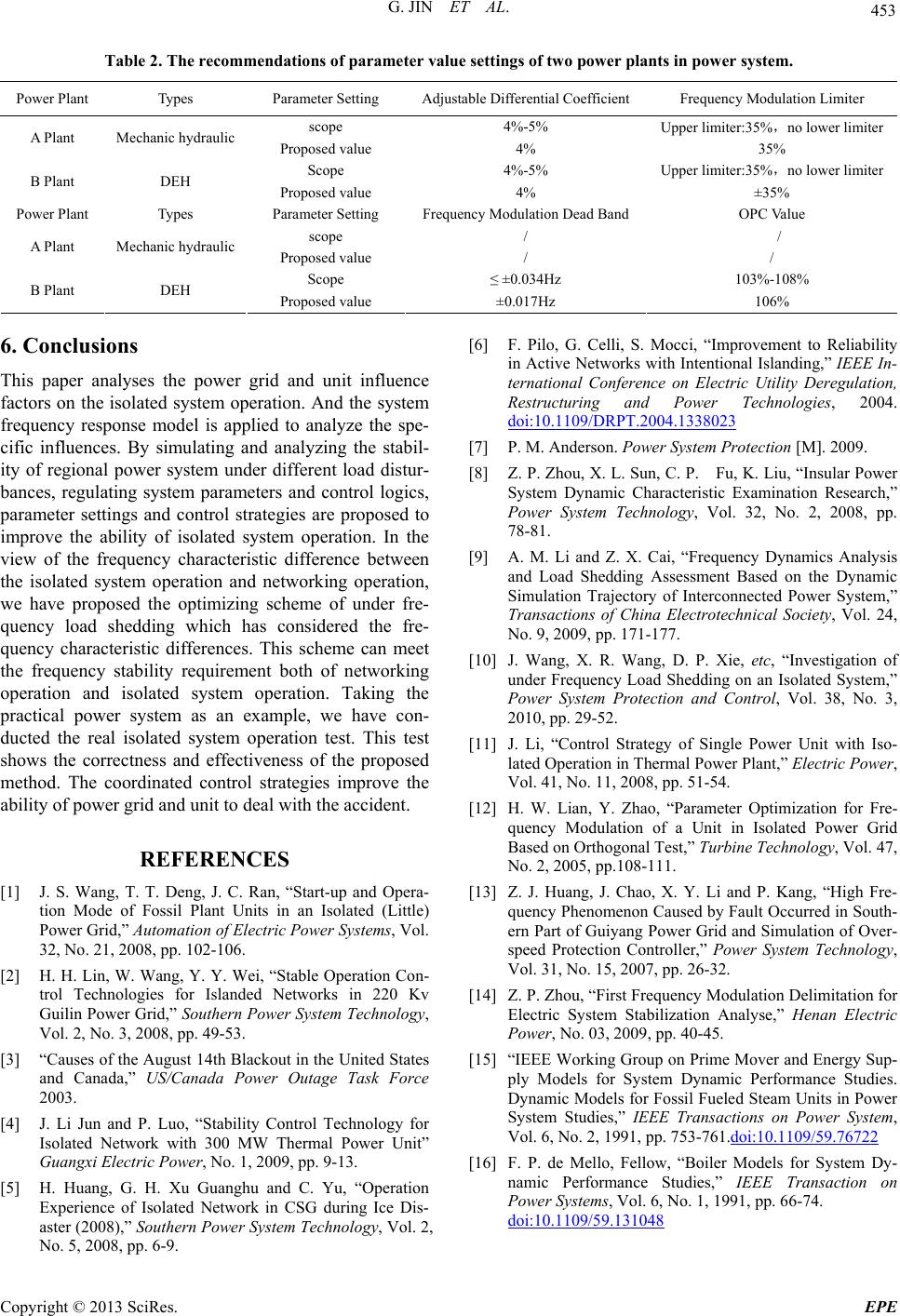 G. JIN ET AL. 453 Table 2. The recommendations of parameter value settings of two power plants in power system. Power Plant Types Parameter Setting Adjustable Differential Coefficient Frequency Modulation Limiter scope 4%-5% Upper limiter:35%,no lower limiter A Plant Mechanic hydraulicProposed value 4% 35% Scope 4%-5% Upper limiter:35%,no lower limiter B Plant DEH Proposed value 4% ±35% Power Plant Types Parameter Setting Frequency Modulation Dead Band OPC Value scope / / A Plant Mechanic hydraulicProposed value / / Scope ≤ ±0.034Hz 103%-108% B Plant DEH Proposed value ±0.017Hz 106% 6. Conclusions This paper analyses the power grid and unit influence factors on the isolated system operation. And the system frequency response model is applied to analyze the spe- cific influences. By simulating and analyzing the stabil- ity of regional power system under different load distur- bances, regulating system parameters and control logics, parameter settings and control strategies are proposed to improve the ability of isolated system operation. In the view of the frequency characteristic difference between the isolated system operation and networking operation, we have proposed the optimizing scheme of under fre- quency load shedding which has considered the fre- quency characteristic differences. This scheme can meet the frequency stability requirement both of networking operation and isolated system operation. Taking the practical power system as an example, we have con- ducted the real isolated system operation test. This test shows the correctness and effectiveness of the proposed method. The coordinated control strategies improve the ability of power grid and unit to deal with the accident. REFERENCES [1] J. S. Wang, T. T. Deng, J. C. Ran, “Start-up and Opera- tion Mode of Fossil Plant Units in an Isolated (Little) Power Grid,” Automation of Electric Power Systems, Vol. 32, No. 21, 2008, pp. 102-106. [2] H. H. Lin, W. Wang, Y. Y. Wei, “Stable Operation Con- trol Technologies for Islanded Networks in 220 Kv Guilin Power Grid,” Southern Power System Technology, Vol. 2, No. 3, 2008, pp. 49-53. [3] “Causes of the August 14th Blackout in the United States and Canada,” US/Canada Power Outage Task Force 2003. [4] J. Li Jun and P. Luo, “Stability Control Technology for Isolated Network with 300 MW Thermal Power Unit” Guangxi Electric Power, No. 1, 2009, pp. 9-13. [5] H. Huang, G. H. Xu Guanghu and C. Yu, “Operation Experience of Isolated Network in CSG during Ice Dis- aster (2008),” Southern Power System Technology, Vol. 2, No. 5, 2008, pp. 6-9. [6] F. Pilo, G. Celli, S. Mocci, “Improvement to Reliability in Active Networks with Intentional Islanding,” IEEE In- ternational Conference on Electric Utility Deregulation, Restructuring and Power Technologies, 2004. doi:10.1109/DRPT.2004.1338023 [7] P. M. Anderson. Power System Protection [M]. 2009. [8] Z. P. Zhou, X. L. Sun, C. P. Fu, K. Liu, “Insular Power System Dynamic Characteristic Examination Research,” Power System Technology, Vol. 32, No. 2, 2008, pp. 78-81. [9] A. M. Li and Z. X. Cai, “Frequency Dynamics Analysis and Load Shedding Assessment Based on the Dynamic Simulation Trajectory of Interconnected Power System,” Transactions of China Electrotechnical Society, Vol. 24, No. 9, 2009, pp. 171-177. [10] J. Wang, X. R. Wang, D. P. Xie, etc, “Investigation of under Frequency Load Shedding on an Isolated System,” Power System Protection and Control, Vol. 38, No. 3, 2010, pp. 29-52. [11] J. Li, “Control Strategy of Single Power Unit with Iso- lated Operation in Thermal Power Plant,” Electric Power, Vol. 41, No. 11, 2008, pp. 51-54. [12] H. W. Lian, Y. Zhao, “Parameter Optimization for Fre- quency Modulation of a Unit in Isolated Power Grid Based on Orthogonal Test,” Turbine Technology, Vol. 47, No. 2, 2005, pp.108-111. [13] Z. J. Huang, J. Chao, X. Y. Li and P. Kang, “High Fre- quency Phenomenon Caused by Fault Occurred in South- ern Part of Guiyang Power Grid and Simulation of Over- speed Protection Controller,” Power System Technology, Vol. 31, No. 15, 2007, pp. 26-32. [14] Z. P. Zhou, “First Frequency Modulation Delimitation for Electric System Stabilization Analyse,” Henan Electric Power, No. 03, 2009, pp. 40-45. [15] “IEEE Working Group on Prime Mover and Energy Sup- ply Models for System Dynamic Performance Studies. Dynamic Models for Fossil Fueled Steam Units in Power System Studies,” IEEE Transactions on Power System, Vol. 6, No. 2, 1991, pp. 753-761.doi:10.1109/59.76722 [16] F. P. de Mello, Fellow, “Boiler Models for System Dy- namic Performance Studies,” IEEE Transaction on Power Systems, Vol. 6, No. 1, 1991, pp. 66-74. doi:10.1109/59.131048 Copyright © 2013 SciRes. EPE |