

Paper Menu >>
Journal Menu >>
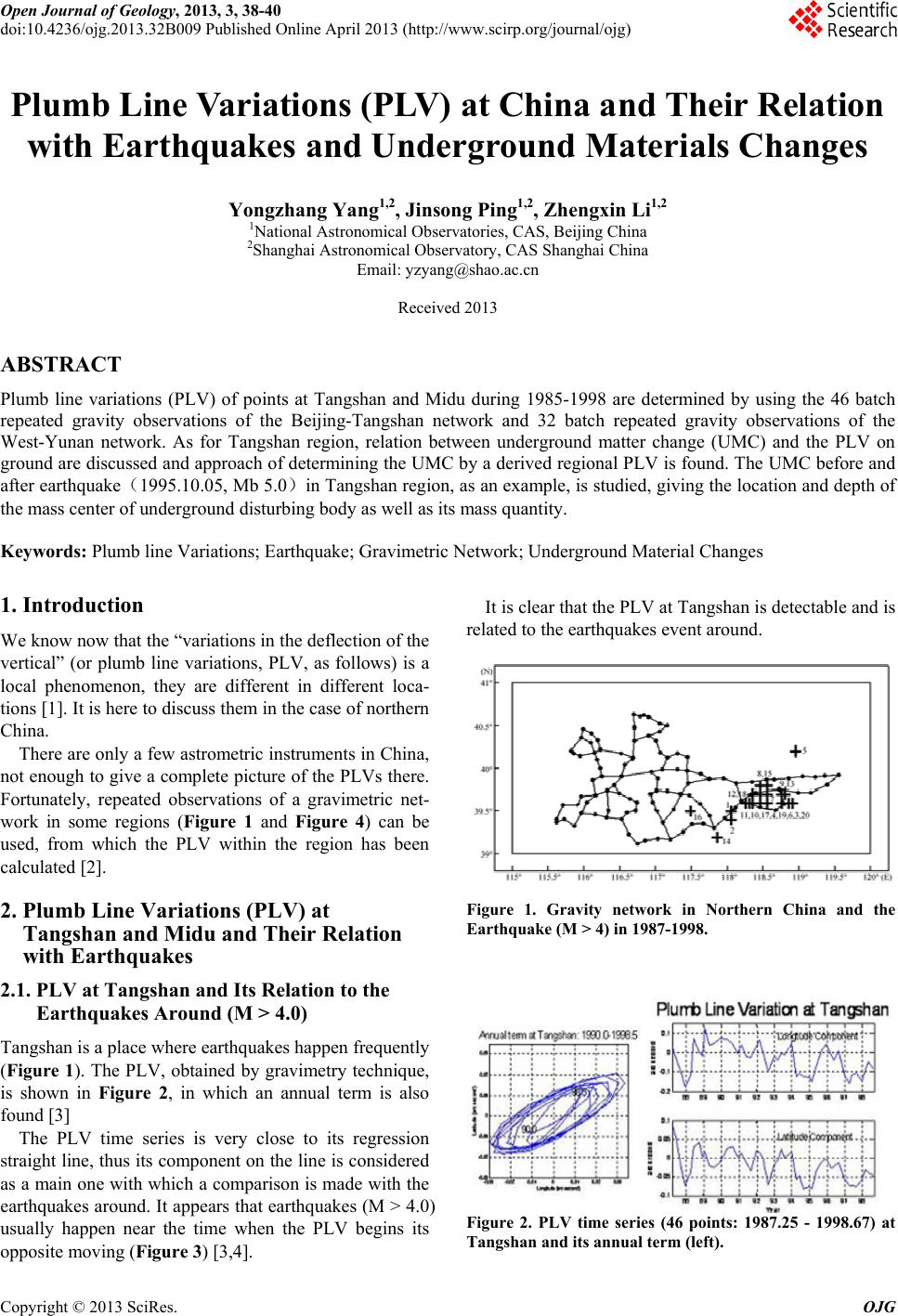 Open Journal of Geology, 2013, 3, 38-40 doi:10.4236/ojg.2013.32B009 Published Online April 2013 (http://www.scirp.org/journal/ojg) Plumb Line Variations (PLV) at China and Their Relation with Earthquakes and Underground Materials Changes Yongzhang Yang1,2, Jinsong Ping1,2, Zhengxin Li1,2 1National Astronomical Observatories, CAS, Beijing China 2Shanghai Astronomical Observatory, CAS Shanghai China Email: [email protected] Received 2013 ABSTRACT Plumb line variations (PLV) of points at Tangshan and Midu during 1985-1998 are determined by using the 46 batch repeated gravity observations of the Beijing-Tangshan network and 32 batch repeated gravity observations of the West-Yunan network. As for Tangshan region, relation between underground matter change (UMC) and the PLV on ground are discussed and approach of determining the UMC by a derived regional PLV is found. The UMC before and after earthquake(1995.10.05, Mb 5.0)in Tangshan region, as an example, is studied, giving the location and depth of the mass center of underground disturbing body as well as its mass quantity. Keywords: Plumb line Variations; Earthquake; Gravimetric Network; Underground Material Changes 1. Introduction We know now that the “variations in the deflection of the vertical” (or plumb line variations, PLV, as follows) is a local phenomenon, they are different in different loca- tions [1]. It is here to discuss them in the case of northern China. There are only a few astrometric instruments in China, not enough to give a complete picture of the PLVs there. Fortunately, repeated observations of a gravimetric net- work in some regions (Figure 1 and Figure 4) can be used, from which the PLV within the region has been calculated [2]. 2. Plumb Line Variations (PLV) at Tangshan and Midu and Their Relation with Earthquakes 2.1. PLV at Tangshan and Its Relation to the Earthquakes Around (M > 4.0) Tangshan is a place where earthquakes happen frequently (Figure 1). The PLV, obtained by gravimetry technique, is shown in Figure 2, in which an annual term is also found [3] The PLV time series is very close to its regression straight line, thus its component on the line is considered as a main one with which a comparison is made with the earthquakes around. It appears that earthquakes (M > 4.0) usually happen near the time when the PLV begins its opposite moving (Figure 3) [3,4]. It is clear that the PLV at Tangshan is detectable and is related to the earthquakes ev ent around. Figure 1. Gravity network in Northern China and the Earthquake (M > 4) in 1987-1998. Figure 2. PLV time series (46 points: 1987.25 - 1998.67) at Tangshan and its annual term (left). Copyright © 2013 SciRes. OJG 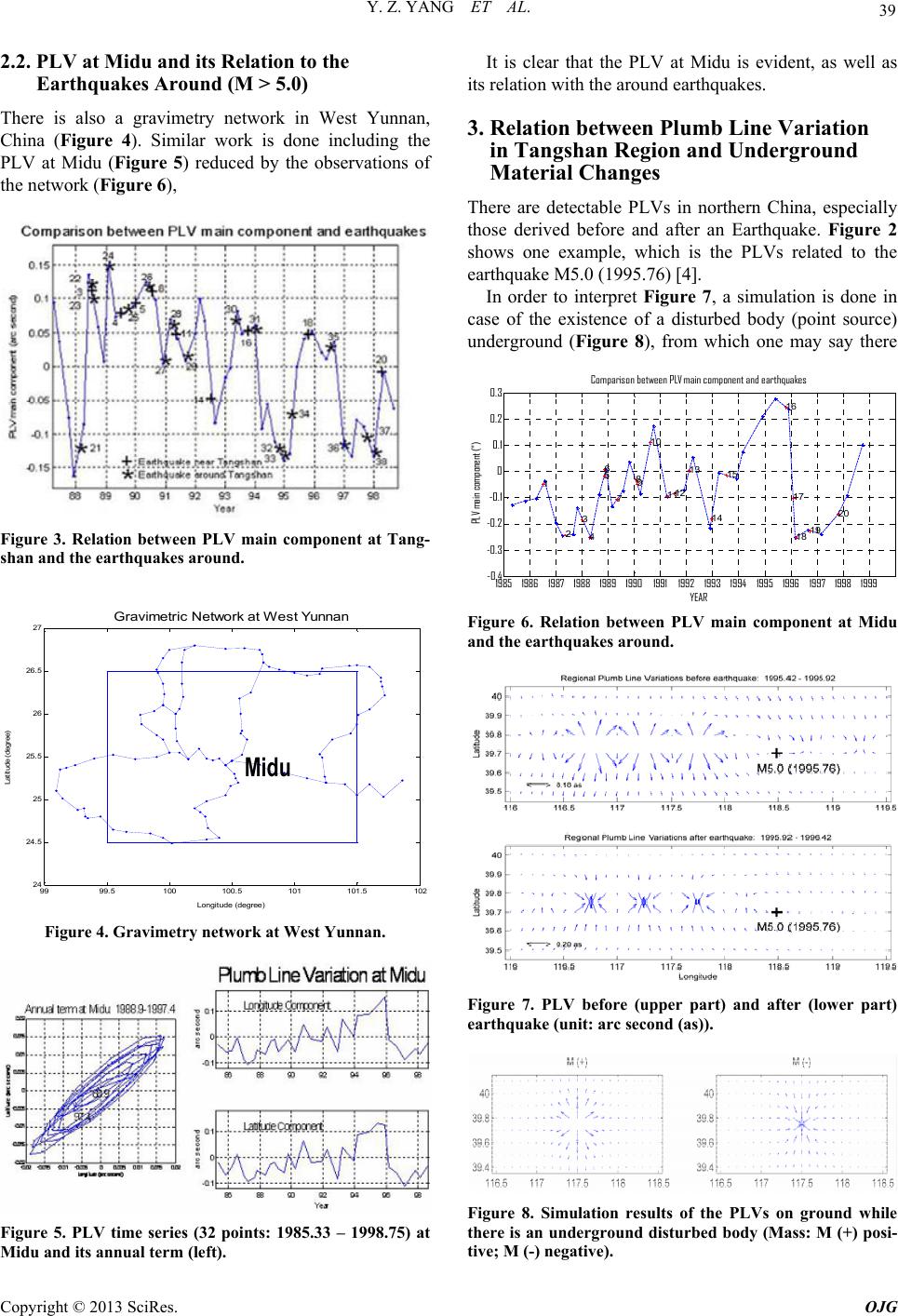 Y. Z. YANG ET AL. 39 2.2. PLV at Midu and its Relation to the Earthquakes Around (M > 5.0) There is also a gravimetry network in West Yunnan, China (Figure 4). Similar work is done including the PLV at Midu (Figure 5) reduced by the observations of the network (Figure 6), Figure 3. Relation between PLV main component at Tang- shan and the earthquakes around. 99 99.5 100 100.5101 101.5102 24 24.5 25 25.5 26 26.5 27 Gravimetric Network at West Yunnan Longitude (degree) Latitude (degree) Midu Figure 4. Gravimetry network at West Yunnan. Figure 5. PLV time series (32 points: 1985.33 – 1998.75) at Midu and its annual term (left). It is clear that the PLV at Midu is evident, as well as its relation with the around earthquakes. 3. Relation between Plumb Line Variation in Tangshan Region and Underground Material Changes There are detectable PLVs in northern China, especially those derived before and after an Earthquake. Figure 2 shows one example, which is the PLVs related to the earthquake M5 .0 (1995.76) [4 ] . In order to interpret Figure 7, a simulation is done in case of the existence of a disturbed body (point source) underground (Figure 8), from which one may say there 1985 19861987198819891990 1991 1992 19931994 1995 1996 1997 19981999 -0.4 -0.3 -0.2 -0.1 0 0.1 0.2 0.3 1 2 3 4 5 6 7 8 9 10 11 12 13 14 15 16 17 18 19 20 YEAR PLV main component (") Comparison between PLV main component and earthquakes Figure 6. Relation between PLV main component at Midu and the earthquakes ar ound. Figure 7. PLV before (upper part) and after (lower part) earthquake (unit: arc sec ond (as)). Figure 8. Simulation results of the PLVs on ground while there is an underground disturbed body (Mass: M (+) posi- tive; M (-) negative). Copyright © 2013 SciRes. OJG 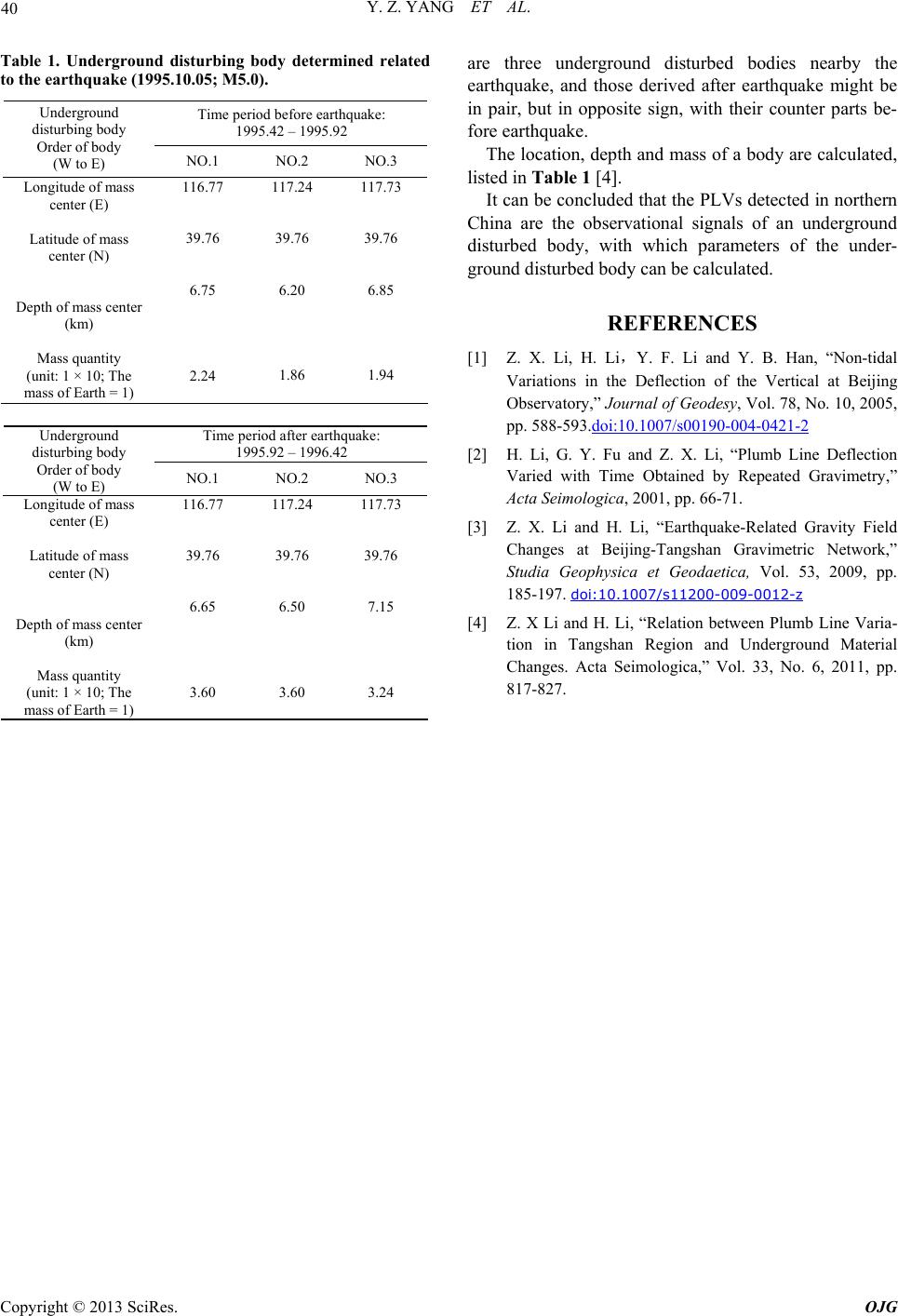 Y. Z. YANG ET AL. Copyright © 2013 SciRes. OJG 40 Table 1. Underground disturbing body determined related to the earthquake (1995.10.05; M5.0). Time period before earthquake: 1995.42 – 1995.92 Underground disturbing body Order of body (W to E) NO.1 NO.2 NO.3 Longitude of mass center (E) Latitude of mass center (N) Depth of mass center (km) Mass quantity (unit: 1 × 10; The mass of Eart h = 1) 116.77 39.76 6.75 2.24 117.24 39.76 6.20 1.86 117.73 39.76 6.85 1.94 Time period after earthquake: 1995.92 – 1996.42 Underground disturbing body Order of body (W to E) NO.1 NO.2 NO.3 Longitude of mass center (E) Latitude of mass center (N) Depth of mass center (km) Mass quantity (unit: 1 × 10; The mass of Eart h = 1) 116.77 39.76 6.65 3.60 117.24 39.76 6.50 3.60 117.73 39.76 7.15 3.24 are three underground disturbed bodies nearby the earthquake, and those derived after earthquake might be in pair, but in opposite sign, with their counter parts be- fore earthquake. The loc ation, depth and mass o f a body are calcula ted, listed in Table 1 [4]. It can be conclud ed that the PLVs detected in northern China are the observational signals of an underground disturbed body, with which parameters of the under- ground distu rb e d bo dy ca n be calculated. REFERENCES [1] Z. X. Li, H. Li,Y. F. Li and Y. B. Han, “Non-tidal Variations in the Deflection of the Vertical at Beijing Observatory,” Journal of Geodesy, Vol. 78, No. 10, 2005, pp. 588-593.doi:10.1007/s00190-004-0421-2 [2] H. Li, G. Y. Fu and Z. X. Li, “Plumb Line Deflection Varied with Time Obtained by Repeated Gravimetry,” Acta Seimologica, 2001, pp. 66-71. [3] Z. X. Li and H. Li, “Earthquake-Related Gravity Field Changes at Beijing-Tangshan Gravimetric Network,” Studia Geophysica et Geodaetica, Vol. 53, 2009, pp. 185-197. doi:10.1007/s11200-009-0012-z [4] Z. X Li and H. Li, “Relation between Plumb Line Varia- tion in Tangshan Region and Underground Material Changes. Acta Seimologica,” Vol. 33, No. 6, 2011, pp. 817-827. |