

Paper Menu >>
Journal Menu >>
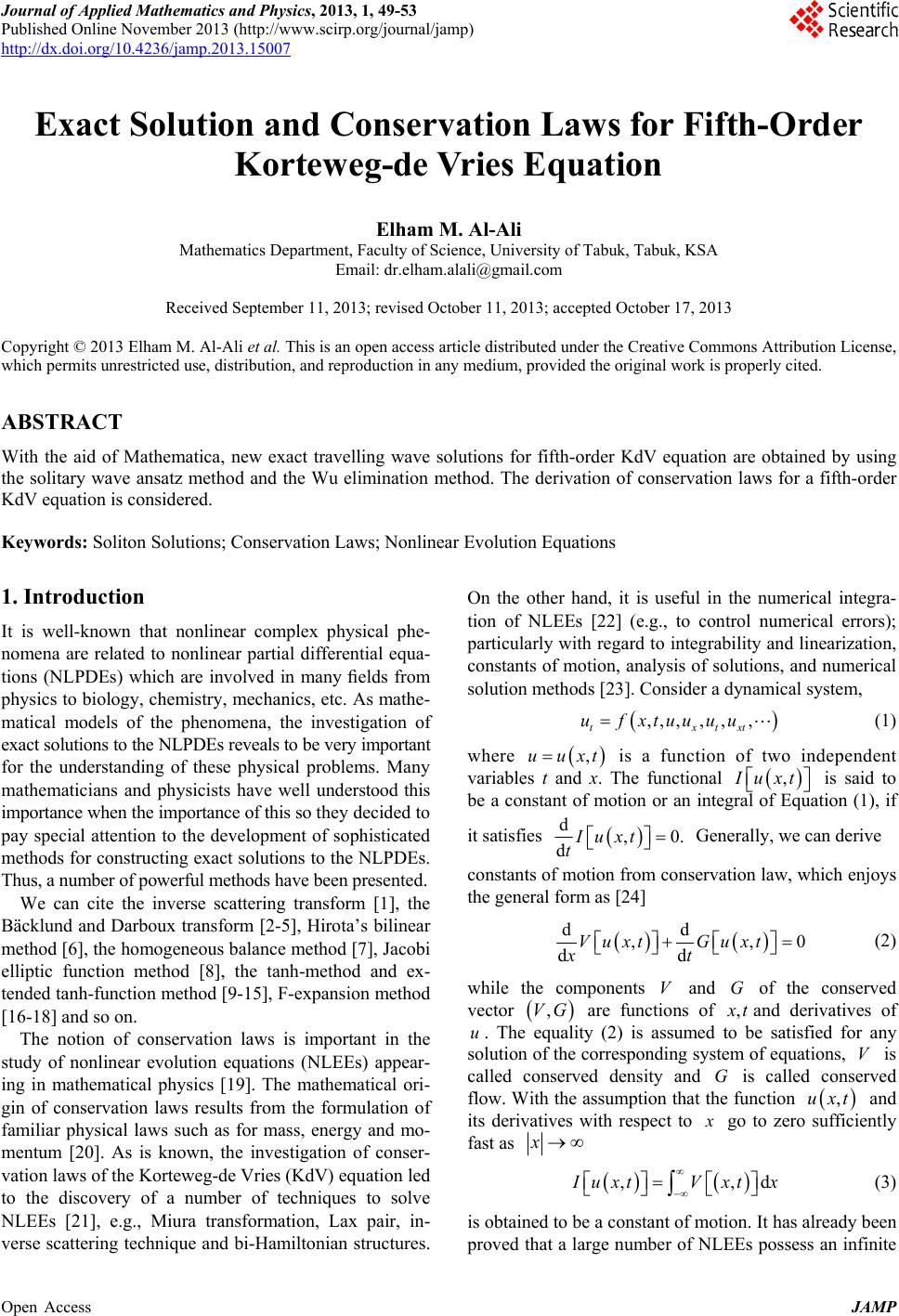 Journal of Applied Mathematics and Physics, 2013, 1, 49-53 Published Online November 2013 (http://www.scirp.org/journal/jamp) http://dx.doi.org/10.4236/jamp.2013.15007 Open Access JAMP Exact Solution and Conservation Laws for Fifth-Order Korteweg-de Vr ies Equation Elham M. Al-Ali Mathematics Department, Faculty of Science, University of Tabuk, Tabuk, KSA Email: [email protected] Received September 11, 2013; revised October 11, 2013; accepted October 17, 2013 Copyright © 2013 Elham M. Al-Ali et al. This is an open access article distributed under the Creative Commons Attribution License, which permits unrestricted use, distribution, and reproduction in any medium, provided the original work is properly cited. ABSTRACT With the aid of Mathematica, new exact travelling wave solutions for fifth-order KdV equation are obtained by using the solitary wave ansatz method and the Wu elimination method. The derivation of conservation laws for a fifth-order KdV equation is considered. Keywords: Soliton Solutions; Conservation Laws; Nonlinear Evolution Equations 1. Introduction It is well-known that nonlinear complex physical phe- nomena are related to nonlinear partial differential equa- tions (NLPDEs) which are involved in many fields from physics to biology, chemistry, mechanics, etc. As mathe- matical models of the phenomena, the investigation of exact solutions to the NLPDEs reveals to be very important for the understanding of these physical problems. Many mathematicians and physicists have well understood this importance when the importance of this so they decided to pay special attention to the development of sophisticated methods for constructing exact solutions to the NLPDEs. Thus, a number of powerful methods have been presented. We can cite the inverse scattering transform [1], the Bäcklund and Darboux transform [2-5], Hirota’s bilinear method [6], the homogeneous balance method [7], Jacobi elliptic function method [8], the tanh-method and ex- tended tanh-function method [9-15], F-expansion method [16-18] and so on. The notion of conservation laws is important in the study of nonlinear evolution equations (NLEEs) appear- ing in mathematical physics [19]. The mathematical ori- gin of conservation laws results from the formulation of familiar physical laws such as for mass, energy and mo- mentum [20]. As is known, the investigation of conser- vation laws of the Korteweg-de Vries (KdV) equation led to the discovery of a number of techniques to solve NLEEs [21], e.g., Miura transformation, Lax pair, in- verse scattering technique and bi-Hamiltonian structures. On the other hand, it is useful in the numerical integra- tion of NLEEs [22] (e.g., to control numerical errors); particularly with regard to integrability and linearization, constants of motion, analysis of solutions, and numerical solution methods [23]. Consider a dynamical system, ,, ,,,, txt ufxtuuuu xt (1) where ,uuxt is a function of two independent variables t and x. The functional , I uxt is said to be a constant of motion or an integral of Equation (1), if it satisfies d, dIuxt t0. Generally, we can derive constants of motion from conservation law, which enjoys the general form as [24] dd ,, dd Vu xtG u xt xt 0 (2) while the components V and of the conserved vector G ,VG are functions of , x tand derivatives of . The equality (2) is assumed to be satisfied for any solution of the corresponding system of equations, is called conserved density and G is called conserved flow. With the assumption that the function uV t,ux and its derivatives with respect to x go to zero sufficiently fast as x ,,d I uxtVxtx (3) is obtained to be a constant of motion. It has already been proved that a large number of NLEEs possess an infinite 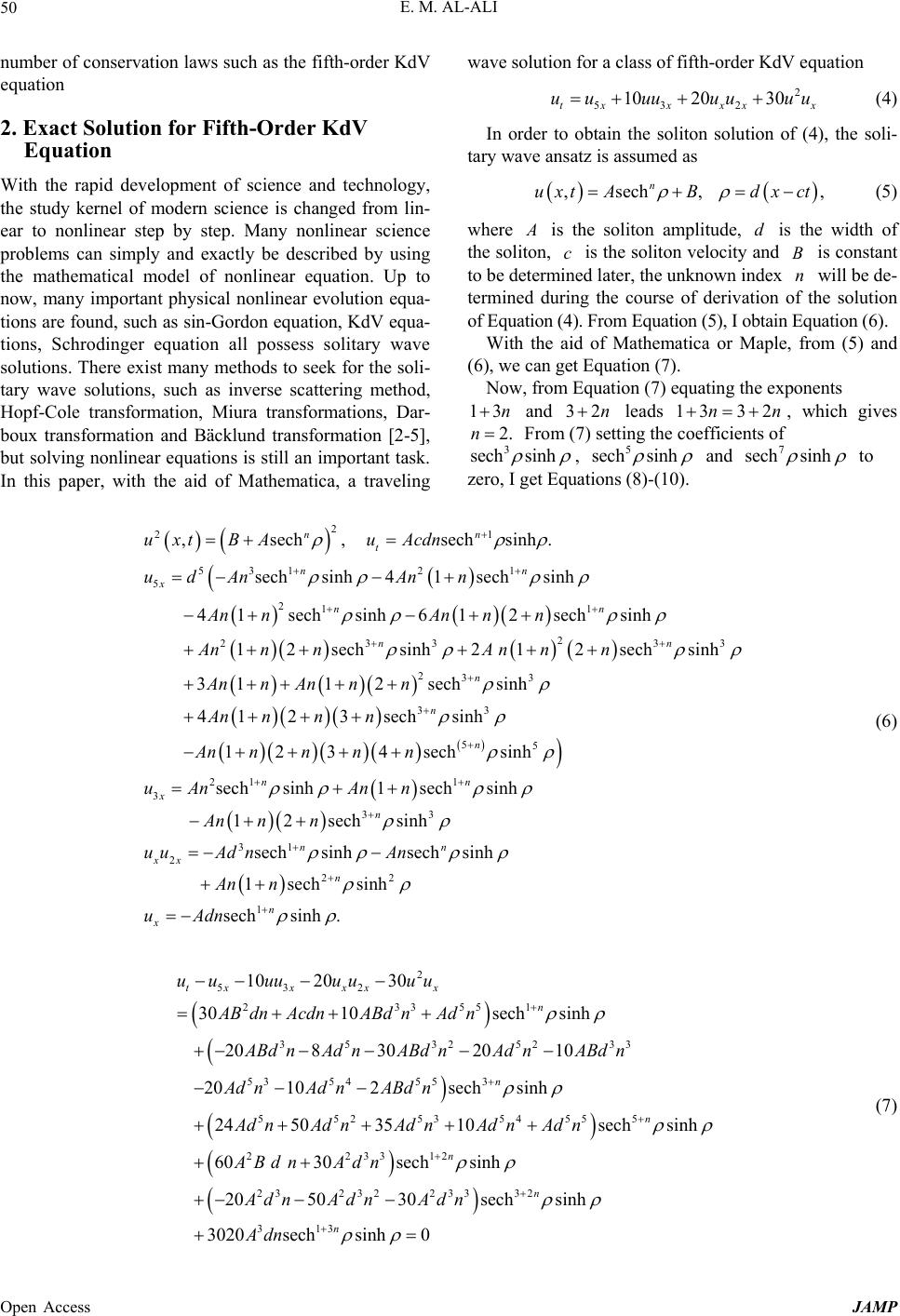 E. M. AL-ALI 50 number of conservation laws such as the fifth-order KdV equation 2. Exact Solution for Fifth-Order KdV Equation With the rapid development of science and technology, the study kernel of modern science is changed from lin- ear to nonlinear step by step. Many nonlinear science problems can simply and exactly be described by using the mathematical model of nonlinear equation. Up to now, many important physical nonlinear evolution equa- tions are found, such as sin-Gordon equation, KdV equa- tions, Schrodinger equation all possess solitary wave solutions. There exist many methods to seek for the soli- tary wave solutions, such as inverse scattering method, Hopf-Cole transformation, Miura transformations, Dar- boux transformation and Bäcklund transformation [2-5], but solving nonlinear equations is still an important task. In this paper, with the aid of Mathematica, a traveling wave solution for a class of fifth-order KdV equation 2 53 2 10 2030 txx xx uu uuuuuu x (4) In order to obtain the soliton solution of (4), the soli- tary wave ansatz is assumed as , sech,, n uxtABdx ct (5) where A is the soliton amplitude, is the width of the soliton, is the soliton velocity and d c B is constant to be determined later, the unknown index n will be de- termined during the course of derivation of the solution of Equation (4). From Equation (5), I obtain Equation (6). With the aid of Mathematica or Maple, from (5) and (6 uating the exponents ), we can get Equation (7). Now, from Equation (7) eq 13n and 32n leads 1332nn, which gives 2.n From (7) setting the coeffici sinh ents of 3 sech , 5 sech sinh and 7 sech sinh to zero, I get Equations (8)-(10). 2 21 5312 1 5 211 2 2333 23 ,sech,sechsinh . sech sinh41 sech sinh 4 1sechsinh6 12sechsinh 12sechsinh2 12sechsinh 3 112sech nn t nn x nn nn n uxtBAu Acdn udAnAnn An nAn nn AnnnA nnn Ann Annn 3 3 33 55 21 1 3 33 31 2 22 1 sinh 4 123sechsinh 1234 sechsinh sech sinh1 sech sinh 12sech sinh sechsinhsech sinh 1 sechsinh sech si n n nn x n nn xx n n x An nnn An nnnn uAn Ann An nn uu AdnAn An n uAdn nh . (6) 2 532 233551 35325233 535455 3 5525354555 10 2030 3010sechsinh 208 302010 20102sech sinh 24503510sech sinh 60 txx xxx n n n uu uuuuuu AB dnAcdnABdnAdn ABd nAd nABd nAd nABd n AdnAdn ABdn Ad nAd nAd nAd nAd n 223312 23232233 32 313 30sechsinh 205030sech sinh 3020sechsinh 0 n n n ABdn Adn Adn AdnAdn Adn (7) Open Access JAMP 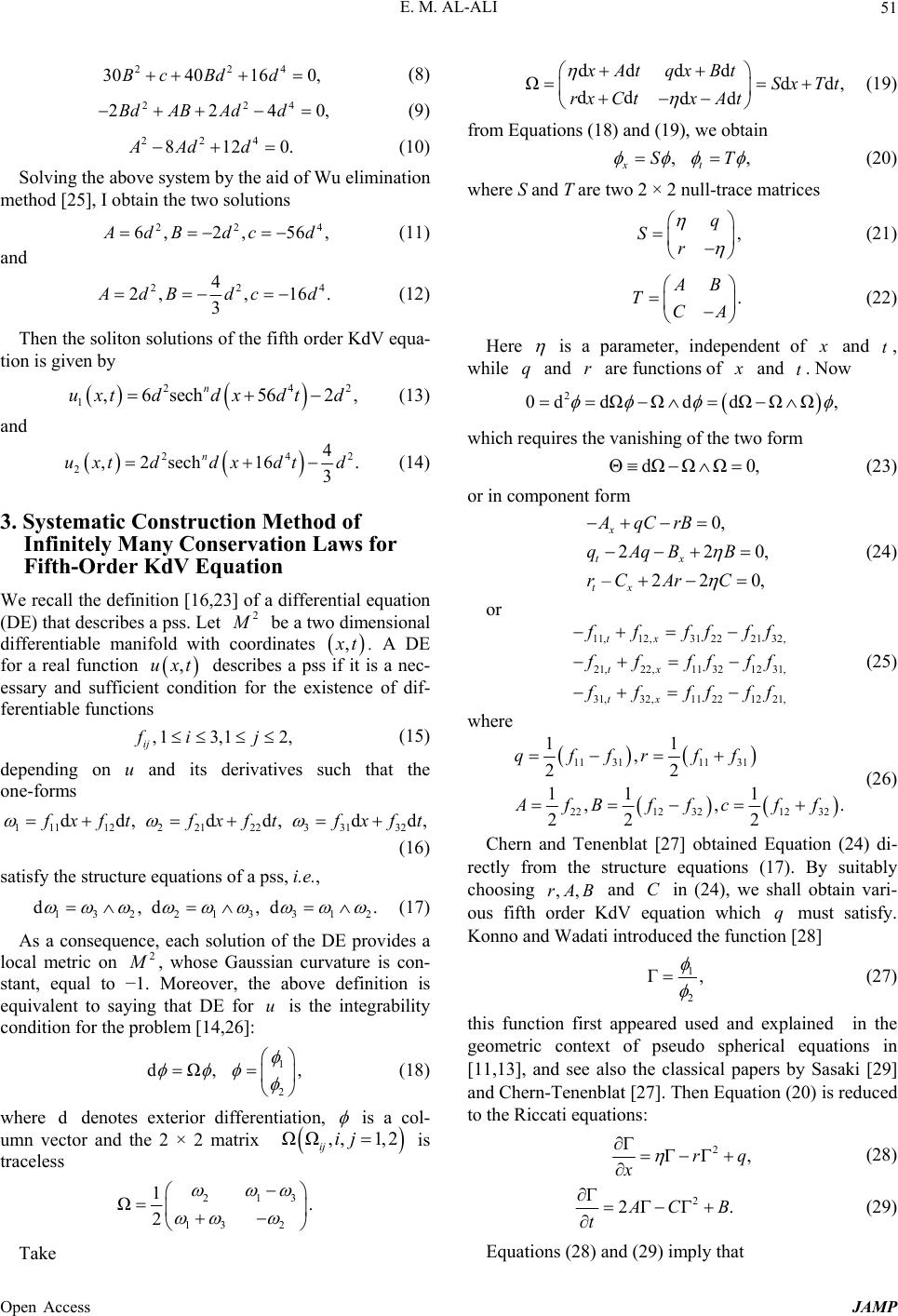 E. M. AL-ALI 51 (8) 0, (9) 0. (10) Solving the above system by the aid of Wu elimination method [25], I obtain the two solutions 4 (11) and 224 304016 0,Bc Bdd 224 224Bd AB Add 224 812AAd d 22 6,2,56,AdBdcd 22 4 2,, 16. 3 4 A dB dcd (12) Then the soliton solutions of the fifth order KdV equa- is given by tion 24 1,6 sech562, n uxtddxdtd 2 and (13) 242 4 2,2 sech16. 3 uxtddx dtd (14) n 3. Systematic Construction Method nfinitely Many Conservation L ifth-Order KdV Equation We recall the definition [16,23] of a differe (DE of aws for I F ntial equation ) that describes a pss. Let 2 M be a two dimensional differentiable manifold with coordinates , x t. A DE for a real function a nec- essary and sufficient conditifor the exi unctions (15) depending on u and its derivatives such that the one-forms , ,uxt describes on pss if it is a stence of dif- ferentiable f ,1 3,12, ij fi j 1 11122212233132 dd,dd,dfxftfxftfx dft (16) isfy the structure equations of a pss, i.e. sat , 132 21312 d,d,d. 3 (17) As a consequence, each solution of the Dovides a local metric on E pr 2 M , who DE for is the integrability condition for the problem [14,26]: se Gaussian curvature is con- stant, equal to −1. Moreover, the above definition is equivalent to saying that u 1 dΩ,, 2 (18) where denotes exterior differentiation, d is a col- umr and the 2 × 2 matrix n vecto ΩΩ 1,2 ij ,,ij is traceless 213 13 2 Take 1 Ω. 2 , (19) from Equations (18) and (19), we obtain dddd Ωdd dd dd xAt qxBtSx Tt rx CtxAt ,, xt ST (20) where S and T are two 2 × 2 null-trace matrices , q Sr (21) . A B TCA (22) Here is a paeter, independent of ram x and t, while q and r are functions of x and t. Now 2 0d dΩΩddΩΩ ,Ω which requires the vanishing of the two form ΘdΩΩΩ 0, (23) or in component form 0, , 0, 22 x AqCrB qAqB B –2 20 tx tx rC Ar C ( or 24) 11,12,312221 32, 21,22,11 321231, 31,32,11 221221, tx tx tx ff ffff ff ffff ff ffff (25) where 22 12 3212 32 11 1 ,, 11 3111 31 22 . 22 2 11 ,qffrff A fBff cff (26) Chern and Tenenblat [27] obtain rectly from the structure equations (17). By suitably choosing and in (24), we shall obtain vari- ous fifthV uation wh Konno and Wadati introduced the function [28] ed Equation (24) di- ,,rAB order Kd C eqich q must satisfy. 1 Γ, 2 ( 27) this function first appeared used and explained in the uations in [11,13], and see also the classical pap 27]. Then Equati : geometric context of pseudo spherical eq ers by Sasaki [29] on (20) is reduced and Chern-Tenenblat [ to the Riccati equations 2,rq x (28) 2 2. A CB t (29) Equations (28) and (29) imply that Open Access JAMP 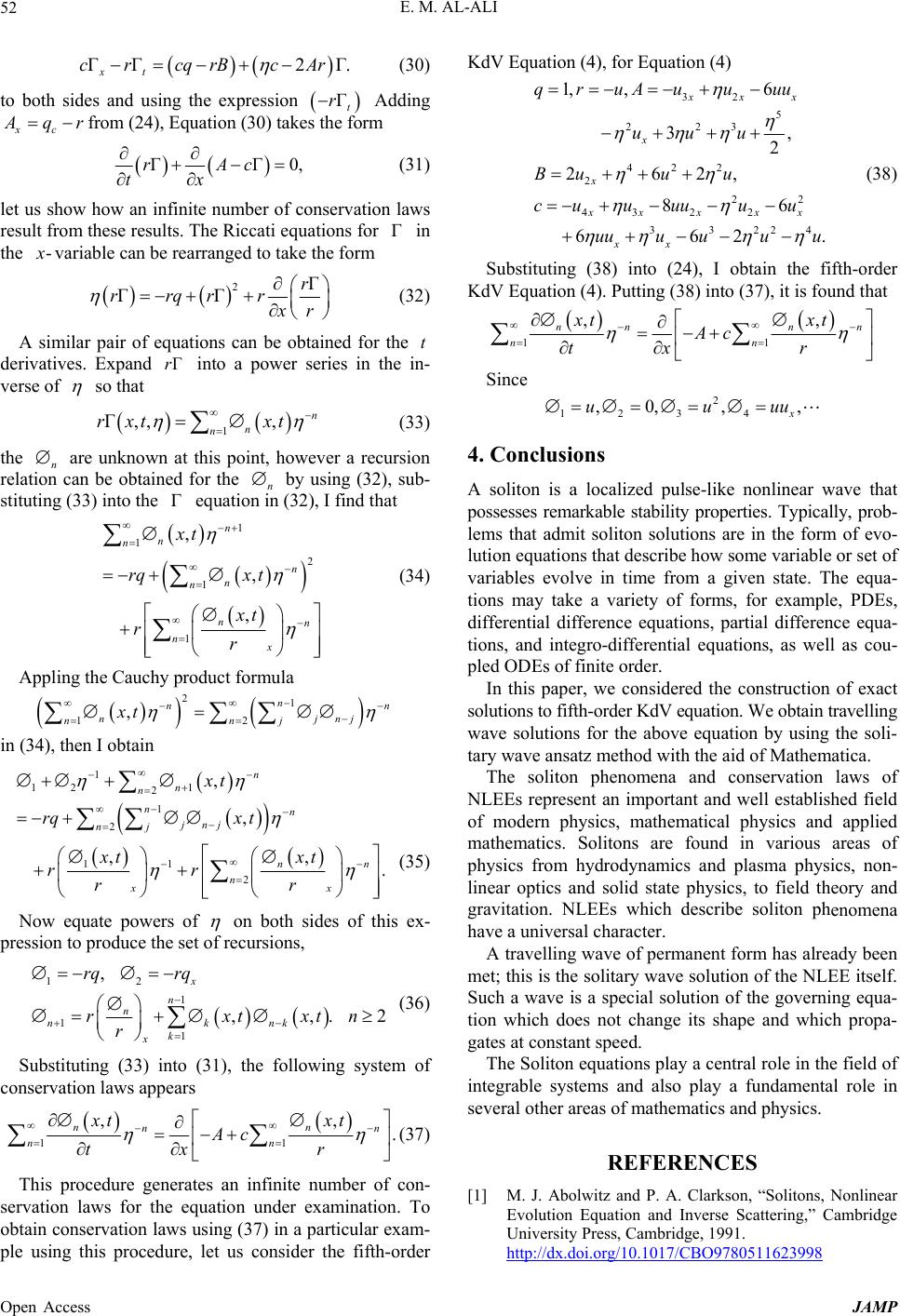 E. M. AL-ALI 52 ГГ 2Г. xt crcqrBcAr (30) to both sides and using the expression Гt r Adding xc A qrfrom (24), Equation (30) takerm s the fo ГГ0,rAc tx (31) let us show how an infinite number of conservatio result from these results. The Riccati equations for in the n laws Г - x variable can be rearranged to take the form 2Г ГГ r rrqrr x r (32) A similar pair of equations can be obtained for the t derivatives. Expand Гr into a power series in the verse of in- so that 1 Г,, , n n rxt xt n (33) the n are unknown at this point, however a recursion relation can be obtained for the n by using (32), sub- stituting (33) into the Г equation in (32), I find that 1 1,n n nxt 2 1 1 , , n n n n rq x t xt rr a j n n (34) n x Appling the Cauchy product formul 2 1 12 ,n n n nnj xt n j in (34), then I obtain 1 1 2,n n nxt 12 1 2, nn jn j nj rq x t 11 2 ,, . nn n xx xt xt rr rr (35) Now equate powers of on both sides of this ex- pression to produce the set of recursions, 12 1 1,, . 2 x n n nknk x rx txtn r (36) 1 , k rq rq Substituting (33) into (31), the followin conservation laws appears g system of 11 ,, . nn nn This procedure generates an infinite number of con- servation laws for the equation under examination. To obtain conservation laws using (37) in a particular exam- ple using this procedure, let us consider the fifth-order KdV Equation (4), for Equation (4) nn xt xt Ac tx r (37) 32 5 223 422 2 22 43 2 2 86 x xxx cu u uuu 33 224 1, ,6 3, 2 262, 662. xx x x x xx qruAu u uu uuu Buu u u uuuuuu x (38) nto (24), I obtain the fifth-order tting (38) into (37), it is found that Substituting (38) i KdV Equation (4). Pu 11 ,, nn nn nn xt xt Ac tx r Since u 4. ear wave that possesses remarkable stability properties. Typically, prob- lems that admit soliton solutions are in the form o lution equations that describe how some variable or set of variables evolve in time from a given state. The equa- tio tions, partial difference equa- tions, and integro-differential equations, as well as cou- pled ODEs of finite order. In this paper, we considered the construction of exact so hysics and applied mathematics. Solitons are found in various areas of physics from hydrodynamics and plasma physics, non- linear optics and solid state physics, to field theory and gravitation. NLEEs which describe soliton ph have a universal character. A travelling wave of permanent form has already been met; this is the solitary wave solution of the NLEE itself. Such a wave is a special solution of the governing equa- tio The Soliton equations play a central role in the field of integrable systems and also play a fundamental role in several other areas of mathematics and physics. REFERENCES and P. A. Clarkson, “Solitons, Nonlinear tion and Inverse Scattering,” Cambridge http://dx.doi.org/10.1017/CBO9780511623998 2 1234 ,0, ,, x uuu Conclusions A soliton is a localized pulse-like nonlin f evo- ns may take a variety of forms, for example, PDEs, differential difference equa lutions to fifth-order KdV equation. We obtain travelling wave solutions for the above equation by using the soli- tary wave ansatz method with the aid of Mathematica. The soliton phenomena and conservation laws of NLEEs represent an important and well established field of modern physics, mathematical p enomena n which does not change its shape and which propa- gates at constant speed. [1] M. J. Abolwitz Evolution Equa University Press, Cambridge, 1991. Open Access JAMP  E. M. AL-ALI Open Access JAMP 53 [2] C. Rogers and P. Wong, “On reciprocal B€ a Acklund Transformations of Inverse Scattering Schemes,” Physica Scripta, Vol. 30, 1984, pp. 10-14. http://dx.doi.org/10.1088/0031-8949/30/1/003 [3] A. H. Khater, D. K. Callebaut, A. A. Abdalla, A. R. She- hata and S. M. Sayed, “Backlund Transformations and Exact Solutions for Self-Dual SU(3) Yang-Mills Equa- tions,” IL Nuovo Cimento B, Vol. 114, 1999, pp. 1-10. [4] C. Qu, Y. Si and R. Liu, “On Affine Sawada-Kotera Equation,” Chaos, Solitons & Fractals, Vol. 15, No. 1, 2003, pp. 131-139. http://dx.doi.org/10.1016/S0960-0779(02)00121-2 [5] O. C. Wright, “The Darboux Transformation of Some Manakov Systems,” Applied Mathematics Letters, Vol. 16, No. 5, 2003, pp. 647-652. http://dx.doi.org/10.1016/S0893-9659(03)00061-2 [6] R. Hirota, “The Direct Method in Soliton Theory,” Cam- bridge University Press, Cambridge, 2004. [7] A. H. Khater, D. K. Callebaut and S. M. Sayed, “Exact Solutions for Some Nonlinear Evolution Equations which Describe Pseudospherical Surfaces,” Journal of Computa- tional and Applied Mathematics, Vol. 189, No. 1-2, 2006, pp. 387-411. http://dx.doi.org/10.1016/j.cam.2005.10.007 [8] S. K. Liu, Z. T. Fu and S. D. Liu, “Jacobi Elliptic Func- tion Expansion Method and Periodic Wave Solutions of Nonlinear Wave Equations,” Physics Letters A, Vol. 289, No. 1-2, 2001, pp. 69-74. http://dx.doi.org/10.1016/S0375-9601(01)00580-1 [9] E. Fan, “Extended Tanh-Function Method and Its Appli- cations to Nonlinear Equations,” Physics Letters A, Vol 277, 2000, pp. 212-219. http://dx.doi.org/10.1016/S0375-9601(00)00725-8 . [10] W. Malfliet and W. Hereman, “The Tanh Method I. Exact Solutions of Nonlinear Wave Equations,” Physica Scripta, Vol. 54, No. 6, 1996, pp. 569-575. http://dx.doi.org/10.1088/0031-8949/54/6/004 K. Chadan and P. C. Sabatier, “Inverse Problem[11] in Quan- tum Scattering Theory,” Springer, New York, 1977. http://dx.doi.org/10.1007/978-3-662-12125-2 [12] M. J. Ablowitz, S. Chakravarty and R. Hal Painlevé and Darboux-Halphen Type Equatio burd, “On ns, in the Painlevé Property, One Century Later,” In: R. Conte, Ed., CRM Series in Mathematical Physics, Springer, Berlin, 1998. M. Elham Al-Ali, “Traveling Wave Solutions for a Ge[13] n- eralized Kawahara and Hunter-Saxton Equations,” Inter- national Journal of Mathematical Analysis, Vol. 7, 2013, pp. 1647-1666. S. M. Sayed, “The Bäcklund Transformations, Exa[14] ct So- lutions, and Conservation Laws for the Compound Modi- fied Korteweg-de Vries-Sine-Gordon Equations which describe Pseudospherical Surfaces,” Journal of Applied Mathematics, Vol. 2013, 2013, pp. 1-7. http://dx.doi.org/10.1155/2013/613065 [15] V. B. Matveev and M. A. Salle, “Darboux Transforma- tions and Solitons,” Springer-Verlag, Berlin, 1991. http://dx.doi.org/10.1007/978-3-662-00922-2 [16] K. Tenenblat, “Transformations of Manifolds and Appli- cations to Deferential Equations, Pitman Monographs and Surveys in Pure and Applied Mathematics 93,” Addison Wesley Longman, England, 1998. [17] A. M. Wazwaz, “New Compactons, Solitons and Periodic Solutions for Nonlinear Va Equations,” Chaos, Solitons & Fractals, Vol. 22, 20 riants of the KdV and the KP 04, pp. 249-260. http://dx.doi.org/10.1016/j.chaos.2004.01.005 [18] A. M. Wazwaz, “Two Reliable Methods for Solving Vari- ants of the KdV Equation with Structures,” Chaos, Solitons & Fractals, Vol. 28, No. Compact and Noncompact 2, 2006, pp. 454-462. http://dx.doi.org/10.1016/j.chaos.2005.06.004 [19] X. G. Geng and H. Wang, “Coupled Ca tions, N-Peakons and Infinitely Many Conservat massa-Holm Equa- ion Laws,” Journal of Mathematical Analysis and Applications, Vol. 403, 2013, pp. 262-271. http://dx.doi.org/10.1016/j.jmaa.2013.02.030 [20] A. H. Khater, D. K. Callebaut and S. M. Sayed, “Conser- vation Laws for Some Nonlinear Evolution Equations which Describe Pseudo-Spherical Surfaces,” Journal of Geometry and Physics, Vol. 51, No. 3, 2004, pp. 332-352. http://dx.doi.org/10.1016/j.geomphys.2003.11.009 [21] J. A. Cavalcante and K. Tenenblat, “Conservation Laws for Nonlinear Evolution Equations,” Journal of Mathe- matical Physics, Vol. 29, 1988, pp. 1044-1059. http://dx.doi.org/10.1063/1.528020 [22] R. Beals, M. Rabelo and K. Tenenblat, “Backlund Trans- formations and Inverse Scattering Solutions for Some Pseudo-Spherical Surfaces,” Studies in Applied Mathe- matics, Vol. 81, 1989, pp. 125-134. [23] E. G. Reyes, “Conservation Laws and C Deformations of Equations Describing alapso-Guichard Pseudo-Spherical Surfaces,” Journal of Mathematical Physics, Vol. 41, 2000, pp. 2968-2979. http://dx.doi.org/10.1063/1.533284 [24] E. G. Reyes, “On Geometrically Integrable Equations and Hierarchies of Pseudo-Spherical Type,” Contemporary Mathematics, Vol. 285, 2001, pp. 145-156. http://dx.doi.org/10.1090/conm/285/04740 [25] W. T. Wu, “Polynomial Equations-Solving and Its Ap- or ons,” Studies in Applied Mathemat- rg/10.1143/PTP.53.1652 plications,” Algorithms and Computation, Beijing, 1994, pp. 1-9. [26] M. J. Ablowitz, D. J. Kaup, A. C. Newell and H. Segur, “The Inverse Scattering Transform-Fourier Analysis f Nonlinear Problems,” Studies in Applied Mathematics, Vol. 53, 1974, pp. 249-257. [27] S. S. Chern and K. Tenenblat, “Pseudospherical Surfaces and Evolution Equati ics, Vol. 74, 1986, pp. 55-83. [28] K. Konno and M. Wadati, “Simple Derivation of Back- lund Transformation from Riccati Form of Inverse Me- thod,” Progress of Theoretical Physics, Vol. 53, 1975, pp. 1652-1656. http://dx.doi.o erical Sur- [29] R. Sasaki, “Soliton Equations and Pseudosph faces,” Nuc lear Physics B, Vol. 154, 1979, pp. 343-357. http://dx.doi.org/10.1016/0550-3213(79)90517-0 |