

Paper Menu >>
Journal Menu >>
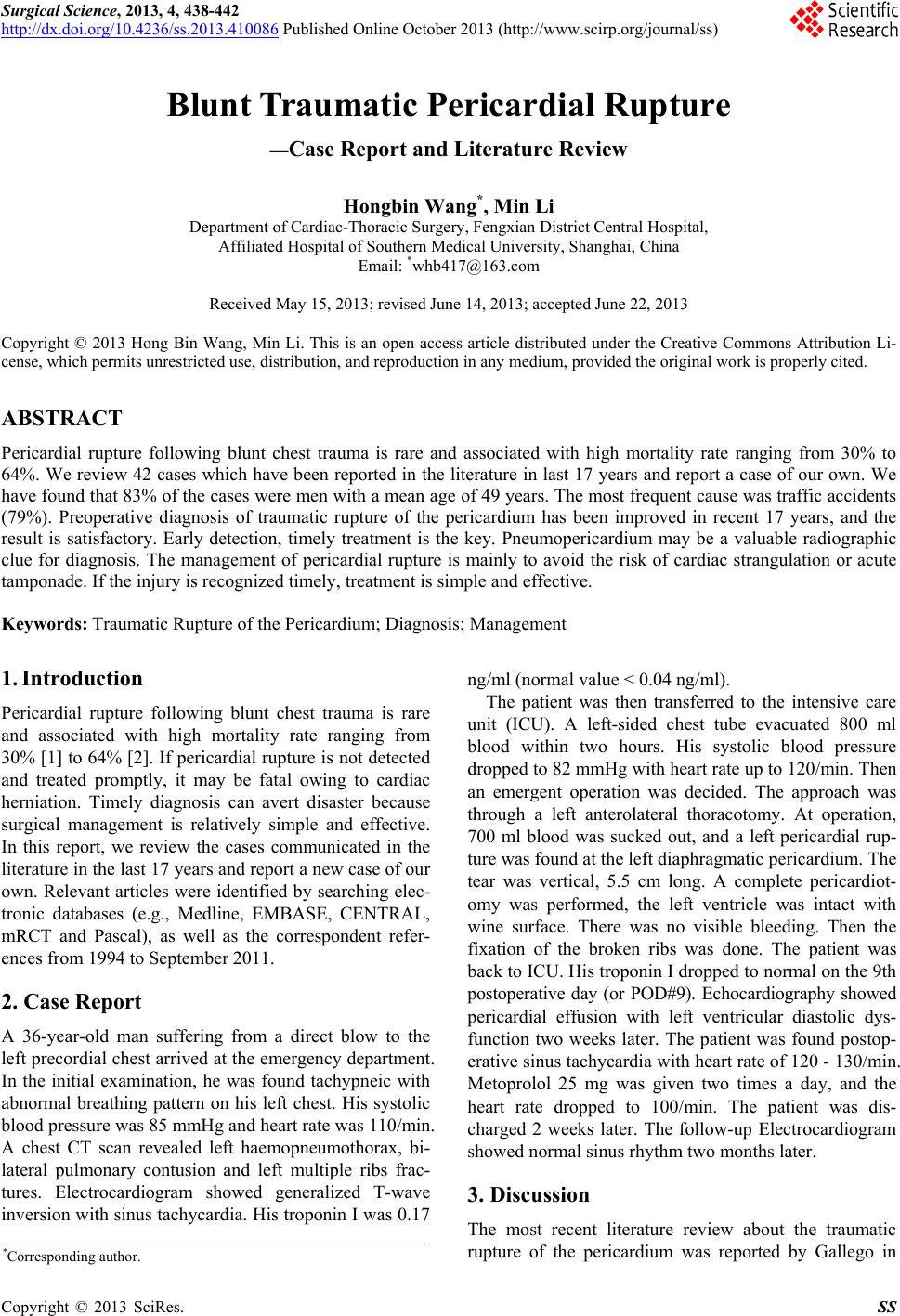 Surgical Science, 2013, 4, 438-442 http://dx.doi.org/10.4236/ss.2013.410086 Published Online October 2013 (http://www.scirp.org/journal/ss) Blunt Traumatic Pericardial Ruptur e —Case Report and Literature Review Hongbin Wang*, Min Li Department of Cardiac-Thoracic Surgery, Fengxian District Central Hospital, Affiliated Hospital of Southern Medical University, Shanghai, China Email: *[email protected] Received May 15, 2013; revised June 14, 2013; accepted June 22, 2013 Copyright © 2013 Hong Bin Wang, Min Li. This is an open access article distributed under the Creative Commons Attribution Li- cense, which permits unrestricted use, distribution, and reproduction in any medium, provided the original work is properly cited. ABSTRACT Pericardial rupture following blunt chest trauma is rare and associated with high mortality rate ranging from 30% to 64%. We review 42 cases which have been reported in the literature in last 17 years and report a case of our own. We have found that 83% of the cases were men with a mean age of 49 years. The most frequent cause was traffic accidents (79%). Preoperative diagnosis of traumatic rupture of the pericardium has been improved in recent 17 years, and the result is satisfactory. Early detection, timely treatment is the key. Pneumopericardium may be a valuable radiographic clue for diagnosis. The management of pericardial rupture is mainly to avoid the risk of cardiac strangulation or acute tamponade. If the injury is recognized timely, treatment is simple and effective. Keywords: Traumatic Rupture of the Pericardium; Diagnosis; Management 1. Introduction Pericardial rupture following blunt chest trauma is rare and associated with high mortality rate ranging from 30% [1] to 64% [2]. If pericardial rupture is not detected and treated promptly, it may be fatal owing to cardiac herniation. Timely diagnosis can avert disaster because surgical management is relatively simple and effective. In this report, we review the cases communicated in the literature in the last 17 years and report a new case of our own. Relevant articles were identified by searching elec- tronic databases (e.g., Medline, EMBASE, CENTRAL, mRCT and Pascal), as well as the correspondent refer- ences from 1994 to September 2011. 2. Case Report A 36-year-old man suffering from a direct blow to the left precordial chest arrived at the emergency department. In the initial examination, he was found tachypneic with abnormal breathing pattern on his left chest. His systolic blood pressure was 85 mmHg and heart rate was 110/min. A chest CT scan revealed left haemopneumothorax, bi- lateral pulmonary contusion and left multiple ribs frac- tures. Electrocardiogram showed generalized T-wave inversion with sinu s tachycardia. His troponin I was 0.1 7 ng/ml (normal value < 0.04 ng/ml). The patient was then transferred to the intensive care unit (ICU). A left-sided chest tube evacuated 800 ml blood within two hours. His systolic blood pressure dropped to 82 mmHg with heart rate up to 120/min. Then an emergent operation was decided. The approach was through a left anterolateral thoracotomy. At operation, 700 ml blood was sucked out, and a left pericardial rup- ture was found at the left diaph ragmatic pericardium. The tear was vertical, 5.5 cm long. A complete pericardiot- omy was performed, the left ventricle was intact with wine surface. There was no visible bleeding. Then the fixation of the broken ribs was done. The patient was back to ICU. His troponin I dropped to normal on the 9th postoperative day (or POD#9). Echocardiography showed pericardial effusion with left ventricular diastolic dys- function two weeks later. The patient was found postop- erative sinus tachycardia with heart rate of 120 - 130/min. Metoprolol 25 mg was given two times a day, and the heart rate dropped to 100/min. The patient was dis- charged 2 weeks later. The follow-up Electrocardiogram showed normal sinus rhythm two months later. 3. Discussion The most recent literature review about the traumatic rupture of the pericardium was reported by Gallego in *Corresponding a uthor. C opyright © 2013 SciRes. SS 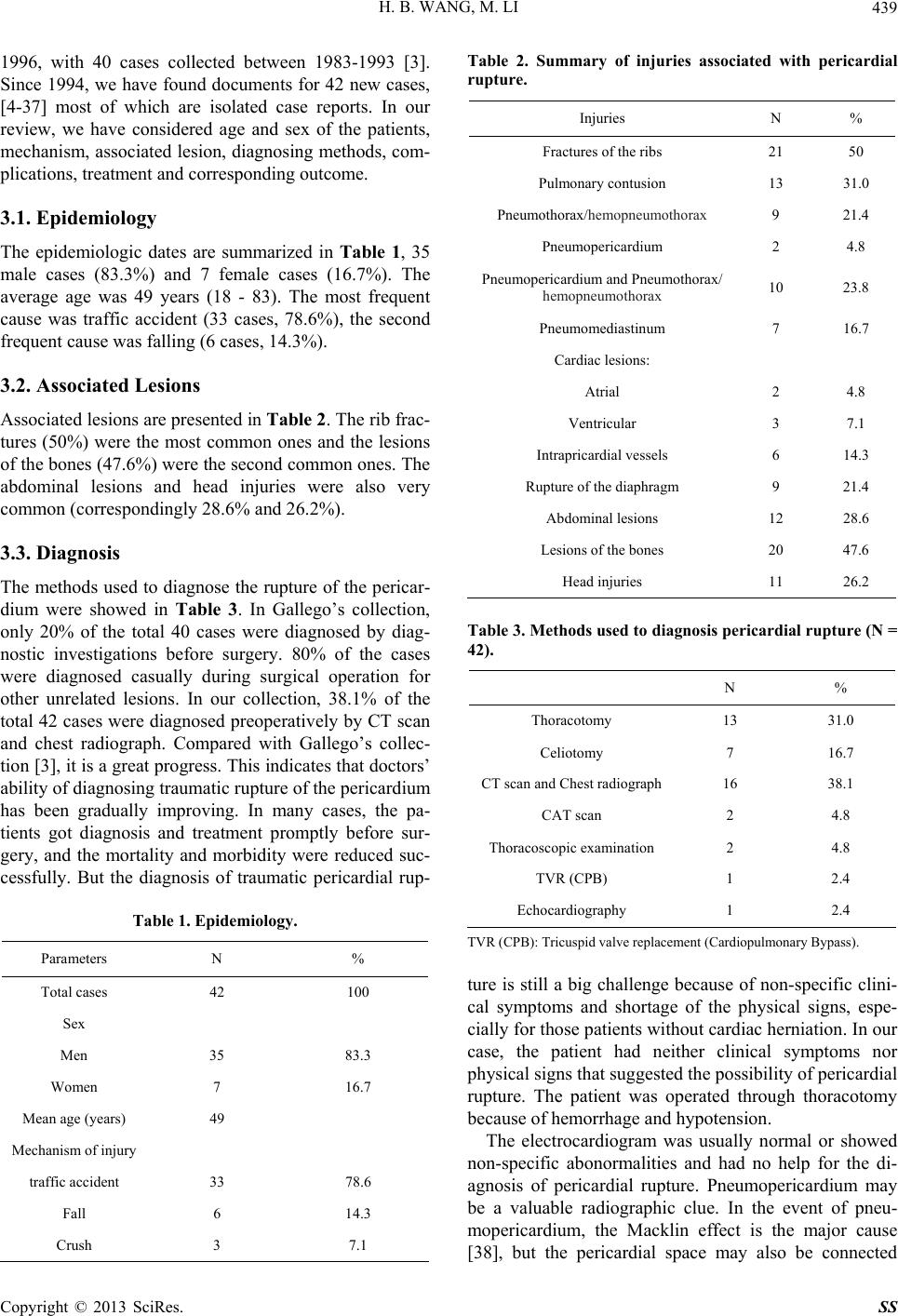 H. B. WANG, M. LI 439 1996, with 40 cases collected between 1983-1993 [3]. Since 1994, we hav e found documents for 42 new cases, [4-37] most of which are isolated case reports. In our review, we have considered age and sex of the patients, mechanism, associated lesion, diagnosing methods, com- plications, treatment and corresponding outcome. 3.1. Epidemiology The epidemiologic dates are summarized in Table 1, 35 male cases (83.3%) and 7 female cases (16.7%). The average age was 49 years (18 - 83). The most frequent cause was traffic accident (33 cases, 78.6%), the second frequent cause was fal l i ng ( 6 cases, 14.3 %). 3.2. Associated Lesions Associated lesions are presented in Table 2. The rib frac- tures (50%) were the most common ones and the lesions of the bones (47.6%) were the second common ones. The abdominal lesions and head injuries were also very common (correspondingly 28.6% and 26.2%). 3.3. Diagnosis The methods used to diagnose the rupture of the pericar- dium were showed in Table 3. In Gallego’s collection, only 20% of the total 40 cases were diagnosed by diag- nostic investigations before surgery. 80% of the cases were diagnosed casually during surgical operation for other unrelated lesions. In our collection, 38.1% of the total 42 cases were diagnosed preoperatively by CT scan and chest radiograph. Compared with Gallego’s collec- tion [3], it is a great progress. This indicates that doctors’ ability of diagnosing traumatic rupture of the pericardium has been gradually improving. In many cases, the pa- tients got diagnosis and treatment promptly before sur- gery, and the mortality and morbidity were reduced suc- cessfully. But the diagnosis of traumatic pericardial rup- Table 1. Epidemiology. Parameters N % Total cases 42 100 Sex Men 35 83.3 Women 7 16.7 Mean age (years) 49 Mechanism of injury traffic accident 33 78.6 Fall 6 14.3 Crush 3 7.1 Table 2. Summary of injuries associated with pericardial rupture. Injuries N % Fractures of th e ribs 21 50 Pulmonary contusion 13 31.0 Pneumothorax/hemopneumothorax 9 21.4 Pneumopericardium 2 4.8 Pneumopericardium and Pneumothorax/ hemopneumothorax 10 23.8 Pneumomediastinum 7 16.7 Cardiac lesions: Atrial 2 4.8 Ventricular 3 7.1 Intrapricardial vessels 6 14.3 Rupture of the diaphragm 9 21.4 Abdominal lesio n s 12 28.6 Lesions of the bones 20 47.6 Head injuries 11 26.2 Table 3. Methods used to diagnosis pericardial rupture (N = 42). N % Thoracotomy 13 31.0 Celiotomy 7 16.7 CT scan and Chest radiograph16 38.1 CAT scan 2 4.8 Thoracoscopic examination 2 4.8 TVR (CPB) 1 2.4 Echocardiography 1 2.4 TVR (CPB): Tricuspid valve replacement (Cardiopulmonary Bypass). ture is still a big challenge because of non-specific clini- cal symptoms and shortage of the physical signs, espe- cially for those patients without card iac herniation . In our case, the patient had neither clinical symptoms nor physical signs that suggested the possibility of pericardial rupture. The patient was operated through thoracotomy because of hem orrhage and hypotension. The electrocardiogram was usually normal or showed non-specific abonormalities and had no help for the di- agnosis of pericardial rupture. Pneumopericardium may be a valuable radiographic clue. In the event of pneu- mopericardium, the Macklin effect is the major cause [38], but the pericardial space may also be connected Copyright © 2013 SciRes. SS 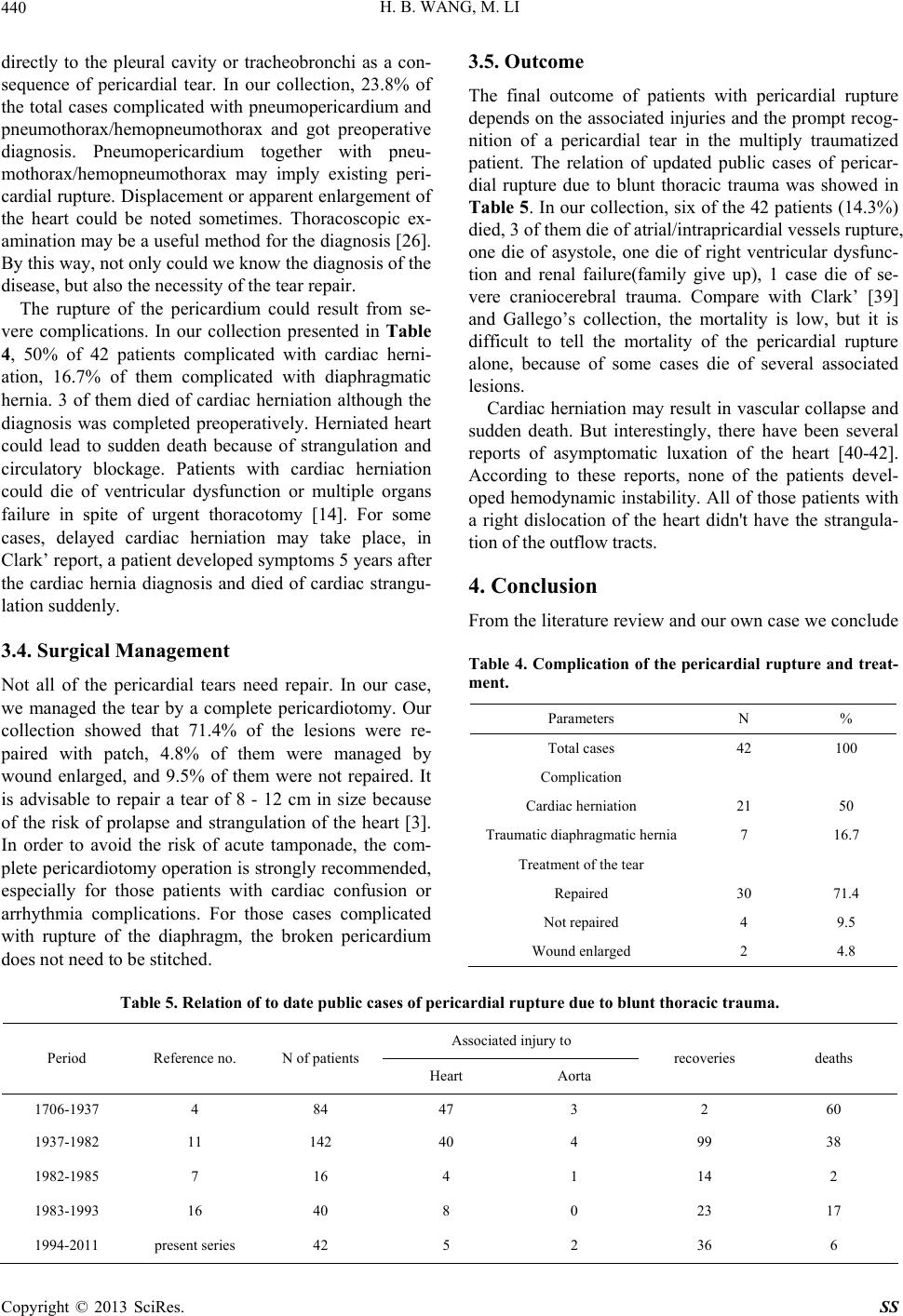 H. B. WANG, M. LI Copyright © 2013 SciRes. SS 440 directly to the pleural cavity or tracheobronchi as a con- sequence of pericardial tear. In our collection, 23.8% of the total cases complicated with pneumopericardium and pneumothorax/hemopneumothorax and got preoperative diagnosis. Pneumopericardium together with pneu- mothorax/hemopneumothorax may imply existing peri- cardial rupture. Displacement or apparent enlargement of the heart could be noted sometimes. Thoracoscopic ex- amination may be a useful method for the diagnosis [26]. By this way, not only co uld w e kno w the diagno sis of th e disease, but also the necessity of the tear repair. The rupture of the pericardium could result from se- vere complications. In our collection presented in Table 4, 50% of 42 patients complicated with cardiac herni- ation, 16.7% of them complicated with diaphragmatic hernia. 3 of them died of cardiac herniation although the diagnosis was completed preoperatively. Herniated heart could lead to sudden death because of strangulation and circulatory blockage. Patients with cardiac herniation could die of ventricular dysfunction or multiple organs failure in spite of urgent thoracotomy [14]. For some cases, delayed cardiac herniation may take place, in Clark’ report, a patient developed symptoms 5 years after the cardiac hernia diagnosis and died of cardiac strangu- lation suddenly. 3.4. Surgical Management Not all of the pericardial tears need repair. In our case, we managed the tear by a complete pericardiotomy. Our collection showed that 71.4% of the lesions were re- paired with patch, 4.8% of them were managed by wound enlarged, and 9.5% of them were not repaired. It is advisable to repair a tear of 8 - 12 cm in size because of the risk of prolapse and strangulation of the heart [3]. In order to avoid the risk of acute tamponade, the com- plete pericardiotomy operation is strongly recommended, especially for those patients with cardiac confusion or arrhythmia complications. For those cases complicated with rupture of the diaphragm, the broken pericardium does not need to be stitched. 3.5. Outcome The final outcome of patients with pericardial rupture depends on the associated injuries and the prompt recog- nition of a pericardial tear in the multiply traumatized patient. The relation of updated public cases of pericar- dial rupture due to blunt thoracic trauma was showed in Table 5. In our collection, six of the 42 patients (14.3%) died, 3 of them die of atrial/intrapricardial vessels rupture, one die of asystole, one die of right ventricular dysfunc- tion and renal failure(family give up), 1 case die of se- vere craniocerebral trauma. Compare with Clark’ [39] and Gallego’s collection, the mortality is low, but it is difficult to tell the mortality of the pericardial rupture alone, because of some cases die of several associated lesions. Cardiac herniation may result in vascular collapse and sudden death. But interestingly, there have been several reports of asymptomatic luxation of the heart [40-42]. According to these reports, none of the patients devel- oped hemodynamic instability. All of those patients with a right dislocation of the heart didn't have the strangula- tion of the outflow tracts. 4. Conclusion From the literature review and our own case we conclude Table 4. Complication of the pericardial rupture and treat- ment. Parameters N % Total cases 42 100 Complication Cardiac herniation 21 50 Traumatic diaphragmatic hernia 7 16.7 Treatment of the tear Repaired 30 71.4 Not repaired 4 9.5 Wound enlarged 2 4.8 Table 5. Relation of to date public cases of pericardial rupture due to blunt thoracic trauma. Associated injury to Period Reference no. N of patients Heart Aorta recoveries deaths 1706-1937 4 84 47 3 2 60 1937-1982 11 142 40 4 99 38 1982-1985 7 16 4 1 14 2 1983-1993 16 40 8 0 23 17 1994-2011 present series 42 5 2 36 6  H. B. WANG, M. LI 441 that, in spite of nonspecific symptoms and diagnosis dif- ficulty, preoperative diagnosis of traumatic rupture of the pericardium has been improved in recent 17 years, and the result is satisfactory. Early detection and timely treatment is the key. Pneumopericardium may be a valu- able radiographic clue for diagnosis. Cardiac herniation with right dislocation may prevent strangulation of the outflow tracts from happening. The management of peri- cardial rupture is mainly to avoid the risk of cardiac strangulation or acute tamponade. If the injury is recog- nized timely, treatment is simple and effective. REFERENCES [1] A. J. Aho, E. A. Vantinen and O. I. Nelimarkka, “Rupture of the Pericardium with Luxation of the Heart after Blunt Trauma,” Journal of Trauma-Injury Infection & Critical Care, Vol. 27, No. 5, 1987, pp. 560-563. http://dx.doi.org/10.1097/00005373-198705000-00017 [2] G. Fulda, A. Rodriguea, S. Z. Turney and R. A. Cowley, “Blunt Traumatic Pericardial Rupture. A Ten-Year Ex- perience 1979 to 1989,” Journal of Cardiovascular Sur- gery, Vol. 31, No. 4, 1990, pp. 525-530. [3] M. G. Gallego, M. J. Lopez-Cambra, M. J. Fernandez- Acenero, T. L. Alvarez-Perez, G. T. Ruiz, P. V. Santos and M. O. Lopez, “Traumatic Rupture of the Pericardium. Case Report and Literature Review,” Journal of Cardio- vascular Surgery, Vol. 37, No. 2, 1996, pp. 187-191. [4] T. Nakamura, J. D. Maloney and S. Osaki, “Traumatic Pericardial Rupture without Cardiac Injury,” General Thoracic and Cardiovascular Surgery, Vol. 56, No. 12, 2008, pp. 602-605. http://dx.doi.org/10.1007/s11748-008-0310-3 [5] M. Kamiyoshihara, T. Nagashima, T. Ibe and I. Takeyoshi, “Rupture of the Diaphragm and Pericardium with Cardiac Herniation after Blunt Chest Trauma,” General Thoracic and Cardiovascular Surgery, Vol. 58, No. 6, 2010, pp. 291-294. http://dx.doi.org/10.1007/s11748-009-0520-3 [6] T. Suzuki, A. Kitami, G. Hori, Y. Maenaka, Y. Takahashi, K. Narihara, Y. Osakabe, S. Kanesaka and S. Shimizu, “Two Cases of Pericardial Rupture Due to Blunt Chest Trauma,” Kyobu Geka, Vol. 47, No. 7, 1994, pp. 569-572. [7] M. Fukuoka, T. Takeuchi, H. Tsubota, Y. Mikuriya, M. Oda and S. Murata, “Traumatic Pericardial Rupture In- volved with Complication by Blunt Chest Trauma,” The Japanese Journal of Thoracic and Cardiovascular Sur- gery, Vol. 52, No. 9, 2004, pp. 423-425. http://dx.doi.org/10.1007/s11748-004-0036-9 [8] K. Imasaka, J. Yoshida, T. Iwai, M. Sakamoto, M. Yo- shitoshi and M. Akao, “A Case of Traumatic Cardiac Contusion Accompanied by the Rupture of Pericardium,” Nihon Kyobu Geka Gakkai Zasshi, Vol. 45, No. 9, 1997, pp. 1627-1632. [9] S. Matsuda, T. Hatta, S. Kurisu, H. Ohyabu, T. Koyama and Y. Kita, “Traumatic Cardiac Herniation Diagnosed by Echocardiography and Chest CT Scanning: Report of a Case,” Surgery Today, Vol. 29, No. 11, 1999, pp. 1221- 1224. http://dx.doi.org/10.1007/BF02482278 [10] Z. Khalpey, T. K. Rajab, J. D. Schmitto and P. C. Camp, “Traumatic Pericardial Rupture with Skeletonized Phrenic Nerve,” Journal of Cardiothoracic Surgery, Vol. 6, 2011, p. 6. http://dx.doi.org/10.1186/1749-8090-6-6 [11] J. H. Sohn, J. W. Song, J. B. Seo, K. H. Do, J. S. Lee, D. K. Kim, et al., “Pericardial Rupture and Cardiac Herni- ation after Blunt Trauma: A Case Diagnosed Using Car- diac MRI,” The British Journal of Radiology, Vol. 78, No. 929, 2005, pp. 447-449. http://dx.doi.org/10.1259/bjr/31146905 [12] S. Baba, K. Shimizu and I. Takeyoshi, “Serial Chest Films Are Needed after a Diagnosis of Pneumopericar- dium Because of Risk of Cardiac Herniation,” The Annals of Thoracic Surgery, Vol. 90, No. 5, 2010, pp. 1705-1707. http://dx.doi.org/10.1016/j.athoracsur.2010.04.032 [13] H. Ota, H. Kawai and S. Tsuchida, “Blunt Trauma to the Intrapericardial Inferior Vena Cava with Concomitant Rupture of the Pericardium,” Kyobu Geka, Vol. 63, No. 4, 2010, pp. 319-323. [14] T. Chughtai, M. M. Chiavaras, P. Sharkey, H. Shulman and H. A. Miller, “Pericardial Rupture with Cardiac Her- niation,” Canadian Journal of Surgery, Vol. 51, No. 5, 2008, pp. E101-E102. [15] J. C. R. Rippey, S. Rao and D. Fatovich, “Blunt Traumatic Rupture of the Pericardium with Cardiac Herniation,” Canadian Journal of Emergency Medicine, Vol. 6, No. 2, 2004, pp. 126-129. [16] J. P. van Brussel, W. J. Vles and L. P. Leenen, “Luxatio Cordis in Blunt-Trauma Thoraco-Abdominal Injuries,” Nederlands Tijdschrift voor Geneeskunde, Vol. 144, No. 22, 2000, pp. 1073-1075. [17] M. Takamatsu, H. Suda and K. Rikitake, “Aortic Dissec- tion Associated with Traumatic Pericardial Rupture,” Kyobu Geka, Vol. 61, No. 2, 2008, pp. 131-134. [18] J. Barrett and W. Satz, “Traumatic, Pericardio-Dia- phragmatic Rupture: An Extremely Rare Cause of Peri- carditis,” The Journal of Emergency Medicine, Vol. 30, No. 2, 2006, pp. 141-145. http://dx.doi.org/10.1016/j.jemermed.2005.04.017 [19] A. K. May, M. A. Patterson, L. W. Rue III, H. J. Schiller, M. F. Rotondo and W. Schwab, “Combined Blunt Car- diac and Pericardial Rupture: Review of the Literature and Report of a New Diagnostic Algorithm,” The Ameri- can Surgeon, Vol. 65, No. 6, 1999, pp. 568-574. [20] P. B. Sherren, R. Galloway and M. Healy, “Blunt Trau- matic Pericardial Rupture and Cardiac Herniation with a Penetrating Twist: Two Case Reports,” Scandinavian Journal of Trauma, Resuscitation and Emergency Medi- cine, Vol. 17, 2009, p. 64. http://dx.doi.org/10.1186/1757-7241-17-64 [21] T. Nishikawa, S. Suehiro, T. Shibata, H. Kumano, M. Hosono and H. Kinoshita, “Blunt Traumatic Rupture of Right Ventricle and Pericardium,” The Japanese Journal of Thoracic and Cardiovascular Surgery, Vol. 46, No. 8, 1998, pp. 781-784. http://dx.doi.org/10.1007/BF03217821 [22] E. Ikeda, S. Kawakami, K. Otsuka, K. Ono, M. Yamada and Y. Onishi, “A Case of Traumatic Diaphragmatic Her- nia Accompanied with Rupture of Pericardium,” Nihon Copyright © 2013 SciRes. SS  H. B. WANG, M. LI 442 Kyobu Geka Gakkai Zasshi, Vol. 43, No. 8, 1995, pp. 1234-1238. [23] A. J. Levine and F. J. Collins, “Blunt Traumatic Pericar- dial Rupture,” Journal of Accident and Emergency Medi- cine, Vol. 12, No. 1, 1995, pp. 55-56. http://dx.doi.org/10.1136/emj.12.1.55 [24] B. E. Wright, T. Reinke and R. W. Aye, “Chronic Trau- matic Diaphragmatic Hernia with Pericardial Rupture and Associated Gastroesophageal Reflux,” Hernia, Vol. 9, No. 4, 2005, pp. 392-396. http://dx.doi.org/10.1007/s10029-005-0339-5 [25] M. Assing, N. Dragicevic, T. R. Hazelton and L. Nal- lamshetty, “Delayed Levorotation of the Heart in Trau- matic Pericardial Rupture,” Emergency Radiology, Vol. 18, No. 3, 2011, pp. 257-261. http://dx.doi.org/10.1007/s10140-010-0923-6 [26] T. Pascal, S. Pierre, L. Thierry, V. Marc, P. D. Jean, G. Roger, et al., “Diagnosis by Video-Assisted Thoracoscopy of Traumatic Pericardial Rupture with Delayed Luxation of the Heart: Case Report,” The Journal of Trauma: In- jury, Infection, and Critical Care, Vol. 38, No. 6, 1995, pp. 967-970. http://dx.doi.org/10.1097/00005373-199506000-00030 [27] N. Farhataziz and M. J. Landay, “Pericardial Rupture after Blunt Chest Trauma,” Journal of Thoracic Imaging, Vol. 20, No. 1, 2005, pp. 50-52. http://dx.doi.org/10.1097/01.rti.0000139391.26138.dd [28] R. Gumpert, S. Archan, V. Matzi and F. M. Smolle-Jütt- ner, “Transdiaphragmatic Repositioning of the Heart in the Setting of Emergency Laparotomy after Blunt Trau- ma,” American Journal of Emergency Medicine, Vol. 27, No. 8, 2009, pp. 1024.e1-1024.e2. [29] T. Siegel, T. Vaughan and P. J. Papadakos, “Blunt Trau- matic Rupture of the Heart, Pericardium, and Supradia- phragmatic Inferior Vena Cava: Case Report,” The Jour- nal of Trauma, Vol. 36, No. 6, 1994, pp. 904-905. http://dx.doi.org/10.1097/00005373-199406000-00029 [30] M. M. Carrick, H. Q. Pham, B. G. Scott and M. J. Wall, “Traumatic Rupture of the Pericardium,” The Annals of Thoracic Surgery, Vol. 83, No. 4, 2007, p. 1554. http://dx.doi.org/10.1016/j.athoracsur.2006.03.018 [31] A. Stefani, L. Brandi, C. Ruggiero and R. Lodi, “A Case of Traumatic Pericardiophrenic Rupture,” Journal of Car- diovascular Surgery, Vol. 39, No. 6, 1998, pp. 859-861. [32] J. Lindenmann, V. Matzi, N. Neuboeck, C. Porubsky, B. Ratzenhofer, A. Maier, et al., “Traumatic Pericardial Rupture with Cardiac Herniation,” The Annals of Tho- racic Surgery, Vol. 89, No. 6, 2010, pp. 2028-2030. http://dx.doi.org/10.1016/j.athoracsur.2009.10.048 [33] Z. Witkowski, J. Lasek, M. Wujtewicz, M. Stasiak, W. Marks and A. Kawecka, “Poland Pericardiodiaphragmatic Rupture and Cardiac Herniation after Multiple Blunt Trauma: Diagnostic and Therapeutic Difficulties,” The Journal of Thoracic and Cardiovascular Surgery, Vol. 130, No. 6, 2005, pp. e1-e2. http://dx.doi.org/10.1016/j.jtcvs.2005.07.054 [34] J. T. Janson, D. G. Harris, J. Pretorius and G. J. Rossouw, “Pericardial Rupture and Cardiac Herniation after Blunt Chest Trauma,” The Annals of Thoracic Surgery, Vol. 75, No. 2, 2003, pp. 581-582. http://dx.doi.org/10.1016/S0003-4975(02)04298-4 [35] F. Schir, F. Thony, O. Chavanon, I. Perez-Moreira, D. Blin and M. Coulomb, “Blunt Traumatic Ruptured of the Pericardium with Cardiac Herniation: Two Cases Diag- nosed Using Computed Tomography,” European Radi- ology, Vol. 11, No. 6, 2001, pp. 995-999. http://dx.doi.org/10.1007/s003300000731 [36] P. A. Poletti, A. Platon, K. Shanmuganathan, D. Didier, A. Kalangos and F. Terrier, “Asymptomatic Traumatic Peri- cardial Rupture with Partial Right Atrial Herniation: Case Report,” Journal of Trauma-Injury Infection & Critical Care, Vol. 58, No. 5, 2005, pp. 1068-1072. http://dx.doi.org/10.1097/01.TA.0000171990.63817.5a [37] T. Furusawa, Y. Fukaya and J. Amano, “Herniation of the Heart Due to Traumatic Rupture of the Pericardium,” European Journal of Cardio-Thoracic Surgery, Vol. 17, No. 6, 2000, pp. 752-753. http://dx.doi.org/10.1016/S1010-7940(00)00435-8 [38] A. J. M. Konijn, P. H. M. Egbers and M. A. Kuiper, “Pneumopericardium Should Be Considered with Elec- trocardiogram Changes after Blunt Chest Trauma: A Case Report,” Journal of Medical Case Reports, Vol. 2, 2008, p. 100. http://dx.doi.org/10.1186/1752-1947-2-100 [39] D. E. Clark, C. S. Wiles III, M. K. Lim, C. M. Dunham and A. Rodriguez, “Traumatic Rupture of the Pericar- dium,” Surgery, Vol. 39, No. 4, 1983, pp. 495-501. [40] P. D. Rooij and H. J. Th. M. Haarman, “Herniation of the Stomach into the Pericardial Sac Combined with Cardiac Luxation Caused by Blunt Trauma: A Case Report,” Journal of Trauma-Injury Infection & Critical Care, Vol. 34, No. 3, 1993, pp. 453-454. http://dx.doi.org/10.1097/00005373-199303000-00028 [41] P. S. Wong, “Traumatic Herniation of the Heart into the Right Hemithorax,” Medical Journal of Malaysia, Vol. 54, No. 4, 1999, pp. 523-525. [42] A. Hadjkacem, O. Chavanon, R. Hacini and D. Blin, “Traumatic Pericardial Rupture with a Right Dislocation of the Heart,” European Journal Cardio-Th oracic Surgery, Vol. 19, No. 2, 2001, p. 215. http://dx.doi.org/10.1016/S1010-7940(00)00627-8 Copyright © 2013 SciRes. SS |