

Paper Menu >>
Journal Menu >>
 Open Journal of Urology, 2013, 3, 253-255 http://dx.doi.org/10.4236/oju.2013.36047 Published Online October 2013 (http://www.scirp.org/journal/oju) Tips for Office-Based Transurethral Biopsy and Fulguration as a Treatment of Tiny Bladder Tumors* Teiichiro Aoyagi1#, Isao Kuroda1, Masaaki Tachibana2 1Tokyo Medical University, Ibaraki Medical Center, Inashiki, Japan 2Toky o Medical University, T o kyo, Japan Email: #[email protected] Received August 8, 2013; revised September 6, 2013; accepted September 14, 2013 Copyright © 2013 Teiichiro Aoyagi et al. This is an open access article distributed under the Creative Commons Attribution License, which permits unrestricted use, distribution, and reproduction in any medium, provided the original work is properly cited. ABSTRACT Among the patients who underwent outpatient cystoscopy as a follow up of bladder cancer, quite a few patients are ob- served tiny papillary lesions suspicious for tumor recurrence. Tran surethral biop sy and/or resection under spinal or gen- eral anesthesia in a hospitalized setting are the usual procedures for th is kind of patients, even thou gh these procedures are simple and brief. We tried transurethral biopsy and fulguration as a treatment for very small bladder tumor in an outpatient setting and here describe tips for these procedures. Olympus CYF-VA flexible cystoscope, a 3 Fr. diathermy probe, monopolar electrosurgical unit were used. No additional anesthetics except for 10 ml of 2% Xylocaine gel ap- plied to (male patient’s) urethra as an initial flexible cystoscopic procedure, was required for tumor treatment. Distilled water was used as an irrigation fluid. Experienced tips of the procedures to avoid tumor recurrence are as follows: tu- mor should be one location, size of the tumor should be less than 5 mm, bladder should be washed several times after the fulguration with hundreds ml of distilled water. We conclud e that outpatient biopsy and fulguration for tiny bladder tumor is effective and less invasive procedure as a treatment of bladder cancer patients. Keywords: Transurethral Surgery; Bladder Cancer; Office Urology; Fulguration; Biopsy 1. Introduction Office-based cystoscopic examination is a usual estab- lished method as an initial and postoperative surveillance of bladder tumor [1]. During the follow up period, small, low grade and superficial bladder tumor recurs in quite a few patients [2]. Although experience and efficacy of office-based fulguration for low grade papillary lesions has been reported previously, this procedure does not performed routinely in the clinical practice, presumably because there is no precise explanation on actual meth- odology and safety [3-5]. However, considering increas- ing comorbidities, use of anti-coagulation medication, economic restriction and so on, ambulatory treatment for these lesions should be beneficial both for patients and surgeons [6]. Here, we present the tips of ambulatory biopsy and fulguration treatment for tiny bladder papil- lary lesions with some improvements after experiences of failure cases. 2. Patients and Methods Fourteen patients, 19 procedures were enrolled in this report. The patient profiles are listed in the Table 1. All the patients had the history of transurethral resection (TUR) or nephroureterectomy surgery under spinal or general anesthesia previously, and followed with repeat surveillance flexible cystoscopy in an outpatient setting. Safety to use diathermia for these patients was confirmed by previous surgery, and informed consent on the treat- ment of ambulatory procedures was made by patient’s signature. This report does not violate ethical standards of the Declaration of Helsinki and its revisions. No addi- tional anesthetics except for 10 ml of 2% Xylocaine gel applied to (male patient’s) urethra as an initial flexible cystoscopic procedure, was required for tumor treatment. Olympus (Tokyo, Japan) CYF-VA flexible cystoscope and Versa Pro unit, Takei (Tokyo Japan) monopolar electrosurgical unit B-1, Olympus flexible biopsy forceps and 3 Fr. Takei Bugbee ureteroscope electrode were used. Normal saline was used for observation, and distilled water was used for treatment as irrigation fluid (Figure 1). *The authors declare that they have no conflict of interests, no funds and no grant on thi s project. #Corresponding author. C opyright © 2013 SciRes. OJU 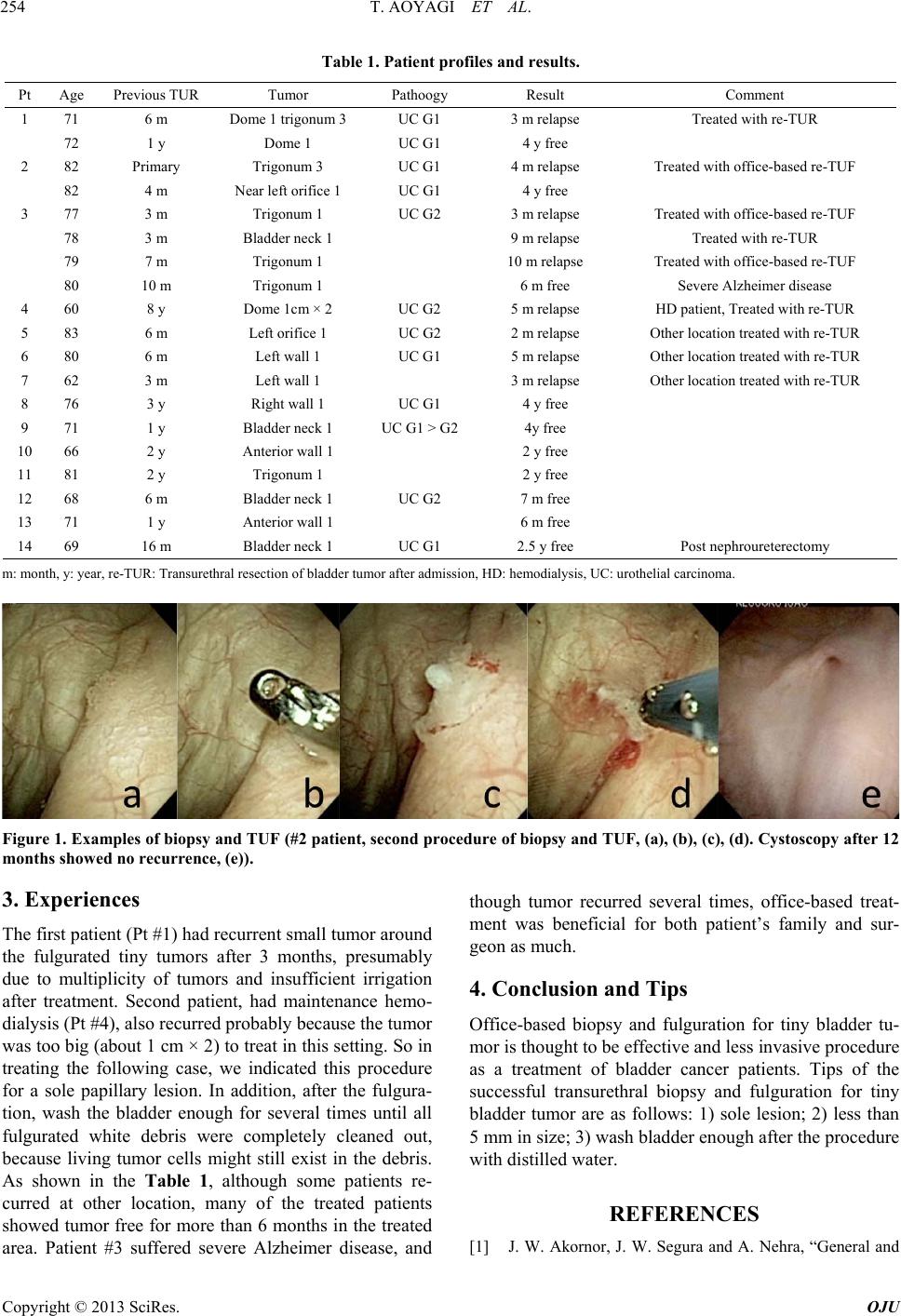 T. AOYAGI ET AL. 254 Table 1. Patient profiles and results. Pt Age Previous TUR Tumor Pathoogy Result Comment 1 71 6 m Dome 1 trigonum 3 UC G1 3 m relapse Treated with re-TUR 72 1 y Dome 1 UC G1 4 y free 2 82 Primary Trigonum 3 UC G1 4 m relapse Treated with office-based re-TUF 82 4 m Near left orifice 1 UC G1 4 y free 3 77 3 m Trigonum 1 UC G2 3 m relapse Treated with office-based re-TUF 78 3 m Bladder neck 1 9 m relapse Treated with re-TUR 79 7 m Trigonum 1 10 m relapse Treated with office-bas ed re-TUF 80 10 m Trigonum 1 6 m free Severe Alzheimer disease 4 60 8 y Dome 1cm × 2 UC G2 5 m relapse HD patient, Treated with re-TUR 5 83 6 m Left orifice 1 UC G2 2 m relapse Other location treated with re-TUR 6 80 6 m Left wall 1 UC G1 5 m relapse Other location tre ated with re-TUR 7 62 3 m Left wall 1 3 m relapse Other location treated with re- TUR 8 76 3 y Right wall 1 UC G1 4 y free 9 71 1 y Bladder neck 1 UC G1 > G2 4y free 10 66 2 y Anterior wall 1 2 y free 11 81 2 y Trigonum 1 2 y free 12 68 6 m Bladder neck 1 UC G2 7 m free 13 71 1 y Anterior wall 1 6 m free 14 69 16 m Bladder nec k 1 UC G1 2.5 y free Post nephroureterectomy m: month, y: year, re-TUR: Transurethral resec ti on of bladder tumor after adm i s sion, HD: hemodialysis, UC: urothelial carcinoma. Figure 1. Examples of biopsy and TUF (#2 patient, second procedure of biopsy and TUF, (a), (b), (c), (d). Cystoscopy after 12 months showed no recurrence, (e)). 3. Experiences The first patient (Pt #1) had recurrent small tumor around the fulgurated tiny tumors after 3 months, presumably due to multiplicity of tumors and insufficient irrigation after treatment. Second patient, had maintenance hemo- dialysis (Pt #4), also recurred probably because the tumor was too big (about 1 cm × 2) to treat in this setting. So in treating the following case, we indicated this procedure for a sole papillary lesion. In addition, after the fulgura- tion, wash the bladder enough for several times until all fulgurated white debris were completely cleaned out, because living tumor cells might still exist in the debris. As shown in the Table 1, although some patients re- curred at other location, many of the treated patients showed tumor free for more than 6 months in the treated area. Patient #3 suffered severe Alzheimer disease, and though tumor recurred several times, office-based treat- ment was beneficial for both patient’s family and sur- geon as much. 4. Conclusion and Tips Office-based biopsy and fulguration for tiny bladder tu- mor is thought to be effective and less invasive procedure as a treatment of bladder cancer patients. Tips of the successful transurethral biopsy and fulguration for tiny bladder tumor are as follows: 1) sole lesion; 2) less than 5 mm in size; 3) wash bladder enough after the procedure with distilled water. REFERENCES [1] J. W. Akornor, J. W. Segura and A. Nehra, “General and Copyright © 2013 SciRes. OJU  T. AOYAGI ET AL. 255 Cystoscopic Procedures,” Urologic Clinics of North Ame- rica, Vol. 32, No. 3, 2005, pp. 319-326. http://dx.doi.org/10.1016/j.ucl.2005.04.002 [2] B. B. O’Neil and W. T. Lowrance, “Office-Based Bladder Tumor Fulguration and Surveillance, Indications and Techniques,” Urologic Clinics of North America, Vol. 40, No. 2, 2013, pp. 175-182. http://dx.doi.org/10.1016/j.ucl.2013.01.007 [3] A. W. Wedderburn, P. Ratan and B. R. Birch, “A Pro- spective Trial of Flexible Cystodiathermy for Recurrent Transitional Cell Carcinoma of the Bladder,” Journal of Urology, Vol. 161, No. 3, 1999, pp. 765-776. http://dx.doi.org/10.1016/S0022-5347(01)61778-6 [4] S. M. Donat, A. North, G. Dalbagni and H. W. Herr, “Ef- ficacy of Office Fulguration for Recurrent Low Grade Papillary Bladder Tumors Less than 0.5 cm,” Journal of Urology, Vol. 171, No. 2, 2004, pp. 636-639. http://dx.doi.org/10.1097/01.ju.0000103100.22951.5e [5] H. W. Herr, S. M. Donat and V. E. Reuter, “Management of Low Grade Papillary Bladder Tumors,” Journal of Urology, Vol. 178, No. 4, 2007, pp. 1201-1205. http://dx.doi.org/10.1016/j.juro.2007.05.148 [6] W. E. Wysokinski and R. D. McBane II, “Periprocedural Bridging Management of Anticoagulation,” Circulation, Vol. 126, 2012, pp. 486-490. http://dx.doi.org/10.1161/CIRCULATIONAHA.112.0928 33 Copyright © 2013 SciRes. OJU |