

Paper Menu >>
Journal Menu >>
 Modern Economy, 2013, 4, 9-13 http://dx.doi.org/10.4236/me.2013.410A002 Published Online October 2013 (http://www.scirp.org/journal/me) Economic Evaluation of Continuous Subcutaneous Insulin Infusion for Children with Diabetes—Part II* Elina Petkova1, Valentina Petkova1, Maia Konstantinova2, Guenka Petrova1 1Department of Social Pharmacy, Faculty of Pharmacy, Medical University, Sofia, Bulgaria 2Endocrinology Clinic, University Pediatric Hospital, Medical University, Sofia, Bulgaria Email: guenka.pet[email protected] Received September 4, 2013; revised September 28, 2013; accepted October 7, 2013 Copyright © 2013 Elina Petkova et al. This is an open access article distributed under the Creative Commons Attribution License, which permits unrestricted use, distribution, and reproduction in any medium, provided the original work is properly cited. ABSTRACT The aim of this study is to assess long-term metabolic outcomes in children with diabetes mellitus and to compare the efficacy, feasibility and metabolic control expenses for treatment with continuous subcutaneous insulin infusion (CSII), compared to human insulin treatment. The study sample included 34 children aged 3 to 18 years with type 1 diabetes, 17 with continuous subcutaneous insulin infusion (CSII) therapy and 17 with standard treatment with human insulin. The study observed for the following variables: duration of the disease, diabetic control, HbA1c deviation scores; height and weight deviation and price of the treatment. Methods applied include meta-analyses in the published medical lit- erature, pharmacoeconomic analysis and statistical analysis. From the 34 children with diabetes type 1 observed retro- spectively during the period 1999-2012, 17 were on CSII (mean age 10 years, mean duration of the disease—7 years, average usage of CSII—3 years). The test stripes cost 533 Euro/year (1100 stripes per year) and their average cost ac- cording to the duration of the disease is 3779.45 Euro since diagnosis. The blood glucose monitoring system costs 20 Euro and for the duration of the disease—4.96 Euro per patient per year. The average improvement of HbA(1c) after the CSII introduction is 1.85, while after the applicatio n of human insulin—0.28. Th e treatment with CSII leads to signifi- cant improvement in glycemic control compared to the treatment with human insulin. The reduced HbA(1c) shows good diabetes management, from one point of view, and good quality of life—from another. Keywords: Diabetes; CSII; Metabolic Control 1. Introduction The exponential rise in th e prevalence of diabetes can be associated with an increase in the long-term complica- tions that associate with this disease. Type-1-diabetes (T1DM) patients treated with unmodified regular human insulin (RHI) rarely achieve their glycemic target and often suffer from postprandial hyperglycemic incidents, together with an increased risk of hypoglycemia in the post-absorptive period [1]. The pattern of diabetic com- plications is changing. Western Europe advanced reti- nal disease and end-stage renal failure are diminishing, while coronary heart disease has become a leading com- plication. Recent meta-analyses in the literature have been found to improve g lycemic control with continuous subcutaneous insulin infusion (CSII) compared with multiple daily injections (MDI) of insulin for patients with diabetes mellitus. For example, in Australia, CSII is predominantly used in type-1-diabetes mellitus patient populations [2]. Continuous subcutaneous insulin infu sion (CSII) is considered an option for type-1 diabetic patien ts unsatisfactorily controlled with multiple daily injections (MDI). Short-acting analogs are superior to regular hu- man insulin in CSII. There is evidence supporting the advantages of short-acting analog-based CSII over MDI in type-1 diabetes. The reduction of glycated hemoglobin (hba1c) level with CSII was evident in trials enrolling patients with mean age greater than 10 years [3]. The main goals for managing children with type-1-diabetes mellitus include achieving normal blood sugar levels, minimizing hypoglycemic incidents, optimizing quality of life, and preventing or delaying long-term comp- lications. Continuous subcutaneous insulin infusion (CS II ) is a treatment option that can assist in achieving all of these goals in all ages of children [4]. European Union countries reimburse insulin therapy for individuals with health insurance, but for CSII reimbursement, a variety of approaches exist [5-7]. The objective of this study is to assess the cost of using CSII of insulin to treat children *Competing Interests: the authors declare that they have no competing interests. C opyright © 2013 SciRes. ME  E. PETKOVA ET AL. 10 with type-1 diabetes in Bulgaria and to compare it with the changes in BMI and HbA(1c). The study was per- formed from the perspective of the Bulgarian NHIF and patients. The main study question discussed is “will the use of CSII be cost-effective for the Bulgarian health care system?” 2. Methods 2.1. Literature Review PubMed was searched using keywords CSII, type-1 dia- betes, pediatric population and all articles analyzing the safety, efficacy, and cost-effectiveness of CSII usage and human insulin treatment in the pediatric population were selected. In total, 4 studies were selected and their objec- tives, methodologies, results and conclusions were com- pared [2,8 -10]. 2.2. Type of the CSII Usage Study In order to perform the main aim of the study a combined retrospective and prospective analysis of children patient records after the introduction of CSII was performed based on the patients’ records and observation. The main setting is Endocrinology Clinic of University pediatric hospital of the Medical University, Sofia. The study was reviewed and approved by the Ethics committee of the Science medical council of the Medical University in Sofia. 2.3. Patient Screening A total of 34 children with type-1-diabetes were ob- served divided into two groups: with an active group using CSII and a control group using human insulin therapy. Thirty children in the country use CSII, and of these, 17 were included in the survey, after their parents signed informed-consent forms. The active group in- cluded all children who began using the CSII pumps during the period 2007-2011 when the data collection began. Also since 2010, all children were transferred to real time insulin pumps; therefore at the moment of ob- servation, they all used the same type of pump from the same manufacturer. The control group was formed after reviewing patient records and random selection accord- ing to age, duration of diabetes, entrance BMI and HbA 1c level. Their parents also signed informed-consent forms. 2.4. Data Collection The duration of the observation was from 01.02.2012 to 31.08.2012 (7 months). During this period, the diabetes maintenance phase after CSII in trod uc tion was measured. Data for the selected children was collected on their demographics, age, gender, weight, duration of disease, therapeutic schema (CSII or analogue insulin treatment with a pen device) and HbA1c before the inclusion in the pump program, and at the end of the observation. 2.5. Cost-Effectiveness Analysis For both groups of children, the health care resources used by them were recorded, namely insulin, pumps (1 for 4 years), consumables for pumps (6 - 10 sets and 6 - 10 reservoirs), strips (n = 1100 per patient per year), glucometers (1 for 5 years including sensor prices), GP and endocrinology visits, and hospitalization due to dia- betes. Sensors were used from 7 to 10 days. Yearly costs of CSII, blood glucose monitoring systems, insulin ther- apy, and strips were calculated by multiplying the num- ber of resource s used by their prices. Prices of pumps and blood glucose monitoring systems were collected from the manufacturers’ websites. To calculate the yearly pump costs, the prices were divided by 4, which is rec- ommended by the manufacturers as the period of use for initial users [11]. All other costs were taken from the Bulgarian NHIF tariff [12]. Costs are presented in Bul- garian leva (BGN). At the time, the exchange rate was 1 Euro: 1.95 BGN. The primary outcome observed was the change in HbA(1c) before the pump introduction and at the end of the study. The secondary outcome observed was the BMI change during the same period. In this pilot study we did not include the hypoglycemia episodes due to lack of data for all children. Children were introduced to pumps in different time periods, and in order to calcu- late the corresponding decrease in the HbA1c level, the total decrease during the period was divided into the du- ration of the period when the particular child was using the pump. Finally the average decrease for both groups was calculated. 2.6. Sensitivity Analysis To test the robustness of the results, a one-way sen- sitivity analysis was performed by consecutively varying the changes in the HbA1c within the standard deviation interval for both groups of patients with 0.05. 2.7. Statistical Processing Descriptive statistics were applied to the patient’s charac- te r i s tic and ou tcomes. A T-test analysis was also perfor med to test the statistical significance in the outcome changes. 3. Results Subcutaneous insulin infusion (CSII) systems are not a standard treatment for the Bulg arian children. So th ey are of a limited usage and are not includ ed in the Positive list for reimbursement. 3.1. Analysis of Published Studies There are 4 studies in the literature that discuss the effi- Copyright © 2013 SciRes. ME  E. PETKOVA ET AL. 11 cacy, safety and/or cost-effectiveness of CSII usage in the pediatric population—Table 1. The number of ob- served patients varied from 19 to 95. All of these studies measured the decrease in HbA1C, and some, in addition , focused on patients’ demographic characteristics, glucose level, hypoglycemia, and quality of life. All of the stud- ies conclude that CSII is safe and effective, leading to greater decreases in HbA1c levels, allowing for im- proved quality of life, decreased hypoglycemic events and improved child and parent adherence as shown in Table 1. The published studies define the HbA1c level as the widely accepted measure of diabetes control in pediatric practice. Positive therapeutic results after CSII introduc- tion that might lead to better long-term outcomes are ob- served. 3.2. Results of the Study The University pediatric clinic has been introducing CSII on the request of the parents, with only 30 children hav- ing applied so far. From 1999 to 2011, 17 children with diabetes type-1 were observed (mean age 113.82 months in the active group and 112.41 in the control group). The duration of diabetes was a little lower in the control group—Table 2. The average improvement of HbA (1c) in the active group after the CSII introduction is 1.85, while after the application of human insulin—0.28 (Table 2). From the 34 children with diabetes type 1 observed retrospectively during the period 1999-2012 17 were on CSII (mean age 10 years, mean duration of the disease— 7 years, average usage of CSII—3 years). The test stripes costs 533 Euro/year (1100 stripes per year) and their av- erage cost according to the duration of the disease is 3779.45 Euro since diagnosis. The blood glucose moni- toring system costs 20 Euro and for the duration of the disease—4.96 Euro per patient per year. The CSII price is 3896 Euro and compared to the duration of usage it costs 1290 euro pe r patient per year. Adding and the cost of insulin and pumps consumables the total yearly cost per patient in the active group treated with CSII is 2735.79 Euro. The total yearly cost weighed with the duration of the disease for the passive group treated with human insulin is 930.39 Euro (Table 3). Based on these calculations the cost-effectiveness ra- tion for the active group is 1563.31 Euro and for the group on human insulin is 3322.82 Euro. Thus the in- vestment in the therapy of children diabetes with con- tinuous infusion of insulin with pumps is cost-effective in comparison with the therapy with human insulin be- cause it costs less for unit of HbA1c level improvement. The one way sensitive analysis shows that the CSII therapy remains cost-effective within the established thera- peutic interval. 4. Discussion Continuous subcutaneous insulin infusion (CSII) systems are of a limited usage because they are not reimbursed by the Health Insurance Fund in Bulgaria. No official crite- ria for CSII usage in child populations have been estab- lished and only parents with sufficiently high income are able to afford such a therapeutic approach. In this sense, evaluation of the cost-effectiveness of CSII usage is in- fluenced by a number of factors, such as health insurance policy, parents’ preferences, income and therapeutic standards. This study shows that the usage of CSII with child populations is an efficient therapy and confirms similar findings reported in the literature on improve- ments in terms of better metabolic control, reduced rates of complications and better quality of life [2,13]. The study also shows that the children using CSII manage to maintain stable and target HbA1c levels, which are preconditions for better diabetes management (UKPDS, DCCT). The studies of the CSII usage in child populations are very limited for comparing long-term results in detail, but bearing in mind the evidence for the adult population, it can be predicted that strict and reli- able disease control for children will support their long- term survival. One limitation of this study is the small pati ent sample due to the limited number of child ren on CSII in Bulg aria, but it includes more than 57% of all the CSII users in the country, which ensures reliable results for the whole group. The number of the patients is twice as high as Wilsons’ study [8]. We did not calculate the cost-effec- tiveness of CSII pumps related to the second observed outco me—BM I, bec ause an incre ase in child ren’s weight as a result of their normal developmental growth was observed in the both groups. The results from the study can be an evidence for the Bulgarian NHIF to include CSII within the reimburse- ment system. Strict criteria for appropriate selection of children must be developed, as well as cost controls in order to make the final decision. The reimbursement practice in some countries provides such evidence, as in Serbia, where insurance authorities are paying for con- sumables and patients’ families are paying for pumps. In countries with high GDP, CSII is included within the scope of the reimbursement system [7]. 5. Conclusion The treatment with CSII leads to significant improve- ment in glycemic control compared to the treatment with human insulin. The reduced HbA(1c) shows good diabe- tes management, fr om one point of view, and good qual- ity of life—from another. 6. Acknowledgements We wish to thank to the staff of University paediatric Copyright © 2013 SciRes. ME 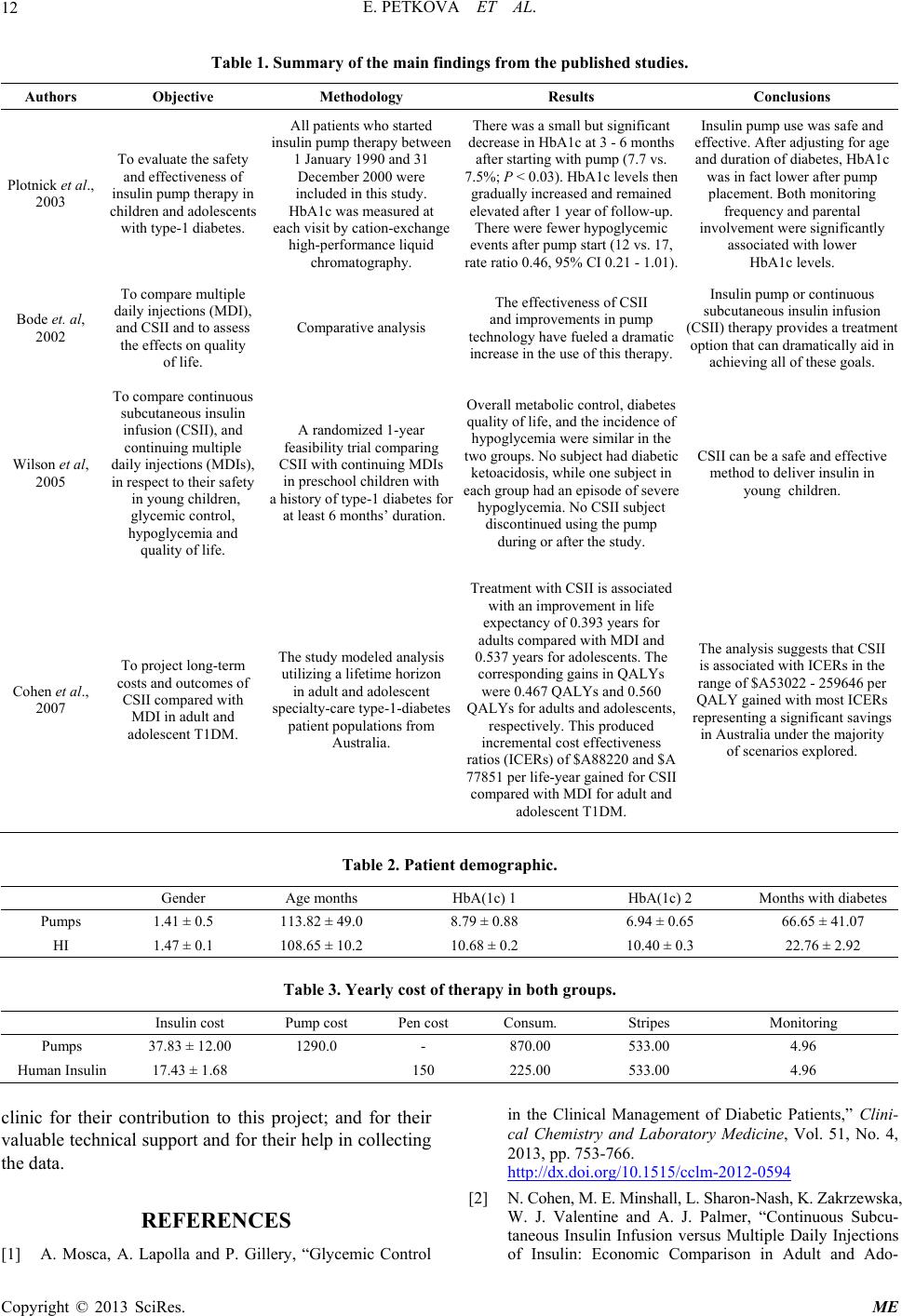 E. PETKOVA ET AL. Copyright © 2013 SciRes. ME 12 Table 1. Summary of the main findings from the published studies. Authors Objective Methodology Results Conclusions Plotnick et al., 2003 To evaluate the safety and effectiveness of insulin pump therapy in children and adolescents with type-1 diabetes. All patients who started insulin pump therapy between 1 January 1990 and 31 December 2000 w ere included in this study. HbA1c was measured at each visit by cation-exchange high-performance liquid chromatography. There was a small but significant decrease in HbA1c at 3 - 6 months after starting with pump (7.7 vs. 7.5%; P < 0.03). HbA1c levels then gradually increased and remained elevated after 1 year of follow-up. There were fewer hypoglycem i c events after pump start (12 vs. 17, rate ratio 0.46, 95 % CI 0.21 - 1.01). Insulin pump use was safe and effective. After adjusting for age and duration of diabetes, HbA1c was in fact lower after pump placement. Both monitoring frequency and parental involvement were significantly associated with lower HbA1c levels. Bode et. al, 2002 To compare multiple daily injections (MDI), and CSII and to assess the effects on quality of life. Comparative analysis The effectiveness of CSII and improvements in pump technology have fueled a dramatic increase in the use of this therapy. Insulin pump or continuous subcutaneous insulin infusion (CSII) therapy provides a treatment option that can dramatically aid in achieving all of these goals. Wilson et al, 2005 To compare cont inuous subcutaneous insulin infusion (CSII), and continuing multiple daily injections (MDIs), in respect to their safety in young children, glycemic c o nt rol, hypoglycemia and quality of life. A randomized 1-year feasibility trial comparing CSII with continu ing MDIs in preschool children with a history of type-1 diabetes for at least 6 months’ duration. Overall metabolic control, diabetes quality of life, and the incidence of hypoglycemia were similar in t he two groups. No subject had diabetic ketoacidosis, while one subject in each group had an episode of severe hypoglycemia. No CSII subject discontinued usi ng the pump during or after the study. CSII can be a safe and effective method to delive r insulin in young children. Cohen et al., 2007 To project long-term costs and outcomes of CSII compared with MDI in adult and adolescent T1DM. The study modeled analysis utilizing a lifetime horizon in adult and adolescent specialty-care type-1-diabetes patient populations from Australia. Treatment with CSII is associated with an improvement in life expectancy of 0.393 years for adults compared with MDI and 0.537 years for adolescents. The corresponding gains in QALYs were 0.467 QALYs and 0.560 QALYs for adults and adolescents, respectively. This produced incremental cost effectiveness ratios (ICERs ) of $A88220 and $A 77851 per life-year gained for C S II compared with MDI for adult and adolescent T1DM. The analysis suggests that CSII is associated with ICERs in the range of $A53022 - 259646 per QALY gained with most ICERs representing a significant savings in Australia under the majority of scenarios explored. Table 2. Patient demographic. Gender Age months HbA(1c) 1 HbA(1c) 2 Months with diabetes Pumps 1.41 ± 0.5 11 3.82 ± 49.0 8.79 ± 0.88 6.94 ± 0.65 66.65 ± 41.07 HI 1.47 ± 0.1 10 8.65 ± 10.2 10.68 ± 0.2 10.40 ± 0.3 22.76 ± 2.92 Table 3. Yearly cost of therapy in both groups. Insulin cost Pump cost Pen cost Consum. Stripes Monitoring Pumps 37.83 ± 12.0 0 1290.0 - 870.00 533.00 4.96 Human Insulin 17.43 ± 1.68 150 225.00 533.00 4.96 clinic for their contribution to this project; and for their valuable techn ical support and for their help in collecting the data. REFERENCES [1] A. Mosca, A. Lapolla and P. Gillery, “Glycemic Control in the Clinical Management of Diabetic Patients,” Clini- cal Chemistry and Laboratory Medicine, Vol. 51, No. 4, 2013, pp. 753-766. http://dx.doi.org/10.1515/cclm-2012-0594 [2] N. Cohen, M. E. Minshall, L. Sharon-Nash, K. Zakrzewska, W. J. Valentine and A. J. Palmer, “Continuous Subcu- taneous Insulin Infusion versus Multiple Daily Injections of Insulin: Economic Comparison in Adult and Ado-  E. PETKOVA ET AL. 13 lescent Type 1 Diabetes Mellitus in Australia,” Pharma- coeconomics. Vol. 25, No. 10, 2007, pp. 881-897. http://dx.doi.org/10.2165/00019053-200725100-00006 [3] M. Monami, C. Lamanna, N. Ma rchionni and E. M an n u c c i, “Continuous Subcutaneous Insulin Infusion versus Mul- tiple Dailyinsulin Injections in Type 1 Diabetes: A Meta- Analysis,” Acta Diabetologica, Vol. 47, No. 1, 2010, pp. 77-81. http://dx.doi.org/10.1007/s00592-009-0132-5 [4] W. Tamborlane, K. Swan, K. Sikes, A. Steffen and S. Weinzime r, “The Renaissa nce of Insulin Pump Treatment in Childhood Type 1 Diabetes,” Reviews in Endocrine & Metabolic Disorders, Vol. 7, No. 3, 2006, pp. 205-213. http://dx.doi.org/10.1007/s11154-006-9018-9 [5] G. Soltesz, C. C. Patterson and G. Dalquist, “EUR ODIA B Study Group Worldwide Childhood Type 1 Diabetes In- cidence—What Can We Learn from Epidemiology?” Pe- diatric Diabetes, Vol. 8, Suppl. 6, 2007, pp. 6-14. http://dx.doi.org/10.1111/j.1399-5448.2007.00280.x [6] F. Carle, R. Gesuita, G. Bruno, G. V. Coppa, A. Falorni, R. Lorini, et al., “Diabetes Incidence in 0- to 14-Year Age-Group in Italy,” Diabetes Care, Vol . 27, No. 1 2, 2004, pp. 2790-2796. http://dx.doi.org/10.2337/diacare.27.12.2790 [7] G Stipancic, L. La Grasta Sabolic, M. Sepec, A. Radica, V. Skrabic, S. Severinski and M. Tiljak, “Regional Dif- ferences in Incidence and Clinical Presentation of Type 1 Diabetes in Children Aged under 15 Years in Croatia,” Croatian Medical Journal, Vol. 53, No. 2, 2012, pp. 141- 148. http://dx.doi.org/10.3325/cmj.2012.53.141 [8] L. Plotnik, et al., “Safety and Effectiveness of Insulin Pump Therapy in Children and Adolescents with Type 1 Diabetes,” Diabetes Care, Vol. 26, No. 4, 2003, pp. 1142- 1146. http://dx.doi.org/10.2337/diacare.26.4.1142 [9] B. W. Bode, H. T. Sabbah, T. M. Gross, L. P. Fredrickson and P. C. Davidson, “Diabetes Management in the New Millennium Using Insulin Pump Therapy,” Diabetes/ Metabolism Research and Reviews, Vol. 18, No. S1, 2002, pp. S14-S20. http://dx.doi.org/10.1002/dmrr.205 [10] D. Wilson, et al., “A Two-Center Randomized Controlled Feasibili ty Tr ial of I nsuli n Pump T hera py in Young Children with Diabetes,” Diabetes Care, Vol. 28, No. 1, 2005, pp. 15-19. http://dx.doi.org/10.2337/diacare.28.1.15 [11] http://www.medtronic-diabetes.bg/ [12] http://www.nhif.bg [13] O. Cohen, A. Korner, R. Chlup, C. S. Zoupas, A. K. Ragozin, K. Wudi, et al., “Improved Glycemic Control through Continuous Glucosesensor-Augmented Insulin Pump Therapy: Prospective Results from a Community and Academic Practice Patient Registry,” Journal of Dia- betes Science and Technology, Vol. 3, No. 4, 2009, pp. 804-811. Copyright © 2013 SciRes. ME |