

Paper Menu >>
Journal Menu >>
 Vol.3, No.7, 441-445 (2013) Open Journal of Preventiv e Me dic ine http://dx.doi.org/10.4236/ojpm.2013.37059 Psychological risk factors associated with falls among elderly people in Baghdad city, Iraq Mohammed A. Abdal Qader1*, Rahmah Mohd. Amin2, Shamsul Azhar Shah1, Zaleha Md. Isa1, Khalib Abdul Latif1, Hasanain Faisal Ghazi1 1Department of Community Health, Universiti Kebangsaan Malaysia Medical Centre, Kuala Lumpur, Malaysia; *Corresponding A u thor: [email protected] 2Medical and Health Science Faculty, Universiti Sultan Zainal Abidin (City Campus), Jalan Sultan Mahmud, Kuala Terengganu, Malaysia Received 15 August 2013; revised 21 September 2013; accepted 6 October 2013 Copyright © 2013 Mohammed A. Abdal Qader et al. This is an open access article distributed under the Creative Commons Attribu- tion License, which permits unrestricted use, distribution, and reproduction in any medium, provided the original work is properly cited. ABSTRACT Background: Ageing of the population is one of the most im portant demographic fac t s th at c ome to the foreground in the 21st century. Objective: To assess the relationship between psycho- logical factors (depression, loneliness, using anti anxiety medication, fear from falls and in- ternal displacement of the population) and falls among elderly people in Baghdad city, Iraq. Methods: A match ed 1:1 comm unity based ca se- control study involving 716 elderly respondents, recruited randomly from six Non Governmental Organization (NGO) in different areas of Bagh- dad. Interviews to each respondent were done accordingly. Geriatric depression scale (GDS) was used to assess the depression among the elderly people. Results: The minimum age for cases and controls was 60 years old while the maximum age for cases was 87 and for controls was 85 years old. The female was predominant than male, 53.6% to 46.4% respectively. The re- lation between depression, fear from fall, using anti anxiety medication, internal displacement and falls was statistically significant (p < 0.001). Conclusions: Psychological factor especially depression among elderly people is one of the important risk factors contributing to falls acci- dent. Fear from falls, displacement and taking anti anxiety medication were also in significant relation. Keywords: Falls; Elderly; Depression; Fear from Fall; Baghdad 1. INTRODUCTION Ageing of the population is one of the most important demographic facts that come to the foreground in the 21st century. Psychological problems of depression, loneliness and dependency feelings are very common among elderly people. Another common issue is falls accident which has a great impact on or leads to many consequences such as bedridden, total dependence on others and can even cause death [1]. According to United Nations report in 2009, the per- centage of 60+ age population in Iraq was 3.9% for men and 5.6% for women, while the sex ratio in 60+ age group was 70 men to each 100 women. Some elderly Iraqis have lost all their relatives over the past few years and now have to depend totally on themselves. Being unable to work because of age or poor health conditions, some of them have urged for begging in the streets and become homeless people while others are supported by their neighbours and relatives[2]. Falls accident could be preventable and is a promising issue to be dealt with in preventive medicine. Hence the public health experts should take into consideration, this preventive issue involving falls among the elderly people seriously. More research is needed to be done to reduce the burden of falls to the community. It is obvious that lack of knowledge about risk factors and how to prevent them will contribute to a high prev alence of falls. There- fore, lack of knowledge in this issue will lead to a lack of preventive actions that should be taken, thus resulting in more falls [3]. Psychological relationships to falls accident were less clear. However, depression and falls, which can be corre- lated to the decrease of functional independence, loss of physical fitness, reduc ed gait velocity and loss of muscle strength are due to immobility and lethargy, which are *The authors declare t hat they have no conflict of interest. Copyright © 2013 SciRes. OPEN A CC ESS  M. A. A. Qader et al. / Open Journal of Preventive Medicine 3 (2013) 441-445 442 common in depression [4]. Fear of falling (FOF) is a major health problem among the elderly living in communities. This feeling can be expressed in older people both who have fallen and also in older people who have never experienced a fall. The main consequences were identified as a decline in physical and mental performance, an increased risk of falling and progressive loss of health-related quality of life [5]. A study by Elliott et al. [6] in eastern North Carolina, United States showed a significant relation be- tween living alone and falls accident to themselves. In Iraq, there are no available studies or literature re- view that assays the epidemiolog y and aetiology of falls, that could be considered as evidence that warrants some attention. The objective of this study is to assess the rela- tionship between psychological factors and falls accident among elderly people in Baghdad city, Iraq. 2. Methods A case control study matched by sex and age was conducted between January and March 2012 in Baghdad city, Iraq. 716 elderly respondents, recruited randomly from six Non Governmental Organization (NGO) in dif- ferent areas of Baghdad; These NGOs provide social & medical services to the community in Iraq. Severely ill respondents, using wheelchair, an elderly fall outside the home and elderly with severe psychosomatic disease were excluded from this study. Face to face interview to each respondent were done accordingly. Back-to-back trans-lation to the questionnaire was done (English-Ara- bic-English). GDS (geriatric depression scale) standard- ized questionnaire (Arabic version) was used to measure the level of depression among the elderly people [7]. A pre test of the questionnaire was carried out to im- prove the questionnaires and make it more understand- able. This study was approved by the Research and Eth- ics Committee of Universiti Kebangsaan Malaysia Me- dical Centre. Code Number FF-017-2012, consent form was taken from the respondents.SPSS version 19 was used for statistical analysis of the data and Pearson chi-square test was performed with a level of signifi- cance p < 0.05. 3. Results The minimum age for cases and controls was 60 years old while the maximum age for cases was 87 and for controls was 85 years old, the mean age for cases was 67.01 while mean age for controls was 66.28 years old. The female was predominant than male, 53.6% to 46.4% respectively. Other socio-demographic characteristics as shown in Table 1 showdifferences between cases and controls. Educational level was a significant contributor for the falls. The employment status was not significant risk factor, while, the monthly family income and marital status were significant risk factors for falls among eld- erly people. Table 1 also shows the distribution of the respon- dents’ depression, fear from fall and living alone. The fear from fall was significantly associated with fall acci- dent and of p < 0.001, the odds ratio is 2.90, with a 95% confidence interval ranging from 2.17 to 4, showed that those who suffer from fear were about 3 times more sus- ceptible to fall than those elderly who does suffer from fear of falling. For depression factor, the p value is sig- nificant (p < 0.001), the odds ratio 2.8, indicating that those elderly with depression is about 3 times more sus- ceptible to fall than those elderly without depression. Living alone was not statistically associated with falls (p = 0.91) with odds ratio of 1.03, and 95% confidence in- terval extending from 1.49 to 1.58. Internal displacement was a significant risk factor of a p value <0.001, those who internally displaced were about 2 times more to falls as compared to non displaced elderly. Elderly people using anti anxiety medications suffer a higher significant risk of falls with odds ratio of 2.3. 4. Discussion Fall is still found to be one of the public health prob- lems among elderly people; falls are a common and often devastating problem among older people, causing a tre- mendous amount of morbidity, mortality and use of health care services. The most important finding in our study was depression and fears from fall as they were significantly associated with an increased risk of being a faller. Some of the limitations in this study are recall bias of the respondents, not an interventional type and logistic problems because of the security situation in Baghdad. While the strength of this study is mainly being a com- munity based study, with large sample size and first kind of study in Iraq. In this study, there is a significant difference between low education and high education among cases and con- trols, those with low education level were at odds of risk by about 1.8 times as compared to those with high edu- cation as shown in other studies [8,9]. There was a significant relationship between monthly income and falls as supported by other studies. The pos- sible reason for that could be those with higher monthly income can get better welfare life, nutrition and more medical services. There were no significant association between current employment status (working or not working) and fall and that was against what some other studies findings [8,9]. Fear from falls was associated with falls accident as Copyright © 2013 SciRes. OPEN A CCESS 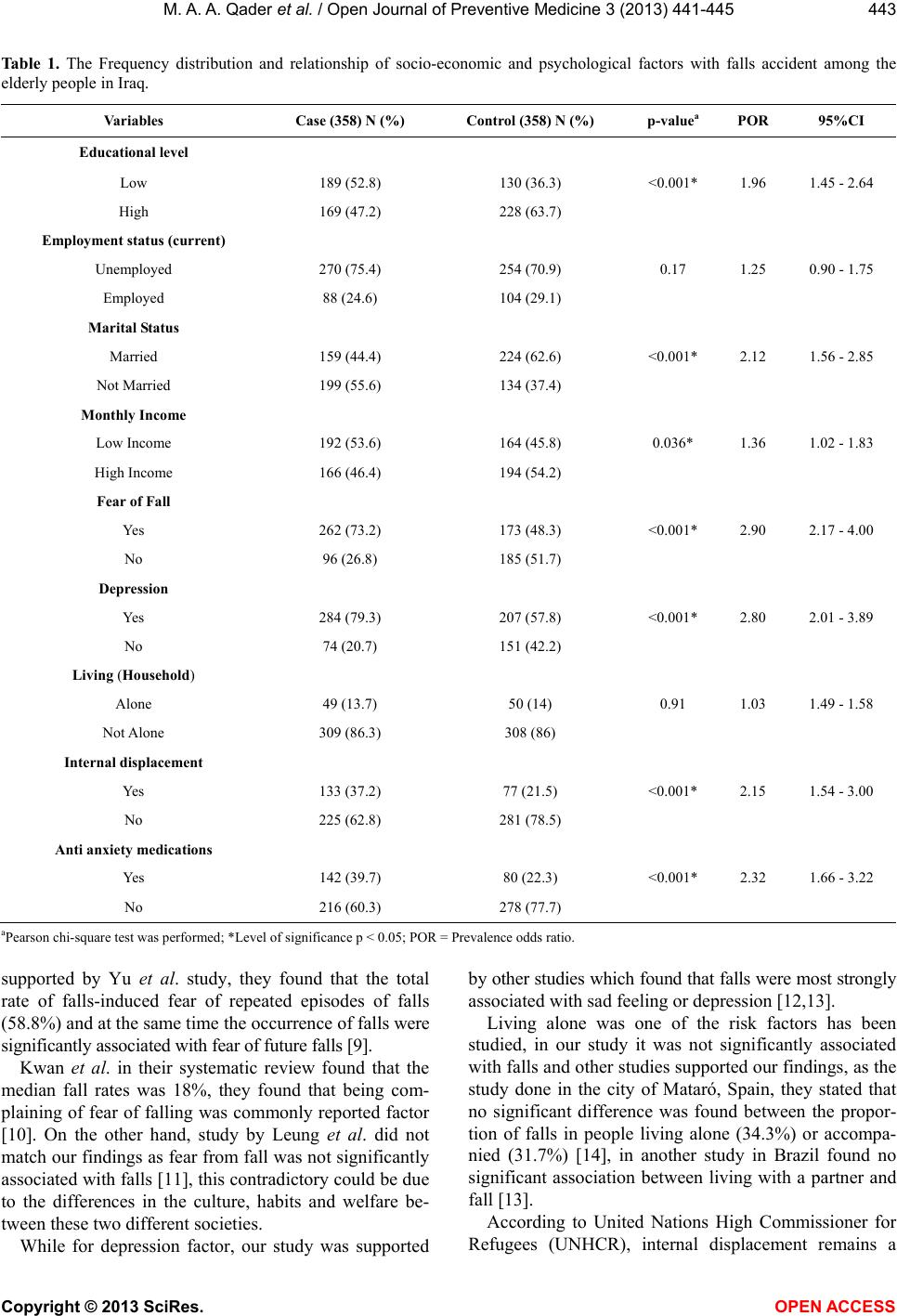 M. A. A. Qader et al. / Open Journal of Preventive Medicine 3 (2013) 441-445 Copyright © 2013 SciRes. OPEN A CCES S 443 Table 1. The Frequency distribution and relationship of socio-economic and psychological factors with falls accident among the elderly people in Iraq. Variables Case (358) N (%) Control (358) N (%) p-valuea POR 95%CI Educational level Low 189 (52.8) 130 (36.3) <0.001* 1.96 1.45 - 2.64 High 169 (47.2) 228 (63.7) Employment status (current) Unemployed 270 (75.4) 254 (70.9) 0.17 1.25 0.90 - 1.75 Employed 88 (24.6) 104 (29.1) Marital Status Married 159 (44.4) 224 (62.6) <0.001* 2.12 1.56 - 2.85 Not Married 199 (55.6) 134 (37.4) Monthly Income Low Income 192 (53.6) 164 (45.8) 0.036* 1.36 1.02 - 1.83 High Income 166 (46.4) 194 (54.2) Fear of Fall Yes 262 (73.2) 173 (48.3) <0.001* 2.90 2.17 - 4.00 No 96 (26.8) 185 (51.7) Depression Yes 284 (79.3) 207 (57.8) <0.001* 2.80 2.01 - 3.89 No 74 (20.7) 151 (42.2) Living (Household) Alone 49 (13.7) 50 (14) 0.91 1.03 1.49 - 1.58 Not Alone 309 (86.3) 308 (86) Internal displacement Yes 133 (37.2) 77 (21.5) <0.001* 2.15 1.54 - 3.00 No 225 (62.8) 281 (78.5) Anti anxiety medications Yes 142 (39.7) 80 (22.3) <0.001* 2.32 1.66 - 3.22 No 216 (60.3) 278 (77.7) aPearson chi-square test was perfor med; *Level of significance p < 0.05; POR = Prevalence odds ratio. supported by Yu et al. study, they found that the total rate of falls-induced fear of repeated episodes of falls (58.8%) and at the same time the occurrence of falls were significantly associated with fear of future falls [9]. Kwan et al. in their systematic review found that the median fall rates was 18%, they found that being com- plaining of fear of falling was commonly reported factor [10]. On the other hand, study by Leung et al. did not match our findings as fear from fall was not significantly associated with falls [11], this contradictory could be due to the differences in the culture, habits and welfare be- tween these two different societies. While for depression factor, our study was supported by other studies which found that falls were most strongly associated wit h sad feeli ng or depression [12,1 3] . Living alone was one of the risk factors has been studied, in our study it was not significantly associated with falls and other studies supported our findings, as the study done in the city of Mataró, Spain, they stated that no significant difference was found between the propor- tion of falls in people living alone (34.3%) or accompa- nied (31.7%) [14], in another study in Brazil found no significant association between living with a partner and fall [13]. According to United Nations High Commissioner for Refugees (UNHCR), internal displacement remains a  M. A. A. Qader et al. / Open Journal of Preventive Medicine 3 (2013) 441-445 444 major problem, and internally displaced persons (IDPs) require continued assistance and protection from UNHCR until a dignified solu tion is found to their troub les. Fami- lies live in poor settlements without adequate shelter and with limited access to water, electricity, schools and health centers [15]. Using anti anxiety drugs were associated with falls as supported by a study done in Great Britain, they found that hypnotics and anti anxiety drugs was independently associated with an increased odds of falling, it was asso- ciated with an increase of about 50% in the odds of fal- ling [16]. Another study found that sleeping pills won’t increase elderly fall risk, they found that it’s insomnia itself, not sleeping pills, that increases the risk for falls and injuries among elderly people [17]. 5. Conclusion Psychological factor especially depression among eld- erly is one of the important risk factors contributing to falls. Also, fear from falls, displacement and taking anti- anxiety medications are significant risk factors of falls. 6. Recommendations Findings from this research enhance knowledge about the contributing fall-related factors in elderly. Insights gained from this research will assist community an d pub- lic health leaders and health care professionals in devel- oping more effective intervention strategies to prevent or decrease falls, and associated psychological and physical consequences To prevent falls, it is necessary to intervene on factors associated with falls. Methods include encouraging re- gular physical activity to improve equilibrium and mus- cle strength and the continuous monitoring of health status to prevent further deterioration. Fall prevention is need ed for elderly individuals living in the community and should target the elderly adults with less education level and low monthly income while helping to en sure that individuals who are living without family have the appropriate support. 7. ACKNOWLEDGEMENTS This study was funded by the Universiti Kebangsaan Malaysia Medical Centre Fundamental Research Grant, Code Number FF-017- 2012 without which the study would not have been poss i b le. REFERENCES [1] Graafmans, W.C., Ooms, M.E., Hofstee, H.M.A, Bezemer, P.D., Bouter, L.M. and Lips, P. (1996) Falls in the elderly: A prospective study of risk factors and risk profiles. American Journal of Epidemiology, 143, 11. http://dx.doi.org/10.1093/oxfordjournals.aje.a008690 [2] UN Office for the Coordination of Humanitarian Affairs (2007) IRAQ: Elderly most vulnerable to insecurity IRIN, the humanitarian news and analysis service of the inte- grated regional information networks, UN-OCHA, Bagh- dad city. [3] Tremblay Jr. K.R. and Barber, C.E. (2010) Preventing falls in the elderly. http://www.ext.colostate.edu/pubs/consumer/10242.html [4] Rao, S.S. (2005) Prevention of falls in older patients. American Family Physici an, 72, 81-88. [5] Scheffer, A.C., Schuurmans, M.J., van Dijk, N., van der Hooft, T. and de Rooij SE. (2008) Fear of falling: Meas- urement strategy, prevalence, risk factors and conse- quences among ol d er persons. Age and Ageing, 37, 19-24. http://dx.doi.org/10.1093/ageing/afm169 [6] Elliott, S., Painter, J. and Hudson, S. (2009) Living alone and fall risk factors in community-dwelling middle age and older adults. Journal of Community Health, 34, 301- 310. http://dx.doi.org/10.1007/s10900-009-9152-x [7] Samira, N. (2011) http://www.stanford.edu/~yesavage/GDS.html [8] Morgan Robert, O., Virnig Beth. A., Maurice, D., Elsayed A.-M. and Carolee A. De V. (2003) Low-intensity exer- cise and reduction of the risk for falls among at-risk eld- ers. The Journals of Gerontology, 59, M1062-M1067. http://biomedgerontology.oxfordjournals.org/content/59/1 0/M1062.short-aff-1 [9] Yu, P.L., Qin, Z.H., Shi, J., Zhang, J., Xin, M.Z., Wu, Z.L. and Sun, Z.Q. (2009) Prevalence and related factors of falls among the elderly in an urban community of Beijing. Biomedical Environmental Sciences, 22, 179-187. http://dx.doi.org/10.1016/S0895-3988(09)60043-X [10] Kwan, M.M., Close, J.C., Wong, A.K. and Lord, S.R. (2011) Falls incidence, risk factors, and consequences in Chinese older people: A systematic review. Journal of the American Geriatric Society, 59, 536-543. http://dx.doi.org/10.1111/j.1532-5415.2010.03286.x [11] Leung, A., Chi, I., Lou, V. W. and Chan, K.S. (2010) Psy- chosocial risk factors associated with falls among Chi- nese community-dwelling older adults in Hong Kong. Health & Social Care in the Community, 18, 272-281. [12] Stevens, J.A., Ballesteros, M. F., Mack, K.A., Rudd, R.A., DeCaro, E. and Adler, G. (2012) Gender differences in seeking care for falls in the aged Medicare population. American Journal of Preventive Medicine, 43, 59-62. http://dx.doi.org/10.1016/j.amepre.2012.03.008 [13] Juliana, G., Lucy, G., Otávio de T.N. and Marcelo, P.R. (2010) factors related to falls among elderly women resi- dent in a community. Revista da Associação Médica Bra- sileira, 56, 327-332. [14] Salvà, A., Bolíbar, I., Pera, G. and Arias, C. (2004) Inci- dence and consequences of falls among elderly people living in the community. Medicina Clinica (Barc), 122, 172-176. http://dx.doi.org/10.1016/S0025-7753(04)74184-6 [15] United Nations High Commissioner for Refugees (2012) 2012 UNHCR country operations profile, Iraq, UNHCR, Baghdad city. Copyright © 2013 SciRes. OPEN A CCESS  M. A. A. Qader et al. / Open Journal of Preventive Medicine 3 (2013) 441-445 Copyright © 2013 SciRes. OPEN A CCES S 445 [16] Lawlor, D.A., Patel, R. and Shah, E. (2013). Association between falls in elderly women and chronic diseases and drug use: Cross sectional study. BMJ, 327, 712. [17] Alon, A. (2005) Sleeping pills won’t increase elderly fall risk. Health Day News, University of Michigan Health System. |