

Paper Menu >>
Journal Menu >>
 Journal of Crystallization Process and Technology, 2013, 3, 130-135 http://dx.doi.org/10.4236/jcpt.2013.34021 Published Online October 2013 (http://www.scirp.org/journal/jcpt) Copyright © 2013 SciRes. JCPT Bulk Growth and Characterization of D-(–)-Alanine Single Crystals Kalimuthu Moovendaran, Subramanian Natarajan* School of Physics, Madurai Kamaraj University, Madurai, India. Email: *[email protected] Received July 2nd, 2013; revised August 2nd, 2013; accepted August 9th, 2013 Copyright © 2013 Kalimuthu Moovendaran, Subramanian Natarajan. This is an open access article distributed under the Creative Commons Attribution License, which permits unrestricted use, distribution, and reproduction in any medium, provided the original work is properly cited. ABSTRACT Single crystal of D-(–)-alanine (DALA), a non-linear optical material from the amino acid family was grown using a home-made crystal growth setup. The crystals of DALA were also grown by slow evaporation solution technique (SEST). The grown crystals were characterized by using single crystal X-ray diffraction, high resolution X-ray diffraction (HRXRD) and UV-vis-NIR and CD spectroscopy. Measurements of Vicker’s microhardness, laser damage threshold (LDT) value and second harmonic generation (SHG) efficiency are also reported. Thermal and dielectric studies were also carried out. Keywords: D-(–)-Alanine; NLO Material; MKN Setup; HRXRD; CD; SHG 1. Introduction The search for new materials with high optical nonlin- earities is an important field of research due to their prac- tical applications in harmonic generation, amplitude and phase modulation, switching and other signal processing devices. Alanine is the simplest amino acid with an asymmetric carbon atom. L-Alanine and DL-Alanine are the usually available forms of alanine. D-Amino acids do not occur in nature and are usually synthesized by manu- facturers. The crystals of L-alanine [1] and DL-alanine [2] were grown by slow evaporation method, characterized and their NLO property established. Recently, the spec- tral characterization, second harmonic generation (SHG) and hyper Raleigh scattering studies of D-(–)-alanine were reported from our laboratory [3]. The bulk growth of the single crystal of D-(–)-alanine has not been re- ported till date. In the present investigation, a bulk single crystal of D-(–)-alanine (DALA) was grown using a home-made crystal growth setup. The crystals of DALA were also grown by slow evaporation solution technique (SEST). The crystals were characterized by using XRD, HRXRD and spectroscopic techniques. Several useful properties of the crystal, such as microhardness, LDT and SHG were evaluated. Thermo gravimetric and dif- ferential thermal analysis curves were recorded and in- terpreted. Measurements of dielectric constant and loss were also made. 2. Crystal Growth Experiments 2.1. Growth of DALA Crystals Using Slow Evaporation Solution Technique (SEST) D-Alanine (C3H7NO2) is a white crystalline powder with a molecular weight of 89.09. Commercially available D-alanine (M/s. Loba Chemie Pvt. Ltd., purity: 99%) was further purified by recrystallising it once using water as the solvent. A saturated solution of D-alanine was prepared and allowed to evaporate at a room temperature (30˚C). Transparent colourless crystals of size: 10 × 5 × 3 mm were obtained within a period of one week. 2.2. Growth of a Bulk Crystal Using a Home Made Setup A new setup was designed in our laboratory to conduct several crystal growth experiments simultaneously [4]. The home made setup (called as MKN setup) is made up of two large tanks and it consists of several ampoules, dimmerstat, temperature controller, heating coil and a thermometer. Constant temperature and uniform tem- perature gradient were maintained, to increase the growth rate and quality of the crystal grown. The details of this setup has been given elsewhere [4,5]. A suitable seed crystal was chosen from the crystals obtained by the *Corresponding author. 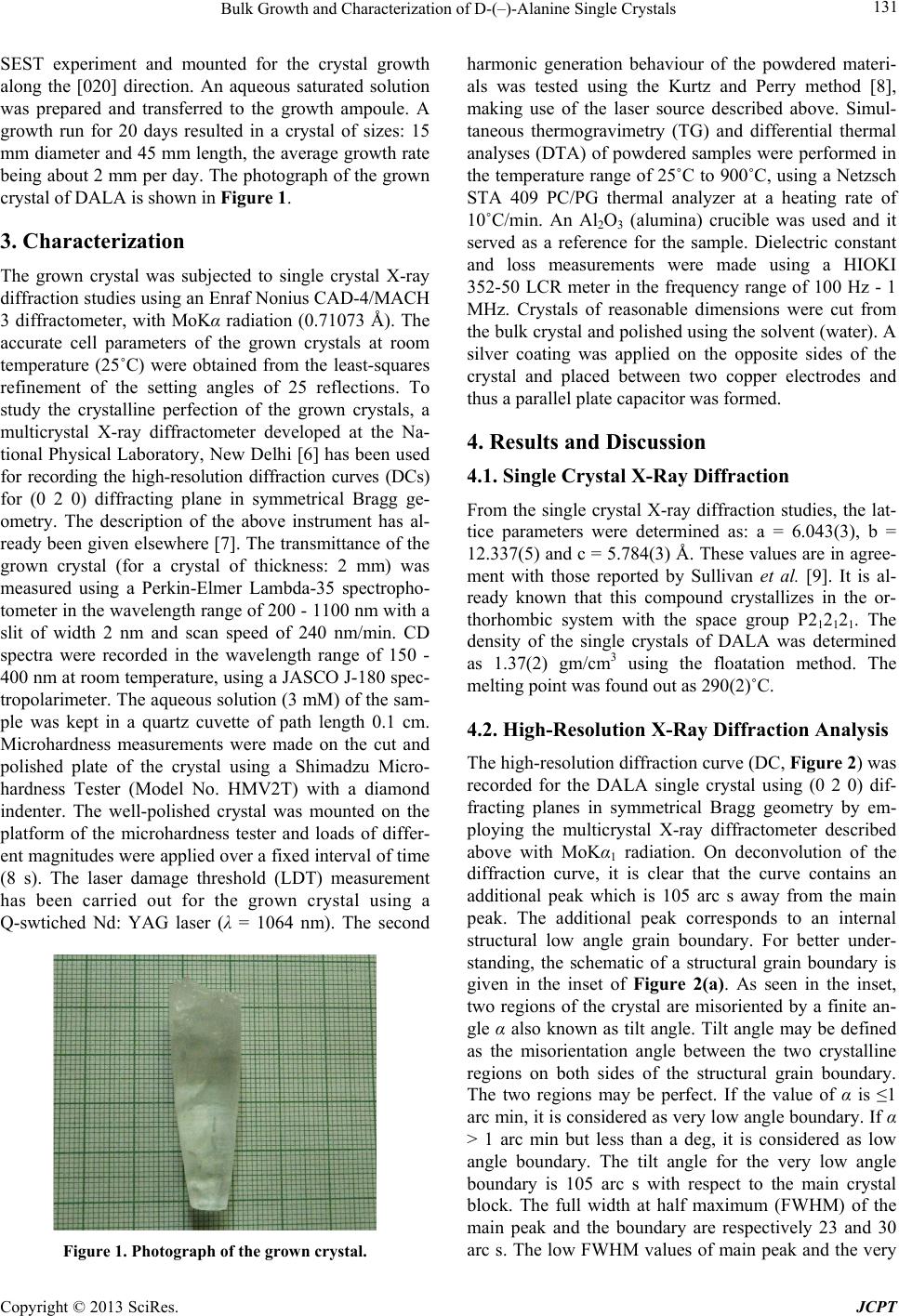 Bulk Growth and Characterization of D-(–)-Alanine Single Crystals Copyright © 2013 SciRes. JCPT 131 SEST experiment and mounted for the crystal growth along the [020] direction. An aqueous saturated solution was prepared and transferred to the growth ampoule. A growth run for 20 days resulted in a crystal of sizes: 15 mm diameter and 45 mm length, the average growth rate being about 2 mm per day. The photograph of the grown crystal of DALA is shown in Figure 1. 3. Characterization The grown crystal was subjected to single crystal X-ray diffraction studies using an Enraf Nonius CAD-4/MACH 3 diffractometer, with MoKα radiation (0.71073 Å). The accurate cell parameters of the grown crystals at room temperature (25˚C) were obtained from the least-squares refinement of the setting angles of 25 reflections. To study the crystalline perfection of the grown crystals, a multicrystal X-ray diffractometer developed at the Na- tional Physical Laboratory, New Delhi [6] has been used for recording the high-resolution diffraction curves (DCs) for (0 2 0) diffracting plane in symmetrical Bragg ge- ometry. The description of the above instrument has al- ready been given elsewhere [7]. The transmittance of the grown crystal (for a crystal of thickness: 2 mm) was measured using a Perkin-Elmer Lambda-35 spectropho- tometer in the wavelength range of 200 - 1100 nm with a slit of width 2 nm and scan speed of 240 nm/min. CD spectra were recorded in the wavelength range of 150 - 400 nm at room temperature, using a JASCO J-180 spec- tropolarimeter. The aqueous solution (3 mM) of the sam- ple was kept in a quartz cuvette of path length 0.1 cm. Microhardness measurements were made on the cut and polished plate of the crystal using a Shimadzu Micro- hardness Tester (Model No. HMV2T) with a diamond indenter. The well-polished crystal was mounted on the platform of the microhardness tester and loads of differ- ent magnitudes were applied over a fixed interval of time (8 s). The laser damage threshold (LDT) measurement has been carried out for the grown crystal using a Q-swtiched Nd: YAG laser (λ = 1064 nm). The second Figure 1. Photograph of the grown crystal. harmonic generation behaviour of the powdered materi- als was tested using the Kurtz and Perry method [8], making use of the laser source described above. Simul- taneous thermogravimetry (TG) and differential thermal analyses (DTA) of powdered samples were performed in the temperature range of 25˚C to 900˚C, using a Netzsch STA 409 PC/PG thermal analyzer at a heating rate of 10˚C/min. An Al2O3 (alumina) crucible was used and it served as a reference for the sample. Dielectric constant and loss measurements were made using a HIOKI 352-50 LCR meter in the frequency range of 100 Hz - 1 MHz. Crystals of reasonable dimensions were cut from the bulk crystal and polished using the solvent (water). A silver coating was applied on the opposite sides of the crystal and placed between two copper electrodes and thus a parallel plate capacitor was formed. 4. Results and Discussion 4.1. Single Crystal X-Ray Diffraction From the single crystal X-ray diffraction studies, the lat- tice parameters were determined as: a = 6.043(3), b = 12.337(5) and c = 5.784(3) Å. These values are in agree- ment with those reported by Sullivan et al. [9]. It is al- ready known that this compound crystallizes in the or- thorhombic system with the space group P212121. The density of the single crystals of DALA was determined as 1.37(2) gm/cm3 using the floatation method. The melting point was found out as 290(2)˚C. 4.2. High-Resolution X-Ray Diffraction Analysis The high-resolution diffraction curve (DC, Figure 2) was recorded for the DALA single crystal using (0 2 0) dif- fracting planes in symmetrical Bragg geometry by em- ploying the multicrystal X-ray diffractometer described above with MoKα1 radiation. On deconvolution of the diffraction curve, it is clear that the curve contains an additional peak which is 105 arc s away from the main peak. The additional peak corresponds to an internal structural low angle grain boundary. For better under- standing, the schematic of a structural grain boundary is given in the inset of Figure 2(a). As seen in the inset, two regions of the crystal are misoriented by a finite an- gle α also known as tilt angle. Tilt angle may be defined as the misorientation angle between the two crystalline regions on both sides of the structural grain boundary. The two regions may be perfect. If the value of α is ≤1 arc min, it is considered as very low angle boundary. If α > 1 arc min but less than a deg, it is considered as low angle boundary. The tilt angle for the very low angle boundary is 105 arc s with respect to the main crystal block. The full width at half maximum (FWHM) of the main peak and the boundary are respectively 23 and 30 arc s. The low FWHM values of main peak and the very 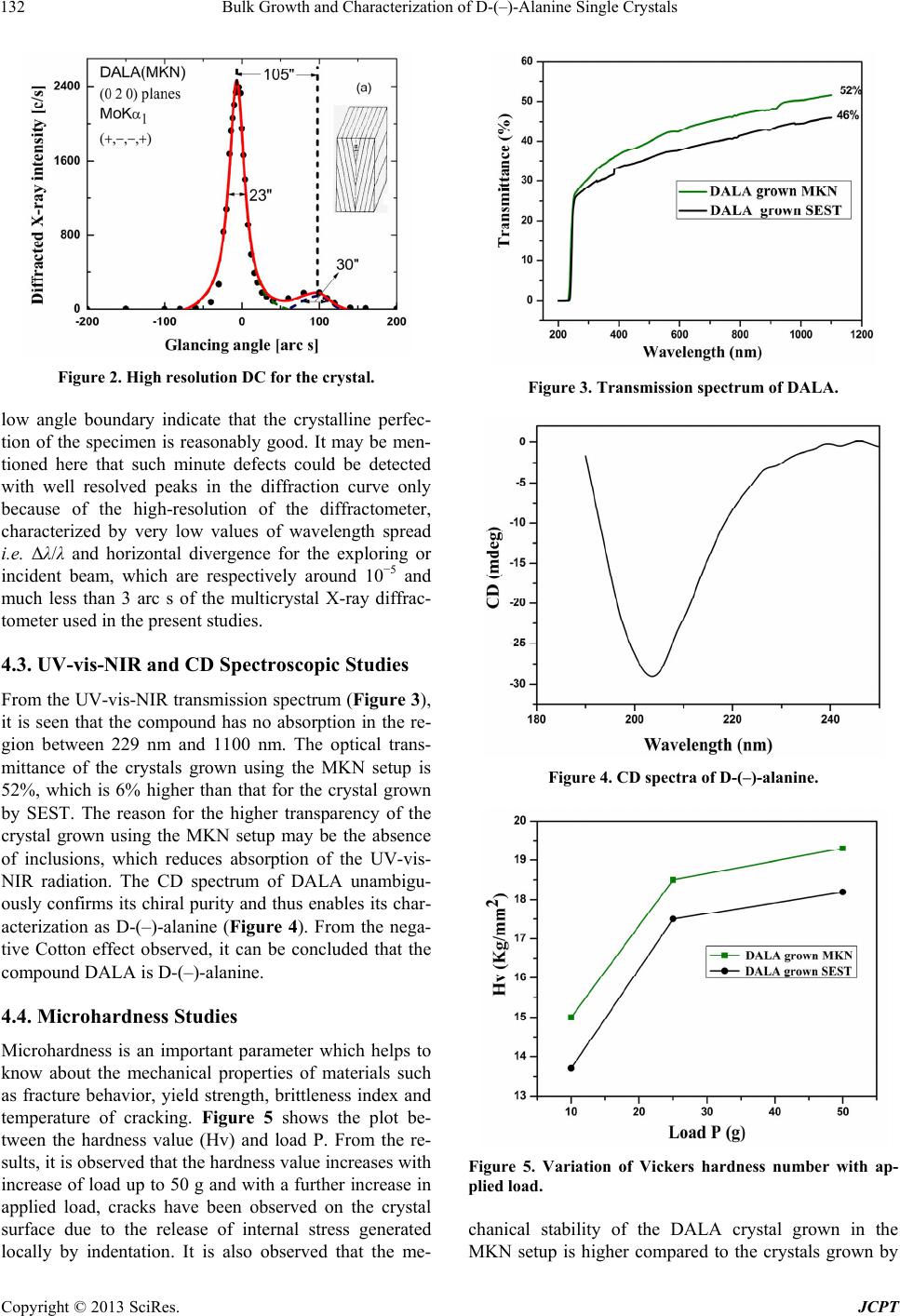 Bulk Growth and Characterization of D-(–)-Alanine Single Crystals Copyright © 2013 SciRes. JCPT 132 Figure 2. High resolution DC for the crystal. low angle boundary indicate that the crystalline perfec- tion of the specimen is reasonably good. It may be men- tioned here that such minute defects could be detected with well resolved peaks in the diffraction curve only because of the high-resolution of the diffractometer, characterized by very low values of wavelength spread i.e. Δλ/λ and horizontal divergence for the exploring or incident beam, which are respectively around 10−5 and much less than 3 arc s of the multicrystal X-ray diffrac- tometer used in the present studies. 4.3. UV-vis-NIR and CD Spectroscopic Studies From the UV-vis-NIR transmission spectrum (Figure 3), it is seen that the compound has no absorption in the re- gion between 229 nm and 1100 nm. The optical trans- mittance of the crystals grown using the MKN setup is 52%, which is 6% higher than that for the crystal grown by SEST. The reason for the higher transparency of the crystal grown using the MKN setup may be the absence of inclusions, which reduces absorption of the UV-vis- NIR radiation. The CD spectrum of DALA unambigu- ously confirms its chiral purity and thus enables its char- acterization as D-(–)-alanine (Figure 4). From the nega- tive Cotton effect observed, it can be concluded that the compound DALA is D-(–)-alanine. 4.4. Microhardness Studies Microhardness is an important parameter which helps to know about the mechanical properties of materials such as fracture behavior, yield strength, brittleness index and temperature of cracking. Figure 5 shows the plot be- tween the hardness value (Hv) and load P. From the re- sults, it is observed that the hardness value increases with increase of load up to 50 g and with a further increase in applied load, cracks have been observed on the crystal surface due to the release of internal stress generated locally by indentation. It is also observed that the me- Figure 3. Transmission spectrum of DALA. Figure 4. CD spectra of D-(–)-alanine. Figure 5. Variation of Vickers hardness number with ap- plied load. chanical stability of the DALA crystal grown in the MKN setup is higher compared to the crystals grown by 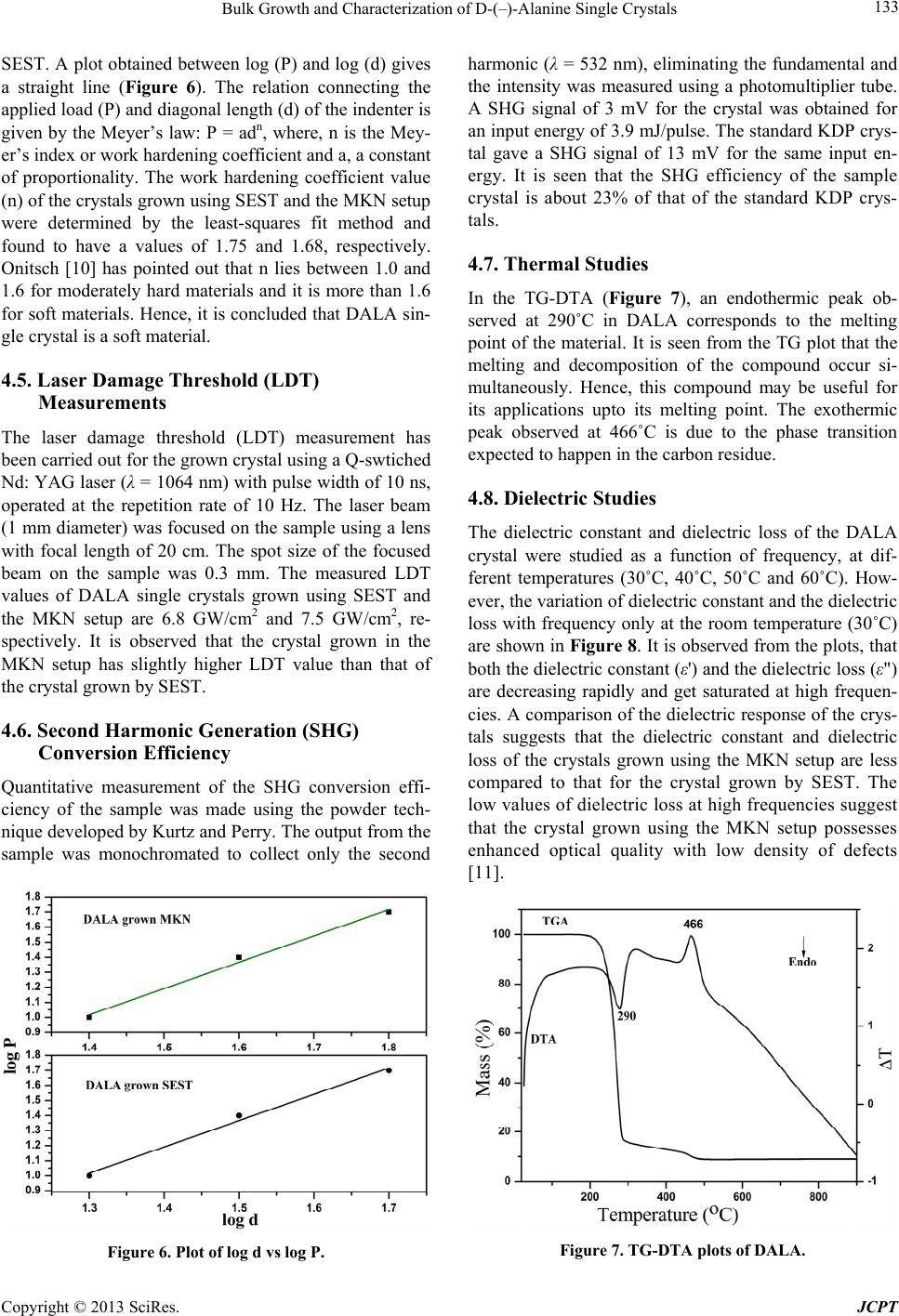 Bulk Growth and Characterization of D-(–)-Alanine Single Crystals Copyright © 2013 SciRes. JCPT 133 SEST. A plot obtained between log (P) and log (d) gives a straight line (Figure 6). The relation connecting the applied load (P) and diagonal length (d) of the indenter is given by the Meyer’s law: P = adn, where, n is the Mey- er’s index or work hardening coefficient and a, a constant of proportionality. The work hardening coefficient value (n) of the crystals grown using SEST and the MKN setup were determined by the least-squares fit method and found to have a values of 1.75 and 1.68, respectively. Onitsch [10] has pointed out that n lies between 1.0 and 1.6 for moderately hard materials and it is more than 1.6 for soft materials. Hence, it is concluded that DALA sin- gle crystal is a soft material. 4.5. Laser Damage Threshold (LDT) Measurements The laser damage threshold (LDT) measurement has been carried out for the grown crystal using a Q-swtiched Nd: YAG laser (λ = 1064 nm) with pulse width of 10 ns, operated at the repetition rate of 10 Hz. The laser beam (1 mm diameter) was focused on the sample using a lens with focal length of 20 cm. The spot size of the focused beam on the sample was 0.3 mm. The measured LDT values of DALA single crystals grown using SEST and the MKN setup are 6.8 GW/cm2 and 7.5 GW/cm2, re- spectively. It is observed that the crystal grown in the MKN setup has slightly higher LDT value than that of the crystal grown by SEST. 4.6. Second Harmonic Generation (SHG) Conversion Efficiency Quantitative measurement of the SHG conversion effi- ciency of the sample was made using the powder tech- nique developed by Kurtz and Perry. The output from the sample was monochromated to collect only the second Figure 6. Plot of log d vs log P. harmonic (λ = 532 nm), eliminating the fundamental and the intensity was measured using a photomultiplier tube. A SHG signal of 3 mV for the crystal was obtained for an input energy of 3.9 mJ/pulse. The standard KDP crys- tal gave a SHG signal of 13 mV for the same input en- ergy. It is seen that the SHG efficiency of the sample crystal is about 23% of that of the standard KDP crys- tals. 4.7. Thermal Studies In the TG-DTA (Figure 7), an endothermic peak ob- served at 290˚C in DALA corresponds to the melting point of the material. It is seen from the TG plot that the melting and decomposition of the compound occur si- multaneously. Hence, this compound may be useful for its applications upto its melting point. The exothermic peak observed at 466˚C is due to the phase transition expected to happen in the carbon residue. 4.8. Dielectric Studies The dielectric constant and dielectric loss of the DALA crystal were studied as a function of frequency, at dif- ferent temperatures (30˚C, 40˚C, 50˚C and 60˚C). How- ever, the variation of dielectric constant and the dielectric loss with frequency only at the room temperature (30˚C) are shown in Figure 8. It is observed from the plots, that both the dielectric constant (ε') and the dielectric loss (ε") are decreasing rapidly and get saturated at high frequen- cies. A comparison of the dielectric response of the crys- tals suggests that the dielectric constant and dielectric loss of the crystals grown using the MKN setup are less compared to that for the crystal grown by SEST. The low values of dielectric loss at high frequencies suggest that the crystal grown using the MKN setup possesses enhanced optical quality with low density of defects [11]. Figure 7. TG-DTA plots of DALA. 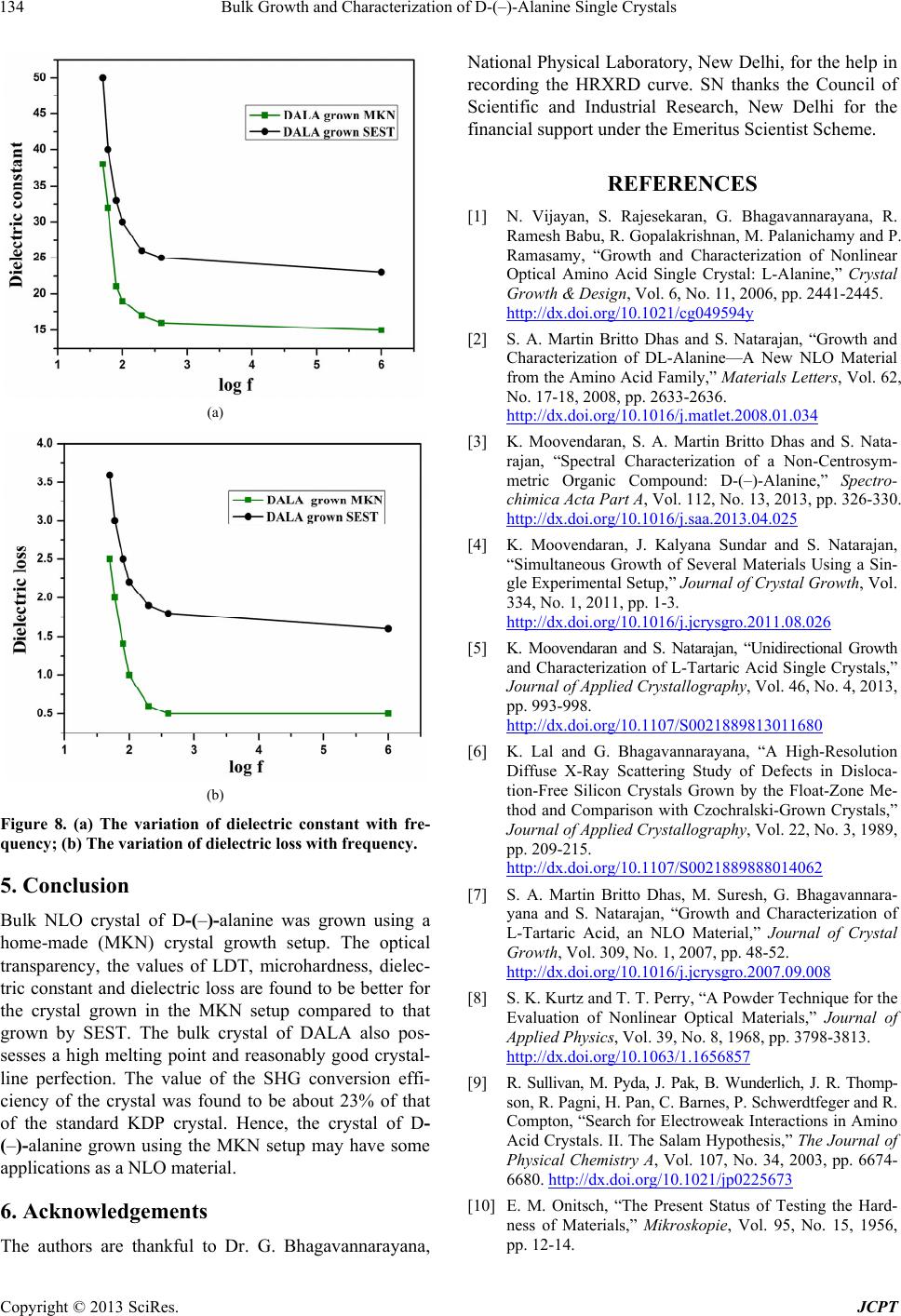 Bulk Growth and Characterization of D-(–)-Alanine Single Crystals Copyright © 2013 SciRes. JCPT 134 (a) (b) Figure 8. (a) The variation of dielectric constant with fre- quency; (b) The variation of dielec tri c loss wi th freque ncy. 5. Conclusion Bulk NLO crystal of D-(–)-alanine was grown using a home-made (MKN) crystal growth setup. The optical transparency, the values of LDT, microhardness, dielec- tric constant and dielectric loss are found to be better for the crystal grown in the MKN setup compared to that grown by SEST. The bulk crystal of DALA also pos- sesses a high melting point and reasonably good crystal- line perfection. The value of the SHG conversion effi- ciency of the crystal was found to be about 23% of that of the standard KDP crystal. Hence, the crystal of D- (–)-alanine grown using the MKN setup may have some applications as a NLO material. 6. Acknowledgements The authors are thankful to Dr. G. Bhagavannarayana, National Physical Laboratory, New Delhi, for the help in recording the HRXRD curve. SN thanks the Council of Scientific and Industrial Research, New Delhi for the financial support under the Emeritus Scientist Scheme. REFERENCES [1] N. Vijayan, S. Rajesekaran, G. Bhagavannarayana, R. Ramesh Babu, R. Gopalakrishnan, M. Palanichamy and P. Ramasamy, “Growth and Characterization of Nonlinear Optical Amino Acid Single Crystal: L-Alanine,” Crystal Growth & Design, Vol. 6, No. 11, 2006, pp. 2441-2445. http://dx.doi.org/10.1021/cg049594y [2] S. A. Martin Britto Dhas and S. Natarajan, “Growth and Characterization of DL-Alanine—A New NLO Material from the Amino Acid Family,” Materials Letters, Vol. 62, No. 17-18, 2008, pp. 2633-2636. http://dx.doi.org/10.1016/j.matlet.2008.01.034 [3] K. Moovendaran, S. A. Martin Britto Dhas and S. Nata- rajan, “Spectral Characterization of a Non-Centrosym- metric Organic Compound: D-(–)-Alanine,” Spectro- chimica Acta Part A, Vol. 112, No. 13, 2013, pp. 326-330. http://dx.doi.org/10.1016/j.saa.2013.04.025 [4] K. Moovendaran, J. Kalyana Sundar and S. Natarajan, “Simultaneous Growth of Several Materials Using a Sin- gle Experimental Setup,” Journal of Crystal Growth, Vol. 334, No. 1, 2011, pp. 1-3. http://dx.doi.org/10.1016/j.jcrysgro.2011.08.026 [5] K. Moovendaran and S. Natarajan, “Unidirectional Growth and Characterization of L-Tartaric Acid Single Crystals,” Journal of Applied Crystallography, Vol. 46, No. 4, 2013, pp. 993-998. http://dx.doi.org/10.1107/S0021889813011680 [6] K. Lal and G. Bhagavannarayana, “A High-Resolution Diffuse X-Ray Scattering Study of Defects in Disloca- tion-Free Silicon Crystals Grown by the Float-Zone Me- thod and Comparison with Czochralski-Grown Crystals,” Journal of Applied Crystallography, Vol. 22, No. 3, 1989, pp. 209-215. http://dx.doi.org/10.1107/S0021889888014062 [7] S. A. Martin Britto Dhas, M. Suresh, G. Bhagavannara- yana and S. Natarajan, “Growth and Characterization of L-Tartaric Acid, an NLO Material,” Journal of Crystal Growth, Vol. 309, No. 1, 2007, pp. 48-52. http://dx.doi.org/10.1016/j.jcrysgro.2007.09.008 [8] S. K. Kurtz and T. T. Perry, “A Powder Technique for the Evaluation of Nonlinear Optical Materials,” Journal of Applied Physics, Vol. 39, No. 8, 1968, pp. 3798-3813. http://dx.doi.org/10.1063/1.1656857 [9] R. Sullivan, M. Pyda, J. Pak, B. Wunderlich, J. R. Thomp- son, R. Pagni, H. Pan, C. Barnes, P. Schwerdtfeger and R. Compton, “Search for Electroweak Interactions in Amino Acid Crystals. II. The Salam Hypothesis,” The Journal of Physical Chemistry A, Vol. 107, No. 34, 2003, pp. 6674- 6680. http://dx.doi.org/10.1021/jp0225673 [10] E. M. Onitsch, “The Present Status of Testing the Hard- ness of Materials,” Mikroskopie, Vol. 95, No. 15, 1956, pp. 12-14.  Bulk Growth and Characterization of D-(–)-Alanine Single Crystals Copyright © 2013 SciRes. JCPT 135 [11] C. Balarew and R. Duhlew, “Application of the Hard and Soft Acids and Bases Concept to Explain Ligand Coordi- nation in Double Salt Structures,” Journal of Solid State Chemistry, Vol. 55, No. 1, 1984, pp. 1-6. http://dx.doi.org/10.1016/0022-4596(84)90240-8 |