

Paper Menu >>
Journal Menu >>
 Open Journal of Orthopedics, 2013, 3, 258-260 http://dx.doi.org/10.4236/ojo.2013.36048 Published Online October 2013 (http://www.scirp.org/journal/ojo) Bilateral Subtalar Dislocation in Gymnast: A Case Report* Atif Mechchat#, Mardy Abdelhak, Mohammed Shimi, Abdelhalim Elibrahimi, Abdelmajid Elmrini Department of Orthopaedic Surgery B4, Hassan II Fez, Morocco. Email: #[email protected], medfes@gmail.com, [email protected], halim[email protected], [email protected] Received August 5th, 2013; revised September 5th, 2013; accepted September 21st, 2013 Copyright © 2013 Atif Mechchat et al. This is an open access article distributed under the Creative Commons Attribution License, which permits unrestricted use, distribution, and reproduction in any medium, provided the original work is properly cited. ABSTRACT Subtalar dislocation is a rare injury in elite athletes. We report an unusual case of simultaneous bilateral subtalar dislo- cation in an internation al female athlete competing in gymnastics. These injuries req uire prompt reduction and immedi- ate immobilisation in a plaster cast for 8 weeks or wire stabilisation after open reduction if an abrupt end to a promis- ing career is to be prevented. Keywords: Subtalar; Dislocation; Bilateral; Gymnast 1. Introduction Subtalar dislocation, also known as peritalar dislocation, refers to the simultaneous dislocation of the distal articu- lations of the talus at the talocalcaneal and talonavicular joints. It is not a common injury and it accounts for ap- proximately 1% of all dislocations. Bilatetral subtalar dis- location is rarely reported in the literature. Clo sed reduc- tion and immobilization remain the treatment of choice. The entrapment of the joint capsule may cause difficulty in closed reduction; hence open reduction may be neces- sary. This case report presents a bilateral subtalar dislo- cation in gymnast with an unsuccessful closed reduction of a medial right subtalar dislocation which required an open reduction technique using wire stabilization and the left ankle treated by closed reduction. 2. Case Report A 24-year-old woman, a gymnast athlete, presented with bilateral recurrent ankle sprains for a period of 2 years. The condition had worsened during the previous 6 months and he went to the team physiotherapist for advice. Bila- teral instability was found but no preventive treatment was given. The gymnast continued to participate in com- petitions at an elitist level. While she was doing her cho- regraphy, she fell after a jump “triple somersaults” and she landed with her left foot on the right one. At depart- ment of orthopaedic surgery B4, the examination reveal- ed an inversion deformity of the both ankles (Figure 1(a)). The dorsalis pedis pulse was readily palpable and sensation was intact. There was no sign of neurovascular damage. Radiographs confirmed a bilateral medial subta- lar dislocation (Figure 1(b)). Under general anaesthesia, only the left ankle was reduced easly but the right ankle needed an open reduction using wire stabilization due to an entrapment of the joint capsule. Both ankles were im- mobilized in a plaster cast for 8 weeks (Figure 1(c)). Fif- teen months later she had no pain. The movements in the subtalar joint were complete. Power in this foot was as good as in the other. 3. Discussion Elite female gymnasts may train on average 5.36 days a week and 5.04 hours a day [1], which exposes them to a high risk of serious injury. Subtalar dislocations in fe- male athletes are not un common but bilateral dislocations are very rare and to our knowledge only one case have been described by Mattingly and Sternin 1983 [2]. They reported a case of bilateral subtalar dislocations after trauma. Bilateral dislocations have been reported with ehlers danlos syndrome [3]. The incidence of subtalar disloca- tion is 6 to 10 times higher than in females [4]. A subtalar dislocation is rarely seen in sports, though, Grantham [5] reported five cases of subtalar dislocations, of which four had occurred in basketball players. He therefore termed the injury “the basket ball foot”. Subtalar dislocation involves the talocalcaneal and talonavicular joints, with the tibiotalar and calcaneocu- boid joints remaining intact [5,6]. There are four types of *Declaration of conflict ing interests: The authors declared no conflicts o f interest with respect to the authorship and/or publication of this article. #Corresponding author. Copyright © 2013 SciRes. OJO 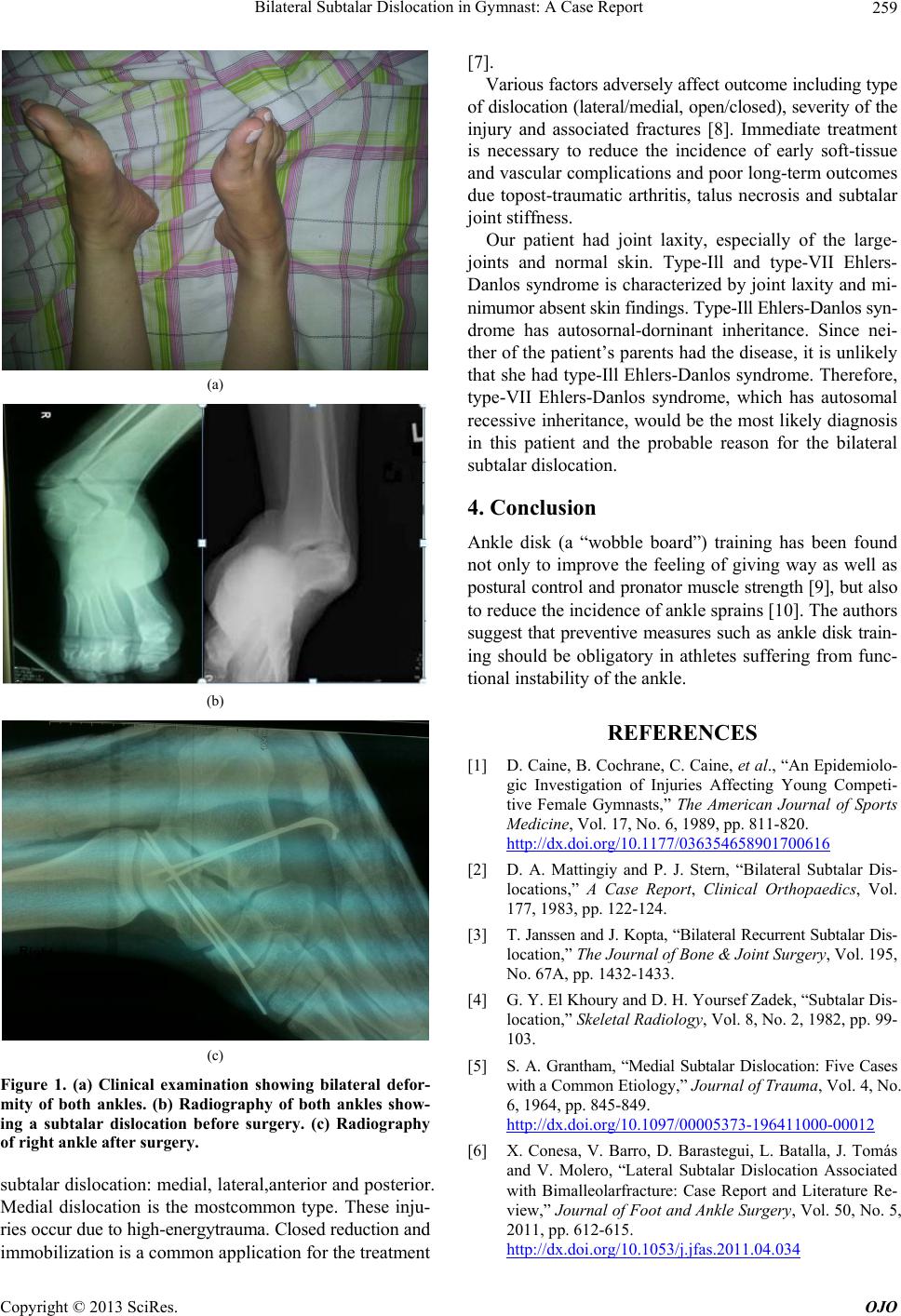 Bilateral Subtalar Dislocation in Gymnast: A Case Report 259 (a) (b) (c) Figure 1. (a) Clinical examination showing bilateral defor- mity of both ankles. (b) Radiography of both ankles show- ing a subtalar dislocation before surgery. (c) Radiography of right ankle after surgery. subtalar dislocation: medial, lateral,anterior and posterior. Medial dislocation is the mostcommon type. These inju- ries occur due to high-energytrauma. Closed reduction and immobilization is a common app lication for the treatment [7]. Various factors adversely affect outcome including type of dislocation (lateral/medial, open/closed), severity of the injury and associated fractures [8]. Immediate treatment is necessary to reduce the incidence of early soft-tissue and vascular complications and poor long-term outcomes due topost-traumatic arthritis, talus necrosis and subtalar joint stiffness. Our patient had joint laxity, especially of the large- joints and normal skin. Type-Ill and type-VII Ehlers- Danlos syndrome is characterized by joint laxity and mi- nimumor absent skin fi ndi ngs. Ty pe-Ill Ehl e rs-Danl os sy n- drome has autosornal-dorninant inheritance. Since nei- ther of the patient’s parents had the disease, it is unlikely that she had type-Ill Ehlers-Danlo s syndrome. Therefore, type-VII Ehlers-Danlos syndrome, which has autosomal recessive inheritance, would be the most likely diagnosis in this patient and the probable reason for the bilateral subtalar dislocation. 4. Conclusion Ankle disk (a “wobble board”) training has been found not only to improve the feeling of giving way as well as postural control and pronator muscle strength [9], but also to reduce the incidence of ankle sprains [10]. The authors suggest that preventive measures such as ankle disk train- ing should be obligatory in athletes suffering from func- tional instab ility of the ankle. REFERENCES [1] D. Caine, B. Cochrane, C. Caine, et al., “An Epidemiolo- gic Investigation of Injuries Affecting Young Competi- tive Female Gymnasts,” The American Journal of Sports Medicine, Vol. 17, No. 6, 1989, pp. 811-820. http://dx.doi.org/10.1177/036354658901700616 [2] D. A. Mattingiy and P. J. Stern, “Bilateral Subtalar Dis- locations,” A Case Report, Clinical Orthopaedics, Vol. 177, 1983, pp. 122-124. [3] T. Janssen and J. Kopta, “Bilateral Recurrent Subt alar Dis- location,” The Journal of Bone & Joint Surgery, Vol. 195, No. 67A, pp. 1432-1433. [4] G. Y. El Khoury and D. H. Yoursef Zadek, “Subtalar Dis- location,” Skeletal Radiology, Vol. 8, No. 2, 1982, pp. 99- 103. [5] S. A. Grantham, “Medial Subtalar Dislocation: Five Cases wi th a Comm on Etiolog y,” Journal of Trauma, Vol. 4, No. 6, 1964, pp. 845-849. http://dx.doi.org/10.1097/00005373-196411000-00012 [6] X. Conesa, V. Barro, D. Barastegui, L. Batalla, J. Tomás and V. Molero, “Lateral Subtalar Dislocation Associated with Bimalleolarfracture: Case Report and Literature Re- view,” Journal of Foot and Ankle Surgery, Vol. 50, No. 5, 2011, pp. 612-615. http://dx.doi.org/10.1053/j.jfas.2011.04.034 Copyright © 2013 SciRes. OJO  Bilateral Subtalar Dislocation in Gymnast: A Case Report Copyright © 2013 SciRes. OJO 260 [7] L. De Palma, A. Santucci, M. Marinelli, E. Borgogno and A. Catalani, “Clinical Outcome of Closed Isolated Sub- talar Dislocations,” Archives of Orthopaedic and Trauma Surgery, Vol. 128, No. 6, 2008, pp. 593-598. http://dx.doi.org/10.1007/s00402-007-0459-8 [8] L. Camarda, U. Martorana and M. D’Arienzo, “Posterior Subtalar Dislocation,” Orthopedics, Vol. 32, No. 7, 2009, p. 530. http://dx.doi.org/10.3928/01477447-20090527-25 [9] H. Tropp, “Functional Instability of the Ankle Joint,” Lin- koping University Medical Dissertations, No. 202, 1985. [10] H. Tropp, C. Askling and J. Gilquist, “Prevention of An- kle Sprains,” The American Journal of Sports Medicine, Vol. 13, No. 4, 1985, pp. 259-262. |