

Paper Menu >>
Journal Menu >>
 Journal of Cancer Therapy, 2013, 4, 1306-1312 http://dx.doi.org/10.4236/jct.2013.48154 Published Online October 2013 (http://www.scirp.org/journal/jct) Improvement of Survival in Patient with Primary Metastatic Breast Cancer over a 10-Year Periode: Prospective Analyses Based on Individual Patient Date from a Multicenter Data Bank Jana Barinoff1*, Florian Heitz2, Sherko Kuemmel2, Christine Dittmer2, Rita Hils3, Fatemeh Lorenz-Salehi3, Alexander Traut2, Andreas du Bois2 1Agaplesion Markus Krankenhaus, Frankfurt am Main, Germany; 2Kliniken Essen Mitte, Essen, Germany; 3Dr. Horst-Schmidt Klinik, Wiesbaden, Germany. Email: *barinoff.jana@googlemail.com, [email protected], [email protected], [email protected], rita.hils@hsk-wiesbaden, fatemeh.loremz-saleh[email protected], [email protected], [email protected] Received July 23rd, 2013; revised August 22nd, 2013; accepted September 1st, 2013 Copyright © 2013 Jana Barinoff et al. This is an open access article distributed under the Creative Commons Attribution License, which permits unrestricted use, distribution, and reproduction in any medium, provided the original work is properly cited. ABSTRACT Approximately 6% of patients with breast cancer have distant metastases at the time of the initial diagnosis. The aim of this analysis was to examine the overall survival rate over time and to investigate the effect of new therapy options. Methods: This retrospective analysis was performed based on the data bank of the Clinic for Gynaecological Oncology/ Dr. Horst Schmidt Klinik, Wiesbaden and the Clinic for Gynaecological Oncology and Senology/Kliniken Essen Mitte, Essen. The patients with primary metastatic breast cancer (pmBC) who were diagnosed and treated at the accredited breast cancer centres of these clinics were enrolled between 1998 and 2007. The date of diagnosis was used to define 2 specifically chosen 5-year periods: 1998-2002 and 2003-2007. The follow-up time was on average 76 months. The Breslow Test was used to evaluate changes in the median survival time and to detect factors associated with the increase in survival rates. Results: Two hundred sixteen patients with complete baselines were analysed. Ninety patients were diagnosed between 1998 and 2002, and 126 patients received their diagnosis of pmBC between 2003 and 2007. The tumour-biological factors were the same in both groups, whereas the therapeutic concepts were different—the later group (2003-2007) received more aromatase inhibitors, taxane-based chemotherapy and trastuzumab. This finding re- sulted in an increased median survival time from 31 months in the years 1998-2002 to 44 months in the group with the first diagnosis between 2003 and 2007. Conclusions: Primary metastatic breast cancer occurred at constant rates over last 10 years. The tumour findings did not change in the time between the two examined groups; however, the treatment options in the 2003-2007 group included newly approved therapies. The time period of the first diagnosis was detected as a risk factor for overall survival. Those patients diagnosed in the more recent time frame had a significantly im- proved survival rate. The establishment of new therapy options may explain this finding. Keywords: Breast Cancer; Primary Metastatic Breast Cancer; Therapy of Metastatic Breast Cancer; Survival of Metastatic Breast Cancer 1. Introduction Breast cancer is the most common malignant tumour of women worldwide. In Germany, breast cancer accounts for 27.8% (70,000 cases) of new cancer diagnoses annu- aly, and it is responsible for 18% of all female cancer death [1,2]. One in five patients develops metastatic disease over time [3-5]. Once the metastatic disease is diagnosed, breast cancer becomes incurable and therapy options become palliative. The post diagnosis 5-year survival rate is approximately 30% [6-8]. Patients with metastatic breast cancer can be separated into two groups: those with primary metastatic disease and those with secondary metastatic disease. The differ- ence is based on the time of the initial diagnosis. Primary metastatic breast cancer is diagnosed synchronously with primary tumours and distant metastases. The patients with secondary metastatic disease develop their metasta- *Corresponding author. Copyright © 2013 SciRes. JCT  Improvement of Survival in Patient with Primary Metastatic Breast Cancer over a 10-Year Periode: Prospective Analyses Based on Individual Patient Date from a Multicenter Data Bank 1307 ses months or years after the first breast carcinoma diag- nosis [9,10]. The present analysis involves only those patients with primary metastatic breast cancer. Approximately 6% of all breast cancer patients test positive for metastatic dis- ease at the time of their first diagnosis [11-13]. The inci- dence rate of this disease has persisted over the last 20 years [14]. The aim of the current retrospective study was to analyse the development of the median survival time over a fixed period and determine the underlying causes. 2. Methods The sample group for the present study was recruited from 6315 patients with breast cancer who were regis- tered at the prospective tumour data bank of the two cen- tres. Data for all patients were continuously collected, and the data bank was updated annually. To be included in the current study, patients had to meet the following criteria: a complete initial treatment at the Dr. Horst Schmidt-Klinik (HSK), Wiesbaden or at the Kliniken Essen Mitte (KEM), Essen; invasive breast cancer (pa- tients with an exclusive DCIS after a primary diagnosis were excluded) with known hormone receptor as well as Her2 status; a primary diagnosis between January 1, 1998 and December 31, 2007; and a diagnosis of metas- tatic disease within 4 weeks after the initial diagnosis and before the start of any systemic treatment. The date of diagnosis was used to define 2 specifically chosen 5-year time periods: 1998-2002 (first period, N = 90, first di- agnosis during the period 1998-2002) and 2003-2007 (second period, N = 126, first diagnosis in the period 2003-2007). The baseline was defined by age and menopausal status at the time of the first diagnosis, tumour-biological characteristics (T-stage, histological subtype, grading, hormone receptor status, Her2 status), and location of the first metastatic manifestation. Systemic treatments in- cluded chemotherapy, endocrine therapy, targeted ther- apy and bisphosphonate therapy. Chemotherapy was specified as anthracycline based (EC, AC, liposomal an- thracycline) or taxane based (paclitaxel or docetaxel). Targeted therapy was defined as therapy with the mono- clonal antibody trastuzumab. Endocrine therapy was de- fined as therapy with tamoxifen or an aromatase inhibi- tor. Patients were monitored for at least 24 months after the primary diagnosis. All information regarding bio- logical tumour properties and treatment modalities were retrieved from the database. Follow-up data were gath- ered using internal data updates and from practising gy- naecologists organised in the “Network Quality Assur- ance Wiesbaden” and “Network Quality Assurance Es- sen” in cooperation with the HSK and KEM. Data are expressed as percentages, means ± standard deviation or 95% confidence interval (CI) or medians, as appropriate. Normally distributed continuous variables were analysed using Student’s unpaired t-test and cate- gorical variables using Χ2 or Fisher’s exact test. The Kaplan-Meier method was employed for survival analy- sis. Differences between groups were evaluated by the Breslow test. All tests were two sided, and differences were deemed significant at p ≤ 0.05. All statistical analy- ses were performed using the SPSS (version 20.0, SPSS Inc., 2011 Chicago, IL). 3. Results Two hundred sixteen patients were diagnosed with pri- mary metastatic breast cancer between 1998 and 2007. The age was on average 61 years. The manifestation of the first metastases was registered in the bone, liver, lung, non-axillar lymph node, pleura, skin, or brain. The rates at which these organs were affected varied: 56.9%, 26.9%, 20.4%, 9.7%, 8.3%, 6.5%, and 3.7%, respectively. Approximately, 8.8% of patients were found to have dis- tant metastases in other locations not listed above. In general, visceral metastases were documented in just over half of all patients (58.3%). Sixty-seven patients (31%) had more than one organ affected at the time of the initial diagnosis. Additionally, 19% of the patients were diagnosed at the stage T1. One in three patients (34.3%) was diagnosed at the stage T2. Approximately half of all patients were registered with T3/4-tumours [11.6% (T3) and 30.6% (T4), respectively). Invasive ductal breast carcinoma was found in 63.4% of all pa- tients. Grades I and II were diagnosed in 46.8% of pa- tients, grade III was found in 32.4%, and unknown grad- ing was registered in 20.8% of patients. Two in three patients (78.2%) tested positive for hormone receptor status and 75.9% of patients had a negative Her2-status (Table 1). The next step was to analyse the baselines in the sub- group: the patients from the first period were compared with patients from the second period. The patients in both subgroups showed no difference in age, menopausal status, tumour-biological characteristics or metastases distribution (Table 2). The analysis of first-line therapies in the subgroups showed that approximately half of the patients in both groups received chemotherapy as the first therapy option (1998-2002: 55.6%; 2003-2007: 50%) (Table 3, Figure 1). Analysis of the therapies revealed that the anthracy- cline-based chemotherapy in the first period was admin- istered more often than in the second period (40% vs. 27%, respectively; p = 0.044). By contrast, the taxane- based chemotherapy was documented in the period 2003- Copyright © 2013 SciRes. JCT  Improvement of Survival in Patient with Primary Metastatic Breast Cancer over a 10-Year Periode: Prospective Analyses Based on Individual Patient Date from a Multicenter Data Bank 1308 Table 1. Patient and tumor characteristics. (%) N 216 (100%) Age, years (median) 61 ± 0.9 1 41 (19%) 2 74 (34.3%) 3 25 (11.6%) 4 66 (30.6%) T stage unknown 10 (4.6%) Positive 162 (75%) N stage Negative 54 (25%) Positive 169 (78.2%) ER/PR Negative 47 (21.8%) Positive 164 (75.9%) Negative 38 (17.6%) Her2 unknown 14 (6.5%) 1 - 2 101 (46.8%) 3 70 (32.4%) Grading unknown 45 (20.8%) Duktal 137 (63.4%) Lobulär 35 (16.2%) Others 18 (8.3%) Histology unknown 26 (12%) yes 126 (58.3%) Viscerale metastases no 90 (41.7%) yes 67 (31%) Multiple localisation no 149 (69%) Pleura 18 (8.3%) Liver 58 (26.9%) Lung 44 (20.4%) Lymph node 21 (9.7%) Skin 14 (6.5%) Brain 8 (3.7%) Bone 123 (56.9%) First matastases Others 19 (8.8%) 1998-2002 90 (41.7%) Periods 2003-2007 126 (58.3%) Time of follow-up time, median, months 76 Events (death) 160 (74.1%) 75% 15 50% (Median 95% CI) 38 (30 - 46) Survival (quantiles), months 25% 71 T: clinical or pathological tumor size, N: clincial or pathological nodes status, ER: estrogen receptor, PR: progesterone receptor. 2007 at 69.8% vs. 16.7% in the period 1998-2002 (p = 0.023). During both periods, the same site of patients received endocrine therapy as the first option (1998-2002: 61.1%; 2003-2007: 63.5%; p = 0.722); however, the type of endocrine therapy was altered: during the first period, tamoxifen was the medicine used (p = 0.000); during the second period, aromatase inhibitors were the therapy of choice to a significant range (25.6% vs. 50.8%; p = 0.000). Targeted therapy with trastuzumab was adminis- tered more often in the later years 2003-2007 (4.4% vs. 16.1%; p = 0.007). The analysis of local therapy options revealed that ap- proximately 67.8% of the patients during the period 1998-2002 had breast surgery (breast-conserving therapy as well as mastectomy), and 40% of patients received this treatment between 2003 and 2007 (p = 0.000). The number of bone metastases patients who received radia- tion therapy was the same during both periods (34.4% vs. 36.5%, respectively). Finally, the time of diagnosis was determined in the analysis as a risk factor for the median survival. The me- dian survival for all patients with a first diagnosis of pmBC was 38 months; the OS during the period 1998- 2002 was 31 months, and the OS during the period 2003- 2001 was 44 months (p = 0.028) (Figure 2). 4. Discussion Metastatic breast cancer is a heterogeneous disease with a list of various scenarios of progress ranging from ef- fects on individual organs with a benign prognosis to extensive systemic metastases resulting in a shortened overall survival rate. The time of metastases also differs. Possibilities range from synchronous diagnosis—for example, primary metastatic breast cancer—to the de- velopment of metastases many years after the first diag- nosis of breast carcinoma [15]. The overall survival rate for primary metastatic breast cancer has constantly improved at a rate of 1% - 2% yearly as shown in published analyses. The reason for this development seems to be the establishment of new therapy options [12,14-16]. Thus, based on the current published data, patients survived longer in the last decade than in the earlier period [17]. Apparently, there is a fac- tor influencing the progress of disease, and this factor is strong enough to affect the overall survival rates. This trend is also observed in our analysis of data concerning primary metastatic breast cancer. To explain this change, we must consider the following questions: Were the tu- mour-biological characteristics identical during the two separate time periods? Additionally, were the therapy options during these two time periods significantly dif- ferent? Andre F. et al. demonstrated that their collective was Copyright © 2013 SciRes. JCT  Improvement of Survival in Patient with Primary Metastatic Breast Cancer over a 10-Year Periode: Prospective Analyses Based on Individual Patient Date from a Multicenter Data Bank Copyright © 2013 SciRes. JCT 1309 Figure 1. First-line therapies according to time periods: 1998-2002 vs. 2003-2007 (%). Figure 2. Survival in patients with pmBC according to time periods: 1998-2002 vs. 2003-2007; CI-95% confidence intervals, estimated by Breslow-test. equal regarding tumour characteristics during the ex- plored periods (1987-1993 vs. 1994-2000), and their findings have been corroborated by many other publica- tions [12,16]. Our data from 2009 also showed no dif- ference in patient baselines and tumour characteristics between the periods 1998-2002 and 2003-2006 [18]. This finding has once again been confirmed in the present study: the distribution of tumour-biological characteris- tics in patients with primary metastatic breast cancer did not significantly differ between the periods 1998-2002 and 2003-2007. Lung metastases were diagnosed more often in the later period, a finding that is attributed to staging examinations performed using computer tomo- graphy. Unusually high rates of brain metastases during the period 1998-2002 cannot be explained despite data clearance. Because the effect of brain metastases on overall survival has not been determined, we should not over interpret this finding. According to the published data, patients with primary metastatic breast cancer have been presented as a homogeneous cohort during the last 25 years. Analysis of therapy over time in our study showed that the anthracycline-based therapy and tamoxifen were ap- plied more often during the early period (1998-2002), 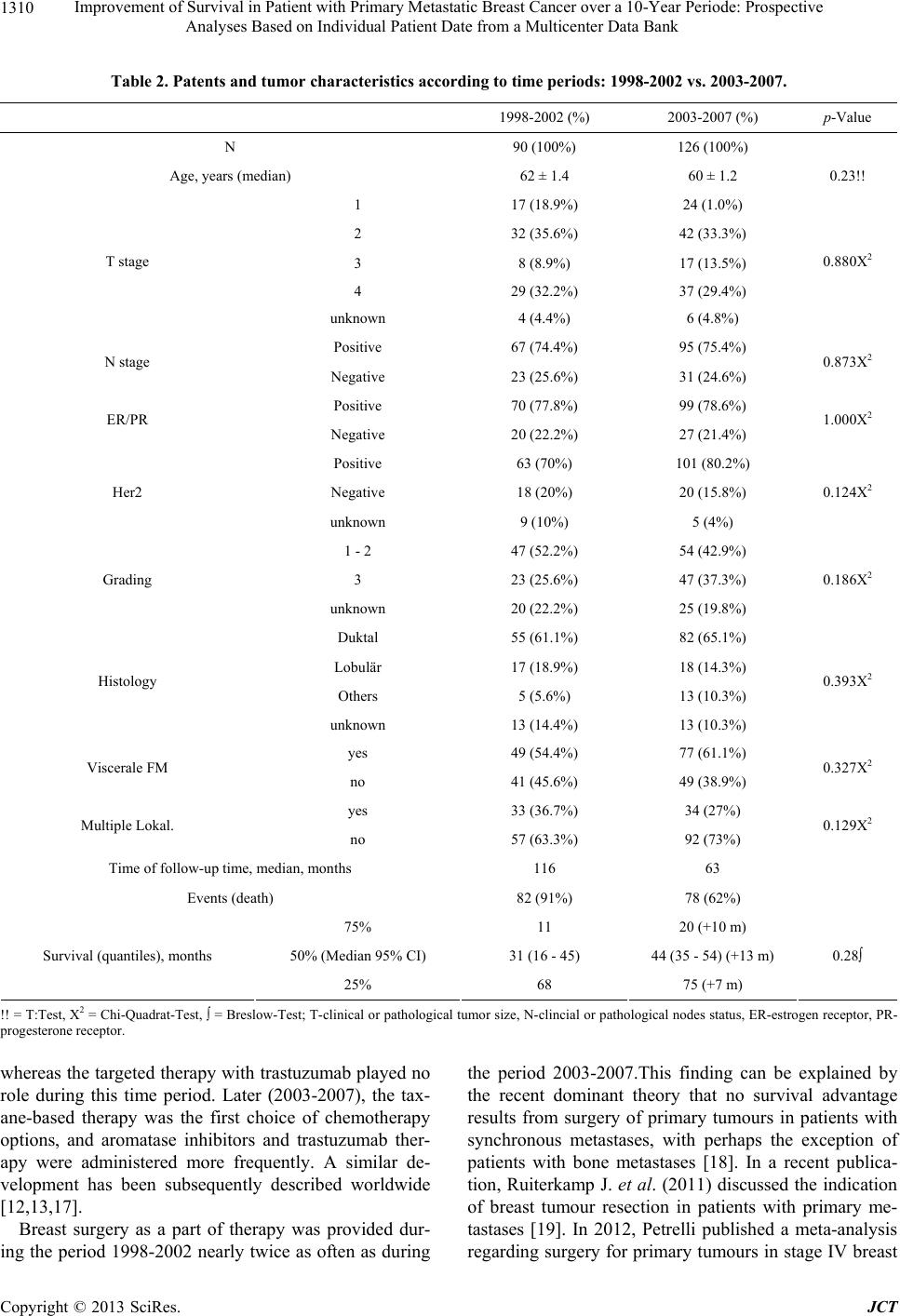 Improvement of Survival in Patient with Primary Metastatic Breast Cancer over a 10-Year Periode: Prospective Analyses Based on Individual Patient Date from a Multicenter Data Bank 1310 Table 2. Patents and tumor characteristics according to time periods: 1998-2002 vs. 2003-2007. 1998-2002 (%) 2003-2007 (%) p-Value N 90 (100%) 126 (100%) Age, years (median) 62 ± 1.4 60 ± 1.2 0.23!! 1 17 (18.9%) 24 (1.0%) 2 32 (35.6%) 42 (33.3%) 3 8 (8.9%) 17 (13.5%) 4 29 (32.2%) 37 (29.4%) T stage unknown 4 (4.4%) 6 (4.8%) 0.880X2 Positive 67 (74.4%) 95 (75.4%) N stage Negative 23 (25.6%) 31 (24.6%) 0.873X2 Positive 70 (77.8%) 99 (78.6%) ER/PR Negative 20 (22.2%) 27 (21.4%) 1.000X2 Positive 63 (70%) 101 (80.2%) Negative 18 (20%) 20 (15.8%) Her2 unknown 9 (10%) 5 (4%) 0.124X2 1 - 2 47 (52.2%) 54 (42.9%) 3 23 (25.6%) 47 (37.3%) Grading unknown 20 (22.2%) 25 (19.8%) 0.186X2 Duktal 55 (61.1%) 82 (65.1%) Lobulär 17 (18.9%) 18 (14.3%) Others 5 (5.6%) 13 (10.3%) Histology unknown 13 (14.4%) 13 (10.3%) 0.393X2 yes 49 (54.4%) 77 (61.1%) Viscerale FM no 41 (45.6%) 49 (38.9%) 0.327X2 yes 33 (36.7%) 34 (27%) Multiple Lokal. no 57 (63.3%) 92 (73%) 0.129X2 Time of follow-up time, median, months 116 63 Events (death) 82 (91%) 78 (62%) 75% 11 20 (+10 m) 50% (Median 95% CI) 31 (16 - 45) 44 (35 - 54) (+13 m) Survival (quantiles), months 25% 68 75 (+7 m) 0.28∫ !! = T:Test, X2 = Chi-Quadrat-Test, ∫ = Breslow-Test; T-clinical or pathological tumor size, N-clincial or pathological nodes status, ER-estrogen receptor, PR- progesterone receptor. whereas the targeted therapy with trastuzumab played no role during this time period. Later (2003-2007), the tax- ane-based therapy was the first choice of chemotherapy options, and aromatase inhibitors and trastuzumab ther- apy were administered more frequently. A similar de- velopment has been subsequently described worldwide [12,13,17]. Breast surgery as a part of therapy was provided dur- ing the period 1998-2002 nearly twice as often as during the period 2003-2007.This finding can be explained by the recent dominant theory that no survival advantage results from surgery of primary tumours in patients with synchronous metastases, with perhaps the exception of patients with bone metastases [18]. In a recent publica- tion, Ruiterkamp J. et al. (2011) discussed the indication of breast tumour resection in patients with primary me- tastases [19]. In 2012, Petrelli published a meta-analysis regarding surgery for primary tumours in stage IV breast Copyright © 2013 SciRes. JCT 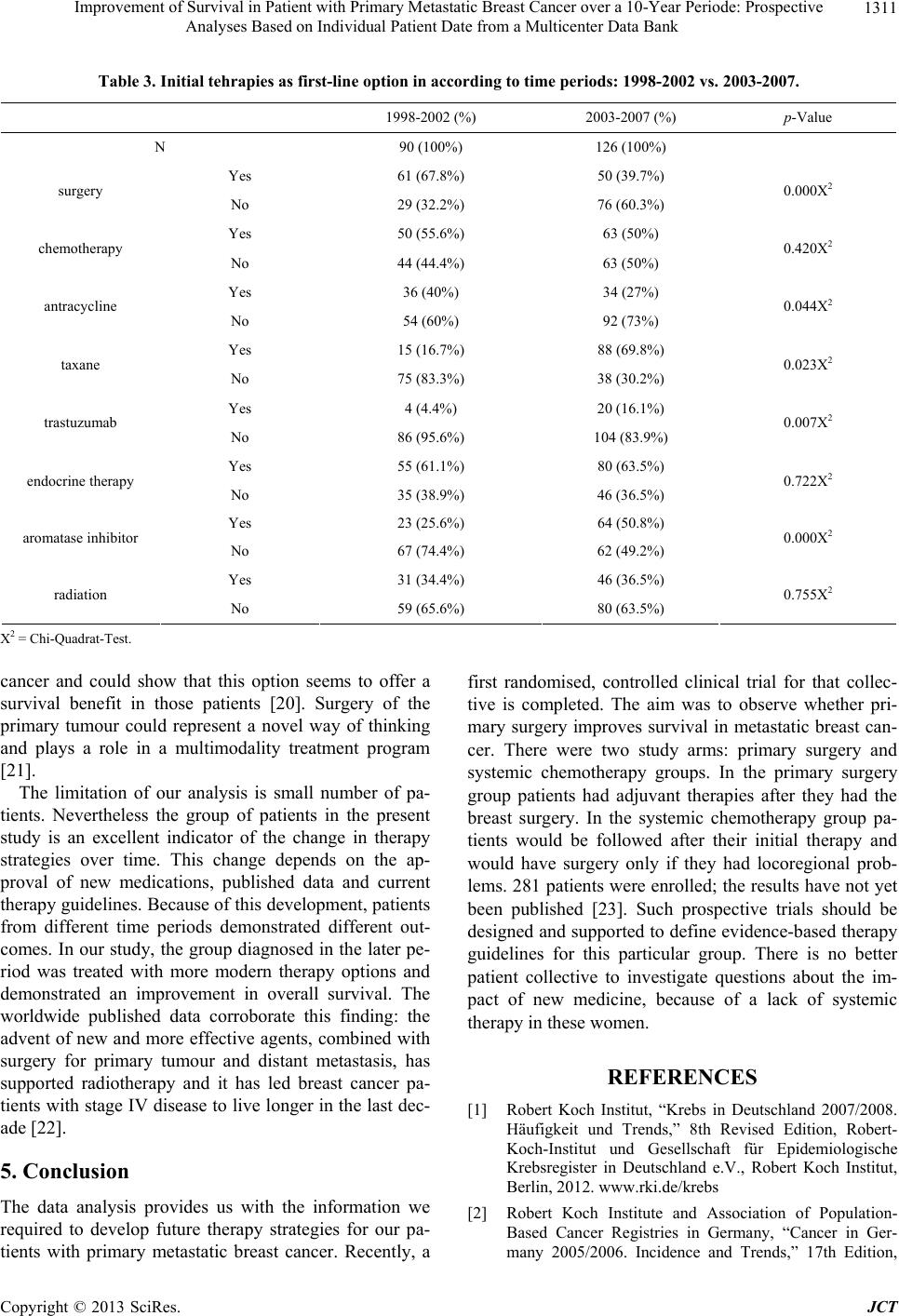 Improvement of Survival in Patient with Primary Metastatic Breast Cancer over a 10-Year Periode: Prospective Analyses Based on Individual Patient Date from a Multicenter Data Bank 1311 Table 3. Initial tehrapies as first-line option in according to time periods: 1998-2002 vs. 2003-2007. 1998-2002 (%) 2003-2007 (%) p-Value N 90 (100%) 126 (100%) Yes 61 (67.8%) 50 (39.7%) surgery No 29 (32.2%) 76 (60.3%) 0.000X2 Yes 50 (55.6%) 63 (50%) chemotherapy No 44 (44.4%) 63 (50%) 0.420X2 Yes 36 (40%) 34 (27%) antracycline No 54 (60%) 92 (73%) 0.044X2 Yes 15 (16.7%) 88 (69.8%) taxane No 75 (83.3%) 38 (30.2%) 0.023X2 Yes 4 (4.4%) 20 (16.1%) trastuzumab No 86 (95.6%) 104 (83.9%) 0.007X2 Yes 55 (61.1%) 80 (63.5%) endocrine therapy No 35 (38.9%) 46 (36.5%) 0.722X2 Yes 23 (25.6%) 64 (50.8%) aromatase inhibitor No 67 (74.4%) 62 (49.2%) 0.000X2 Yes 31 (34.4%) 46 (36.5%) radiation No 59 (65.6%) 80 (63.5%) 0.755X2 X2 = Chi-Quadrat-Test. cancer and could show that this option seems to offer a survival benefit in those patients [20]. Surgery of the primary tumour could represent a novel way of thinking and plays a role in a multimodality treatment program [21]. The limitation of our analysis is small number of pa- tients. Nevertheless the group of patients in the present study is an excellent indicator of the change in therapy strategies over time. This change depends on the ap- proval of new medications, published data and current therapy guidelines. Because of this development, patients from different time periods demonstrated different out- comes. In our study, the group diagnosed in the later pe- riod was treated with more modern therapy options and demonstrated an improvement in overall survival. The worldwide published data corroborate this finding: the advent of new and more effective agents, combined with surgery for primary tumour and distant metastasis, has supported radiotherapy and it has led breast cancer pa- tients with stage IV disease to live longer in the last dec- ade [22]. 5. Conclusion The data analysis provides us with the information we required to develop future therapy strategies for our pa- tients with primary metastatic breast cancer. Recently, a first randomised, controlled clinical trial for that collec- tive is completed. The aim was to observe whether pri- mary surgery improves survival in metastatic breast can- cer. There were two study arms: primary surgery and systemic chemotherapy groups. In the primary surgery group patients had adjuvant therapies after they had the breast surgery. In the systemic chemotherapy group pa- tients would be followed after their initial therapy and would have surgery only if they had locoregional prob- lems. 281 patients were enrolled; the results have not yet been published [23]. Such prospective trials should be designed and supported to define evidence-based therapy guidelines for this particular group. There is no better patient collective to investigate questions about the im- pact of new medicine, because of a lack of systemic therapy in these women. REFERENCES [1] Robert Koch Institut, “Krebs in Deutschland 2007/2008. Häufigkeit und Trends,” 8th Revised Edition, Robert- Koch-Institut und Gesellschaft für Epidemiologische Krebsregister in Deutschland e.V., Robert Koch Institut, Berlin, 2012. www.rki.de/krebs [2] Robert Koch Institute and Association of Population- Based Cancer Registries in Germany, “Cancer in Ger- many 2005/2006. Incidence and Trends,” 17th Edition, Copyright © 2013 SciRes. JCT 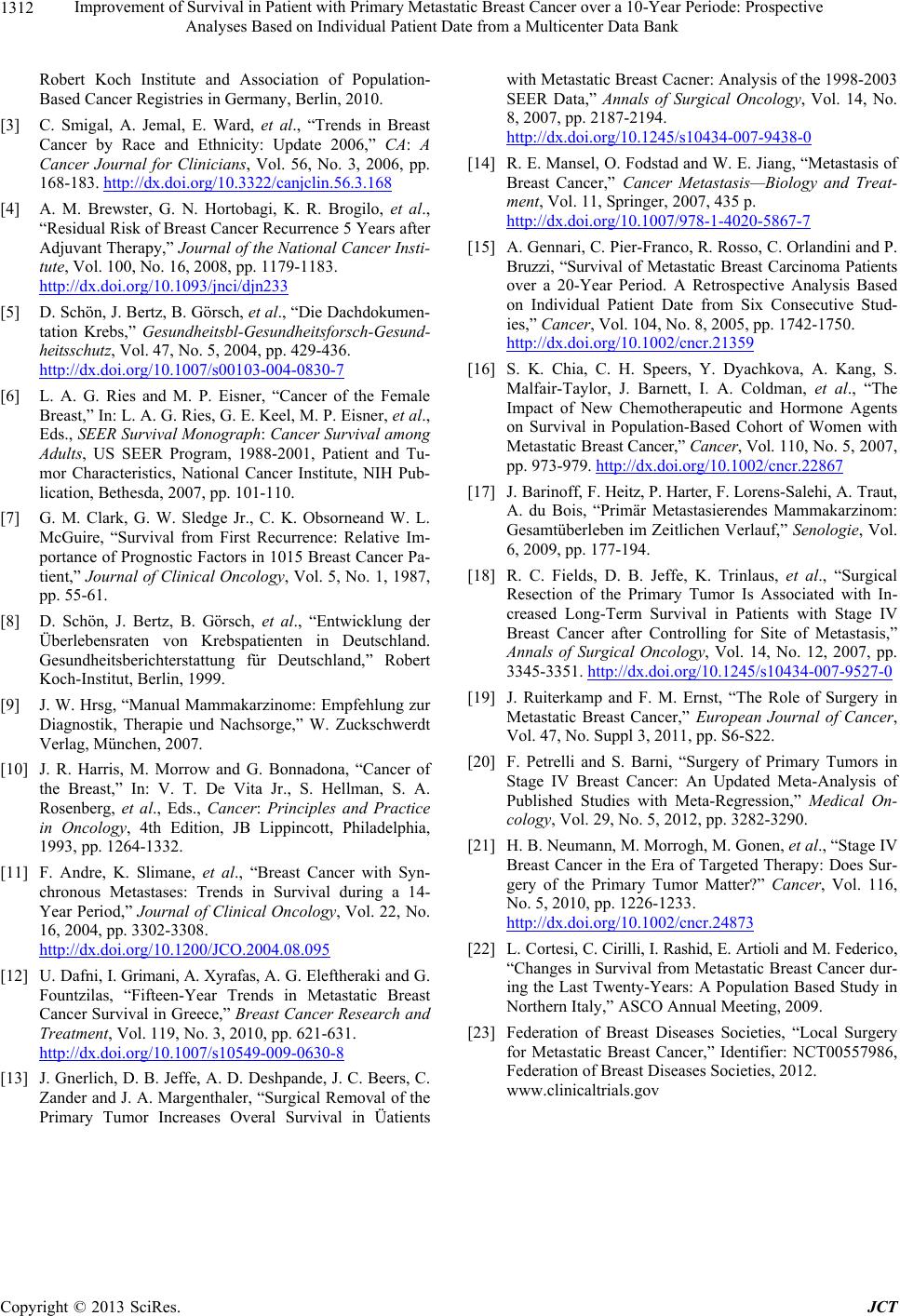 Improvement of Survival in Patient with Primary Metastatic Breast Cancer over a 10-Year Periode: Prospective Analyses Based on Individual Patient Date from a Multicenter Data Bank 1312 Robert Koch Institute and Association of Population- Based Cancer Registries in Germany, Berlin, 2010. [3] C. Smigal, A. Jemal, E. Ward, et al., “Trends in Breast Cancer by Race and Ethnicity: Update 2006,” CA: A Cancer Journal for Clinicians, Vol. 56, No. 3, 2006, pp. 168-183. http://dx.doi.org/10.3322/canjclin.56.3.168 [4] A. M. Brewster, G. N. Hortobagi, K. R. Brogilo, et al., “Residual Risk of Breast Cancer Recurrence 5 Years after Adjuvant Therapy,” Journal of the National Cancer Insti- tute, Vol. 100, No. 16, 2008, pp. 1179-1183. http://dx.doi.org/10.1093/jnci/djn233 [5] D. Schön, J. Bertz, B. Görsch, et al., “Die Dachdokumen- tation Krebs,” Gesundheitsbl-Gesundheitsforsch-Gesund- heitsschutz, Vol. 47, No. 5, 2004, pp. 429-436. http://dx.doi.org/10.1007/s00103-004-0830-7 [6] L. A. G. Ries and M. P. Eisner, “Cancer of the Female Breast,” In: L. A. G. Ries, G. E. Keel, M. P. Eisner, et al., Eds., SEER Survival Monograph: Cancer Survival among Adults, US SEER Program, 1988-2001, Patient and Tu- mor Characteristics, National Cancer Institute, NIH Pub- lication, Bethesda, 2007, pp. 101-110. [7] G. M. Clark, G. W. Sledge Jr., C. K. Obsorneand W. L. McGuire, “Survival from First Recurrence: Relative Im- portance of Prognostic Factors in 1015 Breast Cancer Pa- tient,” Journal of Clinical Oncology, Vol. 5, No. 1, 1987, pp. 55-61. [8] D. Schön, J. Bertz, B. Görsch, et al., “Entwicklung der Überlebensraten von Krebspatienten in Deutschland. Gesundheitsberichterstattung für Deutschland,” Robert Koch-Institut, Berlin, 1999. [9] J. W. Hrsg, “Manual Mammakarzinome: Empfehlung zur Diagnostik, Therapie und Nachsorge,” W. Zuckschwerdt Verlag, München, 2007. [10] J. R. Harris, M. Morrow and G. Bonnadona, “Cancer of the Breast,” In: V. T. De Vita Jr., S. Hellman, S. A. Rosenberg, et al., Eds., Cancer: Principles and Practice in Oncology, 4th Edition, JB Lippincott, Philadelphia, 1993, pp. 1264-1332. [11] F. Andre, K. Slimane, et al., “Breast Cancer with Syn- chronous Metastases: Trends in Survival during a 14- Year Period,” Journal of Clinical Oncology, Vol. 22, No. 16, 2004, pp. 3302-3308. http://dx.doi.org/10.1200/JCO.2004.08.095 [12] U. Dafni, I. Grimani, A. Xyrafas, A. G. Eleftheraki and G. Fountzilas, “Fifteen-Year Trends in Metastatic Breast Cancer Survival in Greece,” Breast Cancer Research and Treatment, Vol. 119, No. 3, 2010, pp. 621-631. http://dx.doi.org/10.1007/s10549-009-0630-8 [13] J. Gnerlich, D. B. Jeffe, A. D. Deshpande, J. C. Beers, C. Zander and J. A. Margenthaler, “Surgical Removal of the Primary Tumor Increases Overal Survival in Üatients with Metastatic Breast Cacner: Analysis of the 1998-2003 SEER Data,” Annals of Surgical Oncology, Vol. 14, No. 8, 2007, pp. 2187-2194. http://dx.doi.org/10.1245/s10434-007-9438-0 [14] R. E. Mansel, O. Fodstad and W. E. Jiang, “Metastasis of Breast Cancer,” Cancer Metastasis—Biology and Treat- ment, Vol. 11, Springer, 2007, 435 p. http://dx.doi.org/10.1007/978-1-4020-5867-7 [15] A. Gennari, C. Pier-Franco, R. Rosso, C. Orlandini and P. Bruzzi, “Survival of Metastatic Breast Carcinoma Patients over a 20-Year Period. A Retrospective Analysis Based on Individual Patient Date from Six Consecutive Stud- ies,” Cancer, Vol. 104, No. 8, 2005, pp. 1742-1750. http://dx.doi.org/10.1002/cncr.21359 [16] S. K. Chia, C. H. Speers, Y. Dyachkova, A. Kang, S. Malfair-Taylor, J. Barnett, I. A. Coldman, et al., “The Impact of New Chemotherapeutic and Hormone Agents on Survival in Population-Based Cohort of Women with Metastatic Breast Cancer,” Cancer, Vol. 110, No. 5, 2007, pp. 973-979. http://dx.doi.org/10.1002/cncr.22867 [17] J. Barinoff, F. Heitz, P. Harter, F. Lorens-Salehi, A. Traut, A. du Bois, “Primär Metastasierendes Mammakarzinom: Gesamtüberleben im Zeitlichen Verlauf,” Senologie, Vol. 6, 2009, pp. 177-194. [18] R. C. Fields, D. B. Jeffe, K. Trinlaus, et al., “Surgical Resection of the Primary Tumor Is Associated with In- creased Long-Term Survival in Patients with Stage IV Breast Cancer after Controlling for Site of Metastasis,” Annals of Surgical Oncology, Vol. 14, No. 12, 2007, pp. 3345-3351. http://dx.doi.org/10.1245/s10434-007-9527-0 [19] J. Ruiterkamp and F. M. Ernst, “The Role of Surgery in Metastatic Breast Cancer,” European Journal of Cancer, Vol. 47, No. Suppl 3, 2011, pp. S6-S22. [20] F. Petrelli and S. Barni, “Surgery of Primary Tumors in Stage IV Breast Cancer: An Updated Meta-Analysis of Published Studies with Meta-Regression,” Medical On- cology, Vol. 29, No. 5, 2012, pp. 3282-3290. [21] H. B. Neumann, M. Morrogh, M. Gonen, et al., “Stage IV Breast Cancer in the Era of Targeted Therapy: Does Sur- gery of the Primary Tumor Matter?” Cancer, Vol. 116, No. 5, 2010, pp. 1226-1233. http://dx.doi.org/10.1002/cncr.24873 [22] L. Cortesi, C. Cirilli, I. Rashid, E. Artioli and M. Federico, “Changes in Survival from Metastatic Breast Cancer dur- ing the Last Twenty-Years: A Population Based Study in Northern Italy,” ASCO Annual Meeting, 2009. [23] Federation of Breast Diseases Societies, “Local Surgery for Metastatic Breast Cancer,” Identifier: NCT00557986, Federation of Breast Diseases Societies, 2012. www.clinicaltrials.gov Copyright © 2013 SciRes. JCT |