

Paper Menu >>
Journal Menu >>
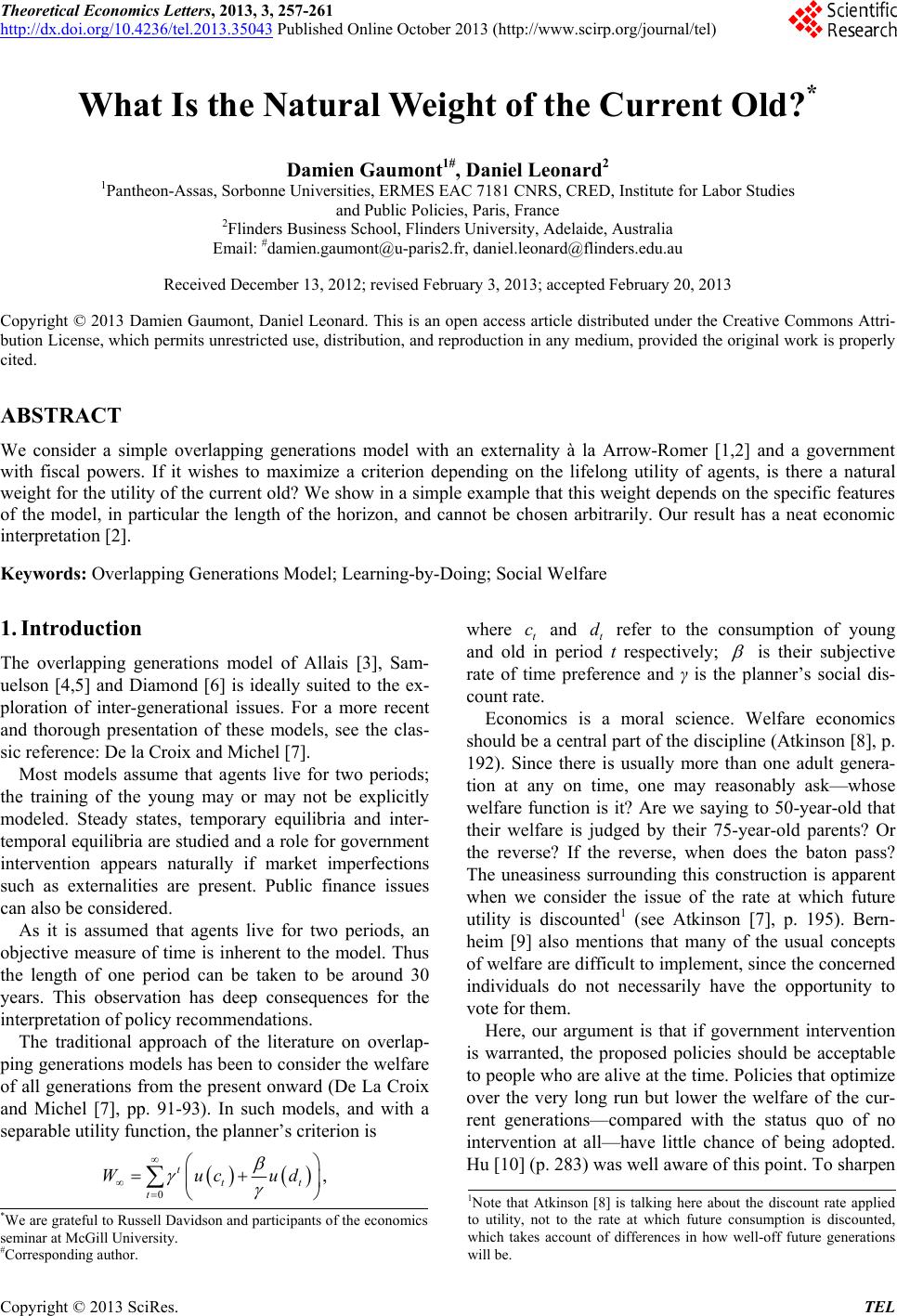 Theoretical Economics Letters, 2013, 3, 257-261 http://dx.doi.org/10.4236/tel.2013.35043 Published Online October 2013 (http://www.scirp.org/journal/tel) What Is the Natural Weight of the Current Old?* Damien Gaumont1#, Daniel Leonard2 1Pantheon-Assas, Sorbonne Universities, ERMES EAC 7181 CNRS, CRED, Institute for Labor Studies and Public Policies, Paris, France 2Flinders Business School, Flinders University, Adelaide, Australia Email: #[email protected], da[email protected] Received December 13, 2012; revised February 3, 2013; accepted February 20, 2013 Copyright © 2013 Damien Gaumont, Daniel Leonard. This is an open access article distributed under the Creative Commons Attri- bution License, which permits unrestricted use, distribution, and reproduction in any medium, provided the original work is properly cited. ABSTRACT We consider a simple overlapping generations model with an externality à la Arrow-Romer [1,2] and a government with fiscal powers. If it wishes to maximize a criterion depending on the lifelong utility of agents, is there a natural weight for the utility of the current old? We show in a simple example that this weight depends on the specific features of the model, in particular the length of the horizon, and cannot be chosen arbitrarily. Our result has a neat economic interpretation [2]. Keywords: Overlapping Generations Model; Learning-by-Doing; Social Welfare 1. Introduction where t and t refer to the consumption of young and old in period t respectively; c d is their subjective rate of time preference and γ is the planner’s social dis- count rate. The overlapping generations model of Allais [3], Sam- uelson [4,5] and Diamond [6] is ideally suited to the ex- ploration of inter-generational issues. For a more recent and thorough presentation of these models, see the clas- sic reference: De la Croix and Michel [7]. Economics is a moral science. Welfare economics should be a central part of the discipline (Atkinson [8], p. 192). Since there is usually more than one adult genera- tion at any on time, one may reasonably ask—whose welfare function is it? Are we saying to 50-year-old that their welfare is judged by their 75-year-old parents? Or the reverse? If the reverse, when does the baton pass? The uneasiness surrounding this construction is apparent when we consider the issue of the rate at which future utility is discounted1 (see Atkinson [7], p. 195). Bern- heim [9] also mentions that many of the usual concepts of welfare are difficult to implement, since the concerned individuals do not necessarily have the opportunity to vote for them. Most models assume that agents live for two periods; the training of the young may or may not be explicitly modeled. Steady states, temporary equilibria and inter- temporal equilibria are studied and a role for government intervention appears naturally if market imperfections such as externalities are present. Public finance issues can also be considered. As it is assumed that agents live for two periods, an objective measure of time is inherent to the model. Thus the length of one period can be taken to be around 30 years. This observation has deep consequences for the interpretation of policy recommendations. Here, our argument is that if government intervention is warranted, the proposed policies should be acceptable to people who are alive at the time. Policies that optimize over the very long run but lower the welfare of the cur- rent generations—compared with the status quo of no intervention at all—have little chance of being adopted. Hu [10] (p. 283) was well aware of this point. To sharpen The traditional approach of the literature on overlap- ping generations models has been to consider the welfare of all generations from the present onward (De La Croix and Michel [7], pp. 91-93). In such models, and with a separable utility function, the planner’s criterion is 0 , t tt t Wucud 1Note that Atkinson [8] is talking here about the discount rate applied to utility, not to the rate at which future consumption is discounted, which takes account of differences in how well-off future generations will be. *We are grateful to Russell Davidson and participants of the economics seminar at McGill University. #Corresponding author. C opyright © 2013 SciRes. TEL 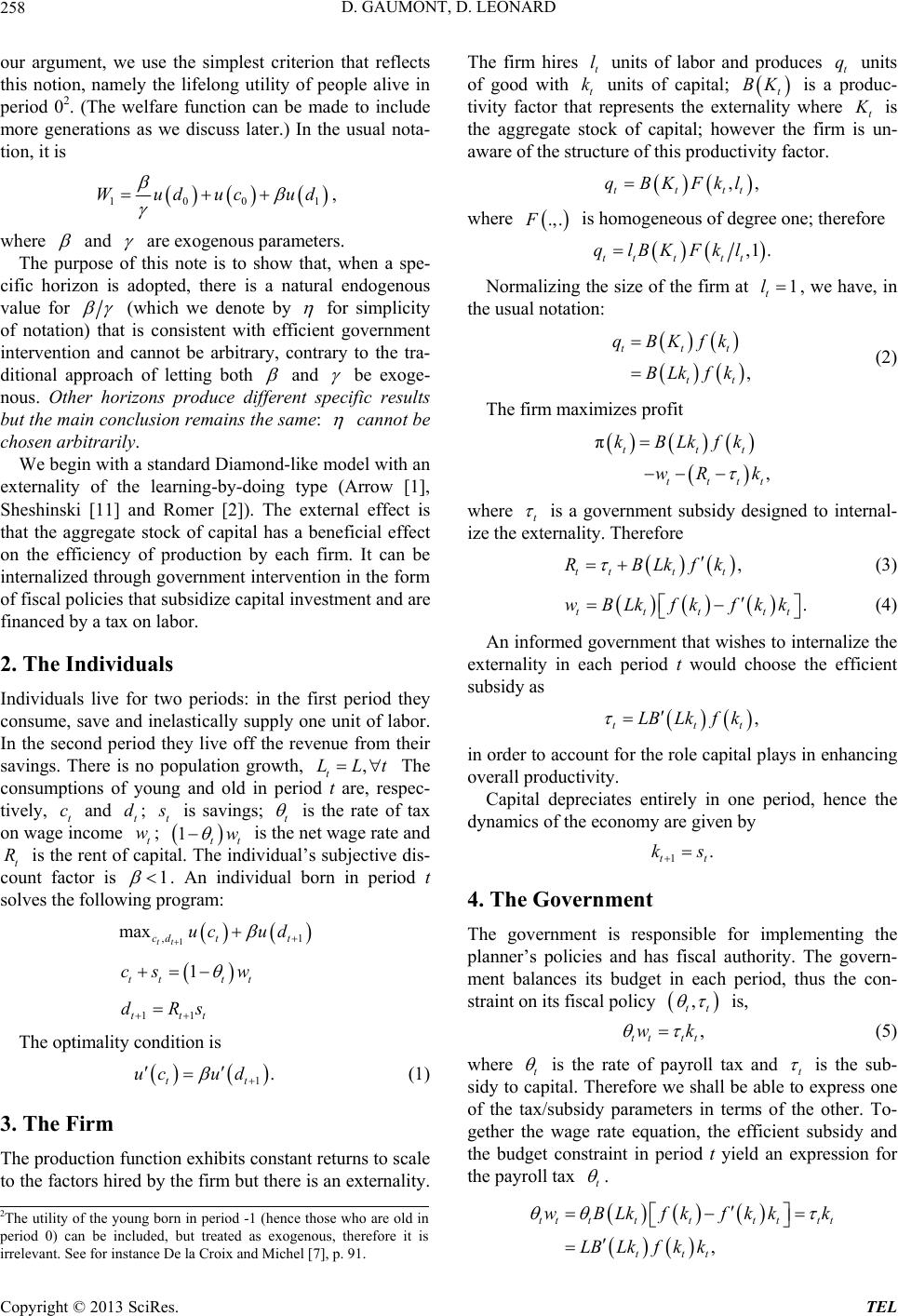 D. GAUMONT, D. LEONARD 258 our argument, we use the simplest criterion that reflects this notion, namely the lifelong utility of people alive in period 02. (The welfare function can be made to include more generations as we discuss later.) In the usual nota- tion, it is 100 Wuducud 1 , where and are exogenous parameters. The purpose of this note is to show that, when a spe- cific horizon is adopted, there is a natural endogenous value for (which we denote by for simplicity of notation) that is consistent with efficient government intervention and cannot be arbitrary, contrary to the tra- ditional approach of letting both and be exoge- nous. Other horizons produce different specific results but the main conclusion remains the same: cannot be chosen arbitrarily. We begin with a standard Diamond-like model with an externality of the learning-by-doing type (Arrow [1], Sheshinski [11] and Romer [2]). The external effect is that the aggregate stock of capital has a beneficial effect on the efficiency of production by each firm. It can be internalized through government intervention in the form of fiscal policies that subsidize capital investment and are financed by a tax on labor. 2. The Individuals Individuals live for two periods: in the first period they consume, save and inelastically supply one unit of labor. In the second period they live off the revenue from their savings. There is no population growth, , t LLt The consumptions of young and old in period t are, respec- tively, t and ; ct dt s is savings; t is the rate of tax on wage income t; t is the net wage rate and t is the rent of capital. The individual’s subjective dis- count factor is w 1t w R 1 . An individual born in period t solves the following program: 1 ,1 max tt cd tt uc ud 1 tt t cs w t t s 11tt dR The optimality condition is 1. t duc u t (1) 3. The Firm The production function exhibits constant returns to scale to the factors hired by the firm but there is an externality. The firm hires units of labor and produces t units of good with t units of capital; t l k q t B K is a produc- tivity factor that represents the externality where t K is the aggregate stock of capital; however the firm is un- aware of the structure of this productivity factor. ,, ttt BFqKklt where .,.F is homogeneous of degree one; therefore ,1 . tt ttt BFql Kkl Normalizing the size of the firm at , we have, in the usual notation: 1 t l , ttt tt Bf B qK L k kfk (2) The firm maximizes profit π , ttt ttt kkk w BL Rk f t where t is a government subsidy designed to internal- ize the externality. Therefore , ttt t BLRkf k (3) . ttt t BLf kkwfkt k (4) An informed government that wishes to internalize the externality in each period t would choose the efficient subsidy as , tt LB Lkkf t in order to account for the role capital plays in enhancing overall productivity. Capital depreciates entirely in one period, hence the dynamics of the economy are given by 1. tt ks 4. The Government The government is responsible for implementing the planner’s policies and has fiscal authority. The govern- ment balances its budget in each period, thus the con- straint on its fiscal policy , tt is, , tt tt wk (5) where t is the rate of payroll tax and t is the sub- sidy to capital. Therefore we shall be able to express one of the tax/subsidy parameters in terms of the other. To- gether the wage rate equation, the efficient subsidy and the budget constraint in period t yield an expression for the payroll tax t . , tt tttt t ttt tt BLf kfkk LBLf kkk wk k 2The utility of the young born in period -1 (hence those who are old in p eriod 0) can be included, but treated as exogenous, therefore it is irrelevant. See for instance De la Croix and Michel [7], p. 91. Copyright © 2013 SciRes. TEL 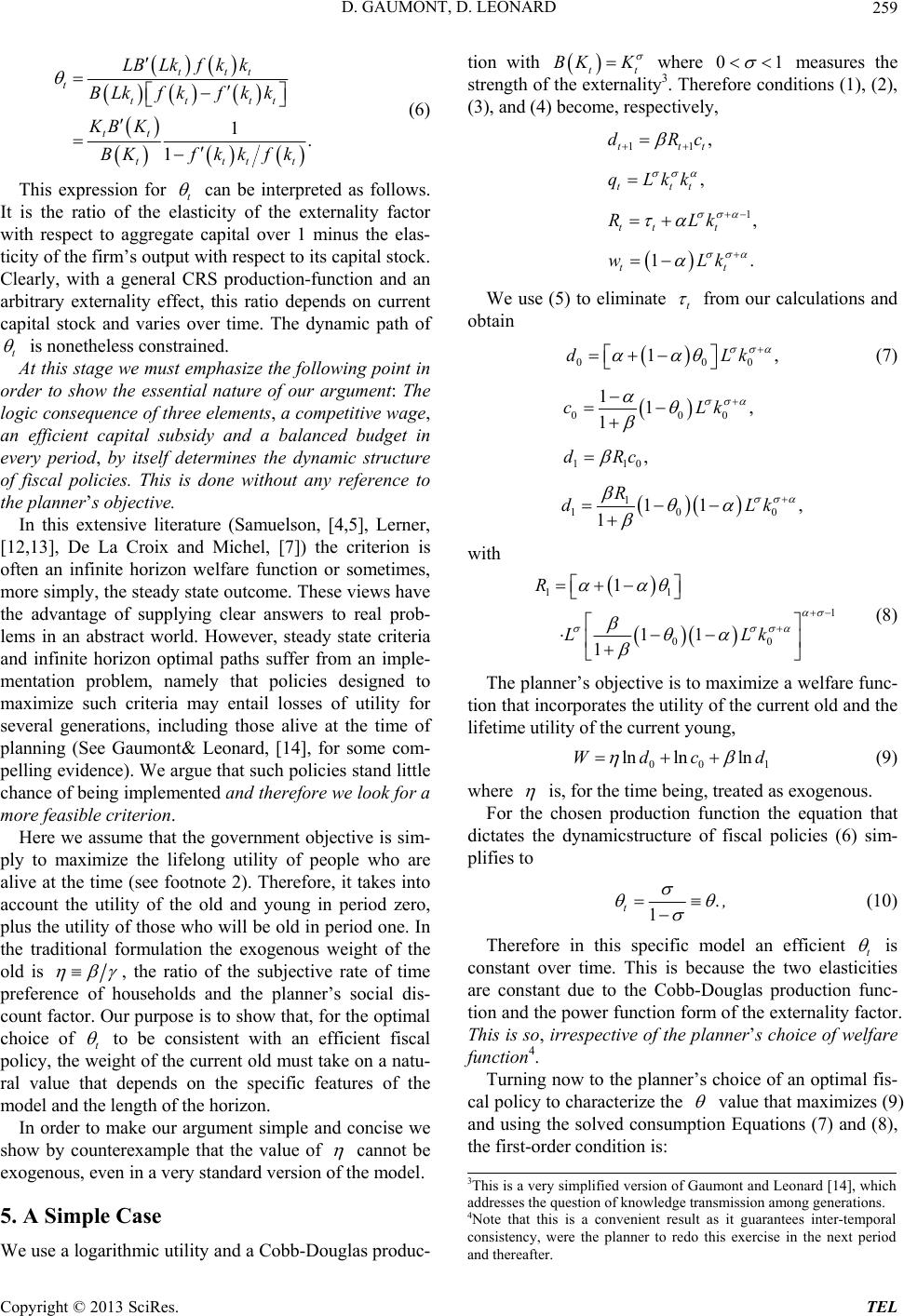 D. GAUMONT, D. LEONARD 259 1. 1 ttt t tt tt tt ttt LBLkf kk BLkf kfkk KB K BKfkkf k t (6) This expression for t can be interpreted as follows. It is the ratio of the elasticity of the externality factor with respect to aggregate capital over 1 minus the elas- ticity of the firm’s output with respect to its capital stock. Clearly, with a general CRS production-function and an arbitrary externality effect, this ratio depends on current capital stock and varies over time. The dynamic path of t is nonetheless constrained. At this stage we must emphasize the following point in order to show the essential nature of our argument: The logic consequence of three elements, a competitive wage, an efficient capital subsidy and a balanced budget in every period, by itself determines the dynamic structure of fiscal policies. This is done without any reference to the planner’s objective. In this extensive literature (Samuelson, [4,5], Lerner, [12,13], De La Croix and Michel, [7]) the criterion is often an infinite horizon welfare function or sometimes, more simply, the steady state outcome. These views have the advantage of supplying clear answers to real prob- lems in an abstract world. However, steady state criteria and infinite horizon optimal paths suffer from an imple- mentation problem, namely that policies designed to maximize such criteria may entail losses of utility for several generations, including those alive at the time of planning (See Gaumont& Leonard, [14], for some com- pelling evidence). We argue that such policies stand little chance of being implemented and therefore we look for a more feasible criterion. Here we assume that the government objective is sim- ply to maximize the lifelong utility of people who are alive at the time (see footnote 2). Therefore, it takes into account the utility of the old and young in period zero, plus the utility of those who will be old in period one. In the traditional formulation the exogenous weight of the old is , the ratio of the subjective rate of time preference of households and the planner’s social dis- count factor. Our purpose is to show that, for the optimal choice of t to be consistent with an efficient fiscal policy, the weight of the current old must take on a natu- ral value that depends on the specific features of the model and the length of the horizon. In order to make our argument simple and concise we show by counterexample that the value of cannot be exogenous, even in a very standard version of the model. 5. A Simple Case We use a logarithmic utility and a Cobb-Douglas produc- tion with t BK K t where 01 measures the strength of the externality3. Therefore conditions (1), (2), (3), and (4) become, respectively, 11 , tt dR t c , ttt qLkk 1, tt t RLk 1. tt wLk We use (5) to eliminate t from our calculations and obtain 00 1d0 ,Lk (7) 00 11, 1 cL 0 k 11 ,dRc 0 1 10 11 1, R dL 0 k with 11 1 00 1 11 1 R LL k 1 d (8) The planner’s objective is to maximize a welfare func- tion that incorporates the utility of the current old and the lifetime utility of the current young, 00 ln lnlnWdc (9) where is, for the time being, treated as exogenous. For the chosen production function the equation that dictates the dynamicstructure of fiscal policies (6) sim- plifies to . 1 t , (10) Therefore in this specific model an efficient t is constant over time. This is because the two elasticities are constant due to the Cobb-Douglas production func- tion and the power function form of the externality factor. This is so, irrespective of the planner’s choice of welfare function4. Turning now to the planner’s choice of an optimal fis- cal policy to characterize the value that maximizes (9) and using the solved consumption Equations (7) and (8), the first-order condition is: 3This is a very simplified version of Gaumont and Leonard [14], which addresses the question of knowledge transmission among generations. 4Note that this is a convenient result as it guarantees inter-temporal consistency, were the planner to redo this exercise in the next period and thereafter. Copyright © 2013 SciRes. TEL 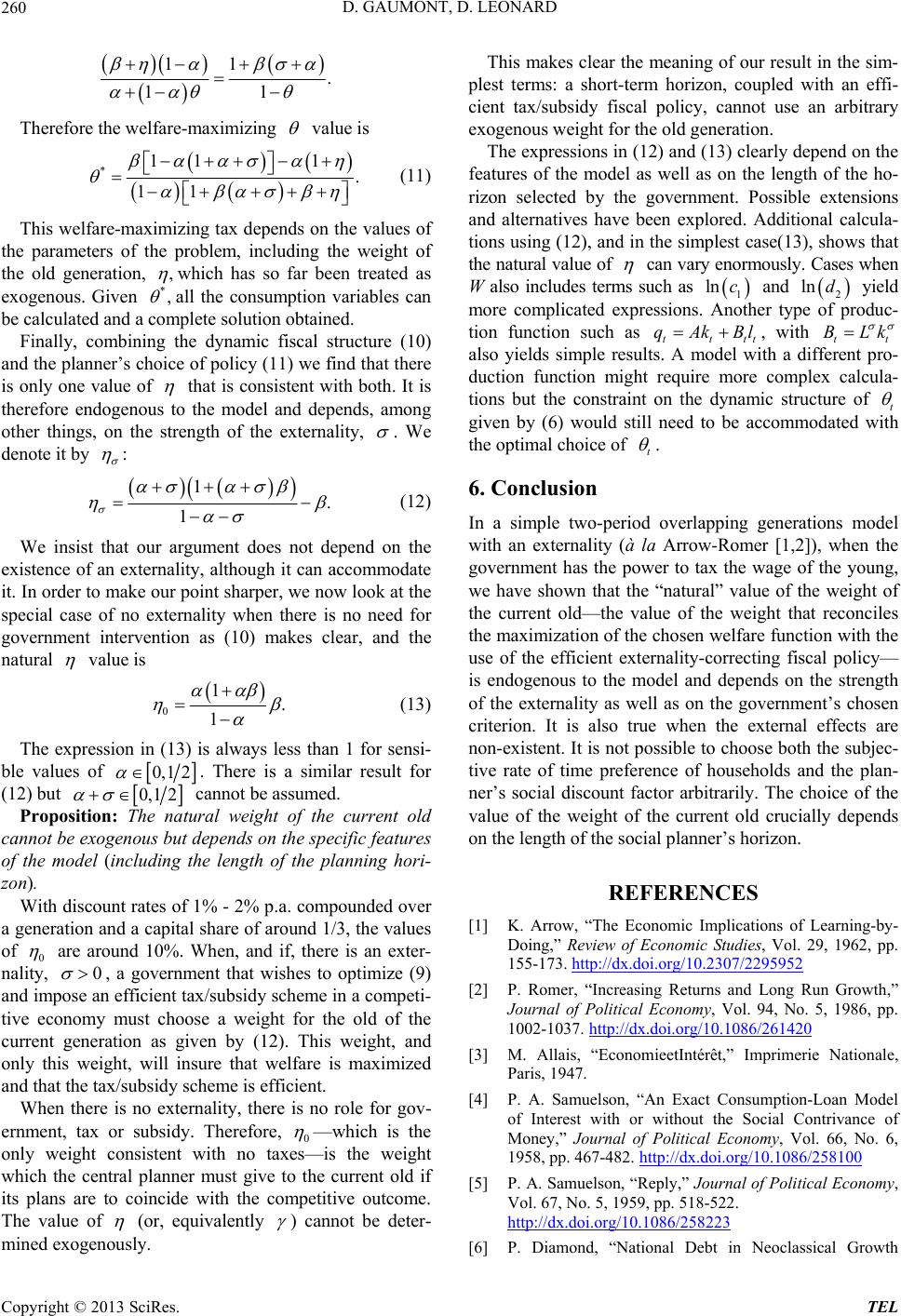 D. GAUMONT, D. LEONARD 260 11 . 11 This makes clear the meaning of our result in the sim- plest terms: a short-term horizon, coupled with an effi- cient tax/subsidy fiscal policy, cannot use an arbitrary exogenous weight for the old generation. Therefore the welfare-maximizing value is *11 1. 11 (11) The expressions in (12) and (13) clearly depend on the features of the model as well as on the length of the ho- rizon selected by the government. Possible extensions and alternatives have been explored. Additional calcula- tions using (12), and in the simplest case(13), shows that the natural value of can vary enormously. Cases when W also includes terms such as 1 ln c and 2 ln d yield more complicated expressions. Another type of produc- tion function such as tttt qA lkB , with tt BLk also yields simple results. A model with a different pro- duction function might require more complex calcula- tions but the constraint on the dynamic structure of t given by (6) would still need to be accommodated with the optimal choice of t . This welfare-maximizing tax depends on the values of the parameters of the problem, including the weight of the old generation, , which has so far been treated as exogenous. Given *, all the consumption variables can be calculated and a complete solution obtained. Finally, combining the dynamic fiscal structure (10) and the planner’s choice of policy (11) we find that there is only one value of that is consistent with both. It is therefore endogenous to the model and depends, among other things, on the strength of the externality, . We denote it by : 1. 1 (12) 6. Conclusion In a simple two-period overlapping generations model with an externality (à la Arrow-Romer [1,2]), when the government has the power to tax the wage of the young, we have shown that the “natural” value of the weight of the current old—the value of the weight that reconciles the maximization of the chosen welfare function with the use of the efficient externality-correcting fiscal policy— is endogenous to the model and depends on the strength of the externality as well as on the government’s chosen criterion. It is also true when the external effects are non-existent. It is not possible to choose both the subjec- tive rate of time preference of households and the plan- ner’s social discount factor arbitrarily. The choice of the value of the weight of the current old crucially depends on the length of the social planner’s horizon. We insist that our argument does not depend on the existence of an externality, although it can accommodate it. In order to make our point sharper, we now look at the special case of no externality when there is no need for government intervention as (10) makes clear, and the natural value is 0 1. 1 (13) The expression in (13) is always less than 1 for sensi- ble values of 0,1 2 . There is a similar result for (12) but 0,1 2 cannot be assumed. Proposition: The natural weight of the current old cannot be exogenous but depends on the specific features of the model (including the length of the planning hori- zon). REFERENCES With discount rates of 1% - 2% p.a. compounded over a generation and a capital share of around 1/3, the values of 0 are around 10%. When, and if, there is an exter- nality, 0 , a government that wishes to optimize (9) and impose an efficient tax/subsidy scheme in a competi- tive economy must choose a weight for the old of the current generation as given by (12). This weight, and only this weight, will insure that welfare is maximized and that the tax/subsidy scheme is efficient. [1] K. Arrow, “The Economic Implications of Learning-by- Doing,” Review of Economic Studies, Vol. 29, 1962, pp. 155-173. http://dx.doi.org/10.2307/2295952 [2] P. Romer, “Increasing Returns and Long Run Growth,” Journal of Political Economy, Vol. 94, No. 5, 1986, pp. 1002-1037. http://dx.doi.org/10.1086/261420 [3] M. Allais, “EconomieetIntérêt,” Imprimerie Nationale, Paris, 1947. [4] P. A. Samuelson, “An Exact Consumption-Loan Model of Interest with or without the Social Contrivance of Money,” Journal of Political Economy, Vol. 66, No. 6, 1958, pp. 467-482. http://dx.doi.org/10.1086/258100 When there is no externality, there is no role for gov- ernment, tax or subsidy. Therefore, 0 —which is the only weight consistent with no taxes—is the weight which the central planner must give to the current old if its plans are to coincide with the competitive outcome. The value of (or, equivalently ) cannot be deter- mined exogenously. [5] P. A. Samuelson, “Reply,” Journal of Political Economy, Vol. 67, No. 5, 1959, pp. 518-522. http://dx.doi.org/10.1086/258223 [6] P. Diamond, “National Debt in Neoclassical Growth Copyright © 2013 SciRes. TEL  D. GAUMONT, D. LEONARD Copyright © 2013 SciRes. TEL 261 Models,” American Economic Review, Vol. 55, No. 5, 1965, pp. 1126-1150. [7] D. De La Croix and Ph. Michel, “A Theory of Economic Growth: Dynamics and Policy in Overlapping Genera- tions,” Cambridge University Press, Cambridge, 2002. http://dx.doi.org/10.1017/CBO9780511606434 [8] A. B. Atkinson “Economics as a Moral Science,” Eco- nomica, Vol. 76, No. 304, 2009, pp. 791-804. http://dx.doi.org/10.1111/j.1468-0335.2009.00788.x [9] B. D. Bernheim, “Behavioral Welfare Economics,” Jour- nal of the European Economic Association, Vol. 7, No. 2-3, 2009, pp. 267-319. http://dx.doi.org/10.1162/JEEA.2009.7.2-3.267 [10] S. C. Hu, “Social Security, the Supply of Labor and Capital Accumulation,” American Economic Review, Vol. 69, No. 3, 1979, pp. 274-284. [11] E. Sheshinski, “Test of the Learning by Doing Hypothe- sis,” The Review of Economics and Statistics, Vol. 49, No. 4, 1967, pp. 568-678. http://dx.doi.org/10.2307/1928342 [12] A. Lerner, “Consumption-Loan Interest and Money,” Jour- nal of Political Economy, Vol. 67, No. 5, 1959, pp. 512- 518. http://dx.doi.org/10.1086/258222 [13] A. Lerner, “Consumption-Loan Interest and Money: Re- joinder,” Journal of Political Economy, Vol. 67, No. 5, 1959, pp. 523-524. http://dx.doi.org/10.1086/258224 [14] D. Gaumont and D. Leonard, “Human Capital, External- ities and Growth in an Overlapping Generations Model,” Research in Economics, Vol. 60, No. 3, 2010, pp. 186- 200. http://dx.doi.org/10.1016/j.rie.2010.04.001 |