

Paper Menu >>
Journal Menu >>
 Journal of Signal and Information Processing, 2013, 4, 138-143 doi:10.4236/jsip.2013.43B024 Published Online August 2013 (http://www.scirp.org/journal/jsip) Frequency Synchronization in OFDM System C. Geetha Priya1, A. M. Vasumathi2 1Department of Electronics and Communication Engineering, K.L.N. College of Information Technology, Pottapalayam-630611, Sivagangai District, Tamil Nadu, India; 2Dean Academic & Research Committee Chairman, K.L.N. College of Information Tech- nology, Pottapalayam-630611, Sivagangai District, Tamil Nadu, India. Email: [email protected], [email protected] Received April, 2013. ABSTRACT An accurate frequency synchronization method using the zadoff-chu (ZC) constant envelop preamble is analyzed, and a new preamble weighted by pseudo-noise sequence is used for orthogonal frequency division multiplexing (OFDM) systems. Using this method, frequency offset estimator range is greatly enlarged with no loss in accuracy. The range of the frequency estimation is ±30 of subcarrier spacing using ZC sequence as preamble. Simulations in the MATLAB for an AWGN channel show that the proposed method achieves superior performance to existing techniques in terms of frequency accuracy and range. Keywords: Orthogonal Frequency Division Multiplexing (OFDM); Additive White Gaussian Noise (AWGN); Carrier Frequency Offset (CFO); Constant Amplitude Zero Auto Correlation (CAZAC); Zadoff-Chu (ZC) 1. Introduction Orthogonal frequency division multiplexing (OFDM) is a digital multi-carrier modulation technique that has be- come an increasingly popular scheme in modern digital communications. It is the attractive technique for high speed wireless communications. It is robust against fre- quency-selective fading in a multipath channel eliminat- ing the need for complex time-domain equalization. Sev- eral wireless communication systems adopt OFDM as their modulation technique such as wireless local area networks (WLAN), wireless fidelity WiFi, mobile worldwide interoperability for microwave access (Mobile WiMAX), 3rd generation partnership project long term evolution (3GPP LTE), digital audio broadcasting (DAB), digital video broadcasting (DVB), digital video broad- casting-terrestrial transmission systems (DVB-T), digital video broadcasting-handhelds (DVB-H), digital video broadcasting- satellite services to handhelds(DVB-SH) wireless standards. Especially, mobile digital broadcast- ing system has attracted considerable attention which provides not only TV and radio services but also data and multimedia services to mobile phone and portable de- vices. The disadvantages of OFDM system are peak to average power ratio (PAPR), carrier frequency offset (CFO) and timing offset (TO). OFDM is very sensitive to carrier frequency offsets in the received signal due to doppler shifts or instabilities in the local oscillator (LO) and results in a loss of subcarrier orthogonality leading to inter carrier interference (ICI). Hence, it is required to reduce the frequency errors to a small fraction of the subcarrier spacing. These offsets are considered constant for simulation purposes as the oscil- lators drift with temperature, supply voltage, load and the other slowly changing environmental parameters. The variations in the CFO due to doppler effects are also con- sidered to be slow in comparison to simulation time. In practical system scenarios, the frequency offset can be many multiples of the subcarrier spacing due to the use of consumer-grade oscillators in the receiver. Therefore, a wide frequency estimation range enables greater flexi- bility in terms of reducing the cost of OFDM receivers to mass-market consumers. Various techniques have been proposed in the literature for the frequency synchroniza- tion in OFDM. 2. Literature Review Moose [1] derived the maximum likelihood estimation (MLE) for carrier frequency offset (CFO) in the fre- quency domain. The limit of the acquisition for the CFO is ±1/2 the subcarrier spacing. Van de Beek et al. [2] have shown the joint Maximum Likelihood (ML) esti- mator of time and frequency offset. This algorithm ex- ploits the cyclic prefix preceding the OFDM symbols reducing the need for pilots. Schmidl and Cox [3] pro- posed frequency and timing synchronization algorithm by using repeated data symbol. The range of CFO esti- mation is ±1. Michele et al. proposed a training symbol of more than two identical parts to achieve better accu- Copyright © 2013 SciRes. JSIP  Frequency Synchronization in OFDM System 139 racy. The estimation range can be made as large as de- sired without the need of the second training symbol [4]. Fredrik Tufvesson et al. compared and analyzed the preambles for OFDM systems based on repeated OFDM data symbols or repeated short pseudo noise sequences. Synchronization based on PN-sequence preambles of- fered greater power reductions in stand-by model [5]. Minn et al. [6] compared the performance of timing off- set estimation methods with modification in the training structure and found a smaller estimator variance in his scheme. Ren et al. [7] proposed the modified preamble in WLANs with a typical structure weighted by the pseudo- noise sequence which enlarged range of frequency offset estimation to ±4. Hlaing Minn et al. [8] presented a fre- quency offset estimation approach using a maximum- likelihood principle with a sliding observation vector (SOV-ML). Chin-Liang Wang et al. [9] proposed a method to make a modulatable orthogonal sequence par- tially geometric for large CFO estimation. Wei Zhong [10] proposed a novel integral frequency offset (IFO) estimation method which examined the phase changes of synchronization signals in frequency domain. This method provided excellent IFO estimation performance with very low computational complexity. Sung-Ju Lee et al. [11] proposed the carrier frequency offset mitigation scheme in wireless digital cooperative broadcasting sys- tem using multi-symbol encapsulated orthogonal fre- quency division multiplexing (MSE-OFDM), which uses one cyclic prefix (CP) for multiple OFDM symbols. Adegbenga B. Awoseyila et al. [12] proposed a novel technique for 3GPP LTE specifications using only one training symbol with a simple structure of two identical parts to achieve robust, low-complexity and full-range time-frequency synchronization in OFDM systems. E. C. Kim et al. [13] enhanced the performance frequency off- set compensation by adding a ternary sequence to OFDM signals in the time domain which finds application in design of synchronization block of OFDM scheme for wireless multimedia communication services. The power level of the ternary sequence to be added needs to be low enough in order not to affect the normal operation of the OFDM system. Ilgyu Kim et al. [14] proposed an effi- cient synchronization signal structure for OFDM-based Cellular Systems The sequence used for the Primary Synchronization signal is generated from a frequency- domain ZC sequence for high rate and multimedia data service systems such as LTE in the 3GPP. Ji-Woong Choi et al. [15] described the joint ML estimation using correlation of any pair of repetition patterns, providing optimized performance. In Moose method, the limit of the estimation for the CFO is ±1/2 the subcarrier spacing. In Schmidl and Cox method, the limit of the estimation for the CFO is ±1 the subcarrier spacing. In Minn method, the limit of the es- timation for the CFO is ±2 the subcarrier spacing. In Ren method, the limit of the estimation for the CFO is ±4 the subcarrier spacing. The method using ZC sequence as preamble, the limit of the estimation for the CFO is ±30 the subcarrier spacing. Hence the Carrier Frequency Offset estimation range is large when compared to the previous methods. This paper is based on preamble-aided methods that can be applied to both burst-mode and continuous OFDM applications. The organization of the paper is as follows. In Section I, the OFDM system model and importance of frequency offset estimation is described. In Section II, the frequency offset estimation of previous methods is explained. The algorithm for frequency offset estimation using ZC sequence is given in Section III. Simulation results and discussions are presented in Section IV. Finally, in Section V, conclusions are drawn. 3. The OFDM System Model The incoming input binary streams are first mapped into constellation points according to any of the digital modulation schemes such as QPSK/QAM. In QPSK (Quadrature Phase Shift Keying) modulation, the incom- ing binary bits are combined in the form of two bits and are mapped into constellation point. After mapping into constellation points, the incoming serial bits are con- verted into parallel bits transmitting N OFDM samples at a time. The OFDM signal is generated using N subcarri- ers. The total bandwidth is divided into 64 sub channels. The N constellation points are modulated using N sub- carriers whose carrier frequencies are orthogonal in na- ture. The modulation is similar to taking inverse dis- crete/fast fourier transform (IDFT/IFFT) operation. The output of N point (IFFT) block is the OFDM signal. Now the N OFDM signal samples are combined and then transmitted i.e., the parallel samples are now converted into serial sequence and then it is transmitted. The OFDM baseband signal at the transmitter is expressed as in (1) 12 0 1 ()(). 01 Njnk N k xnX knN e N (1) where n -time domain sample index X (k) -modulated QPSK data symbol on the kth subcarrier N -total number of subcarriers and x (n) -OFDM signal. In order to maintain a signal to noise ratio (SNR) of 20 decibels or greater for the OFDM carriers, offset is limited to 4% or less than the inter carrier spacing which is simulated in Figure 1. The lower bound for the SNR at the output of the DFT for the OFDM carriers in a channel with AWGN and frequency offset is derived as in [1] and Copyright © 2013 SciRes. JSIP 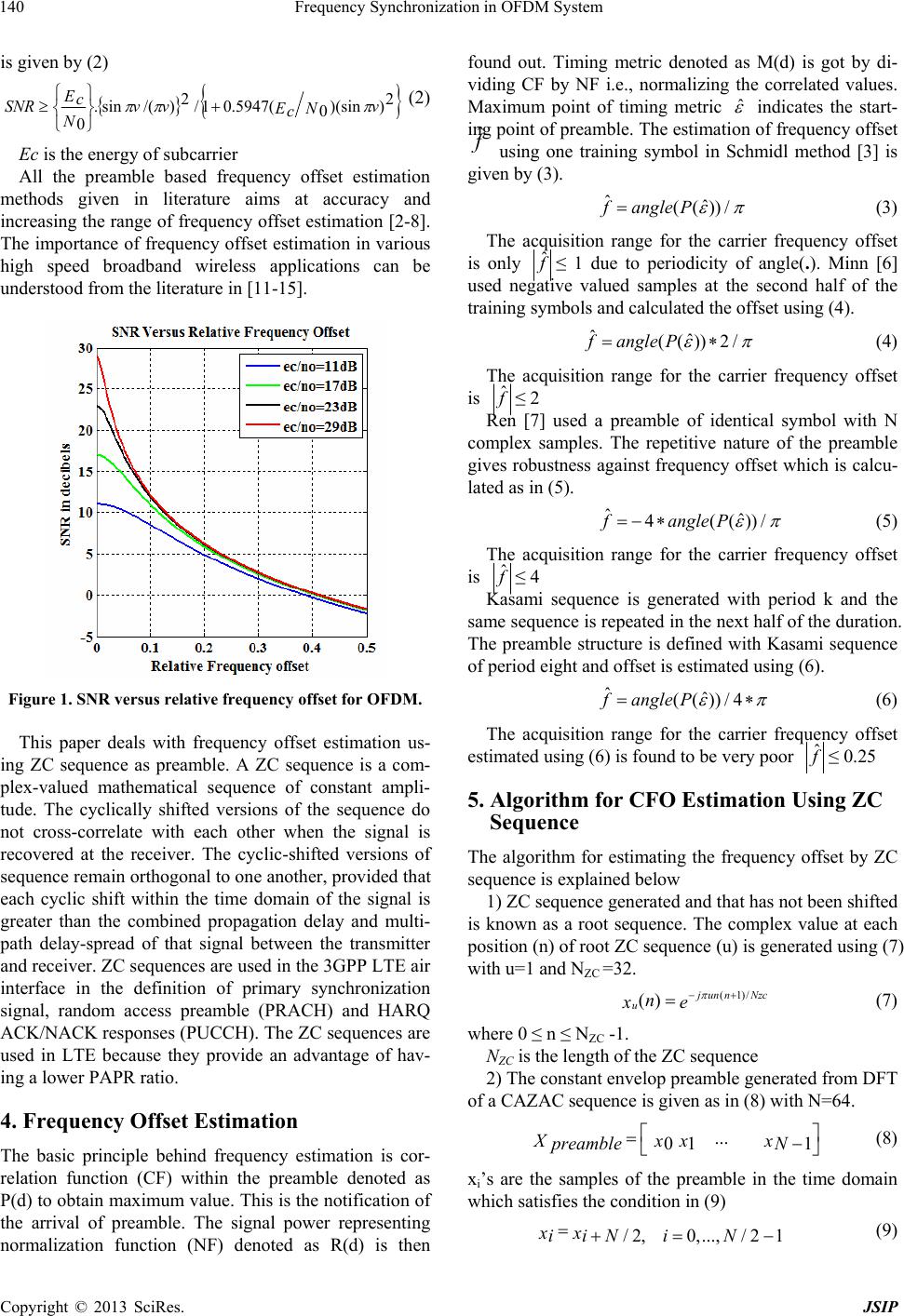 Frequency Synchronization in OFDM System 140 is given by (2) 2 ))(sin 0 (5947.01/ 2 )/(sin. 0 v N Ec vv N Ec SNR (2) Ec is the energy of subcarrier All the preamble based frequency offset estimation methods given in literature aims at accuracy and increasing the range of frequency offset estimation [2-8]. The importance of frequency offset estimation in various high speed broadband wireless applications can be understood from the literature in [11-15]. Figure 1. SNR versus relative frequency offset for OFDM. This paper deals with frequency offset estimation us- ing ZC sequence as preamble. A ZC sequence is a com- plex-valued mathematical sequence of constant ampli- tude. The cyclically shifted versions of the sequence do not cross-correlate with each other when the signal is recovered at the receiver. The cyclic-shifted versions of sequence remain orthogonal to one another, provided that each cyclic shift within the time domain of the signal is greater than the combined propagation delay and multi- path delay-spread of that signal between the transmitter and receiver. ZC sequences are used in the 3GPP LTE air interface in the definition of primary synchronization signal, random access preamble (PRACH) and HARQ ACK/NACK responses (PUCCH). The ZC sequences are used in LTE because they provide an advantage of hav- ing a lower PAPR ratio. 4. Frequency Offset Estimation The basic principle behind frequency estimation is cor- relation function (CF) within the preamble denoted as P(d) to obtain maximum value. This is the notification of the arrival of preamble. The signal power representing normalization function (NF) denoted as R(d) is then found out. Timing metric denoted as M(d) is got by di- viding CF by NF i.e., normalizing the correlated values. Maximum point of timing metric ˆ indicates the start- ing point of preamble. The estimation of frequency offset f using one training symbol in Schmidl method [3] is given by (3). ˆ ˆˆ (())/fangle P (3) The acquisition range for the carrier frequency offset is only ˆ f ≤ 1 due to periodicity of angle(.). Minn [6] used negative valued samples at the second half of the training symbols and calculated the offset using (4). ˆˆ (())2/fangleP (4) The acquisition range for the carrier frequency offset is ˆ f ≤ 2 Ren [7] used a preamble of identical symbol with N complex samples. The repetitive nature of the preamble gives robustness against frequency offset which is calcu- lated as in (5). ˆˆ 4(())fangle P/ (5) The acquisition range for the carrier frequency offset is ˆ f ≤ 4 Kasami sequence is generated with period k and the same sequence is repeated in the next half of the duration. The preamble structure is defined with Kasami sequence of period eight and offset is estimated using (6). ˆˆ (())/4fangle P (6) The acquisition range for the carrier frequency offset estimated using (6) is found to be very poor ˆ f ≤ 0.25 5. Algorithm for CFO Estimation Using ZC Sequence The algorithm for estimating the frequency offset by ZC sequence is explained below 1) ZC sequence generated and that has not been shifted is known as a root sequence. The complex value at each position (n) of root ZC sequence (u) is generated using (7) with u=1 and NZC =32. (1)/ () j un nNzc un xe (7) where 0 ≤ n ≤ NZC -1. NZC is the length of the ZC sequence 2) The constant envelop preamble generated from DFT of a CAZAC sequence is given as in (8) with N=64. ... 01 1 xx x Xpreamble N (8) xi’s are the samples of the preamble in the time domain which satisfies the condition in (9) /2,0,...,/2 1 xx iiN iN (9) Copyright © 2013 SciRes. JSIP 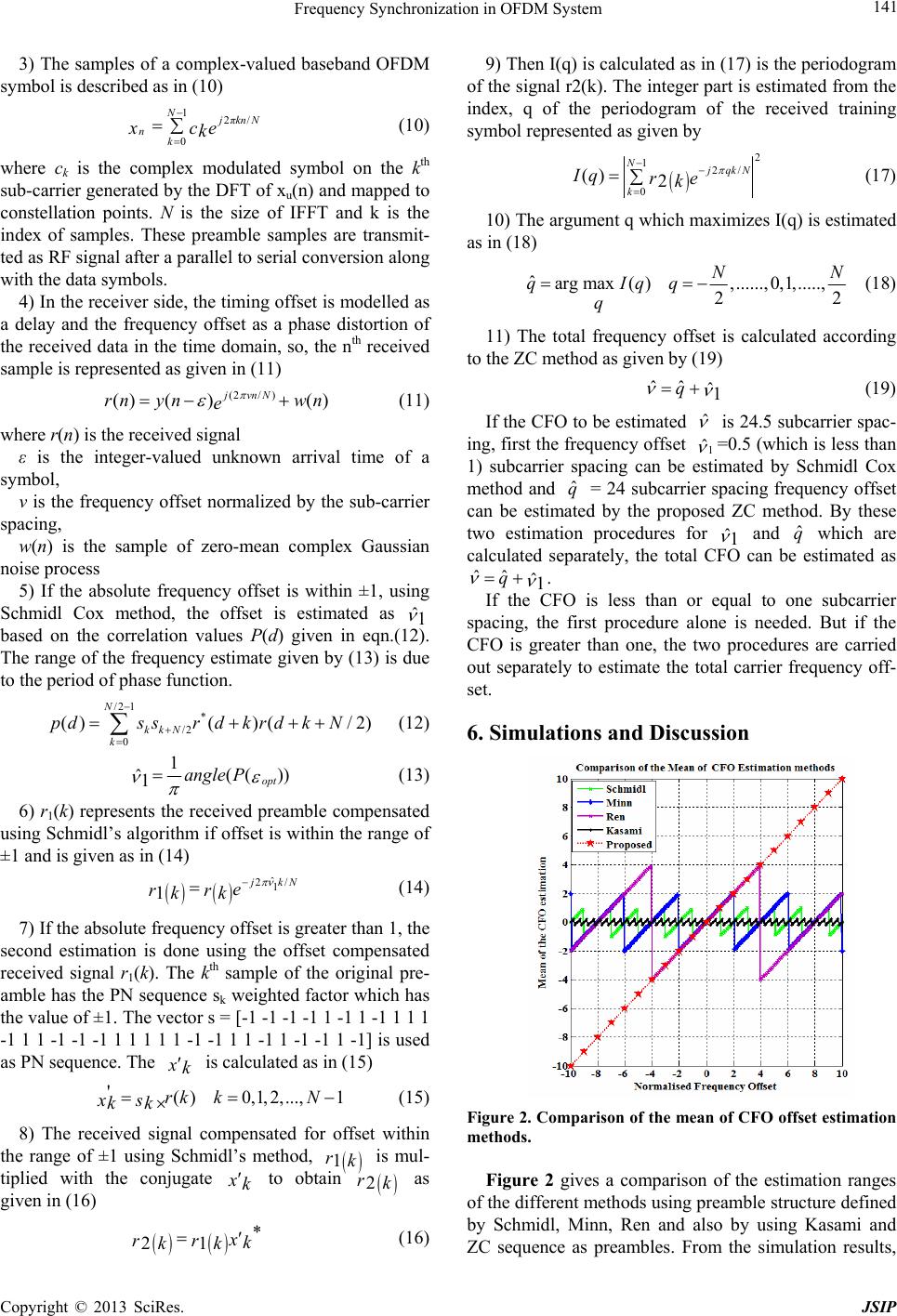 Frequency Synchronization in OFDM System 141 3) The samples of a complex-valued baseband OFDM symbol is described as in (10) 12/ 0 Njπkn N n k xce k (10) where ck is the complex modulated symbol on the k th sub-carrier generated by the DFT of xu(n) and mapped to constellation points. N is the size of IFFT and k is the index of samples. These preamble samples are transmit- ted as RF signal after a parallel to serial conversion along with the data symbols. 4) In the receiver side, the timing offset is modelled as a delay and the frequency offset as a phase distortion of the received data in the time domain, so, the nth received sample is represented as given in (11) (2/ ) () ()() jvnN rn ynwn e (11) where r(n) is the received signal ε is the integer-valued unknown arrival time of a symbol, v is the frequency offset normalized by the sub-carrier spacing, w(n) is the sample of zero-mean complex Gaussian noise process 5) If the absolute frequency offset is within ±1, using Schmidl Cox method, the offset is estimated as ˆ1 based on the correlation values P(d) given in eqn.(12). The range of the frequency estimate given by (13) is due to the period of phase function. /2 1* /2 0 ()( )(/2) N kkN k pdssrd krd kN (12) 1(( )) ˆ1opt angle P (13) 6) r1(k) represents the received preamble compensated using Schmidl’s algorithm if offset is within the range of ±1 and is given as in (14) ˆ 2/ 1 1 j kN e rr kk (14) 7) If the absolute frequency offset is greater than 1, the second estimation is done using the offset compensated received signal r1(k). The kth sample of the original pre- amble has the PN sequence sk weighted factor which has the value of ±1. The vector s = [-1 -1 -1 -1 1 -1 1 -1 1 1 1 -1 1 1 -1 -1 -1 1 1 1 1 1 -1 -1 1 1 -1 1 -1 -1 1 -1] is used as PN sequence. The x k is calculated as in (15) '()0,1, 2,...,1rk kN xs kk (15) 8) The received signal compensated for offset within the range of ±1 using Schmidl’s method, is mul- tiplied with the conjugate 1 rk x k to obtain k2 r as given in (16) 21 x rr k kk (16) 9) Then I(q) is calculated as in (17) is the periodogram of the signal r2(k). The integer part is estimated from the index, q of the periodogram of the received training symbol represented as given by 2 12/ 0 () 2 N j qk N k Iq e rk (17) 10) The argument q which maximizes I(q) is estimated as in (18) ˆargmax(),......,0,1,....., 22 NN qIqq q (18) 11) The total frequency offset is calculated according to the ZC method as given by (19) ˆˆˆ1 q (19) If the CFO to be estimated ˆ is 24.5 subcarrier spac- ing, first the frequency offset 1 ˆ =0.5 (which is less than 1) subcarrier spacing can be estimated by Schmidl Cox method and = 24 subcarrier spacing frequency offset can be estimated by the proposed ZC method. By these two estimation procedures for ˆ q ˆ1 and which are calculated separately, the total CFO can be estimated as ˆ q ˆˆˆ1 q . If the CFO is less than or equal to one subcarrier spacing, the first procedure alone is needed. But if the CFO is greater than one, the two procedures are carried out separately to estimate the total carrier frequency off- set. 6. Simulations and Discussion Figure 2. Comparison of the mean of CFO offset estimation methods. Figure 2 gives a comparison of the estimation ranges of the different methods using preamble structure defined by Schmidl, Minn, Ren and also by using Kasami and ZC sequence as preambles. From the simulation results, Copyright © 2013 SciRes. JSIP 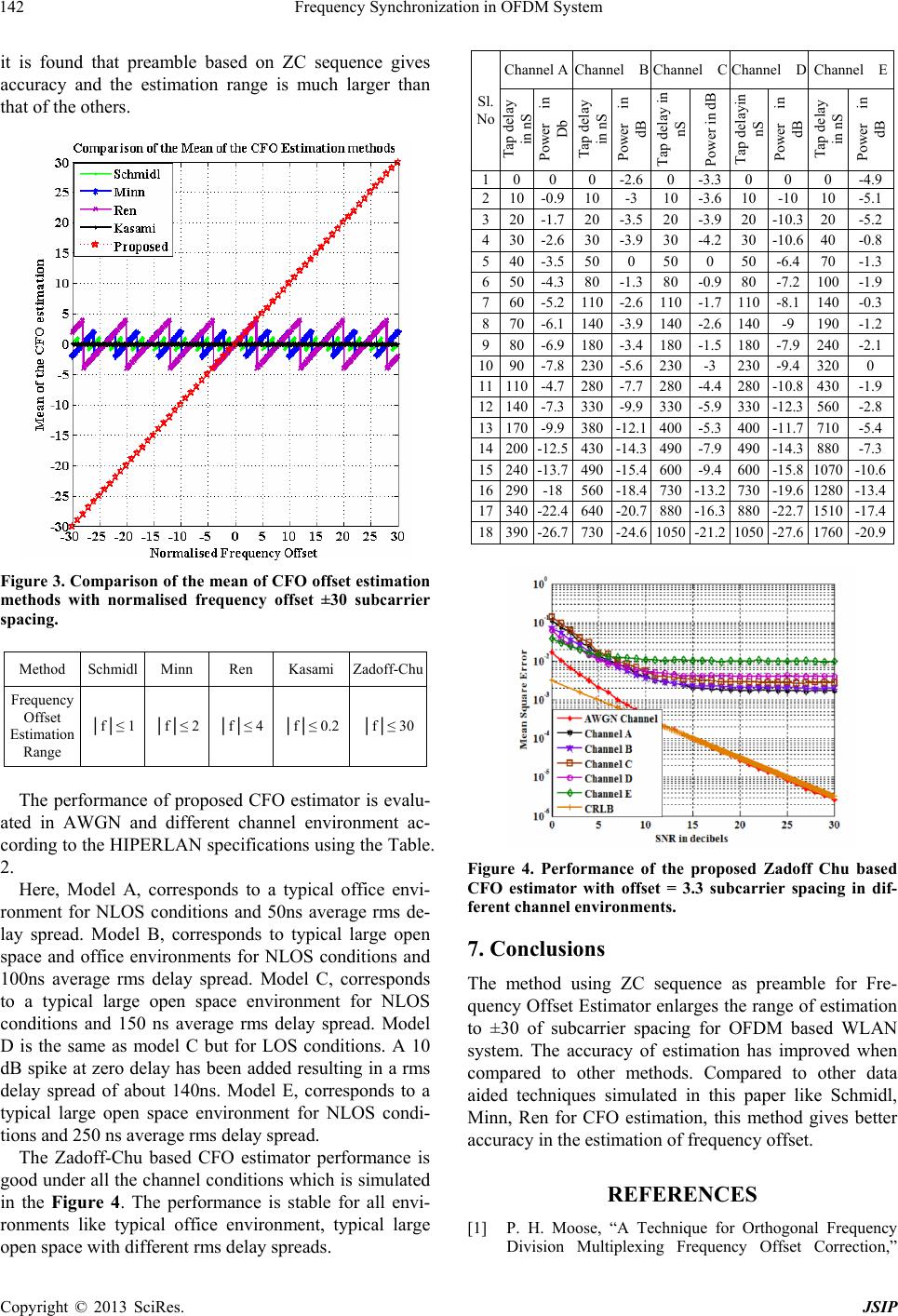 Frequency Synchronization in OFDM System 142 it is found that preamble based on ZC sequence gives accuracy and the estimation range is much larger than that of the others. Figure 3. Comparison of the mean of CFO offset estimation methods with normalised frequency offset ±30 subcarrier spacing. Method Schmidl Minn Ren Kasami Zadoff-Chu Frequency Offset Estimation Range │f│≤ 1 │f│≤ 2 │f│≤ 4 │f│≤ 0.2 │f│≤ 30 The performance of proposed CFO estimator is evalu- ated in AWGN and different channel environment ac- cording to the HIPERLAN specifications using the Table. 2. Here, Model A, corresponds to a typical office envi- ronment for NLOS conditions and 50ns average rms de- lay spread. Model B, corresponds to typical large open space and office environments for NLOS conditions and 100ns average rms delay spread. Model C, corresponds to a typical large open space environment for NLOS conditions and 150 ns average rms delay spread. Model D is the same as model C but for LOS conditions. A 10 dB spike at zero delay has been added resulting in a rms delay spread of about 140ns. Model E, corresponds to a typical large open space environment for NLOS condi- tions and 250 ns average rms delay spread. The Zadoff-Chu based CFO estimator performance is good under all the channel conditions which is simulated in the Figure 4. The performance is stable for all envi- ronments like typical office environment, typical large open space with different rms delay spreads. Channel AChannel BChannel C Channel D Channel E Sl. No Tap delay in nS Power in Db Tap delay in nS Power in dB Tap delay in nS Power in dB Tap delayin nS Power in dB Tap delay in nS Power in dB 1 00 0 -2.6 0 -3.3 0 0 0 -4.9 2 10-0.9 10-310 -3.6 10 -10 10-5.1 3 20-1.7 20 -3.5 20 -3.9 20 -10.3 20-5.2 4 30-2.6 30 -3.9 30 -4.2 30 -10.6 40-0.8 540-3.5500 50 0 50 -6.4 70-1.3 6 50-4.3 80 -1.3 80 -0.9 80 -7.2 100-1.9 760 -5.2 110 -2.6 110 -1.7 110 -8.1 140-0.3 870 -6.1 140 -3.9 140 -2.6 140 -9 190-1.2 980 -6.9 180 -3.4 180 -1.5 180 -7.9 240-2.1 1090-7.8230-5.6230 -3 230 -9.4 3200 11110-4.7 280 -7.7 280 -4.4 280 -10.8 430-1.9 12140-7.3 330 -9.9 330 -5.9 330 -12.3 560-2.8 13170-9.9 380-12.1400 -5.3 400 -11.7 710-5.4 14200-12.5430-14.3490 -7.9 490 -14.3 880-7.3 15240-13.7490-15.4600 -9.4 600 -15.8 1070-10.6 16290-18560 -18.4730 -13.2 730 -19.6 1280-13.4 17340-22.4 640-20.7880 -16.3 880 -22.7 1510-17.4 18390 -26.7730-24.6 1050 -21.2 1050 -27.6 1760-20.9 Figure 4. Performance of the proposed Zadoff Chu based CFO estimator with offset = 3.3 subcarrier spacing in dif- ferent channel environments. 7. Conclusions The method using ZC sequence as preamble for Fre- quency Offset Estimator enlarges the range of estimation to ±30 of subcarrier spacing for OFDM based WLAN system. The accuracy of estimation has improved when compared to other methods. Compared to other data aided techniques simulated in this paper like Schmidl, Minn, Ren for CFO estimation, this method gives better accuracy in the estimation of frequency offset. REFERENCES [1] P. H. Moose, “A Technique for Orthogonal Frequency Division Multiplexing Frequency Offset Correction,” Copyright © 2013 SciRes. JSIP 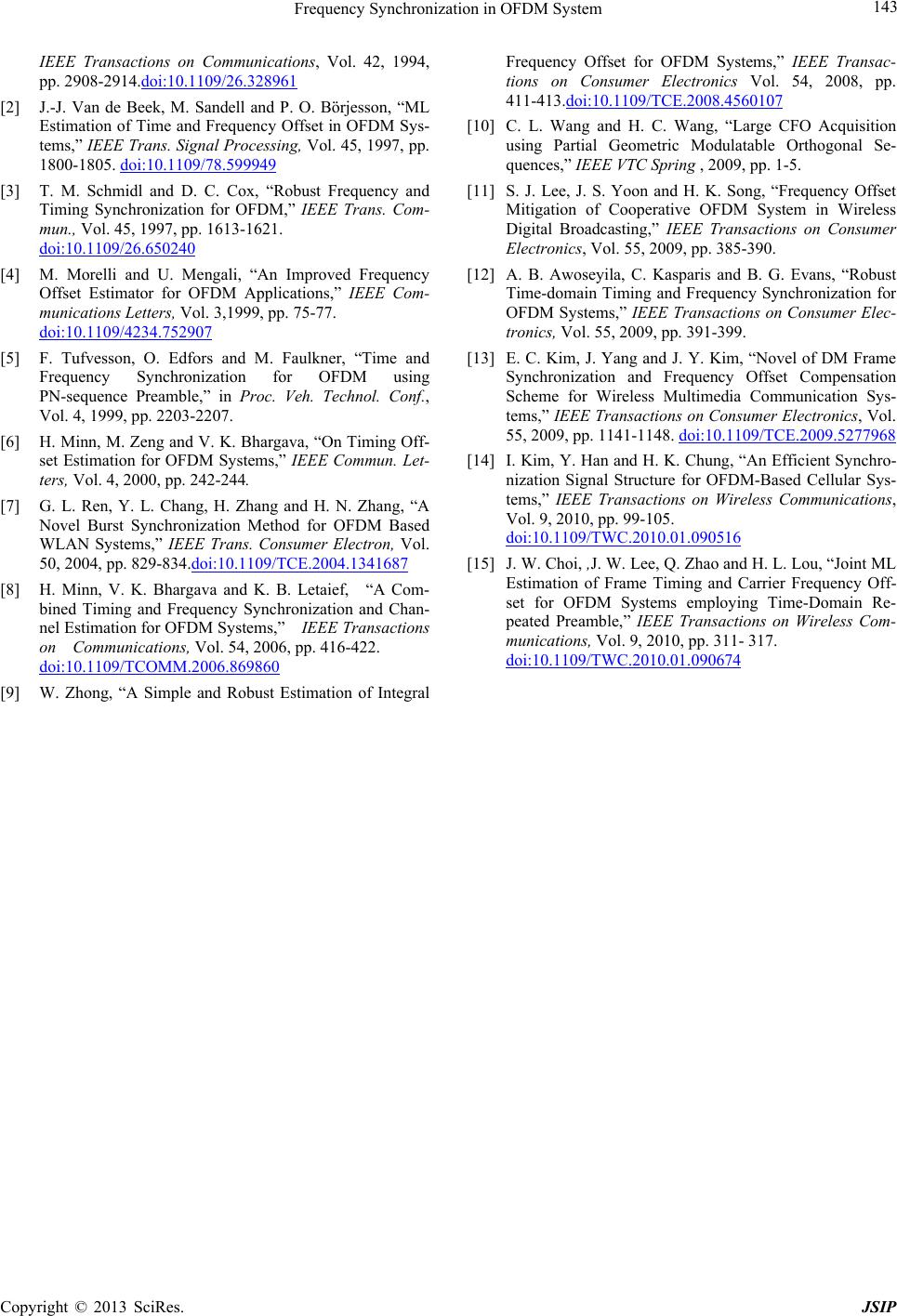 Frequency Synchronization in OFDM System Copyright © 2013 SciRes. JSIP 143 IEEE Transactions on Communications, Vol. 42, 1994, pp. 2908-2914.doi:10.1109/26.328961 [2] J.-J. Van de Beek, M. Sandell and P. O. Börjesson, “ML Estimation of Time and Frequency Offset in OFDM Sys- tems,” IEEE Trans. Signal Processing, Vol. 45, 1997, pp. 1800-1805. doi:10.1109/78.599949 [3] T. M. Schmidl and D. C. Cox, “Robust Frequency and Timing Synchronization for OFDM,” IEEE Trans. Com- mun., Vol. 45, 1997, pp. 1613-1621. doi:10.1109/26.650240 [4] M. Morelli and U. Mengali, “An Improved Frequency Offset Estimator for OFDM Applications,” IEEE Com- munications Letters, Vol. 3,1999, pp. 75-77. doi:10.1109/4234.752907 [5] F. Tufvesson, O. Edfors and M. Faulkner, “Time and Frequency Synchronization for OFDM using PN-sequence Preamble,” in Proc. Veh. Technol. Conf., Vol. 4, 1999, pp. 2203-2207. [6] H. Minn, M. Zeng and V. K. Bhargava, “On Timing Off- set Estimation for OFDM Systems,” IEEE Commun. Let- ters, Vol. 4, 2000, pp. 242-244. [7] G. L. Ren, Y. L. Chang, H. Zhang and H. N. Zhang, “A Novel Burst Synchronization Method for OFDM Based WLAN Systems,” IEEE Trans. Consumer Electron, Vol. 50, 2004, pp. 829-834.doi:10.1109/TCE.2004.1341687 [8] H. Minn, V. K. Bhargava and K. B. Letaief, “A Com- bined Timing and Frequency Synchronization and Chan- nel Estimation for OFDM Systems,” IEEE Transactions on Communications, Vol. 54, 2006, pp. 416-422. doi:10.1109/TCOMM.2006.869860 [9] W. Zhong, “A Simple and Robust Estimation of Integral Frequency Offset for OFDM Systems,” IEEE Transac- tions on Consumer Electronics Vol. 54, 2008, pp. 411-413.doi:10.1109/TCE.2008.4560107 [10] C. L. Wang and H. C. Wang, “Large CFO Acquisition using Partial Geometric Modulatable Orthogonal Se- quences,” IEEE VTC Spring , 2009, pp. 1-5. [11] S. J. Lee, J. S. Yoon and H. K. Song, “Frequency Offset Mitigation of Cooperative OFDM System in Wireless Digital Broadcasting,” IEEE Transactions on Consumer Electronics, Vol. 55, 2009, pp. 385-390. [12] A. B. Awoseyila, C. Kasparis and B. G. Evans, “Robust Time-domain Timing and Frequency Synchronization for OFDM Systems,” IEEE Transactions on Consumer Elec- tronics, Vol. 55, 2009, pp. 391-399. [13] E. C. Kim, J. Yang and J. Y. Kim, “Novel of DM Frame Synchronization and Frequency Offset Compensation Scheme for Wireless Multimedia Communication Sys- tems,” IEEE Transactions on Consumer Electronics, Vol. 55, 2009, pp. 1141-1148. doi:10.1109/TCE.2009.5277968 [14] I. Kim, Y. Han and H. K. Chung, “An Efficient Synchro- nization Signal Structure for OFDM-Based Cellular Sys- tems,” IEEE Transactions on Wireless Communications, Vol. 9, 2010, pp. 99-105. doi:10.1109/TWC.2010.01.090516 [15] J. W. Choi, ,J. W. Lee, Q. Zhao and H. L. Lou, “Joint ML Estimation of Frame Timing and Carrier Frequency Off- set for OFDM Systems employing Time-Domain Re- peated Preamble,” IEEE Transactions on Wireless Com- munications, Vol. 9, 2010, pp. 311- 317. doi:10.1109/TWC.2010.01.090674 |