

Paper Menu >>
Journal Menu >>
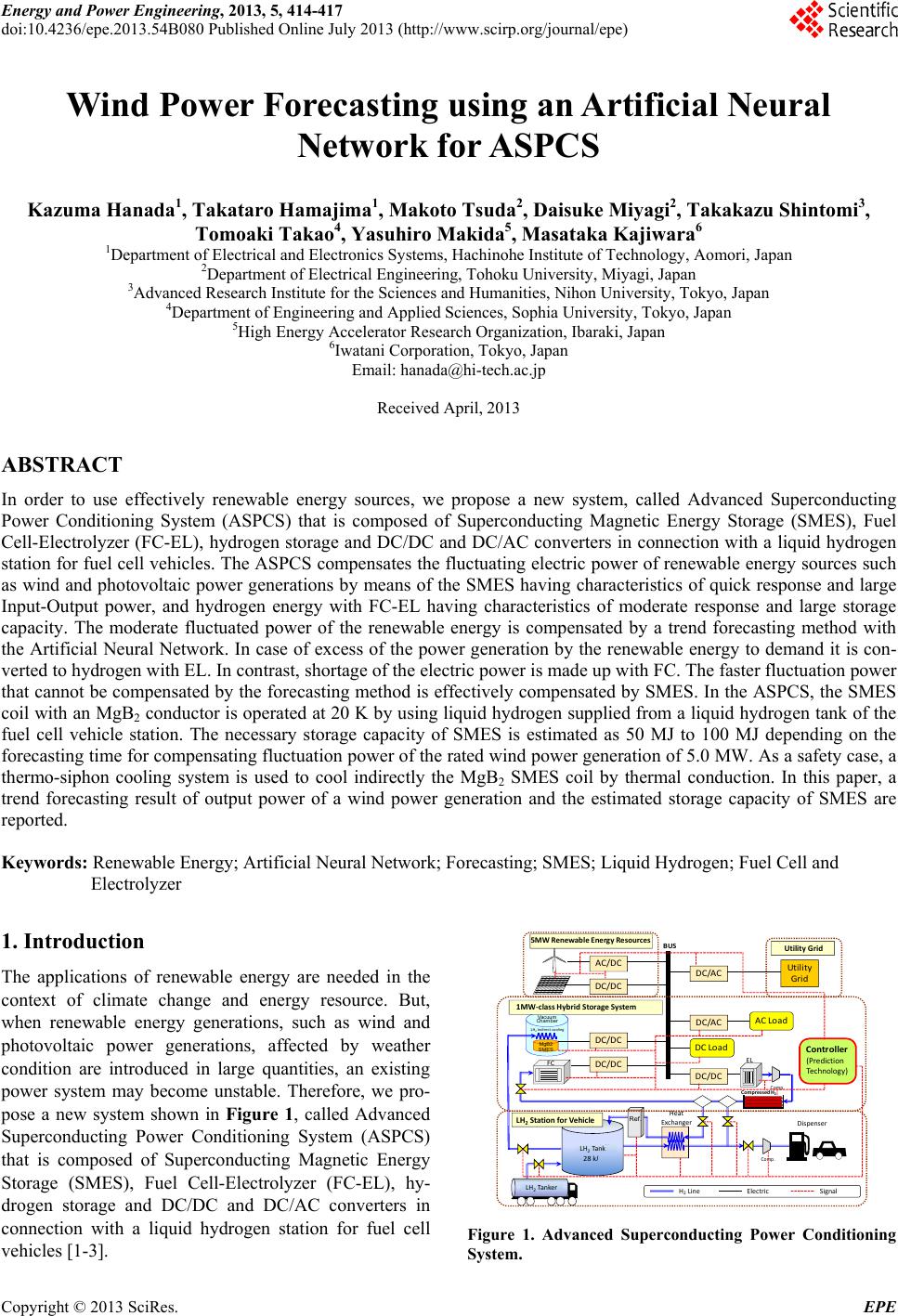 Energy and Power Engineering, 2013, 5, 414-417 doi:10.4236/epe.2013.54B080 Published Online July 2013 (http://www.scirp.org/journal/epe) Wind Power Forecasting using an Artificial Neural Network for ASPCS Kazuma Hanada1, Takataro Hamajima1, Makoto Tsuda2, Daisuke Miyagi2, Takakazu Shintomi3, Tomoaki Takao4, Yasuhiro Makida5, M as at ak a Kajiwara6 1Department of Electrical and Electronics Systems, Hachinohe Institute of Technology, Aomori, Japan 2Department of Electrical Engineer ing, Tohoku University, Miyagi, Japan 3Advanced Research Institute for the Sciences and Humanities, Nihon University, Tokyo, Japan 4Department of Engineering and Applied Sciences, Sophia University, Tokyo, Japan 5High Energy Accelerator Research Organization, Ibaraki, Japan 6Iwatani Corporation, Tokyo, Japan Email: [email protected] Received April, 2013 ABSTRACT In order to use effectively renewable energy sources, we propose a new system, called Advanced Superconducting Power Conditioning System (ASPCS) that is composed of Superconducting Magnetic Energy Storage (SMES), Fuel Cell-Electrolyzer (FC-EL), hydrogen storage and DC/DC and DC/AC converters in connection with a liquid hydrogen station for fuel cell vehicles. The ASPCS compensates the fluctuating electric power of renewable energy sources such as wind and photovoltaic power generations by means of the SMES having characteristics of quick response and large Input-Output power, and hydrogen energy with FC-EL having characteristics of moderate response and large storage capacity. The moderate fluctuated power of the renewable energy is compensated by a trend forecasting method with the Artificial Neural Network. In case of excess of the power generation by the renewable energy to demand it is con- verted to hydrogen with EL. In contr ast, sh or tage of the electr ic pow er is made up with FC. The f aster fluctu ation power that cannot be compensated by the forecasting method is effectively compensated by SMES. In the ASPCS, the SMES coil with an MgB2 conductor is operated at 20 K by using liquid hydrogen supp lied from a liquid hydrogen tank of the fuel cell vehicle station. The necessary storage capacity of SMES is estimated as 50 MJ to 100 MJ depending on the forecasting time for compensating fluctuation power of the rated wind power generation of 5.0 MW. As a safety case, a thermo-siphon cooling system is used to cool indirectly the MgB2 SMES coil by thermal conduction. In this paper, a trend forecasting result of output power of a wind power generation and the estimated storage capacity of SMES are reported. Keywords: Renewable Energy; Artificial Neural Network; Forecasting; SMES; Liquid Hydrogen; Fuel Cell and Electrolyzer 1. Introduction The applications of renewable energy are needed in the context of climate change and energy resource. But, when renewable energy generations, such as wind and photovoltaic power generations, affected by weather condition are introduced in large quantities, an existing power system may become unstable. Therefore, we pro- pose a new system shown in Figure 1, called Advanced Superconducting Power Conditioning System (ASPCS) that is composed of Superconducting Magnetic Energy Storage (SMES), Fuel Cell-Electrolyzer (FC-EL), hy- drogen storage and DC/DC and DC/AC converters in connection with a liquid hydrogen station for fuel cell vehicles [1-3]. AC/DC DC/DC DC/DC FC DC/DC DC/AC Utility Grid DC/AC ACLoad DCLoad DC/DC カードル EL Comp. LH 2 貯蔵 ディスペンサ 熱交換器 Comp. Ref. MgB2 SMES Vacuum Chamber LH2間接冷却 LH2 ローリー Controller (含未来予 測技術) 5MWクラス自然エネルギー源 1MWクラスハイブリッド貯蔵システム 商用電力系統 液体水素ステーション BUS 28 kl 水素系 信号系電気系 CompressedH 2 Dispenser (Prediction Technology) Heat Exchanger H 2 Line ElectricSignal LH 2 Ta nk LH 2 Ta nk er LH 2 StationforVehicl e 1MW‐classHybridStorageSystem 5MWRenewableEnergyResou rces UtilityGrid LH 2 Indirectcooling Figure 1. Advanced Superconducting Power Conditioning System. Copyright © 2013 SciRes. EPE 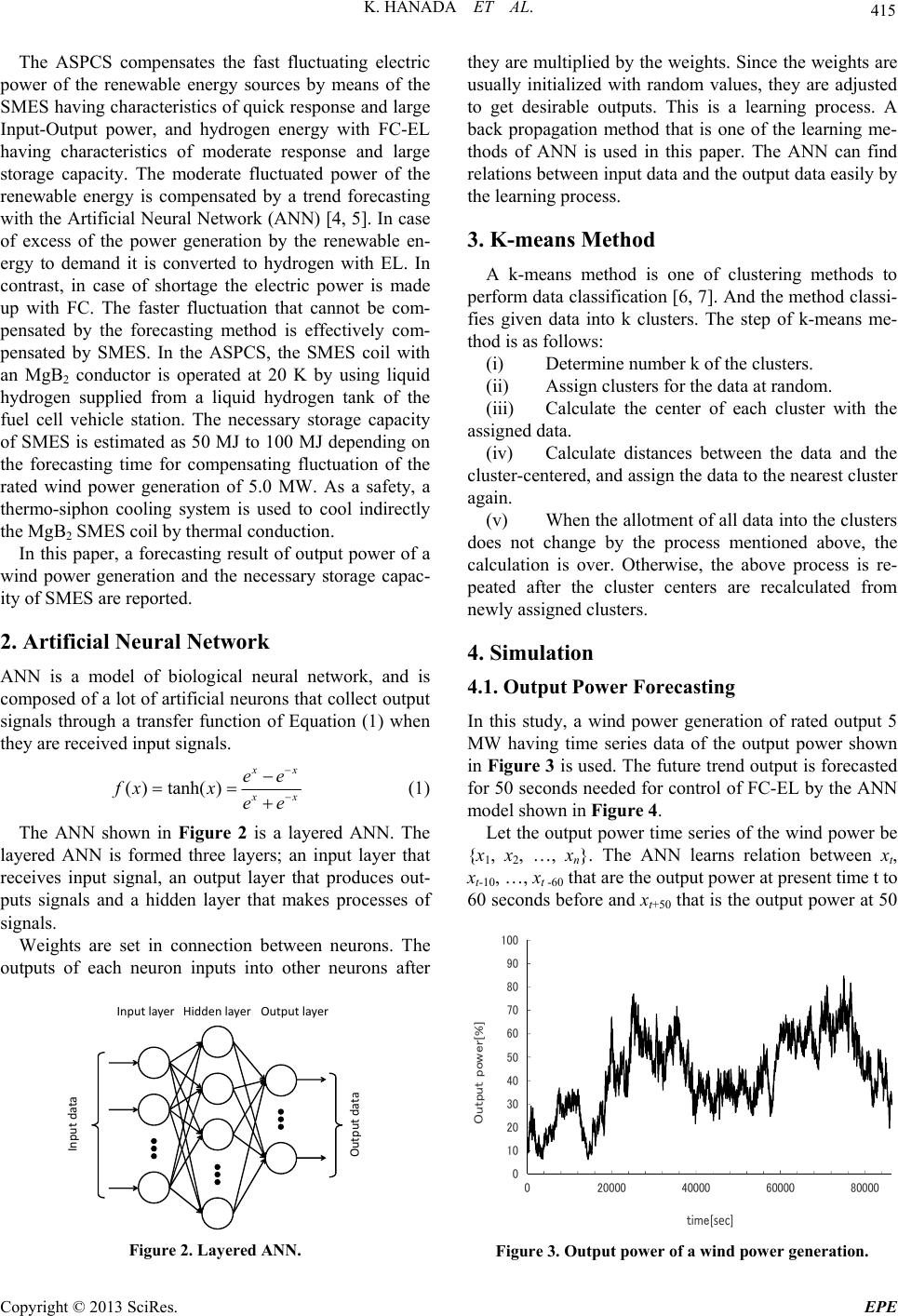 K. HANADA ET AL. 415 The ASPCS compensates the fast fluctuating electric power of the renewable energy sources by means of the SMES having characteristics of quick response and large Input-Output power, and hydrogen energy with FC-EL having characteristics of moderate response and large storage capacity. The moderate fluctuated power of the renewable energy is compensated by a trend forecasting with the Artificial Neural Network (ANN) [4, 5 ]. In case of excess of the power generation by the renewable en- ergy to demand it is converted to hydrogen with EL. In contrast, in case of shortage the electric power is made up with FC. The faster fluctuation that cannot be com- pensated by the forecasting method is effectively com- pensated by SMES. In the ASPCS, the SMES coil with an MgB2 conductor is operated at 20 K by using liquid hydrogen supplied from a liquid hydrogen tank of the fuel cell vehicle station. The necessary storage capacity of SMES is estimated as 50 MJ to 100 MJ depending on the forecasting time for compensating fluctuation of the rated wind power generation of 5.0 MW. As a safety, a thermo-siphon cooling system is used to cool indirectly the MgB2 SMES coil by thermal conduction. In this paper, a forecasting result of output power of a wind power generation and the necessary storage capac- ity of SMES are reported. 2. Artificial Neural Network ANN is a model of biological neural network, and is composed of a lot of artificial neurons that collect output signals through a transfer function of Equation (1) when they are received input signals. ( )tanh( ) x x x x ee fxx ee (1) The ANN shown in Figure 2 is a layered ANN. The layered ANN is formed three layers; an input layer that receives input signal, an output layer that produces out- puts signals and a hidden layer that makes processes of signals. Weights are set in connection between neurons. The outputs of each neuron inputs into other neurons after Inputlayer HiddenlayerOutputlayer Inputdata Outputdata Figure 2. Layered ANN. they are multiplied by the weights. Sin ce the weights are usually initialized with random values, they are adjusted to get desirable outputs. This is a learning process. A back propagation method that is one of the learning me- thods of ANN is used in this paper. The ANN can find relations between input data and the output data easily by the learning process. 3. K-means Method A k-means method is one of clustering methods to perform data classification [6, 7]. And the method classi- fies given data into k clusters. The step of k-means me- thod is as follows: (i) Determine number k of the clusters. (ii) Assign clusters for the data at random. (iii) Calculate the center of each cluster with the assigned da t a . (iv) Calculate distances between the data and the cluster-centered, and assign the data to the nearest cluster again. (v) When the allotment of all data into th e clusters does not change by the process mentioned above, the calculation is over. Otherwise, the above process is re- peated after the cluster centers are recalculated from newly assigned clusters. 4. Simulation 4.1. Output Power Forecasting In this study, a wind power generation of rated output 5 MW having time series data of the output power shown in Figure 3 is used. The future trend output is forecasted for 50 seconds needed for control of FC-EL by the ANN model shown in F igure 4. Let the output power time series of the wind power be {x1, x2, …, xn}. The ANN learns relation between xt, xt-10, …, xt -60 that are the output power at present time t to 60 seconds before and xt+50 that is the output power at 50 0 10 20 30 40 50 60 70 80 90 100 020000 40000 60000 80000 Output power[%] time[sec] Figure 3. Output power of a wind pow er generation. Copyright © 2013 SciRes. EPE 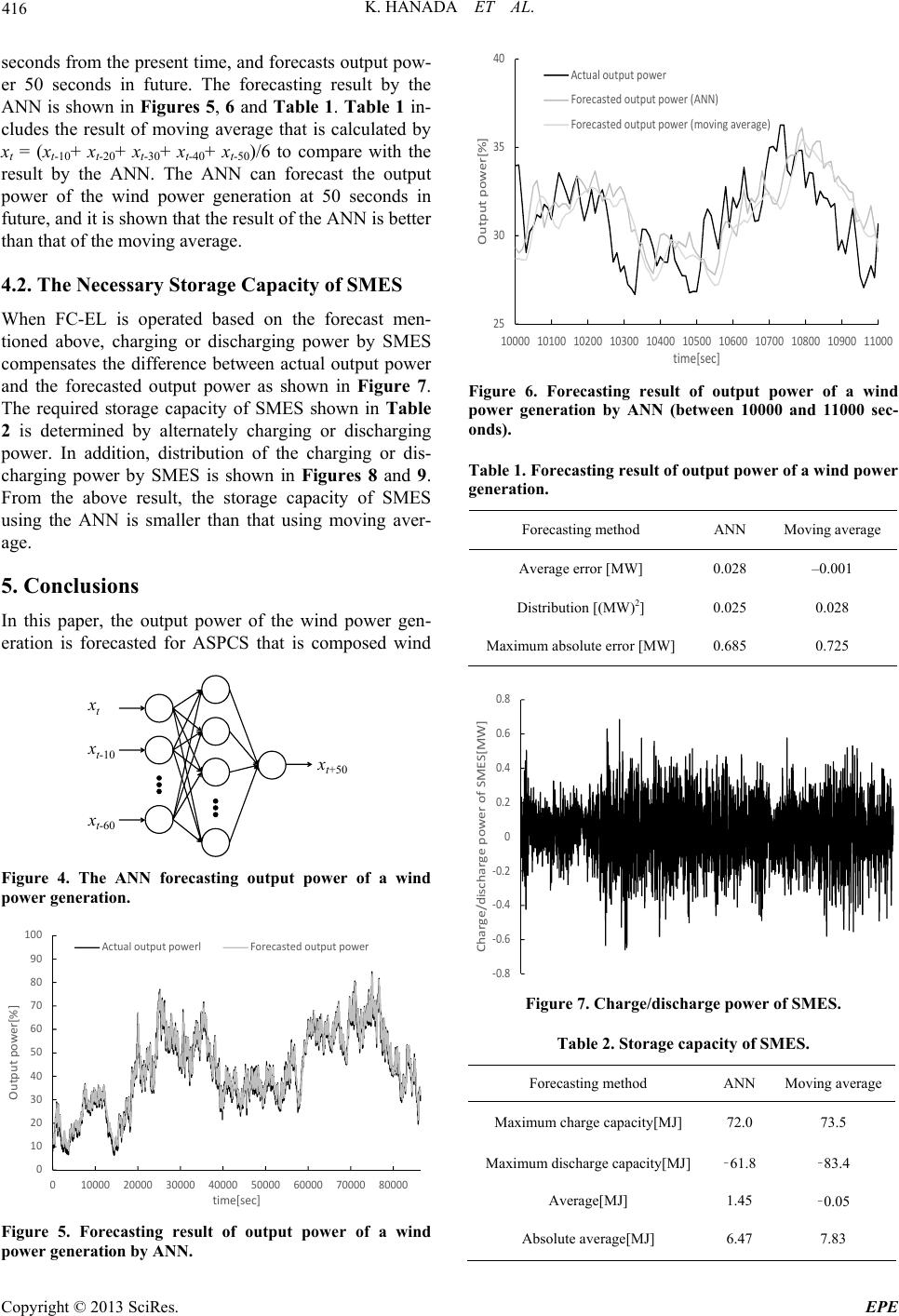 K. HANADA ET AL. 416 seconds from the present time, and forecasts output pow- er 50 seconds in future. The forecasting result by the ANN is shown in Figures 5, 6 and Ta ble 1. Table 1 in- cludes the result of moving average that is calculated by xt = (xt-10+ xt-20+ xt-30+ xt-40+ xt-50)/6 to compare with the result by the ANN. The ANN can forecast the output power of the wind power generation at 50 seconds in future, and it is shown that the resu lt of the ANN is b etter than that of the moving av erage. 4.2. The Necessary Storage Capacity of SMES When FC-EL is operated based on the forecast men- tioned above, charging or discharging power by SMES compensates the difference between actual output power and the forecasted output power as shown in Figure 7. The required storage capacity of SMES shown in Table 2 is determined by alternately charging or discharging power. In addition, distribution of the charging or dis- charging power by SMES is shown in Figures 8 and 9. From the above result, the storage capacity of SMES using the ANN is smaller than that using moving aver- age. 5. Conclusions In this paper, the output power of the wind power gen- eration is forecasted for ASPCS that is composed wind x t x t-10 x t-60 x t+50 Figure 4. The ANN forecasting output power of a wind power generation. 0 10 20 30 40 50 60 70 80 90 100 010000 20000 30000 40000 50000 60000 70000 80000 Outputpower[%] time[sec] Actualou tput powerl Forecastedoutputpower Figure 5. Forecasting result of output power of a wind power generation by ANN. 25 30 35 40 10000 10100 10200 10300 10400 10500 10600 10700 10800 10900 11000 Outputpower[%] time[sec] Actualoutputpower Forecastedoutputpower(ANN) Forecastedoutputpower(movingaverage) Figure 6. Forecasting result of output power of a wind power generation by ANN (between 10000 and 11000 sec- onds). Table 1. Forecasting result of output pow er of a wind power generation. Forecasting method ANN Moving average Average error [MW] 0.028 –0.001 Distribution [(MW)2] 0.025 0.028 Maximum absolute error [MW] 0.685 0.725 ‐0.8 ‐0.6 ‐0.4 ‐0.2 0 0.2 0.4 0.6 0.8 Charge/dischargepowerofSMES[MW] Figure 7. Charge/discharge power of SMES. Table 2. Storage capacity of SMES. Forecasting method ANN Moving average Maximum charge capacity[MJ] 72.0 73.5 Maximum discharge capacity[MJ] –61.8 –83.4 Average[MJ] 1.45 –0.05 Absolute average[MJ] 6.47 7.83 Copyright © 2013 SciRes. EPE 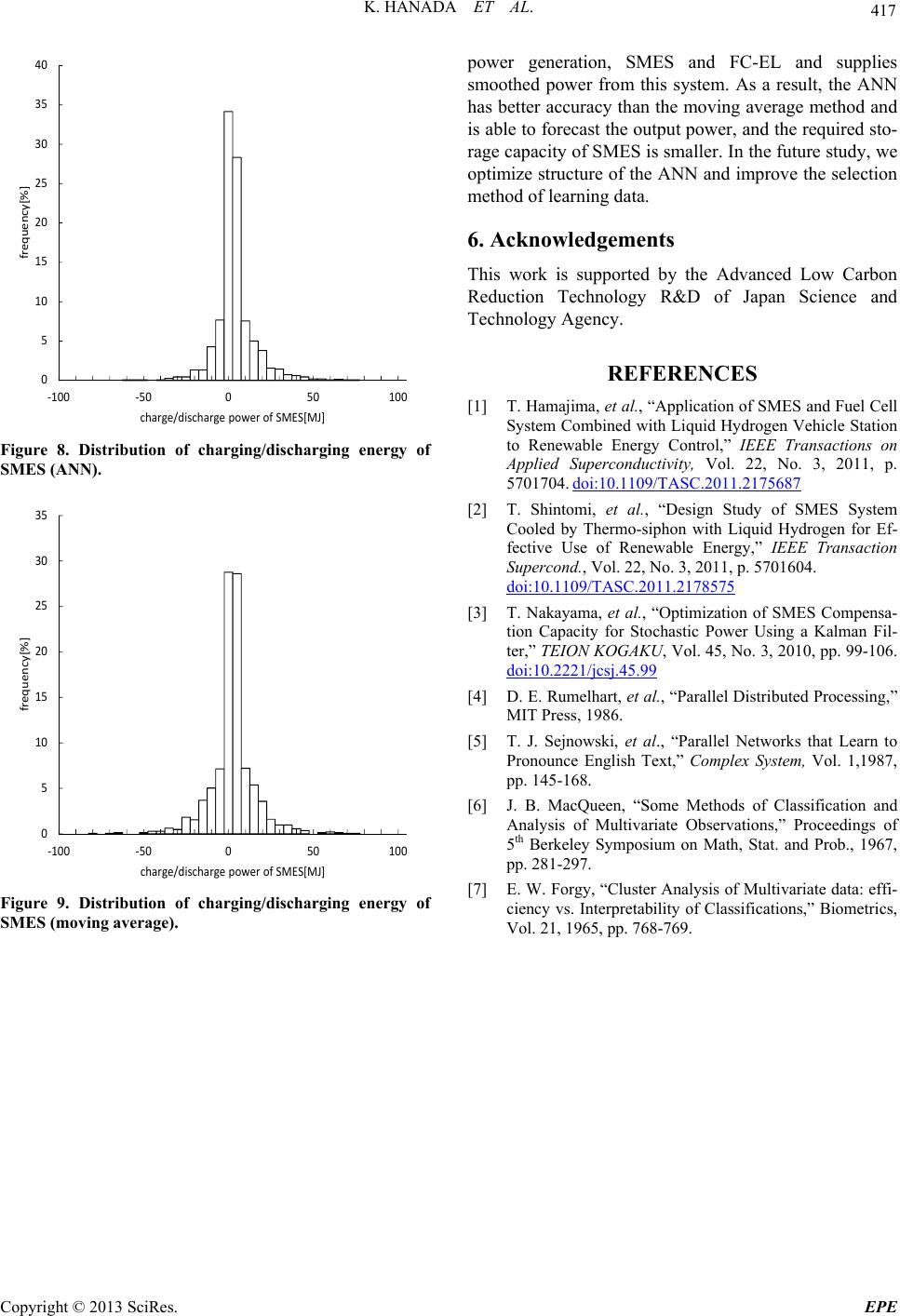 K. HANADA ET AL. Copyright © 2013 SciRes. EPE 417 power generation, SMES and FC-EL and supplies smoothed power from this system. As a result, the ANN has better accuracy than the moving average method and is able to forecast the output power, and the required sto- rage capacity of SMES is smaller. In the future study, we optimize structure of th e ANN and improve the selection method of learnin g dat a . 0 5 10 15 20 25 30 35 40 ‐100 ‐50050 100 frequency[%] charge/dischargepowerofSMES[MJ] 6. Acknowledgements This work is supported by the Advanced Low Carbon Reduction Technology R&D of Japan Science and Technol o gy Agency. REFERENCES [1] T. Hamajima, et al., “Application of SMES and Fuel Cell System Combined with Liquid Hydrogen Vehicle Station to Renewable Energy Control,” IEEE Transactions on Applied Superconductivity, Vol. 22, No. 3, 2011, p. 5701704. doi:10.1109/TASC.2011.2175687 Figure 8. Distribution of charging/discharging energy of SMES (ANN). [2] T. Shintomi, et al., “Design Study of SMES System Cooled by Thermo-siphon with Liquid Hydrogen for Ef- fective Use of Renewable Energy,” IEEE Transaction Supercond., Vol. 22, No. 3, 2011, p. 5701604. doi:10.1109/TASC.2011.2178575 0 5 10 15 20 25 30 35 ‐100 ‐50050 100 frequency[%] charge/dischargepowerofSMES[MJ] [3] T. Nakayama, et al., “Optimization of SMES Compensa- tion Capacity for Stochastic Power Using a Kalman Fil- ter,” TEION KOGAKU, Vol. 45, No. 3, 2010, pp. 99-106. doi:10.2221/jcsj.45.99 [4] D. E. Rumel hart, et al., “Parallel Distributed Processing,” MIT Press, 1986. [5] T. J. Sejnowski, et al., “Parallel Networks that Learn to Pronounce English Text,” Complex System, Vol. 1,1987, pp. 145-168. [6] J. B. MacQueen, “Some Methods of Classification and Analysis of Multivariate Observations,” Proceedings of 5th Berkeley Symposium on Math, Stat. and Prob., 1967, pp. 281-297. [7] E. W. Forgy, “Cluster Analysis of Multivariate data: effi- ciency vs. Interpretability of Classifications,” Biometrics, Vol. 21, 1965, pp. 768-769. Figure 9. Distribution of charging/discharging energy of SMES (moving average). |