

Paper Menu >>
Journal Menu >>
 Energy and Power Engineering, 2013, 5, 315-318 doi:10.4236/epe.2013.54B062 Published Online July 2013 (http://www.scirp.org/journal/epe) Experiment Research on Gasification Character of Pulverized Coal at Medium Temperature Tong Lou1, Zhon g-xiao Zhang1,2, Jun-jie Fan2, Hai-quan An2, Zhi-hao Zhou1, Pu-jie Yue1 1College of Environment and Architecture, University of Shanghai for Science and Technology, Shanghai, China 2School of Mechanical Engineering, Shanghai Jiao Tong University, Shanghai, China Email: [email protected] Received March, 2013 ABSTRACT In this paper, effect of gasification temperature and residence time on gasification characteristics of typical pulverized coals under atmosphere pressure were studied on a one-dimensional electric heating drop tube furnace system to evalu- ate gasification characteristics of pulverized coal at medium temperature. The results show that the gasification rate increases with the raising of the gasification temperature under the temperature among 1150℃ and 1450℃, and as the temperature is above 1350℃, the increasing rate become slower. Cold gas efficiency and carbon conversion meet the maximum value when the temperature approaches the ash fusion point of coal. With the further rise of the temperature, ash on the surface of the char starts to be melted, the gasification reaction rate decreases, due to the hindrance of the effective contact between coal char and gasification agent. The gasification efficiency would become steady when the residence time exceeds 8s. Keywords: Gasification Characteristic; Pulverized Coal; Carbon Conversion; Cold Gas Efficiency 1. Introduction Issues on natural resource and environment become in- creasingly severely in China, due to the long-term use of traditional coal combustion. Integrated gasification com- bined cycle (IGCC) takes advantage on high efficient and environmentally-friendly, is a new power generation technology. Gasified is one of the key devices of IGCC power generation system. Compared to the other gasifi- cation technologies, entrained flow gasification technol- ogy get rapid development for its advantages of high gasification intensity, high carbon conversion and be easily practiced on a large scale. Influencing factors on gasification efficiency of entrained flow gasified are many, effect of gasification temperature and residence time on gasification characteristics of typical pulverized coals were studied on a one-dimensional electric heating drop tube furnace system under the conditions of atmos- phere pressure and medium temperature from 1150℃ to 1450℃[1-3]. 2. Experimental System and Work Conditions 2.1. Experimental System Figure 1 is the picture of experimental system, which is consisted of high temperature tube electric heating fur- nace, ash collected system and syngas cleaned and de- tected system. The furnace is made of corundum tube(2.1 m in length, 60 mm in inner diameter), the adjust tem- perature is up to 1550℃, the gas analysis equipment is a infrared gas analyzer produced by Wuhan Cubic Opto- electronics Technology Co., Ltd., which can proceed real time measurement on CO, CO2, H2, CH4 and O2. Figure 1. The schematic picture of the experimental process. Copyright © 2013 SciRes. EPE 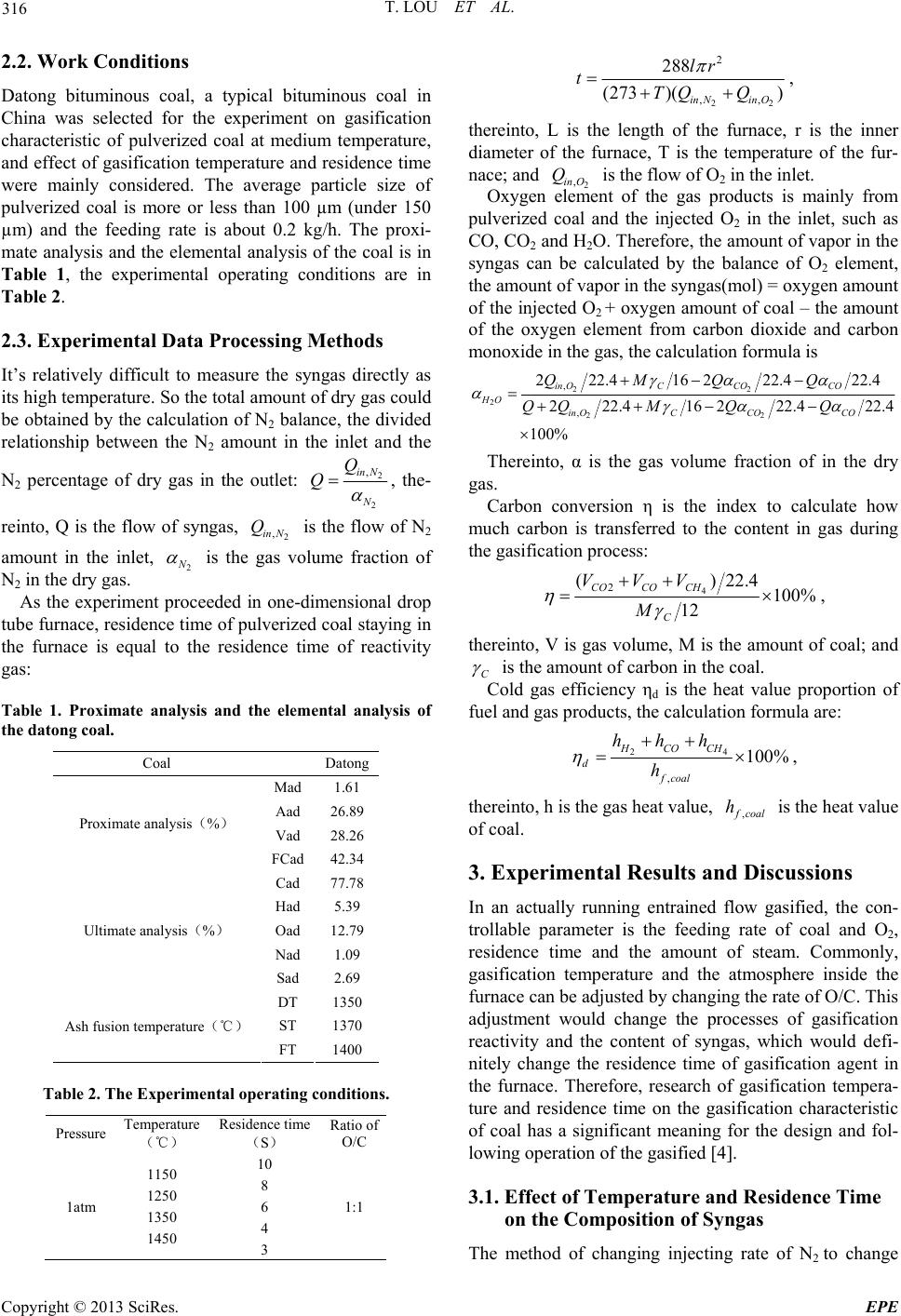 T. LOU ET AL. 316 2.2. Work Conditions Datong bituminous coal, a typical bituminous coal in China was selected for the experiment on gasification characteristic of pulverized coal at medium temperature, and effect of gasification temperature and residence time were mainly considered. The average particle size of pulverized coal is more or less than 100 µm (under 150 µm) and the feeding rate is about 0.2 kg/h. The proxi- mate analysis and the elemental analysis of the coal is in Table 1, the experimental operating conditions are in Table 2. 2.3. Experimental Data Processing Methods It’s relatively difficult to measure the syngas directly as its high temperature. So the total amount of dry gas could be obtained by the calculation of N2 balance, the divided relationship between the N2 amount in the inlet and the N2 percentage of dry gas in the outlet: 2 2 ,in N N Q Q , the- reinto, Q is the flow of syngas, is the flow of N2 2 ,in N Q amount in the inlet, 2 N is the gas volume fraction of N2 in the dry gas. As the experiment proceeded in one-dimensional drop tube furnace, residence time of pulverized coal staying in the furnace is equal to the residence time of reactivity gas: Table 1. Proximate analysis and the elemental analysis of the datong coal. Coal Datong Mad 1.61 Aad 26.89 Vad 28.26 Proximate analysis(%) FCad 42.34 Cad 77.78 Had 5.39 Oad 12.79 Nad 1.09 Ultimate analysis(%) Sad 2.69 DT 1350 ST 1370 Ash fusion temperature(℃) FT 1400 Table 2. The Experimental operating conditions. Pressure Temperature (℃) Residence time (S) Ratio of O/C 1atm 1150 1250 1350 1450 10 8 6 4 3 1:1 22 2 ,, 288 (273 )() inNin O lr tTQ Q , thereinto, L is the length of the furnace, r is the inner diameter of the furnace, T is the temperature of the fur- nace; and is the flow of O2 in the inlet. 2 ,inO Oxygen element of the gas products is mainly from pulverized coal and the injected O2 in the inlet, such as CO, CO2 and H2O. Therefore, the amount of vapor in the syngas can be calculated by the balance of O2 element, the amount of vapor in the syngas(mol) = oxygen amount of the injected O2 + oxygen amount of coal – the amount of the oxygen element from carbon dioxide and carbon monoxide in the gas, the calculation formula is Q 22 2 22 , , 222.416 222.422.4 222.416 222.422.4 100% in OCCOCO HO in OCCOCO QMQ Q QQM QQ Thereinto, α is the gas volume fraction of in the dry gas. Carbon conversion η is the index to calculate how much carbon is transferred to the content in gas during the gasification process: 4 2 ()22.4 100% 12 COCO CH C VVV M , thereinto, V is gas volume, M is the amount of coal; and C is the amount of carbon in the coal. Cold gas efficiency ηd is the heat value proportion of fuel and gas products, the calculation formula are: 24 , 100% HCOCH df coal hhh h , thereinto, h is the gas heat value, , f coal h is the heat value of coal. 3. Experimental Results and Discussions In an actually running entrained flow gasified, the con- trollable parameter is the feeding rate of coal and O2, residence time and the amount of steam. Commonly, gasification temperature and the atmosphere inside the furnace can be adjusted by changing the rate of O/C. This adjustment would change the processes of gasification reactivity and the content of syngas, which would defi- nitely change the residence time of gasification agent in the furnace. Therefore, research of gasification tempera- ture and residence time on the gasification characteristic of coal has a significant meaning for the design and fol- lowing operation of the gasified [4]. 3.1. Effect of Temperature and Residence Time on the Composition of Syngas The method of changing injecting rate of N2 to change Copyright © 2013 SciRes. EPE 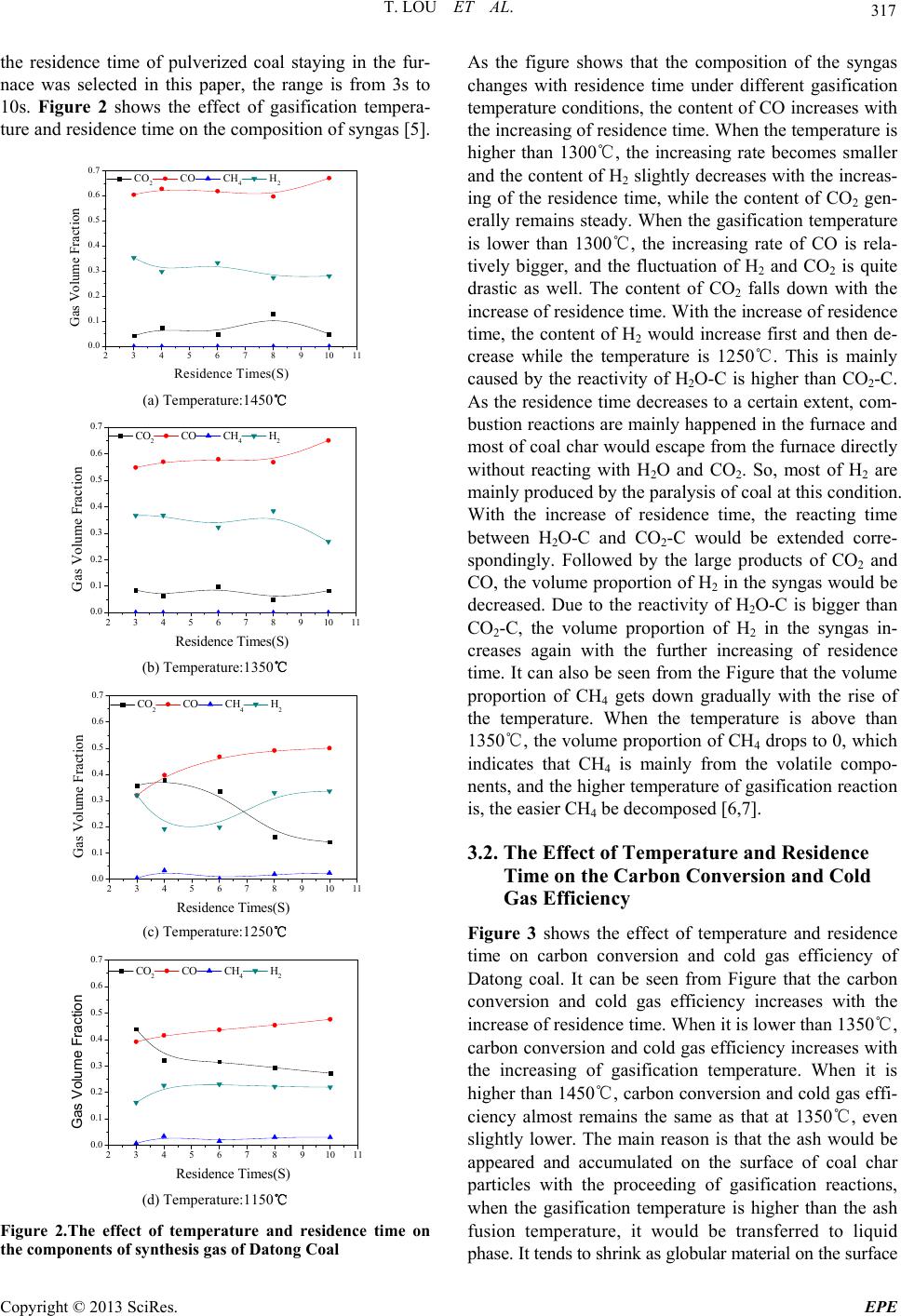 T. LOU ET AL. 317 the residence time of pulverized coal staying in the fur- nace was selected in this paper, the range is from 3s to 10s. Figure 2 shows the effect of gasification tempera- ture and residence time on the composition of syngas [5]. 123456789101 0.0 0.1 0.2 0.3 0.4 0.5 0.6 0.7 CO2 CO CH4 H2 Gas Volume Fraction Residence Times(S) (a) Temperature:1450℃ 123456789101 0.0 0.1 0.2 0.3 0.4 0.5 0.6 0.7 CO2 CO CH4 H2 Gas Volume Fraction Residence Times(S) (b) Temperature:1350℃ 123456789101 0.0 0.1 0.2 0.3 0.4 0.5 0.6 0.7 CO2 CO CH4 H2 Gas Volume Fraction Residence Times(S) (c) Temperature:1250℃ 112345678910 0.0 0.1 0.2 0.3 0.4 0.5 0.6 0.7 CO2 CO CH4 H2 Gas Volume Fracti on Residence Times(S) (d) Temperature:1150℃ Figure 2.The effectidence time on e syngas 3.2. The Effect of Temperature and Residence Figu of temperature and residence of temperature and res the components of synthesis gas of Datong Coal As the figure shows that the composition of th changes with residence time under different gasification temperature conditions, the content of CO increases with the increasing of residence time. When the temperature is higher than 1300℃, the increasing rate becomes smaller and the content of H2 slightly decreases with the increas- ing of the residence time, while the content of CO2 gen- erally remains steady. When the gasification temperature is lower than 1300℃, the increasing rate of CO is rela- tively bigger, and the fluctuation of H2 and CO2 is quite drastic as well. The content of CO2 falls down with the increase of residence time. With the increase of residence time, the content of H2 would increase first and then de- crease while the temperature is 1250℃. This is mainly caused by the reactivity of H2O-C is higher than CO2-C. As the residence time decreases to a certain extent, com- bustion reactions are mainly happened in the furnace and most of coal char would escape from the furnace directly without reacting with H2O and CO2. So, most of H2 are mainly produced by the paralysis of coal at this condition. With the increase of residence time, the reacting time between H2O-C and CO2-C would be extended corre- spondingly. Followed by the large products of CO2 and CO, the volume proportion of H2 in the syngas would be decreased. Due to the reactivity of H2O-C is bigger than CO2-C, the volume proportion of H2 in the syngas in- creases again with the further increasing of residence time. It can also be seen from the Figure that the volume proportion of CH4 gets down gradually with the rise of the temperature. When the temperature is above than 1350℃, the volume proportion of CH4 drops to 0, which indicates that CH4 is mainly from the volatile compo- nents, and the higher temperature of gasification reaction is, the easier CH4 be decomposed [6,7]. Time on the Carbon Conversion and Cold Gas Efficiency re 3 shows the effect time on carbon conversion and cold gas efficiency of Datong coal. It can be seen from Figure that the carbon conversion and cold gas efficiency increases with the increase of residence time. When it is lower than 1350℃, carbon conversion and cold gas efficiency increases with the increasing of gasification temperature. When it is higher than 1450℃, carbon conversion and cold gas effi- ciency almost remains the same as that at 1350℃, even slightly lower. The main reason is that the ash would be appeared and accumulated on the surface of coal char particles with the proceeding of gasification reactions, when the gasification temperature is higher than the ash fusion temperature, it would be transferred to liquid phase. It tends to shrink as globular material on the surface Copyright © 2013 SciRes. EPE 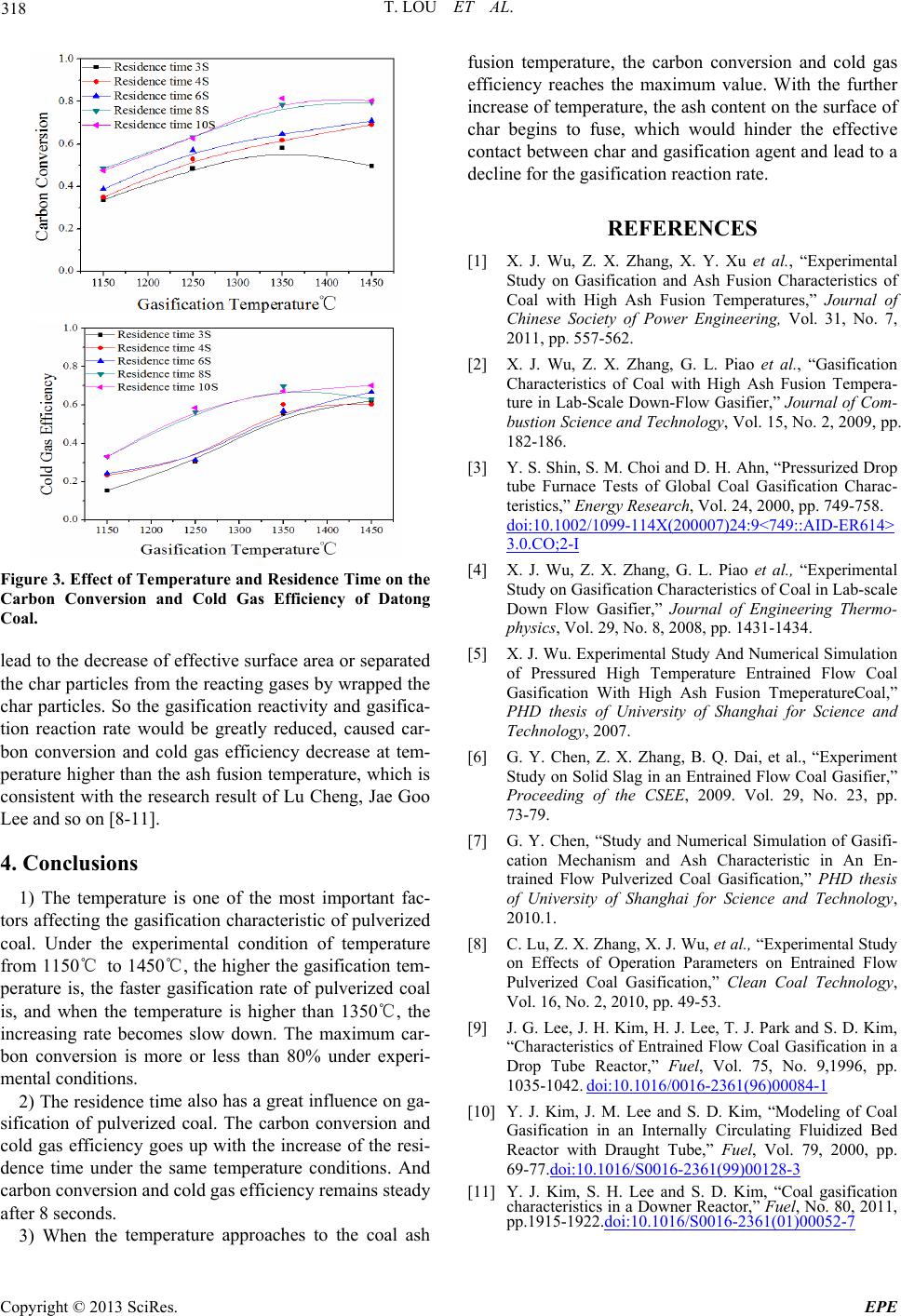 T. LOU ET AL. Copyright © 2013 SciRes. EPE 318 Figure 3. Effect of Te mperature and Residence Time on the ad to the decrease of effective surface area or separated 4. Conclusions re is one of the most important fac- to me also has a great influence on ga- si temperature approaches to the coal ash fu REFERENCES [1] X. J. Wu, Z. al., “Experimental ng, G. L. Piao et al., “Gasification , S. M. Choi and D. H. Ahn, “Pressurized Drop sion temperature, the carbon conversion and cold gas efficiency reaches the maximum value. With the further increase of temperature, the ash content on the surface of char begins to fuse, which would hinder the effective contact between char and gasification agent and lead to a decline for the gasification reaction rate. X. Zhang, X. Y. Xu et Study on Gasification and Ash Fusion Characteristics of Coal with High Ash Fusion Temperatures,” Journal of Chinese Society of Power Engineering, Vol. 31, No. 7, 2011, pp. 557-562. [2] X. J. Wu, Z. X. Zha Characteristics of Coal with High Ash Fusion Tempera- ture in Lab-Scale Down-Flow Gasifier,” Journal of Com- bustion Science and Technology, Vol. 15, No. 2, 2009, pp. 182-186. [3] Y. S. Shin tube Furnace Tests of Global Coal Gasification Charac- teristics,” Energy Research, Vol. 24, 2000, pp. 749-758. doi:10.1002/1099-114X(200007)24:9<749::AID-ER614> 3.0.CO;2-I [4] X. J. Wu, Z. X. Zhang, G. L. Piao et al., “Experimental mulation Zhang, B. Q. Dai, et al., “Experiment hen, “Study and Numerical Simulation of Gasifi- . X. Zhang, X. J. Wu, et al., “Experimental Study J. Park and S. D. Kim, Study on Gasification Characteristics of Coal in Lab-scale Down Flow Gasifier,” Journal of Engineering Thermo- physics, Vol. 29, No. 8, 2008, pp. 1431-1434. [5] X. J. Wu. Experimental Study And Numerical Si Carbon Conversion and Cold Gas Efficiency of Datong Coal. le of Pressured High Temperature Entrained Flow Coal Gasification With High Ash Fusion TmeperatureCoal,” PHD thesis of University of Shanghai for Science and Technology, 2007. [6] G. Y. Chen, Z. X. the char particles from the reacting gases by wrapped the char particles. So the gasification reactivity and gasifica- tion reaction rate would be greatly reduced, caused car- bon conversion and cold gas efficiency decrease at tem- perature higher than the ash fusion temperature, which is consistent with the research result of Lu Cheng, Jae Goo Lee and so on [8-11]. Study on Solid Slag in an Entrained Flow Coal Gasifier,” Proceeding of the CSEE, 2009. Vol. 29, No. 23, pp. 73-79. [7] G. Y. C cation Mechanism and Ash Characteristic in An En- trained Flow Pulverized Coal Gasification,” PHD thesis of University of Shanghai for Science and Technology, 2010.1. [8] C. Lu, Z 1) The temperatu rs affecting the gasification characteristic of pulverized coal. Under the experimental condition of temperature from 1150℃ to 1450℃, the higher the gasification tem- perature is, the faster gasification rate of pulverized coal is, and when the temperature is higher than 1350℃, the increasing rate becomes slow down. The maximum car- bon conversion is more or less than 80% under experi- mental conditions. 2) The residence ti on Effects of Operation Parameters on Entrained Flow Pulverized Coal Gasification,” Clean Coal Technology, Vol. 16, No. 2, 2010, pp. 49-53. [9] J. G. Lee, J. H. Kim, H. J. Lee, T. “Characteristics of Entrained Flow Coal Gasification in a Drop Tube Reactor,” Fuel, Vol. 75, No. 9,1996, pp. 1035-1042. doi:10.1016/0016-2361(96)00084-1 [10] Y. J. Kim, J. M. Lee and S. D. Kim, “Modeling of Coal fication of pulverized coal. The carbon conversion and cold gas efficiency goes up with the increase of the resi- dence time under the same temperature conditions. And carbon conversion and cold gas efficiency remains steady after 8 seconds. 3) When the Gasification in an Internally Circulating Fluidized Bed Reactor with Draught Tube,” Fuel, Vol. 79, 2000, pp. 69-77.doi:10.1016/S0016-2361(99)00128-3 [11] Y. J. Kim, S. H. Lee and S. D. Kim, “Coal gasification characteristics in a Downer Reactor,” Fuel, No. 80, 2011, pp.1915-1922.doi:10.1016/S0016-2361(01)00052-7 |