

Paper Menu >>
Journal Menu >>
 Open Journal of Gastroenterology, 2013, 3, 295-297 OJGas http://dx.doi.org/10.4236/ojgas.2013.36050 Published Online October 2013 (http://www.scirp.org/journal/ojgas/) Azathioprine induced liver cirrhosis: An unusual side effect Aida Ben Slama Trabelsi1*, Eya Hamami1, Mehdi Ksiaa1, Ahlem Souguir1, Mohamed Ben Mabrouk2, Ahlem Brahem1, Ali Jmaa1, Salem Ajmi1 1Department of Gastroenterology, Sahloul Hospital, Sousse, Tunisia 2Department of S u rgery, Sahloul Hospital, Sousse, Tunisia Email: *[email protected] Received 14 August 2013; revised 21 September 2013; accepted 6 October 2013 Copyright © 2013 Aida Ben Slama Trabelsi et al. This is an open access article distributed under the Creative Commons Attribution License, which permits unrestricted use, distribution, and reproduction in any medium, provided the original work is properly cited. ABSTRACT In recent years, the hepatotoxic potential of thiopuri- nes, in particular 6-thioguanine (6-TG), has been dis- cussed in literature. However, cirrhosis was excep- tionally reported. We report the case of a 56-year-old woman with ileocaecal Crohn’s disease treated with azathioprine. After taking azathioprine (2 mg/kg dai- ly) for four years, she underwent surgical treatment for acute intestinal obstruction. In peroperative, we noticed a cirrhotic liver. A surgical biopsy was per- formed and the diagnosis of cirrhosis was confirmed. Autoimmune and viral liver diseases were ruled out by laboratory parameters. Therefore, Azathioprine is believed to be the causative factor for inducing liver cirrhosis. Thus, treating inflammatory bowel disease effectively while trying to limit iatrogenic disease is a continuo us struggle. Keywords: Azathioprine; Crohn’s Disease; Hepatotoxicity; Liver Cirrhosis 1. INTRODUCTION Nowadays, thiopurines (azathioprine (AZA) and mercap- topurine (6 MP)) are the most commonly used immuno- modulatory drugs for managing patients with inflam- matory bowel disease (IBD) [1]. They are among the pharmacological agents with the greatest potential to cause adverse reactions. The side-effects of thiopurines can be divided into dose independent or “allergic/idiosy- ncratic” and dose-dependent events. Hepatic toxicity is believed to be a dose independent side effect of AZA. In recent years, the hepatotoxic profile of thiopurines has been recognised. Most hepatic lesions described are vascular, such as peliosis hepatis, veno-occlusive disease, perisinusoidal fibrosis, hepatoportal sclerosis, and no- dular regenerative hyperplasia. Even after long term treatment, most series report a rate of hepatic abnormalities of between 1% - 3%, which are usually limited to abnormal liver function tests and minor changes seen on liver biopsy specimens. The occurrence of side-effects, however, is a major drawback in the use of AZA or MP [2]. Cirrhosis is an excep tional complication of thiopurine drugs; only one case was reported in literature [3]. We report a rare case of liver cirrhosis in a Crohn’s disease patient associated with AZA therapy and we try to do a review of the literature regarding this complica- tion. 2. CASE REPORT A 56-year-old woman was followed, for 20 years, for ileocaecal Crohn disease complicated with stenosis. A corticosteroid pulse therapy was administered to induce remission. In 2000, a surgical treatment consisting of an ileocaecal resection was performed due to an acute in- testinal obstruction caused by the terminal ileum stenosis (Figure 1). During surgery, liver was macroscopically normal. In the post-operative, Budesonide therapy was immediately initiated. The disease remained quiescent and regular laboratory controls including serum transa- minases were normal. In 2006, the patient was treated with AZA in doses of 2 mg/kg/j. She remained free of endoscopic and clinical recurrence until 2010 when she underwent reoperation for adhesions bowel obstruction. She had a new resection of the ileum. At laparotomy, the liver was macroscopi- cally fibrosed. A surgical hepatic biopsy specimen was taken for histological examination and confirmed liver cirrhosis. Liver function tests were normal. Viral liver diseases *Corresponding a uthor. OPEN ACCESS 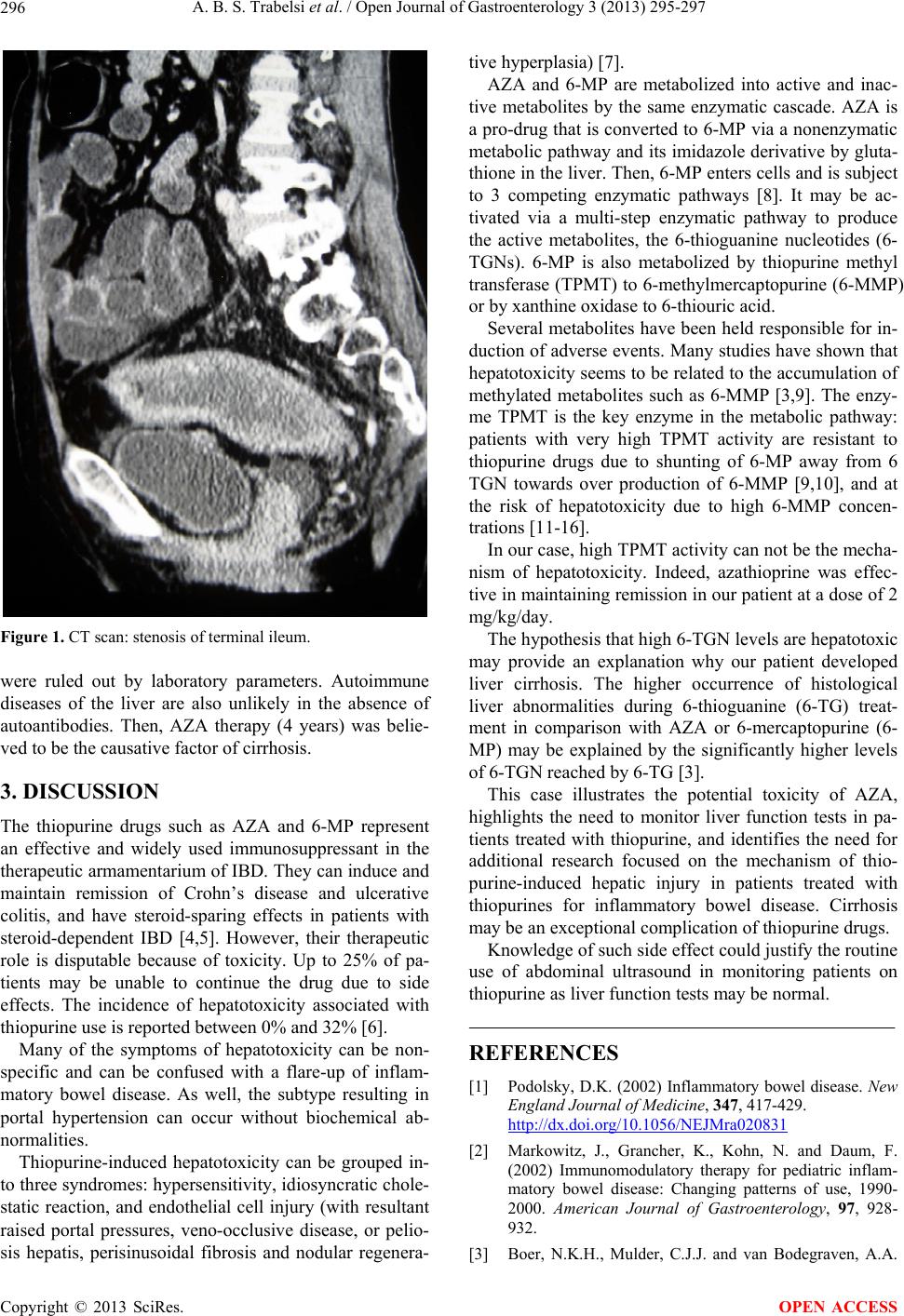 A. B. S. Trabelsi et al. / Open Journal of Gastroenterology 3 (2013) 295-297 296 Figure 1. CT scan: stenosis of terminal ileum. were ruled out by laboratory parameters. Autoimmune diseases of the liver are also unlikely in the absence of autoantibodies. Then, AZA therapy (4 years) was belie- ved to be the causative factor of cirrhosis. 3. DISCUSSION The thiopurine drugs such as AZA and 6-MP represent an effective and widely used immunosuppressant in the therapeutic armamentarium of IBD. They can induce and maintain remission of Crohn’s disease and ulcerative colitis, and have steroid-sparing effects in patients with steroid-dependent IBD [4,5]. However, their therapeutic role is disputable because of toxicity. Up to 25% of pa- tients may be unable to continue the drug due to side effects. The incidence of hepatotoxicity associated with thiopurine use is reported between 0% and 32% [6]. Many of the symptoms of hepatotoxicity can be non- specific and can be confused with a flare-up of inflam- matory bowel disease. As well, the subtype resulting in portal hypertension can occur without biochemical ab- normalities. Thiopurine-induced hepatotoxicity can be grouped in- to three syndromes: hype rsensitivity, idiosyn cratic chole- static reaction, and endothelial cell injury (with resultant raised portal pressures, veno-occlusive disease, or pelio- sis hepatis, perisinusoidal fibrosis and nodular regenera- tive hyperplasia) [7 ]. AZA and 6-MP are metabolized into active and inac- tive metabolites by the same enzymatic cascade. AZA is a pro-drug that is converted to 6-MP via a nonenzymatic metabolic pathway and its imid azole derivative by gluta- thione in the liver. Th en, 6-MP enters cells and is subject to 3 competing enzymatic pathways [8]. It may be ac- tivated via a multi-step enzymatic pathway to produce the active metabolites, the 6-thioguanine nucleotides (6- TGNs). 6-MP is also metabolized by thiopurine methyl transferase (TPMT) to 6-methylmercaptopurine (6-MMP) or by xanthine oxidase to 6-t h i ou ri c acid. Several metabolites have been h eld responsible for in- duction of adverse events. Many studies have shown that hepatotoxicity seems to be related to the accumulation of methylated metabolites such as 6-MMP [3,9]. The enzy- me TPMT is the key enzyme in the metabolic pathway: patients with very high TPMT activity are resistant to thiopurine drugs due to shunting of 6-MP away from 6 TGN towards over production of 6-MMP [9,10], and at the risk of hepatotoxicity due to high 6-MMP concen- trations [11-16]. In our case, high TPMT activity can not be the mecha- nism of hepatotoxicity. Indeed, azathioprine was effec- tive in maintaining remission in our patien t at a do se of 2 mg/kg/day. The hypothesis that high 6-TGN levels are hepatotoxic may provide an explanation why our patient developed liver cirrhosis. The higher occurrence of histological liver abnormalities during 6-thioguanine (6-TG) treat- ment in comparison with AZA or 6-mercaptopurine (6- MP) may be explained by the significantly higher levels of 6-TGN reached by 6-TG [3]. This case illustrates the potential toxicity of AZA, highlights the need to monitor liver function tests in pa- tients treated with thiopurine, and identifies the need for additional research focused on the mechanism of thio- purine-induced hepatic injury in patients treated with thiopurines for inflammatory bowel disease. Cirrhosis may be an exceptional complication of thiopurine drugs. Knowledge of such side effect could justify the routine use of abdominal ultrasound in monitoring patients on thiopurine as liver fu nction tests may be normal. REFERENCES [1] Podolsky, D.K. (2002) Inflammatory bowel disease. New England Journal of Medicine, 347, 417-429. http://dx.doi.org/10.1056/NEJMra020831 [2] Markowitz, J., Grancher, K., Kohn, N. and Daum, F. (2002) Immunomodulatory therapy for pediatric inflam- matory bowel disease: Changing patterns of use, 1990- 2000. American Journal of Gastroenterology, 97, 928- 932. [3] Boer, N.K.H., Mulder, C.J.J. and van Bodegraven, A.A. Copyright © 2013 SciRes. OPEN ACCESS  A. B. S. Trabelsi et al. / Open Journal of Gastroenterology 3 (2013) 295-297 Copyright © 2013 SciRes. 297 OPEN ACCESS (2005) Myelotoxicity and hepatotoxicity during azathio- prine therapy. Netherlands Journal of Medicine, 63, 444- 446. [4] Pearson, D.C., May, G.R., Fick, G.H. and Sutherland, L.R. (1995) Azathioprine and 6- mercaptopurine in Croh n’s disease. A meta-analysis. Annals of Internal Medicine, 123, 132-142. http://dx.doi.org/10.7326/0003-4819-123-2-199507150-0 0009 [5] Fraser, A.G., Orchard, T.R. and Jewell, D.P. (2002) The efficacy of aza thiopri ne for the trea tment of i nflamma tory bowel disease: A 30 year review. Gut, 50, 485-489. http://dx.doi.org/10.1136/gut.50.4.485 [6] Lowry, P.W., Franklin, C.L., Weaver, A.L., et al. (2001) Measurement of thiopurine methyltransferase activity and azathioprine metabolites in patients with inflammatory bowel disease. Gut, 49, 665-670. http://dx.doi.org/10.1136/gut.49.5.665 [7] Gisbert, J.P., González-Lama, Y. and Maté, J. (2007) Thiopurine-induced liver injury in patients with inflame- matory bowel disease: A systematic review. American Journal of Gastroenterology, 102, 1518-1527. http://dx.doi.or g/10.1111/j.1572-0241.2007.01187.x [8] Macdonald, A. (2006) Omega-3 fatty acids as adjunctive therapy in Crohns disease. Gastroenterology Nursing, 29, 295-301. http://dx.doi.org/10.1097/00001610-200607000-00005 [9] Cuffari, C., Dassopoulos, T., Turnbough, L., Thompson, R.E. and Bayless, T.M. (2004) Thiopurine methyltrans- ferase activity influences clinical response to azathioprine in inflammatory bowel disease. Clinical Gastroenterol- ogy and Hepatology, 2, 410-417. http://dx.doi.org/10.1016/S1542-3565(04)00127-2 [10] Kiefer, K. and El-Matary, W. (2009) 6 mercaptopurine as an alternative to azathioprine in azathioprine-induced he- patoxicity. Inflammatory Bowel Diseases, 15, 318-319. http://dx.doi.org/10.1002/ibd.20603 [11] Boson, W.L., Romano-Silva, M.A., Correa, H., Falcao, R.P., Teixeira-Vidigal, P.V. and De Marco, L. (2003) Thiopurine methyltransferase polymorphisms in a Bra- zilian population. Pharmacogenomics Journal, 3, 178- 182. http://dx.doi.org/10.1038/sj.tpj.6500175 [12] Dubinsky, M.C., Lamothe, S. and Yang, H.Y. (2000) Pharmacogenomics and metabolite measurement for 6- mercaptopurine therapy in inflammatory bowel disease. Gastroenterology, 118, 705-713. http://dx.doi.org/10.1016/S0016-5085(00)70140-5 [13] Dubinsky, M.C., Yang, H. and Hassard, P.V. (2002) 6-MP metabolite profiles provide a biochemical explana- tion for 6-MP resistance in patients with inflammatory bowel disease. Gastroenterology, 122, 904-915. http://dx.doi.org/10.1053/gast.2002.32420 [14] Hosni-Ahmed, A., Barnes, J.D., Wan, J. and Jones, T.S. (2011) Thiopurine methyltransferase predicts the extent of cytotoxicty and DNA damage in astroglial cells after thioguanine exposure. PLoS One, 6, e29163. http://dx.doi.org/10.1371/journal.pone.0029163 [15] Coulthard, S. and Hogarth, L. (2005) The thiopurines: An update. Investigational New Drugs, 23, 523-532. http://dx.doi.org/10.1007/s10637-005-4020-8 [16] Gastal, G.R., Moreira, S., Noble, C.F., Ferreira, L.E., França, P.H. and Pinho, M. (2012) Toxicity of azathio- prine: Why and when? Analysis of the prevalence of polymorphism in Joinville, SC, Brazil. Arquivos de Gas- troenterologia, 49, 130-134. http://dx.doi.org/10.1590/S0004-28032012000200007 LIST OF ABBREVIATIONS AZA: azathioprine 6 MP: mercaptopurine IBD: inflammatory bowel disease 6-TGNs: 6-thioguanine nucleotides TPMT: thiopurine methyl transferase 6-MMP: 6-methylmercapt opurine 6TG: 6-thioguanine |