

Paper Menu >>
Journal Menu >>
 Energy and Power Engineering, 2013, 5, 36-40 doi:10.4236/epe.2013.54B007 Published Online July 2013 (http://www.scirp.org/journal/epe) Study on Co-combustion Characteristics of Superfine Coal with Conventional Size Coal in O2/CO2 Atmosphere Yuhang Zhang, Mingyan Gu*, Biao Ma, Huaqiang Chu Department of Metallurgy and resource, Anhui University of Technology, Ma’an shan, China Email: seveny1110@foxmail.com, [email protected] Received March, 2013 ABSTRACT The pulverized coal combustion in O2/CO2 atmosphere is one of the promising new technologies which can reduce the emission of carbon dioxide and NOx. In this study, the combustion behaviors of different mixing ratio of Shenhua coal with 20 μm and 74 μm particle size in the O2/CO2 atmosphere and air atmosphere were studied by using a ther- mal-gravimetric analyzer. The combustion characteristics such as ignition and burnout behavior were investigated in the temperature from 20℃ to 850℃. The influence of mixing ratio on combustion characteristics was conduced. The re- sults obtained showed that the ignition temperature of the two kinds of particle size in O2/CO2 atmosphere is higher than in the air, while the activation energy in O2/CO2 atmosphere is lower. With the increasing ratio of 20 μm superfine pul- verized coals, the ignition temperature and the activation energy decreased, while the DTG peak value increased, the maximum burning rate position advanced. There were three trends for the ignition temperature curve with the increas- ing of superfine coal ratio: the ignition of the mixed coal decreased rapidly, then changed less, at last reduced quickly. Keywords: Coal Particle Size; Co-combustion; Thermo-gravimetric; Heat of Combustion 1. Introduction Coal makes a significant contribution to energy produc- tion and because of its availability and flexibility,it is likely to continue to be a major part of the energy scene for some time. However, this fuel has the disadvantage of producing more CO2 per unit of energy produced than the other fossil fuels which will in time require the ap- plication of carbon capture and storage technologies. Coal combustion in O2/CO2 is considered as a new gen- eration of combustion technology that both direct access to high concentrations of CO2 and comprehensively con- trol the coal-fired pollutant emission [1-3]. During the O2/CO2 combustion, coal is burnt in a mixture of O2 and recycled flue gas (mainly CO2 and H2O), to yield a rich CO2 stream. Previous results have shown that the re- placement of N2 by CO2 can cause significant differences in the area such as burning stability, char burnout, heat transfer and gas temperature profiles [4-6]. The flame propagation speed, flame stability and gas temperature in O2/CO2 environment are lower and the unburned carbon content is higher than those in air environment. Experi- mental studies on coal-fired O2/CO2 combustion have been performed in laboratory and semi-industrial scale test facilities of different size [7-10]. The coal combus- tion appears ignition delay and combustion instability in O2/CO2 [11], improving the oxygen concentration [12] and using the superfine pulverized coal combustion can improve the combustion characteristics, and the particle size has a great influence on the combustion characteris- tics [13-14]. In this study, the combustion process of mixed coal with 20 μm and 74 μm of Shenhua coal under both air and O2/CO2 atmosphere were employed by a thermal-gra- vimetric analyzer (TGA). The influence of superfine pulverized coal on the combustion characteristics was analyzed in the atmosphere of O2/CO2 and the ignition temperature and kinetic parameters were obtained. The results obtained provide a better understanding of coal combustion in O2/CO2 atmosphere. 2. Experimental A NETZSCH STA449C simultaneous thermal analyzer was used in this work. The temperature was increased from 20℃ to 850℃ linearly at the heating rate of 10 K·min-1. The flow rate of evolved gas was fixed at 80 ml·min-1, 7.5 mg of fuel sample with 20 μm and 74 μm sizes were used for each test. Two kinds of different par- ticle size with Shenhua coal and their mixture were used in this study and their proximate analysis was listed in Table 1. The sizes of coal are 20μm and 74μm respec- tively. Copyright © 2013 SciRes. EPE 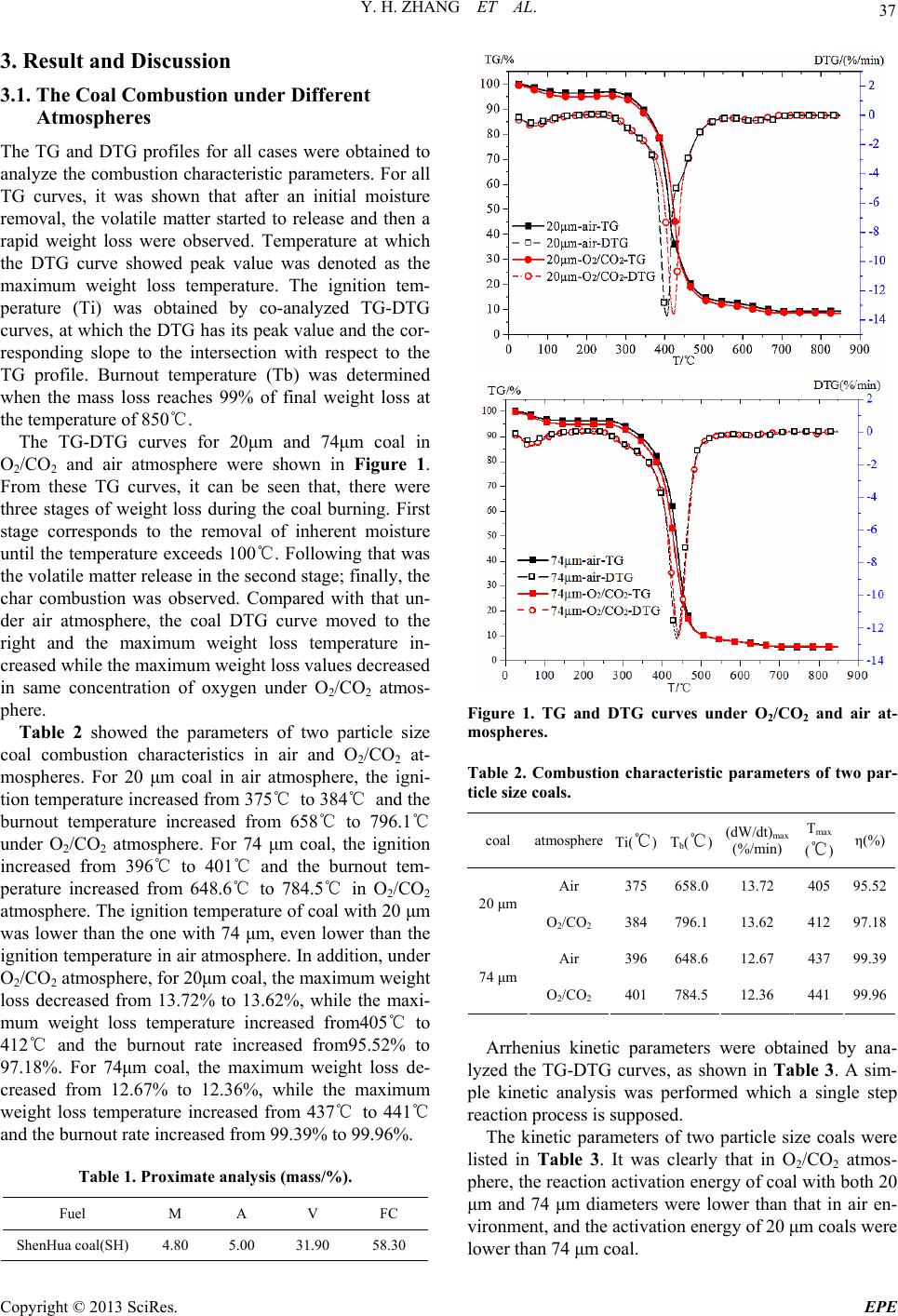 Y. H. ZHANG ET AL. 37 3. Result and Discussion 3.1. The Coal Combustion under Different Atmospheres The TG and DTG profiles for all cases were obtained to analyze the combustion characteristic parameters. For all TG curves, it was shown that after an initial moisture removal, the volatile matter started to release and then a rapid weight loss were observed. Temperature at which the DTG curve showed peak value was denoted as the maximum weight loss temperature. The ignition tem- perature (Ti) was obtained by co-analyzed TG-DTG curves, at which the DTG has its peak value and the cor- responding slope to the intersection with respect to the TG profile. Burnout temperature (Tb) was determined when the mass loss reaches 99% of final weight loss at the temperature of 850℃. The TG-DTG curves for 20μm and 74μm coal in O2/CO2 and air atmosphere were shown in Figure 1. From these TG curves, it can be seen that, there were three stages of weight loss during the coal burning. First stage corresponds to the removal of inherent moisture until the temperature exceeds 100℃. Following that was the volatile matter release in the second stage; finally, the char combustion was observed. Compared with that un- der air atmosphere, the coal DTG curve moved to the right and the maximum weight loss temperature in- creased while the maximum weight loss values decreased in same concentration of oxygen under O2/CO2 atmos- phere. Table 2 showed the parameters of two particle size coal combustion characteristics in air and O2/CO2 at- mospheres. For 20 μm coal in air atmosphere, the igni- tion temperature increased from 375℃ to 384℃ and the burnout temperature increased from 658℃ to 796.1℃ under O2/CO2 atmosphere. For 74 μm coal, the ignition increased from 396℃ to 401℃ and the burnout tem- perature increased from 648.6℃ to 784.5℃ in O2/CO2 atmosphere. The ignition temperature of coal with 20 μm was lower than the one with 74 μm, even lower than the ignition temperature in air atmosphere. In addition, under O2/CO2 atmosphere, for 20μm coal, the maximum weight loss decreased from 13.72% to 13.62%, while the maxi- mum weight loss temperature increased from405℃ to 412℃ and the burnout rate increased from95.52% to 97.18%. For 74μm coal, the maximum weight loss de- creased from 12.67% to 12.36%, while the maximum weight loss temperature increased from 437℃ to 441℃ and the burnout rate increased from 99.39% to 99.96%. Table 1. Proximate analysis (mass/%). Fuel M A V FC ShenHua coal(SH) 4.80 5.00 31.90 58.30 Figure 1. TG and DTG curves under O2/CO2 and air at- mospheres. Table 2. Combustion characteristic parameters of two par- ticle size coals. coal atmosphereTi(℃)T b(℃) (dW/dt)max (%/min) Tmax (℃)η(%) Air 375 658.0 13.72 40595.52 20 μm O2/CO2 384 796.1 13.62 41297.18 Air 396 648.6 12.67 43799.39 74 μm O2/CO2 401 784.5 12.36 44199.96 Arrhenius kinetic parameters were obtained by ana- lyzed the TG-DTG curves, as shown in Table 3. A sim- ple kinetic analysis was performed which a single step reaction process is supposed. The kinetic parameters of two particle size coals were listed in Table 3. It was clearly that in O2/CO2 atmos- phere, the reaction activation energy of coal with both 20 μm and 74 μm diameters were lower than that in air en- vironment, and the activation energy of 20 μm coals were lower than 74 μm coal. Copyright © 2013 SciRes. EPE 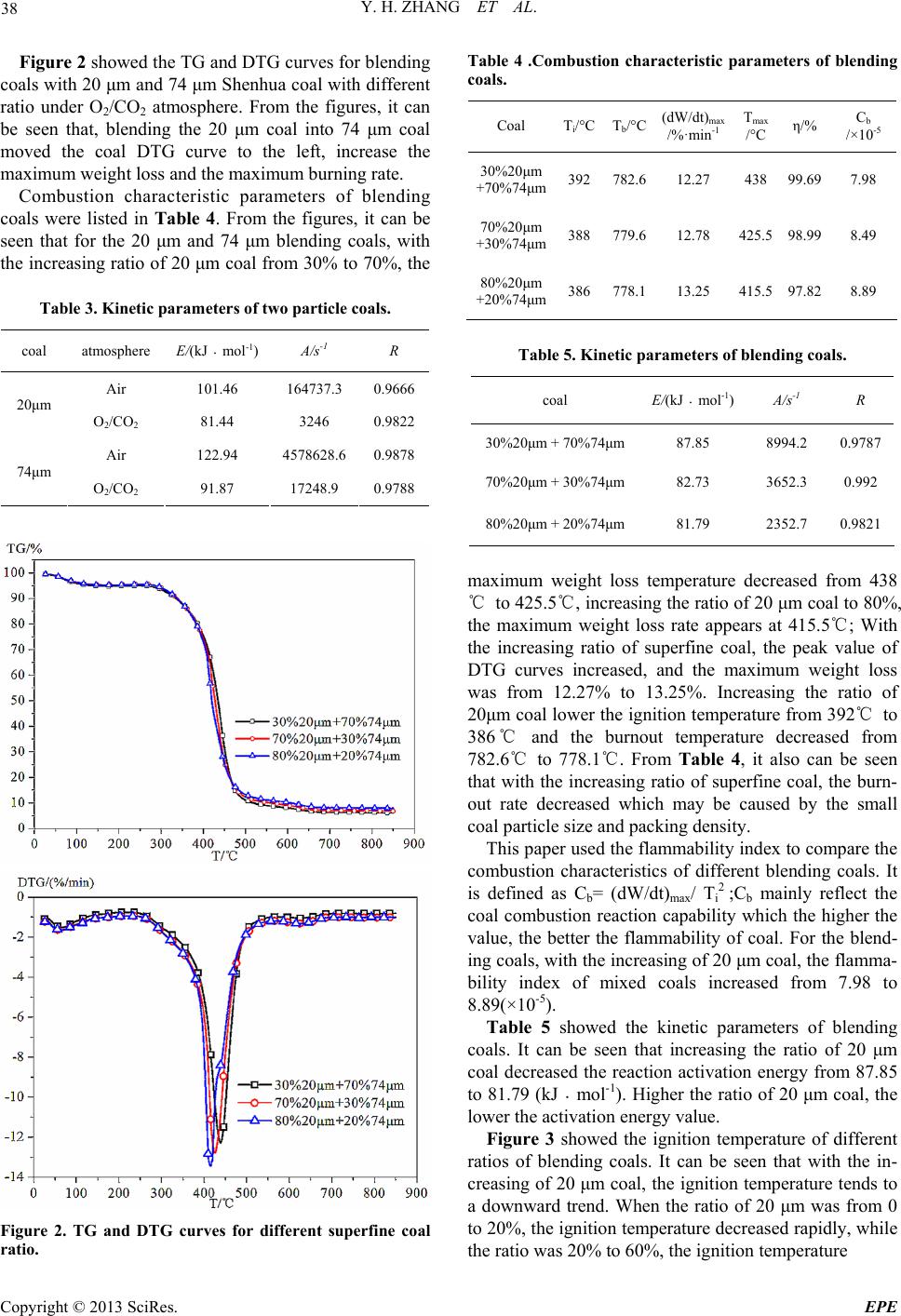 Y. H. ZHANG ET AL. 38 Figure 2 showed the TG and DTG curves for blending coals with 20 μm and 74 μm Shenhua coal with different ratio under O2/CO 2 atmosphere. From the figures, it can be seen that, blending the 20 μm coal into 74 μm coal moved the coal DTG curve to the left, increase the maximum weight loss and the maximum burning rate. Combustion characteristic parameters of blending coals were listed in Table 4. From the figures, it can be seen that for the 20 μm and 74 μm blending coals, with the increasing ratio of 20 μm coal from 30% to 70%, the Table 3. Kinetic parameters of two particle coals. coal atmosphere E/(kJ﹒mol-1) A/s-1 R Air 101.46 164737.3 0.9666 20μm O2/CO2 81.44 3246 0.9822 Air 122.94 4578628.6 0.9878 74μm O2/CO2 91.87 17248.9 0.9788 Figure 2. TG and DTG curves for different superfine coal ratio. Table 4 .Combustion characteristic parameters of blending coals. Coal Ti/°C Tb/°C (dW/dt)max /%·min-1 Tmax /°C η/% Cb /×10-5 30%20μm +70%74μm392782.612.27 438 99.697.98 70%20μm +30%74μm388779.612.78 425.5 98.998.49 80%20μm +20%74μm386778.113.25 415.5 97.828.89 Table 5. Kinetic parameters of blending coals. coal E/(kJ﹒mol-1 ) A/s-1 R 30%20μm + 70%74μm 87.85 8994.2 0.9787 70%20μm + 30%74μm 82.73 3652.3 0.992 80%20μm + 20%74μm 81.79 2352.7 0.9821 maximum weight loss temperature decreased from 438 ℃ to 425.5℃, increasing the ratio of 20 μm coal to 80%, the maximum weight loss rate appears at 415.5℃; With the increasing ratio of superfine coal, the peak value of DTG curves increased, and the maximum weight loss was from 12.27% to 13.25%. Increasing the ratio of 20μm coal lower the ignition temperature from 392℃ to 386 ℃ and the burnout temperature decreased from 782.6℃ to 778.1℃. From Table 4, it also can be seen that with the increasing ratio of superfine coal, the burn- out rate decreased which may be caused by the small coal particle size and packing density. This paper used the flammability index to compare the combustion characteristics of different blending coals. It is defined as Cb= (dW/dt)max/ Ti 2 ;Cb mainly reflect the coal combustion reaction capability which the higher the value, the better the flammability of coal. For the blend- ing coals, with the increasing of 20 μm coal, the flamma- bility index of mixed coals increased from 7.98 to 8.89(×10-5). Table 5 showed the kinetic parameters of blending coals. It can be seen that increasing the ratio of 20 μm coal decreased the reaction activation energy from 87.85 to 81.79 (kJ﹒mol-1). Higher the ratio of 20 μm coal, the lower the activation energy value. Figure 3 showed the ignition temperature of different ratios of blending coals. It can be seen that with the in- creasing of 20 μm coal, the ignition temperature tends to a downward trend. When the ratio of 20 μm was from 0 to 20%, the ignition temperature decreased rapidly, while the ratio was 20% to 60%, the ignition temperature Copyright © 2013 SciRes. EPE 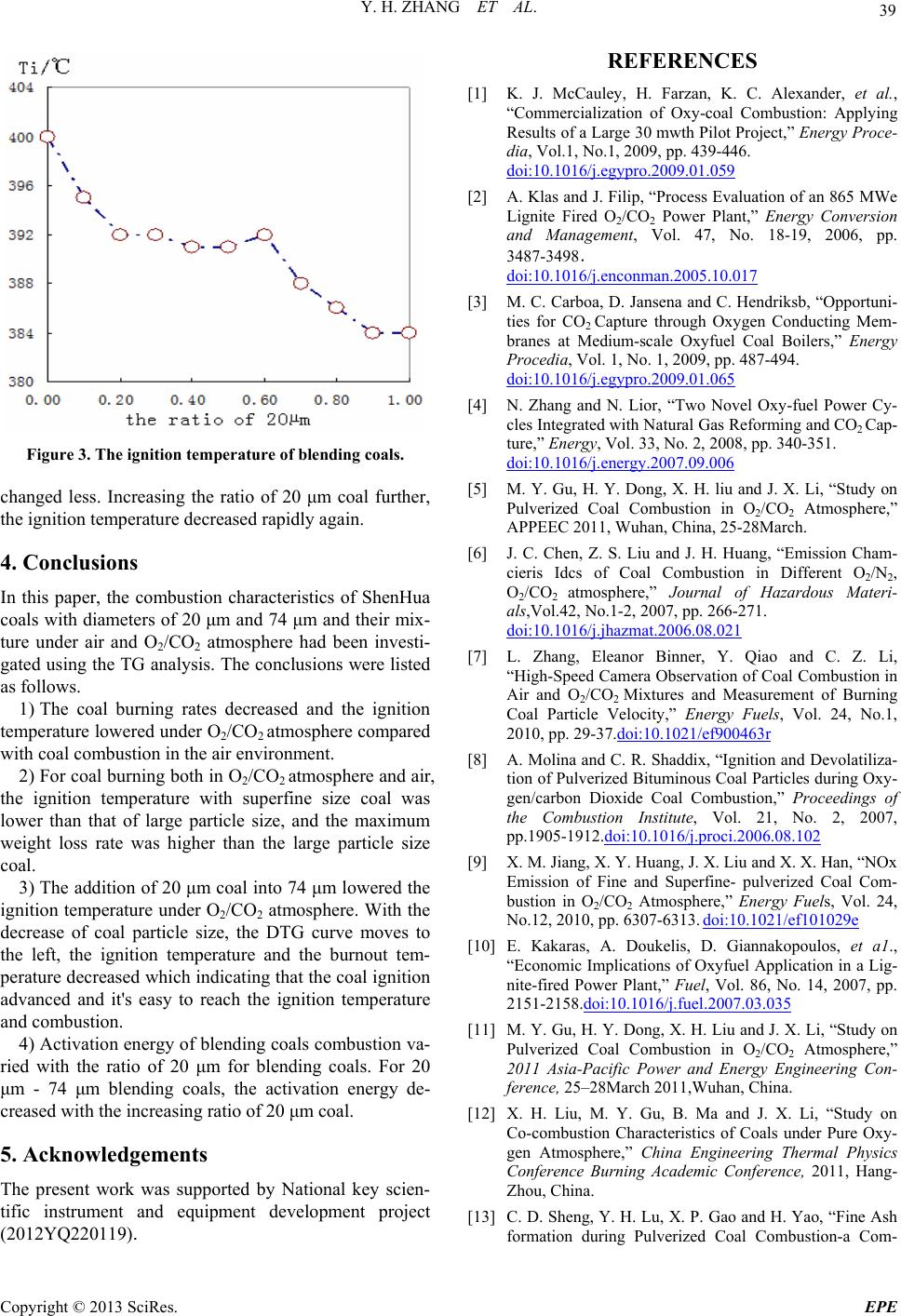 Y. H. ZHANG ET AL. 39 Figure 3. The ignition temperature of blending coals. changed less. Increasing the ratio of 20 μm coal further, the ignition temperature decreased rapidly again. 4. Conclusions In this paper, the combustion characteristics of ShenHua coals with diameters of 20 μm and 74 μm and their mix- ture under air and O2/CO2 atmosphere had been investi- gated using the TG analysis. The conclusions were listed as follows. 1) The coal burning rates decreased and the ignition temperature lowered under O2/CO2 atmosphere compared with coal combustion in the air environment. 2) For coal burning both in O2/CO2 atmosphere and air, the ignition temperature with superfine size coal was lower than that of large particle size, and the maximum weight loss rate was higher than the large particle size coal. 3) The addition of 20 μm coal into 74 μm lowered the ignition temperature under O2/CO2 atmosphere. With the decrease of coal particle size, the DTG curve moves to the left, the ignition temperature and the burnout tem- perature decreased which indicating that the coal ignition advanced and it's easy to reach the ignition temperature and combustion. 4) Activation energy of blending coals combustion va- ried with the ratio of 20 μm for blending coals. For 20 μm - 74 μm blending coals, the activation energy de- creased with the increasing ratio of 20 μm coal. 5. Acknowledgements The present work was supported by National key scien- tific instrument and equipment development project (2012YQ22011 9). REFERENCES [1] K. J. McCauley, H. Farzan, K. C. Alexander, et al., “Commercialization of Oxy-coal Combustion: Applying Results of a Large 30 mwth Pilot Project,” Energy Proce- dia, Vol.1, No.1, 2009, pp. 439-446. doi:10.1016/j.egypro.2009.01.059 [2] A. Klas and J. Filip, “Process Evaluation of an 865 MWe Lignite Fired O2/CO2 Power Plant,” Energy Conversion and Management, Vol. 47, No. 18-19, 2006, pp. 3487-3498. doi:10.1016/j.enconman.2005.10.017 [3] M. C. Carboa, D. Jansena and C. Hendriksb, “Opportuni- ties for CO2 Capture through Oxygen Conducting Mem- branes at Medium-scale Oxyfuel Coal Boilers,” Energy Procedia, Vol. 1, No. 1, 2009, pp. 487-494. doi:10.1016/j.egypro.2009.01.065 [4] N. Zhang and N. Lior, “Two Novel Oxy-fuel Power Cy- cles Integrated with Natural Gas Reforming and CO2 Cap- ture,” Energy, Vol. 33, No. 2, 2008, pp. 340-351. doi:10.1016/j.energy.2007.09.006 [5] M. Y. Gu, H. Y. Dong, X. H. liu and J. X. Li, “Study on Pulverized Coal Combustion in O2/CO2 Atmosphere,” APPEEC 2011, Wuhan, China, 25-28March. [6] J. C. Chen, Z. S. Liu and J. H. Huang, “Emission Cham- cieris Idcs of Coal Combustion in Different O2/N2, O2/CO2 atmosphere,” Journal of Hazardous Materi- als,Vol.42, No.1-2, 2007, pp. 266-271. doi:10.1016/j.jhazmat.2006.08.021 [7] L. Zhang, Eleanor Binner, Y. Qiao and C. Z. Li, “High-Speed Camera Observation of Coal Combustion in Air and O2/CO2 Mixtures and Measurement of Burning Coal Particle Velocity,” Energy Fuels, Vol. 24, No.1, 2010, pp. 29-37.doi:10.1021/ef900463r [8] A. Molina and C. R. Shaddix, “Ignition and Devolatiliza- tion of Pulverized Bituminous Coal Particles during Oxy- gen/carbon Dioxide Coal Combustion,” Proceedings of the Combustion Institute, Vol. 21, No. 2, 2007, pp.1905-1912.doi:10.1016/j.proci.2006.08.102 [9] X. M. Jiang, X. Y. Huang, J. X. Liu and X. X. Han, “NOx Emission of Fine and Superfine- pulverized Coal Com- bustion in O2/CO2 Atmosphere,” Energy Fuels, Vol. 24, No.12, 2010, pp. 6307-6313. doi:10.1021/ef101029e [10] E. Kakaras, A. Doukelis, D. Giannakopoulos, et a1., “Economic Implications of Oxyfuel Application in a Lig- nite-fired Power Plant,” Fuel, Vol. 86, No. 14, 2007, pp. 2151-2158.doi:10.1016/j.fuel.2007.03.035 [11] M. Y. Gu, H. Y. Dong, X. H. Liu and J. X. Li, “Study on Pulverized Coal Combustion in O2/CO2 Atmosphere,” 2011 Asia-Pacific Power and Energy Engineering Con- ference, 25–28March 2011,Wuhan, China. [12] X. H. Liu, M. Y. Gu, B. Ma and J. X. Li, “Study on Co-combustion Characteristics of Coals under Pure Oxy- gen Atmosphere,” China Engineering Thermal Physics Conference Burning Academic Conference, 2011, Hang- Zhou, China. [13] C. D. Sheng, Y. H. Lu, X. P. Gao and H. Yao, “Fine Ash formation during Pulverized Coal Combustion-a Com- Copyright © 2013 SciRes. EPE  Y. H. ZHANG ET AL. Copyright © 2013 SciRes. EPE 40 f060420v parison of O2/CO2 Combustion Versus Air combus- tion ,”Energy Fu e ls, Vol. 21, No.2, 2007, pp.435-440. doi:10.1021/e [14] J. J. Fan, “Experimental Study of the Characteristics of Superfine Pulverized Coal Pyrolysis,” Power Engineering, Vol. 10, 2005, pp. 170-174. |