

Paper Menu >>
Journal Menu >>
 Advances in Applied Sociology 2013. Vol.3, No.6, 246-252 Published Online October 2013 in SciRes (http://www.scirp.org/journal/aasoci) http://dx.doi.org/10.4236/aasoci.2013.36033 Copyright © 2013 SciRe s . 246 The Perception of Children on Child Sexual Abuse: The Case of Children in Some Selected Schools in the Cape Coast Metropolis, Ghana Solomon Sika-Bright , Chinyere C. P. Nnor om Department of Sociolog y & Anthropology , University of Ca p e Coast, Cape Coast, Ghana Email: sikabright@ yahoo .com, [email protected] Received July 22nd, 2013; revised August 22nd, 2013; accepted August 29th, 2013 Copyright © 2013 Solomon Sika-Bright, Chinyere C. P. Nnorom. This is an open access article distributed un- der the Creative Commons Attribution License, which permits unrestricted use, distribution, and reproduction in any medium, provided the o riginal work is proper ly cited. Children are mostly the victims of child sexual abuse however, most children have little or no idea about what child sexual abuse entails and the forms it takes. In addition, the opinions of children have mostly been neglected in cases of child sexual abuse. The study therefore was carried out to explore how much children know about child sexual abuse and to suggest ways of publicising the phenomenon among chil- dren. A proportional sample of 256 children was selected from five public basic schools in the Cape Coast Metropolis to participate in the study. From interviews with the children, varied ideas were obtained. Parenting styles, child’s age, child’s educational level and sex of the child were found to influence the perception of the child on child sexual abuse. The cultural belief of “sex as a secret” was also found to be integrally related to child’s perception on sexual abuse in Cape Coast. Recommendations are made and the most important thing that the Ghana Education Service should intensify is sex education in the basic schools’ curriculum to enable them to identify and report such cases whenever experienced. Keywords: Abuse; Cape Coast; Child; Sexual; Ghana; Perception Introduction Child sexual abuse (CSA) has always been and still is, to a large extent, a problem for both parents and professionals world-wide. Children are mostly the victims of child sexual abuse (UNICEF, 2008; Leach et al., 2003). According to the World Health Organization, approximately one in every three children is a victim of CSA (Krug, Dahlberg, Mercy, Zwi, & Lozano, 2002). However, most children have little or no idea about child sexual abuse and the forms it takes. Children all over the world are being subjected to horrific forms of sexual victimization by adults who are supposed to be protecting them, and in some cases, by their own parents, siblings and relatives (Parrot & Cummings, 2008). The effects of CSA on children are very devastating and have both short and long term conse- quences. A lot of CSA cases go unreported (Draucker & Mart- solf, 2006; Finkelhor, 1986) and the phenomenon is still on the increase (Draucker & Martsolf, 2006). Prevalence rate of sexual abuse has been difficult to determine for various reasons; esti- mates have widely varied as a result of different definitions of the term and the sensitive nature of the phenomenon accompa- nied by shame and stigma experienced by victims makes it dis- incentive to report its occurrence (Saewyc, Pettingell, Lara, & Magee, 2003). World Health Organization (WHO) estimates that about 223 million children (150 million girls and 73 mil- lion boys) have experienced forced sexual intercourse or other forms of sexual violence globally (United Nations on Violence Against Children [UNVAC], 2006). Current studies carried out by the United Nations indicate that sexual abuse within schools is a widespread but largely unrecognized problem in many countries. The closed nature of the school environment means that children can be at great risk of sexual abuse in schools (Leach, Fiscian, Kadzamira, Lemani, & Machakanja, 2003). The Ghanaian situation is not different. Studies have shown that child sexual abuse is a problem in schools (Leach et al., 2003; Brown, 2002). For instance, Brown (2002), studying public schools, discovered that 11 percent of the children studied had been victims of either rape or defile- ment. Leach et al. (2003) revealed in their study that 27 percent of the female respondents had been propositioned by their school teacher. Another study conducted in 2003 found out that 6 percent of the girls studied had been victims of sexual black- mail by teachers over class grades, and 14 percent of rape cases had been perpetrated by school mates, while 24 percent of the boys in the survey admitted to having raped a girl or having taken part in a collective rape (UNICEF, 2008). All of us have different attitude towards sexuality and how it should be expressed. We may be negative, positive, possibly reluctant or embarrassed but never entirely indifferent. Public perceptions and attitudes concerning child sexual abuse are im- portant, especially those of children because such perceptions can affect the reporting of sexual abuse, the prosecution of per- petrators, and the provision of clinical services (Baron, Burgess, & Kao, 1991; Dawes, 1988). Besides, empirical research on the perceptions of children on child sexual abuse has been lacking. The study fills a gap by undertaking to explore what children know about CSA.  S. SIKA-BRIGHT, C. C. P. NNOROM Copyright © 2013 SciRe s . 247 Some Conceptual Definitions Like several phenomena in the behavioural and social sci- ences, CSA does not lend itself to a single definition. Defini- tions of child sexual abuse are usually based on the values and orientations of the individuals, communities and societies (San- derson, 2006; Webster, 2001). According to Wurtele and Mil- ler-Perrin (1992), defining child sexual abuse is confronted with difficulties due to cultural differences and time bound nature of the phenomenon. The main focus of some definitions is the age at which the abuse is committed (Brown & Finkelhor, 1986; Webster, 2000) however, others place much emphasis on what qualifies as an abuse (Draucker & Martsolf, 2006; San- derson, 2006; Webster, 2001). Some researchers adopt a con- servative definition of CSA which focuses on fondling, at- tempted intercourse, and intercourse (Himelein & McElrath, 1996). Proulx and colleagues (1995), for instance, included in their definition everything from unwanted kissing of the but- tocks to insertion of objects into an orifice. Based on differ- ences as to how researchers operationalise CSA, it appears to be a daunting task to accurately define CSA. Meanwhile, other researchers adopt definitions that are very broad in the actions that constitute sexual abuse. However, this paper adopts San- derson’s (2006: p. 25) definition of CSA as the “involvement of dependent children and adolescents in sexual activities with an adult or any person older or bigger, where there is a difference in age, size or power, in which the child is used as a sexual object for the gratification of the older person’s needs, or de- sires to which the child is unable to give informed consent due to the imbalance of power or any mental or physical disability”. The meaning of the term “sexual” is very central to the defi- nition of CSA. However, sexuality varies across cultures and individuals (Sanderson, 2006). For example, should “sexual” be operationally defined as sexual intercourse, it would limit the number of reported cases of CSA. However, if one expands the definition to include inappropriate touch such as fondling or “showing or using a child in the production of pornography” (Sanderson, 2006: p. 25) the probability of higher prevalence rates increases (Sanderson, 2006). Falling out of Sanderson’s definition, sexual abuse often involves direct physical contact, touching, kissing, fondling, rubbing, oral sex, or penetration of the vagina or anus. Sometimes a sex offender may receive grat- ification just by exposing himself to a child, or by observing or filming a child removing his or her clothes. Offenders often do not use physical force, but may use play, deception, threats, or other coercive methods to engage youngsters and maintain their silence. Let us now consider some effects of child sexual abuse. Effects of CSA It has been reported in the literature that children who are victims of sexual abuse are likely to suffer significant and long- term psychological distress and dysfunction (Briere, 1992). Finkelhor (1994) examined prevalence rates of CSA in 19 countries and found that all studies looking at long-term impli- cations of CSA reported a relationship between histories of CSA and mental health issues later in life. According to Follette and Pistorello (1995), survivors of sexual abuse often suffer a disruption in trust in intimate relationship. Similarly, if the perpetrator is a relative or acquaintance, victims of child sexual abuse are less likely to report the offence, or they are likely to disclose the abuse after a delay (Arata, 1998; DiPetro, 2003; Hanson et al., 1999; Smith et al., 2000; Wyatt & Newcomb, 1990). Women survivors have also been found to be less able to provide adequate parenting and as offering less emotional sup- port to their male partners (Webster, 2001). According to Briere (1992) the most common cognitive distortions are viewing one- self in a negative light, the perception of being helpless and hopeless, as well as an inability to trust other people. These changes in cognitions can impact one’s emotions. Feelings of fear and sadness as well as depression are also noted effects of CSA (Davis & Petretic-Jackson, 2000; Johnson & Williams- Keeler, 1998; Sanderson, 2006). Research has also indicated that female survivors of CSA are at an increased risk of devel- oping major depression (Kendler, Khun, & Prescott, 2004; Whiffen, Thompson, & Aube, 2000). Theoretical Issues The study is informed by the symbolic interaction perspec- tive. Karp and Yoels (1993) define symbolic interactionism as “a theoretical perspective in sociology that focuses attention on the processes through which persons interpret and give mean- ings to the objects, events, and situations that make up their social worlds” (p. 31). In Mind, Self, and Society (1934), Mead explained how behaviours are constructed from a symbolic interactionist’s perspective. The development of the self is central to symbolic interac- tionism. This happens as an individual imaginatively constructs the attitudes of others about a particular role, and thus antici- pates the reaction of the other (Bailey, 2001). It must be noted however that not all “others” are equally influential in con- structing the self. Three categories of “others”—the generalized other, reference groups and significant other—exert various forms of influences on the construction of the self: the “gener- alized other”, the widespread cultural norms and values we use as reference in evaluating ourselves (Macionis, 2000). Media portrayals of child sexual abuse cases are the generalized others helping the formation of children’s perception about the prac- tice. “Reference groups” are social groups to which people may or may not belong but use as a standard for evaluating their values, attitudes, and behaviours (Merton & Rossi, 1950 in Anderson & Taylor, 2006). “Significant others” are considered actual influential people with whom an individual interacts. Perception on child sexual abuse can be framed in symbolic interaction terms. Individuals in society go through the process of socialization to form their perception about all forms of be- haviour in society. Such perceptions, in one way or the other, shape the individual’s behaviour. When forming these percep- tions, the individual varies both the relative benefits of the be- havior and the influences of a key reference groups and/or sig- nificant others. That is if a child’s family abhors CSA, that child then has a reference group that may influence how he/she perceives CSA as a behaviour that must not be tolerated. How- ever, such a perception could change if a key significant other supports and encourages CSA. Through this process, percep- tions about behaviours are formed. Formation of perception, therefore, is an activity with symbolic importance for most people. Subjects and Methods Study Area The study was conducted in Cape Coast Metropolis. The  S. SIKA-BRIGHT, C. C. P. NNOROM Copyright © 2013 SciRe s . 248 Cape Coast Metropolitan is bounded on the south by the Gulf of Guinea, west by the Komenda/Edina/Eguafo/Abrem Munici- pal, east by the Abura/Asebu/Kwamankese District and north by the Twifu/Hemang/Lower Denkyira District. The Metropolis covers an area of 122 square kilometers and is the smallest Metropolis in the country. The capital, Cape Coast, is also the capital of the Central Region. The Metropolis is known as the educational basket of the country as it houses a lot of schools including a polytechnic and a university. The main economic activities among the members in the Metropolis are fishing, trading and farming (Ghana News Agency, 2011). Cape Coast Metropolis was selected purposely because of its heterogeneous inhabitants. Design The study adopted a descriptive cross sectional survey design. This design sought to elicit facts and information on children’s perception on the nature, spread, and reasons for perpetuation of child sexual abuse among school children in the study area. Study Populatio n The population of the study was made up of all basic school children aged between 12 and 17 years in five basic schools in the Metropolis. Two of the five basic schools are located in the university community, namely Amamoma and Akotokyir. The other three schools were located in Pedu, Brofoyerdru, and Ba- kaano. This implies that pupils in five Junior High Schools (JHS) in the metropolis were the target population. Sampling Procedure The primary respondents of the study comprised school chil- dren in Junior High School (JHS) 1, 2, and 3. The study em- ployed various sampling techniques in selecting the respon- dents. The five basic schools were purposively selected because of easy access to information. In each school, quota sampling was adopted based on the number of pupils in each class. When the quota for each class was determined, simple random sam- pling in the form of the lottery method was adopted to select individual pupils within each class. In all 256 respondents were selected to participate in the study. Techniques of Data Collection The study utilised both primary and secondary methods of investigation. Primary data were obtained from interviews with respondents. The interview schedule was designed to collect primary data from sampled children. The instrument was pre- tested and redrafted. Permission was sought from heads of the schools where respondents were selected. The respondents were assured of confidentiality of disclosures; they were also in- formed of the purpose of the study and their right to withdraw from the study at any time. Debriefing was done at the end of the process. Secondary sources of information for the study included child sexual abuse studies conducted internationally and in Ghana. The data was collected over a period of four (4) weeks. Two research assistants were employed and given a day’s workshop to familiarise them on how to conduct such sensitive interviews as child sexual abuse, the import of the questions in the questionnaire and translation of the questions from English into the local dialect of the study areas. Data Analysis Data collected from the respondents was edited, coded, and analysed for common themes, patterns and inter-relationships. The coded data was analysed using Statistical Product for Ser- vice Solutions (SPSS) version 16 for Microsoft Windows. De- scriptive statistics were produced and relevant statistical charts and tables were used to present the data as shown in the results below. Results Socio-Demographic Characteristics of Respondents The most important socio-demographic variables describing the children interviewed in this study are summarized in Table 1. Children’s ages ranged from 10 - 17 years with a mean age of 13.14 years (Table 1). The majority (71.5%) of the children interviewed were between 10 and 14 years of age, while 73 children representing 28.5% were aged between 15 and 17 years. In addition, most respondents (55.1%) interviewed were females. This indicates the high level of female enrolment at the basic level. All the respondents interviewed were at the JHS level. However, 59.4% were in JHS three compared with ap- proximately 6% who were in JHS one. Respondents indicated their ethnicity as shown in Table 1. The findings indicated that a lot of the respondents (73%) were Akans. Cape Coast is Akan dominated area and this confirms their preponderance in the study area. Meanwhile there were 19 (7.4%) Hausas. The ma- jority of the respondents (67.6%) were staying with their par- ents, whereas 2.3% were staying with their friends. The Perception of Children on Child Sexual Abuse The cardinal objective of this paper was to explore the per- ceptions of children on child sexual abuse. As such the respon- dents were asked several questions to elicit response in this regard. On whether the respondents have heard of child sexual abuse, their responses show they have heard of it. The study asked their source of information on child sexual abuse and their responses are indicated in Table 2. Teachers emerged as their main sources of information about child sexual abuse as 155 expressed so compared with thirty-six (36) respondents who reported that their parents were their sources of informa- tion. When source of information on CSA was cross-tabulated with sex, age and JHS level, certain trends were realised. Fe- males were more likely to obtain information on CSA from parents (17.7%) and teachers (64.5%) than their male counter- parts (9.6% and 55.7% respectively) (Table 2). However males were more comfortable in receiving information on CSA from friends (20.9%) than females (3.5%). Respondents within the ages of 10 - 14 were also more likely to talk to other adults than their teachers about CSA. The majority (67.8%) of respondents in JHS three were more likely to mention their teachers as their sources of information on CSA. The respondents expressed diverse knowledge about child sexual abuse. On whether the respondents were aware that chil- dren may be sexually abused by family members and friends, as many as 14% had no idea. However, 43% respondents each reported yes and no respectivel y. On whether it is good for anyone to ask a child to undress and expose his or her genitals, most of the respondents (81.6%) responded in the negative. However, approximately 15% felt it 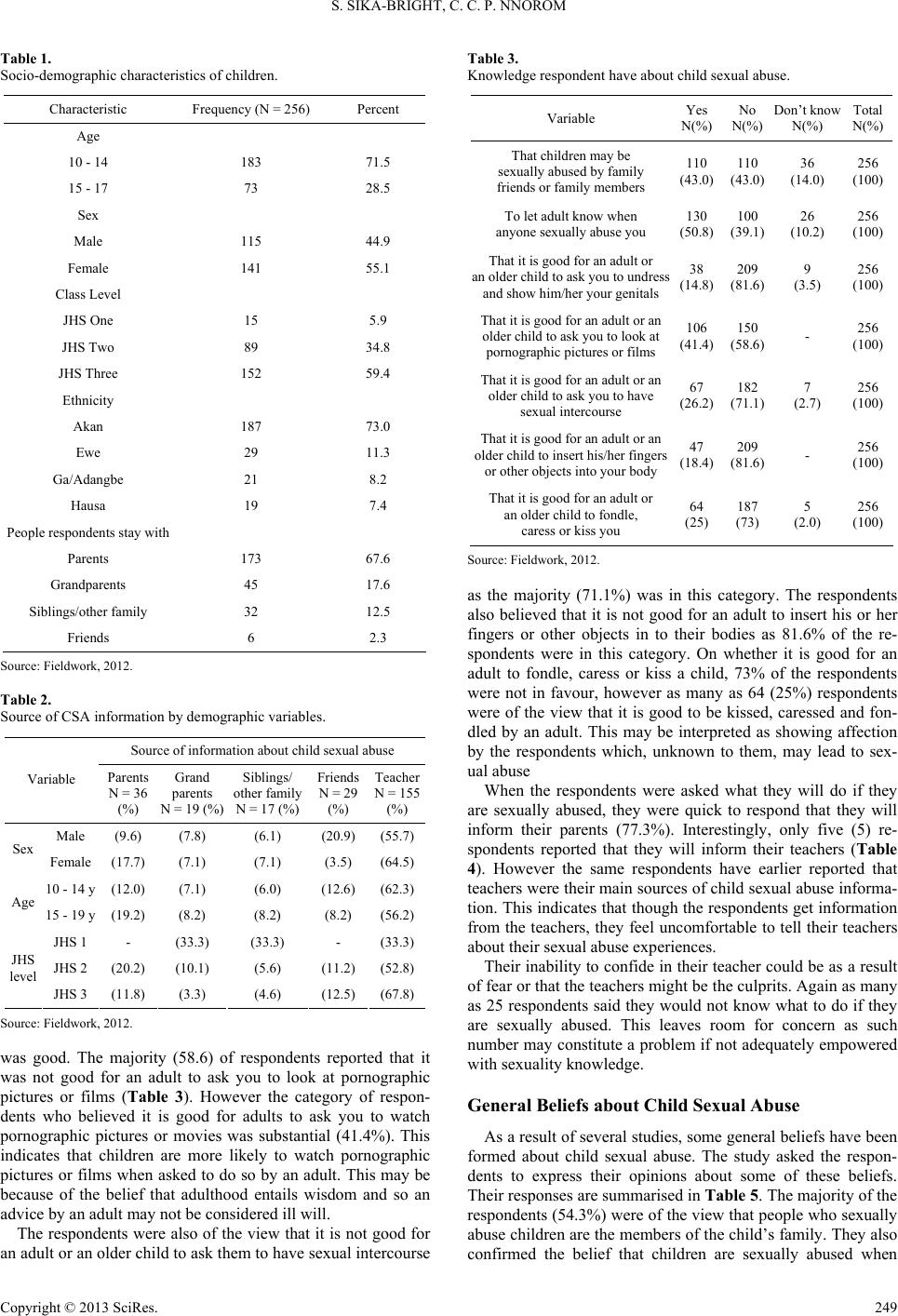 S. SIKA-BRIGHT, C. C. P. NNOROM Copyright © 2013 SciRe s . 249 Table 1. Socio-demographic charac teristics of chi l dr e n . Characteristic Frequency (N = 256) Percent Age 10 - 14 183 71.5 15 - 17 73 28.5 Sex Male 115 44.9 Female 141 55.1 Class Leve l JHS One 15 5.9 JHS Two 89 34.8 JHS Three 152 59.4 Ethnicity Akan 187 73.0 Ewe 29 11.3 Ga/Adangbe 21 8.2 Hausa 19 7.4 People respondents stay with Parents 173 67.6 Grandparents 45 17.6 Siblings/other family 32 12.5 Friends 6 2.3 Source: Fieldwork, 2012. Table 2. Source of CSA information by demographic vari a b le s . Source of inf ormation about child sex ual abuse Variable Parents N = 36 (%) Grand parents N = 19 (%) Siblings/ other family N = 17 (%) Friends N = 29 (%) Teacher N = 155 (%) Male (9.6) (7.8) (6.1) (20.9)(55.7) Sex Female (17.7) (7.1) (7.1) (3.5) (64.5) 10 - 14 y (12.0) (7.1) (6.0) (12.6)(62.3) Age 15 - 19 y (19.2) (8.2) (8.2) (8.2) (56.2) JHS 1 - (33.3) (33.3) - (33 .3) JHS 2 (20.2) (10.1) (5.6) (11.2)(52.8) JHS level JHS 3 (11.8) (3.3) (4.6) (12.5)(67.8) Source: Fieldwork, 2012. was good. The majority (58.6) of respondents reported that it was not good for an adult to ask you to look at pornographic pictures or films (Table 3). However the category of respon- dents who believed it is good for adults to ask you to watch pornographic pictures or movies was substantial (41.4%). This indicates that children are more likely to watch pornographic pictures or films when asked to do so by an adult. This may be because of the belief that adulthood entails wisdom and so an advice by an adult may not be considered ill will. The respondents were also of the view that it is not good for an adult or an older child to ask them to have sexual intercourse Table 3. Knowledge responde n t have about child sexual abuse. Variable Yes N(%) No N(%) Don’t know N(%) Total N(%) That childre n may be sexually abused by family friends or family mem bers 110 (43.0) 110 (43.0) 36 (14.0) 256 (100) To let adult know when anyone sexua lly abuse you 130 (50.8) 100 (39.1) 26 (10.2) 256 (100) That it is good for an adult or an older child to ask yo u t o undress and show him/her your genitals 38 (14.8) 209 (81.6) 9 (3.5) 256 (100) That it is good for an adult or an older child to ask you to look at pornographic picture s or films 106 (41.4) 150 (58.6) - 256 (100) That it is good for an adult or an older child to ask you to ha ve sexual intercourse 67 (26.2) 182 (71.1) 7 (2.7) 256 (100) That it is good for an adult or an older child to insert his/her fingers or other objects into your body 47 (18.4) 209 (81.6) - 256 (100) That it is good for an adult or an older child to fondle, caress or kiss you 64 (25) 187 (73) 5 (2.0) 256 (100) Source: Fieldwork, 2012. as the majority (71.1%) was in this category. The respondents also believed that it is not good for an adult to insert his or her fingers or other objects in to their bodies as 81.6% of the re- spondents were in this category. On whether it is good for an adult to fondle, caress or kiss a child, 73% of the respondents were not in favour, however as many as 64 (25%) respondents were of the view that it is good to be kissed, caressed and fon- dled by an adult. This may be interpreted as showing affection by the respondents which, unknown to them, may lead to sex- ual abuse When the respondents were asked what they will do if they are sexually abused, they were quick to respond that they will inform their parents (77.3%). Interestingly, only five (5) re- spondents reported that they will inform their teachers (Table 4). However the same respondents have earlier reported that teachers were their main sources of child sexual abuse informa- tion. This indicates that though the respondents get information from the teachers, they feel uncomfortable to tell their teachers about their sexual abu se e xpe ri en ces . Their inability to confide in their teacher could be as a result of fear or that the teachers might be the culprits. Again as many as 25 respondents said they would not know what to do if they are sexually abused. This leaves room for concern as such number may constitute a problem if not adequately empowered with sexuality knowledge. General Beliefs about Child Sexual Abuse As a result of several studies, some general beliefs have been formed about child sexual abuse. The study asked the respon- dents to express their opinions about some of these beliefs. Their responses are summarised in Table 5. The majority of the respondents (54.3%) were of the view that people who sexually abuse children are the members of the child’s family. They also confirmed the belief that children are sexually abused when 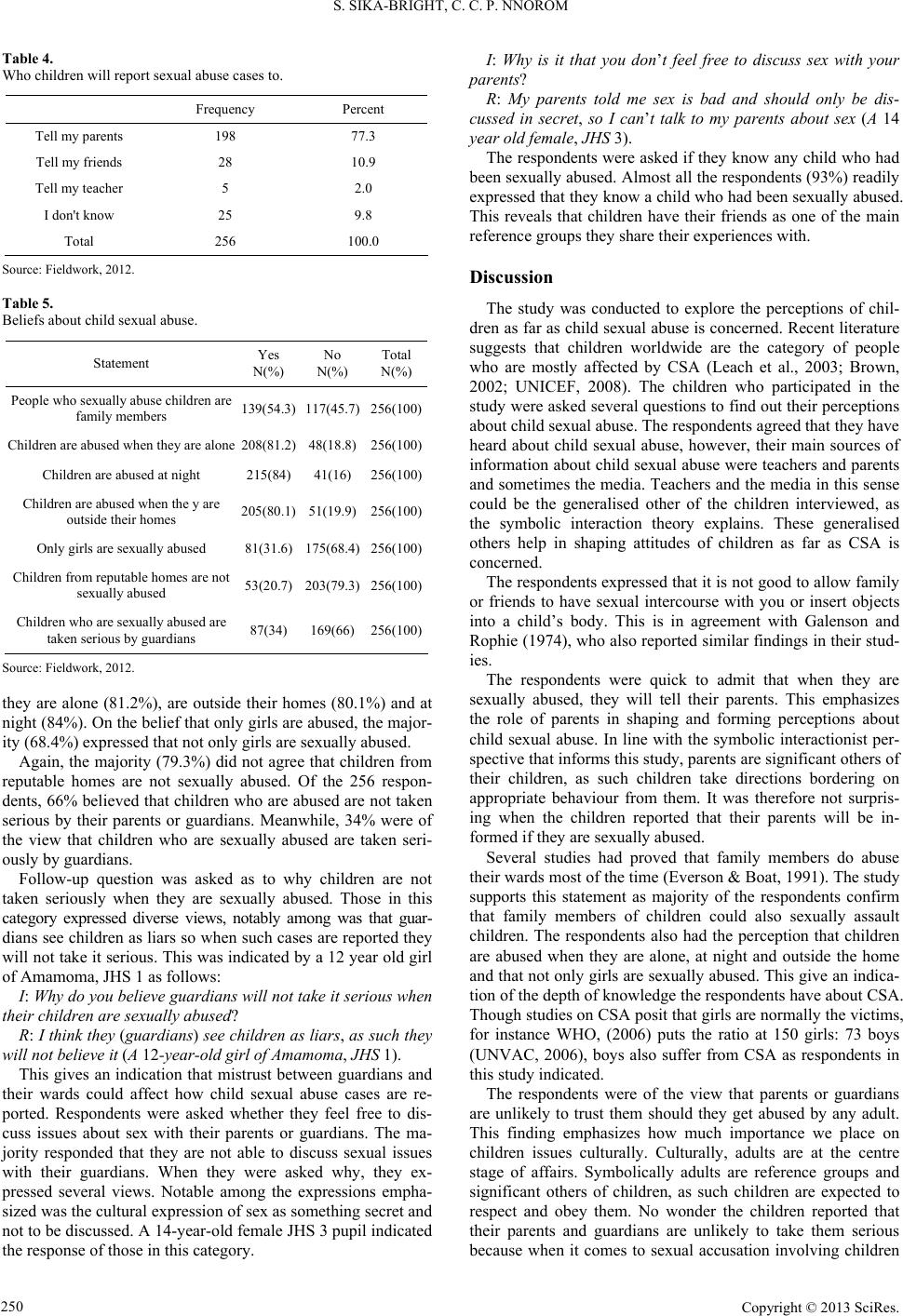 S. SIKA-BRIGHT, C. C. P. NNOROM Copyright © 2013 SciRe s . 250 Table 4. Who children will report sexual abuse cases t o . Frequency Percent Tell my parents 198 77.3 Tell my friends 28 10.9 Tell my teacher 5 2.0 I don't know 25 9.8 Total 256 100.0 Source: Fieldwork, 2012. Table 5. Beliefs about child sexual abuse. Statement Yes N(%) No N(%) Total N(%) People who sexually abuse children are family me mbers 139(54.3) 117(45.7)256(100) Children a re abused when they are alone208(81.2) 48(18.8)256(100) Children are abused at nig ht 215(84) 41(16) 256(100) Children are abused when the y are outside their homes 205(80.1) 51(19.9)256(100) Only girls are sexually abused 81(31.6) 175(68.4)256(100) Children from reputable homes a re not sexually abused 53(20.7) 203(79.3)256(100) Children who are sexually a bused are taken serious by guardians 87(34) 169(66)256(100) Source: Fieldwork, 2012. they are alone (81.2%), are outside their homes (80.1%) and at night (84%). On the belief that only girls are abused, the major- ity (68.4%) expressed that not only girls are sexually abused. Again, the majority (79.3%) did not agree that children from reputable homes are not sexually abused. Of the 256 respon- dents, 66% believed that children who are abused are not taken serious by their parents or guardians. Meanwhile, 34% were of the view that children who are sexually abused are taken seri- ously by guardians. Follow-up question was asked as to why children are not taken seriously when they are sexually abused. Those in this category expressed diverse views, notably among was that guar- dians see children as liars so when such cases are reported they will not take it serious. This was indicated by a 12 year old girl of Amamoma, JHS 1 as follows: I: Why do you believe guardians will not take it serious when their children are sexually abused? R: I think they (guardians) see children as liars, as such they will not believe it (A 12-year-old girl of Amamoma, JHS 1). This gives an indication that mistrust between guardians and their wards could affect how child sexual abuse cases are re- ported. Respondents were asked whether they feel free to dis- cuss issues about sex with their parents or guardians. The ma- jority responded that they are not able to discuss sexual issues with their guardians. When they were asked why, they ex- pressed several views. Notable among the expressions empha- sized was the cultural expression of sex as something secret and not to be discussed. A 14-year-old female JHS 3 pupil indicated the response of those in this category. I: Why is it that you don’t feel free to discuss sex with your parents? R: My parents told me sex is bad and should only be dis- cussed in secret, so I can’t talk to my parents about sex (A 14 year old female, JHS 3). The respondents were asked if they know any child who had been sexually abused. Almost all the respondents (93%) readily expressed that they know a child who had been sexually abused. This reveals that children have their friends as one of the main reference groups they share their experiences with. Discussion The study was conducted to explore the perceptions of chil- dren as far as child sexual abuse is concerned. Recent literature suggests that children worldwide are the category of people who are mostly affected by CSA (Leach et al., 2003; Brown, 2002; UNICEF, 2008). The children who participated in the study were asked several questions to find out their perceptions about child sexual abuse. The respondents agreed that they have heard about child sexual abuse, however, their main sources of information about child sexual abuse were teachers and parents and sometimes the media. Teachers and the media in this sense could be the generalised other of the children interviewed, as the symbolic interaction theory explains. These generalised others help in shaping attitudes of children as far as CSA is concerned. The respondents expressed that it is not good to allow family or friends to have sexual intercourse with you or insert objects into a child’s body. This is in agreement with Galenson and Rophie (1974), who also reported similar findings in their stud- ies. The respondents were quick to admit that when they are sexually abused, they will tell their parents. This emphasizes the role of parents in shaping and forming perceptions about child sexual abuse. In line with the symbolic interactionist per- spective that informs this study, parents are significant others of their children, as such children take directions bordering on appropriate behaviour from them. It was therefore not surpris- ing when the children reported that their parents will be in- formed if they are sexually abuse d . Several studies had proved that family members do abuse their wards most of the time (Everson & Boat, 1991). The study supports this statement as majority of the respondents confirm that family members of children could also sexually assault children. The respondents also had the perception that children are abused when they are alone, at night and outside the home and that not only girls are sexually abused. This give an indica- tion of the depth of knowledge the respondents have about CSA. Though studies on CSA posit that girls are normally the victims, for instance WHO, (2006) puts the ratio at 150 girls: 73 boys (UNVAC, 2006), boys also suffer from CSA as respondents in this study indicated. The respondents were of the view that parents or guardians are unlikely to trust them should they get abused by any adult. This finding emphasizes how much importance we place on children issues culturally. Culturally, adults are at the centre stage of affairs. Symbolically adults are reference groups and significant others of children, as such children are expected to respect and obey them. No wonder the children reported that their parents and guardians are unlikely to take them serious because when it comes to sexual accusation involving children 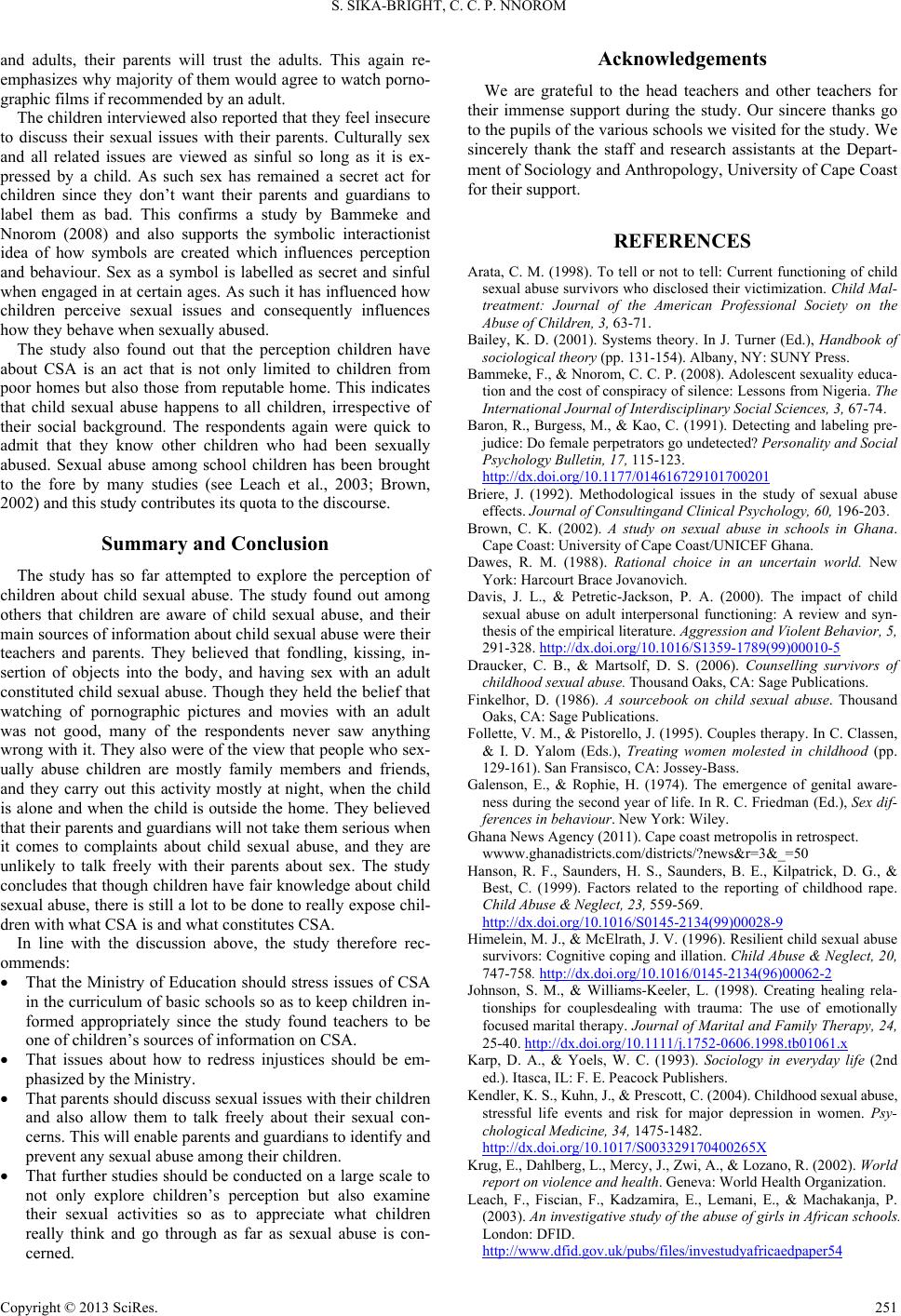 S. SIKA-BRIGHT, C. C. P. NNOROM Copyright © 2013 SciRe s . 251 and adults, their parents will trust the adults. This again re- emphasizes why majority of them would agree to watch porno- graphic films if recommended by an adult. The children interviewed also reported that they feel insecure to discuss their sexual issues with their parents. Culturally sex and all related issues are viewed as sinful so long as it is ex- pressed by a child. As such sex has remained a secret act for children since they don’t want their parents and guardians to label them as bad. This confirms a study by Bammeke and Nnorom (2008) and also supports the symbolic interactionist idea of how symbols are created which influences perception and behaviour. Sex as a symbol is labelled as secret and sinful when engaged in at certain ages. As such it has influenced how children perceive sexual issues and consequently influences how they behave when sexually abused. The study also found out that the perception children have about CSA is an act that is not only limited to children from poor homes but also those from reputable home. This indicates that child sexual abuse happens to all children, irrespective of their social background. The respondents again were quick to admit that they know other children who had been sexually abused. Sexual abuse among school children has been brought to the fore by many studies (see Leach et al., 2003; Brown, 2002) and this study contributes its quota to the discourse. Summary and Conclusion The study has so far attempted to explore the perception of children about child sexual abuse. The study found out among others that children are aware of child sexual abuse, and their main sources of information about child sexual abuse were their teachers and parents. They believed that fondling, kissing, in- sertion of objects into the body, and having sex with an adult constituted child sexual abuse. Though they held the belief that watching of pornographic pictures and movies with an adult was not good, many of the respondents never saw anything wrong with it. They also were of the view that people who sex- ually abuse children are mostly family members and friends, and they carry out this activity mostly at night, when the child is alone and when the child is outside the home. They believed that their parents and guardians will not take them serious when it comes to complaints about child sexual abuse, and they are unlikely to talk freely with their parents about sex. The study concludes that though children have fair knowledge about child sexual abuse, there is still a lot to be done to really expose chil- dren with what CSA is and what constitutes CSA. In line with the discussion above, the study therefore rec- ommends: That the Ministry of Education should stress issues of CSA in the curriculum of basic schools so as to keep children in- formed appropriately since the study found teachers to be one of children’s sources of information on CSA. That issues about how to redress injustices should be em- phasized by the Ministry. That parents should discuss sexual issues with their children and also allow them to talk freely about their sexual con- cerns. This will enable parents and guardians to identify and prevent any sexual abuse among their children. That further studies should be conducted on a large scale to not only explore children’s perception but also examine their sexual activities so as to appreciate what children really think and go through as far as sexual abuse is con- cerned. Acknowledgements We are grateful to the head teachers and other teachers for their immense support during the study. Our sincere thanks go to the pupils of the various schools we visited for the study. We sincerely thank the staff and research assistants at the Depart- ment of Soc iol ogy a nd Ant hro polo gy, Un ive rsity of Cape Co ast for their support. REFERENCES Arata, C. M. (1998). To tell or not to tell: Current functioning of child sexual abuse survivors who disclosed their victimization. Child Mal- treatment: Journal of the American Professional Society on the Abuse of Children, 3, 63-71. Bailey, K. D. (2001). Systems theory. In J. Turner (Ed.), Handbook of sociological theory (pp. 131-154). Albany, NY: SUNY Press. Bammeke, F., & Nnorom, C. C. P. (2008). Adolescent sexuality educa- tion and the cost of conspiracy of silence: Lessons from Nigeria. The International Journal of Interdisciplinary S ocial Sciences, 3, 67-74. Baron, R., Burgess, M., & Kao, C. (1991). Detecting and labeling pre- judice: Do female perpetrators go undetected? Personality and Social Psychology Bulletin, 17, 115-123. http://dx.doi.org/10.1177/014616729101700201 Briere, J. (1992). Methodological issues in the study of sexual abuse effects. Journal of Consultingand Clinical Psychology, 60, 196-203. Brown, C. K. (2002). A study on sexual abuse in schools in Ghana. Cape Coast: University of Cape Coast/UNICEF Ghana. Dawes, R. M. (1988). Rational choice in an uncertain world. New York: Harcourt Brace Jovanovich. Davis, J. L., & Petretic-Jackson, P. A. (2000). The impact of child sexual abuse on adult interpersonal functioning: A review and syn- thesis of the empirical literature. Aggression and Violent Behavior, 5, 291-328. http://dx.doi.org/10.1016/S1359-1789(99)00010-5 Draucker, C. B., & Martsolf, D. S. (2006). Counselling survivors of childhood sexual abuse . Thousand Oaks, CA: Sage Publications. Finkelhor, D. (1986). A sourcebook on child sexual abuse. Thousand Oaks, CA: Sage Publications. Follette, V. M., & Pistorello, J. (1995). Couples therapy. In C. Classen, & I. D. Yalom (Eds.), Treating women molested in childhood (pp. 129-161). San F ransisco, CA: Jossey-Bas s . Galenson, E., & Rophie, H. (1974). The emergence of genital aware- ness during the second year of life. In R. C. Friedman (Ed.), Sex dif- ferences in behaviour. New York: Wiley. Ghana News Agency (2011). C ape coast metropolis in retrospect. wwww.ghanadistricts.com/districts/?news&r=3&_=50 Hanson, R. F., Saunders, H. S., Saunders, B. E., Kilpatrick, D. G., & Best, C. (1999). Factors related to the reporting of childhood rape. Child Abuse & Neglect, 23, 559-569. http://dx.doi.org/10.1016/S0145-2134(99)00028-9 Himelein, M. J., & McElrath, J. V. (1996). Resilient child sexual abuse survivors: Cognitive coping and illation. Child Abuse & Neglect, 20, 747-758. http://dx.doi.org/10.1016/0145-2134(96)00062-2 Johnson, S. M., & Williams-Keeler, L. (1998). Creating healing rela- tionships for couplesdealing with trauma: The use of emotionally focused marital therapy. Journal of Marital and Family Therapy, 24, 25-40. http://dx.doi.org/10.1111/j.1752-0606.1998.tb01061.x Karp, D. A., & Yoels, W. C. (1993). Sociology in everyday life (2nd ed.). Itasca, IL: F. E. Peacock Publishers. Kendler, K. S., Kuhn, J., & Prescott, C. (2004). Childhood sexual abuse, stressful life events and risk for major depression in women. Psy- chological Medicine, 34, 1475-1482. http://dx.doi.org/10.1017/S003329170400265X Krug, E., Dahlberg, L., Mercy, J., Zwi, A., & Lozano, R. (2002). World report on violence and health. Geneva: World Health Organization. Leach, F., Fiscian, F., Kadzamira, E., Lemani, E., & Machakanja, P. (2003). An investigative study of the abuse of girls in African schools. London: DFID. http://www.dfid.gov.uk/pubs/files/investudyafricaedpaper54  S. SIKA-BRIGHT, C. C. P. NNOROM Copyright © 2013 SciRe s . 252 Mead, G. H. (1934). Mind, self, and society. In C. Morris (Ed.), Chi- cago: University of Chicago Press. Parrot, A., & Cummings, N. (2008). Sexual enslavement of girls and women worldwide. London: Praeger. Proulx, J., Koverola, C., Fedorowicz, A., & Kral, M. (1995). Coping strategies as predictors of distress in survivors of single and multiple sexual victimization and nonvictimised controls. Journal of Applied Social Psychology, 2 5 , 1464-1483. http://dx.doi.org/10.1111/j.1559-1816.1995.tb02627.x Saewyc, E. M., Pettingell, S., Lara, L., & Magee, L. L. (2003). The prevalence of sexual abuse among adolescents in school. The Journal of School Nursing, 19, 266-268. http://dx.doi.org/10.1177/10598405030190050401 Sanderson, C. (2006). Counselling adult survivors of child sexual abuse. London: Jessica Kingsley Publishers. Smith, D. W., Letourneau, E. J., & Saunders, B. E. (2000). Delay in disclosure of childhood rape: Results from a national survey. Child Abuse & Neglect, 24, 273-287. http://dx.doi.org/10.1016/S0145-2134(99)00130-1 UNICEF (2008). Abus, exploitation et violence sexuels a l‘encontredes enfants a l’ecole en Afrique de l’ouest et du centre. UNICEF Bureau Regional, Afrique de l’Ouest et du Centre. Webster, R. E. (2001). Symptoms and long-term outcomes for children who have been sexually assaulted. Psychology in the Schools, 38, 533-547. http://dx.doi.org/10.1002/pits.1041 Whiffen, V. E., Thompson, J. M., & Aube, J. A. (2000). Mediators of the link between childhood sexual abuse and adult depressive symp- toms. Journal of Interpersonal Violence, 15, 1100-1120. http://dx.doi.org/10.1177/088626000015010006 Wurtele, S. K., & Miller-Perrin, C. L. (1992). Preventing child sexual abuse. London: University of Nebraska. Wyatt, G. E., & Newcomb, M. D. (1990). Internal and external media- tors of women’s sexual abuse in childhood. Journal of Consulting & Clinical Psychology, 58, 758-767. http://dx.doi.org/10.1037/0022-006X.58.6.758 |