

Paper Menu >>
Journal Menu >>
 International Journal of Geosciences, 2013, 4, 54-59 http://dx.doi.org/10.4236/ijg.2013.45B009 Published Online September 2013 (http://www.scirp.org/journal/ijg) Copyright © 2013 SciRes. IJG Survey of Climate-Related Risks to Tilapia Pond Farms in Northern Thailand Pornpimol Pimolrat1, Niwooti Whangchai1, Chanagun Chitmanat1, Jongkon Promya1, Louis Lebel2 1Faculty of Fisheries Technology and Aquatic Resources, Maejo University, Chiang Mai, Thailand 2Unit for Social and Environmental Research (USER) Faculty of Social Science, Chiang Mai University, Chiang Mai, Thailand Email: [email protected] Received July 2013 ABSTRACT Climate is an important factor for aquacultur e production. This study aimed to understand how farmers that culture til a- pia in earthen ponds perceive and respond to climate impacts. Important climate-related risks identified include extr eme temperatures (hot and cold), excessive rainfall, prolonged cloud cover, flood and drought. Site visits and data collection using questionnaires were conducted to identify important factors influencing farm profits, losses, decision to increase or decrease ponds. Special attention was given to knowledge about fish markets and weather and the impacts of weather and climate on fish growth, diseas e outbre aks and water quality in ponds . Altoge ther 585 fish farms in four prov inces in northern part of Thailand selected to cover a range of elevations above sea level and thus climate were surveyed (Na- kornsawan < 100 m, Lampang 100 - 300 m, Phayao 300 - 500 m and Chiang Mai > 500 m). Fish farms at different ele- vations reported different climate and weather-related impacts. In the area where elevation above sea level is < 100 m, farmers were affected more by floods and extreme hot weather which caused fish deaths and stress that reduced feeding and growth rates. Conversely, fish farmers in the area where elevation above sea level is >500 were impacted mainly by drought and cold weather. These conditions also caused disease outbreaks and reduced feeding rates. Farmers respond- ed by reducing the amount of feed supplied and considering non-fish pond or non-farm supplementary occupations as an adaptation strategy. Among non-climate related factors high prices of feed were most commonly identified as a key issue by farmers. The differences among sites at higher and lower elevation provided insights into the kind of changes in risks farmers may face as climate changes that could be helpful in developing adaptation strategies for individual farmers and the sector as a whole. Keywords: Climate; Tilapia Pond Culture; Aquaculture; Thailand 1. Introduction Climate is an environmental factor that is strongly asso- ciated to aquaculture productivity [1]. Being coldblooded animal, fish is affected by the temperature of the sur- rounding water which influences the body temperature, growth rate, food consumption, feed conversion, and other body functions [2,3]. Over the past few years, ris- ing global temperatures have received much attention because of their worldwide impact on ecosystems. The climate models referenced by the Intergovernmental Panel on Climate Change (IPCC) [4] predicted that glob- al temperatures are likely to increase by 1.4˚C to 6.4˚C in this century. Nile tilapia (Oreochromis niloticus) is a freshwater fish of great commercial interest. It is easy to cultur e and adapts well to a range of environments. Tilapia culture is one of the largest aquaculture industries in Thailand [5]. In the mountainous northern region, relatively high alti- tude and latitude contribute to more pronounced seasonal temperature variation, with cooler winters than in other regions. Numerous climate variables vary with elevation [6]. Some farmers rear fish in cages suspended in rivers. This culture system is sensitive to extreme weather events, such as floods or droughts [7,8]. It is also sensi- tive to seasonal differences in water temperature, flow speeds and water quality. Ponds, however, are the most common production systems on a worldwide basis. Tila- pia fish culture in earthen ponds in northern Thailand can be divided into three categories: commercial, integrated (with pig or chicke n) and subsistence. In recent years, production of pond-raised tilapia in northern Thailand has been hampered by climate-related risks including extreme temperatures (hot and cold), ex- cessive rainfall, prolonged cloud cover, flood and drought all of which potentially cause fish deaths, stress and reduced feeding and growth rates. In order to better understand the effects of climate on tilapia pond farms  P. PIMOLRAT ET AL. Copyright © 2013 SciRes. IJG 55 this study compared sites along an elevation gradient in northern Thailand. The specific objective of this study was to improve understanding of how fish farmers in different elevation perceive and respond to climate im- pacts. The differences among sites at higher and lower elevation provided insights into the kind of changes in risks farmers may face as climate changes that could be helpful in developing adaptation strategies for individual farmers and the sector as a whole. 2. Material and Methods 2.1. Sampling of Fish Farms A total of 585 fish farmers were interviewed for this study. The tilapia farmers were randomly selected from the list of farmers in collaboration with the fisheries of- ficers of the Department of Fisheries. An effort was made to interview fish farmers currently or recently hav- ing reared tilapia in fish ponds in nine provinces in northern part of Thailand. Not all who had recently stopped farming could be contacted. Local fisheries offi- cials, community leaders and private sector feed and stock suppliers were used to help locate farmers. Almost all farmers approached agreed to participate in the survey and were able to answer all questions. Interviews were carried out using a structure d questionnaire with farmers. The questionnaire covered individual, farm and site level characteristics as well as more detailed sections about impacts from extreme temperatures (hot and cold), ex- cessive rai nfal l, prol onged cl ou d cove r, fl ood a nd droug ht . Sites were grouped by provinces into four elevations for analysis: <100 meters above sea level (masl) (Nak- honsawan, Pichit, Kamphengphet, Uttaradit and Phitsa- nulok), 100 - 300 masl (Lampang), and 300 - 500 masl (Phayao and Chiangrai) and >500 masl (upland areas in Chiangmai). The characteristic climate of each elevation are described and summarized in Tabl e 1. 2.2. Data Analysis The data were compared between elevations for each fish farm. All reports about difference in this text were sig- nificant at the P < 0.05 or better level; Tukey HSD tests were used post-hoc to separate means following detec- tion of a significant main effect in ANOVA when there was three or more means. 3. Results and Discussion 3.1. Characteristics of Fish Farmers The characteristic of the farms and farmers’ obtained from the present study are presented in Table 2. The re- sults show that there were more male farmers than fe- males. Fish farmers were mostly middle-age and had a primary school level of education. Approximately 30% of households had a monthly income in the range of 5,000 - 10,000 Thai Baht. The fish farmers’ commonly had pond-culture experience ranged from 3 - 10 years. 3.2. Climate Impacts at Di f f erent Elevation The likelihood of climate impacts on farms in different range of elevation (masl) is shown in Figure 1. Fish farms at different elevations reported different climate and weather-related impacts. In the area where elevation above sea level is <100 m, farms were affected more by floods (36%) and extreme hot weather (31%). Farms at elevation above sea level 100 - 300 had higher drought (35%) problem than other areas. The highest long cloud cover (51%) impact was foun d in 300 - 500 sites. On the other hand, fish farmers in the area where elevation above sea level is >500 were impacted most by extreme cold weather. Table 1. Climate in the four study areas (between years 1990-2010). Provinces for which precipitation and temperature data are shown bel ow are underlined. Conditions E levation MASL (m) <100 100 - 300 300-500 >500 Provinces Nakon-swan Kamphengphet Phitsanolok Uttaradit Lampang Phayao Chiangrai Chiangmai Mean minimum temp in coldest month 18.6 (Jan) 15.7 (Jan) 13.3 (Jan) 12.6 (Dec) Mean maximum temp in coldest month 37.6 (Apr) 37.9 (Apr) 35.4 (Apr) 27.4 (Apr) Mean precipitation in wettest month 250.2 (Sep) 218.6 (Sep) 281.2 (Sep) 186.8 (Sep) Mean precipitation in driest month 4.4 (Jan) 3.9 (Jan) 7.4 (Jan) 3.3 (J an) Average mean annual precipitation (mm) 1289.4 900.3 1398.9 1233 CV (mean annual precipitation) 0.07 0.47 0.30 0.16 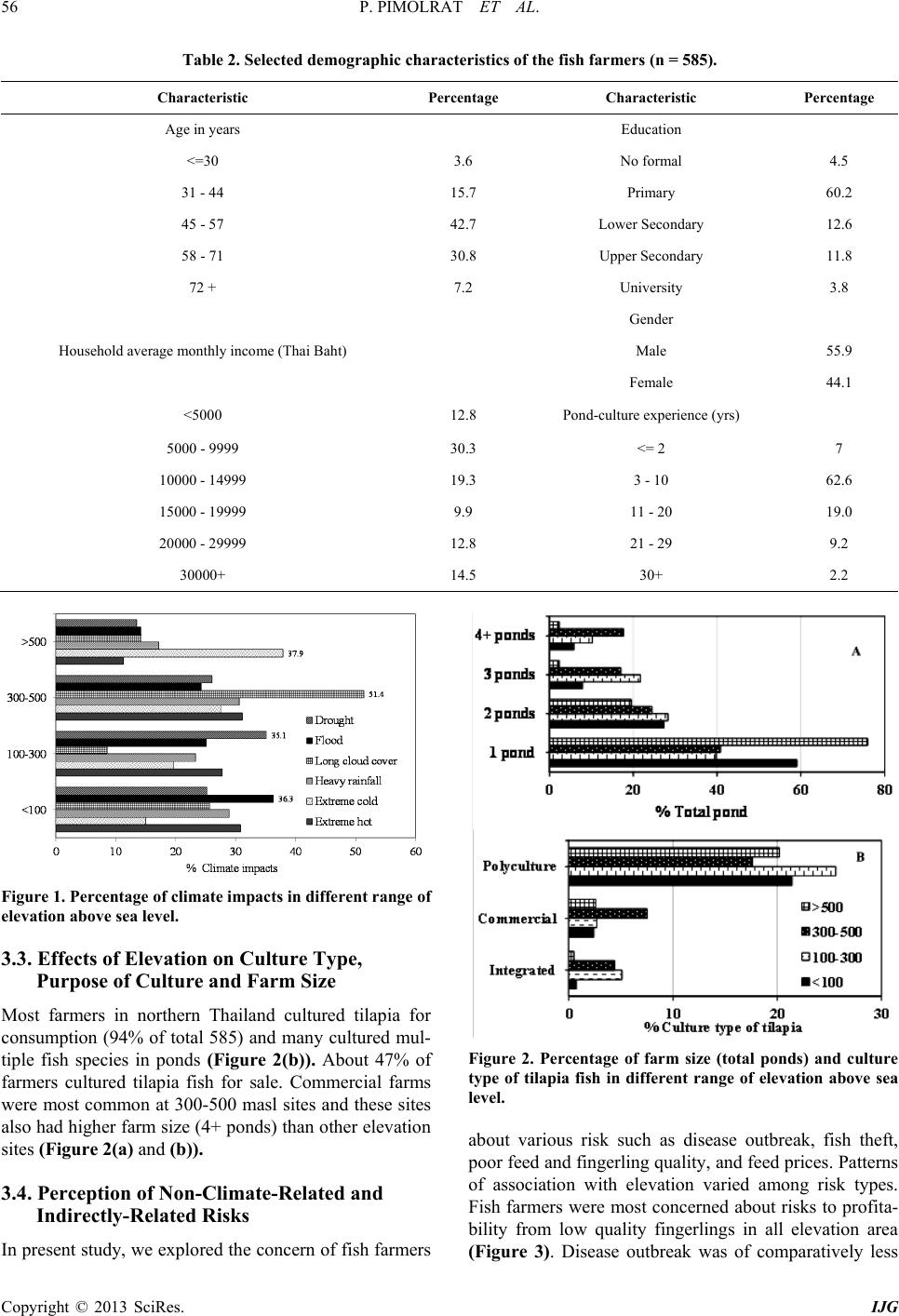 P. PIMOLRAT ET AL. Copyright © 2013 SciRes. IJG 56 Table 2. Selected demographic characteristics of the fish farmers (n = 585). Characteristic Percentage Characteristic Percentage Age in years Education <=30 3.6 No formal 4.5 31 - 44 15.7 Primary 60.2 45 - 57 42.7 Lower Secondary 12.6 58 - 71 30.8 Upper Secondary 11.8 72 + 7.2 University 3.8 Household average monthly income (Thai Baht) Gender Male 55.9 Female 44.1 <5000 12.8 Pond-culture experience (yrs) 5000 - 9999 30.3 <= 2 7 10000 - 14999 19.3 3 - 10 62.6 15000 - 19999 9.9 11 - 20 19.0 20000 - 29999 12.8 21 - 29 9.2 30000+ 14.5 30+ 2.2 Figure 1. Percentage of climate impacts in different range of elevation above sea level. 3.3. Effects of Elevation on Culture Type, Purpose of Culture and Farm Size Most farmers in northern Thailand cultured tilapia for consumption (94% of total 585) and many cultured mul- tiple fish species in ponds (Figure 2(b)). About 47% of farmers cultured tilapia fish for sale. Commercial farms were most common at 300-500 masl sites and these sites also had higher farm size (4+ ponds) than other elevation sites (Fi gure 2(a) and (b)). 3.4. Perception of Non-Climate-Related and Indirectly-Related Risks In present study, w e explored the concern of fish farmers Figure 2. Percentage of farm size (total ponds) and culture type of tilapia fish in different range of elevation above sea level. about various risk such as disease outbreak, fish theft, poor feed and fingerling quality, and feed prices. Patterns of association with elevation varied among risk types. Fish farmers were most concerned about risks to profita- bility from low quality fingerlings in all elevation area (Figure 3). Disease outbreak was of comparatively less 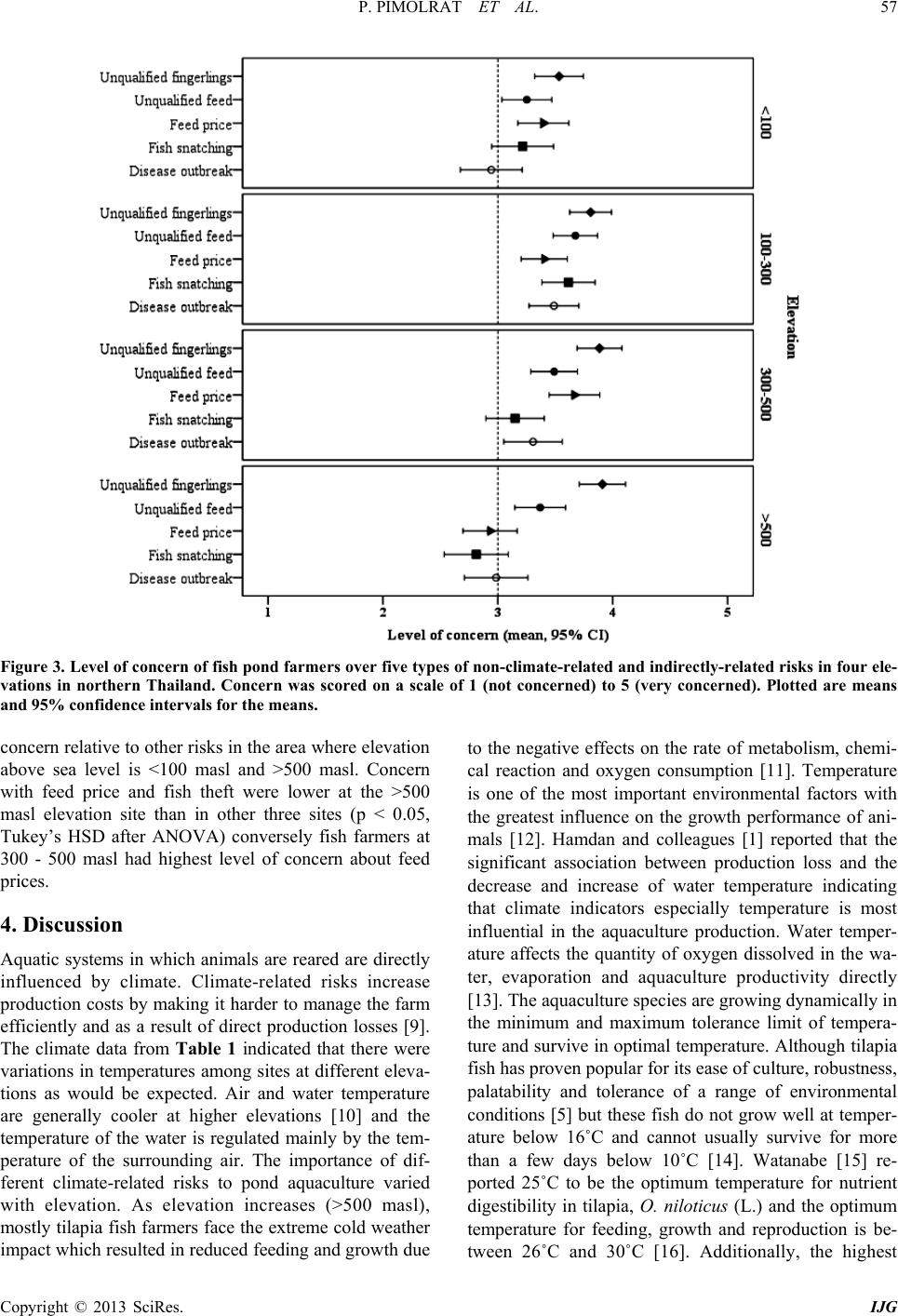 P. PIMOLRAT ET AL. Copyright © 2013 SciRes. IJG 57 Figure 3. Level of concern of fish pond farmers over five types of non-climate-related and indir ectly-related risks in four ele- vations in northern Thailand. Concern was scored on a scale of 1 (not concerned) to 5 (very concerned). Plotted are means and 95% confidence intervals for the means. concern relative to other risks in the area where elevation above sea level is <100 masl and >500 masl. Concern with feed price and fish theft were lower at the >500 masl elevation site than in other three sites (p < 0.05, Tukey’s HSD after ANOVA) conversely fish farmers at 300 - 500 masl had highest level of concern about feed prices. 4. Discussion Aquatic systems in which animals are reared are directly influenced by climate. Climate-related risks increase production costs by making it harder to manage the farm efficiently and as a result of direct production losses [9]. The climate data from Table 1 indicated that there were variations in temperatures a mong sites at different elev a- tions as would be expected. Air and water temperature are generally cooler at higher elevations [10] and the temperature of the water is regulated mainly by the tem- perature of the surrounding air. The importance of dif- ferent climate-related risks to pond aquaculture varied with elevation. As elevation increases (>500 masl), mostly tilapia fish farmers face the extreme cold weather impact which resulted in reduced feeding and growth due to the negative effects on the rate of metabolism, chemi- cal reaction and oxygen consumption [11]. Temperature is one of the most important environmental factors with the greatest influence on the growth performance of ani- mals [12]. Hamdan and colleagues [1] reported that the significant association between production loss and the decrease and increase of water temperature indicating that climate indicators especially temperature is most influential in the aquaculture production. Water temper- ature affects the quantity of oxygen dissolved in the wa- ter, evaporation and aquaculture productivity directly [13]. The aquaculture species are growing dynamically in the minimum and maximum tolerance limit of tempera- ture and survive in optimal temperature. Although tilapia fish has proven popular for its ease of culture, robustness, palatability and tolerance of a range of environmental conditions [5] but these fish do not grow well at temper- ature below 16˚C and cannot usually survive for more than a few days below 10˚C [14]. Watanabe [15] re- ported 25˚C to be the optimum temperature for nutrient digestibility in tilapia, O. niloticus (L.) and the optimum temperature for feeding, growth and reproduction is be- tween 26˚C and 30˚C [16]. Additionally, the highest  P. PIMOLRAT ET AL. Copyright © 2013 SciRes. IJG 58 percentage of small farm size (one pond) was also found in this elevation (>500 masl) one reason possible because of the unsuitable temperature for culture tilapia fish. O. niloticus is known to tolerate high temperatu res: up to 40˚C - 42˚C [17]. However, rapid temperature varia- tion will have a negative effect on these species growth due to the less dissolved oxygen in the warm water [12]. The present study clearly showed that farmers growing fish above sea level, <100 and 300 - 500 masl, were af- fected more by extreme hot weather than other areas. Especially, farms at 300 - 500 elevation sites which are in the highest commercial categories, and the larger farm sizes (4+ ponds) are usually found in this elevation, the farmers should be more aware of this important risk be- cause the association between high temperature and dis- solved oxygen (DO) have impact on fish production. In addition, the temperatures above 32˚C may significantly results in slow growth, reduce feeding efficiency and increase mortality [12]. Floods are seasonal phenomena happening frequently during rainy season in certain regions [13]. In 2011, many areas in Thailand had severe flooding leading to highest ever damage costs [18]. The present study clearly showed that the fish farmers at elevation <100 masl (Nakonswan, Phijit, Kamphengphet, Phitsanolok and Uttaradit) faced higher impact from floods than in other regions. According to the flood, many farmers have to leave their houses, farms, and lose their job therefore most farms in this site are smaller (one pond) and were mostly subsistence culture. For reduction and adapting to this impact, some farmers who cultured tilapia in these areas changed to culture other fish species for example Mekong giant catfish (Pangasianodon gigas) or used the bigger fingering to reduce time of culture per crop. This strategy will help them minimize the production loss and ensure that the percentage of new fish stock rises suc- cessfully and survive in the massive raining season that occurs at year end. Generally, the impact of drought or amount of precipitation (Table 1) has been associated with the volume of water for exchange during culture. The long drought season and raining fluctuation impli- cated less DO problem to the pond water [1]. In this study, the impacts from drought were mostly founded at 100 - 300 masl where highest percentage of poly culture system has been carried out. Finally, levels of concern on non-climate risks are as- sociated between elevation and culture type of fish. It was found that the unqualified fingering and feed prices implicated more concerned to culture tilapia fish, espe- cially at the large commercial tilapia culture of northern Thailand (at 300 - 500 masl, Phayao and Chiangrai provinces). To reduce or solve this problem, research in genetics and selective breeding will be needed to im- prove pr od uc tion effi c iency. 5. Conclusions This study showed that the climate-related events and phenomenon (flood, drought, long cloud cover, and ex- treme hot and cold weather) to tilapia pond culture var ies with elevation and culture systems. The extreme cold weather are mostly presented at >500 masl elevation where the highest percentage of small farm size (one pond) was found. On the other hand, the fish farmers at <100 masl elevation (Nakonswan, Phijit, Kamphengphet, Phitsanolok and Uttaradit) faced higher impact from flooding than in other regions. Moreover, the data from our quantitative survey indicated that low quality finger- ings and high feed price are factors of high concern to tilapia farmers, especially at the large commercial tilapia culture of northern Thailand (at 300 - 500 masl, Phayao and Chiangrai provinces). The findings of our survey improve understanding of how fish farmers at different elevation obtain the climate impacts that could be helpful in developing adaptation s trategies for individual f armers and the sector as a whole. Future work should focus on how farmers manage risks and awareness of climate change. 6. Acknowledgements The work was carried out with the aid of a grant from the International Development Research Centre, Ottawa, Canada, as a contribution to the AQUADAPT project. Thanks to the many field assistants, students, officials and farmers who he lpe d with the surveys. REFERENCES [1] R. Hamdan, F. Kari and A. Othman, “Climate Variability and Socioeconomic Vulnerability of Aquaculture Farmers in Malaysia,” Proceeding of the 2011 International Con- ference on Business and Economics Research, Singapore, 2011, pp. 47-52. [2] P. J. Britz, T. Hecht and S. Mangold, “Effect of Temper- ature on Growth, Feed Consumption and Nutritional In- dices of Haliotis midae Fed a Formulated Diet,” Aqua- culture, Vol. 152, 1997, pp. 191-203. http://dx.doi.org/10.1016/S0044-8486(97)00002-1 [3] P. A. Azevedo, C. Y. Cho, S. Leeson and D. P. Bureau, “Effects of Feeding Level and Water Temperature on Growth, Nutrient and Energy Utilization and Waste Out- puts of Rainbow Trout (Oncorhynchus mykiss),” Aquatic Living Resources, Vol. 11, No. 4, 1998, pp. 227-238. http://dx.doi.org/10.1016/S0990-7440(98)89005-0 [4] IPCC, “Climate Change 2001: Thescientific Basis,” Cam- bridge University Press, Oxford, 2001. [5] B. Belton, D. Turongruang, R. Bhujel and D. C. Little, “The History, Status, and Future Prospects of Monosex Tilapia Culture in Thailand,” Aquaculture Asia Magazine, Vol. 16, 2009, pp. 16-19. [6] A. V. Badyaev and C. K. Ghalambor, “Evolution of Life  P. PIMOLRAT ET AL. Copyright © 2013 SciRes. IJG 59 History along Elevation Gradients: Trade-Off between Parental Care and Fecundity,” Ecology, Vol. 82, No. 10, 2001, pp. 2948-2960. http://dx.doi.org/10.1890/0012-9658(2001)082[2948:EO LHAE]2.0.CO;2 [7] P. Lebel, S. Leudpasuk, L. Lebel and P. Chaibu, “Fish Cage Culture in Upper Part of Ping River,” Journal of Fisheries Technology, Vol. 1, No. 2, 2007, pp. 160-170. [8] P. Lebel, P. Chaibu and L. Lebel, “Women Farm Fish: Gender and Commercial Fish Cage Culture on the Upper Ping River, Northern Thailand,” Gender, Technology and Development, Vol. 13, No. 2, 2009, pp. 199-224. http://dx.doi.org/10.1177/097185241001300202 [9] V. T. Sulit, M. E. T. Aldon, I. T. Tendencia, A. M. J. Ortiz, S. B Alayon and A. S. Ledesma, “Regional Tech- nical Consultation on the Aquaculture of P. vannamei and other Exotic Shrimps in Southeast Asia. Manila, Philip- pines,” Aquaculture Department, Southeast Asian Fishe- ries Development Center, 2005. [10] C. L. Meays, “Elevation, Thermal Environment, and Stream Temperatures on Headwater Streams in Nor- theastern Oregon” Master Thesis, Oregon State Universi- ty, 2000. [11] J. H. Tidwell, S. Coyle, C. Weibel and J. Evans, “Effects and Interactions of Stocking Density a nd Added Substrate on Production and Population Structure of Freshwater Prawns Macrobrachium rosenbergii,” Journal of the World Aquaculture Society, Vol. 30, 1999, pp. 174-179. http://dx.doi.org/10.1111/j.1749-7345.1999.tb00864.x [12] N. P. Pandit and M. Nakamura, “Effect of High Temper- ature on Survival, Growth and Feed Conversion Ratio of Nile Tilapia, Oreochromis Niloticus,” Our Nature, Vol. 8, 2010, pp. 219-224. [13] M. N. Kutty, “Site Selection for Aquaculture: Climatic Factors,” 1987. http://www.fao.org/docrep/field/003/AC171E/AC171E00 .HTM [14] J. Chervinski, “Environmental Physiology of Tilapias,” Proceeding of the Biology and Culture of Tilapia, IC- LARM Conference, Manila, Philippines, 1982. [15] T. Watanabe, T. Takeuchi, S. Satoh and V. Kiron, “Di- gestible Crude Protein Contents in Various Feedstuffs Determined with Four Freshwater Fish Species,” F i she- ries Science, Vol. 62, 1996, pp. 278-282. [16] W. J. Hauser, “Temperature Requirement of Tilapia,” California Fish and Game, Vol. 63, No. 4, 1977, pp. 228- 233. [17] J. C. Philippart and J. C. Ruwet, “Ecology and Distribu- tion of Tilapias,” In: R. S. V. Pullin & R. H. Lowe- McConnell, Eds., The Biology and Culture of Tilapias, ICLARM, Manila, Philippines, 1982, pp. 15-60. [18] HAII, “2011 Thailand Flood Executive Summary,” 2012. http://www.thaiwater.net/web/index.php/ourworks2554/3 79-2011flood-summary .html |