

Paper Menu >>
Journal Menu >>
 International Journal of Geosciences, 2013, 4, 46-53 http://dx.doi.org/10.4236/ijg.2013.45B008 Published Online September 2013 (http://www.scirp.org/journal/ijg) Copyright © 2013 SciRes. IJG Relationships of Dissolved Oxygen with Chlorophyll-a and Phytoplankton Composition in Tilapia Ponds Kornkanok Kunlasak1,2, Chanagun Chitmanat1, Niwooti Whangchai1, Jongkon Promya1, Louis Lebel2 1Faculty of Fisheries Technology and Aquatic Resources, Maejo University, Chiang Mai, Thailand 2Unit for Social and Environmental Research (USER) Faculty of Social Science, Chiang Mai University, Ch iang Mai, Thailand Email: [email protected] Received July 2013 ABSTRACT This study investigated the relationships among the parameters of dissolved oxygen, chlorophyll-a and phytoplankton composition in tilapia ponds. Each pond (a total of 18 ponds) was sampled once in the dry, winter season between J an- uary and March and again early in the rainy season between May and June. The data were analyzed by examining cor- relations among parameters as affected by season, altitude and culture system. Observations were made at sites located in 5 selected provinces of northern Thailand: Chiangrai, Chiangmai, Phayao, Lampang and Nakornsawan. Mean eleva- tion of these areas range from 25 to 582 meters above sea level (masl) and were categorized into low (<400 masl) and high (>400 masl) elevation sites. Ponds were 0.8 - 2.0 m deep, 0.16 - 0.64 ha in area and could be further categorized into high and low input systems.Mean air temperature in winter ranged between 16.5˚C - 35.8˚C while mean water temperature ranged between 25.5˚C - 27.1˚C. In rainy season, air temperature ranged between 22.0˚C - 3 7. 3˚C an d wa- ter temperature ranged between 29.4˚C - 31.8˚C. The amount of chlorophyll-a in both seasons were comparable (p > 0.05), but chlorophyll-a in high input system was significantly higher (p < 0.05) than in low input ponds. Only weak correlation was found between chlorophyll-a, DOmax and DOmin. Multifactor-ANOVA was used to analyze the differ- ence of total bacteria and filamentous cyanobacteria in ponds based upon elevation, culture systems and season. Result shows that there is a significant interaction observed between elevation, culture system and season (p < 0.05). Species diversity and composition of phytoplankton in fish ponds in 2 seasons revealed the presence of 90 genera of phytop- lankton under all 7 divisions. Divisions Chlorophyta and Cyanophyta had the most number of genera identified in both seasons with Pediastrum spp., and Scendesmus spp., and Anabaena spp. as dominant genera/genus, respectively. Keywords: Dissolved O xygen; Chlorophyll-a; Phytoplankton Composition; Tilapia Ponds; Elevation, Season 1. Introduction Increased demand for high protein food and apparent declines in capture fisheries together have helped drive rapid expansion of the aquaculture industry in the past two decades. Th e aquacultur e industry howev er is facing challenges such as high cost of inputs and climatic changes. Climate effect such as increase in temperature is observed to increase disease transmission, deplete oxy- gen, increase incidence of harmful algal blooms in ponds to mention a few [1]. Tilapia culture is one of the major aquaculture indus- tries in Thailand with river cage and earthen pond cul- tures were both practiced. However, some tilapia cage farmers have switched from river to earthen pond due to difficulties with extreme water flows and poor water quality. There are substantial differences in tilapia cul- ture systems among places depending on various con- straints and opportunities such as topography (lowland and upland) and availability of water and alternative nu- trient inputs [2]. Elevation above sea level, for instance, influences air and water temperature in pond culture [3]. Physical, chemical and biological water quality in fish pond ecosystem influences growth and survival rates as well as reproduction and likelihood of disease infection [4]. Dissolved oxygen (DO), in particular, is an important factor for fish respiration and phytoplankton dynamics. DO content typically correlates with phytoplankton den- sity in fish ponds. Main tenance of phytoplank ton popula- tions at desired levels is an important but difficult aspect of fish pond management. Many fish culture manuals stress that an algal bloo m must be maintained to improve oxygen levels, to prevent macrophyte growth, and to provide natural foods, either directly or indirectly, for fish in the pond [5-7]. At the same time, however, uncon- trolled algal growth causes many serious problems for aquaculturists [8]. Thus, proper management of phytop-  K. KUNLASAK ET AL. Copyright © 2013 SciRes. IJG 47 lankton growth is a major goal of modern pond aquacul- ture [7-10]. While phytoplankton affects water quality in several ways [7,8], the difficulty and importance of managing phytoplankton stem primarily from the complex rela- tionship between algal dynamics and dissolved oxygen levels. Phytoplankton are the major source of dissolved oxygen in fish ponds as well as—directly as consumers and indirectly as the source of detritus upon which most bacterial respiration is b ased—the major sink for oxygen [11,12]. Dissolved oxygen levels depend primarily on the relative magnitudes of photosynthetic oxygen generation and total plankton respiration [13]. Given the complexity of this relationship and the importance of dissolved oxy- gen to aquacultural production [14], the interaction be- tween dissolved oxygen and phytoplankton biomass should be e xamined in de t a il. Water quality in aquaculture ponds is influenced by management and other external factors such as culture system, stocking densities, water exchange practices and sources, and fertilizer application. The main objective of this research was to determine the association between chlorophyll-a, phytoplankton composition, and dissolved oxygen in tilapia ponds from different culture systems in winter and rainy seasons. This information will be then used to develop techniques to manage phytoplankton and dissolved ox yge n dynamics in fish ponds . 2. Materials and Methods 2.1. Study Sites In this study, data was collected in the dry, winter season, between January and March and in the early rainy season between May and June 2013. Observations were made in 18 ponds at sites located in 5 selected provinces of northern Thailand: Chiangrai, Chiangmai, Phayao, Lam- pang and Nakornsawan. Mean elevation of these areas range from 25 to 582 meters above sea level (masl). Ponds were 08 - 2.0 m deep and 0.16 - 0.64 ha in size at different elevations above sea level (low: <400 masl and high: >400 mas l) and employed different cultu re systems: high input (high load of nutrient resulting either from intensive feed ing or from manure fertilization) and low input (low load of nutrient where feeding was sporadic). 2.2. Water Sampling and Analysis Pond water samples were assessed to determine levels of algal biomass, total bacteria and other water quality pa- rameters. Dissolved oxygen was monitored in situ along with pH, temperature, turbidity and conductivity using the multi-meter TOA DKK WQC-22A (Japan). Water samples were collected for nutrient analyses (nitrate-N, nitrite-N, total ammonia-N, and orthophosphate-P) and chlorophyll-a determination in the laboratory following standard methods [15]. For hydro-biological analysis, phytoplankton was sampled by filtration of 5-L pond water with a net of 10-μm mesh. Samples were concen- trated in a 30-mL plastic bottle and immediately pre- served with 1 mL Lugol’s solution. Species and count of phytoplankton were determined using an Olympus BH2 microscope with the aid of a 1000 oil immersion objec- tive. Total bacterial analysis was done using the pour plate technique as described in ISO, 1999 and SCA, 2002 [16,17] 2.3. Statistical Analysis Analysis of Variance (ANOVA) was used to compare water pond parameters across the two seasons and eleva- tion groups. Paired sample T-test was used to compare the differences of water quality variables between the two seasons, elevation groups and culture systems. 3. Results and Discussion 3.1. Effect of Season on the Relationship between Chlorophyll-a and Dissolved Oxygen Monitoring of tilapia ponds was carried out during winter and early rainy season. Mean chlorophyll-a concentra- tions, DOmax and DOmin were comparable between the two seasons (Tabl e 1 ). Mean DO ( max and min) concen- trations were not significantly different between the two seasons. A significant negative correlation was found between chlorophyll-a and DOmin in both seasons (Fig- ure 1). There was no association with DOmax. The fre- quency of DOmin levels b elow 1-ppm threshold value (red line in figures) were comparable between the two sea- sons. As a general rule of thumb, DO level in ponds corre- lates with the amount of chlorophyll-a which results from phytoplankton biomass. In water bodies when the amount of phytoplankton increases, the amount of chlo- rophyll-a increases as well [18] and so does DO due to algal photosynthesis during daylight (positive relation- ship with DOmax). However, as phytoplankton biomass Table 1. Means (±SD) of chl orophyll-a, DOmax and DOmin in winter and rainy season. Parameter Season Winter Rainy Mean Chlorophyll-a (µg·L−1) 177.8 ± 174.0ns 204.8 ± 220.1ns Mean DO max (mg·L−1) 7.78 ± 1.94ns 7.59 ± 4.60ns Mean DO min (mg·L−1) 1.96 ± 2.19ns 1.12 ± 1.68ns Values with the same letter superscripts in rows are not significantly differ- ent (P > 0.05) . 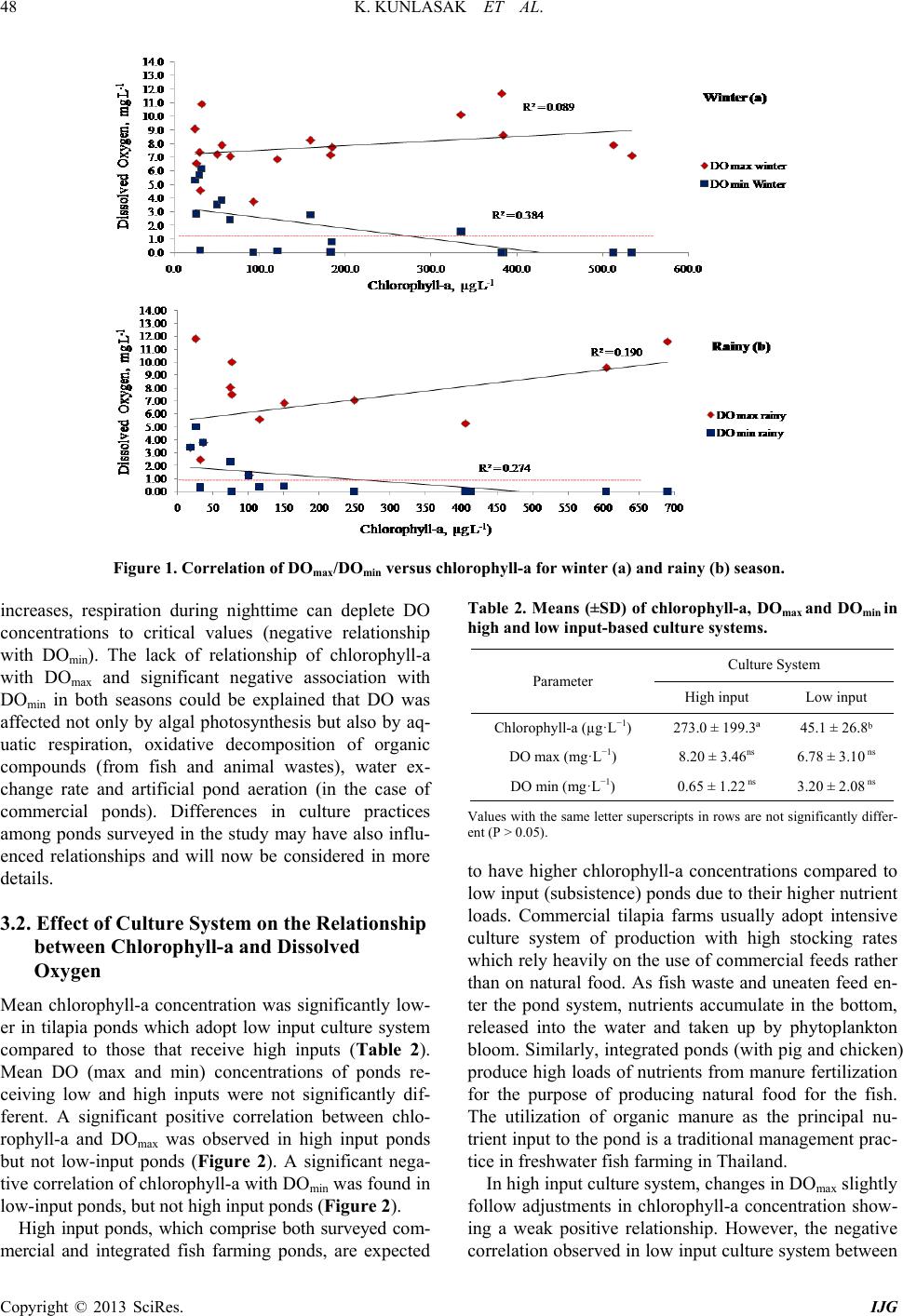 K. KUNLASAK ET AL. Copyright © 2013 SciRes. IJG 48 Figure 1. Correlation of DOmax/DOmin versus chlorophyll-a for winter (a) and rainy (b) season. increases, respiration during nighttime can deplete DO concentrations to critical values (negative relationship with DOmin). The lack of relationship of chlorophyll-a with DOmax and significant negative association with DOmin in both seasons could be explained that DO was affected not only by algal photosynthesis but also by aq- uatic respiration, oxidative decomposition of organic compounds (from fish and animal wastes), water ex- change rate and artificial pond aeration (in the case of commercial ponds). Differences in culture practices among ponds surveyed in the study may have also influ- enced relationships and will now be considered in more details. 3.2. Effect of Culture System on the Relationship between Chlorophyll-a and Dissolved Oxygen Mean chlorophyll-a concentration was significantly low- er in tilapia ponds which adopt low input culture system compared to those that receive high inputs (Table 2). Mean DO (max and min) concentrations of ponds re- ceiving low and high inputs were not significantly dif- ferent. A significant positive correlation between chlo- rophyll-a and DOmax was observed in high input ponds but not low-input ponds (Figure 2). A significant nega- tive correlation of chlorophyll-a with DOmin was found in low-input ponds, bu t not high input ponds (Figure 2). High input ponds, which comprise both surveyed com- mercial and integrated fish farming ponds, are expected Table 2. Means (±SD) of chlorophyll-a, DOmax and DOmin in high and low input-based culture systems. Parameter Culture System High input L ow input Chlorophyll-a (µg·L−1) 273.0 ± 199.3ª 45.1 ± 26.8ᵇ DO max (mg·L−1) 8.20 ± 3.46ns 6.78 ± 3.10 ns DO min (mg·L−1) 0.65 ± 1.22 ns 3.20 ± 2.08 ns Values wit h the same letter superscripts in rows are no t significantl y differ- ent (P > 0.05) . to have higher chlorophyll-a concentrations compared to low input (su bsistence) ponds due to their higher nutrient loads. Commercial tilapia farms usually adopt intensive culture system of production with high stocking rates which rely heavily on th e use of commercial f eeds rather than on natural food. As fish waste and uneaten feed en- ter the pond system, nutrients accumulate in the bottom, released into the water and taken up by phytoplankton bloom. Similarly, integrated ponds (with p ig and chicken) produce high loads of nutrients from manure fertilization for the purpose of producing natural food for the fish. The utilization of organic manure as the principal nu- trient input to the pon d is a traditional management pra c- tice in freshwater fish farming in Thailand. In high input culture system, changes in DOmax slightly follow adjustments in chlorophyll-a concentration show- ing a weak positive relationship. However, the negative correlation observed in low input culture system between 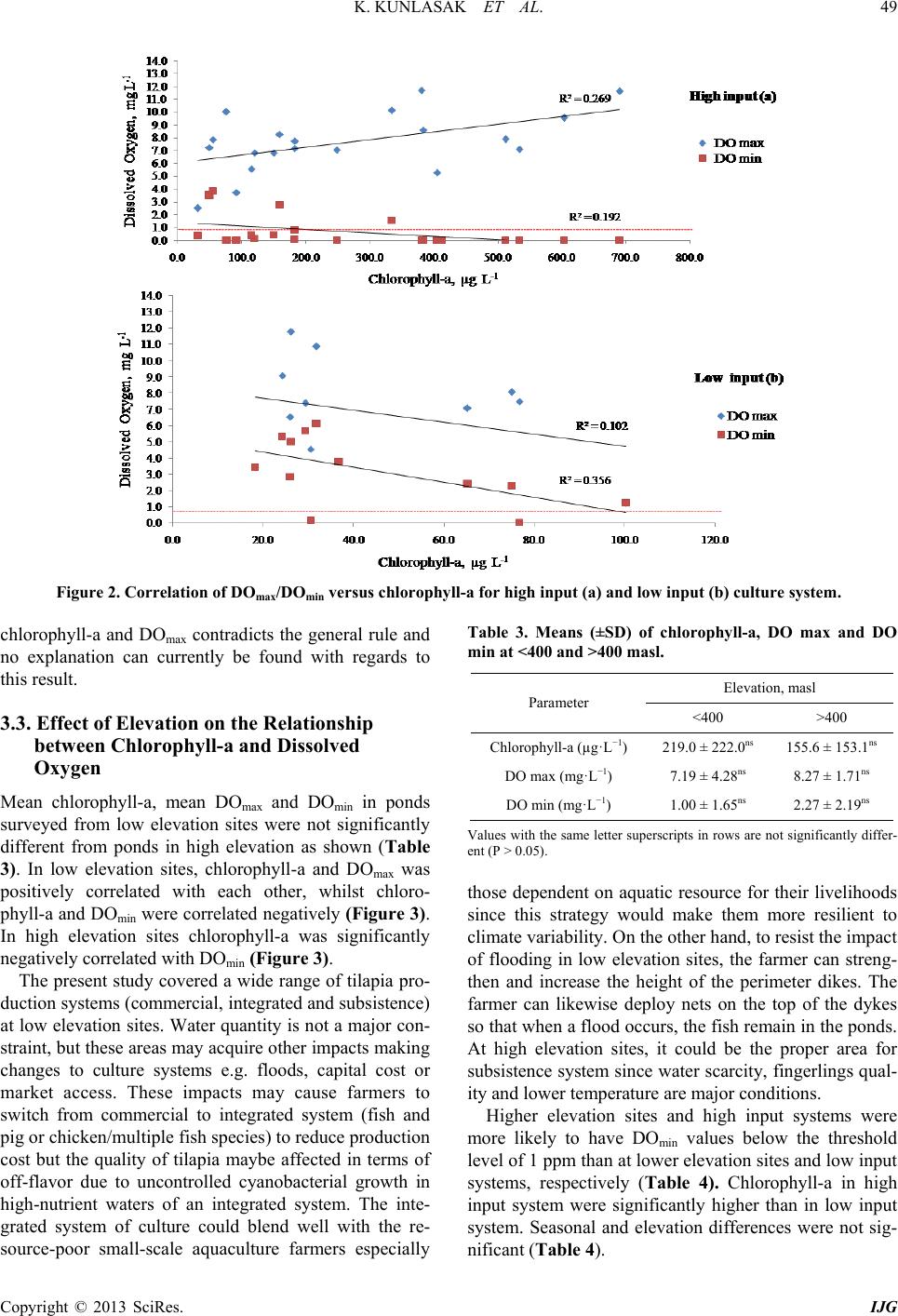 K. KUNLASAK ET AL. Copyright © 2013 SciRes. IJG 49 Figure 2. Correlation of DOmax/DOmin versus chlorophyll-a for hi gh input (a) and low input ( b) culture syst em. chlorophyll-a and DOmax contradicts the general rule and no explanation can currently be found with regards to this result. 3.3. Effect of Elevation on the Relationship between Chlorophyll-a and Dissolved Oxygen Mean chlorophyll-a, mean DOmax and DOmin in ponds surveyed from low elevation sites were not significantly different from ponds in high elevation as shown (Table 3). In low elevation sites, chlorophyll-a and DOmax was positively correlated with each other, whilst chloro- phyll-a and DOmin were correlated negatively (Figure 3). In high elevation sites chlorophyll-a was significantly negatively correlated with DOmin (Figure 3). The present study covered a wide range of tilapia pro- duction systems (commercial, integrated and subsistence) at low elevation sites. Water quantity is not a major con- straint, but these areas may acquire other impacts making changes to culture systems e.g. floods, capital cost or market access. These impacts may cause farmers to switch from commercial to integrated system (fish and pig or chicken/multiple fish species) to reduce production cost but the quality of tilapia maybe affected in terms of off-flavor due to uncontrolled cyanobacterial growth in high-nutrient waters of an integrated system. The inte- grated system of culture could blend well with the re- source-poor small-scale aquaculture farmers especially Table 3. Means (±SD) of chlorophyll-a, DO max and DO min at <400 and >400 masl. Parameter Elevation, masl <400 >400 Chlorophyll-a (µg·L−1) 219.0 ± 222.0ns 155.6 ± 153.1ns DO max (mg·L−1) 7.19 ± 4.28ns 8.27 ± 1.71ns DO min (mg·L−1) 1.00 ± 1.65ns 2.27 ± 2.19ns Values wit h the same letter superscripts in rows are not significantly differ- ent (P > 0.05) . those dependent on aquatic resource for their livelihoods since this strategy would make them more resilient to climate variability. On the o ther hand, to resist the impact of flooding in low elevation sites, the farmer can streng- then and increase the height of the perimeter dikes. The farmer can likewise deploy nets on the top of the dykes so that when a flood occurs, the fish remain in the ponds. At high elevation sites, it could be the proper area for subsistence system since water scarcity, fingerlin gs qual- ity and lower temperature are major conditions. Higher elevation sites and high input systems were more likely to have DOmin values below the threshold level of 1 ppm than at lower elevation sites and low input systems, respectively (Table 4). Chlorophyll-a in high input system were significantly higher than in low input system. Seasonal and elevation differences were not sig- nificant (Table 4).  K. KUNLASAK ET AL. Copyright © 2013 SciRes. IJG 50 Figure 3. Correlation of DOmax/DOmin versus chlorophyll-a for <400 masl (a) and >400 masl (b) sites. Table 4. Percentage (%) of tilapia ponds with DOmin below t he threshold value (1 ppm) and effect of season, culture system and elevation on c hlorophyll-a. Factor Mean Chlorophyll-a (µg ·L−1) Number of ponds (%) Total (n) No. with <1 p p m D O mi n. Season Winter 177.8 ± 174.0ns 18 9 50.00 Rainy 204.9 ± 220.1ns 15 10 66.67 Culture system high input 273.0 ± 199.3ª 22 17 77.27 low input 45.1 ± 26.9ᵇ 12 2 16.67 Elevation <400 218.9 ± 222.0ns 18 13 72.22 >400 155.6 ± 153.1ns 15 6 40.00 Values with different letter superscripts in the column are signifi cantly different (P < 0.05). 3.4. Effect of Elevation, Culture System and Season on Total Bacterial Load Mean total bacteria concentration in pond water at high input system in low elevation sites (<400 masl) was sig- nificantly higher (P < 0.05) than in high elevation sites (>400 masl) whilst in low input systems at high elevation sites mean total bacteria concentration was significantly higher (P < 0.05) than at low elevation sites (Table 5). Multifactor-ANOVA was used to evaluate differences in total bacterial concentration in ponds based upon ele- vation, culture system and s eason. Significant interaction among elevation, culture system and season for total bacteria concentration were observed (Figu re 4). In general, temperature varies inversely with elevation. This is one of the reasons why lower bacteria activity was seen in higher altitude ponds (>400 masl). Mean  K. KUNLASAK ET AL. Copyright © 2013 SciRes. IJG 51 Table 5. Total bacteria (×103) (±SD) in ponds at different elevation i n both culture sys t em . Culture System Elevation, masl <400 >400 High input 7.37 ± 5.30ª 1.17 ± 1.11ᵇ Low input 0.29 ± 0.16ᵇ 0.97 ± 0.59ª Values with different letter superscripts in rows are significantly different (P < 0.05). Figure 4. Total bacteria in ponds at different elevation and culture sy s t em in both seasons. temperatures at low elevation sites are higher by 2 de- grees than at high elevation sites. High organic loading also increased nutrient and bacterial levels in high input pond systems at <400 masl. Commercial and integrated culture systems (high input systems) have higher fish stocking density and feeding rate and therefore the amount of organic matter and waste (including excess uneaten feeds) are expectedly high for these systems which increase bacterial load in water. This could deplete DO from water during the decomposition of these mate- rials at the bottom. Farms, especially those which grow tilapia in commercial ponds like the one in Phayao (>400 masl), use aerators to counteract DO depletion during nighttime. However, for low input pond system at high elevation sites, bacterial level is higher than the hotter low eleva- tion sites. This observation contr adicts the result obtain ed for high inp ut pond system. T emperatu re has b een sh own to be one of the limiting factors for bacterial growth par- ticularly in relatively low temperatures (<12˚C - 15˚C) although many of bacteria are adapted to colder envi- ronment, hence, the result. It is also possible that subsis- tence ponds in higher altitudes had higher organic matter content than in lower altitude ponds which could have significantly contribute to the bacterial load in the water. 3.5. Phytoplankton Density and Effect of Elevation, Culture System and Season on Filamentous Cyanobacteria Biomass For the assessment of diversity and composition of phy- toplankton in the surveyed ponds, a total of 90 genera of phytoplankton from 7 divisions were identified covering the 2 sampling seasons. Divis ion C hl oro phy t a ( 49 ge ne ra, 54.4%) was the most abundant followed by Bacillario- phyta (13 gene ra, 14.4%), Cyanophyta (10 genera, 11.1%), Cryptophyta (7 genera, 7.8%), Chromophyta (5 genera, 5.6%), Euglenophyta (5 genera, 5.6%), and Pyr- rhophyt a (1 genus, 1.1% ) whi ch wa s fo und onl y in winte r. In terms of phytoplankton density, Cyanophyta (cyano- bacteria) dominated the pond waters in winter whilst Chlorophyta were the prevalent group during rainy sea- son. There were no significant differences in total bio- mass of both Cyanophyta and Chlorophyta between sea- sons (Figure 5). Among the phytoplankton identified in the study, Pediastrum spp. and Scendesmus spp., both chlorophytes, and Anabaena spp., a cyanobacteria, dom- inated the pond waters. Mean density of filamentous cyanobacteria was sig- nificantly higher (P < 0.05) in high input system at low elevation sites (<400 masl) than in high elevation sites (>400 masl). However, result for low input system shows otherwise, where density of filamentous cyanobacteria was observed to be significantly higher (P < 0.05) at high elevation sites as opposed to low elevation sites (Table 6). Figure 5. Phy t opl an kt on densitie s in ponds in 2 seasons. Table 6. Cell density (×103) (±SD) of filamentous cyanobac- teria in ponds at different elevation in both culture system. Culture System Elevation, masl <400 >400 High input 7.96 ± 5.37ª 1.43 ± 0.1ᵇ Low input 0.34 ± 0.16ᵇ 1.78 ± 0.6ª Values with different letter superscripts in rows are significantly different (P < 0.05).  K. KUNLASAK ET AL. Copyright © 2013 SciRes. IJG 52 Multifactor-ANOVA was used to analyze the differ- ence of filamentous cyanobacterial biomass in ponds based upon elevation, culture system and season (Figure 6). Results show significant interaction s among elevation, culture system and season for filamentous cyanobacteria. Water temperature plays a significant role in the dis- semination of phytoplankton [19]. Seasonal variability changes algal density and diversity. The study shows that the amount of phytoplankton in rainy season is generally higher than in winter, except for Chlorophyta, which conforms to the amount of chlorophyll-a in the ponds. Furthermore, the quantity of filamentous cyanobacteria in high input system was higher than in low input system owing to the huge amount of nutrients present in the former. The water temperature during the study ranged between 28˚C - 32˚C. High fish stocking densities (>10,000 fish ha−1) and feeding rates (exceeding 70 kg ha−1·d−1) resulted in high waste loading rates that often caused excessive eutrophication in fish ponds, leading to the proliferation of cyanobacteria [20] in high input sys- tem, especially during the rainy season. Generally, cya- nobacteria require higher temperature than any other al- gae in order to increase its growth rate [21,22] hence, the high temperature during rainy season supports highly visible blooms of cyanobacteria, in particular, Anabaena spp. One major implication with filamentous cyanobac- teria , s u ch as An aba e na spp., dominating the pond waters is the production of off-flavors, which could be acquired by the fish and adversely affect market demand. 3.6. Managing Chlorophyll-a and Dissolved Oxygen in Aquaculture Ponds Chlorophyll-a and dissolved oxygen are relevant para- meters to be managed in an aquaculture pond system. Phytoplankton, which is indexed by chlorophyll-a, can develop conspicuously in pond waters, leading to eu- trophic conditions, especially during climate-driven low-water periods. Similarly, dissolved oxygen is impor- tant to the health of aquatic ecosystems and a key indi- cator in determining water quality. Uncontrolled phytop- lankton growth (high chlorophyll-a) can be a serious problem for the farmers as it takes more oxygen out of the water during the night than what remains in solution from daytime photosynthesis. Moreover, phytoplankton die offs can increase bacterial decomposition and the reduction in normal oxygen production can lead to oxy- gen depletions, high ammonia levels, and stressed or dead fish. To alleviate this problem mechanical aeration must be applied to meet the increased demand for oxygen and prevent oxygen depletion and subsequent fish losses or stress [22]. In high input systems nutrient reduction is arguably the best strategy to reduce the incidence of al- gae, especially harmful cyanobacterial blooms [23]. Thus, maintaining the suitable amount of phytoplankton in fish pond is important. An important limitation of this study was the restric- tion of sampling to just two time periods. Observations over more months and multiple years are needed to fully the effects of seasons and other climate-driven factor s on chlorophyll-a and dissolve d o xygen relationships . 5. Conclusion The relationships between chlorophyll-a, and DO max or DO min were complex, being effected by season, nu- trient inputs and elevation. Taken together findings sug- gest that other factors other than algal photosynthesis were involved. As would be expected chlorophyll-a was much higher in high input than in low input ponds. Sig- nificant interactions were observed for total bacteria and filamentous cyanobacteria between elevation, culture system and season. Divisions Chlorophyta and Cyano- phyta had the most number of genera identified in both seasons with Pediastrum spp., and Scendesmus spp., and Anabaena spp. as dominant genera/genus, respectively. 6. Acknowledgements The work was carried out with the aid of a grant from the International Development Research Centre, Ottawa, Canada, as a contribution to the AQUADAPT project. Figure 6. Density of filamentous cyanobacteria in ponds at different elevation and culture system in 2 seasons. 0.00 2000.00 4000.00 6000.00 8000.00 10000.00 12000.00 <400 >400 Cells mL -1 Elevation, mas l high input winter high input rainy low input winter Filamentous Cyanobacteria  K. KUNLASAK ET AL. Copyright © 2013 SciRes. IJG 53 Special thanks to Redel Gutierrez of Maejo University for editing this paper. REFERENCES [1] K. M. Brander, “Global Fish Production and Climate Change,” Vol. 104, 2007, pp. 19709-19714. http://dx.doi.org/10.1073/pnas.0702059104 [2] C. Lueanthuwapranit, “The Principle of Aquaculture,” Bangkok, 2005, p. 434. [3] H. S. Egna and C. E. Boyd, “Dynamic of Pond Aquacul- ture,” CRC Press, New York, 1997. [4] Z. A. Ahmed, Hisham, et al., “Eco-Monitoring of Climate Impact on Earthen Pond Water Quality in El-Fayoum, Egypt,” International Research Journal of Microbiology, Vol. 11, 2011, pp. 442-454. [5] F. P. Meyer, K. E. Sneed and P. T. Eschmeyer, “Second Report to the Fish Farmers: Status of Warmwater Fish Farming and Progress in Fish Farming Research,” Bureau of Sports Fisheries and Wildlife, Washington, DC, 1973, p. 12. [6] Anonymous, “Lecture Notes on the Training Course in Fresh Water Fish Culture. III. Adult Fish Culture in Pond,” Kwangtung Provincial Research Institute of Aquatic Products, Kwangchow, 1975. [7] C. E. Boyd, “Water Quality Management for Pond Fish Culture,” Elsevier, Amsterdam, 1982, p. 318. [8] D. W. Smith, “Biological Control of Excessive Phytop- lankton Growth and Enhancement of Aquacultural Pro- duction,” Ph.D. Dissertation, University of California, Santa Barbara, 1987, p. 196. [9] A. W. Sin and M. T. Chiu, “Summer and Winter Kills in Fish Ponds of Hong Kong and Their Possible Prediction,” Aquaculture, Vol. 29, 1982, pp.125-135. http://dx.doi.org/10.1016/0044-8486(82)90039-4 [10] B. A. Costa-Pierce., E. A. Laws and S. Malecha, “Effects of Fish and Plant Polyculture and Feed Source on the Water Quality of Prawn (Macrobrachium rosenbergii) ponds in Hawaii,” Trans, Vol. 114, 1985, pp. 826-836. [11] C. E. Boyd, “The Chemical Oxygen Demand of Waters and Biological Materials from Ponds,” 1973. [12] H. K. Dupree and J. V. Huner, “Third Report to the Fish Farmers: The Status of Warmwater Fish Farming and Progress in Fish Farming Research,” U.S. Fish and Wild- life Service, Washington, DC, 1984, p. 270. [13] J. A. Steel, “Phytoplankton Models,” In: E. D. LeCren and R. H. Lowe-McConnell, Eds., Functioning of Fresh- water Ecosystems, Cambridge University Press, Cam- bridge, Vol. 2, 1980, pp. 20-227. [14] J. W. Andrews, T. Murai and Gibbons, “The Influence of Dissolved Oxygen on the Growth of Channel Catfish,” Trans, Vol. 102, 1973, pp. 835-838. http://dx.doi.org/10.1577/1548-8659(1973)102<835:TIO DOO>2.0.CO;2 [15] APHA, “Standard Method for the Examination of Water and Wastewater,” 15th Edition, American Public Health Association, Washington DC, 1980. [16] ISO, ISO 6222:1999, “Water Quality Enumeration of Culturable Mcro-Organisms Colony Count by Inoculum in a Nutrient Agar Culture Medium,” International Or- ganization for Standardization, Geneva, 1999. [17] SCA, “The Microbiology of Drinking Water (2002) Part 7 Methods for the Enumeration of Heterotrophic Bacteria,” 2002. [18] J. T. Hardy, “Phytoneuston Ecology of a Temperate Ma- rine Lagoon,” Limnology and Oceanography, Vol. 18, 1973, pp. 525-533. http://dx.doi.org/10.4319/lo.1973.18.4.0525 [19] J. E. G. Raymont, “Plankton and Productivity in Oceans,” Press, Ltd., Oxford, 1963. [20] P. V. Zimba and C. C. Grimm, “A Synoptic Survey of Musty/Muddy Odor Metabolites and Microcystin Toxin Occurrence and Concentration in Southeastern USA Channel Catfish (Ictalurus punctatus Ralfinesque) Pro- duction Ponds,” Aquaculture , Vol. 218, 2003, pp. 81-87. [21] R. D. Robarts and T. Zohary, “Temperature Effects on Photosynthetic Capacity, Respiration and Growth Rates of Bloom-Forming Cyanoba cteria,” New Zealand Journal of Marine and Freshwater Research, Vol. 21, 1987, pp. 391-399. http://dx.doi.org/10.1080/00288330.1987.9516235 [22] M. W. Brunson, C. G. Lutz and R. M. Durbrow, “Algae Blooms in Commercial Fish Production Ponds,” SRAC. [23] M. T. Dokulil and K. Teubner, “Cyanobacterial Domin- ance in Lakes,” Hydrobiologia, Vol. 438, 2000, pp. 3-12. |