

Paper Menu >>
Journal Menu >>
 Open Journal of Nursing, 2013, 3, 415-419 OJN http://dx.doi.org/10.4236/ojn.2013.36056 Published Online October 2013 (http://www.scirp.org/journal/ojn/) The current state of, and outstanding issues relating to, nursing diagnosis, as taught in basic nursing education in Japan —Based on a questionnaire study implemented by nursing universities— Chiharu Ito, Harumi Ejiri Department of Nursing College of Life and Health Sciences, Chubu University, Aichi, Japan Email: [email protected] Received 21 June 2013; revised 22 July 2013; accepted 19 August 2013 Copyright © 2013 Chiharu Ito, Harumi Ejiri. This is an open access article distributed under the Creative Commons Attribution Li- cense, which permits unrestricted use, distribution, and reproduction in any medium, provided the original work is properly cited. ABSTRACT This report attempts to ascertain the current state of, and outstanding issues relating to, nursing diagnosis, as taught in nursing education in Japan, and to ob- tain basic resources that will allow the improvement of said nursing diagnosis training. A self-completed, anonymous survey was carried out in regard to tea- ching staff responsible for classes in “nursing proc- ess” or “nursing diagnosis” at 183 university institu- tions involved in nursing education nationwide. Re- sponses were received from 82 people, which clarified the following three points. 1) Of the 63 universities teaching nursing process as an independent subject, approximately 62% included nursing diagnosis. 2) A diverse range of educational materials were used in nursing diagnosis training, including NANDA-I nurs- ing diagnosis. 3) In implementing nursing process us- ing nursing diagnosis, issues raised included the fol- lowing: the limitations of education “on paper”, using theoretical patients, insufficient skills among teaching staff, the difficulty of realizing practical training in a clinical setting, and the tendency to try to make a simple diagnosis fit the circumstances. In the future, this study suggests that it may be important to create a set of guidelines guaranteeing a minimum level of educational content in relation to nursing diagnosis, which must be learned before graduation. Keywords: Nursing Education; Nursing Diagnosis; Questionnaire Survey 1. INTRODUCTION Since the early 1990s, nursing diagnosis has become an area of interest in Japan, along with the move to establish nursing as a specialist profession, with the practice of nursing diagnosis, as developed in the USA, being in- troduced. Furthermore, in 2001, the Ministry of Health, Labour and Welfare issued plans for a four-stage system of medical treatment based on a system of electronic medical records, known as the “Grand Design for Healthcare and Medical Informatics”. As one aspect of these measures, hospitals with 200 or more beds are be- ing encouraged to introduce electronic medical records with the objective of efficiently utilizing medical infor- mation. For this reason, the concept of nursing diagnosis has come to be used as one method of organizing entries conventionally made to nursing records in such a way as to facilitate their utilization as data, and the practice has begun to roll out widely within the clinical workplace. It has been pointed out [1-3], however, that while ef- forts have been made to ensure the label of “nursing di- agnosis” developed in the USA which is “applied”, “se- lected” or “extracted”, it is unclear whether nursing di- agnosis itself has been sufficiently understood. For this reason, it is vital that the requisite training is given dur- ing nursing education, allowing the acquisition of skills to appropriately respond to this situation. At present, however, there are questions relating to exactly how much content is being taught during training for nursing diagnosis within Japanese nursing education. Given the situation described above, the authors con- sidered that there may be a need to create an educational program, comprising educational content and methods, to improve nursing diagnosis training, and to link its practice to the clinical workplace. As the first step in this process, we wished to clarify the current state of, and outstanding issues relating to, nursing diagnosis. OPEN ACCESS  C. Ito, H. Ejiri / Open Journal of Nursing 3 (2013) 415-419 416 2. OBJECTIVES OF RESEARCH To ascertain the current state of, and outstanding issues relating to, nursing diagnosis, as taught in nursing educa- tion in Japan, and to obtain basic resources that will al- low the improvement of said nursing d iagnosis training. 3. RESEARCH METHODS 3.1. Research Design Quantitative, descriptive research implemented using an anonymous, self-completed questionnaire. 3.2. Target and Survey Period The survey period was between December and January 2010. The target of the survey was teaching staff respon- sible for classes in “nursing process” or “nursing diagno- sis” at the 183 university institutions invo lved in nursing education nationwide, who were asked to self-complete an anonymous survey. 3.3. Survey Method and Contents 1) The subjects were sent a survey request envelope, which contained one set of documents comprising a let- ter explaining the objectives and methods of the survey and a request for participation, an anonymous survey document, and a return envelope. The completed survey document guaranteed anonymity by being placed in the return envelope and mailed back to the project. Subjects were asked to respond within two weeks. The anony- mous, self-completed questionnaire document surveyed the following subjects: Basic attributes. 2) The subjects were asked whether nursing process or nursing diag nosis are taught as independ ent subjects, and if they are, the number of credits awarded, hours taught, and in what academic year the students take these courses. 3) The subjects were asked whether “nursing diagno- sis” is included when implementing nursing process, and the reasons for their response (in a free answer). 4) At universities where nursing diagnosis is included, subjects were asked which theories they used when im- plementing nursing process, and asked to circle those that apply from a list of examples including NANDA-I nursing diagnosis, Carpen ito n ursing d iagnosis, Go rdo n’s functional health pattern s, etc. At universities where nursing diagnosis is included, subjects were asked about problems relating to the prac- tical implementation of nursing process, with free an- swers given under the categories of Information collec- tion, Assessment, Diagnosis, Setting outcomes, Planning, and Other. 4. ETHICAL CONSIDERATIONS Subjects were asked to return their completed question- naires in the return envelopes provided. The returned questionnaires were mixed with those sent back by other respondents, to ensure that they were processed anony- mously with no relation to one another. In this survey, since the authors had a record of the addresses to which questionnaires had been sent in order to manage distribu- tion, no statement of agreement, which may allow indi- vidual identification, was obtained, and agreement was assumed by the return of a response. Furthermore, the submission of questionnaires was anonymous, facilitat- ing the protection of privacy, a free decision by subjects as to whether or not to participate in the survey and the inclusion of negat i ve opinions. Al l procedures carried out as part of this research were subjected to the ethical re- views implemented by the research institution to which the authors belong, and were thereby approved. 5. RESULTS 5.1. Attributes Eighty-two responses were obtained (response rate 45.3%). The attributes of respondents were as follows: nine were aged 60 or above, 37 were in their 50s, 28 were in their 40s, and 8 were in their 30s. Seventy-nine were female and three males. Thirty-five respondents were professors, 28 associate professors, 17 lecturers and 5 assistant pro- fessors. 5.2. The Current State of Nursing Diagnosis within Nursing Education Of 82 institutions, 63 teach nursing process as an inde- pendent subject, while 19 universities did not. The 63 universities in question gave the following responses in regard to the number of credits, number of hours, and academic year to which taught: 35 institutions offered a single credit for the subject, and 24 offered two credits; 38 institutions (the largest number) taught the subject for 30 hours, while the next largest group was the 8 institu- tions that taught it for 60 hours. In terms of academic year in which taught, 48 schools taught it to second -year students, while 15 taught it to first-year students. Thirty- nine of the 63 universities included “nursing diagnosis” when imple menting nursing pro cess, while 21 stated that they do not include it, and three did not respond. Reasons for including nursing diagnosis were “its importance in implementing nursing process”, “in order to roll out electronic medical records”, and “moving with the times”, among others. Reasons for considering it unnec- essary included “the process is more important than giv- ing a name to the diagnosis”, and “there is a tendency to force a situation to fit a process”, etc. In regard to the educational content of institutions including nursing di- agnosis (to which multiple answers were possible), 28 Copyright © 2013 SciRes. OPEN ACCESS 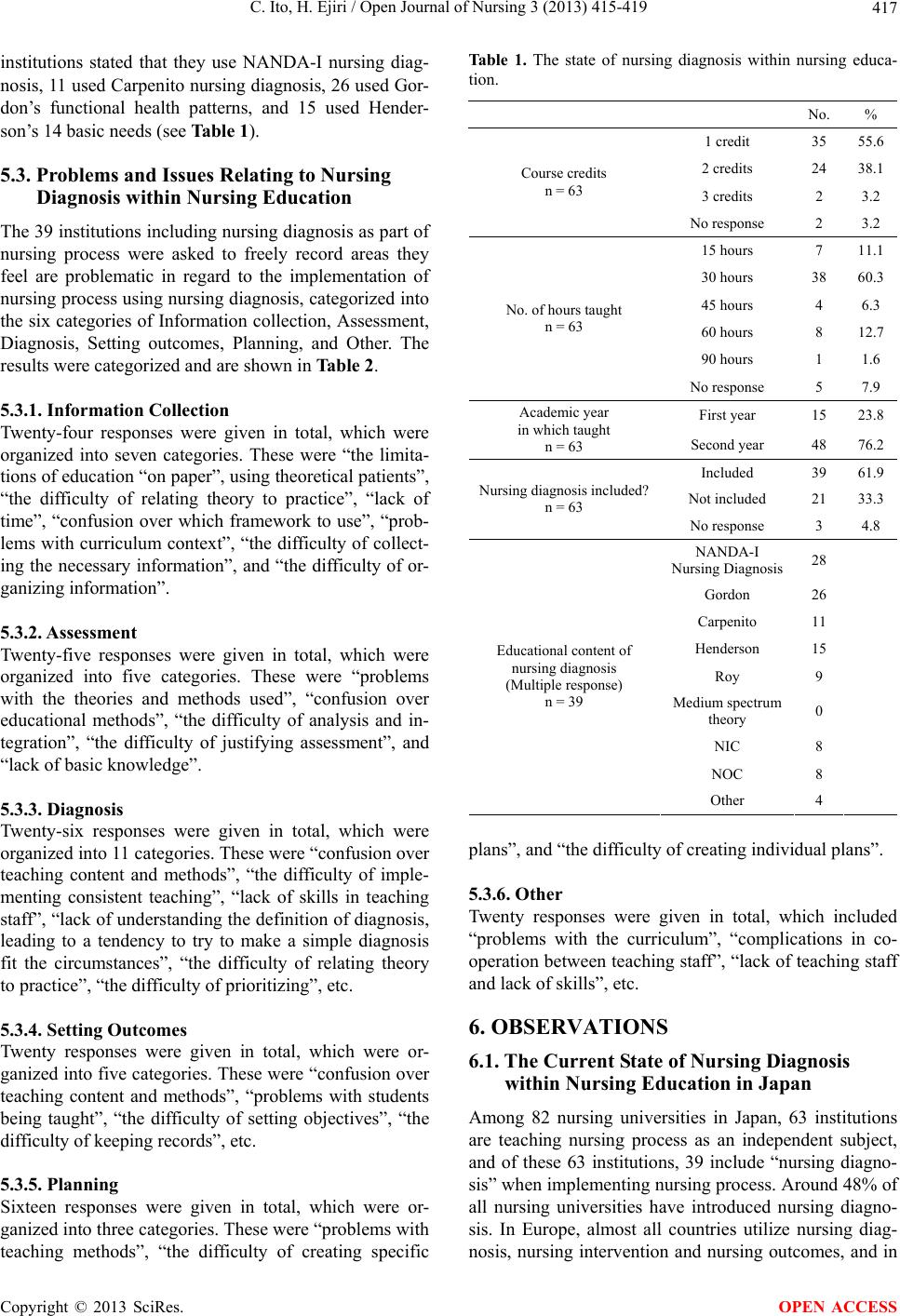 C. Ito, H. Ejiri / Open Journal of Nursing 3 (2013) 415-419 417 institutions stated that they use NANDA-I nursing diag- nosis, 11 used Carpenito nursing diagnosis, 26 used Gor- don’s functional health patterns, and 15 used Hender- son’s 14 basic needs (see Table 1). 5.3. Problems and Issues Relating to Nursing Diagnosis within Nursing Education The 39 institutions including nursing diagnosis as part of nursing process were asked to freely record areas they feel are problematic in regard to the implementation of nursing process us ing nursing diagnosis, categorized into the six categories of Information collection, Assessment, Diagnosis, Setting outcomes, Planning, and Other. The results were categorized and are shown in Table 2. 5.3.1. Information Collection Twenty-four responses were given in total, which were organized into seven categories. These were “the limita- tions of education “on paper”, using theoretical patients”, “the difficulty of relating theory to practice”, “lack of time”, “confusion over which framework to use”, “prob- lems with curriculum context”, “the difficulty of collect- ing the necessary information”, and “the difficulty of or- ganizing information”. 5.3.2. Ass essment Twenty-five responses were given in total, which were organized into five categories. These were “problems with the theories and methods used”, “confusion over educational methods”, “the difficulty of analysis and in- tegration”, “the difficulty of justifying assessment”, and “lack of basic knowledge”. 5.3.3. Diagnosis Twenty-six responses were given in total, which were organized into 11 categories. These were “confusion over teaching content and methods”, “the difficulty of imple- menting consistent teaching”, “lack of skills in teaching staff”, “lack of understanding the definition of diagnosis, leading to a tendency to try to make a simple diagnosis fit the circumstances”, “the difficulty of relating theory to practice”, “the difficulty of prioritizing”, etc. 5.3.4. Setti ng Outcomes Twenty responses were given in total, which were or- ganized into five categories. These were “confusion over teaching content and methods”, “problems with students being taught”, “the difficulty of setting objectives”, “the difficulty of keeping records”, etc. 5.3.5. Plan ni n g Sixteen responses were given in total, which were or- ganized into three categories. These were “problems with teaching methods”, “the difficulty of creating specific Ta bl e 1 . The state of nursing diagnosis within nursing educa- tion. No.% 1 credit 35 55.6 2 credits 24 38.1 3 credits 2 3.2 Course credits n = 63 No response 2 3.2 15 hours 7 11.1 30 hours 38 60.3 45 hours 4 6.3 60 hours 8 12.7 90 hours 1 1.6 No. of hours taught n = 63 No response 5 7.9 First year 15 23.8 Academic year in which taught n = 63 Second year 48 76.2 Included 39 61.9 Not included 21 33.3 Nursing diagnosis included? n = 63 No response 3 4.8 NANDA-I Nursing Diagnosis 28 Gordon 26 Carpenito 11 Henderson 15 Roy 9 Medium spectrum theory 0 NIC 8 NOC 8 Educational content of nursing diagnosis (Multiple response) n = 39 Other 4 plans”, and “the difficulty of creating individual plans”. 5.3.6. Other Twenty responses were given in total, which included “problems with the curriculum”, “complications in co- operation between teaching staff”, “lack of teaching staff and lack of skills”, etc. 6. OBSERVATIONS 6.1. The Current State of Nursing Diagnosis within Nursing Education in Japan Among 82 nursing universities in Japan, 63 institutions are teaching nursing process as an independent subject, and of these 63 institutions, 39 include “nursing diagno- sis” when implementing nursing process. Around 48% of all nursing universities have introduced nursing diagno- sis. In Europe, almost all countries utilize nursing diag- nosis, nursing intervention and nursing outcomes, and in Copyright © 2013 SciRes. OPEN ACCESS 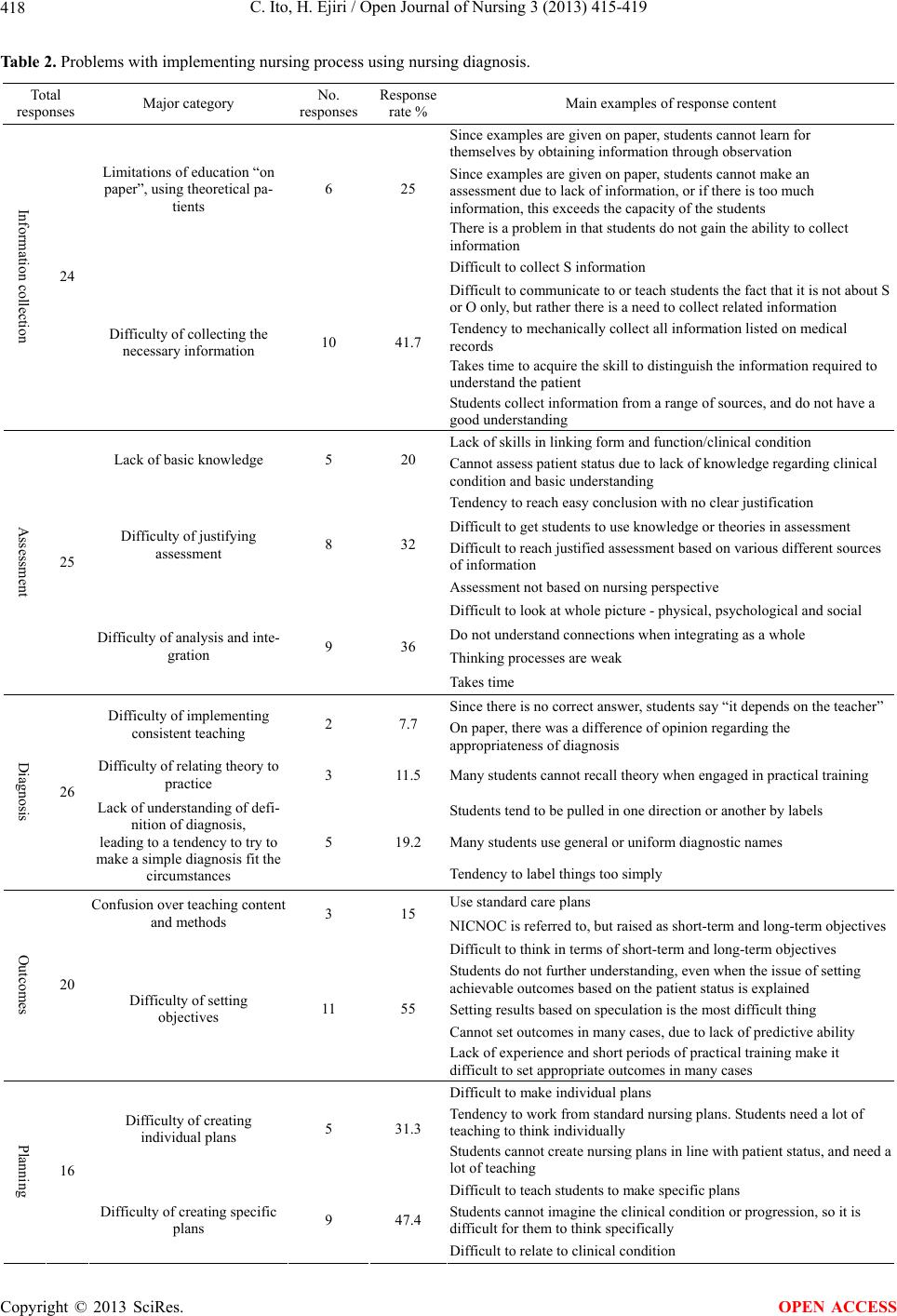 C. Ito, H. Ejiri / Open Journal of Nursing 3 (2013) 415-419 Copyright © 2013 SciRes. 418 OPEN ACCESS Table 2. Problems with implementing nursing process using nursing diagnosis. Total responses Major category No. responses Response rate % Main examples of response content Since examples are given on paper, students cannot learn for themselves by obtaining information through observat ion Since examples are given on paper, students cannot make an assessment due to lack of informa tion, or if there is too much information, this exceeds the capacity of the students Limitations of education “on paper”, using theoretic al p a - tients 6 25 There is a problem in that students do not gain the ability to collect information Difficult to collect S i nformation Difficult to communicate to or t each students the fact that it is not about S or O only, but rather there is a need to collect related information Tendency to mechanically collect all information lis t ed on medical records Takes time to acquire the skill to distinguish the information required to understand the patient Information collection 24 Difficulty of collecting the necessary information 10 41.7 Students collect information from a range of sources, and do not have a good understanding Lack of skills in linking form and function/clinical condition Lack of basic knowledge 5 20 Cannot assess patient status due to lack of knowledge regarding clinical condition and basic understanding Tendency to reach easy conclusion with no clear justification Difficult to get students t o us e k n ow ledge or theories i n assessment Difficult to reach justified assessment based on various different sources of information Difficulty of justifying assessment 8 32 Assessment not based on nursing perspective Difficult to look at whole picture - physical, psychological and social Do not understand connections w h en integrating as a whole Thinking processes are weak Assessment 25 Difficulty of analysis and inte- gration 9 36 Takes time Since there is no correct answer, students say “it depends on the teacher” Difficulty of implementi ng consistent teaching 2 7.7 On paper, there was a difference of opinion regarding the appropriateness of diagnosis Difficulty of relating theory to practice 3 11.5 Many students cannot recall theory when engaged in practical training Students tend to be pulled in one direction or another by labels Many students use general or uniform diagnostic nam es Diagnosis 26 Lack of understanding of defi- nition of diagnosis, leading to a tendency to try to make a simple diagnosis fit the circumstances 5 19.2 Tendency to label things too simply Use standard care plans Confusion over teaching content and methods 3 15 NICNOC is referred to, but raised as short-term and long-term objectives Difficult to think in terms of short-term and long-term objectives Students do not further understan ding, even when the issue of setting achievable outcomes based o n t h e patient status is explained Setting results based on speculation is the most difficult thing Cannot set outcomes in many cases, due to lack of predictive ability Outcomes 20 Difficulty of setting objectives 11 55 Lack of experience and short periods of p ractical training make it difficult to set appr o priate outcomes in many cas es Difficult to make individual plans Tendency to work from standard nursing plans. Studen ts need a lot of teaching to think indiv i d u a l l y Difficulty of creating individual plans 5 31.3 Students cannot create nursing plans in line wit h patient status, and nee d a lot of teaching Difficult to teach students to mak e spe cific plans Students cannot imagine the clinical condition or progression , so it is difficult f or them to think specifically Planning 16 Difficulty of creating specific plans 9 47.4 Difficult to relate to clinical condition  C. Ito, H. Ejiri / Open Journal of Nursing 3 (2013) 415-419 419 North America, almost all nursing education programs teach nursing diagnosis as part of nursing process, which, when considered in the light of the fact that NANDA-I nursing diagnosis is in use [4], indicates a lack of pene- tration of training relating to nursing diagnosis within nursing education in Japan. The specific content of nursing education in Japan is in fact left to the individual training institution, and is flexible, allowing each institution to develop its own uni- que curriculum based on its educational philosophy and policies, with the objective of providing attractive nurs- ing education [5]. Given this situation, in order to train nursing staff who can meet contemporary needs, it is considered necessary to ensure that a minimum level of educational content relating to nursing diagnosis, which includes clinical opinion, is a compulsory part of learn- ing prior to graduation. 6.2. Problems and Issues Relating to Nursing Diagnosis Based on the results of this survey, it is clear th at institu- tions face a range of problems, including difficulties in ensuring sufficient time within the limited time provided within the educational curriculum; limitations felt in re- gard to education “on paper”, using theoretical patients, in terms of information collection, creating a patient im- age, implementation and assessment; issues relating to teaching content and methods, including confusion as to what theories should be taught, and a lack of skills among teaching staff and basic knowledge among stu- dents. This suggests that the use of training usin g nursing diagnosis is still at a stage of trial and error within edu- cation, and that in the future, it will be necessary to take steps to solve the problems identified in this study in order to work towards more effective nursing diagnosis education. Issues in regard to improving nursing diagno- sis training include placing nursing diagnosis in context within nursing education, teaching content and methods that link it to clinical practical training, and a common understanding between teaching staff, and it is consid- ered that the creation of guidelines is an issue requiring consideration in order to achieve these. 7. CONCLUSIONS This study has clarified the following three points: 1) Of the 63 universities teaching nursing process as an independent subject, approximately 62% includ e nurs- ing diagnosis. 2) A diverse range of teaching content is used in nurs- ing diagnosis, including NANDA-I nursing diagnosis. 3) In implementing nursing process using nursing di- agnosis, issues raised included the following: the limita- tions of education “on paper”, using theoretical patients, insufficient skills among teaching staff, the difficulty of linking to practical training in a clinical setting, and the tendency to try to make a simple diagnosis fit the cir- cumstances. 8. ACKNOWLEDGEMENTS The authors are extremely grateful to all the teaching staff who cooper- ated in progressing this study. REFERENCES [1] Kamizuru, S. (2008) A fundamental review of nursing diagnosis. Igakugeijutusha, Tokyo. [2] Kamizuru, S. (2010) Nursing diagnosis seminar materials. Kango Laboratory, Japan. [3] Nakaki, T. (2004) Understanding nursing diagnosis. Gak- ken, T okyo. [4] Gordon, M. (2000) Perspective of nursing diagnosis as a world movement. Nursing diagnosis, 5, 15-28. [5] Matsuno, K. (1996) What has been commissioned to the new curriculum. The Future of Nursing, 21, 49-53. Copyright © 2013 SciRes. OPEN ACCESS |