

Paper Menu >>
Journal Menu >>
 International Journal of Geosciences, 2013, 4, 39-45 http://dx.doi.org/10.4236/ijg.2013.45B007 Published Online September 2013 (http://www.scirp.org/journal/ijg) Copyright © 2013 SciRes. IJG Legal Issues and Scientific Constraints in the Environmental Assessment of the Deepw ater Horizon Oi l Spill in Mexico Exclusive Economic Zone (EEZ) in the Gulf of Mexico Luis A. Soto, Alfonso Vázquez-Botello UA-Oceanic and Coastal Processes-Instituto de Ciencias del Mar y Limnología, Universidad Nacional Autónoma de México, México, D.F., México Email: [email protected] Received July 2013 ABSTRACT The largest accidental marine oil spill (4.9 million barrels) in the Gulf of Mexico (GoM) seabed (1600 m) caused by the sinking of the Deepwater Horizon oil rig in 2010, put to the test once again the resilient capacity of the pelagic and benthic realms of this Large Marine Ecosystem. Many are the ecological services provided by its waters (fisheries, tourism, aquaculture and fossil fuel reserves) to neighboring countries (US, Mexico and Cuba). However, the unprece- dented volumes of hydrocarbons, gas and chemical dispersants (Corexit) introduced in the system, represent ecological stressors whose deleterious effects are still the subject of civil claims and scientific controversy. Presumably, the short scale effects were confined to the Gulf’s northeastern shallow waters, and the combined actions of weathering, biode- gradation, and oil recovery left the system almost under pre-spill conditions. Unfortunately, surface and subsurface oil plumes were detected in the spill aftermath, and their dispersion trajectories threatened Mexico EEZ. Surface o il slicks were detected in the pristine waters of northern Yucatán, while subsurface oil plumes from the Macondo’s well blow out were dangerously advancing southwest towards key fishing grounds in the northwestern GoM. This disaster prompted the Mexican government to implement an ambitious ocean monitoring program adopting a bottom-up approach focused on building a base line for more than 42 physicochemical and biological variables for water, sediment and biota from the continental shelf-slope region of the NW GoM. Technological constraints have precluded systematic observations in the vast Mexican EEZ that could discriminate natural variability and oil seep emissions from antropic disturbances. Therefore, preliminary risk analyses relied on seasonal and historical records. Two years of field observations revealed subtle environmental changes in the studied area attributed to antropic disturbances. Waters maintained oligotrophic conditions and zooplankton and benthic infaunal biomass were also poor. Biomarkers in sediments and biota did not exceed EPA’s benchmarks, and sediment’s fingerprinting (δ13C) indicated marine carbon sources. Geomarkers revealed an active transport fro m the Mississippi towa rds the NW GoM of phyllosilicates bearing a weathered oil coating. Con- sequently, shelf and slope sediment toxicity begins to show an increasing trend in the region. The complexity of hydro- carbons bioaccumulation and biodegradation processes in deep waters of the GoM seems to indicate that meso- and large-scale observations may prove to be essential in understanding the capacity of the GoM to recover its ecological stability. Keywords: Deepwa t er Horizon; Macondo’s Oil Spill Accident; Mexic o ’s Exclusive Economic Zone; G ul f of Mexico 1. Introduction The oil spill caused by the sinking of the Deepwater Ho- rizon Platform (DWH) in the northern Gulf of Mexico (GoM) is unprecedented in the history of catastrophic events in the marine environment in both coastal and deep-waters. The assessment of the environmental con- sequences caused by this spill has represented a major challenge for the scientific community of the neighboring countries sharing the waters and resources of this Large Marine Ecosystem. The precise volume of oil spilled and the trajectory of surface and subsurface oil slicks are still controversial issues. Similarly, the persistence in time and space of weathered oil, its by-products, and their environmental effects, constitute major research uncertainties for most of the current studies hitherto accomplished. In the af- termath of the oil spill accident, the reports released by 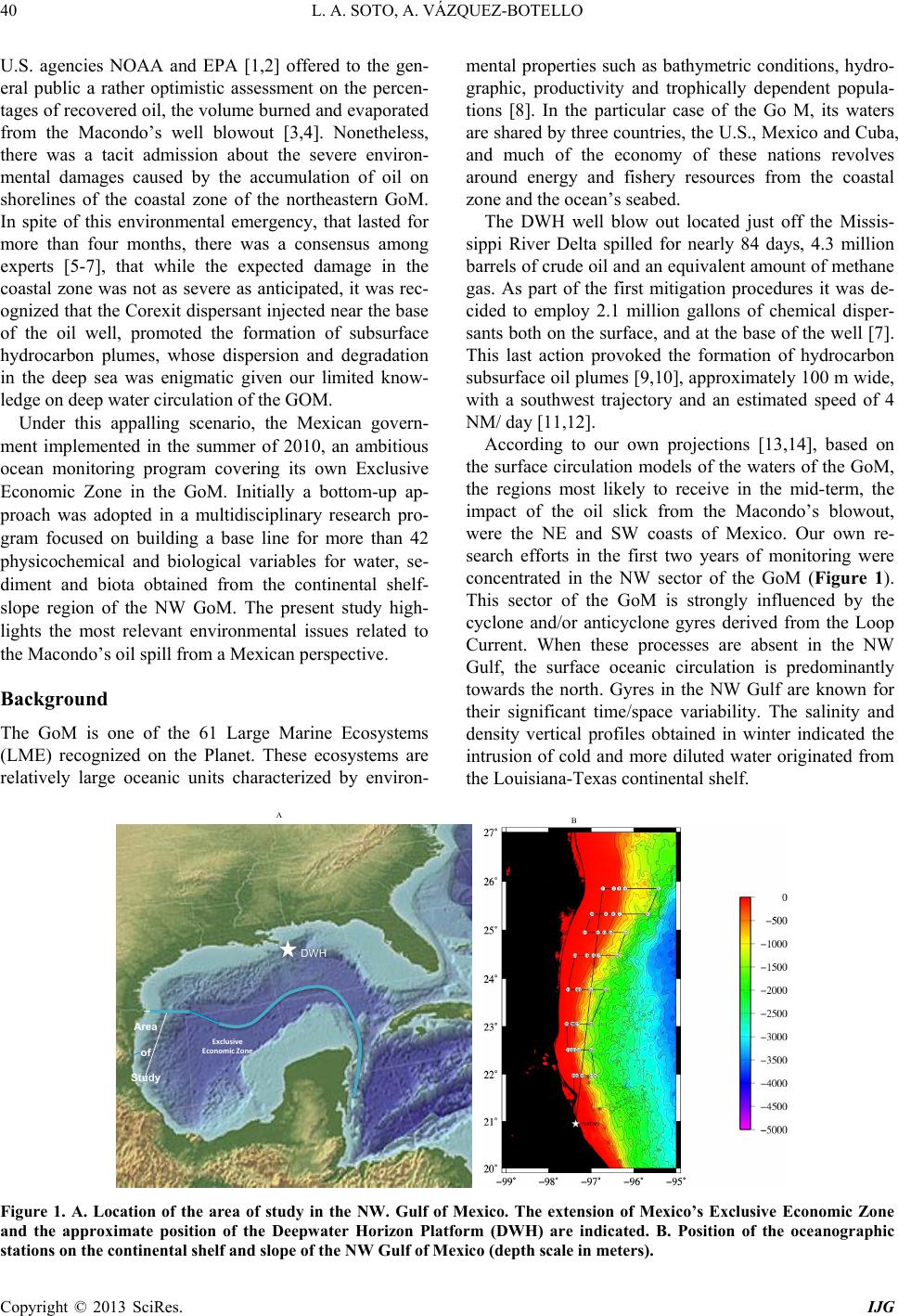 L. A. SOTO, A. VÁZQUEZ-BOTELLO Copyright © 2013 SciRes. IJG 40 U.S. agencies NOAA and EPA [1,2] offered to the gen- eral public a rather optimistic assessment on the percen- tages of recovered oil, the volume burned and evaporated from the Macondo’s well blowout [3,4]. Nonetheless, there was a tacit admission about the severe environ- mental damages caused by the accumulation of oil on shorelines of the coastal zone of the northeastern GoM. In spite of this environmental emergency, that lasted for more than four months, there was a consensus among experts [5-7], that while the expected damage in the coastal zone was not as severe as anticipated, it was rec- ognized that the Corexit dispersant injected near the base of the oil well, promoted the formation of subsurface hydrocarbon plumes, whose dispersion and degradation in the deep sea was enigmatic given our limited know- ledge on deep water circulation of the GOM. Under this appalling scenario, the Mexican govern- ment implemented in the summer of 2010, an ambitious ocean monitoring program covering its own Exclusive Economic Zone in the GoM. Initially a bottom-up ap- proach was adopted in a multidisciplinary research pro- gram focused on building a base line for more than 42 physicochemical and biological variables for water, se- diment and biota obtained from the continental shelf- slope region of the NW GoM. The present study high- lights the most relevant environmental issues related to the Macondo’s oil spill from a Mexican perspective . Background The GoM is one of the 61 Large Marine Ecosystems (LME) recognized on the Planet. These ecosystems are relatively large oceanic units characterized by environ- mental properties such as bathymetric conditions, hydro- graphic, productivity and trophically dependent popula- tions [8]. In the particular case of the Go M, its waters are shared by three countries, the U.S., Mexico and Cuba, and much of the economy of these nations revolves around energy and fishery resources from the coastal zone and the ocean’s seabed. The DWH well blow out located just off the Missis- sippi River Delta spilled for nearly 84 days, 4.3 million barrels of crude oil and an equivalent amount of methane gas. As part of the first mitigation procedures it was de- cided to employ 2.1 million gallons of chemical disper- sants both on the surface, and at the base of the well [7]. This last action provoked the formation of hydrocarbon subsurface oil plumes [9,10], approximately 100 m wide, with a southwest trajectory and an estimated speed of 4 NM/ day [11,12 ]. According to our own projections [13,14], based on the surface circulation models of the waters of the GoM, the regions most likely to receive in the mid-term, the impact of the oil slick from the Macondo’s blowout, were the NE and SW coasts of Mexico. Our own re- search efforts in the first two years of monitoring were concentrated in the NW sector of the GoM (Figure 1). This sector of the GoM is strongly influenced by the cyclone and/or anticyclone gyres derived from the Loop Current. When these processes are absent in the NW Gulf, the surface oceanic circulation is predominantly towards the north. Gyres in the NW Gulf are known for their significant time/space variability. The salinity and density vertical profiles obtained in winter indicated the intrusion of cold and more diluted water originated from the Louisiana-Texas continental shelf. Figure 1. A. Location of the area of study in the NW. Gulf of Mexico. The extension of Mexico’s Exclusive Economic Zone and the approximate position of the Deepwater Horizon Platform (DWH) are indicated. B. Position of the oceanographic stations on the continental shelf and slope of the NW Gulf of Mexico (depth scale in meters). Exclusive Economic Zone DWH Area of Study AB  L. A. SOTO, A. VÁZQUEZ-BOTELLO Copyright © 2013 SciRes. IJG 41 It is worth noting to ind icate at this point the technical difficulties involved in the identification of Macondo’s crude oil once it was over dispersed by surface and bot- tom currents, and exposed to weathering and biodegrada- tion processes. This situation seems augmented by the facts that in the GoM there are natural emission of hy- drocarbons and gas [15]. Sometimes the geochemical record of GoM sediments reflects a composition of veg- etable waxes, biofilms, and weathered hydrocarbons from subsurface natural filtrations beneath the seabed. In the particular case of the Macondo’s blowout, the envi- ronmental damage assessment is also magnified by mix- ing processes and fractionating of the oil components [16-18]. For tu nately, there is valuable oceanographic informa- tion [13,14,19-22] available from the regions under study (SW marine ecosystem—Campeche Sound , and th e NW sector—continental shelf of Tamaulipas and Veracruz) that documents the pre-spill environmental conditions of the GoM. 2. Main Oceanographic Features in Mexico’s EEZ: NW Gulf of Mexico The Gulf of Mexico is one of the most productive water bodies on earth. Its area is about 1.5 million km2, with a maximum depth of 3,800 m in the area known as Sigsbee Abyssal Plain. It is relevant to note, that the valuable natural resource of the GoM are also exposed to the ac- tion stressful natural chemical and biological factors whose synergy causes environmental changes with a certain degree of predictability (seasonality). There are also catastrophic weather events such as storms and hur- ricanes, which modify the coastline, and can alter the patterns of sediment transport, thus promoting erosion. Its water chemical balance can also be altered by the ex- traction of fossil fuels and gas beneath the seabed. In recent years, excessive discharge of organic mate- rials (fertilizers) in areas near the Mississippi River [23] and Coatzacoalcos have generated the formation of hy- poxic areas in which the O2 concentration level drops alarmingly, threatening the survival of communities oc- cupying the marine seabed. In reference to the Tamauli- pas and northern Veracruz coasts (Figure 1), these are highly influenced by river discharges (Bravo, Soto la Marina, Pánuco) that enrich with nutrients and organic matter the waters of the adjacent continental shelf. The continental shelf in this region is narrow with a maxi- mum length of 50 km and with steep and rugged slopes, particularly off the coast of northern Veracruz. The se- dimentary environment in the coastal strip is dominated by terrigenous input from rivers and lagoons; sand and biogenic muds predominate in deeper areas (Figure 2). Other major physiographic features in the GoM are the presence of extensive coastal lagoons namely Laguna Madre and Tamiahua; both function as natural nursery grounds for many estuarine-dependent species (penaeid shrimp and oysters). The waters of the continental shelf in this region of the GoM exhibit stratification and mix- ing conditions from April to September and November to March, respectively. During the rainy season (June-Sep- tember), the rivers have a significant dilution and cooling effects in the salinity (30 psu) and temperature of the river plume (23˚C). Due to the intrusion of ocean water toward the coast, these parameters are maintained at 23˚C and 36 psu, and shallow seasonal thermocline (18 m). Winter northern fronts promote the mixing of the water column causing low salinity and temperature (34 psu and 15˚C) and the deepening of the thermocline (80 to 160 m). The waters of this region are considered well ventilated to 100 m, with oxygen concentrations of 4 - 5 ml·L−1. The reference values of nutrients (PO4, NO3, NO2, and SiO2) tend to be more enriched during the mixing phase of the water column, reducing its concentration values when stratified conditions are established. There is a positive correlation between significant nutrient val- ues and sites under the influence of river and lagoon dis- charges. However, the rapid consumption of nutrients by neritic phytoplankton maintains oligotrophic conditions. The surface concentration values of chlorophyll a (>0.10 mg·m−3) correlate well with sites receiving low fluvial influence, while oceanic environments are characterized by poor chlorophyll concentrations (<0.05 mg·m−3). A vital information in this study are the reference concentrations of heavy metals and polycyclic aromatic hydrocarbons (PAH’s) in surface sediments previously recorded in the study area. Heavy metals such as Cr, Ni, and Cd reach significant concentrations along the Ta- maulipas’ shelf [24]. There are also high levels (26.9 μg·g−1) of PAH’s in sediments off Tamaulipas and Vera- cruz attributable to chronic oil spills in the area. 3. Economic Damage Assessment The estimation of natural resource damages caused b y oil spills is extremely controversial. The main difficulty re- sides in the complexity involved in assessing the ecolog- ical services offered by the different biotic components of the marine ecosystem. An event such as the Macon- do’s oil spill is subject of legal claims from physical damages, cleanup and preventative actions to the loss of fishing grou nds and landscape prop erty value. Acco rding to international agreements (International Oil Pollution Fund) and US federal legislatio n (Oil Po llution Act, 1990) addressing oil spill accidents, the responsible party, Brit- ish Petroleum in this case, can be held accountable for the caused environmental damages, while the affected parties must provide sufficient evidence of the source of  L. A. SOTO, A. VÁZQUEZ-BOTELLO Copyright © 2013 SciRes. IJG 42 98.0 97.0 96.0 22.0 23.0 24.0 25.0 26.0 12345 6 7 8 9 10 11 12 13 14 15 16 17 18 19 20 21 22 23 24 25 26 27 28 29 30 31 32 33 3435 0.3 0.8 1.3 1.8 2.3 Bravo River Madre Lagoon Soto La Marina River Pánuco River Tamiahua Lagoon % Longitude O Latitude N (a) 98.097.096.0 22.0 23.0 24.0 25.0 26.0 12345 6 7 8 9 10 11 12 1314 15 16 17 18 19 20 21 22 23 2425 26 27 28 29 30 31 32 33 3435 25 29 33 37 41 Bravo River Madre Lagoon Soto La Marina River Pánuco River Tamiahua Lagoon % Longitude W Latitude N (c 98.0 97.0 96.0 22.0 23.0 24.0 25.0 26.0 12345 6 7 8 9 10 11 12 13 14 15 16 17 18 19 20 21 22 23 24 25 26 27 28 29 30 31 32 33 3435 62 66 70 74 78 Bravo River Madre Lagoon Soto La Marina River Pánuco River Tamiahua Lagoon % Longitude W Latitude N (b) Figure 2. Dis tr ibution and composition of surface sediments in the NW Gulf of Mexico. (a) Sand. (b) Silt. (c) Clay. the spilled oil, and an economic quantification of the alleged damages. Sumaila et al. (2012) have briefly ex- plained some of the various attempts made in assessing economic environmental damages due to oil spills. Ap- parently, accidents caused by oil tankers are highly vari- able in nature. They depend on the type of oil, the vo- lume spilled and the area where the accident occurs. While oil rig accidents like the Deepwater Horizon plat- form, located in a “sensitive ecoregions” have substantial ecological and economic damages [25]. 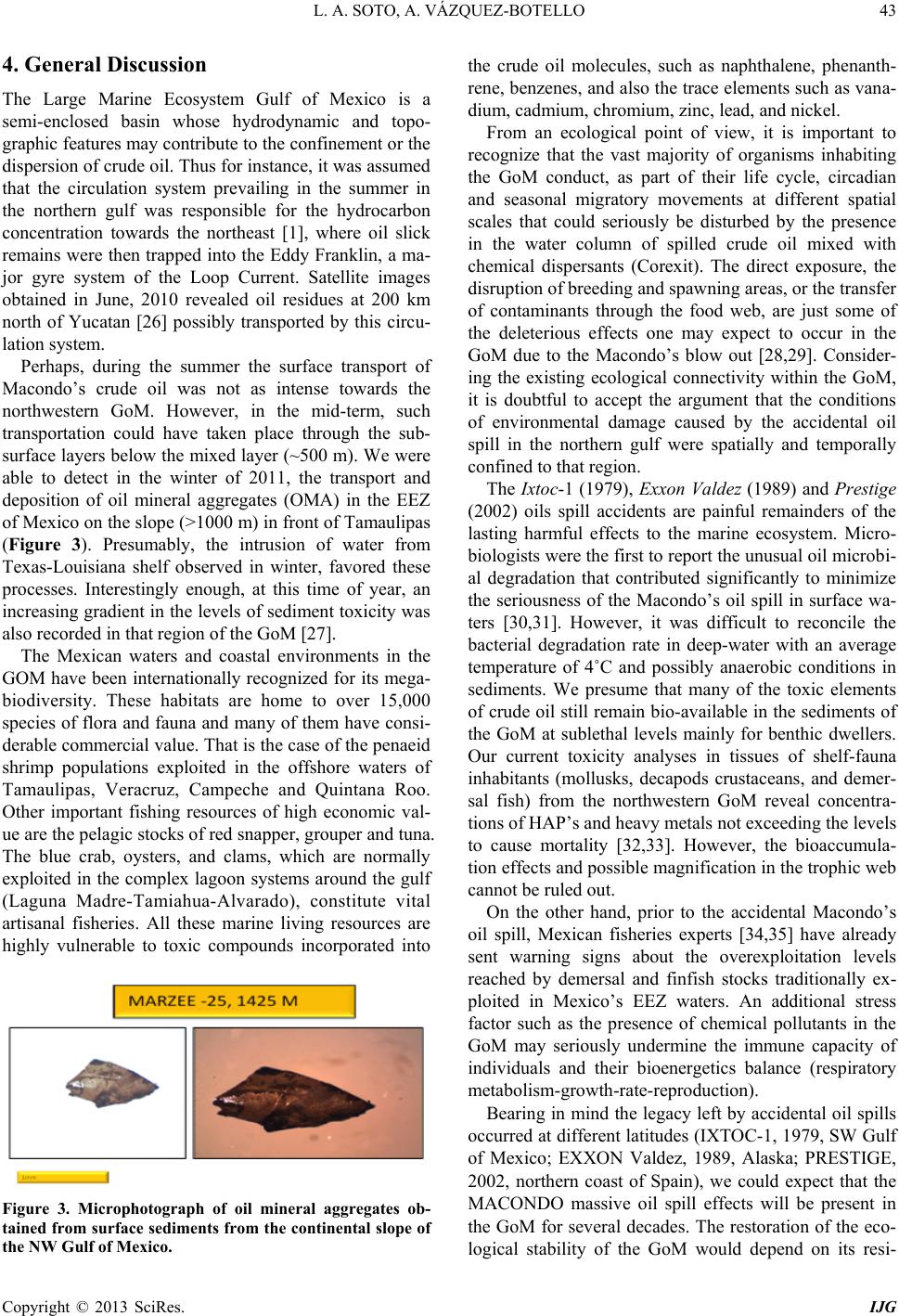 L. A. SOTO, A. VÁZQUEZ-BOTELLO Copyright © 2013 SciRes. IJG 43 4. General Discu ssi on The Large Marine Ecosystem Gulf of Mexico is a semi-enclosed basin whose hydrodynamic and topo- graphic features may contribute to the confinement or the dispersion of crude oil. Thus for instance, it was assumed that the circulation system prevailing in the summer in the northern gulf was responsible for the hydrocarbon concentration towards the northeast [1], where oil slick remains were then trapped into the Eddy Franklin, a ma- jor gyre system of the Loop Current. Satellite images obtained in June, 2010 revealed oil residues at 200 km north of Yucatan [26] possibly transported by this circu- lation system. Perhaps, during the summer the surface transport of Macondo’s crude oil was not as intense towards the northwestern GoM. However, in the mid-term, such transportation could have taken place through the sub- surface layers below the mixed layer (~500 m). We were able to detect in the winter of 2011, the transport and deposition of oil mineral aggregates (OMA) in the EEZ of Mexico on the slope (>1000 m) in front of Tamaulipas (Figure 3). Presumably, the intrusion of water from Texas-Louisiana shelf observed in winter, favored these processes. Interestingly enough, at this time of year, an increasing gradient in the levels of sediment toxicity was also recorded in that region of the GoM [27]. The Mexican waters and coastal environments in the GOM have been internationally recognized for its mega- biodiversity. These habitats are home to over 15,000 species of flora and fauna and many of them have consi- derable commercial value. That is the case of the penaeid shrimp populations exploited in the offshore waters of Tamaulipas, Veracruz, Campeche and Quintana Roo. Other important fishing resources of high economic val- ue are the pelagic stocks of red snapper, grouper and tuna. The blue crab, oysters, and clams, which are normally exploited in the complex lagoon systems around the gulf (Laguna Madre-Tamiahua-Alvarado), constitute vital artisanal fisheries. All these marine living resources are highly vulnerable to toxic compounds incorporated into Figure 3. Microphotograph of oil mineral aggregates ob- tained from surface sediments from the continental slope of the NW Gulf of Mexico. the crude oil molecules, such as naphthalene, phenanth- rene, benzenes, and also the trace elements such as vana- dium, cadmium, chromium, zinc, lead, and nickel. From an ecological point of view, it is important to recognize that the vast majority of organisms inhabiting the GoM conduct, as part of their life cycle, circadian and seasonal migratory movements at different spatial scales that could seriously be disturbed by the presence in the water column of spilled crude oil mixed with chemical dispersants (Corexit). The direct exposure, the disruption of breeding and spawning areas, or the transfer of contaminants through the food web, are just some of the deleterious effects one may expect to occur in the GoM due to the Macondo’s blow out [28,29]. Consider- ing the existing ecological connectivity within the GoM, it is doubtful to accept the argument that the conditions of environmental damage caused by the accidental oil spill in the northern gulf were spatially and temporally confined to that region. The Ixtoc-1 (1979), Exxon Valdez (1989) and Prestige (2002) oils spill accidents are painful remainders of the lasting harmful effects to the marine ecosystem. Micro- biologists were the first to report the unusual oil microb i- al degradation that contributed significantly to minimize the seriousness of the Macondo’s oil spill in surface wa- ters [30,31]. However, it was difficult to reconcile the bacterial degradation rate in deep-water with an average temperature of 4˚C and possibly anaerobic conditions in sediments. We presume that many of the toxic elements of crude oil still remain bio-available in the sediments of the GoM at sublethal levels mainly for benthic dwellers. Our current toxicity analyses in tissues of shelf-fauna inhabitants (mollusks, decapods crustaceans, and demer- sal fish) from the northwestern GoM reveal concentra- tions of HA P’s and heavy metals not exceeding the levels to cause mortality [32,33]. However, the bioaccumula- tion effects and possible magnification in the troph ic w eb cannot be rul ed out. On the other hand, prior to the accidental Macondo’s oil spill, Mexican fisheries experts [34,35] have already sent warning signs about the overexploitation levels reached by demersal and finfish stocks traditionally ex- ploited in Mexico’s EEZ waters. An additional stress factor such as the presence of chemical pollutants in the GoM may seriously undermine the immune capacity of individuals and their bioenergetics balance (respiratory metabolism-growth-rate-reproduction). Bearing in mind the legacy left by accidental oil spills occurred at different latitudes (IXTOC-1, 1979, SW Gulf of Mexico; EXXON Valdez, 1989, Alaska; PRESTIGE, 2002, northern coast of Spain), we could expect that the MACONDO massive oil spill effects will be present in the GoM for several decades. The restoration of the eco- logical stability of the GoM would depend on its resi- 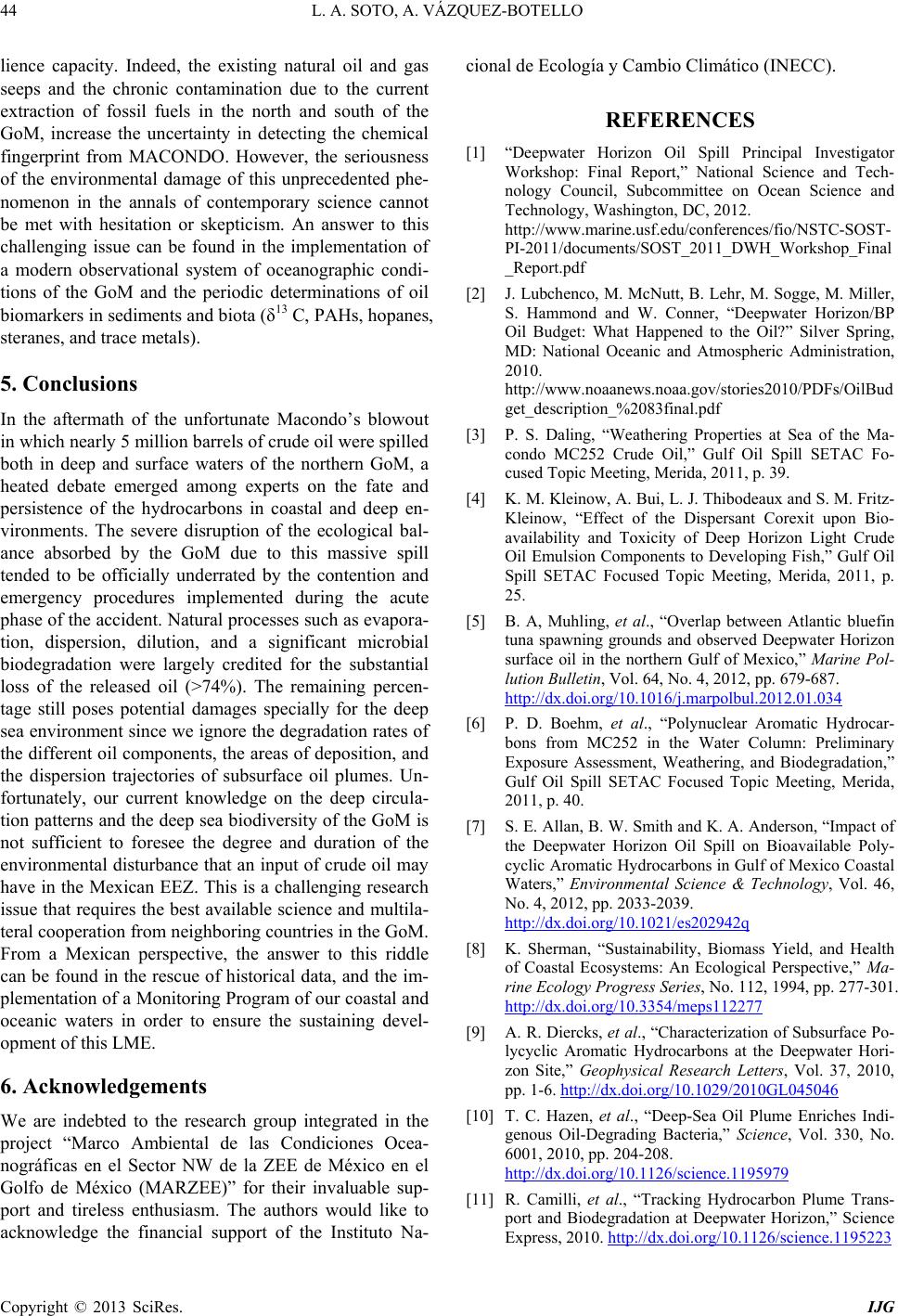 L. A. SOTO, A. VÁZQUEZ-BOTELLO Copyright © 2013 SciRes. IJG 44 lience capacity. Indeed, the existing natural oil and gas seeps and the chronic contamination due to the current extraction of fossil fuels in the north and south of the GoM, increase the uncertainty in detecting the chemical fingerprint from MACONDO. However, the seriousness of the environmental damage of this unprecedented phe- nomenon in the annals of contemporary science cannot be met with hesitation or skepticism. An answer to this challenging issue can be found in the implementation of a modern observational system of oceanographic condi- tions of the GoM and the periodic determinations of oil biomarkers in sediments and biota (δ13 C, PAHs, hopanes, steranes, and trace metals). 5. Conclusions In the aftermath of the unfortunate Macondo’s blowout in which nearly 5 million barrels of crude oil were spilled both in deep and surface waters of the northern GoM, a heated debate emerged among experts on the fate and persistence of the hydrocarbons in coastal and deep en- vironments. The severe disruption of the ecological bal- ance absorbed by the GoM due to this massive spill tended to be officially underrated by the contention and emergency procedures implemented during the acute phase of the accident. Natural processes such as evapora- tion, dispersion, dilution, and a significant microbial biodegradation were largely credited for the substantial loss of the released oil (>74%). The remaining percen- tage still poses potential damages specially for the deep sea environment since we ignore the degradation rates of the different oil components, the areas of deposition, and the dispersion trajectories of subsurface oil plumes. Un- fortunately, our current knowledge on the deep circul a- tion patterns and the deep sea biodiversity of the GoM is not sufficient to foresee the degree and duration of the environmental disturbance that an input of crude oil may have in the Mexican EEZ. This is a challenging research issue that requires the best available science and multila- teral cooperation from neighboring countries in the GoM. From a Mexican perspective, the answer to this riddle can be found in the rescue of historical data, and the im- plementation of a Monitoring Pr ogram of our coastal a nd oceanic waters in order to ensure the sustaining devel- opment of this LME. 6. Acknowledgements We are indebted to the research group integrated in the project “Marco Ambiental de las Condiciones Ocea- nográficas en el Sector NW de la ZEE de México en el Golfo de México (MARZEE)” for their invaluable sup- port and tireless enthusiasm. The authors would like to acknowledge the financial support of the Instituto Na- cional de Ecología y Cambio Climático (INECC). REFERENCES [1] “Deepwater Horizon Oil Spill Principal Investigator Workshop: Final Report,” National Science and Tech- nology Council, Subcommittee on Ocean Science and Technology, Washington, DC, 2012. http://www.marine.usf.edu/conferences/fio/NSTC-SOST- PI-2011/documents/SOST_2011_DWH_Workshop_Final _Report.pdf [2] J. Lubchenco, M. McNutt, B. Lehr, M. Sogge, M. Miller, S. Hammond and W. Conner, “Deepwater Horizon/BP Oil Budget: What Happened to the Oil?” Silver Spring, MD: National Oceanic and Atmospheric Administration, 2010. http://www.noaanews.noaa.gov/stories2010/PDFs/OilBud get_description_%2083final.pdf [3] P. S. Daling, “Weathering Properties at Sea of the Ma- condo MC252 Crude Oil,” Gulf Oil Spill SETAC Fo- cused Topic Meeting, Merida, 2011, p. 39. [4] K. M. Kleinow, A. Bui, L. J. Thibodeaux and S. M. Fritz- Kleinow, “Effect of the Dispersant Corexit upon Bio- availability and Toxicity of Deep Horizon Light Crude Oil Emulsion Components to Developing Fish,” Gulf Oil Spill SETAC Focused Topic Meeting, Merida, 2011, p. 25. [5] B. A, Muhling, et al., “Overlap between Atlantic bluefin tuna spawning grounds and observed Deepwater Horizon surface oil in the northern Gulf of Mexico,” Marine Pol- lution Bulletin, Vol. 64, No. 4, 2012, pp. 679-687. http://dx.doi.org/10.1016/j.marpolbul.2012.01.034 [6] P. D. Boehm, et al., “Polynuclear Aromatic Hydrocar- bons from MC252 in the Water Column: Preliminary Exposure Assessment, Weathering, and Biodegradation,” Gulf Oil Spill SETAC Focused Topic Meeting, Merida, 2011, p. 40. [7] S. E. Allan, B. W. Smith and K. A. Anderson, “Impact of the Deepwater Horizon Oil Spill on Bioavailable Poly- cyclic Aromatic Hydrocarbons in Gulf of Mexico Coastal Waters,” Environmental Science & Technology, Vol. 46, No. 4, 2012, pp. 2033-2039. http://dx.doi.org/10.1021/es202942q [8] K. Sherman, “Sustainability, Biomass Yield, and Health of Coastal Ecosystems: An Ecological Perspective,” Ma- rine Ecology Progress Series, No. 112, 1994, pp. 277-301. http://dx.doi.org/10.3354/meps112277 [9] A. R. Diercks, et al., “Characterization of Subsurface Po- lycyclic Aromatic Hydrocarbons at the Deepwater Hori- zon Site,” Geophysical Research Letters, Vol. 37, 2010, pp. 1-6. http://dx.doi.org/10.1029/2010GL045046 [10] T. C. Hazen, et al., “Deep-Sea Oil Plume Enriches Indi- genous Oil-Degrading Bacteria,” Science, Vol. 330, No. 6001, 2010, pp. 204-208. http://dx.doi.org/10.1126/science.1195979 [11] R. Camilli, et al., “Tracking Hydrocarbon Plume Trans- port and Biodegradation at Deepwater Horizon,” Science Express, 2010. http://dx.doi.org/10.1126/science.1195223 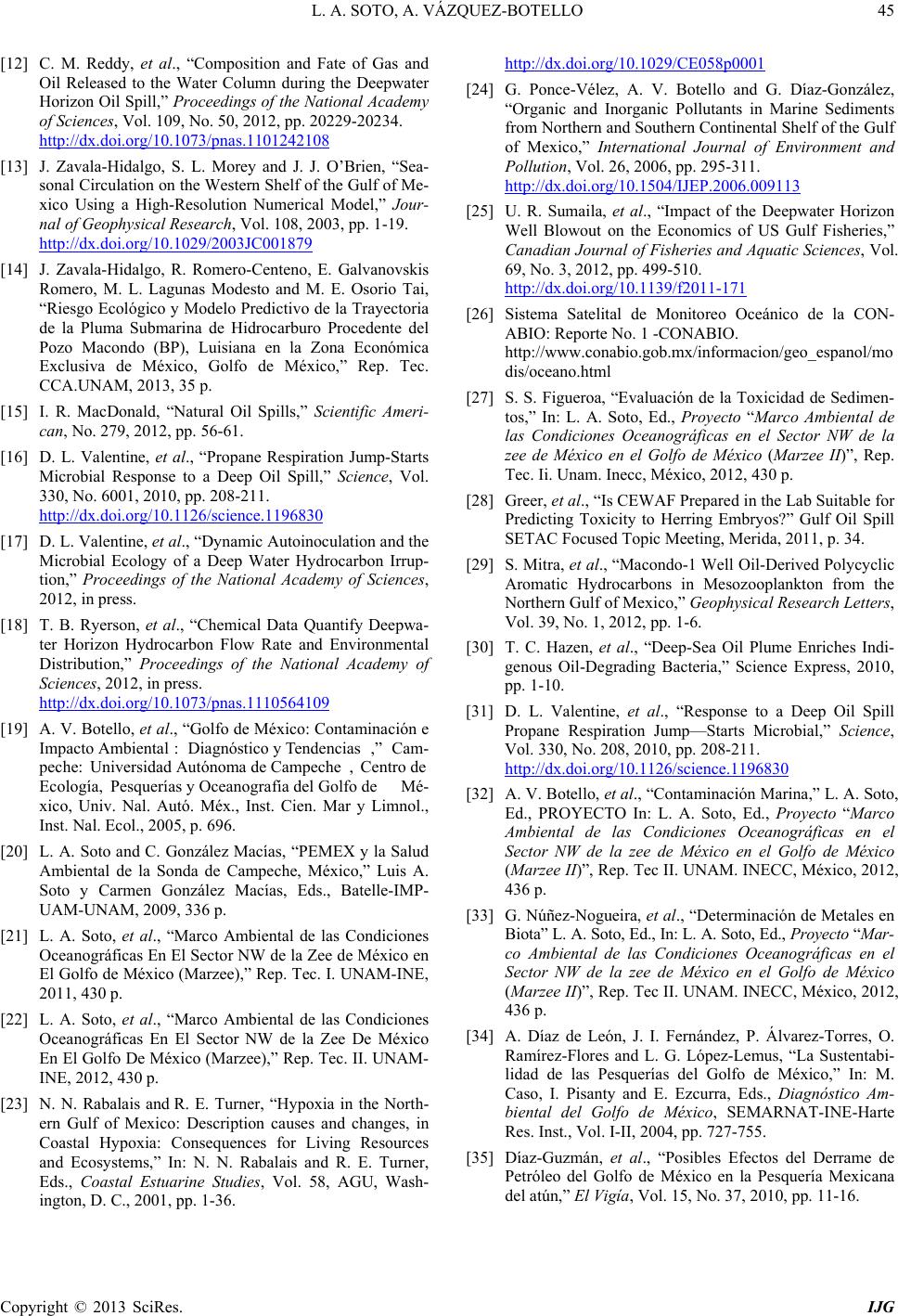 L. A. SOTO, A. VÁZQUEZ-BOTELLO Copyright © 2013 SciRes. IJG 45 [12] C. M. Reddy, et al., “Composition and Fate of Gas and Oil Released to the Water Column during the Deepwater Horizon Oil Spi ll,” Proceedings of the National Academy of Sciences, Vol. 109, No. 50, 2012, pp. 20229-20234. http://dx.doi.org/10.1073/pnas.1101242108 [13] J. Zavala-Hidalgo, S. L. Morey and J. J. O’Brien, “Sea- sonal Circulation on the Western Shelf of the Gulf of Me- xico Using a High-Resolution Numerical Model,” Jour- nal of Geophysical Research, Vol. 108, 2003, pp. 1-19. http://dx.doi.org/10.1029/2003JC001879 [14] J. Zavala-Hidalgo, R. Romero-Centeno, E. Galvanovskis Romero, M. L. Lagunas Modesto and M. E. Osorio Tai, “Riesgo Ecológico y Modelo Predictivo de la Trayec toria de la Pluma Submarina de Hidrocarburo Procedente del Pozo Macondo (BP), Luisiana en la Zona Económica Exclusiva de México, Golfo de México,” Rep. Tec. CCA.UNAM, 2013, 35 p. [15] I. R. MacDonald, “Natural Oil Spills,” Scientific Ameri- can, No. 279, 2012, pp. 56-61. [16] D. L. Valentine, et al., “Propane Respiration Jump-Starts Microbial Response to a Deep Oil Spill,” Scienc e, Vol. 330, No. 6001, 2010, pp. 208-211. http://dx.doi.org/10.1126/science.1196830 [17] D. L. Valentine, et al., “Dynamic Autoinoculation and the Microbial Ecology of a Deep Water Hydrocarbon Irrup- tion,” Proceedings of the National Academy of Sciences, 2012, in press. [18] T. B. Ryerson, et al., “Chemical Data Quantify Deepwa- ter Horizon Hydrocarbon Flow Rate and Environmental Distribution,” Proceedings of the National Academy of Sciences, 2012, in press. http://dx.doi.org/10.1073/pnas.1110564109 [19] A. V. Botello, et al., “Golfo de México: Contaminación e Impacto Ambiental: Diagnóstico y Tendencias,” Cam- peche: Universidad Autónoma de Ca mpeche, Centro de Ecología, Pesquerías y Oceanografía de l Golfo de Mé- xico, Univ. Nal. Autó. Méx., Inst. Cien. Mar y Limnol., Inst. Nal. Eco l ., 2005, p. 696. [20] L. A. Soto and C. González Macías, “PEMEX y la Salud Ambiental de la Sonda de Campeche, México,” Luis A. Soto y Carmen González Macías, Eds., Batelle-IMP- UAM-UNAM, 2009, 336 p. [21] L. A. Soto, et al., “Marco Ambiental de las Condiciones Oceanográficas En El Sector NW de la Zee de México en El Golfo de México (Marzee),” Rep. Tec. I. UNAM-INE, 2011, 430 p. [22] L. A. Soto, et al., “Marco Ambiental de las Condiciones Oceanográficas En El Sector NW de la Zee De México En El Golfo De México (Marzee),” Rep. Tec. II. UNAM- INE, 2012, 430 p. [23] N. N. Rabalais and R. E. Turner, “Hypoxia in the North- ern Gulf of Mexico: Description causes and changes, in Coastal Hypoxia: Consequences for Living Resources and Ecosystems,” In: N. N. Rabalais and R. E. Turner, Eds., Coastal Estuarine Studies, Vol. 58, AGU, Wash- ington, D. C., 2001, pp. 1-36. http://dx.doi.org/10.1029/CE058p0001 [24] G. Ponce-Vélez, A. V. Botello and G. Díaz-González, “Organic and Inorganic Pollutants in Marine Sediments from Northern and Southern Continental Shelf of the Gulf of Mexico,” International Journal of Environment and Pollution, Vol. 26, 2006, pp. 295-311. http://dx.doi.org/10.1504/IJEP.2006.009113 [25] U. R. Sumaila, et al., “Impact of the Deepwater Horizon Well Blowout on the Economics of US Gulf Fisheries,” Canadian Journal of Fisheries and Aquatic Sciences, Vol. 69, No. 3, 2012, pp. 499-510. http://dx.doi.org/10.1139/f2011-171 [26] Sistema Satelital de Monitoreo Oceánico de la CON- ABIO: Reporte No. 1 -CONAB IO. http://www.conabio.gob.mx/informacion/geo_espanol/mo dis/oceano.html [27] S. S. Figueroa, “Evaluación de la Toxicidad de Sedimen- tos,” In: L. A. Soto, Ed., Proyecto “Marco Ambiental de las Condiciones Oceanográficas en el Sector NW de la zee de México en el Golfo de México (Marzee II)”, Rep. Tec. Ii. Unam. Inecc, México, 2012, 430 p. [28] Greer, et al., “Is CEWAF Prepared in the Lab Suitable for Predicting Toxicity to Herring Embryos?” Gulf Oil Spill SETAC Focused Topic Meeting, Merida, 2011, p. 34. [29] S. Mitra, e t al., “Macondo-1 Well Oil-Derive d Polycycli c Aromatic Hydrocarbons in Mesozooplankton from the Northern Gulf of Mexico,” Geophysical Research Letters, Vol. 39, No. 1, 2012, pp. 1-6. [30] T. C. Hazen, et al., “Deep-Sea Oil Plume Enriches Indi- genous Oil-Degrading Bacteria,” Science Express, 2010, pp. 1-10. [31] D. L. Valentine, et al., “Response to a Deep Oil Spill Propane Respiration Jump—Starts Microbial,” Science, Vol. 330, No. 208, 2010, pp. 208-211. http://dx.doi.org/10.1126/science.1196830 [32] A. V. Botello, et al., “Contaminación Marina,” L. A. Soto, Ed., PROYECTO In: L. A. Soto, Ed., Proyecto “Marco Ambiental de las Condiciones Oceanográficas en el Sector NW de la zee de México en el Golfo de México (Marzee II)”, Rep. Tec II. UNAM. INECC, México, 2012, 436 p. [33] G. Núñez-Nogueira, et al ., “Determinación de Metales en Biota” L. A. Soto, Ed., In: L. A. Soto, Ed., Proyecto “Mar- co Ambiental de las Condiciones Oceanográficas en el Sector NW de la zee de México en el Golfo de México (Marzee II)”, Rep. Tec II. UNAM. INECC, México, 2012, 436 p. [34] A. Díaz de León, J. I. Fernández, P. Álvarez-Torres, O. Ramírez-Flores and L. G. López-Lemus, “La Sustentabi- lidad de las Pesquerías del Golfo de México,” In: M. Caso, I. Pisanty and E. Ezcurra, Eds., Diagnóstico Am- biental del Golfo de México, SEMARNAT-INE -Harte Res. Inst., Vol. I-II, 2004, pp. 727-755. [35] Díaz-Guzmán, et al., “Posibles Efectos del Derrame de Petróleo del Golfo de México en la Pesquería Mexicana del atún,” El Vigía, Vol. 15, No. 37, 2010, pp. 11-16. |