

Paper Menu >>
Journal Menu >>
 Pharmacology & Pharmacy, 2013, 4, 1-6 http://dx.doi.org/10.4236/pp.2013.47A2001 Published Online October 2013 (http://www.scirp.org/journal/pp) 1 Acute Toxicity and Antipyretic Activities of a Methanolic Extract of Alchornea cordifolia Leaves K. E. Effo1*, G. Kouakou-Siransy1, G. Irie-Nguessan1, R. W. Sawadogo2, I. L. Dally3, A. B. Kamenan1, L. S. Kouakou1, J. Kablan-Brou1 1 Laboratoire de Pharmacologie et de Physiologie, UFR des Sciences Pharmaceutiques et Biologiques, Université Félix Houphouët Boigny, Abidjan, Côte d’Ivoire; 2Laboratoire de Pharmacologie et de Toxicologie, Institut de Recherche en Sciences de la Santé (IRSS/CNRST), Ouagadougou, Burkina Faso; 3Laboratoire de Galénique, UFR des Sciences Pharmaceutiques et Biologiques, Uni- versité Félix Houphouët Boigny, Abidjan, Côte d’Ivoire. Email: *[email protected] Received August 9th, 2013; revised September 12th, 2013; accepted September 28th, 2013 Copyright © 2013 K. E. Effo et al. This is an open access article distributed under the Creative Commons Attribution License, which permits unrestricted use, distribution, and reproduction in any medium, provided the original work is properly cited. ABSTRACT Alchornea cordifolia (Euphorbiaceae) is a very prized plant among traditional healers in Africa. Its leaves are used for its antipyretic properties in traditional areas. The aim of our study is to determine the acute toxicity and the antipyretic activity of a methanolic extract of Alchornea cordifolia leaves. Acute toxicity was assessed by measuring mortality, changes in body weight, spontaneous movements, and normal rectal temperature in mice. Antipyretic activity was evaluated by brewer’s yeast-induced hyperpyrexia in rats according to Teotino method (1963). The antipyretic effect of methanolicextract of Alchornea cordifolia leaves was compared with paracetamol (100 mg/kg bw) orally. Groups of mice treated with doses of 6500; 3250; 1625 and 812.5mg/kg of the extr act did not show any mortality, nor sign ificant alteration of body weight, nor alteration of spontaneous movements. However, incomplete reversed dose-dependent hypothermic activity was observed with doses of 50.78; 101.56; 203.12; 406.25; and 812.5 mg/kg p.o. of the extract, showing acute toxicity of this plant. In the antipyretic assay, the extract with doses of 50.78; 101.56; 203.12; 406.25; and 812.5 mg/kg p.o. exhibited a significant dose-dependent antipyretic activity similar to paracetamol (100 mg/kg bw) in rats. Thus Alchornea cordifolia may inhibit prostaglandins-biosynthesis from hypothalamus. Our results support claims on its traditional uses in management of fever. However Alchornea cordifolia may aff ect hypothalamus not only during fever but also when body temperature is normal. Keywords: Alchornea cordifolia; Acute Toxicity; Brewer’s Yeast; Hypothermia 1. Introduction Alchornea cordifolia (Euphorbiaceae) is a plant that is widely used in traditional medicine in Africa, from Sene- gal to Cameroon, as a remedy for several diseases. Its leaves are renowned for being febrifuge [1]. Previous studies revealed no mortality in mice in acute toxicity tests, several pharmacological activities such as antim- icrobial [2-4], antiameobic [5], antimalarial [6], anti-in- flammatory [7,8], antispasmodic [9], antioxidant [10], antidiarrheic [11], and anti-stress properties [12]. How- ever, there is no existing pharmacological data that indi- cated the antipyretic activity o f Alchornea cordifolia. T h u s, the aim of our study was to determine the acute toxicity and the antipyretic activity of the methanolic extract of Alchornea cordifolia leaves in rats. 2. Materials and Methods 2.1. Plant Material Fresh Alchornea cordifolia (Schum. and Thonn.) leaves were harvested in the Floristic National Center of Abid- jan and the collected leaves were given to the botanic expert Prof Aké-Assi Laurent affiliated with the Univer- sity of Cocody (Abidjan), who verified their uniformity with the specimens previously deposited and catalogued in the herbarium of the Floristic National Center of Abid- jan. The leaves were collected and dried in darkness in a 25˚C air-conditioned room 2.2. Experimental Animals Mice (Mus musculus) (15 - 34 g) and rats (Rattus norvegicus) (weighing 150 - 286 g) were purchased from *Corresponding author. Copyright © 2013 SciRes. PP  Acute Toxicity and Antipyretic Activities of a Methanolic Extract of Alchornea cordifolia Leaves 2 Department of Nutrition and Pharmacology of the Uni- versity of Cocody (Abidjan, Côte d’Ivoire). The animals were then bred at the Department of Pharmacology of the faculty of pharmacy of the University of Cocody. All animals were kept in the room maintained under envi- ronmentally controlled conditions of 24˚C ± 1˚C and 12 h light - 12 h dark cycle. The animals had free access to water and food and were acclimatized at least 1 week before starting the experiments. The animals were cared for and treated according to the principles of care for, and use of, laboratory animals, formally approved by the Bo ar d of Ethics of the Cocody University, in compliance with the Guide for Care and Use of Laboratory. And before the experiments they were fasted overnight with water ad libitum. 2.3. Chemicals Metha nol (Si g m a ), so di um car b oxy -m e thyl -c el lul o se (CMC) Sigma (France). Paracetamol: (Doliprane 100 mgpoudre- pour solution buvable) (Sanofi Aventis), brewer’s yeast Arkogélules (Arkopharma) were used in this study. 2.4. Methanolic Extract The fine powder (200 g) of dried leaves were macerated for 24 h at room temperature in 700 ml of methanol. The methanolic extract obtained were dried in a rotavapor (Büchi R180) and conserved at 4˚C, and aliquo ts of dried powder were used for pharmacological studies after sus- pending in 2% CM C. For acute toxicity test, the stock solution was concen- trated at 650 mg/ml. Three other ranges of concentration were prepared from this stock solution by successive dilutions in 1/2 (325 mg/ml, 162.5 mg/ml, and 81.25 mg/ml). We used successively for th e hypothermic activity and antipyretic activity, solutions concentrated at 81.25 mg/ml, 40.62 mg/ml, 20.31 mg/ml, 10.15 mg/ml and 5.07 mg/ml 2.5. Acute Toxicity Test Mortality, body weight changes and spontaneous motor activity were assessed in mice and hypothermic activity in rats. 2.6. Spontaneous Motor Activity (SMA) A multi-counter activity cage, Letica activity cages (LE 886) connected to AM1051 (Benwick electronics) data logger were used for this study. The AM1051 data logger is provided with two layers of infrared sensor placed horizontally to monitor the rearing, mobile and static activities, as well as the active and mobile times. Mice were singly placed in each cage and activity was auto- matically recorded by the instrument for 5 min. Each mouse was used only once. The extracts (50.78; 101.56; 203.12; 406.25; and 812.5 mg/kg p.o.) were adminis- trated to five groups of mice (n = 6) and control group received CMC. SMA measurements started one hour after the administration of the extract and the fourth hour and subsequently every two days for 14 day s after treatment. 2.7. Effect on Normal Body Temperature (Hypothermic Activity) Rats weighing 150 - 286 g were divided into six groups of six animals. Initial rectal temperatures were recorded using a 12 channel electric thermometer (LETICA Scien- tific instruments), model 812 RS, PANLAB s. L, Barce- lona. Then extract (50.78 mg/kg; 101.56 mg/kg; 203.12 mg/kg; 406.25 mg/kg; 812.5 mg/kg) was given orally. Temperature changes in body temperature values before and after drug administration were recorded. 2.8. Brewer’s Yeast-Induced Hyperthermia in Rats Rats weighing 180 - 220 g were divided into six groups of six animals. Initial rectal temperatures were recorded using a 12 channel electric thermometer (LETICA scien- tific instrument), model 812 RS, PANLAB s. L, Barce- lona. Hyperthermia was induced in rats according to the method of Teotino et al. [8] by subcutaneous injection of 1 ml/100g b ody weigh t of 20% brewer’s yeast. When the temperature was at a peak, 18 h after yeast injection, only rats which developed satisfactory pyrexia (0.6˚C or more increase in rectal temperature) were used. Then extract (50.78 mg/kg; 101.56 mg/kg; 203.12 mg/kg; 406.25 mg/kg; 812.5 mg/kg) was given orally 24 h after yeast injection. Paracetamol (100 mg/kg, p.o.) served as the reference drug for comparing the antipyretic action of extract and the rectal temperatures of animals were recorded at 1h interval for 4 h following drug treatment. The results are expressed as percentage [13,14]: Percent reduction y east-induced pyrexiapost-treatment tem perature10 0 Yeast-induced py rexia 2.9. Statistical Analysis The results are expressed as mean value ± S.E.M. Fried- man’s test was applied to the results. Mean values were considered significantly different when P < 0.05. 3. Results 3.1. Acute Toxicity Mortality and body changes weight No death was observed nor a significant changes in Copyright © 2013 SciRes. PP 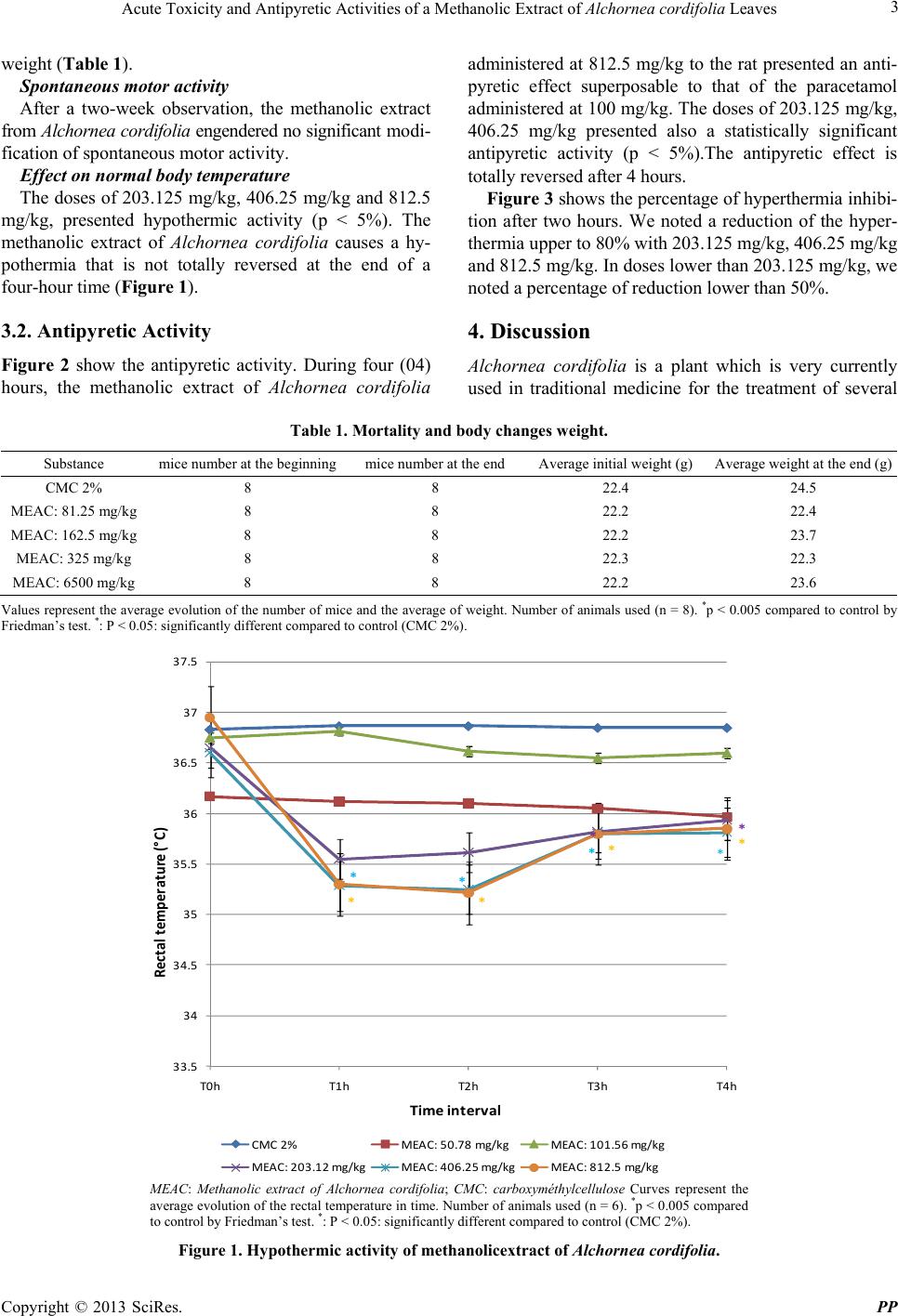 Acute Toxicity and Antipyretic Activities of a Methanolic Extract of Alchornea cordifolia Leaves Copyright © 2013 SciRes. PP 3 weight (Table 1). administered at 812.5 mg/kg to the rat presented an anti- pyretic effect superposable to that of the paracetamol administered at 100 mg/kg. The doses of 203.125 mg/kg, 406.25 mg/kg presented also a statistically significant antipyretic activity (p < 5%).The antipyretic effect is totally reversed after 4 hours. Spontaneous motor activity After a two-week observation, the methanolic extract from Alchornea cordifolia engendered no sign ificant mo di - fication of spontaneous motor activity. Effect on normal body temperature The doses of 203.125 mg/kg, 406.25 mg/kg and 812.5 mg/kg, presented hypothermic activity (p < 5%). The methanolic extract of Alchornea cordifolia causes a hy- pothermia that is not totally reversed at the end of a four-hour time (Figure 1). Figure 3 shows the percentage of hyperthermia inhibi- tion after two hours. We noted a reduction of the hyper- thermia upper to 80% with 203.125 mg/kg, 406.25 mg/kg and 812.5 mg/kg. In doses lower than 203.125 mg/kg, we noted a percentage of reduction lower than 50%. 4. Discussion 3.2. Antipyretic Activity Figure 2 show the antipyretic activity. During four (04) hours, the methanolic extract of Alchornea cordifolia Alchornea cordifolia is a plant which is very currently used in traditional medicine for the treatment of several Table 1. Mortality and body changes weight. Substance mice number at the beginning mice number at the end Average initial weight (g) Average weight at the end (g) CMC 2% 8 8 22.4 24.5 MEAC: 81.25 mg/kg 8 8 22.2 22.4 MEAC: 162.5 mg/kg 8 8 22.2 23.7 MEAC: 325 mg/kg 8 8 22.3 22.3 MEAC: 6500 mg/kg 8 8 22.2 23.6 Values rep resent the average ev olution of the number of mice an d the average o f weight. Number o f animals used ( n = 8). *p < 0.005 compared to control by Friedman’s te s t. *: P < 0.05: significantly diffe r ent compared t o control (CMC 2%). 33.5 34 34.5 35 35.5 36 36.5 37 37.5 T0h T1h T2h T3h T4h Rectal temperature (°C) Time interval CMC 2%MEAC: 50.78 mg/kgMEAC: 101.56 mg/kg MEAC: 203.12 mg/kgMEAC: 406.25 mg/kgMEAC: 812.5 mg/kg * * * ** * * *** MEAC: Methanolic extract of Alchornea cordifolia; CMC: carboxyméthylcellulose Curves represent the average evo lutio n of the r ectal temper atur e in ti me. Number o f animals used (n = 6 ). *p < 0.005 compared to control by Friedman’s test. *: P < 0.05: significantly different compared to control (CMC 2%). Figure 1. Hypothermic activity of methanolicextract of Alchornea cordifolia. 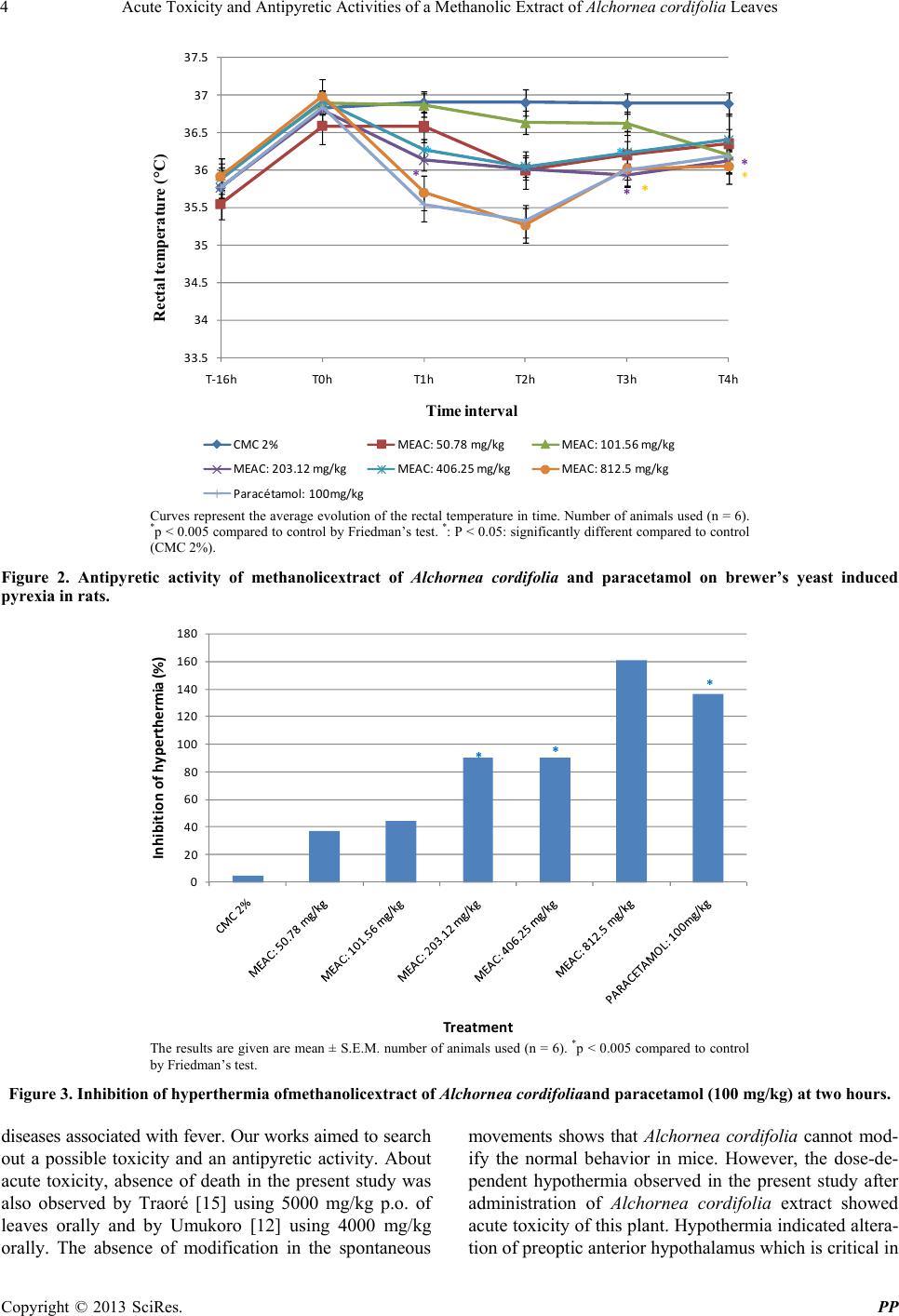 Acute Toxicity and Antipyretic Activities of a Methanolic Extract of Alchornea cordifolia Leaves 4 33.5 34 34.5 35 35.5 36 36.5 37 37.5 T-16hT0h T1hT2h T3hT4h Rectal temperature (°C) Time interval CMC 2%MEAC: 50.78 mg/kgMEAC: 101.56 mg/kg MEAC: 203.12 mg/kgMEAC: 406.25 mg/kgMEAC: 812.5 mg/kg Paracétamol: 100mg/kg ** * * * ** Curves r epresent the av erage evo lution o f the rect al temperat ure in t ime. Number o f animals u sed (n = 6). *p < 0.005 compared to control by Friedman’s test. *: P < 0.05: significantly different compared to control (CMC 2%). Figure 2. Antipyretic activity of methanolicextract of Alchornea cordifolia and paracetamol on brewer’s yeast induced pyrexia in rats. 0 20 40 60 80 100 120 140 160 180 Inhibition of hyperthermia (%) Treatment * * * The result s are given are mean ± S .E.M. number of animals used (n = 6). *p < 0.005 compared to control by Friedman’s test. Figure 3. Inhibition of hyperthermia ofmethanolicextract of Alchornea cordifoliaand paracetamol (100 mg/kg) at two hours. diseases associated with fever. Our works aimed to s ear ch out a possible toxicity and an antipyretic activity. About acute toxicity, absence of death in the present study was also observed by Traoré [15] using 5000 mg/kg p.o. of leaves orally and by Umukoro [12] using 4000 mg/kg orally. The absence of modification in the spontaneous movements shows that Alchornea cordifolia cannot mod- ify the normal behavior in mice. However, the dose-de- pendent hypothermia observed in the present study after administration of Alchornea cordifolia extract showed acute toxicity of this plant. Hypothermia indicated altera- tion of preoptic anterior hypothalamus which is critical in Copyright © 2013 SciRes. PP  Acute Toxicity and Antipyretic Activities of a Methanolic Extract of Alchornea cordifolia Leaves 5 the neuronal network of thermoregulation. The hypothala- mus regulated the set point at which body temperature is maintained. Hyperthermia inhibition observed in the pre- sent work varies from 89% to 160%. Evolution of hyper- thermia inhibition due to Alchornea cordifolia at 812.5 mg/kg during four hour was similar to paracetamol (100 mg/kg p.o.) with a pick at two hours (Figure 2). The mechanism of the induced hyperthermia by brewer’s yeast is mediated by prostaglandins biosynthesis [16,17]. Brewer’s yeast administrated through subcutaneous route, behaves lik e an exogenous pyrogen. Thu s, it produces an inflammatory process that according to Milton et al. [18] and Aronoff et al. [19], leads to the biosynthesis of chemical mediators as prostaglandins due to arachidonic acid. Among prostaglandins, PGE2 is strongly involved in the disturbance of the hypothalamic thermostat and so is responsable for fever [18,19]. Thus, the antipyretic activity of Alchornea cordifolia observed in this study would be related to the inhibition of the production of prostaglandins. Apart from their involvement in fever, prostaglandins are also known for their vasodilatation effect that generates red blotch and oedema as inflamma- tion characteristics. Thus the hypothesis about the inhibi- tion of the production of prostaglandins by Alchornea cordifolia could be uphold with the works by Osabede and Okoye [8] as well as those by Mavar-Manga et al. [7] highlighting the protecting effect of Alchornea cordifolia against oedema, the inflamemation model induced in rodent. These antipyretic property lay in the saponins contain in Alchornea cordifolia leaves [5,9] that, according to Gepdiremen et al. [20] are strong prostaglandin inhibi- tors. 5. Conclusion This antipyretic activity that is similar to paracetamol one could partly justify the traditional use of Alchornea cordifolia leaves against fever in the African societies. Considering the partially reversible hypothermic effect in a 4-hour observation time, we plan a more elaborate study on the neurotoxicity of that plant. 6. Acknowledgments The authors are grateful to Pr. L. Aké-Assi (Centre Na- tional de Floristique d’Abidjan) for botanical identifica- tion. REFERENCES [1] E. J. Adjanohoun, “Fiche Espèce: Alchornea cordifolia,” Bull Med Trad Pharm, Vol. 8, No. 2, 1994, pp. 203-213. [2] A. O. Ajao, N.-O. Shonukan, B. FemiI-Onadeko, “Anti- bacterial Effect of Aqueous and Alcohol Extracts of Spondias mombin and Alchornea cordifolia, Two Local Antimicrobial Remedies,” International Journal of Crude Drug Research, Vol. 23, No. 2, 1985, pp. 67-72. [3] A. Lamikanra, “Antimicrobial Spectrum of Alchornea cordifolia Leaf Extract,” Phytotherapy Research, Vol. 13, No. 1, 1999, pp. 67-69. http://dx.doi.org/10.1002/(SICI)1099-1573(199902)13:1< 67::AID-PTR366>3.0.CO;2-F [4] A. Lamikanra, A. O. Ogundani and F. O. Ogungbamila, “Antibacterial Constituents of Alchornea cordifolia Lea- ves,” Phytotherapy Research, Vol. 4, No. 5, 1990, pp. 198-200. http://dx.doi.org/10.1002/ptr.2650040508 [5] L. Tona, K. Kambu, N. Ngimbi, N. Mesia, O. Penge, M. Lusakibanza, K. Cimanga, T. De Bruyne, S Apers, J Tooté, L. Pieters and A. J. Vlietinck, “Antiamoebic and Spasmolitic Activities of Extracts from Some Antidiar- roeal Traditional Preparations Used in Kinshasa, Congo,” Phytomedicine, Vol. 4, No. 5, pp. 31-38. http://dx.doi.org/10.1016/S0944-7113(00)80019-7 [6] J. T. Banzouzi, R. Prado, H. Menan, A. Valentin, C. Roumestan, M. Mallie, Y. Pelissier and Y. Blache, “In Vitro Antiplasmodial Activity of Extracts of Alchornea cordifolia and Identification of an Active Constituent: Ellagic Acid,” Journal of Ethnopharmacology, Vol. 81, No. 3, 2002, pp. 399-401. http://dx.doi.org/10.1016/S0378-8741(02)00121-6 [7] M. H. Manga, D. Brkic, D. E. P. Marie and J. Quetin-Le- clercq, “In Vivo Anti-Inflammatory Acti vity of Alchornea cordifolia (Schmach. & Thonn) Müll. Arg. (Euphor- biaceae), ” Journal of Ethnopharmacology, Vol. 92, No. 2-3, 2004, pp. 209-214. http://dx.doi.org/10.1016/j.jep.2004.02.019 [8] U. M. Teotino, L. P. Friz, A. Gandini and D. D. Bella, “Thio Derivatives of 2,3-Dihydro-4H-1,3-Benzoazin-4- one Synthesis and Pharmacological Properties,” Journal of Medicinal Chemistry, Vol. 6, No. 3, 1963, pp. 248-250. http://dx.doi.org/10.1021/jm00339a007 [9] F. O. Ogungbamila and G. Samuelsson, “Smooth muscle relaxing flavonoids from Alchornea cordifolia,” Acta Pharmaceutica Nordica, Vol. 2, No. 6, 1990, pp. 421- 422. [10] R. Nia, D. H. Paper, G. Franz and E. E. Essien, “Anti- Angiogenic, Anti-Inflammatory and Anti-Oxidant Poten- tial of an African Recipe: Alchornea cordifolia Seeds,” Acta Horticulturae, Vol. 678, 2005, pp. 91-96. [11] G. A. Agbor, T. Leopold and N. Y. Jeanne, “The Antidi- arrhoeal Activity of Alchornea cordifolia Leaf Extract,” Phytotherapy Research, Vol. 18, No. 11, 2004, pp. 873- 876. http://dx.doi.org/10.1002/ptr.1446 [12] S. Umukoro and A. C. Aladeokin, “Evaluation of the Anti-Stress and Anticonvulsant Activities of Leaf Extract of Alchornea cordifolia in Mice,” Journal of Ethnophar- macology, Vol. 127, No. 3, 2010, pp. 768-770. http://dx.doi.org/10.1016/j.jep.2009.11.023 [13] E. Makonnen, A. Debella, L. Zerihun, D. Abebe and F. Teka, “Antipyretic Properties of the Aqueous and Ethenol Extracts of the Leaves of Ocimum suave and Ocimum lamifolium in Mice,” Journal of Ethnopharmacology, Vol. 88, No. 1, 2003, pp. 85-91. Copyright © 2013 SciRes. PP  Acute Toxicity and Antipyretic Activities of a Methanolic Extract of Alchornea cordifolia Leaves Copyright © 2013 SciRes. PP 6 http://dx.doi.org/10.1016/S0378-8741(03)00175-2 [14] N. Mascolo, R. Sharma, S. C. Jain and F. Capasso, “Eth- nopharmacology of Calotropis procera Flowers,” Journal of Ethnopharmacology, Vol. 22, No. 2, 1988, pp. 211-221. http://dx.doi.org/10.1016/0378-8741(88)90129-8 [15] M. Traoré, “Alchornea cordifolia. SCHMACH (Euphor- biaceae): Revue des activités Biologiques et L’etude de la Toxicité. Université de Bamako, Mali, 2004, 107 p. [16] R. Howard, “Preoperative and Postoperative Pain Con- trol,” Archives of Disease in Childhood, Vol. 69, No. 6, 1993, pp. 699-703. http://dx.doi.org/10.1136/adc.69.6.699 [17] J. R. Vane, “The Evolution of Non-Steroidal Anti-Inflam- matory Drugs and Their Mechanisms of Action,” Drugs, Vol. 33, Suppl. 1, 1987, pp. 18-27. http://dx.doi.org/10.2165/00003495-198700331-00005 [18] A. S. Milton, “Prostaglandins and Fever,” Trends in Pharmacological Sciences, Vol. 3, 1982, pp. 490-492. http://dx.doi.org/10.1016/0165-6147(82)91250-0 [19] M. D. Aronoff and E. G. Neilson, “Antipyretics: Mecha- nisms of Action and Clinical Use in Fever Suppression,” The American Journal of Medicine, Vol. 111, No. 4, 2001, pp. 304-315. [20] A. Gepdiremen, V. Mshvildadze, H. Suleyman and R. Elias, “Acute and Chronic Anti-Inflammatory Effects of Hedera colchica in Rats,” Journal of Ethnopharmacology, Vol. 94, No. 1, 2004, pp. 191-195. http://dx.doi.org/10.1016/j.jep.2004.06.001 |