

Paper Menu >>
Journal Menu >>
 Archaeological Discovery 2013. Vol.1, No.2, 32-36 Published Online October 2013 in SciRes (http://www.scirp.org/journal/ad) http://dx.doi.org/10.4236/ad.2013.12002 Copyright © 2013 SciRes. 32 Deposition of Transparent, Hydrophobic TiO2 Film for the Protection of Outdoor and Marine Cultural Heritage Assets Fabio Stranges1,2, Marianna Barberio1,2*, Pasquale Barone1,2, Andrea Abenante1, Andrea Leuzzi1, Peppino Sapia1,2, Fang Xu1, Assunta Bonanno1 1Physics Department, University of Calabria, Cosenza, Italy 2Biology, Ecolgy and Earth Science Department, University of Calabria, Cosenza, Italy Email: *[email protected] Received June 28th, 2013; revised August 1st, 2013; accepted August 10th, 2013 Copyright © 2013 Fabio Stranges et al. This is an open access article distributed under the Creative Commons Attribution License, which permits unrestricted use, distribution, and reproduction in any medium, provided the original work is properly cited. In this work we present two new methods to obtain TiO2 transparent coverage and to impart superhydro- phobicity to stones and ceramics surface of monuments. The first method, adapted for small artifacts eas- ily transportable in restoration laboratory, consists of a simple evaporation of Ti directly on ceramic sur- face in a controlled oxygen atmosphere. The second method consents the coverage of large surface di- rectly in situ. The TiO2 is evaporated on a salt surface with desired dimensions and then deposited on ce- ramic surfaces. In both cases the dioxide layers are transparent, don’t damage the ceramic surfaces and are easily removable. In fact, the dioxide layer can be removed simply by 30 minutes of laser ablation process. Keywords: Marine Artifacts; Photocatalic Activity; Protection of Cultural Heritage Introduction In recent decades several scientific efforts have been made to fabricate superhydrophobic surfaces by using numerous tech- niques and methods, for example, plasma treatment (Manoudis, 2009; Chen, 1999; Coulson, 2000; Tserepi, 2006), photolitho- graphy (Oner, 2000; Gao, 2006) and sol-gel (Shirtcliffe, 2003; Mahltig, 2003; Hikita, 2005). Water repellent coatings can be important in many applications including, for example, the prevention of icing in cold weather, the promotion of self- cleaning process induced by rainwater on outdoor surfaces, the prevention of clotting in artificial blood vessels, the decrease of corona activity developed in conductors of transmission lines under rainy conditions, the production of waterproof and stain resistent textiles, and the reduction of friction in water (Ma- noudis, 2009; Gao, 2006; Zorba, 2008). One of the applications of the superhydrophobic coatings is their use as surface protec- tive barriers for the preservations and conservation of ceramic and stone monuments. The most important degradation factor of outdoor, immovable cultural heritage is the rainwater which can causes stone deterioration through cycles of freezing and thawing inside the pores of the stones or by intraporous cry- stallization of the salts transferred by the water (Manoudis, 2009; Manoudis, 2008). For this reason, the application of hy- drophobic coatings has been suggested for the surface pro- tection of outdoor cultural heritage assets (Manoudis, 2009; Manoudis, 2008). Moreover several monuments are collocated in marine sites and cannot be removed from seabed, in these conditions the corrosion caused by marine water and microor- ganism can causes serious problems to conservation. Recently Manoudis et al. described (Manoudis, 2009; Manoudis, 2008) a simple method that can be used to impart superhydrophobicity to different stones surfaces (used in restoration of the castle of Prague). This method is based on the dispersion of nanoparticle in a polymeric solution that can be sprayed on the substrate. The resulting composite polymer-nanoparticle film exhibits superhydrophobic properties. However, this method cannot be applied in marine archeo- logical sites (in underwater conditions the spray process is im- possible and the dispersed particles can create environmental pollution). Moreover, in marine archeological sites the cover- age of ceramic and stone must have an antibacterial action to inhibit the deterioration caused by the attack of marine micro- organisms. In this optics, a surface coverage by TiO2 substrate, with its phocatalytic oxidation properties (Liu, 2005; Naeem, 2010), can solve both the problems: idrophobicity and antibac- terial activity. Here we describe two simple methods to obtain TiO2 cover- age applicable in air and in marine water conditions. The ob- tained coverages are transparent (so it don’t modify the artistic properties of monument) and hydrophobic, don’t damage the ceramic surface and are easily removable by a simple cleaning process of laser ablation (Stranges, 2013). Materials and Methods All the experiments were conducted on several ceramic frag- ments obtained from a “Carosello” (Gattuso, 2012), a structural hollow element made of clay, placed in arches, in domes or even and in the walls of buildings such as churches and houses, with the function lighten the structures (the specific “carosello” used in these experiments come from a site in Calabria: the Sanctuary of “Madonna del Buonconsiglio” in san Giacomo di Cerzeto, Cosenza, Italy dated back to 1844 ± 11). The frag- *Corresponding author. 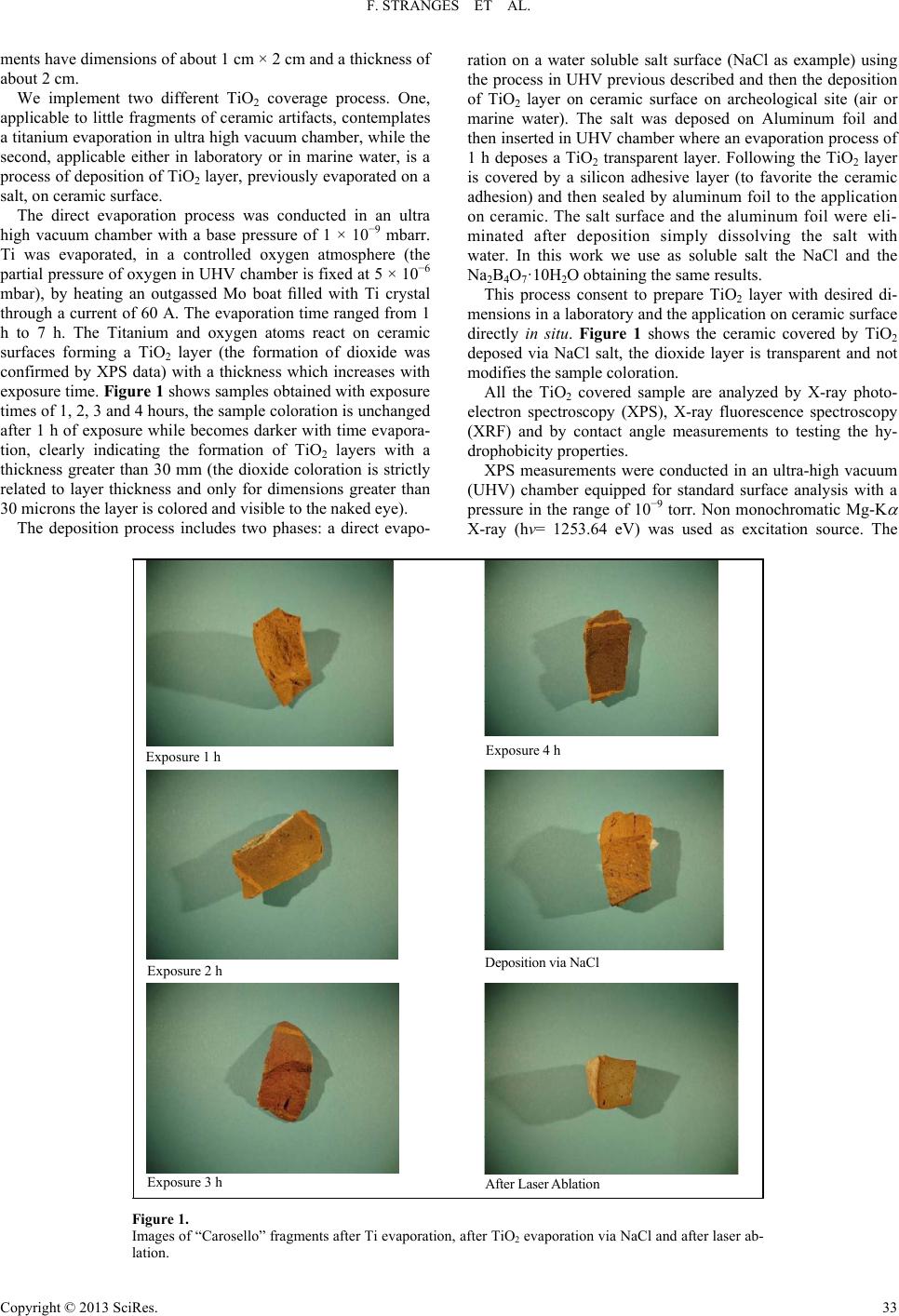 F. STRANGES ET AL. Copyright © 2013 SciRes. 33 ments have dimensions of about 1 cm × 2 cm and a thickness of about 2 cm. We implement two different TiO2 coverage process. One, applicable to little fragments of ceramic artifacts, contemplates a titanium evaporation in ultra high vacuum chamber, while the second, applicable either in laboratory or in marine water, is a process of deposition of TiO2 layer, previously evaporated on a salt, on ceramic surface. The direct evaporation process was conducted in an ultra high vacuum chamber with a base pressure of 1 × 10⁻⁹ mbarr. Ti was evaporated, in a controlled oxygen atmosphere (the partial pressure of oxygen in UHV chamber is fixed at 5 × 10⁻⁶ mbar), by heating an outgassed Mo boat filled with Ti crystal through a current of 60 A. The evaporation time ranged from 1 h to 7 h. The Titanium and oxygen atoms react on ceramic surfaces forming a TiO2 layer (the formation of dioxide was confirmed by XPS data) with a thickness which increases with exposure time. Figure 1 shows samples obtained with exposure times of 1, 2, 3 and 4 hours, the sample coloration is unchanged after 1 h of exposure while becomes darker with time evapora- tion, clearly indicating the formation of TiO2 layers with a thickness greater than 30 mm (the dioxide coloration is strictly related to layer thickness and only for dimensions greater than 30 microns the layer is colored and visible to the naked eye). The deposition process includes two phases: a direct evapo- ration on a water soluble salt surface (NaCl as example) using the process in UHV previous described and then the deposition of TiO2 layer on ceramic surface on archeological site (air or marine water). The salt was deposed on Aluminum foil and then inserted in UHV chamber where an evaporation process of 1 h deposes a TiO2 transparent layer. Following the TiO2 layer is covered by a silicon adhesive layer (to favorite the ceramic adhesion) and then sealed by aluminum foil to the application on ceramic. The salt surface and the aluminum foil were eli- minated after deposition simply dissolving the salt with water. In this work we use as soluble salt the NaCl and the Na2B4O7·10H2O obtaining the same results. This process consent to prepare TiO2 layer with desired di- mensions in a laboratory and the application on ceramic surface directly in situ. Figure 1 shows the ceramic covered by TiO2 deposed via NaCl salt, the dioxide layer is transparent and not modifies the sample coloration. All the TiO2 covered sample are analyzed by X-ray photo- electron spectroscopy (XPS), X-ray fluorescence spectroscopy (XRF) and by contact angle measurements to testing the hy- drophobicity properties. XPS measurements were conducted in an ultra-high vacuum (UHV) chamber equipped for standard surface analysis with a pressure in the range of 10−9 torr. Non monochromatic Mg-K X-ray (hν= 1253.64 eV) was used as excitation source. The Exposure 1 hExposure 4 h Exposure 2 h Exposure 3 h Deposition via NaCl After Laser Ablation Figure 1. Images of “Carosello” fragments after Ti evaporation, after TiO2 evaporation via NaCl and after laser ab- lation. 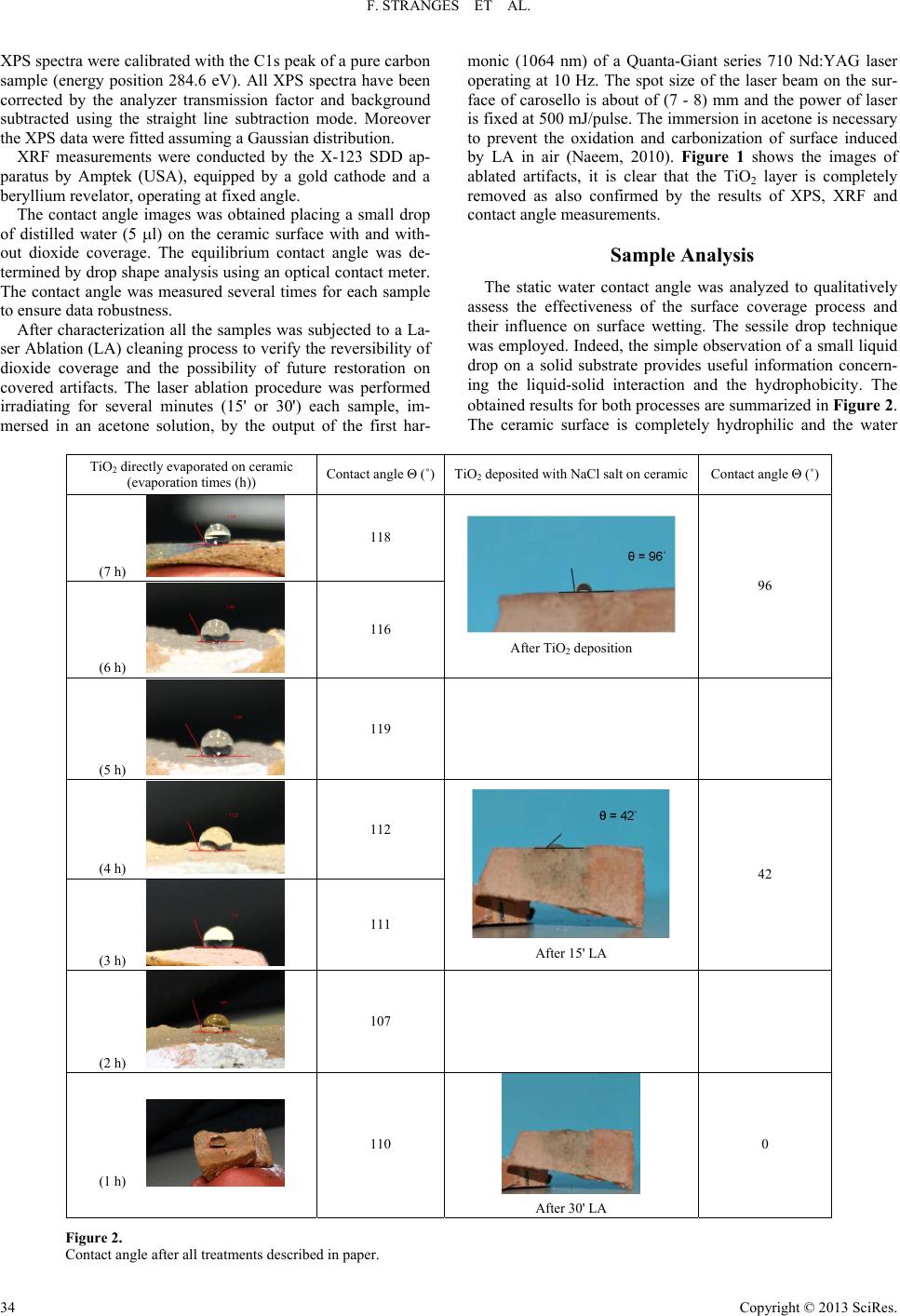 F. STRANGES ET AL. Copyright © 2013 SciRes. 34 XPS spectra were calibrated with the C1s peak of a pure carbon sample (energy position 284.6 eV). All XPS spectra have been corrected by the analyzer transmission factor and background subtracted using the straight line subtraction mode. Moreover the XPS data were fitted assuming a Gaussian distribution. XRF measurements were conducted by the X-123 SDD ap- paratus by Amptek (USA), equipped by a gold cathode and a beryllium revelator, operating at fixed angle. The contact angle images was obtained placing a small drop of distilled water (5 l) on the ceramic surface with and with- out dioxide coverage. The equilibrium contact angle was de- termined by drop shape analysis using an optical contact meter. The contact angle was measured several times for each sample to ensure data robustness. After characterization all the samples was subjected to a La- ser Ablation (LA) cleaning process to verify the reversibility of dioxide coverage and the possibility of future restoration on covered artifacts. The laser ablation procedure was performed irradiating for several minutes (15' or 30') each sample, im- mersed in an acetone solution, by the output of the first har- monic (1064 nm) of a Quanta-Giant series 710 Nd:YAG laser operating at 10 Hz. The spot size of the laser beam on the sur- face of carosello is about of (7 - 8) mm and the power of laser is fixed at 500 mJ/pulse. The immersion in acetone is necessary to prevent the oxidation and carbonization of surface induced by LA in air (Naeem, 2010). Figure 1 shows the images of ablated artifacts, it is clear that the TiO2 layer is completely removed as also confirmed by the results of XPS, XRF and contact angle measurements. Sample Analysis The static water contact angle was analyzed to qualitatively assess the effectiveness of the surface coverage process and their influence on surface wetting. The sessile drop technique was employed. Indeed, the simple observation of a small liquid drop on a solid substrate provides useful information concern- ing the liquid-solid interaction and the hydrophobicity. The obtained results for both processes are summarized in Figure 2. The ceramic surface is completely hydrophilic and the water TiO2 directly evaporated on ceramic (evaporation times (h)) Contact angle Θ (˚)TiO 2 deposited with NaCl salt on ceramic Contact angle Θ (˚) (7 h) 118 (6 h) 116 After TiO2 deposition 96 (5 h) 119 (4 h) 112 (3 h) 111 After 15' LA 42 (2 h) 107 (1 h) 110 After 30' LA 0 Figure 2. Contact angle after all treatments described in paper. 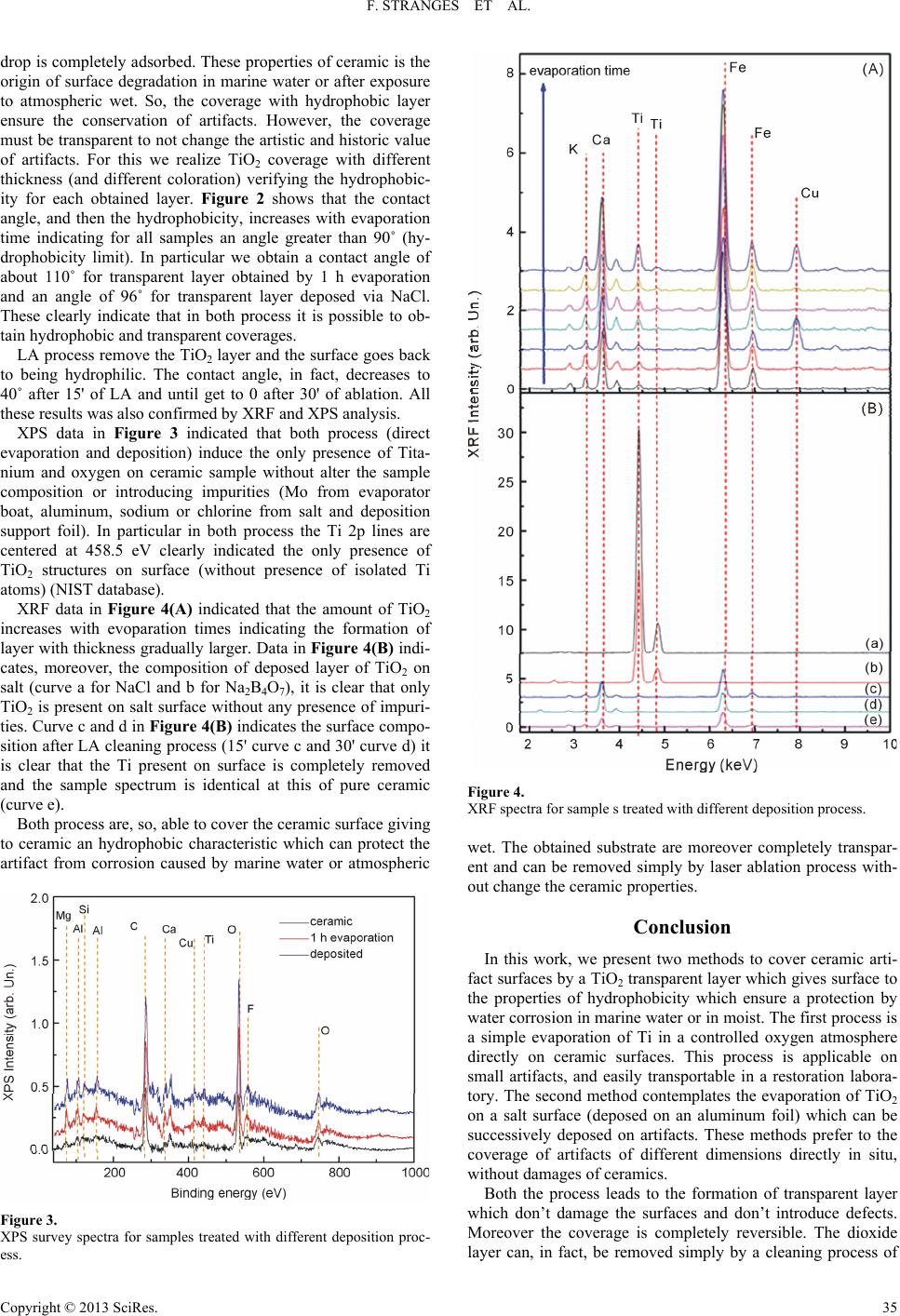 F. STRANGES ET AL. Copyright © 2013 SciRes. 35 drop is completely adsorbed. These properties of ceramic is the origin of surface degradation in marine water or after exposure to atmospheric wet. So, the coverage with hydrophobic layer ensure the conservation of artifacts. However, the coverage must be transparent to not change the artistic and historic value of artifacts. For this we realize TiO2 coverage with different thickness (and different coloration) verifying the hydrophobic- ity for each obtained layer. Figure 2 shows that the contact angle, and then the hydrophobicity, increases with evaporation time indicating for all samples an angle greater than 90˚ (hy- drophobicity limit). In particular we obtain a contact angle of about 110˚ for transparent layer obtained by 1 h evaporation and an angle of 96˚ for transparent layer deposed via NaCl. These clearly indicate that in both process it is possible to ob- tain hydrophobic and transparent coverages. LA process remove the TiO2 layer and the surface goes back to being hydrophilic. The contact angle, in fact, decreases to 40˚ after 15' of LA and until get to 0 after 30' of ablation. All these results was also confirmed by XRF and XPS analysis. XPS data in Figure 3 indicated that both process (direct evaporation and deposition) induce the only presence of Tita- nium and oxygen on ceramic sample without alter the sample composition or introducing impurities (Mo from evaporator boat, aluminum, sodium or chlorine from salt and deposition support foil). In particular in both process the Ti 2p lines are centered at 458.5 eV clearly indicated the only presence of TiO2 structures on surface (without presence of isolated Ti atoms) (NIST database). XRF data in Figure 4(A) indicated that the amount of TiO2 increases with evoparation times indicating the formation of layer with thickness gradually larger. Data in Figure 4(B) indi- cates, moreover, the composition of deposed layer of TiO2 on salt (curve a for NaCl and b for Na2B4O7), it is clear that only TiO2 is present on salt surface without any presence of impuri- ties. Curve c and d in Figure 4(B) indicates the surface compo- sition after LA cleaning process (15' curve c and 30' curve d) it is clear that the Ti present on surface is completely removed and the sample spectrum is identical at this of pure ceramic (curve e). Both process are, so, able to cover the ceramic surface giving to ceramic an hydrophobic characteristic which can protect the artifact from corrosion caused by marine water or atmospheric Figure 3. XPS survey spectra for samples treated with different deposition proc- ess. Figure 4. XRF spectra for sample s treated with different deposition process. wet. The obtained substrate are moreover completely transpar- ent and can be removed simply by laser ablation process with- out change the ceramic properties. Conclusion In this work, we present two methods to cover ceramic arti- fact surfaces by a TiO2 transparent layer which gives surface to the properties of hydrophobicity which ensure a protection by water corrosion in marine water or in moist. The first process is a simple evaporation of Ti in a controlled oxygen atmosphere directly on ceramic surfaces. This process is applicable on small artifacts, and easily transportable in a restoration labora- tory. The second method contemplates the evaporation of TiO2 on a salt surface (deposed on an aluminum foil) which can be successively deposed on artifacts. These methods prefer to the coverage of artifacts of different dimensions directly in situ, without damages of ceramics. Both the process leads to the formation of transparent layer which don’t damage the surfaces and don’t introduce defects. Moreover the coverage is completely reversible. The dioxide layer can, in fact, be removed simply by a cleaning process of  F. STRANGES ET AL. Copyright © 2013 SciRes. 36 laser ablation (30' at 1064 nm, 500 mJ) without surface dam- aging. REFERENCES Chen, W., Fadeev, A. Y., Hsieh, M. C., Oner, D., Youngblood, J., & McCarty, T. J. (1999). Ultrahydrophobic and ultralyophobic surfaces: Some comments and examples. Langmuir, 15, 3395-3399. http://dx.doi.org/10.1021/la990074s Coulson, S. R., Woodward, I., Badyal, J. P. S., Brewer, S. A., & Willis, C. J. (2000). Super-repellent composite fluoropolymer surfaces. The Journal of Physical Chemistry B, 104, 8836-8840. http://dx.doi.org/10.1021/jp0000174 Gao, L., & McCarthy, T. J. (2006). A perfectly hydrophobic surface (θA/θR = 180˚/180˚). Journal of the American Chemical Society, 128, 9052-9053. http://dx.doi.org/10.1021/ja062943n Gao, L., & McCarthy, T. J. (2006). The “lotus effect” explained: Two reasons why two length scales of topography are important. Lang- muir, 22, 2966-2967. http://dx.doi.org/10.1021/la0532149 Gattuso, C., Renzelli, D., Barone, P., Pingitore, V., & Oliva, A. (2012). Sar and Maad TL Dating of “Caroselli” from three sites in Calabria, South Italy. Mediterranean Archeology and Archeometry, 12, 43-54. Hikita, M., Tanaka, K., Nakamura, T., Kajiyama, T., & Takahara, A. (2005). Super-liquid-repellent surfaces prepared by colloidal silica nanoparticles covered with fluoroalkyl groups. Langmuir, 21, 7299- 7302. http://dx.doi.org/10.1021/la050901r Liu, G., Zhang, X., Xu, Y., Niu, X., Zheng, L., & Ding, X. (2005). The preparation of Zn2+-doped TiO2 nanoparticles by sol-gel and solid phase reaction methods respectively and their photocatalytic ac- tivities. Chemosphere, 59, 1367-1371. http://dx.doi.org/10.1016/j.chemosphere.2004.11.072 Mahltig, B., & Bottcher, H. (2003). Modified silica sol coatings for water-repellent textiles. Journal of Sol-Gel Science and Technology, 27, 43-52. http://dx.doi.org/10.1023/A:1022627926243 Manoudis, P. N., Karapanagiotis, I., Tsakalof, A., Zuburtikudis, I., Kolinekeova, B., & Panayiotou, C. (2009). Superhydrophobic films for the protection of outdoor cultural heritage assets. Applied Physics A, 97, 351-360. http://dx.doi.org/10.1007/s00339-009-5233-z Manoudis, P. N., Karapanagiotis, I., Tsakalof, A., Zuburtikudis, I., & Panayiotou, C. (2008). Superhydrophobic composite films produced on various substrates. Langmuir, 24, 11225-11232. http://dx.doi.org/10.1021/la801817e Naeem, K., & Ouyang, F. (2010). Preparation of Fe3+-doped TiO2 nanoparticles and its photocatalytic activity under UV light. Physica B, 221, 221-226. NIST XPS Database (2012). NIST X-ray photoelectron spectroscopy database. http://srdata.nist.gov/xps Oner, D., & McCarty, T. J. (2000). Ultrahydrophobic surfaces. Effects of topography length scales on wettability. Langmuir, 16, 7777-7782. http://dx.doi.org/10.1021/la000598o Shirtcliffe, N. J., McHale, G., Newton, M. I., & Perry, C. C. (2003). Intrinsically superhydrophobic organosilica sol-gel foams. Langmuir, 19, 5626-5631. http://dx.doi.org/10.1021/la034204f Stranges, F., Barberio, M., Barone, P., Pingitore, V., Xu, F., & Bo- nanno, A. (2013). Laser ablation of silver artifacts in vacuum: Solu- tion to silver tarnishing problem. Journal of Earth Science and Engineering, in Press. Tserepi, A. D., Vlachopoulu, M. E., & Gogolides, E. (2006). Nanotexturing of poly(dimethylsiloxane) in plasmas for creating robust super-hydro- phobic surfaces. Nanotechnology, 17, 3977. http://dx.doi.org/10.1088/0957-4484/17/15/062 Zorba, V., Stratakis, E., Barberoglou, M., Spanakis, E., Tzanetakis, P., Anastasiadis, S. H., & Fotakis, C. (2008). Biomimetic artificial sur- faces quantitatively reproduce the water repellency of a lotus leaf. Advanced Materials, 20, 4049-4054. http://dx.doi.org/10.1002/adma.200800651 |