

Paper Menu >>
Journal Menu >>
 International Journal of Geosciences, 2013, 4, 18-23 http://dx.doi.org/10.4236/ijg.2013.45B004 Published Online September 2013 (http://www.scirp.org/journal/ijg) Copyright © 2013 SciRes. IJG Effects of Temperatu re upon Water Tu rnover in Fish Ponds in Northern Thailand Patcharawalai Sriyasak1,2, Chanagun Chitmanat1, Niwooti Whangchai1, Jongkon Promya1, Louis Lebel2 1Faculty of Fisheries Technology and Aquatic Resources, Maejo University, Chiang Mai, Thailand 2Unit for Social and Environmental Research (USER), Faculty of Social Science, Chiang Mai University, Chiang Mai, Thailand Email: l [email protected] Received June 2013 ABSTRACT Fish culture in earthen ponds is an important source of income for farmers in northern Thailand. Water quality in ponds has strong impacts on fish production farmers’ return and is sensitive to weather and climate. Low levels of dissolved oxygen in fish ponds are major cause of mass mortality. Stratification with depth in ponds followed by rapid turnover or exchange of surface and bottom water can expose fish to dangerously low dissolved oxygen levels. The main purpose of this study was to observe the effects of weather on stratification and subsequent water turnover in fish ponds in northern Thailand, especially in the winter and rainy season, when stratification was expected to be most severe. Temperature and water quality measurements were made in fish ponds at 18 farms with depths ranged from 0.8 - 2.0 m and size of 0.16 - 0.64 ha. Measurements were made during January and May 2013. Fish farm pond sites were divided into two groups based on elevation above sea level: low (<400 masl) and high (>400 masl) and categorized into 3 types of farm- ing: commercial, integrated and subsistence. In lower elevation sites, water turnover occurred at night between 22.00 and 02.00 in winter and between 18.00 and 02.00 in rainy season. At higher elevation, turnover occurred in ponds be- tween 20.00 and 22.00 in winter and between 14.00 and 18.00 in rainy season. Turnover was slower in the lower eleva- tion than in higher elevation zones and generally occurred earlier during the rainy season than in the winter. Mean DO in winter was significantly higher (p < 0.05) than in rainy season, whilst water temperature and amount of ammo- nia-nitrogen during the rainy season was significantly higher (p < 0.05) than in winter. Turnover improves distribution of dissolved oxygen through the water column and minimizes organic matter accumulation. Cloud cover during the rainy season may have contributed to limit oxygen production and thus may have significantly affect water quality in ponds. Fish farmers should consider more explicitly the role of temperature and cloud conditions when managing dis- solved oxygen levels in their fish ponds. Therefore, efficient pond aeration or pond mixing strategies for reducing strati- fication still plays an important component for providing sound pond management in tilapia production ponds. Keywords: Climate; Temperature; Oxygen; Turnover; Fish Culture 1. Introduction Tilapia fish culture in earthen ponds is expanding dra- matically in Thailand [1]. Farmers, especially in the northern area raise these popular freshwater fish under intensive or extensive methods, in pond cages and most commonly along with livestock under the integrated farming scheme for local consumption and livelihood. Currently, fish farmers face difficulties in rearing tilapia in earthen ponds. Warmer pond temperatures due to cli- mate change may be a contributing factor to this problem. Temperature and dissolved oxygen (DO) have impacts on fish production [2,3] and may be affected by weather and climate [4,5]. Prolonged extreme hot weather fol- lowed by a heavy rain disturbs the surface water to cool lower temperatures where the cool heavy water layer sink to the bottom floor due to gravity can cause turnover of water in ponds [6,7]. Stratification with depth in ponds followed by rapid turnover or exchange of surface and bottom water can expose fish to dangerously low dis- solved oxygen levels subjecting them to stress and vul- nerability to diseases. Low levels of dissolved oxygen in fish ponds are major cause of fish death [8]. Tilapia fish culture in earthen ponds in northern Thailand can be di- vided into three categories: commercial, integrated (with pig or chicken) and subsistence. Sensitivity to lower dis- solved oxygen in different culture systems causes differ- ent levels of risks of mortality from changes in weather and water turnover. The main purpose of this study was to measure the effects of weather on stratification and subsequent water turnover in fish ponds under different  P. SRIYASAK ET AL. Copyright © 2013 SciRes. IJG 19 culture systems and in different sites across a climate gradient in northern Thailand so as to identify ways to reduce risks of mass mortality under current climate as well as adapt to a changing climate. 2. Material and Methods 2.1. Study Site This study was carried out in 18 ponds located in 5 se- lected provinces of Northern Thailand: Chiangrai, Chi- angmai, Phayao, Lampang and Nakornsawan. Mean ele- vation of these areas range from 25 to 582 meters above sea level (masl). Pond sizes ranged from 0.16 - 0.64 ha with depths of 0.8 - 2.0 m. Ponds were grouped accord- ing to elevation (lower, <400 masl and higher, >400 masl) and culture system: commercial (C), where prepared pel- let feed was regularly provided and crops tended to be harvested at one-time and sold; integrated (I), where fish and livestock were being raised in the same area; and subsistence (S), where feeding was sporadic and fish harvested continuously for consumption and market. The characteristics of each of culture system are further de- scribed and summarized in Table 1. 2.2. Water Parameter Data of water quality in ponds were collected for a typi- cal winter and rainy months, January and May 2013. Water temperature, dissolved oxygen (DO), pH, turbidity and conductivity were monitored at 2-hour interval over a 24-hour period in each season at every 20-cm depth with a multimeter (TOA DKK WQC-22A model, Japan). Water samples were collected 20-cm below the surface and 20-cm just off the bottom using a modified water sampler. Chemical analyses were carried out for Total Ammonia-Nitrogen (TAN), Nitrite-Nitrogen ( 2 NO− -N), Nitrate-Nitrogen ( 3 NO− -N), Orthophosphate ( 3 4 PO − -P), Alkalinity, Total Suspended Solids (TSS) and Chloro- phyll-a (Chl-a) according to standard methods [9]. 2.3. Statistical Analysis ANOVA was used to compare water pond parameters across the two elevation groups and the three culture systems. Paired sample T-test was used to compare the differences of water quality variables between the two seasons at p < 0.05. 3. Results and Discussion 3.1. Temperature Measurements at Sampling Sites Mean air and water temperatures decrease with mean elevation across the climate gradient of sites selected for study (Figure 1). Expectedly, observed air and water temperatures were lower at higher elevation sites. Bi- hourly variation of air temperature in the winter (January) ranged between 16.5˚C and 35.83˚C (28.3 ± 4.11) and water temperature, between 25.5˚C to 27.1˚C (26.3 ± 0.57). Monitored bi-hourly air temperature during the rainy season (May) ranged between 22.0˚C and 37.3˚C (28.14 ± 4.03) an d water temperature, between 29.4˚C to 31.8˚C (30.44 ± 0.80). Altitude affects the temperature of the air because air pressure gets lower as the altitude in- creases and so does inversely affect pond water temper a- ture as well. Table 1. Major properties of ponds monitored in the study. Pond Property Culture System Commercial (C) Integrated (I) Subsistence (S) Pond Area (m2) 1600 - 3200 1600 - 4800 640 - 1280 Pond Depth (m) 1.20 - 1.80 1.20 - 1.50 0.80 - 1.50 Stocking Rate (fish m−2) 3 3 0.5 - 1 Culture Period (d) 30 - 90 30 - 120 120 - 240 Water Renewal 10% per day seldom No renewal Figure 1. Air and water temperatures at different elevations above sea level. 0.0 5.0 10.0 15.0 20.0 25.0 30.0 35.0 40.0 45.0 0100 200 300 400 500 600 700 Temperature (°C) Mean Sea Level; MSL (m) Air Temperature Water Temperature  P. SRIYASAK ET AL. Copyright © 2013 SciRes. IJG 20 3.2. Water Turnover in Ponds All ponds monitored stratify diurnally. During the night and at pre-dawn the water column is isothermal, over mid-day it is thermally stratified but isothermal condi- tions return with the onset of light evening winds. Max- imum temperature was recorded at around mid-afternoon (15:00) in all ponds irrespective of elevation and culture system type, which is typical in a shallow aquaculture pond system. Integrated plots of dissolved oxygen, air and water temperatures of ponds at lower elevation (<400 masl) for the two seasons are shown in Figures 2(a) and 2(b). Mean air and water temperatures in the winter ranged from 21˚C to 35.8˚C (27.9 ± 5.2) and from 27.4˚C to 29.0˚C (28.3 ± 0.53), respectively. Mean surface DO fluctuated between 1.05 and 11.72 mg·L−1 (5.38 ± 3.84). Maximum DO value was at 16:00 daylight hour while the minimum values were observed at dawn (4:00 - 6:00) which coincided with bottom DO concentration mini- mums. Pond bottom DO fluctuated between 0.97 and 4.13 mg·L−1 (2. 25 ± 1.10 ) which reaches its maximum at 20:00. Noteworthy, water turnover of ponds in the winter occurred at 20:00 when bottom DO was at its maximu m. Complete destratification and mixing occurred at 4:00 until 6:00 when surface and bottom DO were almost equal and at nearly isothermal condition. On the other hand, mean air and water temperatures recorded for the rainy season (May) were from 27.2˚C to 37.3˚C (31.1 ± 3.5) and from 28.7˚C to 29.9˚C (30.5 ± 0.90), respectively. Mean range of surface DO was from 0.43 to 14.69 mg·L−1 (4.93 ± 4.89) whereas the mean DO range at the bottom was from 0.30 to 2.9 mg·L−1 (0.94 ± 0.78). Water turnove r transition occurred betwe en 18:00 - 02:00. when surface DO started to drop significantly and bottom DO reaches its maximum and decreases thereafter. Iso- thermal condition and complete destratification were attained at 4:00 until 6:00 as observed in the winter. However, water turnover occurred earlier for the rainy season as compared during the winter. This could be due to rain effect, cooling the surface water by a cold rain and wind close to the temperature of deep water, allow- ing them to mix. In higher elevation sites (>400 masl) (Figures 2(c), 2(d)), mean air and water temperatures during the winter was recorded to be between 16.4˚C to 29.2˚C (21.6 ± 4.78) and between 22.9˚C to 24.5˚C (23.7 ± 0.62), re- spectively. Mean surface DO fluctuated from 3.83 to 11.44 mg·L−1 (7.11 ± 2.77) while the mean bottom DO ranged from 3.39 to 5.30 mg·L−1 (4.23 ± 0.58). In rainy season, mean air and water temperatures ranged from 23.3˚C to 29.8˚C (25.7 ± 2.7) and from 29.4˚C to 31.4˚C (30.4 ± 0.70), respectively. Mean surface DO was 1.36 to 10.88 mg·L−1 (5.32 ± 3.21) and the mean bottom DO varied from 1.17 to 6.46 mg·L−1 (3.42 ± 2.07). Th e same pattern was observed in both higher and lower elevation sites with respect to the relative difference in water turno- ver occurrence between the two seasons, except only that the difference is more pronounced in the former. Water turnover in higher elevation sites occurred at 22:00 in the Figure 2. Air and water temperatures, surface and bottom DO at elevations of sea level and in winter and rainy season. 0.00 1.00 2.00 3.00 4.00 5.00 6.00 7.00 8.00 9.00 10.00 11.00 12.00 13.00 0.0 5.0 10.0 15.0 20.0 25.0 30.0 35.0 40.0 6.008.0010.00 12.00 14.00 16.00 18.00 20.00 22.00 24.002.00 4.00 Time DO (mg/l) Temperature (◦C) Air temperature Water temperature DO Surface DO Bottom Winter < 400 m 0.00 2.00 4.00 6.00 8.00 10.00 12.00 14.00 16.00 0.00 5.00 10.00 15.00 20.00 25.00 30.00 35.00 40.00 6.008.0010.0012.0014.00 16.00 18.00 20.0022.00 24.002.004.00 DO (mg/l) Temperature (◦C) Time Air temperature Water temperature DO Surface DO Bottom Rainy < 400 m 0.00 1.00 2.00 3.00 4.00 5.00 6.00 7.00 8.00 9.00 10.00 11.00 12.00 13.00 0 5 10 15 20 25 30 35 6.008.0010.00 12.00 14.00 16.0018.00 20.00 22.00 24.002.004.00 DO (mg/l) Temperature (◦C) Time Air temperature Water temperature DO Surface DO Bottom Winter > 400 m 0.00 1.00 2.00 3.00 4.00 5.00 6.00 7.00 8.00 9.00 10.00 11.00 12.00 0.0 5.0 10.0 15.0 20.0 25.0 30.0 35.0 6.008.0010.00 12.00 14.00 16.00 18.00 20.00 22.00 24.002.004.00 DO (mg/l) Temperature (◦C) Time Air temperature Water temperature DO Surface DO Bottom Rainy > 400 m A D C B n=9 n=7 n=9 n=7  P. SRIYASAK ET AL. Copyright © 2013 SciRes. IJG 21 winter. For the rainy season, the water turnover occurred during daylight at 14.00 and 18.00 p.m. Due to heavy rain during that time the water on the floor mixed with water then sinking with lower water in the rain (Figure 2). Apparently, isothermal condition and full turnover for both seasons at higher elevation also occurred at around 6:00 which is similar in lower elevation sites. 3.3. Water Quality in Ponds in Different Seasons Mean values of water quality parameters for the two seasons are presented in Table 2. Mean DO in winter was significantly higher than in rainy season, whilst wa- ter temperature and amount of ammonia-nitrogen during the rainy season was significantly higher than in the winter. It was expected though to find higher concentra- tions of DO in ponds during cold winter months. Cold water (lower temperature) has a higher solubility to dis- solved gases than warm water does. A possible explana- tion for the lower mean DO values in the rainy season could be partly due to cloud cover limiting sunlight to reach the water surface, thus affects photosynthesis and oxygen production. Another is the turbidity nature of the water at this period due to inflows from localized run-offs and decomposition of organic matter in the wa- ter. Moreover, ammonia and other partially degraded decomposition products are released during the aerobic decomposition process therefore contributed to signifi- cantly higher ammonia-nitrogen concentration in rainy season. Table 2. Physico-chemical and biological characteristics of monitored ponds by season. Variables Season Winter Rainy Temperature (˚C) 26.0 ± 2.34 a 30.4 ± 1.350 b pH 7.25 ± 0.69 7.24 ± 3.34 DO (mg·L−1) 4.81 ± 1.83a 3.39 ± 1.78b Conductivity (mScm−1) 32.30 ± 26.95 35.52 ± 28.17 Turbidity (NTU) 82.50 ± 46.97 107.32 ± 77.42 Chlorophyll-a (µg·L−1) 209.61 ± 185.23 212.22 ± 226.71 NH4-N (mg· L−1) 0.188 ± 0.15a 0.415 ± 0.35b NO2-N (mg· L −1) 0.014 ± 0.17 0.026 ± 0.04 NO3-N (mg·L−1) 0.028 ± 0.03 0.090 ± 0.14 PO43-P (mg· L −1) 0.105 ± 0.21 0.058 ± 0.09 Alkalinity (mg·L−1) 319.85 ± 262.77 222.94 ± 137.84 TSS (mg·L−1) 55.08 ± 27.16 55.73 ± 25.68 Means followed by different letters are significantly different according to paired t-test at p < 0.05. No significant difference was observed for the other water quality parameters among sampling times. Moreo- ver, all water quality parameters analyzed were generally within the acceptable range for fish culture. 3.4. Effects of Elevation, Culture Type and Season on Water Quality Multifactor-ANOVA was used to analyze the difference of water quality in ponds at different elevation, fish cul- ture systems and season. There were 4 main patterns ob- served. First there was significant interaction between elevation, culture system and season for alkalinity, con- ductivity, turbidity and chlorophyll a (Figure 3). Com- mercial farms have high temperature, TAN, alkalinity and conductivity at altitudes < 400 m, but not the other two culture systems. Second, DO was lower and TAN, turbidity and TSS were higher in ponds in the higher elevation group. Third, integrated culture systems had higher turbidity, TSS and Chl-a than commercial and subsistence culture systems; whereas commercial farms have relatively high TAN and subsistence farms had higher 2 NO − -N and 3 NO − -N. Fourth, TAN, 2 NO − -N and 3 NO − -N were higher in rainy season, while pH and conductivity were higher in winter. For all other water parameters no significant differences were detected. 3.5. Pond Bottom Dissolved Oxygen Measured DO concentration at the bottom of the pond during winter was higher than the threshold value for Nile tilapia (0.8 mg·L−1 at 26˚C) (3) at all times and in all three culture systems (Figure 4(a)). DO in commercial ponds was consistently lower than in other culture sys- tems, but tended to vary more in integrated than subsis- tence ponds over the 24-hour cycle. DO at the bottom of the pond during rainy in commercial and integrated sys- tems were lower than the threshold of DO from midnight to 10:00, whereas in subsistence farms it was always above the threshold of DO (Figure 4(b)). Commercial and integrated culture systems have high- er risk of low oxygen concentration than subsistence systems because both of these systems have higher fish stocking density and feeding rate. The amount of organic matter and waste (including excess uneaten feeds) are expectedly high for these systems, depleting water of DO during the decomposition of these materials at the bot- tom. 3.6. Limitations and Future Research This study had some important limitations that raise questions for future research. First, the observations were based on single dates in each season. Stronger evidence about effects of season requires multiple observations 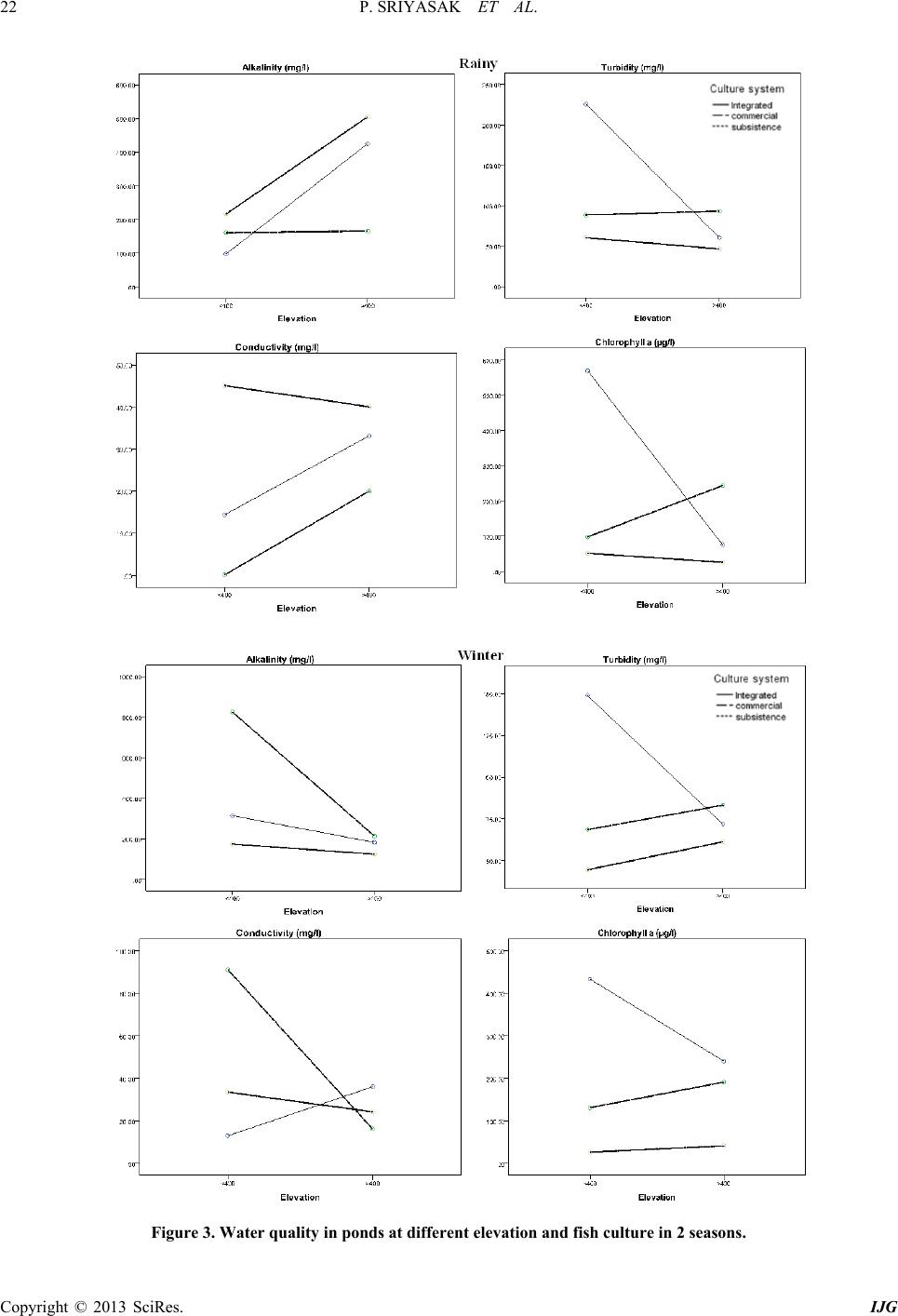 P. SRIYASAK ET AL. Copyright © 2013 SciRes. IJG 22 Figure 3. Water quality in ponds at different elevation and fish culture in 2 seasons. 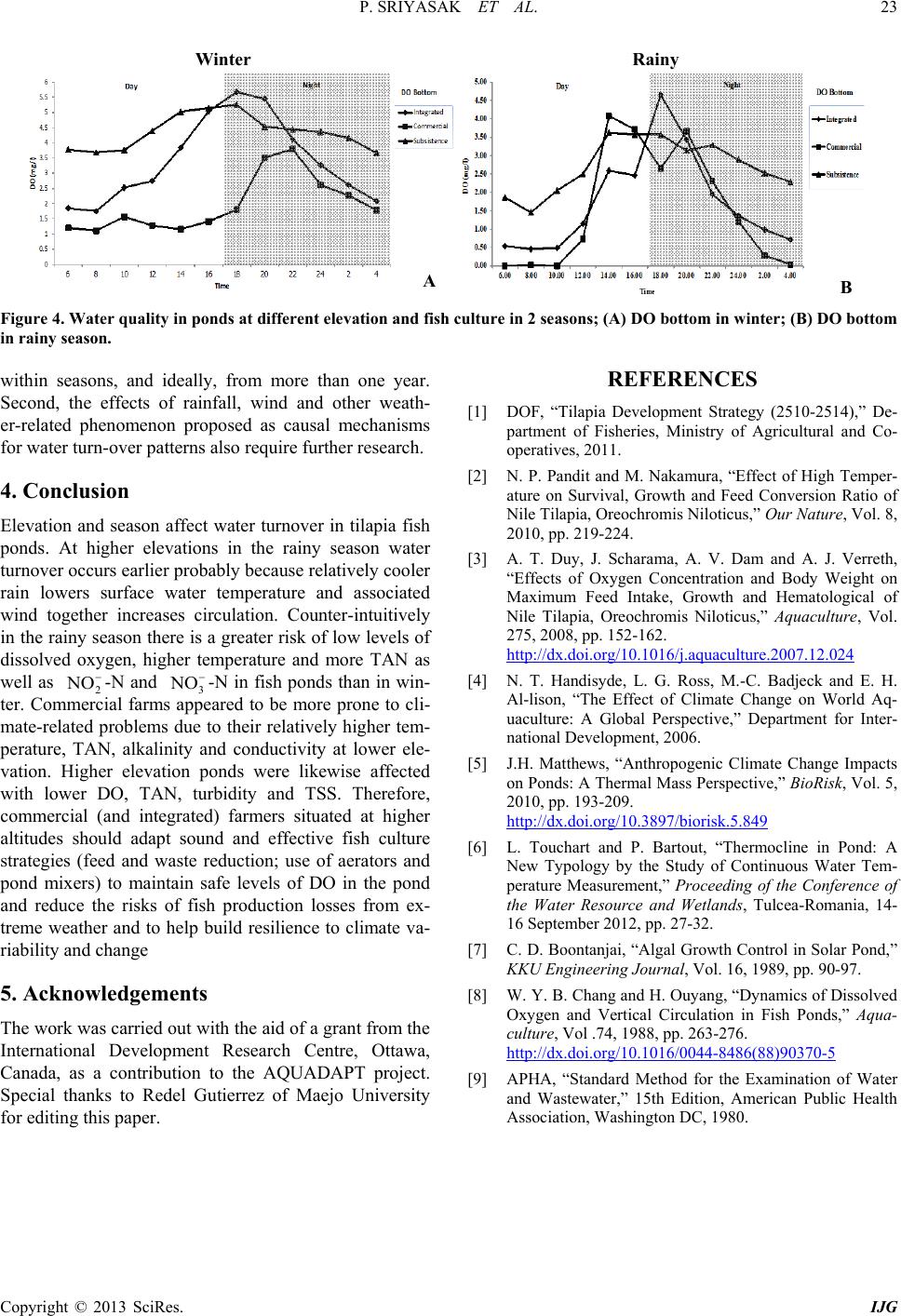 P. SRIYASAK ET AL. Copyright © 2013 SciRes. IJG 23 Figure 4. Water quality in ponds at different elevation and fish culture in 2 seasons; (A) DO bottom in winter; (B) DO bottom in rainy season. within seasons, and ideally, from more than one year. Second, the effects of rainfall, wind and other weath- er-related phenomenon proposed as causal mechanisms for water tur n-over patterns also require further research. 4. Conclusion Elevation and season affect water turnover in tilapia fish ponds. At higher elevations in the rainy season water turnover occurs earlier probably because relatively cooler rain lowers surface water temperature and associated wind together increases circulation. Counter-intuitively in the rainy season there is a greater risk of low levels of dissolved oxygen, higher temperature and more TAN as well as 2 NO − -N and 3 NO − -N in fish ponds than in win- ter. Commercial farms appeared to be more prone to cli- mate-related problems due to their relatively higher tem- perature, TAN, alkalinity and conductivity at lower ele- vation. Higher elevation ponds were likewise affected with lower DO, TAN, turbidity and TSS. Therefore, commercial (and integrated) farmers situated at higher altitudes should adapt sound and effective fish culture strategies (feed and waste reduction; use of aerators and pond mixers) to maintain safe levels of DO in the pond and reduce the risks of fish production losses from ex- treme weather and to help build resilience to climate va- riability and change 5. Acknowledgements The work was carried out with the aid of a grant from the International Development Research Centre, Ottawa, Canada, as a contribution to the AQUADAPT project. Special thanks to Redel Gutierrez of Maejo University for editing this paper. REFERENCES [1] DOF, “Tilapia Development Strategy (2510-2514),” De- partment of Fisheries, Ministry of Agricultural and Co- operatives, 2011. [2] N. P. Pandit and M. Nakamura, “Effect of High Temper- ature on Survival, Growth and Feed Conversion Ratio of Nile Tilapia, Oreochromis Niloticus,” Our Nature, Vol. 8, 2010, pp. 219-224. [3] A. T. Duy, J. Scharama, A. V. Dam and A. J. Verreth, “Effects of Oxygen Concentration and Body Weight on Maximum Feed Intake, Growth and Hematological of Nile Tilapia, Oreochromis Niloticus,” Aquaculture, Vol. 275, 2008, pp. 152-162. http://dx.doi.org/10.1016/j.aquaculture.2007.12.024 [4] N. T. Handisyde, L. G. Ross, M.-C. Badjeck and E. H. Al-lison, “The Effect of Climate Change on World Aq- uaculture: A Global Perspective,” Department for Inter- national Development, 2006. [5] J.H. Matthews, “Anthropogenic Climate Change Impacts on Ponds: A Thermal Mass Perspective,” BioRisk, Vol. 5, 2010, pp. 193-209. http://dx.doi.org/10.3897/biorisk.5.849 [6] L. Touchart and P. Bartout, “Thermocline in Pond: A New Typology by the Study of Continuous Water Tem- perature Measurement,” Proceeding of the Conference of the Water Resource and Wetlands, Tulcea-Romania, 14- 16 September 2012, pp. 27-32. [7] C. D. Boontanjai, “Algal Growth Control in Solar Pond,” KKU Engineering Journal, Vol. 16, 1989, pp. 90-97. [8] W. Y. B. Chang and H. Ouyang, “Dynamics of Dissolved Oxygen and Vertical Circulation in Fish Ponds,” Aqua- culture, Vol .74, 1988, pp. 263-276. http://dx.doi.org/10.1016/0044-8486(88)90370-5 [9] APHA, “Standard Method for the Examination of Water and Wastewater,” 15th Edition, American Public Health Association, Washington DC, 1980. Winter Rainy AB |