

Paper Menu >>
Journal Menu >>
 Open Journal of Applied Sciences, 2013, 3, 1-5 http://dx.doi.org/10.4236/ojapps.2013.33B001 Published Online July 2013 (http://www.scirp.org/journal/ojapps) Copyright © 2013 SciRes. OJAppS Incoherent Oscillations Accompanying Charge Separation in Photosynthetic Re ac tion Cent er s A. G. Yakovlev1, V. A. Shuvalov1,2 1A.N. Belozersky Institute of Physico-Chemical Biology, Moscow State University, Mos c ow , Rus si a 2Institute of Basic Biological Problems, Russian Academy of Sciences, Moscow, Russia Email: ya [email protected], [email protected] Received May 2013 ABSTRACT Early events of charge separation in reaction centers (RCs) of bacterial photosynthesis are modeled by kinetic equations with time-dependent rate constants. An illustrative case of regular motion along a “slow” coordinates leading to oscilla- tions in the kinetics is examined. Different schemes of charge separation are investigated. A good fitting of experimen- tal kinetics of native Rba. sphaeroides RCs is achieved in the fiv e states model P*1BAHA ↔ P*2BAHA ↔ I ↔ P+ A B − HA ↔ P+BA A H − with two excited states * 1 P BAHA and * 2 P BAHA and three charge separated states I, P+ A B − HA and P+BA A H − (P is a primary electron donor, bacteriochlorophyll dimer, BA and HA are an electron acceptor, monomeric bacterioch- lorophyll and bacteriopheophytin in active A-branch, respectively). In the model only the first excited state is directly populated by optical excitation. The emission of the two excited states is assumed to be at 905 and 940 nm, respectively. The intermediate state I is assumed to absorb at 1020 nm as well as the P+ A B − HA state. The model explains the deep oscillations in the kinetics of the * 1,2 P stimulated emission and of the A B − absorption. In the simpler schemes without the I state or with only one excited state the accordance with the experiment is achieved at unreal parameter values. A possible nature of the I and * 2 P BAHA states and a possible incoherent nature of the oscillations are discussed. Keywords: Photosynthesis; Charge Separation; Reaction Center; Electron Transfer 1. Introduction In reaction centers (RCs ) of purple bacteria Rhodobacter (Rba.) sphaeroides primary charge separation consisted in electron is transferred from excited dimer of bacteri- ochlorophyll P* to monomeric bacteriochlorophyll BA within ~3 psec and from A B − to bacteriopheophytin HA within ~1 psec at room temperature (for reviews see [1,2]). Then electron is transferred to primary quinone QA within ~200 psec. At cryogenic temperatures these reactions are accelerated by 2 - 3 times. Excitation of RCs by broadband femtosecond light pulses leads to os- cillations in the kinetics of P* emission [3] and of A B − absorption [4] with a frequencies at 10 - 400 cm−1 (peak at 130 - 150 cm−1). These oscillations are observed in various native and mutant RCs in a wide range of tempe- ratures. According to modern ideas, a vibrational or elec- tronic (or bo th) coherence is a possible explanation of the oscillatory phenomena in the kinetics of the excited and charge separated states. A periodical motion of a vibra- tional wavepacket [5] or a quantum beats between the levels with close energies [6] can produce the damped oscillations in the populations of the RC states. Analysis of the coherent electron transfer was performed on the base of Redfield theory in [7] and in the dispersed pola- ron model [8]. The oscillations in the P* stimulated emission band were theoretically studied by an approach of single electronic transition coupled to one or two vi- brational modes [9-11]. At room temperature the quan- tum coherence should be destroyed very quickly due to thermal motions [12]. On the other hand, the molecular dynamics calculations revealed a number of classical vibrational modes in RCs at 20 - 200 cm–1 [13]. These modes can reflect the nuclear motions in protein matrix as well as inside the RC pigments. A classical stochastic Langevin equation was used to calculate the oscillatory dynamics of the P* ↔ P+ A B. − Reaction controlled by protein relaxation [14] in modified RCs with blocked electron transfers to HA. In the present work the incoherent charge separation dynamics of native Rba. sphaeroides RCs is modeled by the kinetic equations with time-dependent rate constants. This approach is based on the Marcus theory [15]. An aim of the work was to study a possibility of incoherent origin of the oscillatory phenomena observed at early 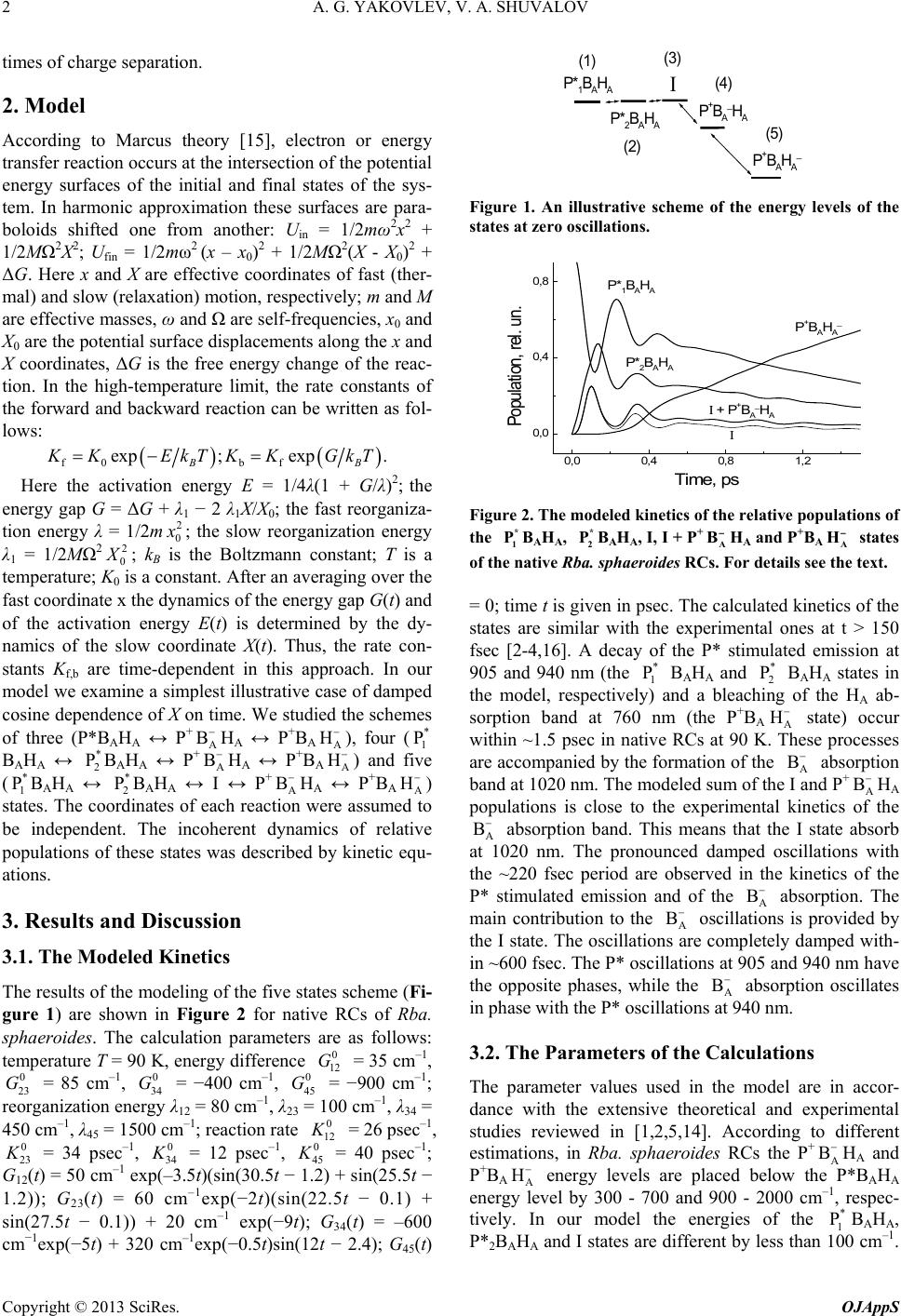 A. G. YAKOVLEV, V. A. SHUVAL OV Copyright © 2013 SciRes. OJAppS 2 times of charge separation. 2. Model According to Marcus theory [15], electron or energy transfer reaction occurs at the intersection of the potential energy surfaces of the initial and final states of the sys- tem. In harmonic approximation these surfaces are para- boloids shifted one from another: Uin = 1/2mω2x2 + 1/2MΩ2X2; Ufin = 1/2mω2 (x – x0)2 + 1/2MΩ2(X - X0)2 + ΔG. Here x and X are effective coordinates of fast (ther- mal) and s low (relaxation) motion, respe ctively; m and M are effective masses, ω and Ω are self-frequencies, x0 and X0 are the potential surface displacements along the x and X coordinates, ΔG is the free energy change of the reac- tion. In the high-temperature limit, the rate constants of the forward and backward reaction can be written as fo l- lows: ( )( ) f0 bf exp; exp. BB KKEkT KKGkT=−= Here the activation energy E = 1/4λ(1 + G/λ)2; the energy gap G = ΔG + λ1 − 2 λ1X/X0; the fast reorganiza- tion energy λ = 1/2m 2 0 x ; the slow reorganization energy λ1 = 1/2MΩ2 2 0 X ; kB is the Boltzmann constant; T is a temperature; K0 is a constant. After an averaging over the fast coordinate x the dynamics of the energy gap G(t) and of the activation energy E(t) is determined by the dy- namics of the slow coordinate X(t). Thus, the rate con- stants Kf,b are time-dependent in this approach. In our model we examine a simplest illustrative case of damped cosine dependence of X on time. We studied the schemes of three (P*BAHA ↔ P+ A B − HA ↔ P+BA A H − ), four ( * 1 P BAHA ↔ * 2 P BAHA ↔ P+ A B − HA ↔ P+BA A H − ) and five ( * 1 P BAHA ↔ * 2 P BAHA ↔ I ↔ P + A B − HA ↔ P+BA A H − ) states. The coordinates of each reaction were assumed to be independent. The incoherent dynamics of relative populations of these states was described by kinetic equ- ations. 3. Results and Discussion 3.1. The Modeled Kinetics The results of the modeling of the five states scheme (Fi- gure 1) are shown in Figure 2 for native RCs of Rba. sphaeroides. The calculation parameters are as follows: temperature Т = 90 K, energy difference 0 12 G = 35 cm–1, 0 23 G = 85 cm–1, 0 34 G = −400 cm–1, 0 45 G = −900 cm–1; reorganization energy λ12 = 80 cm–1, λ23 = 100 cm–1, λ34 = 450 cm–1, λ45 = 1500 cm–1; reactio n rate 0 12 K = 26 psec–1, 0 23 K = 34 psec–1, 0 34 K = 12 psec–1, 0 45 K = 40 psec–1; G12(t) = 5 0 cm–1 exp(–3.5t)(sin(30.5t − 1.2) + sin(25. 5 t − 1.2)); G23(t) = 60 cm–1exp(−2t)(sin(22.5t − 0.1) + sin(27.5t − 0.1)) + 20 cm–1 exp(−9t); G34(t) = –600 cm−1exp(−5t) + 320 cm–1exp(−0.5t)sin(12t − 2.4); G45(t) Figure 1. An illustrative scheme of the energy levels of the states at zero oscillations. Figure 2. The modeled kinetics of the relative populations of the * 1 P BAHA, * 2 P BAHA, I, I + P+ A B− HA and P+BAA H − states of the native Rba. sphaeroides RCs. For details see the text. = 0; time t is given in psec. The calculated kinetics of the states are similar with the experimental ones at t > 150 fsec [2-4,16]. A decay of the P* stimulated emission at 905 and 940 nm (the * 1 P BAHA and * 2 P BAHA states in the model, respectively) and a bleaching of the HA ab- sorption band at 760 nm (the P+BA A H − state) occur within ~1.5 psec in native RCs at 90 K. These processes are accompanied by the formation of the A B − absorption band at 1020 nm. The modeled sum of the I and P+ A B − HA populations is close to the experimental kinetics of the A B − absorption band. This means that the I state absorb at 1020 nm. The pronounced damped oscillations with the ~220 fsec period are observed in the kinetics of the P* stimulated emission and of the A B − absorption. The main contribution to the A B − oscillations is provided by the I state. The oscillatio ns are completely damped with- in ~600 fsec. The P* oscillation s at 905 and 940 nm have the opposite phases, while the A B − absorption oscillates in phase with the P* oscillations at 940 nm. 3.2. The Parameters of the Calculations The parameter values used in the model are in accor- dance with the extensive theoretical and experimental studies reviewed in [1,2,5,14]. According to different estimations, in Rba. sphaeroides RCs the Р+A B−HA and P+ВА A H − energy levels are placed below the P*BAHA energy level by 300 - 700 and 900 - 2000 cm–1, respec- tively. In our model the energies of the * 1 P BAHA, P*2BAHA and I states are different by less than 100 cm–1. ( 5) ( 4) ( 3) ( 2) ( 1) P + B A H A_ P + B A_ H A Ι P* 2 B A H A P* 1 B A H A 0,0 0,4 0,8 1,2 0,0 0,4 0,8 Ι P + B A H A_ Ι + P + B A_ H A P* 2 B A H A P* 1 B A H A Population, rel. un. Time, ps 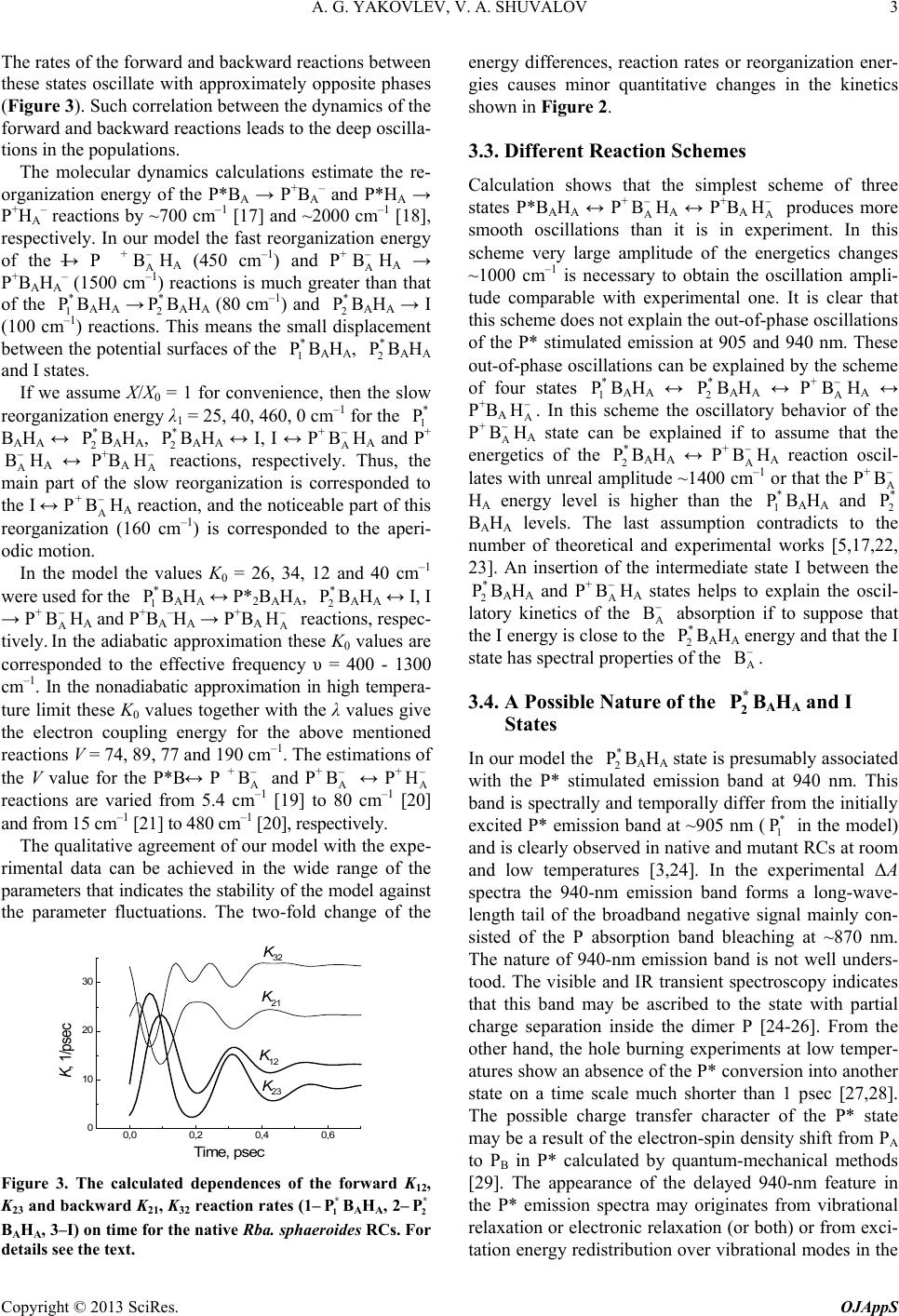 A. G. YAKOVLEV, V. A. SHUVAL OV Copyright © 2013 SciRes. OJAppS 3 The rates of the forw ard and backward reactions between these states oscillate with approximately opposite phases (Figu r e 3 ). Such correlation between the dynamics of the forward and backward reactions leads to the deep oscilla- tions in the populations. The molecular dynamics calculations estimate the re- organization energy of the P*BA → Р+ВА– and Р*HA → Р+HА– reactions by ~700 cm–1 [17] and ~2000 cm–1 [18], respectively. In our model the fast reorganization energy of the I → P+ A B − HA (450 cm–1) and P+ A B − HA → P+BAHA– (1500 cm–1) reactions is much greater than that of the * 1 P BAHA → * 2 P BAHA (80 cm–1) and * 2 P BAHA → I (100 cm–1) reactions. This means the small displacement between the potential surfaces of the * 1 P BAHA, * 2 P BAHA and I states. If we assume X/X0 = 1 for convenience, then the slow reorganization energy λ1 = 25, 40, 460, 0 cm–1 for the * 1 P BAHA ↔ * 2 P BAHA, * 2 P BAHA ↔ I, I ↔ P+A B−HA and P+ A B − HA ↔ P+BA A H − reactions, respectively. Thus, the main part of the slow reorganization is corresponded to the I ↔ P+A B−HA reaction, and the noticeable part of this reorganization (160 cm–1) is corresponded to the aperi- odic motion. In the model the values K0 = 26, 34, 12 and 40 cm–1 were used for the * 1 P BAHA ↔ P*2BAHA, * 2 P BAHA ↔ I, I → P+ A B − HA and P+BA–HA → P+BA A H − reactions, respec- tively. In the adiabatic approximation these K0 values are corresponded to the effective frequency υ = 400 - 1300 cm–1. In the nonadiabatic approximation in high tempera- ture limit these K0 values together with the λ values give the electron coupling energy for the above mentioned reactions V = 74, 89, 77 and 190 cm–1. The estimations of the V value for the P*B ↔ P+ A B − and P+ A B − ↔ P+ A H − reactions are varied from 5.4 cm–1 [19] to 80 cm–1 [20] and from 15 cm –1 [21] to 480 cm–1 [20], respectively. The qualitative agreement of our model with the expe- rimental data can be achieved in the wide range of the parameters that indicates the stability of the model against the parameter fluctuations. The two-fold change of the Figure 3. The calculated dependences of the forward K12, K23 and backward K21, K32 reaction rates (1– * 1 P BAHA, 2– * 2 P BAHA, 3–I) on time for the native Rba. sphaeroides RCs. For details see the text. energy differences, reaction rates or reorganization ener- gies causes minor quantitative changes in the kinetics shown in Figure 2. 3.3. Different Rea ct ion Schemes Calculation shows that the simplest scheme of three states P*BAHA ↔ P+ A B − HA ↔ P+BA A H − produces more smooth oscillations than it is in experiment. In this scheme very large amplitude of the energetics changes ~1000 cm–1 is necessary to obtain the oscillation ampli- tude comparable with experimental one. It is clear that this scheme does not explain the out-of-phase oscillations of the P* stimulated emission at 905 and 940 nm. These out-of-phase oscillations can be explained by the scheme of four states * 1 P BAHA ↔ * 2 P BAHA ↔ P+A B−HA ↔ P+BA A H − . In this scheme the oscillatory behavior of the P+ A B − HA state can be explained if to assume that the energetics of the * 2 P BAHA ↔ P+A B−HA reaction oscil- lates with unreal amplitude ~1 400 cm–1 or that the P+ A B − HA energy level is higher than the * 1 P BAHA and * 2 P BAHA levels. The last assumption contradicts to the number of theoretical and experimental works [5,17,22, 23]. An insertion of the intermediate state I between the * 2 P BAHA and P+A B−HA states helps to explain the oscil- latory kinetics of the A B − absorption if to suppose that the I energy is close to the * 2 P BAHA energy and that the I state has spectral properties of the A B−. 3.4. A Possible Na t ure of the * 2 P BAHA and I States In our model the * 2 P BAHA state is presumably associated with the P* stimulated emission band at 940 nm. This band is spectrally and temporally differ from the initially excited P* emission band at ~905 nm ( * 1 P in the model) and is clearly observed in native and mutant RCs at room and low temperatures [3,24]. In the experimental ΔA spectra the 940-nm emission band forms a long-wave- length tail of the broadband negative signal mainly con- sisted of the P absorption band bleaching at ~870 nm. The nature of 940-nm emission band is not well unders- tood. The visible and IR transient spectroscopy indicates that this band may be ascribed to the state with partial charge separation inside the dimer P [24-26]. From the other hand, the hole burning experiments at low temper- atures show an absence of the P* conversion into another state on a time scale much shorter than 1 psec [27,28]. The possible charge transfer character of the P* state may be a result of the electron-spin density shift from PA to PB in P* calculated by quantum-mechanical methods [29]. The appearance of the delayed 940-nm feature in the P* emission spectra may originates from vibrational relaxation or electronic relaxation (or both) or fro m exci- tation energy redistr ibution over vibrational modes in the 0,0 0,2 0,4 0,6 0 10 20 30 K 12 K 23 K 21 K 32 K, 1/psec Time, psec 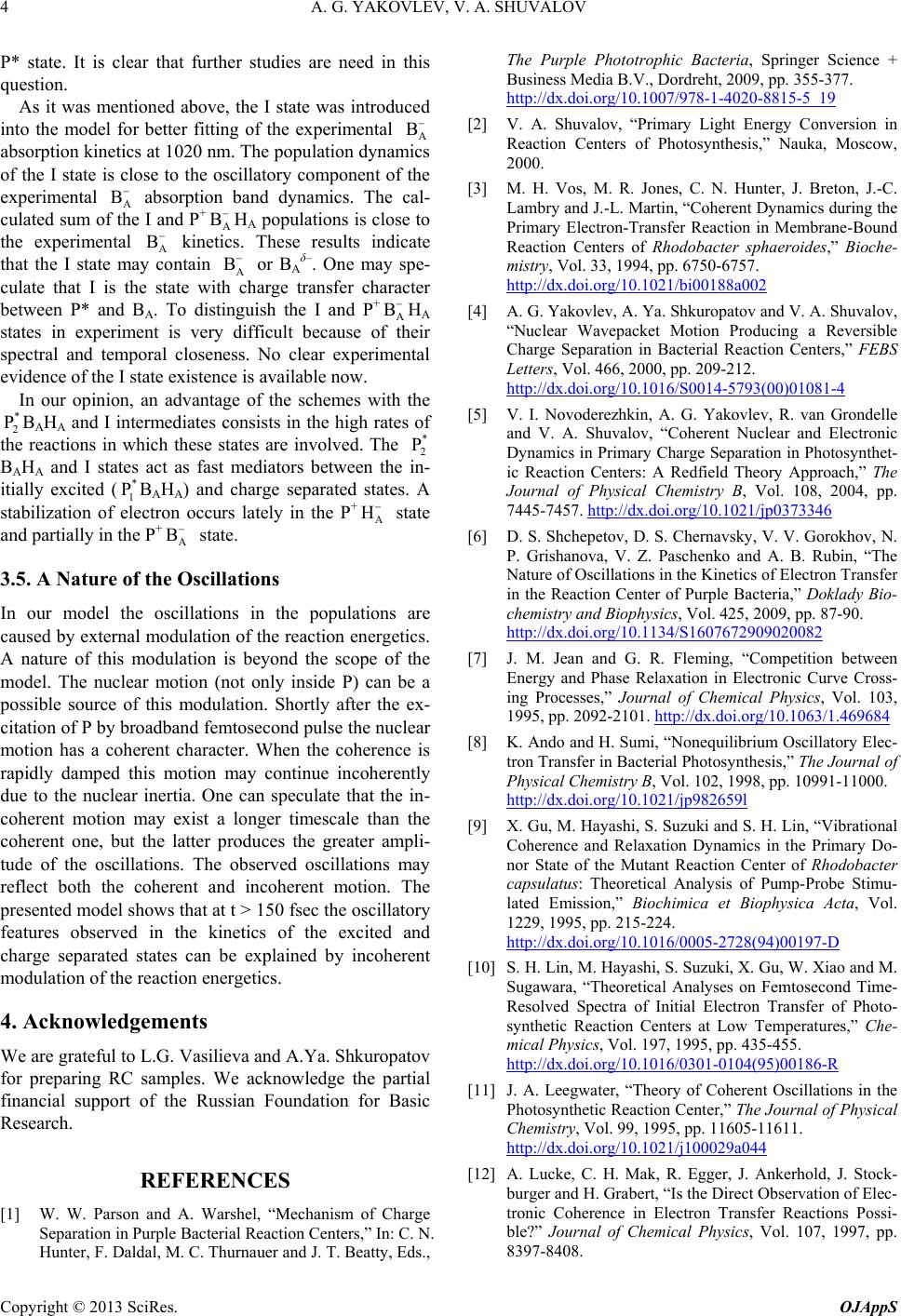 A. G. YAKOVLEV, V. A. SHUVAL OV Copyright © 2013 SciRes. OJAppS 4 P* state. It is clear that further studies are need in this question. As it was mentioned above, the I state was introduced into the model for better fitting of the experimental A B − absorption kinetics at 1020 nm. The population dynamics of the I state is close to the oscillatory component of the experimental A B − absorption band dynamics. The cal- culated sum of the I and P+ A B − HA populations is close to the experimental A B− kinetics. These results indicate that the I state may contain A B − or ВА δ–. One may spe- culate that I is the state with charge transfer character between P* and BA. To distinguish the I and P+A B−HA states in experiment is very difficult because of their spectral and temporal closeness. No clear experimental evidence of the I state existence is available now. In our opinion, an advantage of the schemes with the * 2 P BAHA and I intermediates consists in the high rates of the reactions in which these states are involved. The * 2 P BAHA and I states act as fast mediators between the in- itially excited ( * 1 P BAHA) and charge separated states. A stabilization of electron occurs lately in the P+ A H− state and partially in the P+ A B − state. 3.5. A Nature of the Oscillations In our model the oscillations in the populations are caused by external modulation of the reaction energetics. A nature of this modulation is beyond the scope of the model. The nuclear motion (not only inside P) can be a possible source of this modulation. Shortly after the ex- citation of P by broadband femtosecond pulse the nuclear motion has a coherent character. When the coherence is rapidly damped this motion may continue incoherently due to the nuclear inertia. One can speculate that the in- coherent motion may exist a longer timescale than the coherent one, but the latter produces the greater ampli- tude of the oscillations. The observed oscillations may reflect both the coherent and incoherent motion. The presented model shows th at at t > 150 fsec the oscillatory features observed in the kinetics of the excited and charge separated states can be explained by incoherent modula t ion of the reaction energetics. 4. Acknowledgements We are grateful to L.G. Vasilieva and A.Ya. Shkuropatov for preparing RC samples. We acknowledge the partial financial support of the Russian Foundation for Basic Research. REFERENCES [1] W. W. Parson and A. Warshel, “Mechanism of Charge Separation in Purple Bacterial Reaction Centers,” In: C. N. Hunter, F. Daldal, M. C. Thurnauer and J. T. Beatty, Eds., The Purple Phototrophic Bacteria, Springer Science + Business Media B.V., Dordreht, 2009, pp. 355-377. http://dx.doi.org/10.1007/978-1-4020-8815-5_19 [2] V. A. Shuvalov, “Primary Light Energy Conversion in Reaction Centers of Photosynthesis,” Nauka, Moscow, 2000. [3] M. H. Vos, M. R. Jones, C. N. Hunter, J. Breton, J.-C. Lambry and J.-L. Martin, “Coherent Dynamics during the Primary Electron-Transfer Reaction in Membrane-Bound Reaction Centers of Rhodobacter sphaeroides,” Bioche- mistry, Vol. 33, 1994, pp. 6750-6757. http://dx.doi.org/10.1021/bi00188a002 [4] A. G. Yakovlev, A. Ya. Shkuropatov and V. A. Shuvalov, “Nuclear Wavepacket Motion Producing a Reversible Charge Separation in Bacterial Reaction Centers,” FEBS Letters, Vol. 466, 2000, pp. 209-212. http://dx.doi.org/10.1016/S0014-5793(00)01081-4 [5] V. I. Novoderezhkin, A. G. Yakovlev, R. van Grondelle and V. A. Shuvalov, “Coherent Nuclear and Electronic Dynamics in Primary Charge Separation in Photosynthet- ic Reaction Centers: A Redfield Theory Approach,” The Journal of Physical Chemistry B, Vol. 108, 2004, pp. 7445-7457. http://dx.doi.org/10.1021/jp0373346 [6] D. S. Shchepetov, D. S. Cher navsky , V. V. Gorokhov, N. P. Grishanova, V. Z. Paschenko and A. B. Rubin, “The Nature of Oscillations in the Kinetics of Electron Transfer in the Reaction Center of Purple Bacteria,” Doklady Bio- chemistry and Biophysics, Vol. 425, 2009, pp. 87-90. http://dx.doi.org/10.1134/S1607672909020082 [7] J. M. Jean and G. R. Fleming, “Competition between Energy and Phase Relaxation in Electronic Curve Cross- ing Processes,” Journal of Chemical Physics, Vol. 103, 1995, pp. 2092-2101. http://dx.doi.org/10.1063/1.469684 [8] K. Ando and H. Sumi, “Nonequilibrium Oscillatory Elec- tron Transfer in Bacterial Photosynthesis,” The Journal of Physical Chemistry B, Vol. 102, 1998, pp. 10991-11000. http://dx.doi.org/10.1021/jp982659l [9] X. Gu, M. Hayashi, S. Suzuki and S. H. Lin, “Vibrational Coherence and Relaxation Dynamics in the Primary Do- nor State of the Mutant Reaction Center of Rhodobacter capsulatus: Theoretical Analysis of Pump -Probe Stimu- lated Emission,” Biochimica et Biophysica Acta, Vol. 1229, 1995, pp. 215-224. http://dx.doi.org/10.1016/0005-2728(94)00197-D [10] S. H. Lin, M. Hayashi, S. Suzuki, X. Gu, W. Xiao and M. Sugawara, “Theoretical Analyses on Femtosecond Time- Resolved Spectra of Initial Electron Transfer of Photo- synthetic Reaction Centers at Low Temperatures,” Che- mical Physics, Vol. 197, 1995, pp. 435-455. http://dx.doi.org/10.1016/0301-0104(95)00186-R [11] J. A. Leegwater, “Theory of Coherent Oscillations in the Photosynthetic Reaction Center,” The Journal of Physical Chemistry, Vol. 99, 1995, pp. 11605-11611. http://dx.doi.org/10.1021/j100029a044 [12] A. Lucke, C. H. Mak, R. Egger, J. Ankerhold, J. Stock- burger and H. Grabert, “Is the Direct Observation of Elec- tronic Coherence in Electron Transfer Reactions Possi- ble?” Journal of Chemical Physics, Vol. 107, 1997, pp. 8397-8408.  A. G. YAKOVLEV, V. A. SHUVAL OV Copyright © 2013 SciRes. OJAppS 5 http://dx.doi.org/10.1063/1.475040 [13] W. W. Parson, Z. T. Chu and A. Warshel, “Oscillations of the Energy Gap for the Initial Electron-Transfer Step in Bacterial Reaction Centers,” Photosynthesis Research, Vol. 55, 1998, pp. 147-152. http://dx.doi.org/10.1023/A:1005992121305 [14] D. A. Cherepanov, L. I. Krishtalik and A. Y. Mulkidja- nian, “Photosynthetic Electron Transfer Controlled by Protein Relaxation: Analysis by Langevin Stochastic Ap- proach,” Biophysical Journal, Vol. 80, 2001, pp. 1033- 1049. http://dx.doi.org/10.1016/S0006-3495(01)76084-5 [15] H. Sumi and R. A. Marcus, “Dynamical Effects in Elec- tron Transfer Reactions,” Journal of Chemical Physics, Vol. 84, No. 9, 1986, pp. 4894-4914. http://dx.doi.org/10.1063/1.449978 [16] A. G. Yakovlev, A. Ya. Shkuropatov and V. A. Shuvalov, “Nuclear Wavepacket Motion between P* and P+BA– Po- tential Surfaces with a Subsequent Electron Transfer to HA in Bacterial Reaction Centers at 90 K. Electron Trans- fer Pathway,” Biochemistry, Vol. 41, 2002, pp. 14019- 14027. http://dx.doi.org/10.1021/bi020250n [17] A. Warshel and W. W. Parson, “Dynamics of Biochemi- cal and Biophysical Reactions: Insight from Computer Si- mulations,” Quarterly Review of Biophysics, Vol. 34, 2001, pp. 563-679. http://dx.doi.org/10.1017/S0033583501003730 [18] W. W. Parson, Z. T. Chu and A. Warshel, “Electrostatic Control of Charge Separation in Bacterial Photosynthe- sis,” Biochimica et Biophysica Acta, Vol. 1017, 1990, pp. 251-272. http://dx.doi.org/10.1016/0005-2728(90)90192-7 [19] M. Plato and C. J. Winscom, “A Configuration Interac- tion (CI) Description of Vectorial Electron Transfer in Bacterial Reaction Centers,” In: J. Breton and A. Ver- meglio, Eds., The Photosynthetic Bacterial Reaction Cen- ter, Plenum, New York, 1988, pp. 421-424. http://dx.doi.org/10.1007/978-1-4899-0815-5_41 [20] Y. Hu and S. Mukamel, “Sequential versus Superexchange Electron Transfer in the Photosynthetic Reaction Center,” In: J. Jortner and B. Pullman, Eds., Perspectives in Pho- tosynthesis, Kluwer Acad. Publ., Amsterdam, 1990, pp. 171-184. http://dx.doi.org/10.1007/978-94-009-0489-7_15 [21] A. Warshel, S. Creighton and W. W. Parson, “Electron- Transfer Pathways in the Primary Event of Bacterial Photosynthesis,” The Journal of Physical Chemistry, Vol. 92, 1988, pp. 2696-2701. http://dx.doi.org/10.1021/j100320a057 [22] V. A. Shuvalov and A. G. Yakovlev, “Energy Level of Р+В– with Respect to P* Found from Recombination Flu- orescence Measurements in Pheophytin-Modified Reac- tion Centers,” Membrane and Cell Biology, Vol. 12, No. 5, 1998, pp. 563-569. [23] E. Sim and N. Makri, “Path Integral Simulation of Charge Transfer Dynamics in Photosynthetic Reaction Centers,” The Journal of Physical Chemistry B, Vol. 101, 1997, pp. 5446-5458. http://dx.doi.org/10.1021/jp970707g [24] R. A. Kha typov, A. Yu. Khmelnitskiy, A. M. Khristin, T. Yu. Fufina, L. G. Vasilieva and V. A. Shuvalov, “Primary Charge Separation within P870* in Wild Type and Hete- rodimer Mutants in Femtosecond Time Domain,” Bio- chimica et Biophysica Acta, Vol. 1817, 2012, pp. 1392- 1398. http://dx.doi.org/10.1016/j.bbabio.2011.12.007 [25] V. A. Shuvalov and A. G. Yakovlev, “Coupling of Nuc- lear Wavepacket Motion and Charge Separation in Bac- terial Reaction Centers,” FEBS Letters, Vol. 540, 2003, pp. 26-34. http://dx.doi.org/10.1016/S0014-5793(03)00237-0 [26] P. Hamm and W. Zinth, “Ultrafast Initial Reaction in Bac- terial Photosynthesis Revealed by Femtosecond Infrared Spectroscopy,” The Journal of Physical Chemistry, Vol. 99, 1995, pp. 13537-13544. http://dx.doi.org/10.1021/j100036a034 [27] S. G. Johnson, D. Tang, R. Jankowiak, J. M. Hayes, G. J. Small and D. M. Tiede, “Primary Donor State Mode Structure and Energy Transfer in Bacterial Reaction Cen- ters,” The Journal of Physical Chemistry, Vol. 94, 1990, pp. 5849-5855. http://dx.doi.org/10.1021/j100378a045 [28] P. A. Lyle, S. V. Kolaczkowski and G. J. Small, “Photo- chemical Hole-Burned Spectra of Protonated and Deute- rated Reaction Centers of Rhodobacter sphaeroides,” The Journal of Physical Chemistry, Vol. 97, 1993, pp. 6924- 6933. http://dx.doi.org/10.1021/j100128a030 [29] M. Plato, F. Lendzian, W. Lubitz and K. Möbius, “Mole- cular Orbital Study of Electronic Asymmetry in Primary Donors of Bacterial Reaction Centers,” In: J. Breton and A. Verméglio, Eds., The Photosynthetic Bacterial Reac- tion Center II: Structure, Spectroscopy, and Dynamics, Plenum, New York, 1992, pp. 109-118. http://dx.doi.org/10.1007/978-1-4615-3050-3_13 |