

Paper Menu >>
Journal Menu >>
 Communications and Network, 2013, 5, 666-670 http://dx.doi.org/10.4236/cn.2013.53B2119 Published Online September 2013 (http://www.scirp.org/journal/cn) Channel Estimation for SCM-OFDM Systems by Modified Kalman Filter* Tao Peng1, Yue Xiao1, Shaoqian Li1, Huaqiang Shu2, Eric Pierre Simon2 1Nation Key Lab of Sci. and Techno. On Commun., University of Electronic Science and Technology of China, Chengdu, China 2IEMN Lab, TELICE Group University of Lille, Lille, France Email: [email protected] Received July 2013 ABSTRACT In this paper, the problem of channel estimation for superposition coded modulation-orthogonal frequency division multiplexing (SCM-OFDM) systems over frequency selective channels is investigated. Assuming that the path delays are known, a new channel estimator based on modified Kalman filter algorithms is introduced for the estimation of the multipath Rayleigh channel complex gains (CG). In the simulation, the mean square error (MSE) and bit-error-rate (BER) performances are given to verify the effectiveness of the Kalman estimation algorithms for SCM-OFDM sys- tems. Keywords: Superposition Coded Modulation (SCM); Orthogonal Frequency Division Multiplexing (OFDM); Channel Estimation; Kalman Filter 1. Introduction As a kind of non-orthogonal multiple access scheme, interleave division multiple access (IDMA) was devel- oped by Ping et al. [1,2], in which random interleavers were employed as the only means of user separation. In general, IDMA outperforms conventional code division multiple access (CDMA) in terms of power and band- width efficiency. The key innovation of IDMA is the introduction of low-rate channel coding, chip-level inter- leaving and low-complexity multiu s e r detection. Motivated by the concept of IDMA, superposition coded modulation (SCM) partitions the data to multi layer, where each layer is treated by a user equivalently. The low-rate encoder for all layers is typically identical, and the interleaver of every layer is distinct, which is used to combat the inter-layer interference. SCM has several ad- vantages over conventional coded modulation schemes such as trellis-coded modulation (TCM) and bit-inter - leaved coded-modulation with iterative decoding (BICM- ID). First, the transmitted signal of SCM can be approx- imated as a Gaussian variable according to the central limit theorem. Second, for adaptive modulation, the rate adaptation can be simply realized in SCM by adjusting the number of layers. Furthermore, a low-cost chip-by- chip iterative detection a lgorithm can be adopted in SCM, where the complexity is independent of the number of layers [3,4]. Furthermore, SCM can be combined with orthogonal frequency division multiplexing (OFDM) to combat the frequency selective fading and improve the throughput [5]. For signal detection in the receiver, reliable channel information is needed. There have only been few litera- tures regarding channel estimation for IDMA and SCM systems. For example, least square (LS) and minimum mean square error (MMSE) algorithms are employed to estimate channel response of IDMA systems [6,7]. How- ever, these estimation algorithms perform per-user chan- nel estimation using pilot symbols in the frequency do- main, which lead to poor estimation performance. To alleviate this problem, channel estimation for SCM- OFDM systems is investig ated in this paper. The estima- tion of physical channel parameters includes estimating multipath delays and multipath complex gains (CGs). It is well known that the path delays are quasi-invariant over several OFDM blocks whereas the CGs may change significantly even within one OFDM block. Therefore, the delays are assumed to be perfectly estimated and only the problem of CGs estimation is considered in this paper. Due to the excellent estimation performance of Kalman * This work was supported by the Foundation Project of National Key Laboratory of Science and Technology on Communications under Grant 9140C020404120C0201, National High - Tech R&D Program of China ( “863” Project under Grant number 2011AA01A105), N a- ti onal Grand Special Science and Technology Project of China under Grant No. 2010ZX03006 -002- 02, and the Fundamental Research Funds for the Central Universities. Copyright © 2013 SciRes. CN 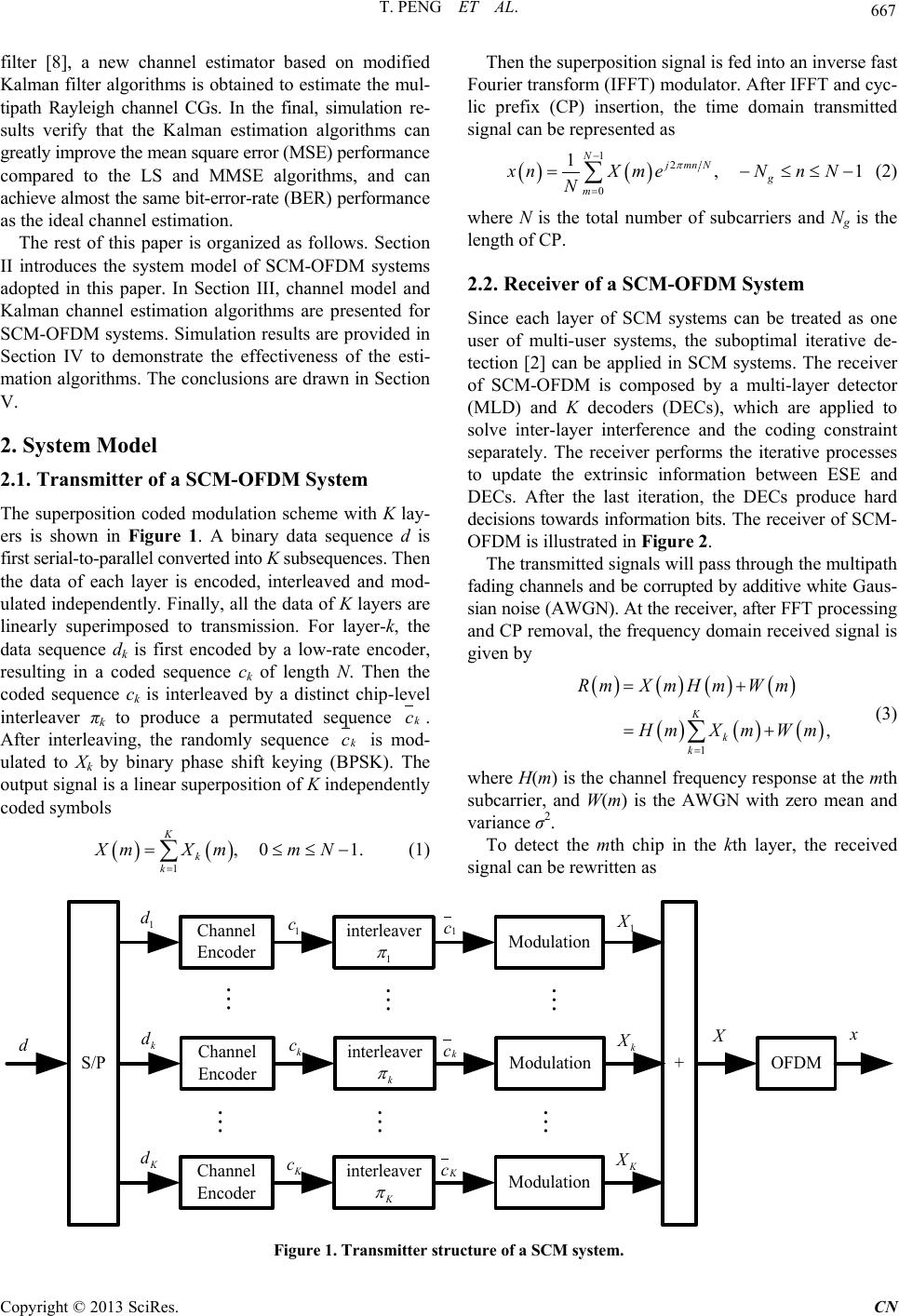 T. PENG ET AL. 667 filter [8], a new channel estimator based on modified Kalman filter algorithms is obtain ed to estimate the mul- tipath Rayleigh channel CGs. In the final, simulation re- sults verify that the Kalman estimation algorithms can greatly improve the mean square error (MSE) performance compared to the LS and MMSE algorithms, and can achieve almost th e same bit-error-rate (BER) performance as the ideal channel estimation. The rest of this paper is organized as follows. Section II introduces the system model of SCM-OFDM systems adopted in this paper. In Section III, channel model and Kalman channel estimation algorithms are presented for SCM-OFDM systems. Simulation results are provided in Section IV to demonstrate the effectiveness of the esti- mation algorithms. The conclusions are drawn in Section V. 2. System Model 2.1. Transmitter of a SCM-OFDM System The superposition coded modulation scheme with K lay- ers is shown in Figure 1. A binary data sequence d is first serial-to-parallel conver ted i nto K subsequences. Then the data of each layer is encoded, interleaved and mod- ulated independently. Finally, all the data of K layers are linearly superimposed to transmission. For layer-k, the data sequence dk is first encoded by a low-rate encoder, resulting in a coded sequence ck of length N. Then the coded sequence ck is interleaved by a distinct chip-level interleaver πk to produce a permutated sequence k c . After interleaving, the randomly sequence k c is mod- ulated to Xk by binary phase shift keying (BPSK). The output signal is a linear superposition of K independently coded symbols ( )( ) 1 1,0 . K k k XmNX mm = =≤≤− ∑ (1) Then the superposition signal is fed into an inverse fast Fourier transform (IFFT) modulator. After IFFT and cyc- lic prefix (CP) insertion, the time domain transmitted signal can be represented as ( )() 12 0 , 1 1 Njmn N mg xn XmnN NNe π − = ≤− ≤=− ∑ (2) where N is the total number of subcarriers and Ng is the length of CP. 2.2. Receiver of a SCM-OFDM System Since each layer of SCM systems can be treated as one user of multi-user systems, the suboptimal iterative de- tection [2] can be applied in SCM systems. The receiver of SCM-OFDM is composed by a multi-layer detector (MLD) and K decoders (DECs), which are applied to solve inter-layer interference and the coding constraint separately. The receiver performs the iterative processes to update the extrinsic information between ESE and DECs. After the last iteration, the DECs produce hard decisions towards information bits. The receiver of SCM- OFDM is illustrated in Figure 2. The transmitted signals will pass through the multipath fading channels and be corrupted by additive white Gaus- sian noise (AWGN). At the receiver, after FFT processing and CP removal, the frequency domain received signal is given by () ()( )( ) ()( )( ) 1 , K k k RmXmHm Wm HmXmWm = =+ =+ ∑ (3) where H(m) is the channel frequency response at the mth subcarrier, and W(m) is the AWGN with zero mean and variance σ2. To detect the mth chip in the kth layer, the received signal can be rewritten as Figure 1. Transm it t er s t ructure of a SC M system. S/P Channel Encoder interleaver Modulation 1 π 1 d 1 c 1 X 1 c + Channel Encoder interleaver Modulation k π k d k c k c Channel Encoder interleaver Modulation K π K d K c K c d X k X K X OFDM x Copyright © 2013 SciRes. CN 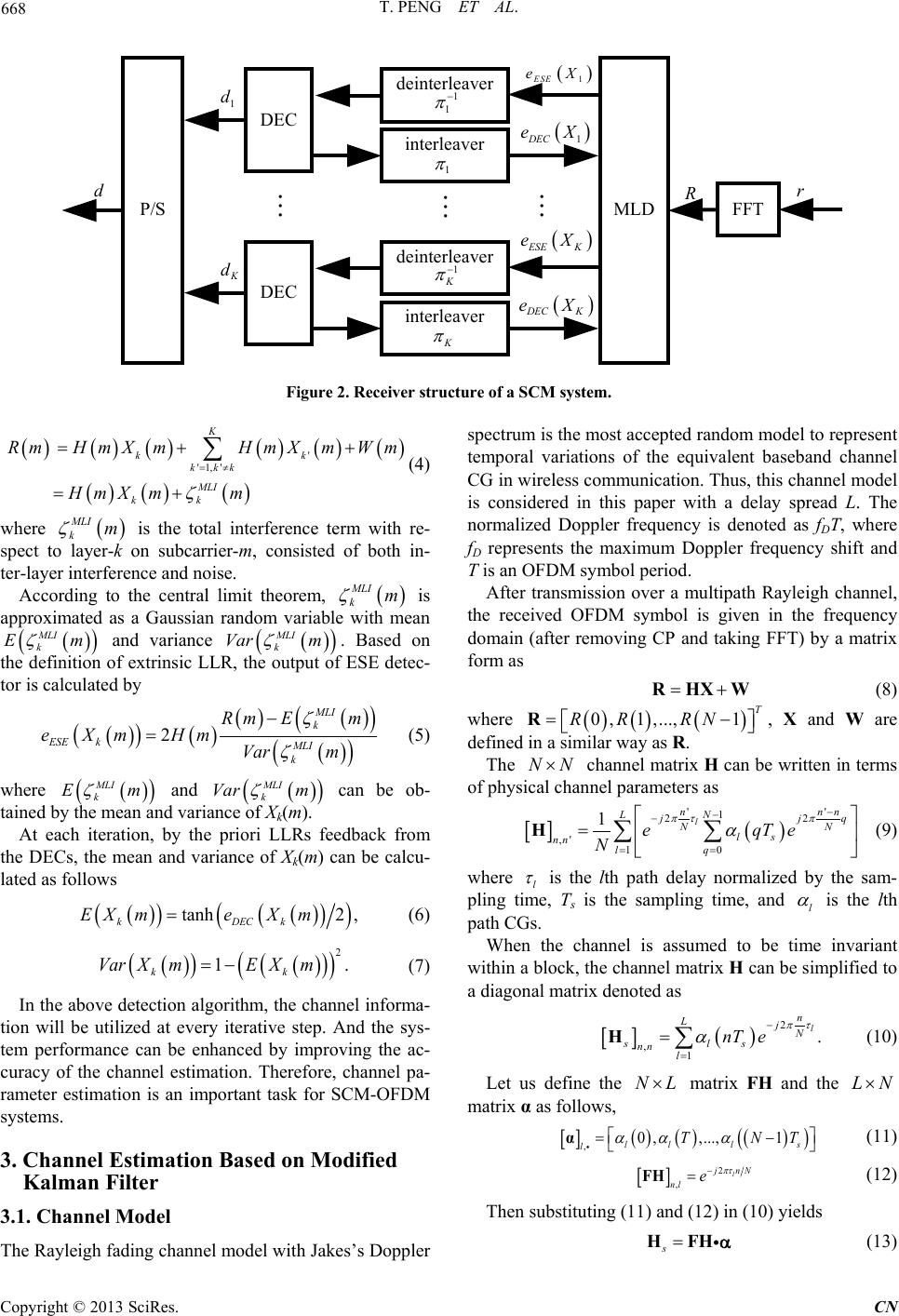 T. PENG ET AL. 668 Figure 2. Receiver structure of a SCM system. ()( )()()( )( ) ()()( ) ' ' 1,' K kk k kk MLI kk RmHmX mHmXmWm HmX mm ζ = ≠ =++ =+ ∑ (4) where ( ) MLI k m ζ is the total interference term with re- spect to layer-k on subcarrier-m, consisted of both in- ter-layer interference and noise. According to the central limit theorem, ( ) MLI k m ζ is approximated as a Gaussian random variable with mean ( ) ( ) MLI k Em ζ and variance ( ) ( ) MLI k Var m ζ . Based on the definition of extrinsic LLR, the output of ESE detec- tor is calculated by ( ) ( ) ( )( )( ) ( ) ( ) ( ) 2 MLI k ESE kMLI k Rm Em eX mHmVar m ζ ζ − = (5) where ( ) ( ) MLI k Em ζ and ( ) ( ) MLI k Var m ζ can be ob- tained by the mean an d va riance of Xk(m). At each iteration, by the priori LLRs feedback from the DECs, the mean and variance of Xk(m) can be calcu- lated as follows ( ) ( ) ( ) ( ) ( ) tanh2 , kDEC k EXme Xm= (6) ( ) ( ) ( ) ( ) ( ) 2 1. kk VarXm EXm= − (7) In the above detection algorith m, the channel informa- tion will be utilized at every iterative step. And the sys- tem performance can be enhanced by improving the ac- curacy of the channel estimation. Therefore, channel pa- rameter estimation is an important task for SCM-OFDM systems. 3. Channel Estimat ion B ased on Modified Kalman Filter 3.1. Channel Model The Rayleigh fading channel model with Jakes’s Doppler spectrum is the most accepted random model to represent temporal variations of the equivalent baseband channel CG in wireless communication. Thus, this channel model is considered in this paper with a delay spread L. The normalized Doppler frequency is denoted as fDT, where fD represents the maximum Doppler frequency shift and T is an OFDM symbol period. After transmission over a multipath Rayleigh channel, the received OFDM symbol is given in the frequency domain (after removing CP and taking FFT) by a matrix form as = +RHX W (8) where ()( )() 0,1 ,...,1 T R RRN= − R , X and W are defined in a similar way as R. The NN× channel matrix H can be written in terms of physical channel parameters as [ ] ( ) '' 1 22 ,' 10 1 l n nn LN j jq NN ls nn lq eqT e N πτ π α − − − = = = ∑∑ H (9) where l τ is the lth path delay normalized by the sam- pling time, Ts is the sampling time, and l α is the lth path CGs. When the channel is assumed to be time invariant within a block, the channel matrix H can be simplified to a diagonal matrix denoted as [ ] ( ) 2 ,1 l n LjN s ls nn l nT e πτ α − = =. ∑ H (10) Let us define the NL× matrix FH and the LN× matrix α as follows, [ ] ( )()() ( ) , 0 ,,...,1 ll ls l T NT αα α = − α (11) [ ] 2 , l j nN nl e πτ − =FH (12) Then substituting (11) and (12) in (10) yields s=H FHα (13) DEC deinterleaver 1 1 π − 1 d MLD interleaver 1 π d R ( ) 1ESE eX ( ) 1DEC eX P/S FFT r DEC deinterleaver 1 K π − K d interleaver K π ( ) ESE K eX () DEC K eX Copyright © 2013 SciRes. CN 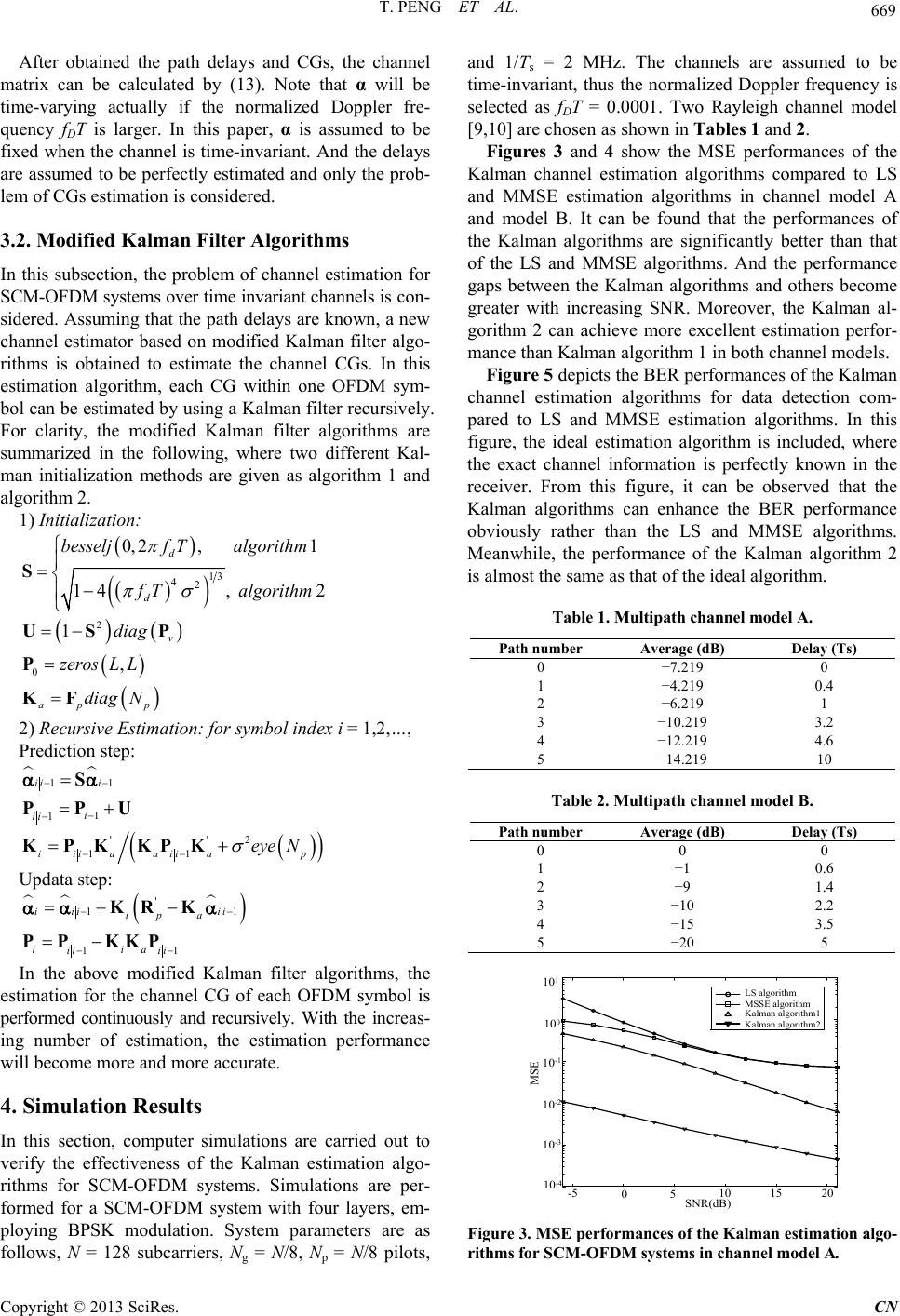 T. PENG ET AL. 669 After obtained the path delays and CGs, the channel matrix can be calculated by (13). Note that α will be time-varying actually if the normalized Doppler fre- quency fDT is larger. In this paper, α is assumed to be fixed when the channel is time-invariant. And the delays are assumed to be perfectly estimated and only the prob- lem of CGs estimation is considered. 3.2. Modified Kalman Filter Algorithms In this subsection, the problem of channel estimation for SCM-OFDM systems over time invariant channels is con- sidered. Assuming that the path delays are known, a new channel estimator based on modified Kalman filter algo- rithms is obtained to estimate the channel CGs. In this estimation algorithm, each CG within one OFDM sym- bol can be estimated by using a Kalman filter recursively. For clarity, the modified Kalman filter algorithms are summarized in the following, where two different Kal- man initialization methods are given as algorithm 1 and algorithm 2. 1) Initialization: ( ) ( ) ( ) 13 42 0,2 ,1 14, 2 d d besseljf Talgorithm f Talgorithm π πσ =− S ( ) ( ) 2 1 v diag= −US P ( ) 0 ,zerosL L=P ( ) app diag N=KF 2) Recursive Estimation: for symbol index i = 1,2,…, Prediction step: 11ii i−− =Sαα 1 1i ii − − = +P PU ( ) ( ) ' '2 11 iaa ap ii ii eye N σ −− = +K PKKPK Updata step: ( ) ' 11i iiii ip a −− =+−KR Kαα α 11 i ia ii ii−− = −P PKKP In the above modified Kalman filter algorithms, the estimation for the channel CG of each OFDM symbol is performed continuously and recursively. With the increas- ing number of estimation, the estimation performance will become more and more accurate. 4. Simulation Results In this section, computer simulations are carried out to verify the effectiveness of the Kalman estimation algo- rithms for SCM-OFDM systems. Simulations are per- formed for a SCM-OFDM system with four layers, em- ploying BPSK modulation. System parameters are as follows, N = 128 subcarriers, Ng = N/8, Np = N/8 pilots, and 1/Ts = 2 MHz. The channels are assumed to be time-invariant, thus the normalized Doppler frequency is selected as fDT = 0.0001. Two Rayleigh channel model [9,10] are chosen as shown in Tables 1 and 2. Figures 3 and 4 show the MSE performances of the Kalman channel estimation algorithms compared to LS and MMSE estimation algorithms in channel model A and model B. It can be found that the performances of the Kalman algorithms are significantly better than that of the LS and MMSE algorithms. And the performance gaps between the Kalman algorithms and others become greater with increasing SNR. Moreover, the Kalman al- gorithm 2 can achieve more excellent estimation perfor- mance than Kalman algorithm 1 in both channel models. Figure 5 depicts the BER performances of the Kalman channel estimation algorithms for data detection com- pared to LS and MMSE estimation algorithms. In this figure, the ideal estimation algorithm is included, where the exact channel information is perfectly known in the receiver. From this figure, it can be observed that the Kalman algorithms can enhance the BER performance obviously rather than the LS and MMSE algorithms. Meanwhile, the performance of the Kalman algorithm 2 is almost the same as that of the ideal algorithm. Table 1. Multipath channel model A. Path number Average (dB) Delay (Ts) 0 −7.219 0 1 −4.219 0.4 2 −6.219 1 3 −10.219 3.2 4 −12.219 4.6 5 −14.219 10 Table 2. Multipath channel model B. Path number Average (dB) Delay (Ts) 0 0 0 1 −1 0.6 2 −9 1.4 3 −10 2.2 4 −15 3.5 5 −20 5 Figure 3. MSE performances of the Kalman estimation algo- rithms for SCM-OFDM systems in ch a nn el m o del A. 10 0 10 -2 10 -1 10 1 10 -3 -5 0 5 10 15 20 SNR(dB) MSE LS algorithm MSSE algorithm Kalman algorithm1 Kalman algorithm2 10 -4 Copyright © 2013 SciRes. CN 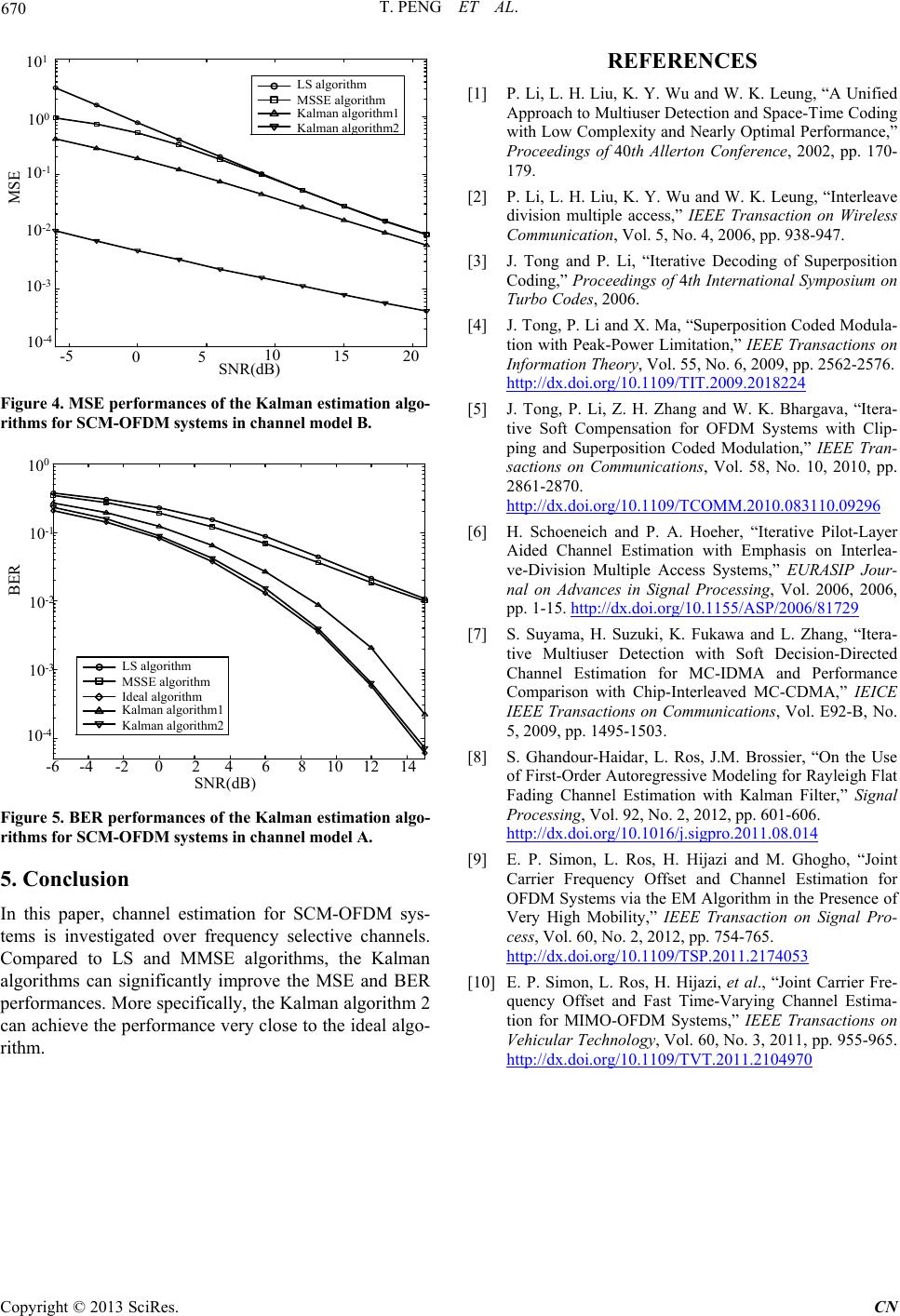 T. PENG ET AL. 670 Figure 4. MSE performances of the Kalman estimation algo- rithms for SCM-OFDM systems i n channel model B. Figure 5. BER performances of the Kalman estimation algo- rithms for SCM-OFDM systems i n channel model A. 5. Conclusion In this paper, channel estimation for SCM-OFDM sys- tems is investigated over frequency selective channels. Compared to LS and MMSE algorithms, the Kalman algorithms can significantly improve the MSE and BER performances. More sp ecifically, the Kalman algorithm 2 can achieve the performance very close to the ideal algo- rithm. REFERENCES [1] P. Li, L. H. Liu, K. Y. Wu and W. K. Leung, “A Unified Approach to Multiuser Detection and Space-Time Coding with Low Complexity and Near ly Optimal Pe rformance,” Proceedings of 40th Allerton Conference, 2002, pp. 170- 179. [2] P. Li, L. H. Liu, K. Y. Wu and W. K. Leung, “Interleave division multiple access,” IEEE Transaction on Wireless Communication, Vol. 5, No. 4, 2006, pp. 938-947. [3] J. Tong and P. Li, “Iterative Decoding of Superposition Coding,” Proce edings of 4th International Symposium on Turbo Codes, 2006. [4] J. Tong, P. Li and X. Ma, “Superposition Coded Modula- tion with Peak-Power Limitation,” IEEE Transactions on Information Theory, Vol. 55, No. 6, 2009, pp. 2562-2576. http://dx.doi.org/10.1109/TIT.2009.2018224 [5] J. Tong, P. Li, Z. H. Zhang and W. K. Bhargava, “Itera- tive Soft Compensation for OFDM Systems with Clip- ping and Superposition Coded Modulation,” IEEE Tran- sactions on Communications, Vol. 58, No. 10, 2010, pp. 2861-2870. http://dx.doi.org/10.1109/TCOMM.2010.083110.09296 [6] H. Schoeneich and P. A. Hoeher, “Iterative Pilot-Layer Aided Channel Estimation with Emphasis on Interlea- ve-Division Multiple Access Systems,” EURASIP Jour- nal on Advances in Signal Processing, Vol. 2006, 2006, pp. 1-15. http://dx.doi.org/10.1155/ASP/2006/81729 [7] S. Suyama, H. Suzuki, K. Fukawa and L. Zhang, “Itera- tive Multiuser Detection with Soft Decision-Directed Channel Estimation for MC-IDMA and Performance Comparison with Chi p-Interleaved MC-CDMA,” IEICE IEEE Transactions on Communications, Vol. E92-B, No. 5, 2009, pp. 1495-1503. [8] S. Ghandour-Haidar, L. Ros, J.M. Brossier, “On the Use of First-Order Autoregressive Modeling for Rayleigh Flat Fading Channel Estimation with Kalman Filter,” Signal Processing, Vol. 92, No. 2, 2012, pp. 601-606. http://dx.doi.org/10.1016/j.sigpro.2011.08.014 [9] E. P. Simon, L. Ros, H. Hijazi and M. Ghogho, “Joint Carrier Frequency Offset and Channel Estimation for OFDM Systems via the EM Algorithm in the Presence of Very High Mobility,” IEEE Transaction on Signal Pro- cess, Vol. 60, No. 2, 2012, pp. 754-765. http://dx.doi.org/10.1109/TSP.2011.2174053 [10] E. P. Simon, L. Ros, H. Hijazi, et al., “Joint Carrier Fre- quency Offset and Fast Time-Varying Channel Estima- tion for MIMO-OFDM Systems,” IEEE Transactions on Vehicular Technology, Vol. 60, No. 3, 2011, pp. 955-965. http://dx.doi.org/10.1109/TVT.2011.2104970 100 10-2 10-1 101 10-3 -5 0 5101520 SNR(dB) MSE LS algorithm MSSE algorithm Kalman algorithm1 Kalman algorithm2 10-4 10 0 10 -2 10 -1 10 -3 SNR(dB) BER LS algorithm MSSE algorithm Kalman algorithm1 Kalman algorithm2 10 -4 -6-4-202 468 10 1214 Ideal algorithm Copyright © 2013 SciRes. CN |