

Paper Menu >>
Journal Menu >>
 Vol.3, No.4, 269-272 (2013) Open Journal of Animal Sciences http://dx.doi.org/10.4236/ojas.2013.34040 No replicated association of the c.-312A > G in EDG1 with marbling in Niigata population of Japanese Black beef cattle Bin Tong1, Narumi Fuke1, Yui Himizu1, Hiroyuki Katou2, Masato Hatano2, Takeshi Ohta3, Hiroyuki Kose4, Takahisa Yamada1* 1Laboratory of Animal Genetics, Graduate School of Science and Technology, Niigata University, Niigata, Japan; *Corresponding Author: [email protected] 2Niigata Prefectural Headquarters, National Federation of Agricultural Cooperative Association, Niigata, Japan 3Central Pharmaceutical Research Institute, Japan Tobacco, Inc., Takatsuki, Japan 4Department of Life Science, Division of Natural Sciences, International Christian University, Mitaka, Japan Received 5 July 2013; revised 15 August 2013; accepted 1 September 2013 Copyright © 2013 Bin Tong et al. This is an open access article distributed under the Creative Commons Attribution License, which permits unrestricted use, distribution, and reproduction in any medium, provided the original work is properly cited. ABSTRACT Marbling, defined by the amount and the distri- bution of intramuscular fat and measured as beef marbling score (BMS), is an economically important trait of beef cattle in Japan. We re- cently rep orted that a single nucl eotide poly mor- phism (SNP), namely, c.-312A > G, in the endo- thelial differentiation sphingolipid G-protein- coupled recepto r, 1 (EDG1) gene was associa ted with the BMS level in the Japanese Black beef cattle population of Oita prefecture, with the G allele being associated with a high level of the BMS. Thus, the c.-312A > G SNP seems to be a candidate marker for marker-assisted selection. In this study, we investigated whether this as- sociation could be replicated in the Japanese Black beef cattle population of Niigata prefec- ture and analyzed the effect of the SNP geno- types on the carcass traits other than the BMS. No significant differences in the BMS level w ere detected among the genotypes of the c.-312A > G SNP in the Niigata Japanese Black beef cattle population. The SNP genotype had no signifi- cant effects on the carcass weight, rib eye area and rib thickness of the cattle population. These findings suggested that the association of the c.-312A > G SNP with the BMS level in the Japa- nese Black beef cattle population was not rep- licated in the Niigata population, and revealed no effects of the SNP genotype on the beef productivity in the Niigata population. Thus, we concluded that th e c.-312A > G SNP is not use ful for effective marker-assisted selection to in- crease meat quality and, additionally, meat pro- ductivity in Japanese Black beef cattle of Niigata prefecture. Keywords: Association; EDG1; Japanese Black Breed; Marbling; Replication Study; Single Nucleotide Polymorphism 1. INTRODUCTION Generally, marbling means the amount of intramuscu- lar fat in musculus longissimus muscle [1]. In Japan, marbling is characterized as the amount and distribution of intramuscular fat in a cross section of musculus long- issimus muscle, and called Shimofuri [1]. High levels of such marbling improve the palatability and acceptability of beef by affecting the taste and tenderness of the meat [2-4]. Because of the impor tance of the presence of mar- bling on the economics of beef production, there is great interest in gaining a better understanding of the molecu- lar architecture of marbling and in generating new op- portunities for more effective marker-assisted breeding. The endothelial d ifferentiation, sphingolipid G -protein coupled receptor, 1 (EDG1) gene, involved in blood ves- sel formation [5], has been previously shown to possess higher expression levels in a high-marbled steer group than in a low-marbled steer group in musculus longis- simus muscle across all ages [6,7]. EDG1 is located within the genomic region of a quantitative trait locu s for marbling on chromosome 3 [7,8], and thus has been re- garded as a positional functional candidate for the gene responsible for marbling [9]. We have recently reported Copyright © 2013 SciRes. OPEN ACCESS 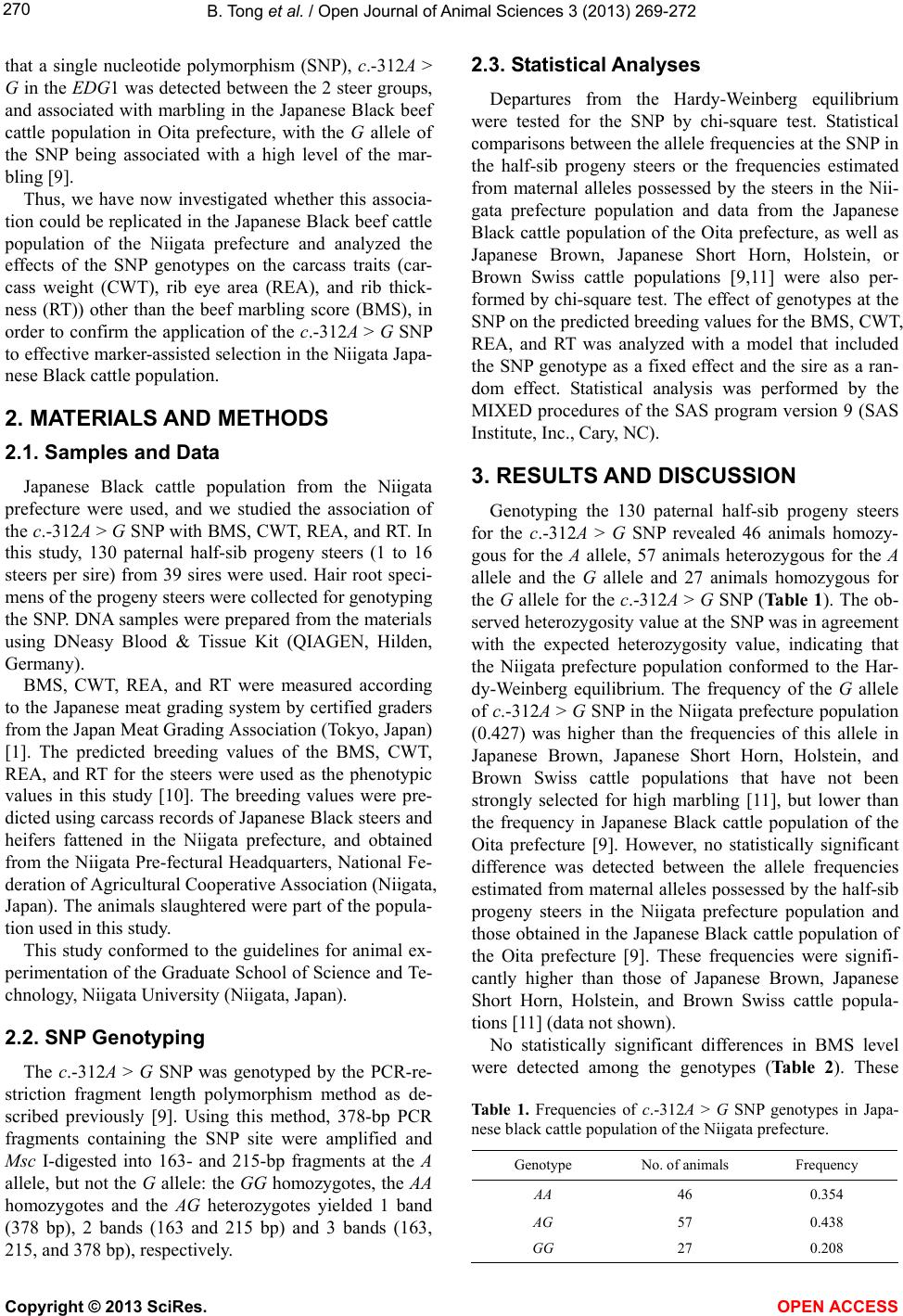 B. Tong et al. / Open Journal of Animal Sciences 3 (2013) 269-272 270 that a single nucleotide polymorphism (SNP), c.-312A > G in th e EDG1 was detected between the 2 steer groups, and associated with marbling in the Japanese Black beef cattle population in Oita prefecture, with the G allele of the SNP being associated with a high level of the mar- bling [9]. Thus, we have now investigated whether this associa- tion could be replicated in the Japane se Black beef cattle population of the Niigata prefecture and analyzed the effects of the SNP genotypes on the carcass traits (car- cass weight (CWT), rib eye area (REA), and rib thick- ness (RT)) other than the beef marbling score (BMS), in order to confirm the application of the c.-312A > G SNP to effective marker-assisted selection in the Niigata Japa- nese Black cattle population. 2. MATERIALS AND METHODS 2.1. Samples and Data Japanese Black cattle population from the Niigata prefecture were used, and we studied the association of the c.-312A > G SNP with BMS, CWT, REA, and RT. In this study, 130 paternal half-sib progeny steers (1 to 16 steers per sire) from 39 sires were used. Hair root speci- mens of the progeny steers were collected for genotyping the SNP. DNA samples were prepared from the materials using DNeasy Blood & Tissue Kit (QIAGEN, Hilden, Germany). BMS, CWT, REA, and RT were measured according to the Japanese meat grading system by certified graders from the Japan Meat Grading Association (Tokyo, Japan) [1]. The predicted breeding values of the BMS, CWT, REA, and RT for the steers were used as the phenotypic values in this study [10]. The breeding values were pre- dicted using carcass records of Japanese Black steers and heifers fattened in the Niigata prefecture, and obtained from the Niigata Pre-fectural Headquarters, National Fe- deration of Agricultural Cooperative Association (Niigata, Japan). The animals slaughtered were part of the popula- tion used in this study. This study conformed to the guidelines for animal ex- perimentation of the Graduate School of Science and Te- chnology, Niigata University (Niigata, Japan). 2.2. SNP Genotyping The c.-312 A > G SNP was genotyped by the PCR-re- striction fragment length polymorphism method as de- scribed previously [9]. Using this method, 378-bp PCR fragments containing the SNP site were amplified and Msc I-digested into 163- and 215-bp fragments at the A allele, but not the G allele: the GG homozygotes, the AA homozygotes and the AG heterozygotes yielded 1 band (378 bp), 2 bands (163 and 215 bp) and 3 bands (163, 215, and 378 bp), respectively. 2.3. Statistical Analyses Departures from the Hardy-Weinberg equilibrium were tested for the SNP by chi-square test. Statistical comparisons between the allele frequencies at the SNP in the half-sib progeny steers or the frequencies estimated from maternal alleles possessed by the steers in the Nii- gata prefecture population and data from the Japanese Black cattle population of the Oita prefecture, as well as Japanese Brown, Japanese Short Horn, Holstein, or Brown Swiss cattle populations [9,11] were also per- formed by chi-square test. The effect of genotypes at the SNP on the predicted breeding values for the BMS, CWT, REA, and RT was analyzed with a model that included the SNP genotype as a fixed effect and the sire as a ran- dom effect. Statistical analysis was performed by the MIXED procedures of the SAS program version 9 (SAS Institute, Inc., Cary, NC). 3. RESULTS AND DISCUSSION Genotyping the 130 paternal half-sib progeny steers for the c.-312A > G SNP revealed 46 animals homozy- gous for the A allele, 57 animals heterozygous for the A allele and the G allele and 27 animals homozygous for the G allele for the c.-312A > G SNP (Tab le 1). The ob- served heterozygosity value at the SNP was in agreement with the expected heterozygosity value, indicating that the Niigata prefecture population conformed to the Har- dy-Weinberg equilibrium. The frequency of the G allele of c.-312A > G SNP in the Niigata prefecture population (0.427) was higher than the frequencies of this allele in Japanese Brown, Japanese Short Horn, Holstein, and Brown Swiss cattle populations that have not been strongly selected for high marbling [11], but lower than the frequency in Japanese Black cattle population of the Oita prefecture [9]. However, no statistically significant difference was detected between the allele frequencies estimated from maternal alleles possessed by the half-sib progeny steers in the Niigata prefecture population and those obtain ed in the Japanese Black cattle populatio n of the Oita prefecture [9]. These frequencies were signifi- cantly higher than those of Japanese Brown, Japanese Short Horn, Holstein, and Brown Swiss cattle popula- tions [11] (data not shown). No statistically significant differences in BMS level were detected among the genotypes (Table 2). These Tab le 1. Frequencies of c.-312A > G SNP genotypes in Japa- nese black cattle population of the Niigata prefecture. Genotype No. of animals Frequency AA 46 0.354 AG 57 0.438 GG 27 0.208 Copyright © 2013 SciRes. OPEN ACCESS 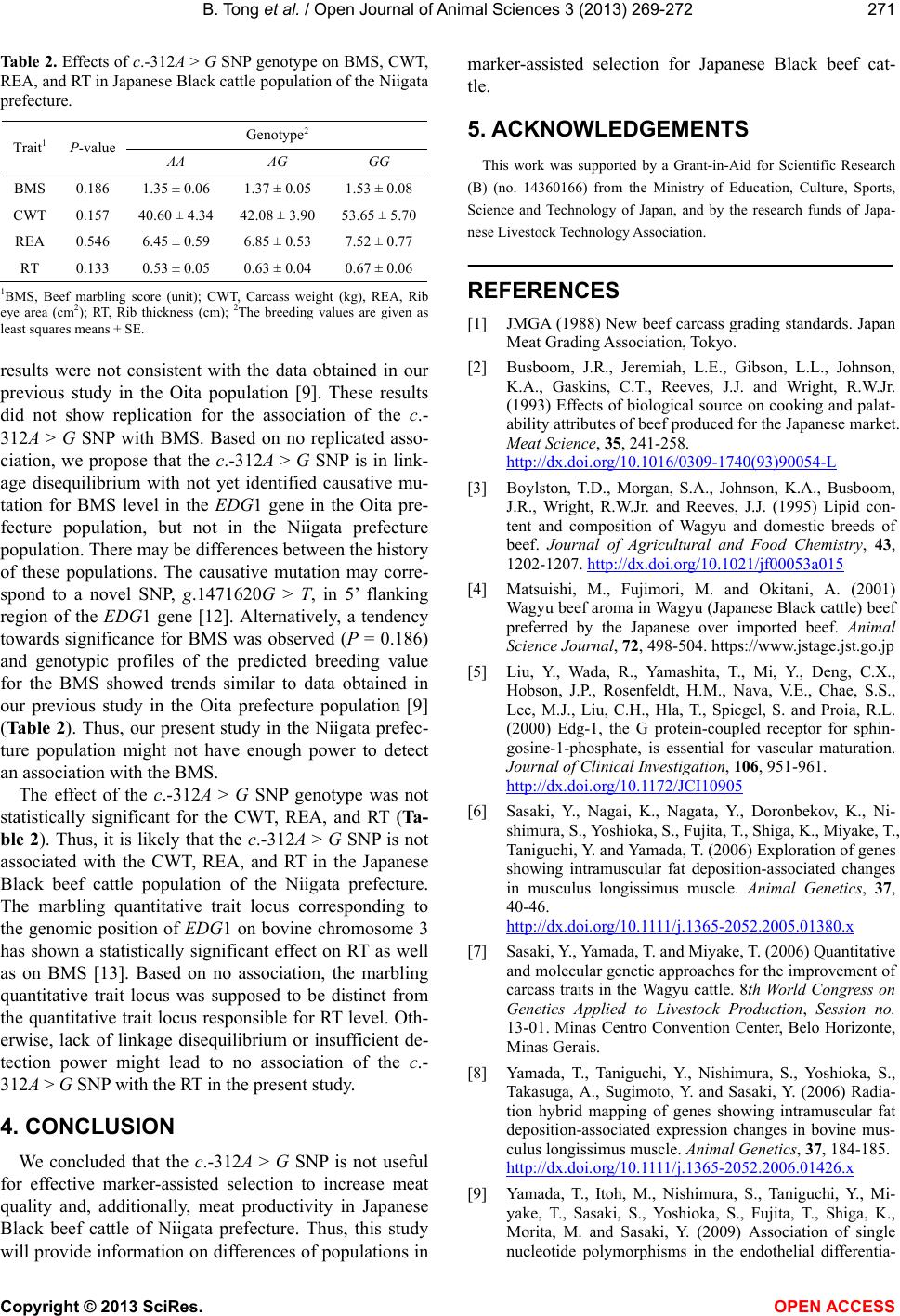 B. Tong et al. / Open Journal of Animal Sciences 3 (2013) 269-272 271 Tabl e 2. Effects of c.-312A > G SNP genotype on BMS, CWT, REA, and RT in Japanese Black cattle population of the Niigata prefecture. Genotype2 Trait1 P-value AA AG GG BMS 0.186 1.35 ± 0.06 1.37 ± 0.05 1.53 ± 0.08 CWT 0.157 40.60 ± 4.34 42.08 ± 3.90 53.65 ± 5.70 REA 0.546 6.45 ± 0.59 6.85 ± 0.53 7.52 ± 0.77 RT 0.133 0.53 ± 0.05 0.63 ± 0.04 0.67 ± 0.06 1BMS, Beef marbling score (unit); CWT, Carcass weight (kg), REA, Rib eye area (cm2); RT, Rib thickness (cm); 2The breeding values are given as least squares means ± SE. results were not consistent with the data obtained in our previous study in the Oita population [9]. These results did not show replication for the association of the c.- 312A > G SNP with BMS. Based on no replicated asso- ciation, we propose that the c.-312A > G SNP is in link- age disequilibrium with not yet identified causative mu- tation for BMS level in the EDG1 gene in the Oita pre- fecture population, but not in the Niigata prefecture population. There may be differences between the history of these populations. The causative mutation may corre- spond to a novel SNP, g.1471620G > T, in 5’ flanking region of the EDG1 gene [12]. Alternatively, a tendency towards significance for BMS was observed (P = 0.186) and genotypic profiles of the predicted breeding value for the BMS showed trends similar to data obtained in our previous study in the Oita prefecture population [9] (Ta bl e 2). Thus, our present study in the Niigata prefec- ture population might not have enough power to detect an association with the BMS. The effect of the c.-312A > G SNP genotype was not statistically significant for the CWT, REA, and RT (Ta- ble 2). Thus, it is likely that the c.-312A > G SNP is not associated with the CWT, REA, and RT in the Japanese Black beef cattle population of the Niigata prefecture. The marbling quantitative trait locus corresponding to the genomic position of EDG1 on bovine chromosome 3 has shown a statistically significant effect on RT as well as on BMS [13]. Based on no association, the marbling quantitative trait locus was supposed to be distinct from the quantitative trait locus responsible for RT level. Oth- erwise, lack of linkage disequilibrium or insufficient de- tection power might lead to no association of the c.- 312A > G SNP with the RT in the present study. 4. CONCLUSION We concluded that the c.-312A > G SNP is not useful for effective marker-assisted selection to increase meat quality and, additionally, meat productivity in Japanese Black beef cattle of Niigata prefecture. Thus, this study will provide information on differences of populatio ns in marker-assisted selection for Japanese Black beef cat- tle. 5. ACKNOWLEDGEMENTS This work was supported by a Grant-in-Aid for Scientific Research (B) (no. 14360166) from the Ministry of Education, Culture, Sports, Science and Technology of Japan, and by the research funds of Japa- nese Livestock Technology Association. REFERENCES [1] JMGA (1988) New beef carcass grading standards. Japan Meat Grading Association, Tokyo. [2] Busboom, J.R., Jeremiah, L.E., Gibson, L.L., Johnson, K.A., Gaskins, C.T., Reeves, J.J. and Wright, R.W.Jr. (1993) Effects of biological source on cooking and palat- ability attributes of beef produced for the Japanese market. Meat Scie nce, 35, 241-258. http://dx.doi.org/10.1016/0309-1740(93)90054-L [3] Boylston, T.D., Morgan, S.A., Johnson, K.A., Busboom, J.R., Wright, R.W.Jr. and Reeves, J.J. (1995) Lipid con- tent and composition of Wagyu and domestic breeds of beef. Journal of Agricultural and Food Chemistry, 43, 1202-1207. http://dx.doi.org/10.1021/jf00053a015 [4] Matsuishi, M., Fujimori, M. and Okitani, A. (2001) Wagyu beef aroma in Wagyu (Japanese Black cattle) beef preferred by the Japanese over imported beef. Animal Science Journal, 72, 498-504. https://www.jstage.jst.go.jp [5] Liu, Y., Wada, R., Yamashita, T., Mi, Y., Deng, C.X., Hobson, J.P., Rosenfeldt, H.M., Nava, V.E., Chae, S.S., Lee, M.J., Liu, C.H., Hla, T., Spiegel, S. and Proia, R.L. (2000) Edg-1, the G protein-coupled receptor for sphin- gosine-1-phosphate, is essential for vascular maturation. Journal of Clinical Investigation, 106, 951-961. http://dx.doi.org/10.1172/JCI10905 [6] Sasaki, Y., Nagai, K., Nagata, Y., Doronbekov, K., Ni- shimura, S., Yoshioka, S., Fujita, T., Shiga, K., Miyake, T., Taniguchi, Y. and Yamada, T. (2006) Exploration of genes showing intramuscular fat deposition-associated changes in musculus longissimus muscle. Animal Genetics, 37, 40-46. http://dx. doi.o rg/10.1111/j .1365-2052.2005.01380.x [7] Sasaki, Y., Yamada, T. and Miyake, T. (2006) Quantitative and molecular genetic approaches for the improvement of carcass traits in the Wagyu cattle. 8th World Congress on Genetics Applied to Livestock Production, Session no. 13-01. Minas Centro Convention Center, Belo Horizonte, Minas Gerais. [8] Yamada, T., Taniguchi, Y., Nishimura, S., Yoshioka, S., Takasuga, A., Sugimoto, Y. and Sasaki, Y. (2006) Radia- tion hybrid mapping of genes showing intramuscular fat deposition-associated expression changes in bovine mus- culus longissimus muscle. Animal Genetics, 37, 184-185. http://dx. doi.o rg/10.1111/j .1365-2052.2006.01426.x [9] Yamada, T., Itoh, M., Nishimura, S., Taniguchi, Y., Mi- yake, T., Sasaki, S., Yoshioka, S., Fujita, T., Shiga, K., Morita, M. and Sasaki, Y. (2009) Association of single nucleotide polymorphisms in the endothelial differentia- Copyright © 2013 SciRes. OPEN ACCESS  B. Tong et al. / Open Journal of Animal Sciences 3 (2013) 269-272 Copyright © 2013 SciRes. OPEN ACCESS 272 tion sphingolipid G-protein coupled receptor 1 gene with marbling in Japanese Black beef cattle. Animal Genetics, 40, 209-216. http://dx. doi.o rg/10.1111/j .1365-2052.2008.01822.x [10] Sasaki, Y., Miyake, T., Gaillard, C., Oguni, T., Matsumoto, M., Ito, M., Kurahara, T., Sasae, Y., Fujinaka, K., Ohta- gaki, S. and Dougo, T. (2006) Comparison of genetic gains per year for carcass traits among breeding programs in the Japanese Brown and the Japanese Black cattle. Journal of Animal Science, 84, 317-323. http://www.journalofanimalscience.org [11] Watanabe, N., Yoshioka, S., Itoh, M., Satoh, Y., Furuta, M., Komatsu, S., Sumio, Y., Fujita, Y., Yamada, T. and Sasaki, Y. (2009) The G allele at the c.-312A>G SNP in the EDG1 gene associated with high marbling in Japanese Black cattle is at a low frequency in breeds not selected for marbling. Animal Genetics, 40, 575-582. http://dx. doi.o rg/10.1111/j .1365-2052.2009.01871.x [12] Yamada, T., Sasaki, S., Sukegawa, S., Miyake, T., Fujita, T., Kose, H., Morita, M., Takahagi, Y., Murakami, H., Morimatsu, F. and Sasaki, Y. (2009) Novel SNP in 5’ flanking region of EDG1 associated with marbling in Japanese Black beef cattle. Animal Science Journal, 80, 486-489. http://dx. doi.o rg/10.1111/j .1740-0929.2009.00665.x [13] Takasuga, A., Watanabe, T., Mizoguchi, Y., Hirano, T., Ihara, N., Takano, A., Yokouchi, K., Fujikawa, A., Chiba, K., Kobayashi, N., Tatsuda, K., Oe, T., Furukawa-Kuroi- wa, M., Nishimura-Abe, A., Fujita, T., Inoue, K., Mizo- shita, K., Ogino, A. and Sugimoto, Y. (2007) Identifica- tion of bovine QTL for growth and carcass traits in Japa- nese Black cattle by replication and identical-by-descent mapping. Mammalian Genome, 18, 125-136. http://dx.doi.org/10.1007/s00335-006-0096-5 |