

Paper Menu >>
Journal Menu >>
 American Journal of Plant Sciences, 2013, 4, 2011-2014 http://dx.doi.org/10.4236/ajps.2013.410251 Published Online October 2013 (http://www.scirp.org/journal/ajps) 2011 Effect of Plant Spacing on Growth and Grain Yield of Soybean Bhagirath S. Chauhan*, Jhoana L. Opeña Weed Scientist and Assistant Scientist, Weed Science, Crop and Environmental Sciences Division, International Rice Research In- stitute, Los Baños, Philippines. Email: *[email protected] Received July 27th, 2013; revised August 29th, 2013; accepted September 15th, 2013 Copyright © 2013 Bhagirath S. Chauhan, Jhoana L. Opeña. This is an open access article distributed under the Creative Commons Attribution License, which permits unrestricted use, distribution, and reproduction in any medium, provided the original work is properly cited. ABSTRACT In the Philippines, rice monoculture systems are common. Compared to these systems, the rice-soybean cropping sys- tem may prove more water-efficient and there is a trend of increasing soybean area in the response to water scarcity and need for crop diversification in the Philippines. A field study was conducted to evaluate the effect of row and plant to plant spacing (20 × 10, 20 × 5, 40 × 10, and 40 × 5 cm) on growth and yield of soybean. Plant height was not influ- enced by the plant geometry. Spacing, however, influenced leaf area and shoot biomass of soybean. Plants grown at the widest spacing (i.e., 40 × 10 cm) produced lowest leaf area and shoot biomass at 6 and 12 weeks after planting. Leaf area and shoot biomass at other three spacing were similar. There was a negative and linear relationship between weed biomass and crop shoot biomass at 6 and 12 weeks after planting. Grain yield of soybean was not affected by plant ge- ometry and it ranged from 1.3 to 1.9 t·ha−1 at different spacing. Keywords: Row Spacing; Plant to Plant Spacing; Leaf Area; Weed Biomass 1. Introduction In the Philippines, rice (Oryza sativa L.) is the most im- portant source of food, where it is mainly grown after intensive tillage in wet conditions. There are two seasons (dry and wet) and farmers grow rice in both seasons. In dry seasons, however, rice requires a huge amount of wa- ter for puddling (repeated tillage in wet conditions called puddling) and planting [1-3]. Farmers in Asia, including the Philippines, are expected to have limited irrigation water in the future to flood their rice fields [4]. There has been an increasing and competing demand for other wa- ter uses in urban areas. The risk of water scarcity may lead to changes in production systems to bring about less water demanding systems [5]. They may include dry- seeded rice and crop diversification. Soybean (Glycine max L.) is one of such crops, which can be grown in dry seasons. Compared to rice monocul- ture systems, the rice-soybean cropping system may prove more water-efficient in the Philippines. At present, soy- bean is not grown on a large area in the Philippines; how- ever, there is a trend of increasing its area in the res- ponse to water scarcity and need for crop diversification. In different countries, soybean is grown at different row spacing [6,7]. The row spacing in soybean can vary from 19 to 76 cm [8]. Narrow row spacing is known to suppress weed growth by closing crop canopy earlier than wider row spacing [7,9,10]. Narrow row spacing may also increase available moisture to the crop, for exam- ple, corn (Zea mays L.) [11]. In soybean and corn, nar- row row spacing was found to increase light interception [6,12,13]. Soybean yield can also be influenced by the plant to plant spacing within a crop row. A computer search of published literature revealed that there is limited information available on the effect of row spacing and plant to plant spacing on the growth and grain yield of soybean in the Philippines. Plant geometry can also influence weed growth in the crop. A study was therefore conducted to evaluate the effect of plant geo- metry on the growth and yield of soybean at Los Baños, Philippines. 2. Materials and Methods The study was conducted at the farm of the International Rice Research Institute, Los Baños, Laguna, Philippines. *Corresponding author. Copyright © 2013 SciRes. AJPS 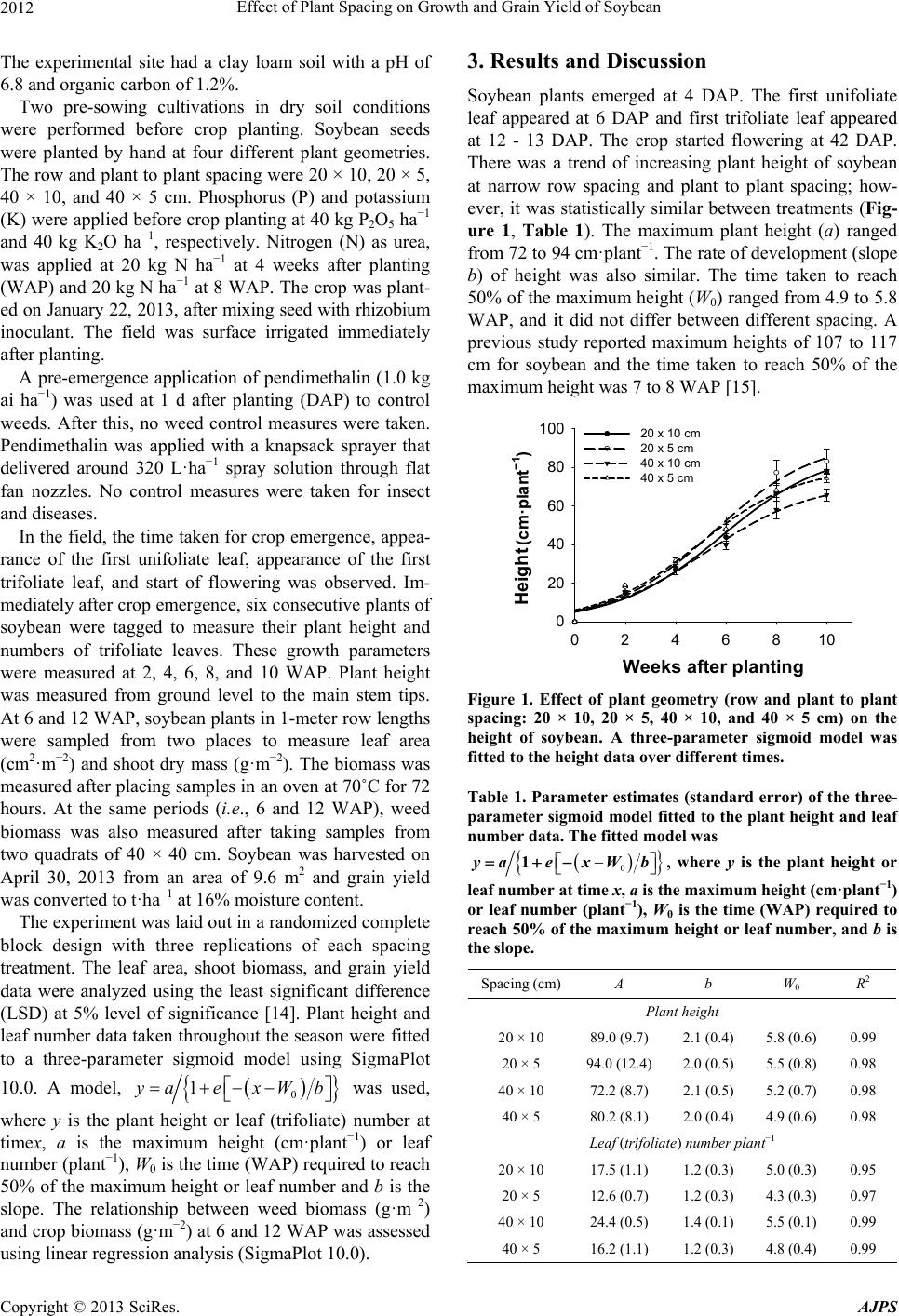 Effect of Plant Spacing on Growth and Grain Yield of Soybean 2012 The experimental site had a clay loam soil with a pH of 6.8 and organic carbon of 1.2%. Two pre-sowing cultivations in dry soil conditions were performed before crop planting. Soybean seeds were planted by hand at four different plant geometries. The row and plant to plant spacing were 20 × 10, 20 × 5, 40 × 10, and 40 × 5 cm. Phosphorus (P) and potassium (K) were applied before crop planting at 40 kg P2O5 ha−1 and 40 kg K2O ha−1, respectively. Nitrogen (N) as urea, was applied at 20 kg N ha−1 at 4 weeks after planting (WAP) and 20 kg N ha−1 at 8 WAP. The crop was plant- ed on January 22, 2013, after mixing seed with rhizobium inoculant. The field was surface irrigated immediately after planting. A pre-emergence application of pendimethalin (1.0 kg ai ha−1) was used at 1 d after planting (DAP) to control weeds. After this, no weed control measures were taken. Pendimethalin was applied with a knapsack sprayer that delivered around 320 L·ha−1 spray solution through flat fan nozzles. No control measures were taken for insect and diseases. In the field, the time taken for crop emergence, appea- rance of the first unifoliate leaf, appearance of the first trifoliate leaf, and start of flowering was observed. Im- mediately after crop emergence, six consecutive plants of soybean were tagged to measure their plant height and numbers of trifoliate leaves. These growth parameters were measured at 2, 4, 6, 8, and 10 WAP. Plant height was measured from ground level to the main stem tips. At 6 and 12 WAP, soybean plants in 1-meter row lengths were sampled from two places to measure leaf area (cm2·m−2) and shoot dry mass (g·m−2). The biomass was measured after placing samples in an oven at 70˚C for 72 hours. At the same periods (i.e., 6 and 12 WAP), weed biomass was also measured after taking samples from two quadrats of 40 × 40 cm. Soybean was harvested on April 30, 2013 from an area of 9.6 m2 and grain yield was converted to t·ha−1 at 16% moisture content. The experiment was laid out in a randomized complete block design with three replications of each spacing treatment. The leaf area, shoot biomass, and grain yield data were analyzed using the least significant difference (LSD) at 5% level of significance [14]. Plant height and leaf number data taken throughout the season were fitted to a three-parameter sigmoid model using SigmaPlot 10.0. A model, 0 1yаexWb was used, where y is the plant height or leaf (trifoliate) number at timex, a is the maximum height (cm·plant−1) or leaf number (plant−1), W0 is the time (WAP) required to reach 50% of the maximum height or leaf number and b is the slope. The relationship between weed biomass (g·m−2) and crop biomass (g·m−2) at 6 and 12 WAP was assessed using linear regression analysis (SigmaPlot 10.0). 3. Results and Discussion Soybean plants emerged at 4 DAP. The first unifoliate leaf appeared at 6 DAP and first trifoliate leaf appeared at 12 - 13 DAP. The crop started flowering at 42 DAP. There was a trend of increasing plant height of soybean at narrow row spacing and plant to plant spacing; how- ever, it was statistically similar between treatments (Fig- ure 1, Table 1). The maximum plant height (a) ranged from 72 to 94 cm·plant−1. The rate of development (slope b) of height was also similar. The time taken to reach 50% of the maximum height (W0) ranged from 4.9 to 5.8 WAP, and it did not differ between different spacing. A previous study reported maximum heights of 107 to 117 cm for soybean and the time taken to reach 50% of the maximum height was 7 to 8 WAP [15]. Weeks after planting 0246810 Height (cm plant-1) 0 20 40 60 80 100 20 x 10 cm 20 x 5 cm 40 x 10 cm 40 x 5 cm (cm·plant−1) Figure 1. Effect of plant geometry (row and plant to plant spacing: 20 × 10, 20 × 5, 40 × 10, and 40 × 5 cm) on the height of soybean. A three-parameter sigmoid model was fitted to the height data over different times. Table 1. Parameter estimates (standard error) of the three- parameter sigmoid model fitted to the plant height and leaf number data. The fitted model was 0 1yаexWb, where y is the plant height or leaf number at time x, а is the maximum height (cm·plant−1) or leaf number (plant−1), W0 is the time (WAP) required to reach 50% of the maximum height or leaf number, and b is the slope. Spacing (cm)A b W0 R 2 Plant height 20 × 10 89.0 (9.7) 2.1 (0.4) 5.8 (0.6)0.99 20 × 5 94.0 (12.4)2.0 (0.5) 5.5 (0.8)0.98 40 × 10 72.2 (8.7) 2.1 (0.5) 5.2 (0.7)0.98 40 × 5 80.2 (8.1) 2.0 (0.4) 4.9 (0.6)0.98 Leaf (trifoliate) number plant−1 20 × 10 17.5 (1.1) 1.2 (0.3) 5.0 (0.3)0.95 20 × 5 12.6 (0.7) 1.2 (0.3) 4.3 (0.3)0.97 40 × 10 24.4 (0.5) 1.4 (0.1) 5.5 (0.1)0.99 40 × 5 16.2 (1.1) 1.2 (0.3) 4.8 (0.4)0.99 Copyright © 2013 SciRes. AJPS 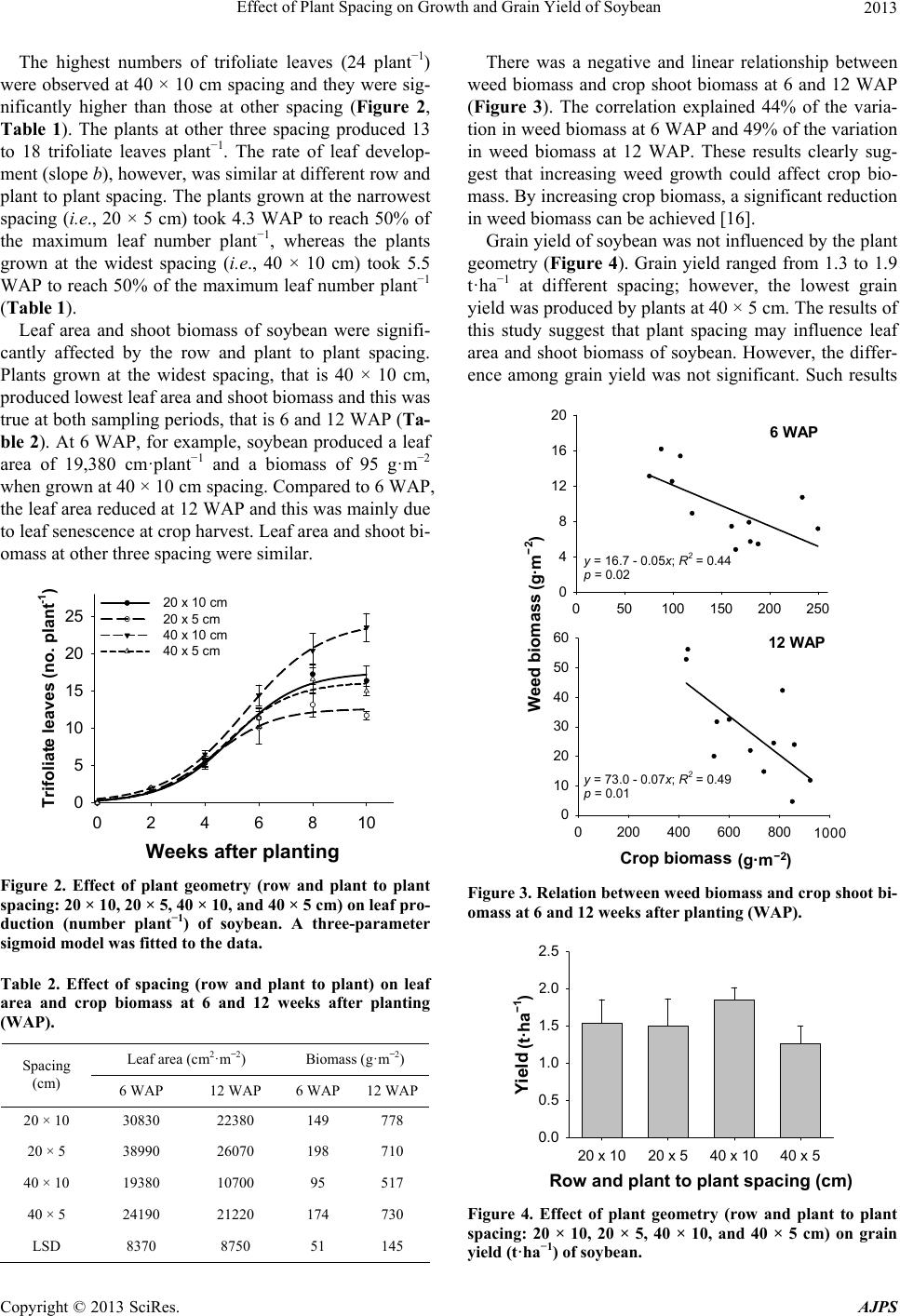 Effect of Plant Spacing on Growth and Grain Yield of Soybean 2013 The highest numbers of trifoliate leaves (24 plant−1) were observed at 40 × 10 cm spacing and they were sig- nificantly higher than those at other spacing (Figure 2, Table 1). The plants at other three spacing produced 13 to 18 trifoliate leaves plant−1. The rate of leaf develop- ment (slope b), however, was similar at different row and plant to plant spacing. The plants grown at the narrowest spacing (i.e., 20 × 5 cm) took 4.3 WAP to reach 50% of the maximum leaf number plant−1, whereas the plants grown at the widest spacing (i.e., 40 × 10 cm) took 5.5 WAP to reach 50% of the maximum leaf number plant−1 (Table 1). Leaf area and shoot biomass of soybean were signifi- cantly affected by the row and plant to plant spacing. Plants grown at the widest spacing, that is 40 × 10 cm, produced lowest leaf area and shoot biomass and this was true at both sampling periods, that is 6 and 12 WAP (Ta- ble 2). At 6 WAP, for example, soybean produced a leaf area of 19,380 cm·plant−1 and a biomass of 95 g·m−2 when grown at 40 × 10 cm spacing. Compared to 6 WAP, the leaf area reduced at 12 WAP and this was mainly due to leaf senescence at crop harvest. Leaf area and shoot bi- omass at other three spacing were similar. Weeks after planting 0246810 Trifoliate leaves (no. plant-1 ) 0 5 10 15 20 25 20 x 10 cm 20 x 5 cm 40 x 10 cm 40 x 5 cm Figure 2. Effect of plant geometry (row and plant to plant spacing: 20 × 10, 20 × 5, 40 × 10, and 40 × 5 cm) on leaf pro- duction (number plant−1) of soybean. A three-parameter sigmoid model was fitted to the data. Table 2. Effect of spacing (row and plant to plant) on leaf area and crop biomass at 6 and 12 weeks after planting (WAP). Leaf area (cm2·m−2) Biomass (g·m−2) Spacing (cm) 6 WAP 12 WAP 6 WAP 12 WAP 20 × 10 30830 22380 149 778 20 × 5 38990 26070 198 710 40 × 10 19380 10700 95 517 40 × 5 24190 21220 174 730 LSD 8370 8750 51 145 There was a negative and linear relationship between weed biomass and crop shoot biomass at 6 and 12 WAP (Figure 3). The correlation explained 44% of the varia- tion in weed biomass at 6 WAP and 49% of the variation in weed biomass at 12 WAP. These results clearly sug- gest that increasing weed growth could affect crop bio- mass. By increasing crop biomass, a significant reduction in weed biomass can be achieved [16]. Grain yield of soybean was not influenced by the plant geometry (Figure 4). Grain yield ranged from 1.3 to 1.9 t·ha−1 at different spacing; however, the lowest grain yield was produced by plants at 40 × 5 cm. The results of this study suggest that plant spacing may influence leaf area and shoot biomass of soybean. However, the differ- ence among grain yield was not significant. Such results y = 16.7 - 0.05x; R2 = 0.44 p = 0.02 050100 150 200 250 Weed biomass (g m-2) 0 4 8 12 16 20 y = 73.0 - 0.07x; R2 = 0.49 p = 0.01 Crop biomass (g m-2) 0200 400 600 800100 0 0 10 20 30 40 50 60 6 WAP 12 WAP (g·m −2 ) (g·m −2 ) 1000 Figure 3. Relation between weed biomass and crop shoot bi- omass at 6 and 12 weeks after planting (WAP). Row and plant to plant spacing (cm) 20 x 1020 x 540 x 1040 x 5 Yield (t ha- 1 ) 0.0 0.5 1.0 1.5 2.0 2.5 (t·ha −1 ) Figure 4. Effect of plant geometry (row and plant to plant spacing: 20 × 10, 20 × 5, 40 × 10, and 40 × 5 cm) on grain yield (t·ha−1) of soybean. Copyright © 2013 SciRes. AJPS  Effect of Plant Spacing on Growth and Grain Yield of Soybean Copyright © 2013 SciRes. AJPS 2014 suggest that soybean can be grown successfully at both 20 and 40 cm row spacing. Narrow row spacing, how- ever, may help in closing canopy earlier than wider row spacing. In a previous study, soybean planted in 18 cm rows was more competitive against weeds than those in 76 cm wide rows [17]. Similarly, Knezevic and collea- gues suggested that planting soybean in wider rows re- duced early season crop tolerance to weeds requiring ear- lier weed management programs than in narrower rows [7]. In water limited environments, narrow row spacing may enhance available moisture to soybean [11]. There is a need to study further the effect of plant geometry on the performance of different cultivars as cultivars differ in their height, leaf morphology, etc. REFERENCES [1] B. S. Chauhan, “Weed Ecology and Weed Management Strategies for Dry-Seeded Rice in Asia,” Weed Technol- ogy, Vol. 26, No. 1, 2012, pp. 1-13. http://dx.doi.org/10.1614/WT-D-11-00105.1 [2] G. Mahajan, B. S. Chauhan and M. S. Gill, “Dry-Seeded Rice Culture in Punjab State of India: Lessons Learned from Farmers,” Field Crops Research, Vol. 144, 2013, pp. 89-99. http://dx.doi.org/10.1016/j.fcr.2013.01.008 [3] G. Mahajan, B. S. Chauhan, J. Timsina, P. P. Singh and K. Singh, “Crop Performance and Water- and Nitrogen-Use Efficiencies in Dry-Seeded Rice in Response to Irrigation and Fertilizer Amounts in Northwest India,” Field Crops Research, Vol. 134, 2012, pp. 59-70. http://dx.doi.org/10.1016/j.fcr.2012.04.011 [4] T. P. Tuong and B. A. M. Bouman, “Rice Production in Water-Scarce Environments, in Water Productivity in Ag- riculture: Limits and Opportunities for Improvements,” In: J. W. Kijne, R. Barker and D. Molden, Eds., CABI Pub- lishing, Wallingford, 2003, pp. 53-67. http://dx.doi.org/10.1079/9780851996691.0053 [5] M. C. R. Alberto, R. J. Buresh, T. Hirano, A. Miyata, R. Wassmann, J. R. Quilty, T. Q. Correa Jr. and J. Sandro, “Carbon Uptake and Water Productivity for Dry-Seeded Rice and Hybrid Maize Grown with Overhead Sprinkler Irrigation,” Field Crops Research, Vol. 146, 2013, pp. 51-65. http://dx.doi.org/10.1016/j.fcr.2013.03.006 [6] J. E. Board and B. J. Harville, “Explanations for Greater Light Interception in Narrow- vs Wide-Row Soybean,” Crop Science, Vol. 32, No. 1, 1992, pp. 198-202. http://dx.doi.org/10.2135/cropsci1992.0011183X0032000 10041x [7] S. Z. Knezevic, S. P. Evans and M. Mainz, “Row Spacing Influences the Critical Timing for Weed Removal in Soy- bean (Glycine max),” Weed Technology, Vol. 17, No. 4, 2003, pp. 666-673. http://dx.doi.org/10.1614/WT02-49 [8] S. M. Hock, S. Z. Knezevic, A. R. Martin and J. L. Lind- quist, “Soybean Row Spacing and Weed Emergence Time Influence Weed Competitiveness and Competitive Indi- ces,” Weed Science, Vol. 54, No. 1, 2006, pp. 38-46. http://dx.doi.org/10.1614/WS-05-011R.1 [9] B. S. Chauhan and D. E. Johnson, “Implications of Nar- row Crop Row Spacing and Delayed Echinochloa colona and Echinochloa crus-galli Emergence for Weed Growth and Crop Yield Loss in Aerobic Rice,” Field Crops Re- search, Vol. 117, 2010, pp. 177-182. http://dx.doi.org/10.1016/j.fcr.2010.02.014 [10] B. S. Chauhan and D. E. Johnson, “Row Spacing and Weed Control Timing Affect Yield of Aerobic Rice,” Field Crops Research, Vol. 121, 2011, pp. 226-231. http://dx.doi.org/10.1016/j.fcr.2010.12.008 [11] D. L. Karlen and C. R. Camp, “Row Spacing, Plant Popu- lation, and Water Management Effects on Corn in the At- lantic Coastal Plain,” Agron Journal, Vol. 77, No. 3, 1985, pp. 393-398. http://dx.doi.org/10.2134/agronj1985.0002196200770003 0010x [12] M. J. Ottman and L. F. Welch, “Planting Patterns and Ra- diation Interception, Plant Nutrient Concentration and Yield in Corn,” Agron Journal, Vol. 81, 1989, pp. 167- 174. http://dx.doi.org/10.2134/agronj1989.0002196200810002 0006x [13] M. Tollenaar, A. A. Dibo, A. Aguilera, S. F. Weise and C. J. Swanton, “Effect of Crop Density on Weed Interfer- ence in Maize,” Agron Journal, Vol. 86, No. 4, 1994, pp. 591-595. http://dx.doi.org/10.2134/agronj1994.0002196200860004 0003x [14] GenStat 8.0, “GenStat Release 8 Reference Manual,” VSN International, Oxford, 2005, 343 p. [15] J. A. Torrion, T. D. Setiyono, K. G. Cassman, R. B. Fergu- son, S. Irmak and J. E. Specht, “Soybean Root Develop- ment Relative to Vegetative and Reproductive Phenol- ogy,” Agron Journal, Vol. 104, No. 6, 2012, pp. 1702-1709. http://dx.doi.org/10.2134/agronj2012.0199 [16] B. S. Chauhan, V. P. Singh, A. Kumar and D. E. Johnson, “Relations of Rice Seeding Rates to Crop and Weed Growth in Aerobic Rice,” Field Crops Research, Vol. 121, 2011, pp. 105-115. http://dx.doi.org/10.1016/j.fcr.2010.11.019 [17] D. Mulugeta and D. Stoltenberg, “Increased Weed Emer- gence and Seed Bank Depletion by Soil Disturbance in a No-Till System,” Weed Science, Vol. 45, 1997, pp. 234- 241. |