

Paper Menu >>
Journal Menu >>
 American Journal of Plant Sciences, 2013, 4, 2006-2010 http://dx.doi.org/10.4236/ajps.2013.410250 Published Online October 2013 (http://www.scirp.org/journal/ajps) Rt-PCR Analysis and Evolutionary Relationship of Some Hungarian Grapevine leafroll associated virus 1 and 3 Isolates* Eszter Cseh1#, András Péter Takács2, Richard Gáborjányi2, László Palkovics3, László Kocsis1 1Department of Horticulture, Georgikon Faculty, University of Pannonia, Keszthely, Hungary; 2Plant Protection Institute, Georgikon Faculty, University of Pannonia, Keszthely, Hungary; 3Department of Plant Pathology, Faculty of Horticultural Science, Corvinus University of Budapest, Budapest, Hungary. Email: #[email protected] Received January 30th, 2013; revised March 1st, 2013; accepted April 1st, 2013 Copyright © 2013 Eszter Cseh et al. This is an open access article distributed under the Creative Commons Attribution License, which permits unrestricted use, distribution, and reproduction in any medium, provided the original work is properly cited. ABSTRACT Hungarian isolates of Grapevine leafroll associated virus 1 and 3 (GLRaV-1, GLRaV-3) were tested using serological (DAS-ELISA) and molecular (RT-PCR) methods. Five hundred bp long PCR products of the part of HSP70 gene of one serologically positive GLRaV-1 and four GLRaV-3 isolates were sequenced. These sequences were applied for phy- logenetic analysis and compared to foreign virus isolates of NCBI GenBank. Phylogenetic analysis of GLRaV-1 HSP70 gene supported the earlier results that it could be divided into two clusters: E and A. The Hungarian isolate 6.4.1 be- longed to the group E. This isolate showed the highest homology with the AY754914 isolate from the Czech Republic. GLRaV-3 sequence data could cluster five groups. Hungarian 2.2; 3.5 and 4.2 isolates were estimated belonging to the group II. The 1.4 isolate from the same vineyard as 2.2 varied in sequence data so it belonged to the other, IV. variant group with two South African, two Austrian and a Syrah isolate. According to the phylogenetic analysis, two variant groups occurred in Hungary. These isolates related with each other, but showed higher similarity of foreign counties. In some cases, they were similar to isolates of the neighbour countries such as Slovakia and Austria. It could be supposed that mainly the exchange of virus infected propagation materials caused the dissemination of GLRaV isolates. Keywords: Grapevine; Virus; GLRaV-1; GLRaV-3; HSP70; RT-PCR; Hungary 1. Introduction Grapevine leafroll symptoms may be induced by a com- plex of viruses, the majority of which belong to the Closteroviridae family. Members of GLRaV-1-4 have been distinguished in Hungary by DAS-ELISA [1]. GLRaV-1 and -3 spread via propagation material and grafting [2] and are transmit- ted by the scale insect [3], and by mealybugs [4-11]. GLRaV-1 and -3 belong to the genus Ampelovirus. The GLRaV-1 genome contains 9 open reading frames enco- ding replication complex consisiting of the methyltrans- ferase, helicase, RNA depending RNA polymerase do- mains, a 70 kDa heat shock protein homologue, a HSP90- like protein, the coat protein, two minor copies of coat protein and other proteins of unknown function [12]. RNA genome of GLRaV-3 is positively single-stranded, and contains 13 open reading frames [13]. It is most closely related to GLRaV-1. Both viruses encode a 70 kDa heat shock protein homolog with conserved amino acid sequence motives [14,15]. This region is used for phylogenetic analysis in order to assess evolutionary re- lationship among members of ampeloviruses [16]. 2. Materials and Methods 2.1. Plant Material Forty-eight grapevine leaf samples of cultivars Kékfran- kos, Juhfark, Pinot noir, Kéknyelű, Cabernet sauvignon, Olaszrizling and Tempranillo originated from different geographical areas: North-West, Middle-West, South- West and Middle-East part of Hungary (Kőszeg, Bala- tonboglár, Badacsonytomaj, Cserszegtomaj, Kecskemét *The nucleotide sequence data reported in this work have been submit- ted in the Genbank database and assigned the accession numbers HE794021, HE794022, HE794023, HE794024 and HE794025. #Corresponding author. Copyright © 2013 SciRes. AJPS 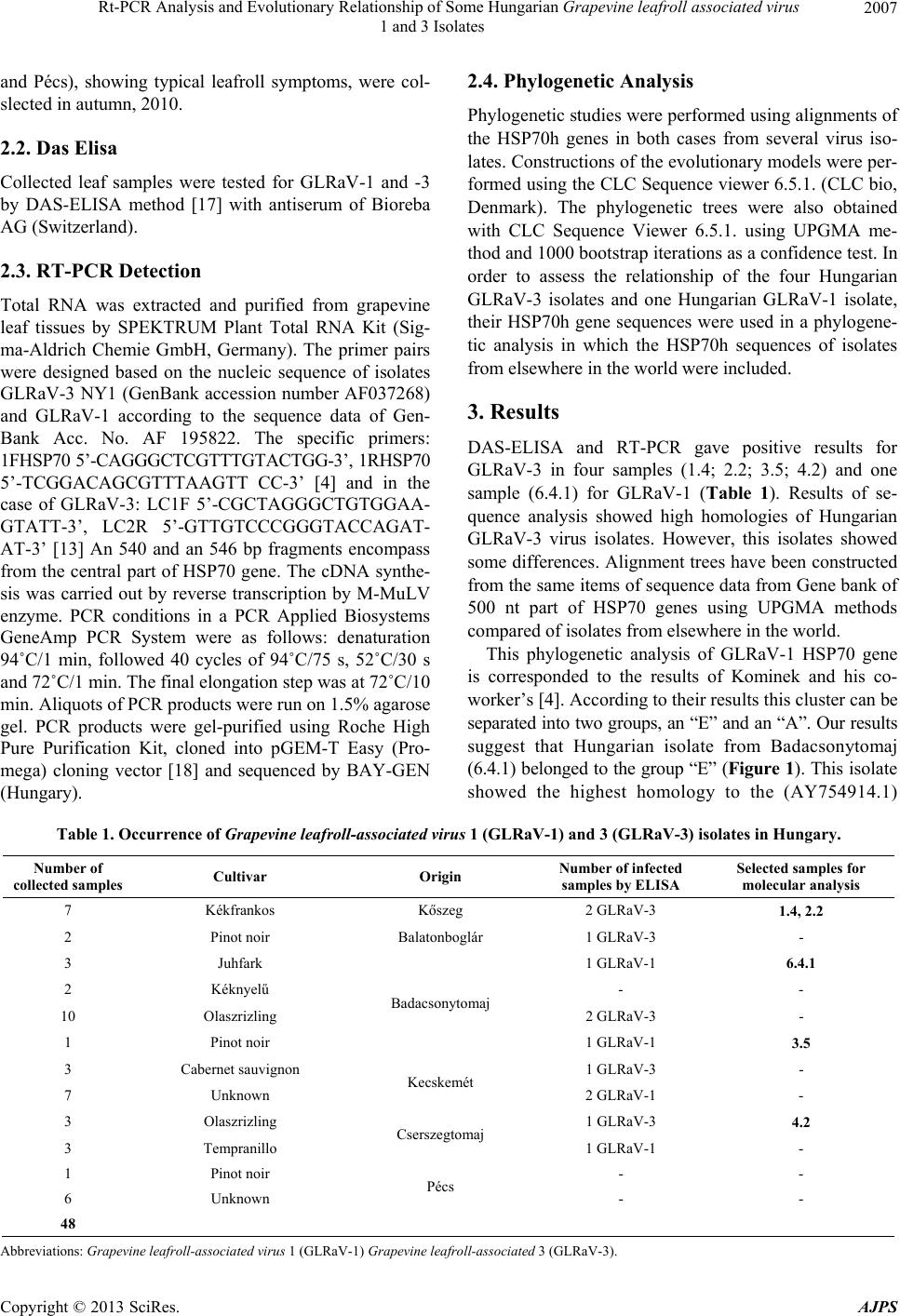 Rt-PCR Analysis and Evolutionary Relationship of Some Hungarian Grapevine leafroll associated virus 1 and 3 Isolates 2007 and Pécs), showing typical leafroll symptoms, were col- slected in autumn, 2010. 2.2. Das Elisa Collected leaf samples were tested for GLRaV-1 and -3 by DAS-ELISA method [17] with antiserum of Bioreba AG (Switzerland). 2.3. RT-PCR Detection Total RNA was extracted and purified from grapevine leaf tissues by SPEKTRUM Plant Total RNA Kit (Sig- ma-Aldrich Chemie GmbH, Germany). The primer pairs were designed based on the nucleic sequence of isolates GLRaV-3 NY1 (GenBank accession number AF037268) and GLRaV-1 according to the sequence data of Gen- Bank Acc. No. AF 195822. The specific primers: 1FHSP70 5’-CAGGGCTCGTTTGTACTGG-3’, 1RHSP70 5’-TCGGACAGCGTTTAAGTT CC-3’ [4] and in the case of GLRaV-3: LC1F 5’-CGCTAGGGCTGTGGAA- GTATT-3’, LC2R 5’-GTTGTCCCGGGTACCAGAT- AT-3’ [13] An 540 and an 546 bp fragments encompass from the central part of HSP70 gene. The cDNA synthe- sis was carried out by reverse transcription by M-MuLV enzyme. PCR conditions in a PCR Applied Biosystems GeneAmp PCR System were as follows: denaturation 94˚C/1 min, followed 40 cycles of 94˚C/75 s, 52˚C/30 s and 72˚C/1 min. The final elongation step was at 72˚C/10 min. Aliquots of PCR products were run on 1.5% agarose gel. PCR products were gel-purified using Roche High Pure Purification Kit, cloned into pGEM-T Easy (Pro- mega) cloning vector [18] and sequenced by BAY-GEN (Hungary). 2.4. Phylogenetic Analysis Phylogenetic studies were performed using alignments of the HSP70h genes in both cases from several virus iso- lates. Constructions of the evolutionary models were per- formed using the CLC Sequence viewer 6.5.1. (CLC bio, Denmark). The phylogenetic trees were also obtained with CLC Sequence Viewer 6.5.1. using UPGMA me- thod and 1000 bootstrap iterations as a confidence test. In order to assess the relationship of the four Hungarian GLRaV-3 isolates and one Hungarian GLRaV-1 isolate, their HSP70h gene sequences were used in a phylogene- tic analysis in which the HSP70h sequences of isolates from elsewhere in the world were included. 3. Results DAS-ELISA and RT-PCR gave positive results for GLRaV-3 in four samples (1.4; 2.2; 3.5; 4.2) and one sample (6.4.1) for GLRaV-1 (Table 1). Results of se- quence analysis showed high homologies of Hungarian GLRaV-3 virus isolates. However, this isolates showed some differences. Alignment trees have been constructed from the same items of sequence data from Gene bank of 500 nt part of HSP70 genes using UPGMA methods compared of isolates from elsewhere in the world. This phylogenetic analysis of GLRaV-1 HSP70 gene is corresponded to the results of Kominek and his co- worker’s [4]. According to their results this cluster can be separated into two groups, an “E” and an “A”. Our results suggest that Hungarian isolate from Badacsonytomaj (6.4.1) belonged to the group “E” (Figure 1). This isolate showed the highest homology to the (AY754914.1) Table 1. Occurrence of Grapevine leafroll-associated virus 1 (GLRaV-1) and 3 (GLRaV-3) isolates in Hungary. Number of collected samples Cultivar Origin Number of infected samples by ELISA Selected samples for molecular analysis 7 Kékfrankos Kőszeg 2 GLRaV-3 1.4, 2.2 2 Pinot noir Balatonboglár 1 GLRaV-3 - 3 Juhfark 1 GLRaV-1 6.4.1 2 Kéknyelű - - 10 Olaszrizling 2 GLRaV-3 - 1 Pinot noir Badacsonytomaj 1 GLRaV-1 3.5 3 Cabernet sauvignon 1 GLRaV-3 - 7 Unknown Kecskemét 2 GLRaV-1 - 3 Olaszrizling 1 GLRaV-3 4.2 3 Tempranillo Cserszegtomaj 1 GLRaV-1 - 1 Pinot noir - - 6 Unknown Pécs - - 48 Abbreviations: Grapevine leafroll-associated virus 1 (GLRaV-1) Grapevine leafroll-associated 3 (GLRaV-3). Copyright © 2013 SciRes. AJPS 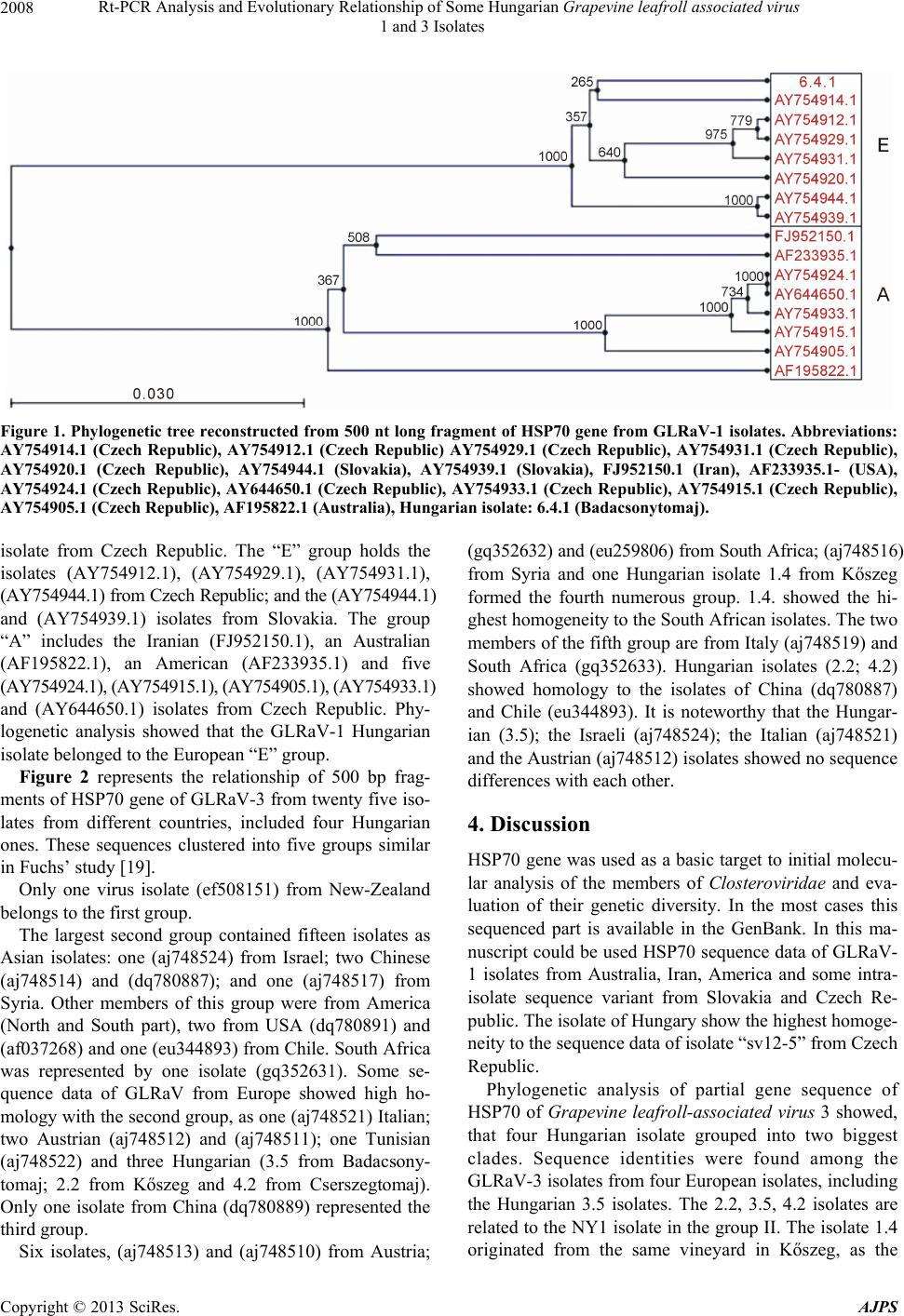 Rt-PCR Analysis and Evolutionary Relationship of Some Hungarian Grapevine leafroll associated virus 1 and 3 Isolates 2008 Figure 1. Phylogenetic tree reconstructed from 500 nt long fragment of HSP70 gene from GLRaV-1 isolates. Abbreviations: AY754914.1 (Czech Republic), AY754912.1 (Czech Republic) AY754929.1 (Czech Republic), AY754931.1 (Czech Republic), AY754920.1 (Czech Republic), AY754944.1 (Slovakia), AY754939.1 (Slovakia), FJ952150.1 (Iran), AF233935.1- (USA), AY754924.1 (Czech Republic), AY644650.1 (Czech Republic), AY754933.1 (Czech Republic), AY754915.1 (Czech Republic), AY754905.1 (Czech Republic), AF195822.1 (Australia), Hungarian isolate: 6.4.1 (Badacsonytomaj). isolate from Czech Republic. The “E” group holds the isolates (AY754912.1), (AY754929.1), (AY754931.1), (AY754944.1) from Czech Republic; and the (AY754944.1) and (AY754939.1) isolates from Slovakia. The group “A” includes the Iranian (FJ952150.1), an Australian (AF195822.1), an American (AF233935.1) and five (AY754924.1), (AY754915.1), (AY754905.1), (AY754933.1) and (AY644650.1) isolates from Czech Republic. Phy- logenetic analysis showed that the GLRaV-1 Hungarian isolate belonged to the European “E” group. Figure 2 represents the relationship of 500 bp frag- ments of HSP70 gene of GLRaV-3 from twenty five iso- lates from different countries, included four Hungarian ones. These sequences clustered into five groups similar in Fuchs’ study [19]. Only one virus isolate (ef508151) from New-Zealand belongs to the first group. The largest second group contained fifteen isolates as Asian isolates: one (aj748524) from Israel; two Chinese (aj748514) and (dq780887); and one (aj748517) from Syria. Other members of this group were from America (North and South part), two from USA (dq780891) and (af037268) and one (eu344893) from Chile. South Africa was represented by one isolate (gq352631). Some se- quence data of GLRaV from Europe showed high ho- mology with the second group, as one (aj748521) Italian; two Austrian (aj748512) and (aj748511); one Tunisian (aj748522) and three Hungarian (3.5 from Badacsony- tomaj; 2.2 from Kőszeg and 4.2 from Cserszegtomaj). Only one isolate from China (dq780889) represented the third group. Six isolates, (aj748513) and (aj748510) from Austria; (gq352632) and (eu259806) from South Africa; (aj748516) from Syria and one Hungarian isolate 1.4 from Kőszeg formed the fourth numerous group. 1.4. showed the hi- ghest homogeneity to the South African isolates. The two members of the fifth group are from Italy (aj748519) and South Africa (gq352633). Hungarian isolates (2.2; 4.2) showed homology to the isolates of China (dq780887) and Chile (eu344893). It is noteworthy that the Hungar- ian (3.5); the Israeli (aj748524); the Italian (aj748521) and the Austrian (aj748512) isolates showed no sequence differences with each other. 4. Discussion HSP70 gene was used as a basic target to initial molecu- lar analysis of the members of Closteroviridae and eva- luation of their genetic diversity. In the most cases this sequenced part is available in the GenBank. In this ma- nuscript could be used HSP70 sequence data of GLRaV- 1 isolates from Australia, Iran, America and some intra- isolate sequence variant from Slovakia and Czech Re- public. The isolate of Hungary show the highest homoge- neity to the sequence data of isolate “sv12-5” from Czech Republic. Phylogenetic analysis of partial gene sequence of HSP70 of Grapevine leafroll-associated virus 3 showed, that four Hungarian isolate grouped into two biggest clades. Sequence identities were found among the GLRaV-3 isolates from four European isolates, including the Hungarian 3.5 isolates. The 2.2, 3.5, 4.2 isolates are related to the NY1 isolate in the group II. The isolate 1.4 riginated from the same vineyard in Kőszeg, as the o Copyright © 2013 SciRes. AJPS  Rt-PCR Analysis and Evolutionary Relationship of Some Hungarian Grapevine leafroll associated virus 1 and 3 Isolates 2009 Figure 2. Phylogenetic tree of the genomic region HSP70 GLRaV-3 constructed by UPGMA method. Abbreviations: ef508151 (New-Zealand), aj748524 (Israel), aj748521 (Italy), aj748512 (Austria), aj748514 (China), dq780887 (China), dq780891 (USA), gq352631 (South Africa), aj748511 (Austria), aj748517 (Syria), eu344893 (Chile), af037268 (USA), aj748522 (Tunisia), dq 780889 (China), aj748513 (Austria), gq352632 (South Africa), eu259806 (South Africa), aj748516 (Syria), aj748510 (Austria), aj748519 (Italy), gq352633 (South Africa), Hungarian isolates: 3.5 (Badacsonytomaj), 2.2 (Kőszeg), 4.2 (Cserszegtomaj) and 1.4 (Kőszeg). isolate 2.2, but this sequence data show higher homoge- neity to the members of the group IV. Some authors have recognised five variant groups. Three major, one isolate from New-Zealand and one from China represent two other groups [13,19-22]. Our results confirm these clustering and the Hungarian isolates could insert in these groups. 5. Conclusion According to the phylogenetic analysis, two variant groups of GLRaV-3 occurred in Hungary. There is a lack of cor- relation of sequence data with geographical origin if the isolates were consistent with the view that the infected propagation material plays the most important role in the spreading. The results are not suitable for the justification of origin and spread of Hungarian virus isolates. Further studies are needed to gain information of the biological significance and role in the transmission of these sequence diversity of grapevine leafroll associated viruses. 6. Acknowledgements This work was partly supported by the OTKA K67658, TÁMOP-4.2.1./B-09/1-KMR-2010-0005, TÁMOP-4.2.2./ B-10/1-2010-0023 and TÁMOP-4.2.1./B-09/1/KONV- 2010-0003 grants. REFERENCES [1] M. Kölber, J. Lázár, G. Farkas and J. Lehoczky, “Szőlő Le- Vélsodródását Okozó Closterovírusok Kimutathatósága. 40th. Plant Protection Scientific Days. Budapest. Hungary (in Hungarian),” 1994, p. 86. [2] G. P. Martelli, “Graft Transmissible Diseases of Grape- vines,” FAO Press, Rome, 1993, p. 263. [3] R. Sforza, E. Boudon-Padieu and C. Greif, “New Mealy- bug Species Vectoring Grapevine leafroll-associated vi- ruses-1 and 3 (GLRaV-1 and -3),” European Journal of Plant Pathology, Vol. 209, pp. 975-981. [4] P. Komínek, M. Glasa and M. Bryxiová, “Analysis of the Molecular Variability of Grapevine leafroll-associated virus 1 Reveals the Presence of Two Distinct Virus Groups and Their Mixed Occurrence in Grapevines,” Virus Genes, Vol. 31, 2005, pp. 247-255. [5] C. Cabailero and A. Segura, “Field Transmission of Gra- pevine Leafroll Associated Virus 3 (GLRaV-3) by the Mealybug Planococcus citri,” Plant Disease, Vol. 81, 1997, pp. 283-286. [6] M. Cid, S. Pereira, C. Cabaleiro, F. Faoro and A. Segura, Copyright © 2013 SciRes. AJPS  Rt-PCR Analysis and Evolutionary Relationship of Some Hungarian Grapevine leafroll associated virus 1 and 3 Isolates 2010 “Presence of Grapevine leafroll-associated virus 3 in Pri- mary Salivary Glands of the Mealybug Vector Planococ- cus citri Suggests a Circular Transmission Mechanism,” European Journal of Plant Pathology, Vol. 118, 2007, pp. 23-30. [7] C. Cabaleiro, C. Couceiro, S. Pereira, M. Cid, M. Barrasa and A. Segura, “Spatial Analysis of Epidemics of Grape- vine Leafroll Associated Virus-3,” European Journal of Plant Pathology, Vol. 121, 2008, pp. 121-130. [8] C. W. Tsai, J. Chau, L. Fernandez, D. Bosco, K. M. Daane and R. P. P. Almeida, “Transmission of Grapevine lea- froll-associated virus 3 by the Vine Mealybug (Plano- coccus ficus),” Plant Disease, Vol. 98, 2008, pp. 1093- 1098. [9] C. L. Petersen and J. G. Charles, “Transmission of Grape- vine Leafroll-Associated Closteroviruses by Pseudococ- cus longispinosus and P. calceolariae,” Plant Pathology, Vol. 46, 1997, pp. 509-515. http://dx.doi.org/10.1046/j.1365-3059.1997.d01-44.x [10] D. A. Golino, S. T. Sim, R. Gill and A. Rowhani, “Califor- nia Mealybugs Can Spread Grapevine Leafroll Disease,” California Agriculture, Vol. 56, No. 6, 2002, pp. 196-201. http://dx.doi.org/10.3733/ca.v056n06p196 [11] C. Cabaleiro and A. Segura, “Temporal Analysis of gra- pevine leafroll associated virus 3 Epidemics,” European Journal of Plant Pathology, Vol. 114, No. 4, 2006, pp. 441-446. http://dx.doi.org/10.1007/s10658-006-0006-4 [12] A. Little and M. A. Rezaian, “Improved Detection of Gra- pevine Leafroll-Associated Virus 1 by Magnetic Capture Hybridisation RT-PCR on a Conserved Region of Viral RNA,” Archives of Virology, Vol. 151, No. 4, 2006, pp. 753-761. http://dx.doi.org/10.1007/s00705-005-0649-z [13] C. Turturo, P. Saldarelli, D. Yafeng, M. Digiaro, A. Mina- fra, V. Savino and G. P. Martelli, “Genetic Variability and Population Structure of Grapevine leafroll-associated vi- rus 3 Isolates,” Journal of General Virology, Vol. 86, No. 1, 2005, pp. 217-224. http://dx.doi.org/10.1099/vir.0.80395-0 [14] A. A. Agranovsky, V. P. Boyko, A. V. Karasev, N. A. Lu- nina, E. V. Koonin and V. V. Dolja, “Nucleotide Sequence of the 3’-Terminal Half of Beet Yellows Closterovirus RNA Genome: Unique Arrangement of Eight Virus Genes,” Journal of General Virology, Vol. 72, No. 1, 1991, pp. 15-23. http://dx.doi.org/10.1099/0022-1317-72-1-15 [15] K. M. Sefc, W. Leonhardt and H. Steinkellner, “Partial Se- quence Identification of Grapevine-leafroll-associated vi- rus-1 and Development of a Highly Sensitive IC-RT-PCR Detection Method,” Journal of Virological Methods, Vol. 86, No. 1, 2000, pp. 101-106. http://dx.doi.org/10.1016/S0166-0934(00)00135-X [16] V. I. Maliogka, C. I. Dovas and N. I. Katis, “Evolutionary Relationships of Virus Species Belonging to a Distinct Lineage within the Ampelovirus Genus,” Virus Research, Vol. 135, No. 1, 2008, pp. 125-135. http://dx.doi.org/10.1016/j.virusres.2008.02.015 [17] M. F. Clark and A. N. Adams, “Characteristics of the Mi- croplate Method of Enzyme-Linked Immunosorbent As- say for the Detection of Plant Viruses,” Journal of Gen- eral Virology, Vol. 34, No. 3, 1977, pp. 475-483. http://dx.doi.org/10.1099/0022-1317-34-3-475 [18] J. Sambrook, E. F. Fritsch and T. Maniatis, “Molecular Cloning: A Laboratory Manual,” 2nd Edition, Cold Spring Harbor Laboratory Press, Cold Spring Harbor, 1989, p. 1659. [19] M. Fuchs, T. E. Martinson, G. M. Loeb and H. C. Hoch, “Survey for the Three Major Leafroll Disease-Associated Viruses in Finger Lakes Vineyards in New York,” Plant Disease, Vol. 93, No. 4, 2009, pp. 395-401. http://dx.doi.org/10.1094/PDIS-93-4-0395 [20] A. E. C. Jooste and D. E. Goszczynski, “Single-Strand Con- formation Polymorphism (SSCP), Cloning and Sequenc- ing Revelas Two Major Groups of Divergent Molecular Variants of Grapevine leafroll-associated virus 3 (GLRaV- 3),” Vitis, Vol. 44, 2005, pp. 39-43. [21] A. E. C. Jooste, H. J. Maree, D. U. Bellstedt, D. E. Gos- zczynski, G. Pietersen and J. T. Burger, “Three Genetic Grapevine leafroll-associated virus 3 Variants Identified from South African Vineyards Show High Variability in Their 5’UTR,” Archives of Virology, Vol. 155, No. 2, 2010, pp. 1997-2006. http://dx.doi.org/10.1007/s00705-010-0793-y [22] H. J. Maree, M. J. Freeborough and J. T. Burger, “Com- plete Nucleotide Sequence of a South African Isolate of Grapevine leafroll-associated virus 3 Reveals a 5’UTR of 737 Nucleotides,” Archives of Virology, Vol. 153, No. 4, 2008, pp. 755-757. http://dx.doi.org/10.1007/s00705-008-0040-y Copyright © 2013 SciRes. AJPS |