

Paper Menu >>
Journal Menu >>
 American Journal of Plant Sciences, 2013, 4, 2001-2005 http://dx.doi.org/10.4236/ajps.2013.410249 Published Online October 2013 (http://www.scirp.org/journal/ajps) 2001 In Vitro Plant Regeneration of Morus indica L. cv. V1 Using Leaf Explant Melur Kodandaram Raghunath1, Karaba N. Nataraja2*, Jyothi Sainath Meghana1, Radha Sivarajan Sajeevan2, Mala V. Rajan1, Syed Mashayak Hussaine Qadri1 1Central Sericultural Research and Training Institute, Srirampura, Mysore, India; 2Department of Crop Physiology, University of Agricultural Sciences, GKVK, Bangalore, India. Email: *[email protected] Received March 26th, 2013; revised April 27th, 2013; accepted May 19th, 2013 Copyright © 2013 Melur Kodandaram Raghunath et al. This is an open access article distributed under the Creative Commons Attribu- tion License, which permits unrestricted use, distribution, and reproduction in any medium, provided the original work is properly cited. ABSTRACT Adventitious bud induction and plantlet regeneration were studied in a popular mulberry variety, V1 using leaf as an explant. Fully expanded leaf explants were cultured on Murashige and Skoog’s (MS) medium supplemented with thidi- azuron (TDZ) (0.5 - 4.0 mg/l), 6-benzylaminopurine (BAP) (0.5 - 2.0 mg/l), indole acetic acid (IAA) (2.0 mg/l), gibber- lic acid (GA3) (1.0 - 2.0 mg/l) silver nitrate (AgNO3) (2.0 mg/l) and different carbon sources such as sucrose, fructose and glucose (10% - 30%) either individually or in combination to induce adventitious buds and regeneration. The high- est percentage (63%) of adventitious bud formation and regeneration (68%) was achieved in the medium containing MS with TDZ (1.0 mg/l), IAA (2.0 mg/l) and AgNO3 (2.0 mg/l). For subsequent regeneration and shoot elongation the MS medium having BAP (1.0 mg/l), GA3 (2.0 mg/l) and AgNO3 (2.0 mg/l) was found to be suitable. Amongst the carbon sources tested, the most suitable carbon source was found to be sucrose (3%) followed by fructose (2%) for adventitious bud formation. Excised in vitro shoots were rooted (60% - 80%) in half strength MS medium supplemented with in- dole-3-butyric acid (1.0 mg/l). The well rooted plantlets were hardened in soil + sand + farm yard manure (FYM) mix- ture with a success rate of 70% - 90%. Since in vitro regeneration is highly genotype-dependent in mulberry, the stan- dardized protocol can be effectively used for further improvement of this leading genotype using biotechnological ap- proaches. Keywords: In Vitro Regeneration; Adventitious Bud; Thidiazuron; Mulberry cv. V1; Carbon Source 1. Introduction Mulberry (Mor u s spp.) is a woody perennial tree of im- portance to the sericulture industry as mulberry leaf is the sole food for the silkworm (Bombyx mori L.) larvae. Ow- ing to its long juvenile period and heterozygosity [1], im- provement of specific characters through conventional breeding is cumbersome and time consuming. Therefore targeted manipulation of elite genotypes through incor- poration of specific genes encoding desired traits using modern biotechnological methods offers a new opportu- nity for crop improvement. An efficient in vitro regenera- tion procedure is pre-requisite for transgenic approach in any crops. Information on development and standardiza- tion of in vitro regeneration protocols in promising mul- berry genotypes is limited, although there are reports in a few genotypes. Studies have been made in mulberry to examine the impact of various growth regulators on in vitro organogenesis and plant regeneration by using dif- ferent explants viz. leaf, internodal segment, hypocotyls and cotyledons [2-12]. However, the shoot differentiation from callus is confined only to a few genotypes and re- peatability of protocols developed was not assured due to the recalcitrant nature of the plant. In this study, we made an attempt to develop and standardize in vitro regenera- tion protocol in a widely cultivated mulberry variety, V1 using leaf explants. The variety is highly popular due to its economic characters under irrigated conditions and the foliage is suitable for both young and late age bivol- tine silkworm rearing. The major emphasis was given to investigate the effect of Thidiazuron (TDZ), a substituted phenyl urea and different carbon sources in inducing ad- ventitious buds and efficient regeneration in V1. *Corresponding author. Copyright © 2013 SciRes. AJPS  In Vitro Plant Regeneration of Morus indica L. cv. V1 Using Leaf Explant 2002 2. Materials and Methods 2.1. Explant Preparation and Surface Sterilization Fully expanded leaf from the top 2nd - 5th position was collected from actively growing shoots of (six months old) mulberry variety, V1. The explants were thoroughly washed in running tap water for 1 hour, followed by im- mersion in a 1% (v/v) liquid detergent (Labolene, Quali- genes, India) for 4 - 5 minutes and again washed thor- oughly in running tap water to remove the traces of the detergent. Surface sterilization was done by treating the explants with 0.1% (v/v) HgCl2 (Qualigens, India) for 3 - 4 minutes and rinsing in sterile distilled water to remove traces of HgCl2. 2.2. Induction of Adventitious Shoot Buds and Plant Regeneration The surface sterilized leaf explants were cultured on Mu- rashige and Skoog’s (1962) [13] supplemented with thi- diazuron (TDZ) (0.5 - 4.0 mg/l), indole acetic acid (IAA) (2.0 mg/l), silver nitrate (AgNO3) (2.0 mg/l) either added singly or in combination. As a carbon source, sucrose (1% - 3%) was added singly or a mixture of sucrose, fructose and glucose in the proportion of 1:1. The pH of the medium was adjusted to 5.8 before gelling with agar- agar (0.8%, Himedia, India). The induced shoot buds were transferred to various shoot induction media supplement- ed with 6-benzylaminopurine (BAP) (0.5 - 2.0 mg/l), gib- berlic acid (GA3) (1.0 - 2.0 mg/l) and silver nitrate (AgNO3) (1.0 - 2.0 mg/l). All the cultures were main- tained at 25˚C ± 2˚C under 16/8 h (day/night) photope- riod with light provided by cool, white fluorescent tubes (Phillips, TL 40 W/54) at a light intensity of 150 - 200 µmol·m−2·s−1. 2.3. Rooting and Hardening of Plantlets Regenerated in vitro shoots of 3 - 4 cm long were clipped off and transferred to half strength MS media fortified with NAA or IBA (1.0 mg/l) to induce roots. The well rooted plantlets were transplanted to small earthen pots filled with potting mixture containing garden soil, sand and FYM (2:1:1 ratio) for hardening and establishment under controlled condition. The transparent plastic cups were inverted over the potted plantlets to maintain high humidity and three weeks after hardening, the plantlets were transplanted to field. 2.4. Data Recording The data on adventitious bud formation and subsequent regeneration were recorded after 4 and 8 weeks of cul- tures respectively. The percentage of rooting and root length were recorded after 20 days and 30 days of sub- culture respectively on rooting medium. Each value of data represented the mean (±SE or SD) of 24 cultures per treatment. 3. Results and Discussion In vitro regeneration in some perennial plants like mul- berry is regulated by several factors and regeneration ef- ficiency is highly genotype-dependent. Similar to other species, the morphogenic response of mulberry leaf ex- plants was influenced by concentrations and combina- tions of the phytohormones and carbon source supple- mented in the medium. First sign of leaf expansion, swelling at the midrib region and basal cut ends with slight callusing were noticed after 10 - 15 days in all the media tested. After 30 days, nodule-like structures were formed on the midrib region and basal cut ends. These structures later turned into the shoot buds (Figures 1(a) and (b)) and subsequently into the shoots, after 45 - 55 days (Figure 1(c)). The adventitious bud formation was maximum at the basal cut ends compared to the midrib region. Of the different adventitious bud induction media tested, TDZ (1.0 mg/l), IAA (2.0 mg/l), AgNO3 (2.0 mg/l) and sucrose (3%) resulted in maximum response of ad- ventitious bud formation (63%, Table 1). The substituted phenyl urea, TDZ, has been shown to be an effective re- gulator of in vitro morphogenesis of many dicot plants especially in woody perennials, influencing callusing, ad- ventitious bud formation, shoot regeneration, somatic em- bryogenesis and protoplast division [10,14,15]. Similar to other studies, in this study, addition of TDZ had benefi- cial effects in inducing bud regeneration. The regenera- tion ability of the adventitious buds transferred to differ- ent regeneration medium was significantly higher (68%, Table 1) in BAP (1.0 mg/l), GA3 (2.0 mg/l) and AgNO3 (2.0 mg/l) containing medium (Figure 1(c)). Similar types of findings were also reported in earlier studies in mulberry [10,15,16]. Carbon source is one of the very important compo- nents of the nutrient media. In the present investigation, different concentrations of sucrose (2% and 3%) and those in combination with fructose and glucose were test- ed for adventitious bud formation. Among the carbon sources tested, the most suitable carbon source was found to be sucrose (3%) followed by fructose (2%, Table 1). As reported earlier, sucrose seems to be the best source of carbon for in vitro regeneration [2,3,10,15,16] of mul- berry variety, V1. In vitro regenerated shoots were rooted successfully with rooting per cent between 60 - 80 and the mean root length ranged from 3.58 - 5.20 cm on 12 MS supple- mented with indole butyric acid (1.0 mg/l) medium after 30 days (Figure 1(d), Table 2). Well-rooted plantlets were hardened with a success rate of 70% - 90% (Figure 1(e) and (f)). Similar observations were reported in M. Copyright © 2013 SciRes. AJPS  In Vitro Plant Regeneration of Morus indica L. cv. V1 Using Leaf Explant 2003 Table 1. Response of leaf explants cultures of V1 mulberry genotype. Sugar (%): A. Sucro se (3%), B. Sucrose (2%), C. Fruc- tose (3%), D. Fructose (2%); E. Sucrose (3%), F. Glucose (2%), G. Sucrose + Fructose (1:1), H. Sucrose + Glucose (1:1). Medium (mg/l) Sugar (%) Adventitious bud induction (%) (±SE) Regeneration (%) (±SE) A 10.0 ± 5.77(16.35) 1.67 ± 1.67 B 23.3 ± 10.93(27.78) 13.33 ± 1.68 C 13.3 ± 1.68(21.34) 3.33 ± 1.67 D 36.67 ± 6.67(37.14) 23.33 ± 3.33 E 13.33 ± 1.68(21.34) 21.67 ± 3.33 F 18.33 ± 3.33(25.19) 5.00 ± 1.67 G 41.67 ± 3.33(40.18) 0.00 ± 0.00 1. MS + TDZ (0.5) + IAA (2.0) + AgNO3 (2.0) H 38.33 ± 3.33(38.22) 0.00 ± 0.00 A 63.33 ± 1.67(52.74) 68.33 ± 4.41 B 51.67 ± 3.33((45.96) 60.00 ± 2.89 C 26.67 ± 4.41(30.95) 18.33 ± 1.67 D 23.33 ± 1.67(28.86) 13.33 ± 1.67 E 28.33 ± 8.82(31.64) 51.67 ± 3.33 F 28.33 ± 3.33(32.09) 21.67 ± 1.67 G 15.00 ± 1.33(22.77) 3.33 ± 1.67 2. MS + TDZ (1.0) + IAA (2.0) + AgNO3 (2.0) H 23.33 ± 1.68(28.86) 30.00 ± 2.89 A 16.67 ± 4.47(23.74) 5.00 ± 2.89 B 11.67 ± 1.67(19.86) 0.00 ± 0.00 C 8.33 ± 4.11(15.09) 5.00 ± 5.00 D 61.67 ± 1.67(51.76) 31.67 ± 6.67 E 48.33 ± 4.41(44.03) 18.33 ± 3.33 F 31.67 ± 6.67(34.04) 10.00 ± 1.67 G 16.67 ± 4.41(23.74) 5.00 ± 2.89 3. MS + TDZ (2.0) + IAA (2.0) + AgNO3 (2.0) H 41.67 ± 6.00(40.11) 28.33 ± 3.33 A 28.33 ± 8.82(31.64) 5.00 ± 2.89 B 51.67 ± 1.67(45.96) 11.67 ± 1.67 C 20.00 ± 2.89(26.45) 16.67 ± 8.33 D 20.00 ± 5.00(26.15) 3.33 ± 3.33 E 33.33 ± 1.67(35.25) 13.33 ± 1.67 F 31.68 ± 6.67(34.04) 8.33 ± 1.67 G 25.00 ± 10.00(29.23) 10.00 ± 5.00 4. MS + TDZ (4.0) + IAA (2.0) + AgNO3 (2.0) H 41.68 ± 3.33(40.17) 20.00 ± 3.33 CD at 5% Medium 4.99 3.15 Sugar 7.06 4.46 Medium × Sugar 9.85 8.98 laeviagata [17]; M. indica var. C176 and C776 [18] and other mulberry varieties [15,16]. The results generated in this study provided a reliable and high frequency regeneration protocol with high re- producibility. The standardized protocol could suitably be used for large scale in vitro propagation and genetic transformation. Table 2. Effect of different auxins on root induction. Medium (12MS + mg/l) Percentage of rooting Mean root length (cm) (±SD) IBA (0.5) 60.00 3.58 ± 0.83 IBA (1.0) 80.00 5.20 ± 0.90 NAA (0.5) 55.00 1.16 ± 0.30 NAA (1.0) 35.00 1.20 ± 0.47 Copyright © 2013 SciRes. AJPS 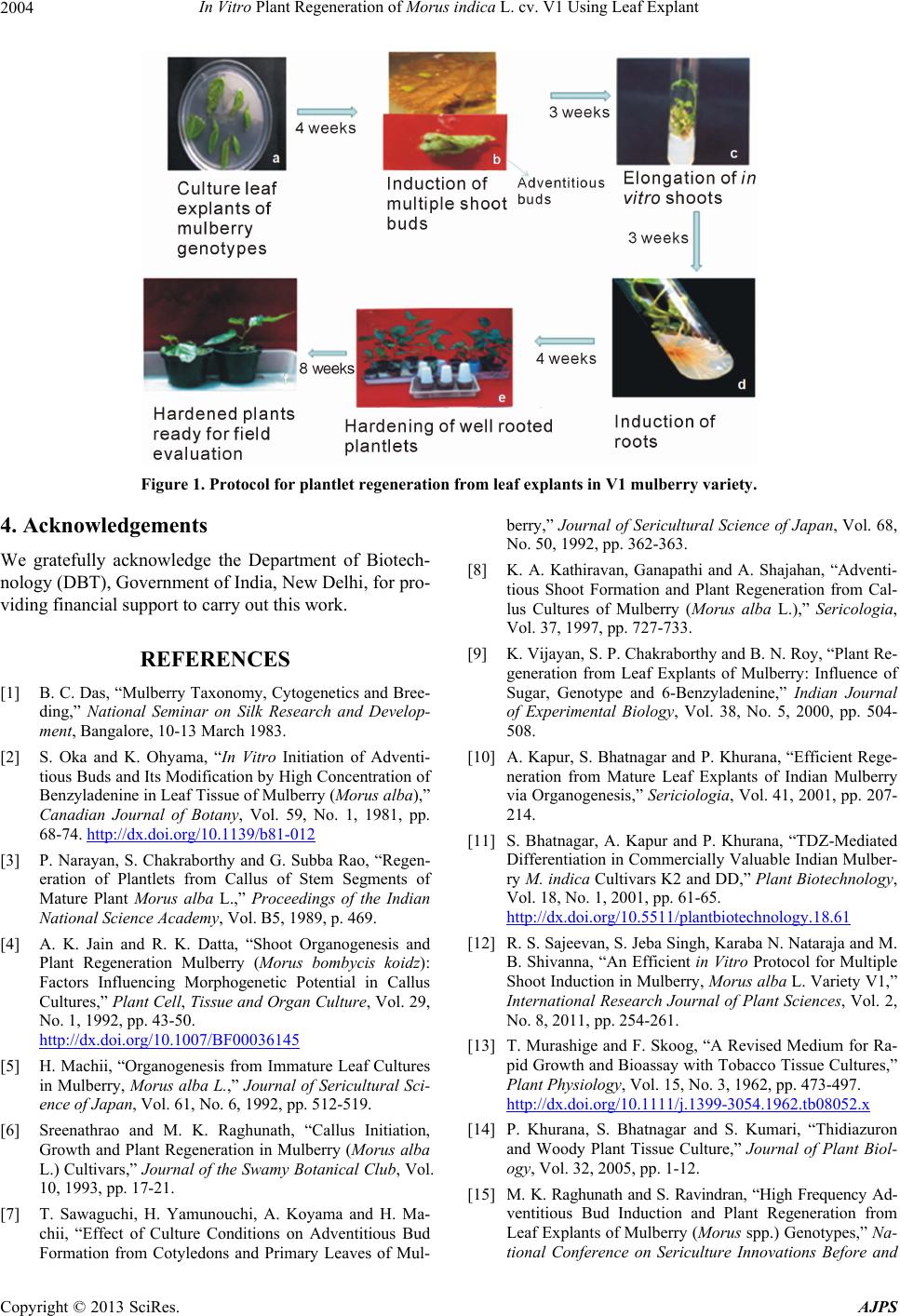 In Vitro Plant Regeneration of Morus indica L. cv. V1 Using Leaf Explant 2004 Figure 1. Protocol for plantlet regeneration from leaf explants in V1 mulberry variety. 4. Acknowledgements We gratefully acknowledge the Department of Biotech- nology (DBT), Government of India, New Delhi, for pro- viding financial support to carry out this work. REFERENCES [1] B. C. Das, “Mulberry Taxonomy, Cytogenetics and Bree- ding,” National Seminar on Silk Research and Develop- ment, Bangalore, 10-13 March 1983. [2] S. Oka and K. Ohyama, “In Vitro Initiation of Adventi- tious Buds and Its Modification by High Concentration of Benzyladenine in Leaf Tissue of Mulberry (Morus alba),” Canadian Journal of Botany, Vol. 59, No. 1, 1981, pp. 68-74. http://dx.doi.org/10.1139/b81-012 [3] P. Narayan, S. Chakraborthy and G. Subba Rao, “Regen- eration of Plantlets from Callus of Stem Segments of Mature Plant Morus alba L.,” Proceedings of the Indian National Science Academy, Vol. B5, 1989, p. 469. [4] A. K. Jain and R. K. Datta, “Shoot Organogenesis and Plant Regeneration Mulberry (Morus bombycis koidz): Factors Influencing Morphogenetic Potential in Callus Cultures,” Plant Cell, Tissue and Organ Culture, Vol. 29, No. 1, 1992, pp. 43-50. http://dx.doi.org/10.1007/BF00036145 [5] H. Machii, “Organogenesis from Immature Leaf Cultures in Mulberry, Morus alba L.,” Journal of Sericultural Sci- ence of Japan, Vol. 61, No. 6, 1992, pp. 512-519. [6] Sreenathrao and M. K. Raghunath, “Callus Initiation, Growth and Plant Regeneration in Mulberry (Morus alba L.) Cultivars,” Journal of the Swamy Botanical Club, Vol. 10, 1993, pp. 17-21. [7] T. Sawaguchi, H. Yamunouchi, A. Koyama and H. Ma- chii, “Effect of Culture Conditions on Adventitious Bud Formation from Cotyledons and Primary Leaves of Mul- berry,” Journal of Sericultural Science of Japan, Vol. 68, No. 50, 1992, pp. 362-363. [8] K. A. Kathiravan, Ganapathi and A. Shajahan, “Adventi- tious Shoot Formation and Plant Regeneration from Cal- lus Cultures of Mulberry (Morus alba L.),” Sericologia, Vol. 37, 1997, pp. 727-733. [9] K. Vijayan, S. P. Chakraborthy and B. N. Roy, “Plant Re- generation from Leaf Explants of Mulberry: Influence of Sugar, Genotype and 6-Benzyladenine,” Indian Journal of Experimental Biology, Vol. 38, No. 5, 2000, pp. 504- 508. [10] A. Kapur, S. Bhatnagar and P. Khurana, “Efficient Rege- neration from Mature Leaf Explants of Indian Mulberry via Organogenesis,” Sericiologia, Vol. 41, 2001, pp. 207- 214. [11] S. Bhatnagar, A. Kapur and P. Khurana, “TDZ-Mediated Differentiation in Commercially Valuable Indian Mulber- ry M. indica Cultivars K2 and DD,” Plant Biotechnology, Vol. 18, No. 1, 2001, pp. 61-65. http://dx.doi.org/10.5511/plantbiotechnology.18.61 [12] R. S. Sajeevan, S. Jeba Singh, Karaba N. Nataraja and M. B. Shivanna, “An Efficient in Vitro Protocol for Multiple Shoot Induction in Mulberry, Morus alba L. Variety V1,” International Research Journal of Plant Sciences, Vol. 2, No. 8, 2011, pp. 254-261. [13] T. Murashige and F. Skoog, “A Revised Medium for Ra- pid Growth and Bioassay with Tobacco Tissue Cultures,” Plant Physiology, Vol. 15, No. 3, 1962, pp. 473-497. http://dx.doi.org/10.1111/j.1399-3054.1962.tb08052.x [14] P. Khurana, S. Bhatnagar and S. Kumari, “Thidiazuron and Woody Plant Tissue Culture,” Journal of Plant Biol- ogy, Vol. 32, 2005, pp. 1-12. [15] M. K. Raghunath and S. Ravindran, “High Frequency Ad- ventitious Bud Induction and Plant Regeneration from Leaf Explants of Mulberry (Morus spp.) Genotypes,” Na- tional Conference on Sericulture Innovations Before and Copyright © 2013 SciRes. AJPS  In Vitro Plant Regeneration of Morus indica L. cv. V1 Using Leaf Explant 2005 Beyond, CSR&TI, Mysore, 28-29 January 2011, p. 4. [16] M. K. Raghunath, S. Lal and P. Khurana, “In Vitro Plant Regeneration from Different Explants of Elite Mulberry (Morus Sp.) Genotypes: AR-12, DD and S-13,” Bangla- desh Journal of Sericology, Vol. 2 & 3, 2009, pp. 31-40. [17] M. Hossain, S. M. Rahman, A. Zaman, Jorader and R. Is- lam, “Micropropagation of Morus laevigata Wall. From Mature Trees,” Plant Cell Reports, Vol. 11, No. 10, 1992, pp. 522-524. http://dx.doi.org/10.1007/BF00236269 [18] S. Bhatnagar, M. Das and P. Khurana, “Rapid in Vitro TDZ-Mediated Micropropagation of M. Indica C176 and C776 through Axillary Buds,” Indian Journal of Sericol- ogy, Vol. 41, 2002, pp. 80-83. Copyright © 2013 SciRes. AJPS |