

Paper Menu >>
Journal Menu >>
 American Journal of Plant Sciences, 2013, 4, 1998-2000 http://dx.doi.org/10.4236/ajps.2013.410248 Published Online October 2013 (http://www.scirp.org/journal/ajps) On the Origin of the Common Bean (Phaseolus vulgaris L.) Andrés J. Cortés1,2 1Departamento de Biologia, Universidad de los Andes, Bogotá, Colombia; 2Department of Plant Ecology and Evolution, Evolution- ary Biology Centre, Uppsala University, Norbyvägen 18D, Uppsala, Sweden. Email: [email protected] Received June 8th, 2013; revised July 9th, 2013; accepted August 1st, 2013 Copyright © 2013 Andrés J. Cortés. This is an open access article distributed under the Creative Commons Attribution License, which permits unrestricted use, distribution, and reproduction in any medium, provided the original work is properly cited. ABSTRACT Phylogeographic methods provide the tools to accurately access the geographic origin and diversification of crop spe- cies. In the present commentary, I urge the common bean community to face those methods and a tree-thinking mental- ity with regards to the long standing debate of th e origin of common bean. Such efforts will ultimately bring back inter- est into wild bean studies and reinforce th e uniquen ess of this species as a system to study diversification , domesticatio n and adaptive processes across the two most diverse hotspots in the world. Keywords: Phylogeography; Domestication; Bottlenecks; Outgroups; Andes; Mesoamerica 1. Introduction Wild bean is thought to have diversified in South and Central America, after which domestication in the south- ern and northern ends of each region gave independent origin to the Andean and Mesoamerican domesticates. Additional structure within each of these genepools ac- counts for up to 10 different races. Both genepools fol- lowed parallel pathways of dissemination through the world, generating new secondary centers of diversity in Africa and Asia [1]. Several recent works defended a Mesoamerican origin of the common bean [2,3]. This was mainly based on the extensive diversity and population structure within the Mesoamerican genepool, and the signature of predomes- tication bottlenecks in the south of the Andes detected in 5 genes across 102 wild accessions. However, these two main lines of evidence are not on ly circumstantial, bu t do not exclude an Andean origin of common bean. Exten- sive population structure does not necessarily correlate with origin, and may also be the result of widespread lo- cal adaptation and unparalleled genetic drift across the Mexican and Guatemalan valleys [1,4]. Meanwhile, de- mographic bottlenecks in the south of the Andes may have occurred during colonization either from Mesoa- merica or from Ecuador and North Peru, and therefore do not exclude the possibility that the origin of common bean is in the latter region with the absence of strong bot- tle-necks during the north ern radiation. Several arguments against a phenetic approach, as the one that has been repeatedly applied to address the origin of beans, must also be considered. In the first place, there are no living ancestral populations or lineages because each one has had the same period of quasi-independent evolu- tion since divergence [5]. Therefore, in the absence of outgroups it is not possible to reconstruct ancestral char- acter states and areas. It will only be possible to identify ancestral alleles, and to differentiate the two competitive hypotheses regarding the origin of common bean if the previous surveys had been combined with a set of care- fully chosen Phaseolus species (Figure 1). This would pro- vide a rooted cladogram and an appropriate phylogenetic inference. Nowadays, wild bean s are still bein g discover- ed [6] and further expeditions in the west slopes of the Ecuadorian and Northern and Central Peruvian Andes are urgently required. A clearer picture of the distribution of the wild accessions is ess ential to carry out a n accurate re- construction of ancestral areas. Furthermore, archeologi- cal clues are much older in the Andes than in Mesoame- rica, and therefore its inclusion is crucial for an accurate reconstruction of areas. Secondly, the genetic proximity between some accessions from the south of the Andes and some from central Mexico may not be due to incomplete linage sorting of ancestral polymorphism, but instead to homoplasy or ancestral introgression [7]. The first option seems particularly plausible in the previous works be- cause they did not use character-state tree reconstruction methods, but distance methods; even though the former methods are the ones that incorporate the nucleotide mu- tation processes into the phylog enetic inference [8]. Copyright © 2013 SciRes. AJPS 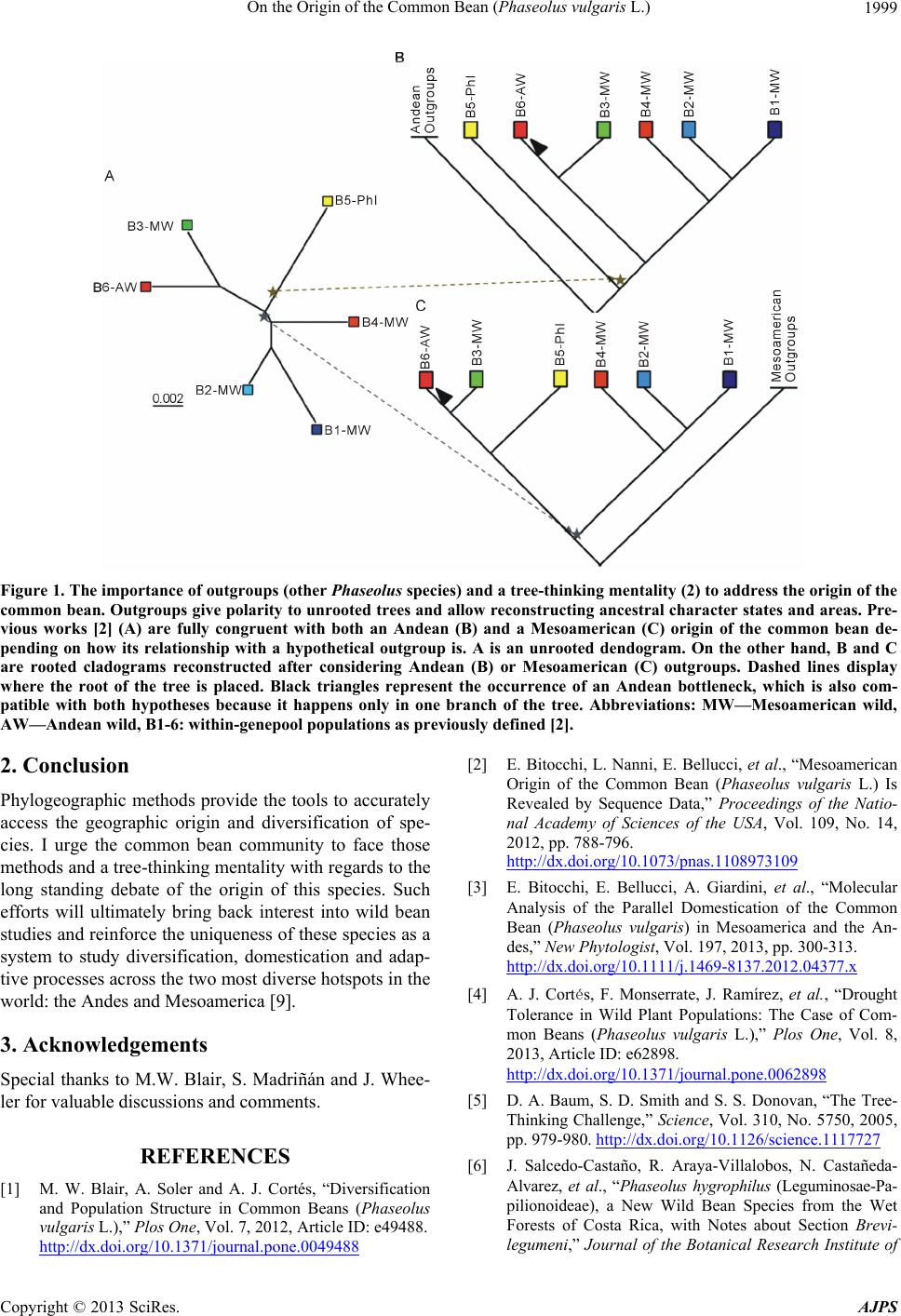 On the Origin of the Common Bean (Phaseolus vulgaris L.) 1999 Figure 1. The importance of outgroups (other Phaseolus species) and a tree-thinking mentality (2) to address the origin of the common bean. Outgroups give polarity to unrooted trees and allow reconstructing ancestral character states and areas. Pre- vious works [2] (A) are fully congruent with both an Andean (B) and a Mesoamerican (C) origin of the common bean de- pending on how its relationship with a hypothetical outgroup is. A is an unrooted dendogram. On the other hand, B and C are rooted cladograms reconstructed after considering Andean (B) or Mesoamerican (C) outgroups. Dashed lines display where the root of the tree is placed. Black triangles represent the occurrence of an Andean bottleneck, which is also com- patible with both hypotheses because it happens only in one branch of the tree. Abbreviations: MW—Mesoamerican wild, AW—Andean wild, B1-6: within-genepool populations as previously de fine d [2]. 2. Conclusion Phylogeographic methods provide the tools to accurately access the geographic origin and diversification of spe- cies. I urge the common bean community to face those methods and a tree-thinking mentality with regards to the long standing debate of the origin of this species. Such efforts will ultimately bring back interest into wild bean studies and reinforce the uniqueness of these species as a system to study diversification, domestication and adap- tive processes across the two most diverse hotspots in the world: the Andes and Mesoamerica [9]. 3. Acknowledgements Special thanks to M.W. Blair, S. Madriñán and J. Whee- ler for valuable discussions and comments. REFERENCES [1] M. W. Blair, A. Soler and A. J. Cortés, “Diversification and Population Structure in Common Beans (Phaseolus vulgaris L.),” Plos One, Vol. 7, 2012, Article ID: e49488. http://dx.doi.org/10.1371/journal.pone.0049488 [2] E. Bitocchi, L. Nanni, E. Bellucci, et al., “Mesoamerican Origin of the Common Bean (Phaseolus vulgaris L.) Is Revealed by Sequence Data,” Proceedings of the Natio- nal Academy of Sciences of the USA, Vol. 109, No. 14, 2012, pp. 788-796. http://dx.doi.org/10.1073/pnas.1108973109 [3] E. Bitocchi, E. Bellucci, A. Giardini, et al., “Molecular Analysis of the Parallel Domestication of the Common Bean (Phaseolus vulgaris) in Mesoamerica and the An- des,” New Phytologist, Vol. 197, 2013, pp. 300-313. http://dx.doi.org/10.1111/j.1469-8137.2012.04377.x [4] A. J. Cortés, F. Monserrate, J. Ramírez, et al., “Drought Tolerance in Wild Plant Populations: The Case of Com- mon Beans (Phaseolus vulgaris L.),” Plos One, Vol. 8, 2013, Article ID: e62898. http://dx.doi.org/10.1371/journal.pone.0062898 [5] D. A. Baum, S. D. Smith and S. S. Donovan, “The Tree- Thinking Challenge,” Science, Vol. 310, No. 5750, 2005, pp. 979-980. http://dx.doi.org/10.1126/science.1117727 [6] J. Salcedo-Castaño, R. Araya-Villalobos, N. Castañeda- Alvarez, et al., “Phaseolus hygrophilus (Leguminosae-Pa- pilionoideae), a New Wild Bean Species from the Wet Forests of Costa Rica, with Notes about Section Brevi- legumeni,” Journal of the Botanical Research Institute of Copyright © 2013 SciRes. AJPS  On the Origin of the Common Bean (Phaseolus vulgaris L.) 2000 Texas, Vol. 5, 2011, pp. 53-65. [7] A. J. Cortés, C. Chavarro and M. W. Blair, “SNP Marker Diversity in Common Bean (Phaseolus vulgaris L.),” Theoretical and Applied Genetics, Vol. 123, No. 5, 2011, pp. 827-845. http://dx.doi.org/10.1007/s00122-011-1630-8 [8] S. Whelan, P. Liò and N. Goldman, “Molecular Phyloge- netics: State-of-the-Art Methods for Looking into the Past,” Trends in Genetics, Vol. 17, No. 5, 2001, pp. 262- 272. http://dx.doi.org/10.1016/S0168-9525(01)02272-7 [9] N. Myers, R. A. Mittermeier, C. G. Mittermeier, et al., “Biodiversity Hotspots for Conservation Priorities,” Na- ture, Vol. 403, 2000, pp. 853-858. http://dx.doi.org/10.1038/35002501 Copyright © 2013 SciRes. AJPS |