

Paper Menu >>
Journal Menu >>
 Communications and Network, 2013, 5, 618-624 http://dx.doi.org/10.4236/cn.2013.53B2111 Published Online September 2013 (http://www.scirp.org/journal/cn) Copyright © 2013 SciRes. CN BISTRO: BitTorrent Based on Space-Time Trade-Off Roanna Lun1, Ye Zhu1, Huirong Fu2 1Departmentof Electr ical and C omputer Engi neering, C leveland State University, Clevelan d, USA 2Department of Computer Science and Engineering, Oakland University, Rochester, USA Email: r.lun@csuohio.edu, [email protected], [email protected] Received July 2013 ABSTRACT Due to the content bundling and the dramatic increase of content size, the download performance in peer-to-peer net- works has become a research focus again recently. In this paper, we propose a novel approach to improve the download performance based on the classical space-time trade-off. With the approach, a peer can speed up local downloads in peer-to-peer networks by contributing a portion of local hard disks for the content distribution in peer-to-peer networks. The contribution can bring performance improve ment to each peer following the approach and in the meantime improve the overall content distribution performance in a peer-to-pe er net work. Based o n the approach, we propose BISTRO, a BitTorrent based on space-time trade -off. The BISTRO is compatible with the vanilla BitTorrent. Our extensive expe- riments show that BISTRO can significantly reduce the download time. Keywords: Peer-to-Peer Networking; BitTorrent 1. Introduction According to the recent study [1-3], the majority of file sharing through peer-to-peer networks is adopting the approach called as content bundling. With the content bundling method, publishers can combine multiple re- lated files s uch as movies of the same genre, episodes of one TV series, and disc images of different flavors of Linux OS and distribute the bundled content in a single large swarm. A user in the swarm may choose one or more files of interest to her in the bundled content to download [3]. In co mpariso n with d is tr ibuting o ne sin gle file through a much smaller swarm, the c ontent b undli ng method can greatly increase the content availability es- pecially for unpopular content [1,2]. In the meant i me, t he size of the content distributed through peer-to-peer net- works is increasing significantly due to the popularity of high-definition multimedia content. Because of the in- crease of the content size in coupling with the content bundling method, the content distribution performance of peer-to-peer networks has become a research focus again. In this paper we propose a new approach to improve the do wnlo ad per formance of t he co ntent dis trib ution with the content bundling method through peer-to-peer net- works. The main idea of the approach originates from the classical space-time trad e-off [4]. In algorithm researches, the tradeoff can be used to reduce the time to solve a problem at the cost of the space efficiency, i.e., more memory or more storage consumption. As the storage becomes cheaper, thanks to Moore’s Law, the peers in peer-to -peer networks have more disk space that can be used to trade off the time of download- ing co ntent . In the new approach, a peer in a swarm con- tributes a portion of local hard disk for the content dis- trib utio n eve n whe n the pee r is no t downloading any file. The peer can benefit from the blocks in the contributed storage since these file blocks can be used to exchange back file blocks needed by the peer when the peer is in the downloading phase. Our major contributions are summarized as follows: We propose a novel approach to improve the perfor- mance of content distribution through peer-to-peer net- works. The approach is based on the classical space- time trade-off. We are particularly interested in improving the per- formance of the Bit Torrent protocol due to its do- mina nce in peer-to-peer networks. We develop Bit- Torrent based on space-time trade-off (BISTRO) with the new approach. We verify the new approach with extensive experi- ment s on BISTRO. Our experiments show that the new approach can significantly speed up content dis- tribution, i.e., and reduce the do wnload time. The rest of the paper is organized as follows: Section 2 defines the problem and briefly introduces the BitTorrent protocols. The detail of the new approach is described in Section 3. We evaluate the performance of BISTRO with extensive experiments in Section 4. Section 5 reviews  R. LUN ET AL. Copyright © 2013 SciRes. CN 619 related works. We discuss the approach and outline the future work in Section 6. We conclude the paper in Sec- tion 7. 2. Problem Definition The goal of this paper is to improve the download per- formance for peers joining content distribution with the content bundling method. We are particularly interested in BitTo rrent due to its do minance in content distr ibution through peer-to-peer networks: 1) More than 79% of In- ternet peer-to-peer bandwidth is used by BitTorrent [5]. 2) The estimated number of monthly BitTorrent users is more t han a quar ter bill ion, whi ch is more than the num- ber of active users of YouTube and Facebook combined [6]. First we would li ke to revie w fundamentals of BitT or- rent related to our approach. BitTorrent allows Internet users (peers) who are intereste d in do wnloading the sa me content to form a network (swarm). In a swarm, peers can download and upload from each other simultaneous- ly. To share a file or bundled files, a torrent file t hat con- tains metadata about the shared files must be created. The content distribution is coordinated by a tracker spe- cified in the torrent file. To join the swarm, a peer first obtains the tracker’s URL in the torrent file, and then connects to the tracker to ask for other peers’ information. Periodically, peers connect to the tracker to provide their downloading status. The tracker also lets peers share in- formation. In BitTorrent, a large file is divided into smaller file blocks of a f ixed size for distribution. T he typical siz e of a file block is 256 KB. Once a peer completely receives a new block of the file, it becomes a possible provider of that block for other peers immediately. Each peer main- tains the status of each file block which indicates whether the file block is available for uploading or not. After a file block is completely downloaded, the status of that block will be marked as available for uploading to other peers. The file block statu s is communicated a mon g peers thro ugh BITF IELD messa ge [7]. One of the most important policies in the BitTorrent protocol is the tit-for-tat incentive policy, which is de- signed to prevent free riding. By the tit-for-tat policy, a peer with a low ratio of the upload rate versus the do wn- load rate is choked by data providers. Once the upload activities increased, meaning that the ratio is going up, the peer gets unchoked. Then the peer can continue to download desired file blocks. In other words, more upl- oad contribution made by a peer can bring the peer more file blocks to download. We believe a new approach to improve the download performance s hould sati sfy the follo wing require ments: 1) The new app roach shoul d be c ompatib le wi th curr ent Bit- Torrent protocols because of the huge user base. In other words, peers adopting the new approach should be able to exchange file blocks with vanilla BitTorrent peers according to the tit-for-tat policy and help content distri- bution in a swarm consisting of both vanilla BitTorrent peers and the peers adopting the new approach; 2) The new approach should bring in extra incentives to moti- vate peers to adopt the new approach. Otherwise no peers will be interested in adopting the new approach. 3. BISTRO: BitTorrent Based on Space-Time Trade-Off In this section, we describe the approach based on the space-time trade-off and present BISTRO. We begin the section with an overview of the approach and then pro- ceed with the details of BISTRO. The rationale behind the new approach and the incentives for peers to use the new approach are introduced at the end of the section. 3.1. Overview The novel approach to improve the download perfor- mance in peer-to-peer networks is based on the classical space-time trade-off, which is often used to speed up program execution at the cost of increased memory usage or storage usage in algorithm researches. We extend the idea to the peer-to-peer networks. To speed up local downloading, a peer can contribute a portion of the local hard disk to the content distribution. The storage contri- buted by the peer can increase the local download speed since more file blocks, including file blocks in the con- tributed storage can be used for exchanging desired file blocks. A BISTRO peer can be in one of the two phases: the dormant phase and the download phase. In the dormant phase, a peer is not downloading any desired files. In- stead the peer is simply participating in the content dis- tribution and filling the local storage contributed to the conte nt di str ibuti o n. In t he d or mant p hase, wh en the co n- tribu ted stora ge is fu ll, some re place ment me thods ar e used to optimize the storage. When the peer becomes inter- ested in downloading some files in the bundled content, such as the next TV episode in a bundle of TV series, it changes into the download phase. During the download phase, the file blocks in the contributed storage can be used to exchange desired file blocks with other peers. The details of the BISTRO are described below. 3.2. Design of BISTRO In this section, we first describe the preliminaries includ- ing storage configurations and then describe the details of the dormant phase and the download phase. To avoid unnecessary repeating of t he original BitTorrent protoco l, we focus on the difference between BISTRO and the  R. LUN ET AL. Copyright © 2013 SciRes. CN 620 vanilla BitTorrent. 1) Preliminaries: In this paper, we assume the content files are bundled. A peer joining the distribution of the bundled content may select one or more files in the con- tent bundle to download [3]. Each peer has a portion of local disk space allocated for use by BISTRO to speed up local downloads. In this paper, we call the portion of the local disk space as the contributed storage. The storage is divided into two parts: the content part and the management part. The content part is used to store file blocks and it takes the majority of t he space al located as the contributed stora ge. The con- tent part is divided into blocks and the size of each block in the content part is the same as the size of file blocks exchanged among BitTorrent peers so that each block of the content part can be used to store one file block. Since most BitTo rrent swarms use 256 KB as the block size so the size of the block in the contributed storage is set to 256 KB by default1. The management part is used to store information required to manage the storage. For example, the information needed by the block replace- ment method is kept in the management pa rt. 2) Dormant Phase: In the dormant phase, a peer has no desire to download a file from a swarm yet. The peer joins the swarm simply to participate in the content dis- tribution to fill and optimize its contributed storage. So that later, the file blocks in the storage can be used by the peer to maximize the return, i.e., exchange back its de- sired file blocks according to the tit-for-tat policy used by BitTorrent. The pre-filled storage is equivalent to the pre-calculated results stored in memory. In the classical time-space trade-off, the pre-calculated results are used to speed program execution. In BISTRO, the prefilled storage is used to speed up both local downloads and the content distribution to other peers. For the dormant phase we extend the vanilla BitTor- rent as follows: BITFIELD Message: A vanilla BitTorrent peer ex- changes the BITFIELD messages with other peers to an- nounce the file blocks that have already downloaded. A BISTRO peer will also announce the file blocks in its contributed storage so that other peers can download these file blocks in the contributed storage. Storage Management: When the storage is not full, a BISTRO peer simply stores downloaded file blocks in the contributed storage since these file blocks are not of interest by the peer in the dormant phase. But when the storage is full and new file blocks are downloaded, cer- tain blocks in the contributed storage may have to be replaced. Obviously the block replacement method is im- portant to the performance: 1) Because of the tit-for-tat policy, file blocks in the contributed storage are essen- tially bargain chips used to exchange back desired file blocks when the peer is in the download phase. So it is important for a peer to keep most useful barga in chips i n the contributed storage to speed up the file downloading in the do wnload p hase; 2) In the dormant phase, the peer has no interest in the blocks within the contributed sto- rage. But the file blocks held by the dormant peers affect the content distribution to other peers in the swarm. In this paper, we propose two storage replacement methods: Random Replacement: The peer randomly selects a file block in the contributed storage and replaces the file block with a newly downloaded file block. Least Frequently Requested (LFR): In the LFR me- thod, the least frequently requested, i.e., the most un- popular file blocks are replaced. To keep track of re- quests on each file block in the contributed storage, a request count associated with each file block is kept in the management part of the storage. The heuristic behind the met hod is that the most popular file blo cks are the most useful bargain chips to exchange back desired file blocks in the download phase. For different content distribution networks, the actual implementation of the dormant phase may vary in terms of participating in the content distribution without the desire to download a file. In some content distribution networks, it is possible for a peer to participate in the distribution passively as a cache node [8]. In other type of content distribution networks, a peer in the dormant phase has to send download requests to participate in the content distribution. For the second type of content dis- tribution networks, the peer in the dormant phase re- quests file blocks randomly or simple select a file ran- domly from the bundled content to download. In BISTRO, the second implementation method is used. The length o f the do rmant p hase depend s on whe n the peer beco mes interested in downloading files. So me peers may want to simply contributing the storage for content distribution so that they can use the file blocks in the storage to speed up their future download. Some peers may want to download desired files immediately after joining a BitTorrent swarm. 3) Download Phase: Whenever a BISTRO peer be- comes interested in downloading files in the swarm, the peer is changed into the download p hase. A BISTRO peer in the download phase acts largely the same as a regular peer in the vanilla BitTorrent. The ma- jo r differe nce is t hat from the begi nning o f the downlo ad phase, the peer has bargain chips, i.e., file blocks in the contributed storage. So when a BISTRO peer advertises the file blocks availab le for sharing, the BI TFIELD mes- sage also contains the availability of the file bloc ks i n the contributed storage. So that other peers can request and download the file blocks in the contributed storage. In the download phase, the contributed storage is not 1The block size in the contributed storage can be changed according to the change of the block size used by BitTorrent swarms. 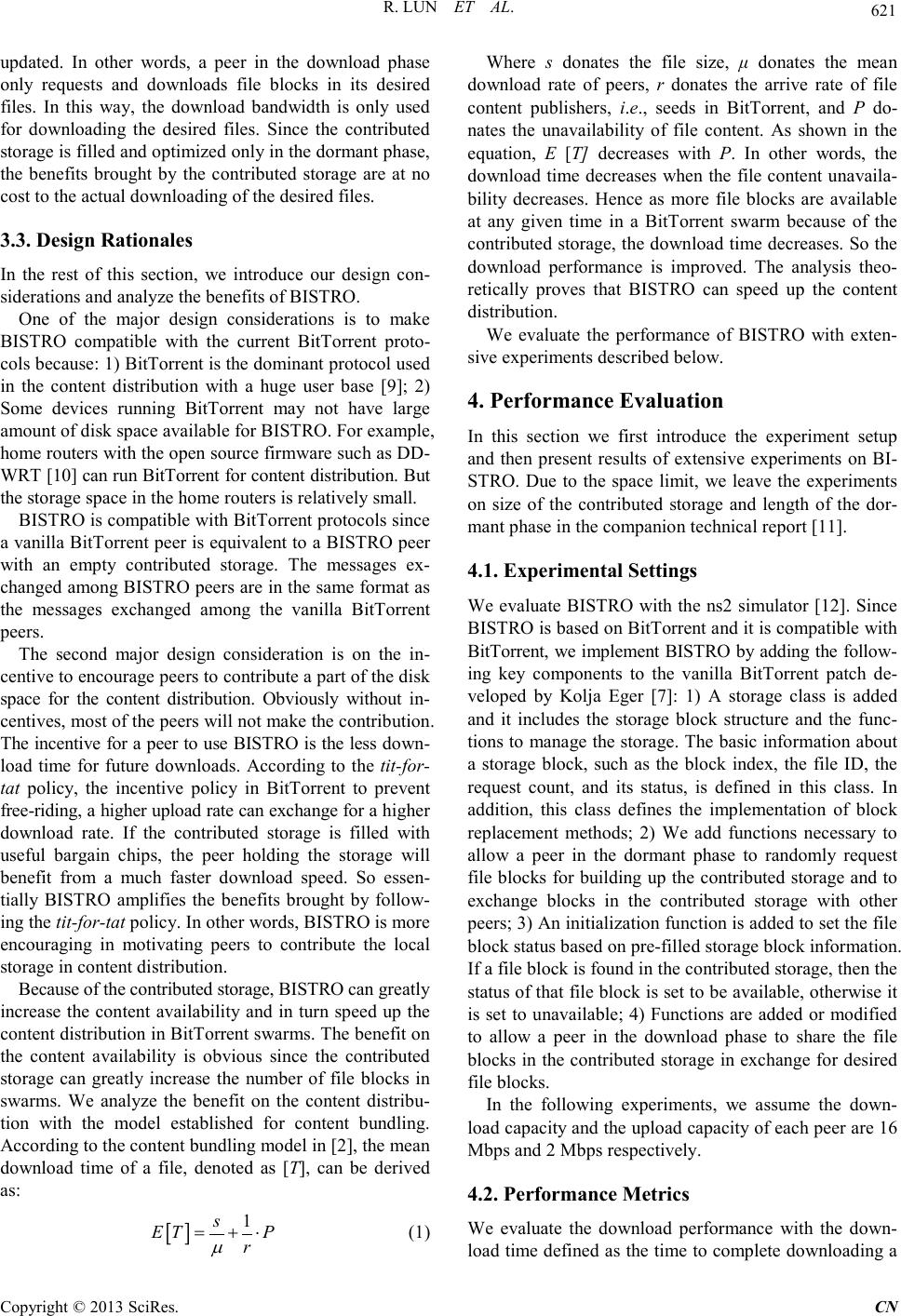 R. LUN ET AL. Copyright © 2013 SciRes. CN 621 updated. In other words, a peer in the download phase only requests and downloads file blocks in its desired files. In this way, the download bandwidth is only used for downloading the desired files. Since the contributed storage is filled and optimized only in the dormant phase, the benefits brought by the contributed storage are at no cost to the actual download ing of the desired files. 3.3. Design Rationales In the rest of this section, we introduce our design con- siderations and analyze the benefits of BISTRO. One of the major design considerations is to make BISTRO compatible with the current BitTorrent proto- cols because: 1) BitTorrent is the dominant protoc ol used in the content distribution with a huge user base [9]; 2) Some devices running BitTorrent may not have large amount of disk space available for BISTRO. For example, home routers with the open source firmware such as DD- WRT [10] can r un B itTo rrent for co ntent dist rib ution. But the storage space in the home routers is relatively small. BIST RO is compatible with B itT orrent proto cols since a vanilla BitTo rrent peer is equivalent to a BIST RO peer with an empty contributed storage. The messages ex- changed among BISTRO peers are in the same format as the messages exchanged among the vanilla BitTorrent peers. The second major design consideration is on the in- centive to encourage peers to contribute a part of the disk space for the content distribution. Obviously without in- centives, mo st of the p eers will not make the contribution. The incentive for a peer to use BISTRO is t he less down- load time for future downloads. According to the tit-for- tat policy, the incentive policy in BitTorrent to prevent free-ridi ng, a hig her up loa d ra te can e xc han ge fo r a higher download rate. If the contributed storage is filled with useful bargain chips, the peer holding the storage will benefit from a much faster download speed. So essen- tially BISTRO amplifies the benefits brought by follow- ing the tit-for-ta t policy. In other words, BISTRO is more encouraging in motivating peers to contribute the local storage in content distribution. Because of the contributed storage, BISTRO can greatly increase the content availability and in turn speed up the content distrib ution in BitT orrent swarms. T he benefit on the content availability is obvious since the contributed storage can greatly increase the number of file blocks in swarms. We analyze the benefit on the content distribu- tion with the model established for content bundling. According to the content bundling model in [2], the mean download time of a file, denoted as [T], can be derived as: [ ] 1s ET P r µ = +⋅ (1) Where s donates the file size, μ donates the mean download rate of peers, r donates the arrive rate of file content publishers, i.e., seeds in BitTorrent, and P do- nates the unavailability of file content. As shown in the equation, E [T] decreases with P. In other words, the download time decreases when the file content unavaila- bility decreases. Hence as more file blocks are available at any given time in a BitTorrent swarm because of the contributed storage, the download time decreases. So the download performance is improved. The analysis theo- retically proves that BISTRO can speed up the content distribution. We evaluate the performance of BISTRO with exten- sive experiments described below. 4. Performance Evaluation In this section we first introduce the experiment setup and then present results of extensive experiments on BI- STRO. Due to the space limit, we leave the experiments on size of the contributed storage and length of the dor- mant phase in the companion technical report [11]. 4.1. Experimental Settings We evaluate BISTRO with the ns2 simulator [12]. Since BIST RO is b ased on BitT orrent and it is co mpatible with BitTorrent, we implement BISTRO by adding the follow- ing key components to the vanilla BitTorrent patch de- veloped by Kolja Eger [7]: 1) A storage class is added and it includes the storage block structure and the func- tions t o manage t he stora ge. The b asic infor mation a bout a storage block, such as the block index, the file ID, the request count, and its status, is defined in this class. In addition, this class defines the implementation of block replacement methods; 2) We add functions necessary to allow a peer in the dormant phase to randomly request file blocks for building up the contributed storage and to exchange blocks in the contributed storage with other peers; 3) An initializatio n fun ction is added to set the file block status based on pre-filled storage bloc k in formation. If a fi le bl ock is found in the contributed storage, then the status of that file bloc k is set to be a vailable, otherwise it is set to unavailable; 4) Functions are added or modified to allow a peer in the download phase to share the file blocks in the contributed storage in exchange for desired file blocks. In the following experiments, we assume the down- load capacity and the upload capacity of each peer are 16 Mbps and 2 Mbps respectively. 4.2. Performance Metrics We evaluate the download performance with the down- load time defined as the time to complete downloading a  R. LUN ET AL. Copyright © 2013 SciRes. CN 622 file or files. The performance metric used to benchmark one network is the average download time of all peers participa ting in the BitTorrent network. Since we do not study effectiveness of any incentive methods in BitTor- rent in this paper, we assume peers are not required to stay in networ k af te r c ompleting downloading all data. As described in Section 3, a BISTRO peer has no de- sire to download any file and the peer is simply contri- buting a por tion of local disk to participate in the content distr ib ut io n p ass i vel y. So the l ength of t he d o rma nt p has e is not a part of download time. In the download phase, a BISTRO peer is actively downloading a desired file so the download time is the length of the download phase for a BISTRO peer. 4.3. Size of the Contributed Storage In this set of experiments, we investigate the download performance with different content file sizes. Among the 100 peers included in this set of experiments, half o f the peers are BISTRO peers with 50 MB or 500 MB contri- buted storage and the other half are vanilla BitTorrent peers. We vary the file size from 100 MB to 1 GB. Fig- ure 1 shows the experiment results with 50 MB and 500 MB contributed storage. From Figure 1, we can observe: 1) The average download time of BISTRO peers in a swarm consisting of half BISTRO peers and half vanilla peers is cons istently 30% less than the do wnload time of peers in the BitTorrent swarm consisting of only vanilla BitTorrent peers. It means BISTRO can greatly reduce the download time; 2) Even the download time taken by the vanilla peers in the swarm with half BISTRO peers and ha l f va nil la pe er s i s 2 0% les s tha n the d ownloa d t ime taken by the peers in the BitTorrent swarm consisting of only vanilla BitTorrent peers. This observation means BISTRO can also help content distribution to vanilla peers; 3) The difference between the download time of BISTRO peers using any of the two block replacement methods and t he download ti me of the vanilla BitTor rent peers is increasing with the file size. In other words, the performance improvement over the vanilla BitTorrent increases with the file size; 4) The performance of BI- STRO peers with the LFR replacement method is close to the performance of BISTRO peers with the random replacement method for small file size. When the down- load file is larger than 700 MB, the LRF replacement methods outperform the random replacement methods. 4.4. Number of Peers In this set of experiments, we study the performance of BISTRO with different swarm sizes, i.e., different num- ber of peers. Figure 2 shows the results on the random replacement method and the LFR replacement method. (a) (b) Figure 1. D ownload Time vs. Download File S ize. (a) (b) Figure 2 . D ownload Time vs. Number of Peers .  R. LUN ET AL. Copyright © 2013 SciRes. CN 623 From these two figures, we again observe the large per- formance improvement of BISTRO over the vanilla Bit- Torrent. Figure 2 also shows that the performance im- provement increases with the number of peers. In summary, the experiment results described above indicate that BISTRO can significantly improve the down- load performance. T he performance improvement brought by BISTRO is consistently more than 30%. Our experi- ments also show that a relatively small contributed sto- rage can bring signi fi cant performance impro vement. 5. Related Work Since its debut in 2001, BitTorrent, the most popular peer-to-peer file sharing protocol, has attracted a signifi- cant amount of researches on its performance. In [13] the improvement of download performance is achieved by collaborative download mechanism. The mechanisms presented in [14,15] have shown that cooperation be- tween peers can also reduce peer’s download time. The approaches of utilizing localization among peers for re- ducing overlay traffic and improving performance were proposed in [16,17]. BISTRO improves the download performance with the contributed storage to trade the local storage for faster download speed. Lee et al. [8] proposed to increase content availability in multi-swarm BitTorrent networks by caching. The pro- posed approach requires significant changes to the Bit- Torrent protocols to support the exchange of file blocks in multiple swarms and it involves a large amount of messages exchanged between multiple trackers. Caching at the ISP level of peer-to-peer networks is proposed by Lehrieder et al. [18] to improve the perfor- mance of content distribution. The ISP-level approach decreases the inter-ISP traffic by storing popular contents at the ISP level so that the remote peers do not have to download them from peers within the ISP. BISTRO im- proves the download performance at the peer level and it is compatible with the vanilla BitTor rent protocols. To the best of our knowledge, BISTRO is the first at- tempt to speed up downloads in peer-to-peer ne twor ks by contributing the local storage space based on the space- time trade-off. 6. Discussion and Future Work The experiments show that BISTRO can greatly reduce the download time when in comparison with the vanilla BitTorrent. But the LRF replacement method used in BISTRO is not significantly better than the random re- placement method. Similar results have been reported on cache design in computer architecture [19]: The Least- Recently Used (LRU) method used for cache block re- placement is only about 1% better than random replace- ment method. Alt houg h the pe rfor ma nce res ults fro m our e xperi ments are consistent with the benchmark results reported in [19] in terms of the difference between the LRF/LRU re- placement methods and the random replacement methods, we believe it is possible to further improve BISTRO’s performance by improving the replacement method. We plan to make more information such as request trend available to replacement methods. We will compare dif- ferent replacement methods in terms of performance gain and processing overhead on the additional information. We also plan to establish a theo retica l model to pr edict the performance of the approach based on the space-time trade-off. The model can be used by peer-to-peer net- work users to determine the tradeoff between the down- load performance and the amount of local storage con- tributed for content distribution. 7. Conclusion In this paper we present a novel approach to improve peers’ do wnload per formance based on the class ical space- time trade-off. The experiment results have shown that the performance improvement over the vanilla BitTorrent is average 30% consistently with different tests. Given the popularity of the low-cost and high-capacity hard disks, we believe the new approach is very promising in practice. 8. Acknowledgements This work was supported in part by the US National Science Foundation (NSF) under grant No. 1144644. Any opinions, findings, conclusions, and recommendations in this paper are those of the authors and do not necessarily reflect the views of the funding agencies. REFERENCES [1] D. Menasche, G. Neglia, D. Towsley and S. Zilberstein, “Strategicreasoning about Bundling in Swarming Sys- tems,” International Conference on Game Theory for Networks, 2009, pp. 611-620. [2] D. S. Menasche, A. A. de Aragao Rocha, B. Li, D. F. Towsley and A. Venkataramani, “Content Availability and Bundling in Swar ming S ystems,” Proceedings of the ACM Conf er ence on Emerging Net w orking Experiments and Technology, 2009, pp. 121-132. [3] J. Han, S. Kim, T. Chung, T. T. Kwon, H.-C. Kim and Y. Choi, “Bundling Practice in Bittorrent: What, How, and Wh y,” Proceedings of the 12th ACM SIGMETRICS/ PERFORMANCE Joint International Conference on Measurement and Modeling of Computer Systems, 2012, pp. 77-88. [4] A. Levitin, “Introduction to the Design and Analys is of Algorithms, 3/E,” Addison-Wesley, 2012. [5] In ternetob s er vat ory.net, “Internet Status Report”.  R. LUN ET AL. Copyright © 2013 SciRes. CN 624 http://www.internetobservatory.net [6] A. Carr, “Bittorrent Has More Users Netflix and Hulu Combined-and Doubled”. http://www.fastcompany.com/1714001 [7] K. Eger, “Bittorrent in ns-2, Patch for NS-2.29”. https://sites.google.com/site/koljaeger/bittorrent-simulatio n-in-ns-2 [8] H. Lee, A. Nakao and J. Kim, “Multi-Swarm Collabora- tion for Improved Content Availability in Bittorrent-Like S ys t e m s ,” Proceedings of Consumer Communications and Networking Conference (CCNC), IEEE, 2011, pp. 565- 569. [9] A. M. Mateus and J. M. Peha, “Quantifying Global Transfers of Copyrighted Content Using Bittorrent”. http://papers.ssrn.com/abstract=1985737 [10] DD-WRT.co m, “Unleash Your Router”. http://www.dd-wrt.com [11] R. Lun, Y. Zhu and H. Fu, “Bistro: Bittorrent Based on Space-Time Trade off,” Department of Electrical and Comput er Engineerin g, Cleveland State Un iversity, Tech. Rep. 20130423a, 2013. http://academic.csuohio.edu/zhu_y/techreport/20130423a. pdf [12] ISI.ed u, “The Network Simulator NS 2”. http://www.isi.edu/nsnam/ns [13] N. Zeilemaker, M. Capota, A. Bakker and J. Pouwelse, “Tribler: Searchand Stream,” IEEE International Confe- rence on Peer-to-Peer Computing (P2P), 2011, pp. 164- 165. [14] C.-J. Wu, C.-Y. Li and J.-M. Ho, “Improving the Down- load Time of BitTorrent-Like Systems,” IEEE Interna- tional Conference on Communications, 2007, pp. 1125- 1129. [15] M. Lingjun, P.-S. Tsang and K.-S. Lui, “Improving File Distribution Performance by Grouping in Peer-to-Peer Networks,” IEEE Transactions on Network and Service Management, 2009, pp. 149 -162. [16] R. Rahman, M. Meulpolder, D. Hales, J. Pouwelse, D. Epema and H. Sips, “Improving Efficiency and Fairness in p2p Systems with Effort-Based Incentives,” IEEE In- ternational Conference on Communications (ICC), 2010, pp. 1-5. [17] C. Tian, X. Liu, H. Jiang, W. Liu and Y. Wang, “IM- PROVING BitTorrent Traffic Performance by Exploiting Geographic Locality,” Global Telecommunications Con- ference, 2008, pp. 1-5. [18] F. Lehrieder, G. Dan, T. Hossfeld, S. Oechsner and V. Singeorzan, “Cachi ng for Bittorrent-Like p2p Systems: A Simple Fluid Model and Its Implications,” IEEE/ACM Transactions on Networking, 2011. [19] J. L. Hennessy and D. A. Patterson, “Computer Architec- ture: A Quantitative Approach,” 3rd Editon, Morgan Kaufmann Publ ishe r s Inc., San Francisco, 2002. |