

Paper Menu >>
Journal Menu >>
 Communications and Network, 2013, 5, 611-617 http://dx.doi.org/10.4236/cn.2013.53B2110 Published Online September 2013 (http://www.scirp.org/journal/cn) Copyright © 2013 SciRes. CN QoS Aware Routing Protocol to Improve Packet Transmission in Shadow-Fading Environment for Mobile Ad Hoc Netw ork s T. Sangeetha1,2, K. K. Venk atesh1,2, Rajesh1,2, M. S. K. Manikandan1,3 1Department of Electronics and Communication Engineering, Madurai, India 2SACS MAVMM Engineering College, Madurai, India 3Thiagarajar College of Engineering, Madurai, India Email: [email protected], [email protected], smartrajesh9@gmail.com, [email protected] Received July 2013 ABSTRACT In Shadow-Fading model, it is difficult to achiev e higher Packet Delivery Ratio (PDR) due to the effects of large scale fading. The main goal of this paper is to improve the PDR in Shadow-Fading environment. To achieve this objective a protocol has been proposed that discovers backup routes for active sessions. These backup routes salvage the packets of active session in case of active route failure. It is found by research that proactively maintaining backup routes for ac- tive sessions can noticeably improve the PDR in Shadow-Fading environment. This protocol has been implemented with a mechanism of having backup routes and simulations have been conducted by using both node disjoint paths and link disjoint paths. Comparisons have been made between new protocol as well as AODV protocol. Simulation has been carried out using Network Simulator 2 (NS2) and the results show that the proposed QoSAR protocol exhibits higher PDR than AODV pro toco l in S hadow-fading environment. Keywords: Shadow-Fading Model ; Adhoc On Demand Distance Vector Routing (AODV); Backup Routes; Node Disjoint Paths; Link Disjoint Paths; Packet Delivery Ratio (PDR); Quality of Service Aware Routing (QoSAR) 1. Introduction In Mobile Ad h oc Netwo rks (MANE Ts), the prov ision of Quality of Service (QoS) guarantees is much more chal- lenging than in wireline networks, mainly due to node mobility, multihop communications, contention for chan- nel access, and a lack of central coordination. QoS guar- antees are required by most multimedia and other time or error sensitive applications. The difficulties in the provi- sion of such guarantees have limited the usefulness of MANETs. The QoS routing protocol is an integral part of any QoS solution since its function is to discover which nodes, if any, are able to serve applications’ requirements. Consequently, it also plays a crucial role in data session admission control. MANET applications are nowadays used in military and in emergencies, entertainments and outdoor industry environments where centralized administration is diffi- cult and costly to install [1]. Two nodes can communi- cate if they are within each other’s radio range, otherwise, routers if they are out of range, thereby it becomes mul- tipath routing. These networks have several salient fea- tures like rapid exploitation, robustness, flexibility, in- trinsic mobility support, highly dynamic network topol- ogy, the limited battery power of mobile devices, limited capacity and asymmetric or unidirectional lin ks [2]. Routing has always been one of the key challenges in Mobile Adhoc Networks and the challenge become more difficult when the network size increases [5]. Man y multi path routing protocols have been proposed for Ad Hoc Networks [3]. The routing protocols mainly are either ta- ble-driven (Proactive) or on-demand (reactive) routing protocols. Many hybrid routing protocols having the com- bination of functionality of both proactive as well as reac- tive routing protocol are also proposed. The proactive routing protocols periodically update the routing tables. When there is a request to forward message the routes are available in the routing table. On the contrary reac- tive routing search the route when there is a request for it. In the route search operation the reactive routing proto- cols, find multiple paths for the same source and destina- tion pair. One out of these multiple paths is selected to forward messages to the destination. The basic idea of On-Demand routing protocol is to  T. Sangeetha ET AL. Copyright © 2013 SciRes. CN 612 search route when it is required. Due to the mobility characteristic of MANET nodes and Dynamic Topology of the network, there are always multiple paths available between the sources to destination pair. The On Demand routing mechanism suggests using the route that is con- sidered best according to the required Quality of Service for the transmission, as in [3] hop count, is th e parameter for selecting a route. Once the best route out of searched route is chosen, the other routes are not given any con- siderations. But maintaining information about these ad- ditional routes will be more advantageous [2-4]. These additional routes can be used as backup routes in the events of link failures. In our paper the route failure can be overcome by disjointness for shadow fading environ- ments. This paper mainly focuses on the idea of finding mul- tiple paths (Multi-path) using Node Disjoint and Link Disjoint paths to improve Packet Delivery Ratio (PDR) of the network in Shadow fading environments. In addi- tion to this, the study also targets to evaluate the perfor- mances of AODV and QoS Aware Routing (QOSAR) protocols based on PDR and throughput. The organiza- tion of the rest of the paper is as follows. Section 2 QoS routing challenges in MANET. Section 3 briefs about the related work. Section 4 presents the discussion about pro- posed routing protocols and in Section 5 Result and Dis- cussion. 2. QoS Routing Challenges In MANET The design of efficient routing protocols is a critical issue for both wired and wireless networks. QoS-Aware Routing (QoSAR) protocols are facing the following design is- sues and constraints. These issues and constraints must be kept in mind while designing these protocols. 2.1. Node Mobility A MANET consists of mobile nodes. Nodes form the network only when they are in the communication range of each other. If they move out of range, link between the two nodes is broken. At times, f ailure of a single link can lead to the major network partitioning. Hence, mobility of the nodes is a major challenging issue for a stable network. Also, failure of certain links results in routing decisions to be made again. 2.2. Lack of Centralized Control The advantage of an ad-hoc network is that it is formed spontaneously without fixed architecture. Participant nodes or members can change their positions dynamically and can join or leave the network independently. Due to this nature of mobile ad-hoc networks it is difficult to pr ovide centralized control. Th us it is difficult to achieve efficient and fair Medium Access Control (MAC). Thu s those com- munication protocols are preferred which utilize only lo- cally available states and operate in a completely distri- buted manner [6]. This increases complexity and an al- gorithm’s overheads, as information about the participant nodes must be collected efficiently. There is no central entity to collect resour ce state information and admission decisions. Instead of central administration, nodes must make decisions based on available network resources, which may lead to potential inaccuracies. Due to lack of infrastructure the control and management of the network is distributed among the nodes. 2.3. The Unreliable Wireless Channels Due to interference from the other transmissions, mul- ti-path fading and shadowing effects the received signal are flat to bit errors. Such errors may lead to packets be- ing not decidable. However, persistent packet error can result in link failure, leading to re-routing, increased pack- et delay and cong estion and packet dropping [7 ]. 2.4. Multiple Paths To send data from a source to destination, a path has to be found beforehand. If a single path is established, send- ing all the traffic on it will deplete all the nodes faster. Also, in case of path failure, alternate path ac ts as a back- up path. Thus, establishing multiple paths aids not only in traffic engineering but also prevents faster network degradation. 2.5. Node-Disjoint Paths Multiple paths between the two nodes can be any link disjoint or node disjoint. Multiple link disjoint paths may have one node common among more than one path. Thus, traffic load on this node will be much higher than the other nodes of the paths. As a result, this node tends to die much earlier than the other nodes, primary to the paths to break down much earlier. Thus, the presence of node disjoint paths prolongs the network lifetime by reducing the energy fall rate of a particular node [8-9]. 3. Related Works This section briefs about the research work on the idea of mul ti-path routing in M obile Ad hoc ne t works. 3.1. Ad Hoc On-Demand Distance Vector Routing In this paper titled “Ad Hoc On-Demand Distance V ector Routing”, Feb- 1999, the authors C.E. Perkins and E.M. Royer have presented a distance vector algorithm that is suitable for use with ad-hoc networks. In AODV each Mobile Host operates as a specialized router, and routes are obtained as needed (i.e., on-demand) with little or no  T. Sangeetha ET AL. Copyright © 2013 SciRes. CN 613 reliance on peri odic a dverti sem ents . Their sim ulati on shows that on-demand route establishment with AODV is quick i.e., and accurate. AODV is a reactive routing protocol, meaning that it provides a route to a destination only on demand. Because AODV does not require global period- ic routing advertisements, the demand on the overall available bandwidth to the mobile nodes is substantially less than in those protocols that do necessitate such ad- vertisements. The main difference between AODV and DSR [5,11] stems out from the fact that DSR uses source routing in which data packet carries the complete path to be tra- versed. In AODV, the source node and the intermediate packet nodes store the next hop information correspond- ing to each flow for data packet transmission. In this protocol, the source node floods the Route Request pack- et in the network when a route is not available for the desired destination. When an intermediate node receives a request for route, it either forwards the request or pre- pares a reply for that route if it has a valid route to the destination. The validity of a route at the intermediate node is determined by comparing the sequence number at the intermediate node with the destination sequence num- ber in the Route Request packet. It may thus obtain mul- tiple routes to different destinations from a single Route Request. Multiple Route Reply packets in response to a single Route Request packet lead to heavy control over- head. AODV avoids the counting-to-infinity problem of other distance-vector protocols by using sequence num- bers on route updates. AODV has the ability for both unicast and multicast routing. But considering this case the AODV protocol not perform well in shadow fading environments its proved in our simulations. 3.2. QoS Routing Solutions In this paper titled “A Survey of QoS routing solutions for Mobile Ad Hoc Networks”, Apr-June 2007 the au- thors L. Hanzo II and R. Tafazolli have presented a QoS routing solutions that is suitable for use with ad-hoc networks [10,13]. This paper offers an up-to-date survey of most major contributions to the pool of QoS routing solutions for MANETs published. It includes a thorough overview of QoS routing metrics, bandwidth, factors affecting per- formance and classify the protocols found in the litera- ture. The aim of MAC protocol was to provide a basic best-effort level of service to ensure network operation in the face of an unpredictable and shared wireless commu- nication medium and to maintain a network topology view and routes in the face of failing links and mobile devices. QoS routing protocols play a major part in a QoS mechanism, since it is their task to find which nodes, if any, can serve an application’s requirements. Therefore, the QoS routing protocol also plays a major part in Ses- sion Admission Control (SAC), since that is dependent on the discovery of a route that can suppo rt the requ ested QoS. The majority of the solutions proposed in this litera- ture till now have focused on providing QoS based on two metrics: throughput and delay. Of these, the more common is throughput. This is most likely because as- sured throughput is somewhat of a “lowest common de- nominator” requirement; most voice or video applications require some level of guaranteed throughput in addition to their other constraints. The proposed protocol will im- prove the QoS based on the above two metrics. 4. Protocol Implem ent at ion In this section, we describe the implementation of pro- posed protocol, which exploits the knowledge of alterna- tive or backup routes to a source’s destination in order to improve the robustness of throughput-QoS assurances in the face of route failures. The main goal of this paper is to improve the Packet Delivery Ratio (PDR) in shadow fading environments. Thus by using the proposed proto- col Quality of Service (QoS) can be improved as much as possible. Hence in the following sections we are going to use the name as QoSAR (Qos Aware Routing) for the propose d protoc ol . In shadow fading environments, it is difficult to achieve high PDR only with the use of primary routes from source to destination. Idea behind QOSAR is to find multiple routes between source and destination. Hence it improves PDR as well as it gives solution to the route failures. In the newly proposed QoSAR protocol, once the ses- sion is ready to transmit, a backup route for that session must be found. We have considered two mechanisms to find multiple routes as follows: 1) Link Disjoint Paths 2) Node Disjoint Paths 4.1. Link Disjoint Paths Link disjoint paths are paths between sources to destina- tion which have no overlapping links. The backup route is selected in such a way they are “sufficiently disjoint” i.e., it includes no more than half of the links in the cur- rent/primary route [12]. In Figure 1 three paths (shown in red color) between sources to destination are called as link disjoint paths. If the primary and backup routes are selected in such a way that, they are sufficiently link disjo int then the route fail- ure is minimized. If a new backup route must be discovered, the search packet, referred to as RReq backup carries a copy of the session’s primary route. To avoid fully flooding the net- work with the RReq-backup, once the RReq backup has traveled at least half of the length of the primary route, 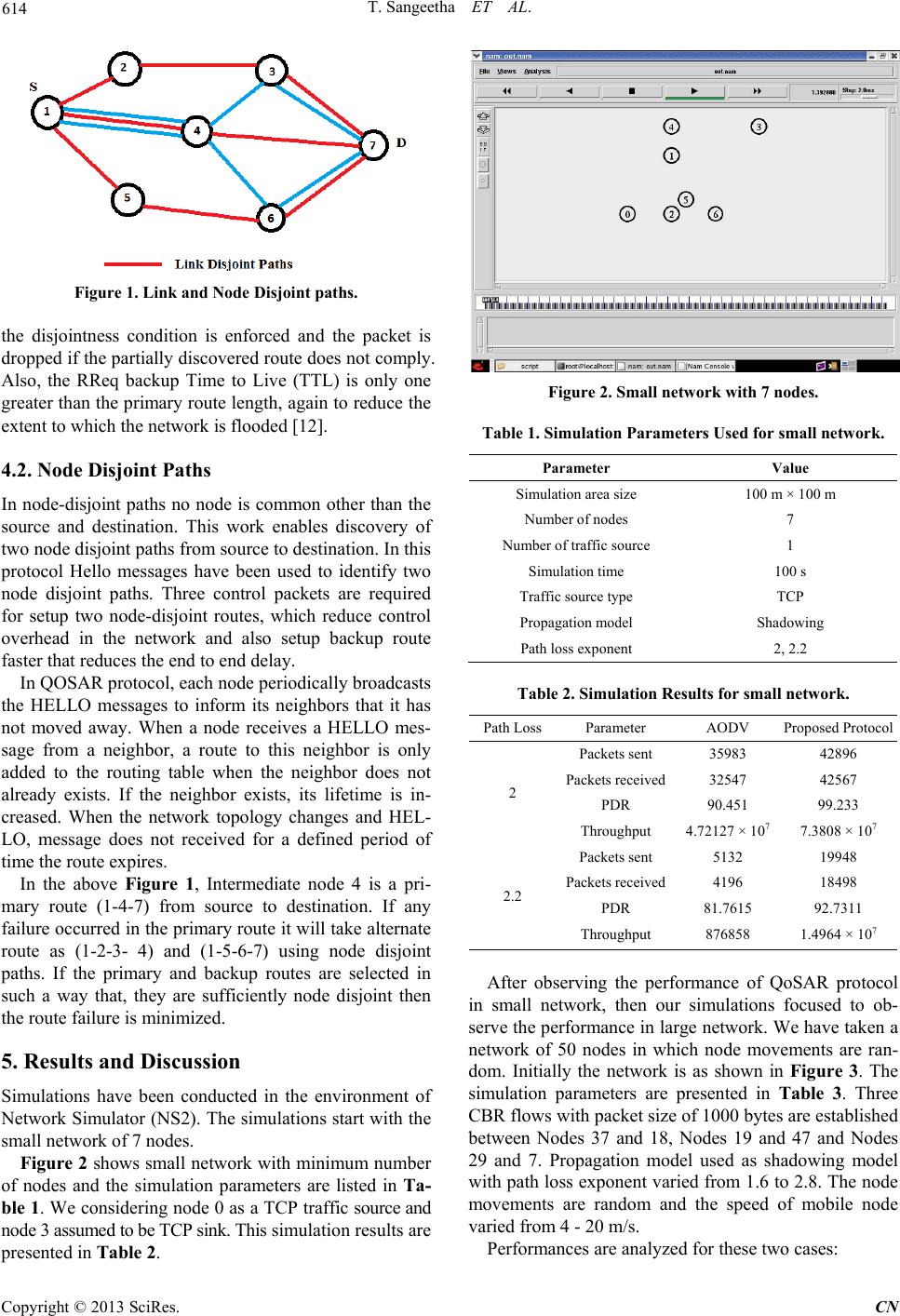 T. Sangeetha ET AL. Copyright © 2013 SciRes. CN 614 Figure 1. Link and Node Disj oint paths. the disjointness condition is enforced and the packet is dropped if the partially discovered route does not comply. Also, the RReq backup Time to Live (TTL) is only one greater than the primary route length, again to reduce the extent to which the network is flooded [12]. 4.2. Node Disjoint Paths In node-disjoint paths no node is common other than the source and destination. This work enables discovery of two node disjoint paths from source to destination. In this protocol Hello messages have been used to identify two node disjoint paths. Three control packets are required for setup two node-disjoint routes, which reduce control overhead in the network and also setup backup route faster that reduces the end to end delay. In QOSAR protocol, each node periodically broadcasts the HELLO messages to inform its neighbors that it has not moved away. When a node receives a HELLO mes- sage from a neighbor, a route to this neighbor is only added to the routing table when the neighbor does not already exists. If the neighbor exists, its lifetime is in- creased. When the network topology changes and HEL- LO, message does not received for a defined period of time the route expires. In the above Figure 1, Intermediate node 4 is a pri- mary route (1-4-7) from source to destination. If any failure occurred in the primary route it will take alternate route as (1-2-3- 4) and (1-5-6-7) using node disjoint paths. If the primary and backup routes are selected in such a way that, they are sufficiently node disjoint then the route failure is minimized. 5. Results and Discussion Simulations have been conducted in the environment of Network Simulator (NS2) . The simulations start with t he small network of 7 nodes. Figure 2 shows small network with minimum number of nodes and the simulation parameters are listed in Ta- ble 1. We con sidering node 0 as a TCP traffic source and node 3 assumed to be TCP sink. This simulation results are presented in Table 2. Figure 2. Small network with 7 nodes. Table 1. Simulation Parameters Used for small network. Parameter Va lue Simulation area size 100 m × 100 m Number of nodes 7 Number of traffic source 1 Simulation time 100 s Traffic source type TCP Propagation model Shadowing Path loss exponent 2, 2.2 Table 2. Simulation Results for small network. Path Loss Parameter AODV Proposed Protocol 2 Packets sent 35983 42896 Packets received 32547 42567 PDR 90.451 99.233 Throughput 4.72127 × 10⁷ 7.3808 × 10⁷ 2.2 Packets sent 5132 19948 Packets received 4196 18498 PDR 81.7615 92.7311 Throughput 876858 1.4964 × 10⁷ After observing the performance of QoSAR protocol in small network, then our simulations focused to ob- serve the performance in large network. We have taken a network of 50 nodes in which node movements are ran- dom. Initially the network is as shown in Figure 3. The simulation parameters are presented in Table 3. Three CBR flows with packet size of 100 0 bytes are estab lished between Nodes 37 and 18, Nodes 19 and 47 and Nodes 29 and 7. Propagation model used as shadowing model with path loss exponent varied from 1.6 to 2.8. The node movements are random and the speed of mobile node varied from 4 - 20 m/s. Performances are analyzed for these two cases: 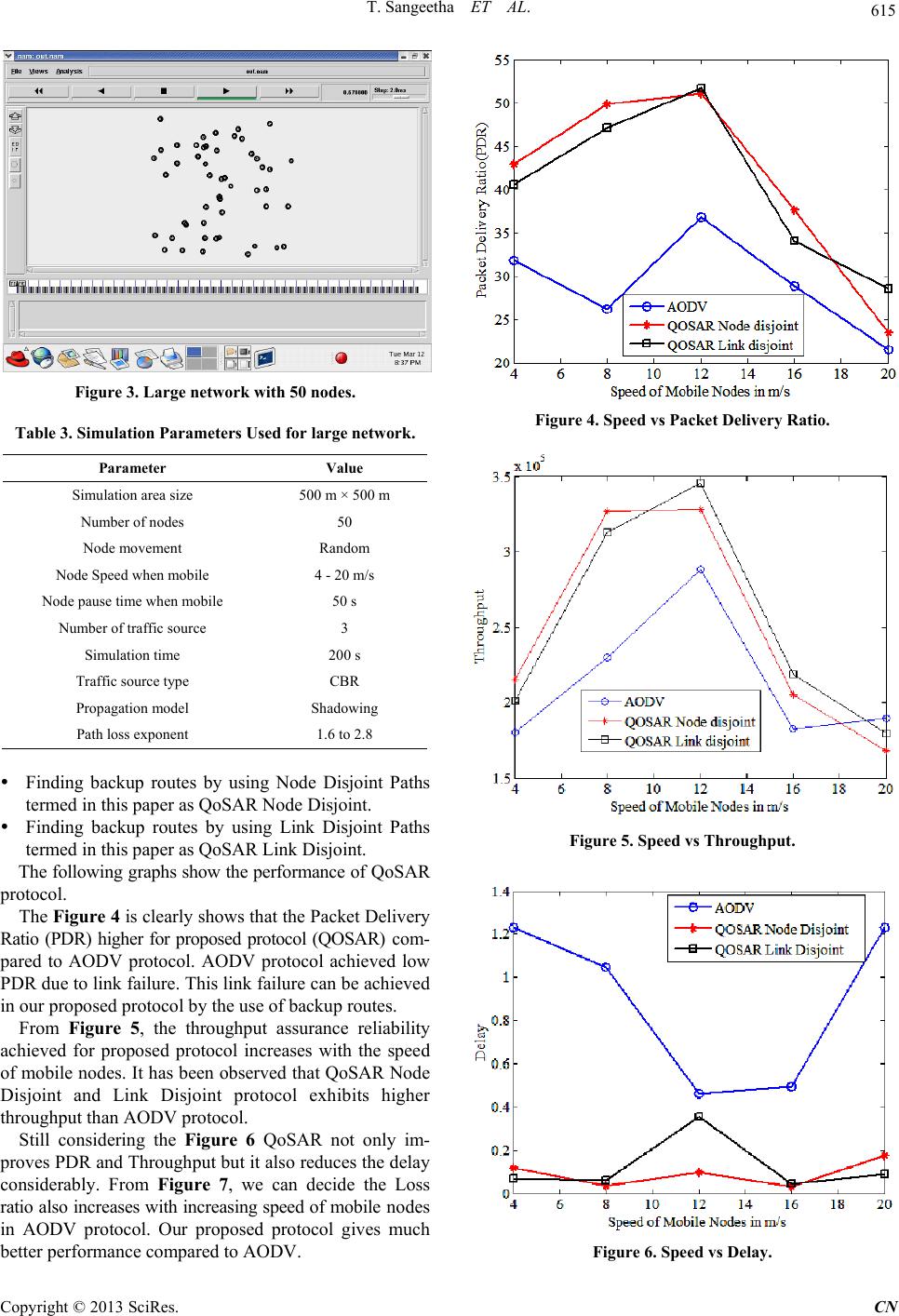 T. Sangeetha ET AL. Copyright © 2013 SciRes. CN 615 Figure 3. Large network with 50 nodes. Table 3. Simulation Parameters Used for large network. Parameter Va lue Simulation area size 500 m × 500 m Number of nodes 50 Node movement Random Node Speed when mobile 4 - 20 m/s Node pause time when mobile 50 s Number of traffic source 3 Simulation time 200 s Traffic source type CBR Propagation model Shadowing Path loss exponent 1.6 to 2.8 Finding backup routes by using Node Disjoint Paths termed in this paper as QoSAR Node Disjoint. Finding backup routes by using Link Disjoint Paths termed in this paper as QoSAR Link Disjoint. The following graphs show the performance of QoSAR protocol. The Figure 4 is clearly shows that the Packet Delivery Ratio (PDR) higher for proposed protocol (QOSAR) com- pared to AODV protocol. AODV protocol achieved low PDR due to link failure. This link failure can be achieved in our prop os ed protocol by the use of backup ro utes. From Figure 5, the throughput assurance reliability achieved for proposed protocol increases with the speed of mobile nodes. It has been observed that QoSAR Node Disjoint and Link Disjoint protocol exhibits higher throug hp ut than AOD V protocol . Still considering the Figure 6 QoSAR not only im- proves PDR and Throughput but it also reduces the delay considerably. From Figure 7, we can decide the Loss ratio also increases with increasing speed of mobile nodes in AODV protocol. Our proposed protocol gives much better performance compared to AODV. Figure 4. Speed vs Packet Delivery Ratio. Figure 5. Speed vs Throughput. Figure 6. Speed vs Delay. 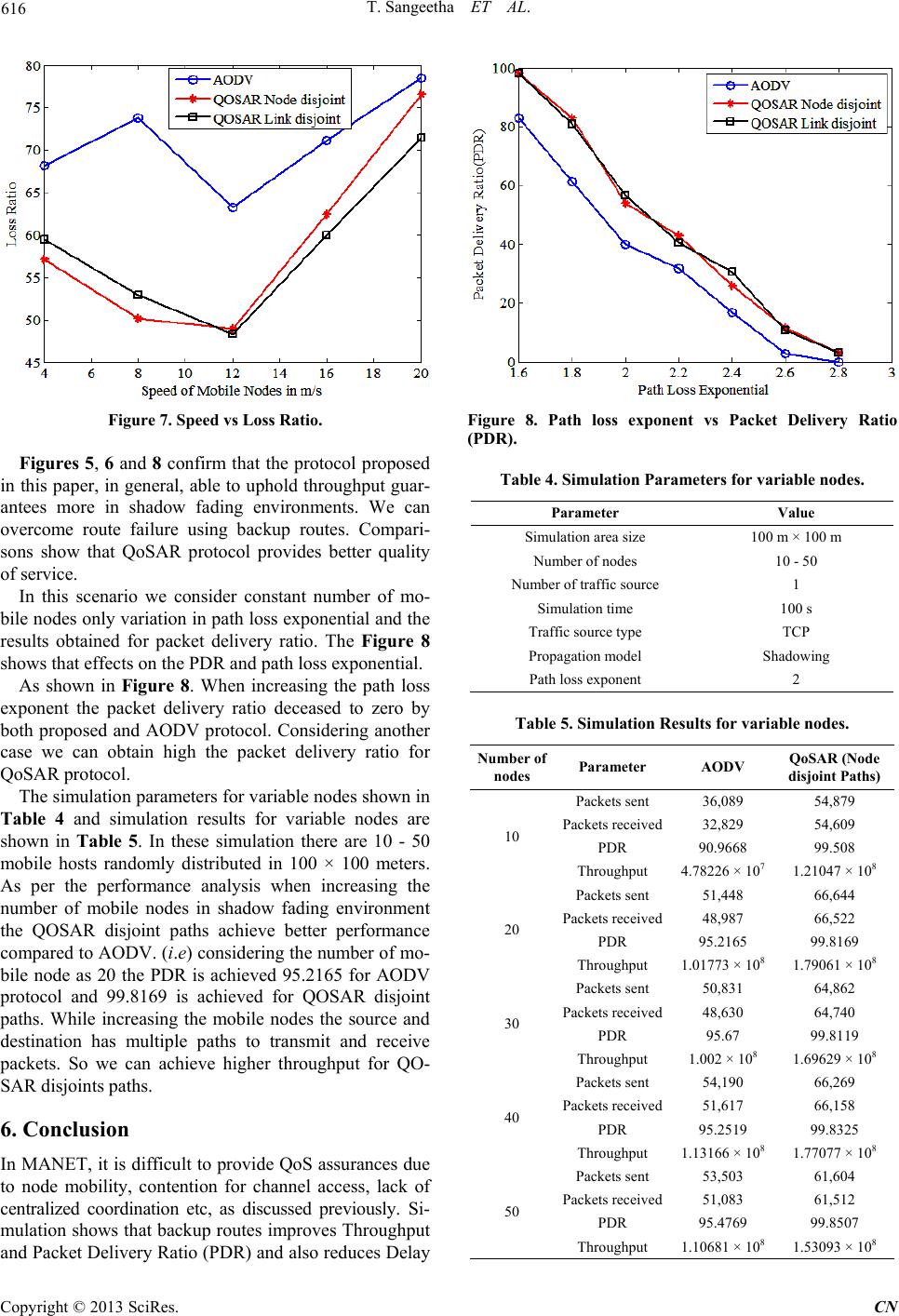 T. Sangeetha ET AL. Copyright © 2013 SciRes. CN 616 Figure 7. Speed vs Loss Ratio. Figures 5, 6 and 8 confirm that the protocol proposed in this paper, in general, able to uphold throughput guar- antees more in shadow fading environments. We can overcome route failure using backup routes. Compari- sons show that QoSAR protocol provides better quality of service. In this scenario we consider constant number of mo- bile nodes only variation in path loss exponential and the results obtained for packet delivery ratio. The Figure 8 shows that effects on the PDR and path loss exponential. As shown in Figure 8. When increasing the path loss exponent the packet delivery ratio deceased to zero by both proposed and AODV protocol. Considering another case we can obtain high the packet delivery ratio for QoSAR protocol. The simulation para meters for varia ble nodes show n in Table 4 and simulation results for variable nodes are shown in Table 5. In these simulation there are 10 - 50 mobile hosts randomly distributed in 100 × 100 meters. As per the performance analysis when increasing the number of mobile nodes in shadow fading environment the QOSAR disjoint paths achieve better performance compared to AODV. (i.e) considering the number of mo- bile node as 20 the PDR is achieved 95.2165 for AODV protocol and 99.8169 is achieved for QOSAR disjoint paths. While increasing the mobile nodes the source and destination has multiple paths to transmit and receive packets. So we can achieve higher throughput for QO- SAR disjoints paths. 6. Conclusion In MANET, it is difficult to provide QoS assur ances due to node mobility, contention for channel access, lack of centralized coordination etc, as discussed previously. Si- mulation shows that backup routes improves Throughput and Packet Delivery Ratio ( PDR) and also reduces Delay Figure 8. Path loss exponent vs Packet Delivery Ratio (PDR). Table 4. Simulation Parameters for variable nodes. Parameter Value Simulation area size 100 m × 100 m Number of nodes 10 - 50 Number of traffic source 1 Simulation time 100 s Traffic source type TCP Propagation model Shadowing Path loss exponent 2 Table 5. Simulation Results for variable nodes. Number of nodes Parameter AODV QoSAR (Node disjoint Paths) 10 Packets sent 36,089 54,879 Packets received 32,829 54,609 PDR 90.9668 99.508 Throughput 4.78226 × 10⁷ 1.21047 × 10⁸ 20 Packets sent 51,448 66,644 Packets received 48,987 66,522 PDR 95.2165 99.8169 Throughput 1.01773 × 10⁸ 1.79061 × 10⁸ 30 Packets sent 50,831 64,862 Packets received 48,630 64,740 PDR 95.67 99.8119 Throughput 1.002 × 10⁸ 1.69629 × 10⁸ 40 Packets sent 54,190 66,269 Packets received 51,617 66,158 PDR 95.2519 99.8325 Throughput 1.13166 × 10⁸ 1.77077 × 10⁸ 50 Packets sent 53,503 61,604 Packets received 51,083 61,512 PDR 95.4769 99.8507 Throughput 1.10681 × 10⁸ 1.53093 × 10⁸ 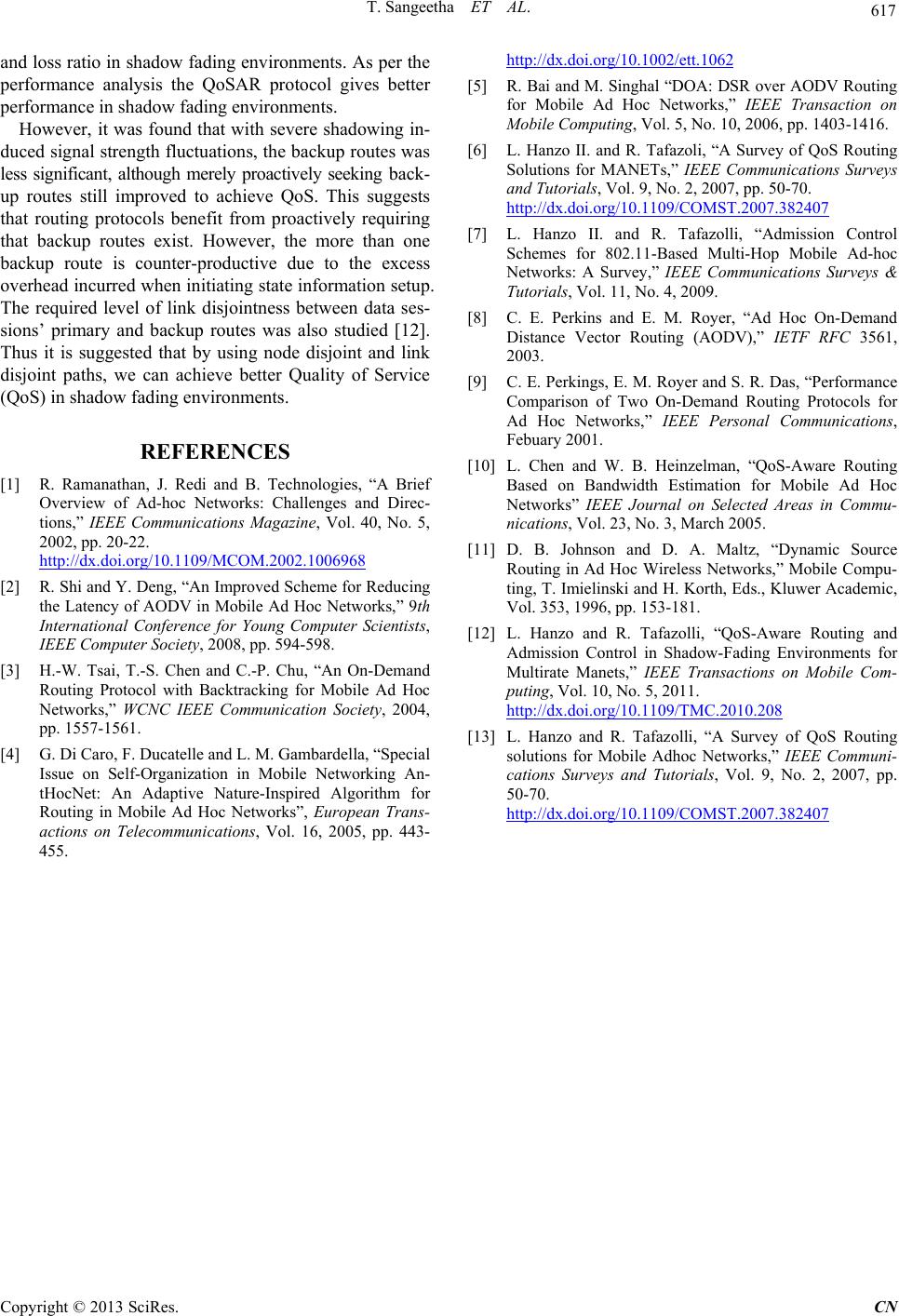 T. Sangeetha ET AL. Copyright © 2013 SciRes. CN 617 and loss ratio in shadow fading environments. As per the performance analysis the QoSAR protocol gives better performance in shadow fading environments. However, it was found that with severe shadowing in- duced signal strength fluctuations, the backup routes was less significant, although merely proactively seeking back- up routes still improved to achieve QoS. This suggests that routing protocols benefit from proactively requiring that backup routes exist. However, the more than one backup route is counter-productive due to the excess overhead incurred when initiating state information setup. The required level of link disjointness between data ses- sions’ primary and backup routes was also studied [12]. Thus it is suggested that by using node disjoint and link disjoint paths, we can achieve better Quality of Service (QoS) in shadow fading environments. REFERENCES [1] R. Ramanathan, J. Redi and B. Technologies, “A Brief Overview of Ad-hoc Networks: Challenges and Direc- tions,” IEEE Communications Magazine, Vol. 40, No. 5, 2002, pp. 20-22. http://dx.doi.org/10.1109/MCOM.2002.1006968 [2] R. Shi and Y. Deng, “An Improved Scheme for Reducing the Latency of AODV in Mobile Ad Hoc Networks,” 9th International Conference for Young Computer Scientists, IEEE Computer Society, 2008, pp. 594-598. [3] H.-W. Tsai, T.-S. Chen and C.-P. Chu, “An On-Demand Routing Protocol with Backtracking for Mobile Ad Hoc Networks,” WCNC IEEE Communication Society, 2004, pp. 1557-1561. [4] G. Di Caro, F. Ducatelle and L. M. Gambardella, “Special Issue on Self-Organization in Mobile Networking An- tHocNet: An Adaptive Nature-Inspired Algorithm for Routing in Mobile Ad Hoc Networks”, European Trans- actions on Telecommunications, Vol. 16, 2005, pp. 443- 455. http://dx.doi.org/10.1002/ett.1062 [5] R. Bai and M. Singhal “DOA: DSR over AODV Routing for Mobile Ad Hoc Networks,” IEEE Transaction on Mobile Computing, Vol. 5, No. 10, 2006, pp. 1403-1416. [6] L. Hanzo II. and R. Tafazoli, “A Survey of QoS Routing Solutions for MANETs,” IEE E Communications Surveys and Tutorials, Vol. 9, No. 2, 2007, pp. 50-70. http://dx.doi.org/10.1109/COMST.2007.382407 [7] L. Hanzo II. and R. Tafazolli, “Admission Control Schemes for 802.11-Based Multi-Hop Mobile Ad-hoc Networks: A Survey,” IEEE Communications Surveys & Tutorials, Vol. 11, No. 4, 2009. [8] C. E. Perkins and E. M. Royer, “Ad Hoc On-Demand Distance Vector Routing (AODV),” IETF RFC 3561, 2003. [9] C. E. Perkings, E. M. Roy er and S. R. Das, “Performance Comparison of Two On-Demand Routing Protocols for Ad Hoc Networks,” IEEE Personal Communications, Febuary 2001. [10] L. Chen and W. B. Heinzelman, “QoS-Aware Routing Based on Bandwidth Estimation for Mobile Ad Hoc Networks” IEEE Journal on Selected Areas in Commu- nications, Vol. 23, No. 3, March 2005. [11] D. B. Johnson and D. A. Maltz, “Dynamic Source Routing in Ad Hoc Wireless Networks,” Mobile Compu- ting, T. Imielinski and H. Korth, Eds., Kluwer Academic, Vol. 353, 1996, pp. 153-181. [12] L. Hanzo and R. Tafazolli, “QoS-Aware Routing and Admission Control in Shadow-Fading Environments for Multirate Manets,” IEEE Transactions on Mobile Com- puting, Vol. 10, No. 5, 2011. http://dx.doi.org/10.1109/TMC.2010.208 [13] L. Hanzo and R. Tafazolli, “A Survey of QoS Routing solutions for Mobile Adhoc Networks,” IEEE Communi- cations Surveys and Tutorials, Vol. 9, No. 2, 2007, pp. 50-70. http://dx.doi.org/10.1109/COMST.2007.382407 |