

Paper Menu >>
Journal Menu >>
 Creative Education 2013. Vol.4, No.10, 646-650 Published Online October 2013 in SciRes (http://www.scirp.org/journal/ce) http://dx.doi.org/10.4236/ce.2013.410093 Copyright © 2013 Sci R e s . 646 A Gender Gap Grade Analysis of Hard Sciences Courses in a School of Pharmacy Erika Hahn1, Catherine Santanello2, Ron Worthington2, McKenzie Ferguson2 1Country Mar t Pharmacy, Bonne Terre, USA 2School of Pharmacy, Southern Illinois University Edwardsville, Edwardsville, USA Email: [email protected] Received July 23rd, 2013; revised August 2 3rd, 2013; accepted August 30th, 2013 Copyright © 2013 Erika Hahn et al. This is an open access article distributed under the Creative Commons At- tribution License, which permits unrestricted use, distribution, and reproduction in any medium, provided the original work is properly cited. A student survey was conducted to determine perceptions of such things as differential treatment due to gender, level of preparedness for courses in the hard sciences, and gender performances of students in the sciences. Additionally, students’ grades of sixteen courses with a heavy hard science focus were analyzed by taking the percent of a letter grade sorted by male or female to determine if there was a significant gender difference in the final grades. Our objectives were to: 1) determine if the underrepresentation of women in some health-related jobs is due to discouragement of females to enter these professions or per- ceptions of success in hard science courses, 2) examine grades in courses with a strong biology and chem- istry focus to see if a significant difference due to gender exists. We concluded that a gender gap in hard sciences grades at the School of Pharmacy did exist but the gap was not large and was not present in all courses. The majority of women were not discouraged to pursue a science based career, but there was a difference in the perceived confidence that many females exhibit in the ability to learn material in the hard science courses and in their preparedness for hard science exams. Keywords: Gender Gap; Hard Sciences; Female Underrepresentation; Pharmacy Introduction Economists use the phrase “gender gap” to refer to differ- ences in the outcomes that women and men achieve in their incomes, types of jobs they choose, and the overall percentage of women and men in the workplace (Goldin, 2004). In accor- dance with this, there is a gender gap stereotype that fe males do not perform as well as ma les in some math and sci ence courses (Schiebinger, 2001). Not only do studies conclude that stereo- typing exists, the gender gap has been supported by grade evaluations in certain science, technology, engineering, and mathematics (STEM)-related courses in which males have his- torically outperformed females with respect to exam scores (Else-Quest, Hyde, & Linn, 2010). This gender gap was found to exist in the United States as well as other countries, but not necessarily globally (Else-Quest, Hyde, & Linn, 2010). Ac- cording to their meta-analysis this gap may be narrowing in some mathematics courses such as algebra. However, there were still significant gaps where males outperformed females in the realm of critical thinking skills, complex problem solving, and in self-confidence. Poor course performance by females could be conceived as confirming a negative gender stereotype (Spencer, Steele, & Quinn, 1999; Beilock, Rydell, & McCon- nell, 2007), possibly causing a female to fear being devalued based on her gender (Steele, Spencer, & Aronson, 2002) and having an impact on her self-confidence to succeed in the hard sciences. What are the origins of this type of stereotyping? Discrepan- cies in grades may be, in part, the result of negative messages from elementary teachers that discourage females from pursu- ing science activities and developing their abilities in these areas (Mullis & Jenkins, 1988). Shepardson and Pizzini (1992) suggest that science educators exhibit differential treatment of girls and boys in science classes, either consciously and/or sub- consciously, which helps to reinforce this gender gap. Sonnert (2009) examined the influence that fathers may have on their children’s perceptions towards the sciences. Fathers are more likely to use scientific terms and take advantage of learning opportunities that are related to science and physics in the household environment. Although it wasn’t found to make a significant difference between sons and daughters, there still may be an impact of how a father talks to his children and on a child’s future views on science and mathematics. In addition to parental influences, factors like the presence or lack of role models and the level of parental education were also seen as influencing one’s views of the hard sciences and future occupa- tional choices. Practice of these stereotypes could cause women to be dis- couraged from pursuing careers in scientific research or aca- demic positions in pharmacy, engineering, physics, etc., ceding those jobs to men due to their own deflated confidence in these science-related fields. Guelich et al. (2002) reported that women attending medical school were less likely to pursue a career in medical research than men, giving competing family obligations and a lack of confidence in this area as chief rea- sons. Underrepresentation of women in (STEM)-related jobs is evident in the US as well as other parts of the world (Anita Borg Institute for Women and Technology, 2012). As reported  E. HAHN ET AL. by the US Bureau of Labor Statistics in 2010, the percentage of women in science positions still lags behind males in many fields: engineers (12.9%), dentists (25.3%), architects (25.8%), and physicians (32.3%). These statistics reveal that men con- tinue to dominate the workforce in math/science fields holding greater than 50% of these careers. The field of Pharmacy differs in that 53% of those employed in the field of Pharmacy are female. (U.S. Dept. of Labor, 2011) Yet given the flexibility in work scheduling and the high income that many pharmacist positions offer, female presence could be even higher if the various behaviors that discourage women during science stud- ies were absent. Even though there are numerous studies showing statistical evidence that gender gaps exist, a study conducted by Ferrin- man, Lubinski, & Benbow (2009) suggests it may be due to preference. They found that there was a difference in what men and women desired in order to balance work and family. The groups of men and women studied were top performers in col- lege. As the groups became older adults they found that men put higher priority on work-related needs such as a higher sal- ary, prestige of the organization they work for, and taking risks. Women, on the other hand, want to be satisfied in the work- place, work in a clean environment and obtain respectful rela- tionships with colleagues. As women started having children, their preference shifted to wanting better working hours. Since STEM careers often involve long hours and a competitive en- vironment, women may face greater difficulty in balancing par- enting and professional roles than men. The gender gap between men and women is a multi-faceted issue. As mentioned, it may be due to gender roles and the at- mosphere that children grow up in or it may be a matter of choice. In order to further address this issue, additional research needs to be conducted to see if specific groups of students suf- fer from similar disparities that often exist in the workplace. Following the publication of Miyake et al. (2010) on values affirmation among college science studies, we asked whether students in our doctor of pharmacy program partition in a simi- lar manner by gender. The following study probed whether a perceived gender gap occurs at the Southern Illinois University Edwardsville School of Pharmacy (SIUE SoP) in the hard sci- ences courses and if the grades earned in the hard sciences courses corresponded to these perceptions. Methods Sixteen courses were selected from fall of 2005 to fall of 2010 for analysis based on the current curriculum during the time of the study. Courses were selected from the first three years of didactic courses of the four year program. Of these sixteen courses, four were considered courses with a heavy math emphasis whereas the remaining courses had a strong sci- ence and chemistry focus. The specific course grades were re- quested from the Registrar’s Office for the SIUE SoP and the identities of the students were withheld from the researchers. The research was approved by the Southern Illinois University Edwardsville Institutional Review Board. Required courses were selected by determining if the courses were taught by instructors listed in the Pharmaceutical Science Department. Some courses at the SIUE SoP are mixed Pharmaceutical Sci- ence and Pharmacy Practice. Therefore, content to be included in this study was determined by hours taught by a Pharmaceu- tical Science instructor during the course. The description of high and low science content was also determined by the hours of instruction by a Pharmaceutical Science instructor whereas greater than approximately 50% of the course hours were con- sidered high science/math content. It was requested that the data include gender and course call number. Students were selected on the basis of attending the School of Pharmacy from its inception date until the present date of the survey (See demographic information, Table 1 and Figure 1). Student grades were sequestered from fall of 2005 to fall of 2010 with a total of six graduating and current classes. The students’ grades were analyzed by taking the percent of a letter grade sorted by male or female. For example, if there were one hundred male students, then the number of A grades for the male students would be divided by the total number of male students. This was completed for all courses. Also, courses that were similar in content were combined. For example, Principles of Drug Action is a two semester course with a similar level of scientific rigor therefore combined into one analysis. In order to analyze the data consistently, data were reviewed according to performance during the respective year in phar- macy school (P1 year, P2 year, P3 year). Due to course changes and inconsistencies for the initial class that entered SIUE School of Pharmacy, the data for year 2005 were removed as well as some of the data from 2006 and 2007. In addition to determining student grades, a voluntary per- ception survey was conducted via Survey Monkey and deliv- ered to students via email. The survey questions are presented in Table 2. The questions were not pretested. All current stu- dents were asked to participate (N = ~320 students) and were informed that their participation would be anonymous and con- fidential. Data analysis primarily involved descriptive statistics. Results The survey request was sent to all current SIUE SOP stu- dents via e-mail request totaling approximately 320 students. Table 1. Admission class demographics. Admission YearCumulative GPA PCAT average F/M Ratio 2005 3.58 68 1.1 2006 3.61 73 1.5 2007 3.61 75 1.3 2008 3.63 75 1.4 2009 3.65 68 1.2 2010 3.54 64 1.8 Figure 1. Admission math/science GPA. Copyright © 2013 Sci R e s. 647 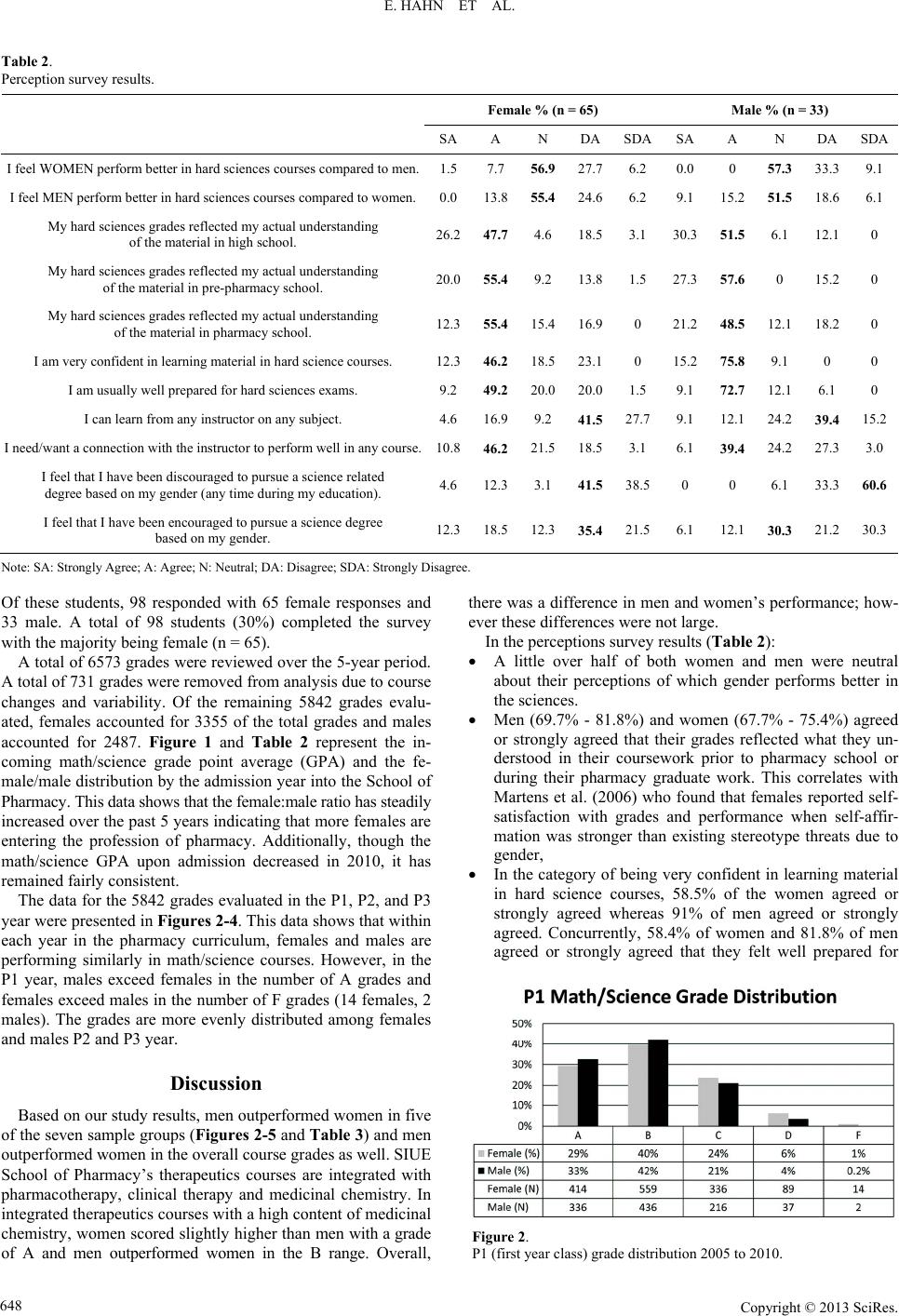 E. HAHN ET AL. Copyright © 2013 Sci R e s. 648 Table 2. Perception survey results. Female % (n = 65) Male % (n = 33) SA A N DASDASA A N DASDA I feel WOMEN perform better in hard scienc es courses compared to men.1.5 7.7 56.9 27.7 6.2 0.0 0 57.3 33.39.1 I feel MEN perform better in ha rd science s courses compared to women.0.0 13.855.4 24.6 6.2 9.1 15.2 51.5 18.66.1 My hard sciences grades re flected my actual understand ing of the material in high school. 26.2 47.7 4.6 18.53.1 30.3 51.5 6.1 12.10 My hard sciences grades re flected my actual understand ing of the material in pre-pharmacy school. 20.0 55.4 9.2 13.81.5 27.3 57.6 0 15.20 My hard sciences grades re flected my actual understand ing of the material in pharmacy school. 12.3 55.4 15.416.90 21.2 48.5 12.1 18.20 I am very confident in learning material in hard scienc e courses. 12.346.2 18.523.10 15.2 75.8 9.1 0 0 I am usually w ell prepared for hard science s exams. 9.2 49.2 20.020.0 1.5 9.1 72.7 12.1 6.1 0 I can lear n fr om any instru ctor on any subject. 4.6 16.99.2 41.5 27.79.1 12.1 24.2 39.4 15.2 I need/want a connection with the instructor to perform well i n any course.10.846.2 21.518.5 3.1 6.1 39.4 24.2 27.33.0 I feel that I have been discouraged to pursue a science related degree based on my gender (any time during my education). 4.6 12.33.1 41.5 38.50 0 6.1 33.360.6 I feel that I have been encouraged to pursue a science degree based on m y gender. 12.3 18.5 12.3 35.4 21.56.1 12.1 30.3 21.2 30.3 Note: SA: Strongly Agree; A: Agree; N: Neutral; DA: Disagree; SDA: Strongly Disagree. there was a differenc e in men and women’s performance; how- ever these differences were not large. Of these students, 98 responded with 65 female responses and 33 male. A total of 98 students (30%) completed the survey with the majority being female (n = 65). In the perceptions survey results (Table 2): A little over half of both women and men were neutral about their perceptions of which gender performs better in the sciences. A total of 6573 grades were reviewed over the 5-year period. A total of 731 grades were removed from analysis due to course changes and variability. Of the remaining 5842 grades evalu- ated, females accounted for 3355 of the total grades and males accounted for 2487. Figure 1 and Table 2 represent the in- coming math/science grade point average (GPA) and the fe- male/male distribution by the admission year into the School of Pharmacy. This data shows that the female:m ale ratio has steadily increased over the past 5 years indicating that more females are entering the profession of pharmacy. Additionally, though the math/science GPA upon admission decreased in 2010, it has remained fairly consistent. Men (69.7% - 81.8%) and women (67.7% - 75.4%) agreed or strongly agreed that their grades reflected what they un‐ derstood in their coursework prior to pharmacy school or during their pharmacy graduate work. This correlates with Martens et al. (2006) who found that females reported self- satisfaction with grades and performance when self-affir‐ mation was stronger than existing stereotype threats due to gender, In the category of being very confident in learning material in hard science courses, 58.5% of the women agreed or strongly agreed whereas 91% of men agreed or strongly agreed. Concurrently, 58.4% of women and 81.8% of men agreed or strongly agreed that they felt well prepared for The data for the 5842 grades evaluated in the P1, P2, and P3 year were presented in Figures 2-4. This data shows that within each year in the pharmacy curriculum, females and males are performing similarly in math/science courses. However, in the P1 year, males exceed females in the number of A grades and females exceed males in the number of F grades (14 females, 2 males). The grades are more evenly distributed among females and males P2 and P3 year. Discussion Based on our study results, men outperformed women in five of the seven sample groups (Figures 2-5 and Table 3) and men outperformed women in the overall course grades as well. SIUE School of Pharmacy’s therapeutics courses are integrated with pharmacotherapy, clinical therapy and medicinal chemistry. In integrated therapeutics courses with a high content of medicinal chemistry, women scored slightly higher than men with a grade of A and men outperformed women in the B range. Overall, Figure 2. P1 (first year class) grade d i s t ribution 2005 to 2010 . 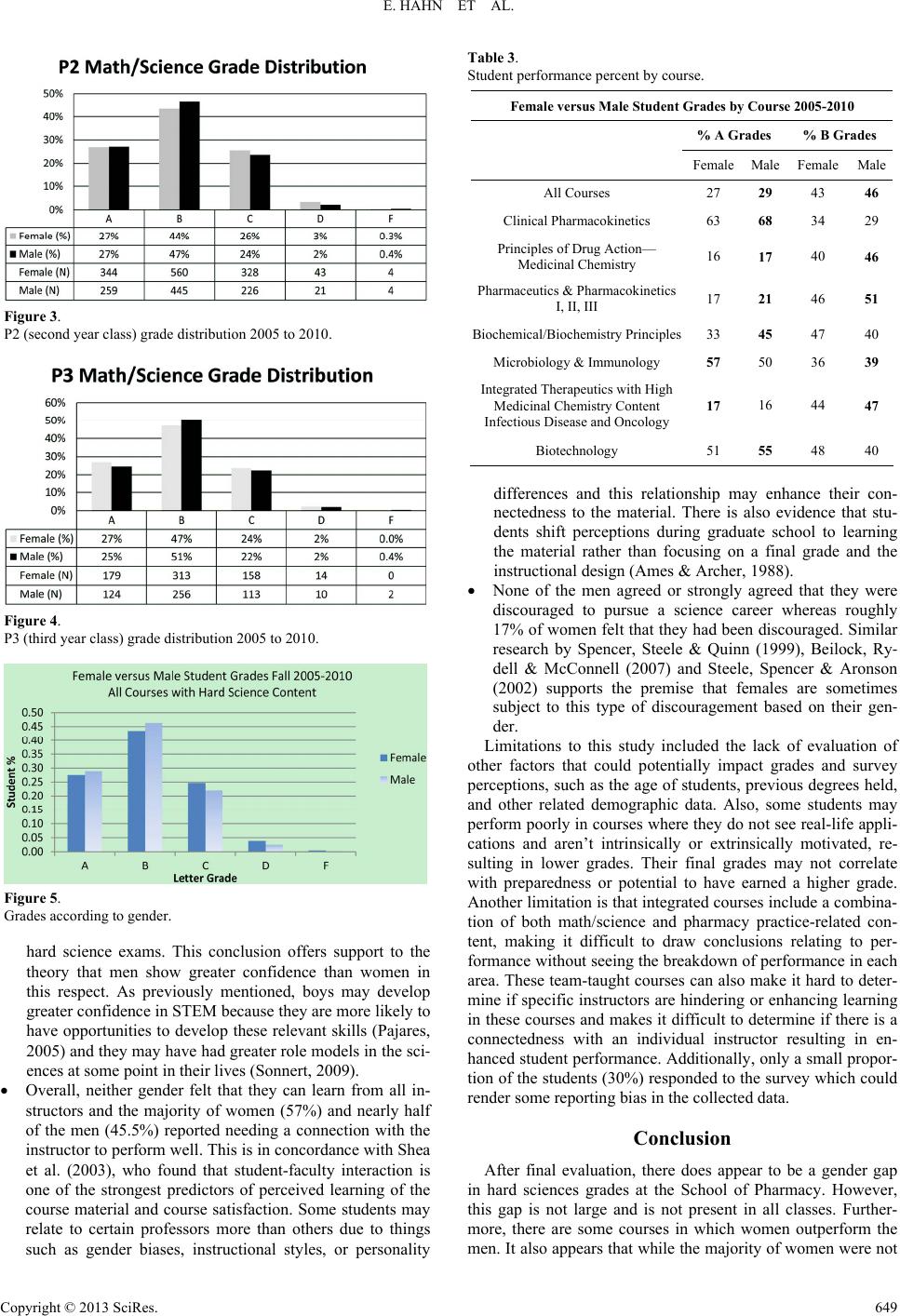 E. HAHN ET AL. Figure 3. P2 (second year class) grade distribution 2005 to 2010 . Figure 4. P3 (third year class) grad e distribution 2005 to 2010. Figure 5. Grades according to gender. hard science exams. This conclusion offers support to the theory that men show greater confidence than women in this respect. As previously mentioned, boys may develop greater confidence in STEM because they are more likely to have opportunities to develop these relevant skills (Pajares, 2005) and they may have had greater role models in the sci‐ ences at some point in their lives (Sonnert, 2009). Overall, neither gender felt that they can learn from all in- structors and the majority of women (57%) and nearly half of the men (45.5%) reported needing a connection with the instructor to perform well. This is in concordance with Shea et al. (2003), who found that student-faculty interaction is one of the strongest predictors of perceived learning of the course material and course satisfaction. Some students may relate to certain professors more than others due to things such as gender biases, instructional styles, or personality Table 3. Student performance percent by course. Female versus Male Student Gr ades by Course 2005-2010 % A Grades % B G ra des Female Male FemaleMale All Courses 27 29 43 46 Clinical Pharmacokinetics 63 68 34 29 Principles of Drug Action — Medicinal C hemistry 16 17 40 46 Pharmaceutics & Pharmacokinetics I, II, III 17 21 46 51 Biochem ical/Biochemistry Principles 33 45 47 40 Microbiology & Immunology 57 50 36 39 Integrated Therapeutics with High Medicinal Che mistry Content Infectious Dise ase and Oncology17 16 44 47 Biotechnology 51 55 48 40 differences and this relationship may enhance their con- nectedness to the material. There is also evidence that stu- dents shift perceptions during graduate school to learning the material rather than focusing on a final grade and the instructional design (Ames & Archer, 1988). None of the men agreed or strongly agreed that they were discouraged to pursue a science career whereas roughly 17% of women felt that they had been discouraged. Similar research by Spencer, Steele & Quinn (1999), Beilock, Ry‐ dell & McConnell (2007) and Steele, Spencer & Aronson (2002) supports the premise that females are sometimes subject to this type of discouragement based on their gen‐ der. Limitations to this study included the lack of evaluation of other factors that could potentially impact grades and survey perceptions, such as the age of students, previous degrees held, and other related demographic data. Also, some students may perform poorly in courses where they do not see real-life appli- cations and aren’t intrinsically or extrinsically motivated, re- sulting in lower grades. Their final grades may not correlate with preparedness or potential to have earned a higher grade. Another limitation is that integrated courses include a combina- tion of both math/science and pharmacy practice-related con- tent, making it difficult to draw conclusions relating to per- formance without seeing the breakdown of performance in each area. These team-taught courses can also make it hard to deter- mine if specific instructors are hindering or enhancing learning in these courses and makes it difficult to determine if there is a connectedness with an individual instructor resulting in en- hanced student performance. Additionally, only a small propor- tion of the students (30%) responded to the survey which could render some reporting bias in the collected data. Conclusion After final evaluation, there does appear to be a gender gap in hard sciences grades at the School of Pharmacy. However, this gap is not large and is not present in all classes. Further- more, there are some courses in which women outperform the men. It also a ppears that while the majority of women we re not Copyright © 2013 Sci R e s. 649  E. HAHN ET AL. Copyright © 2013 Sci R e s. 650 discouraged to pursue a science based career, there does appear to be a difference in the perceived confidence that many fe- males exhibit in the ability to learn material in the hard science courses and in their preparedness for hard science exams. De- spite these perceptions, one could conclude that they pursued and achieved admission to pharmacy school due to their own interest in the health sciences. Additionally, women may have chosen the field of pharmacy due to the fact that there is more potential for earning higher wages with better hours compared to other simila r healt h -re lated careers. REFERENCES Ames, C., & Archer, J. (1988). Achievement goals in the classroom: Student’s learning strategies and motivation processes. Journal of Educational Psycho l o gy, 80, 260-267. http://dx.doi.org/10.1037/0022-0663.80.3.260 Anita Borg Institute for Women and Technology (2012). Solutions to recruit technical women. http://anitaborg.org/files/Anita-Borg-Inst-Solutions-To-Recruit-Tech nical-Women1.pdf Beilock, S. L., Rydell, R. J., & McConnell, A. R. (2007). Stereotype threat and working memory: Mechanisms, alleviation, and spillover. Journal of Experimental Psychology Genera l, 136, 256-276. http://dx.doi.org/10.1037/0096-3445.136.2.256 Else-Quest, N. M., Hyde, J. S., & Linn, M. C. (2010). Cross-national patterns of gender difference in mathematics: A meta-analysis. American Psychological Association, 136, 103-127. Ferrinman, K., Lubinski, D., & Benbow, C. (2009). Work preferences, life values, and personal views of top math/science graduate students and the profoundly gifted: Developmental changes and gender dif- ferences during emerging adulthood and parenthood. Journal of Personality and Social Psychology, 97, 517-532. http://dx.doi.org/10.1037/a0016030 Goldin, C. (2004). Gender gap: The concise encyclopedia of economics. http://www.econlib.org/library/Enc1/GenderGap.html Guelich, J. M., Singer, B. H., Castro, M. C., & Rosenberg, L. E. (2002). A gender gap in the next generation of physician-scientists: Medical student interest and participation in research. Journal of Investigative Medicine, 50, 412-418. http://dx.doi.org/10.2310/6650.2002.32475 Martens, A., Johns, M., Greenberg, J., & Schimel, J. (2006). Combating stereotype threat: The effect of self-affirmation on women’s intellec- tual performance. Journal of Experimental Social Psychology, 46, 236-243. http://dx.doi.org/10.1016/j.jesp.2005.04.010 Miyake, A., Kost-Smith, L. E., Finkelstein, N. D., Pollock, S. J., Cohen, G. L., & Ito, T. A. (2010). Reducing the gender achievement gap in college science: A classroom study of values affirmation. Science, 2330, 1234-1237. http://dx.doi.org/10.1126/science.1195996 Mullis, I., & Jenkins, L. (1988). The science report card (Report No. 17-S-01). Princeton, NJ: Educational Testing Service. Pajares, F. (2005). Gender differences in mathematics self-efficacy beliefs. In A. M. Gallagher, & J. C. Kaufman (eds.), Gender differ- ences in mathematics: An integrative psychological approach. Bos- ton, MA: Cambridge University Press. Schiebinger, L. L. (2001). Has feminism changed science? Cambridge, MA: Harvard University Press. Shea, P., Pickett, A., & Pelz, W. (2003). A follow-up investigation of “teaching presence” in the SUNY Learning Network. Journal of Asynchronous Learning N e t w or k s , 7, 61-80. Shepardson, D. P., & Pizzini, E. L. (1992). Gender bias in female ele- mentary teachers’ perceptions of the scientific ability of students. Science Education, 76, 147-153. http://dx.doi.org/10.1002/sce.3730760204 Sonnert, G. (2009). Parents who influence their children to become scientists: Effects of gender and parental education. Social Studies of Science, 39, 927- 941. http://dx.doi.org/10.1177/0306312709335843 Spencer, S. J, Steele, C. M., & Quinn, J. (1999).Stereotype threat and women’s math performance. Journal of Experimental and Social Psychology, 35, 4-28. http://dx.doi.org/10.1006/jesp.1998.1373 US Bureau of Labor Statistics (20 10 ). BLS information. http://www.bls.gov/bls/blswage.htm US Department of Labor (2011). Women in the labor force: A databook. http://www.bls.gov/cps/wlf-databook2010.htm |