

Paper Menu >>
Journal Menu >>
 Communications and Network, 2013, 5, 570-572 http://dx.doi.org/10.4236/cn.2013.53B2102 Published Online September 2013 (http://www.scirp.org/journal/cn) Copyright © 2013 SciRes. CN Pruned Volterra Models with M emory Effects for Nonlinear Power Amplifiers Pengpeng Li1, Qingfang Zhang1, Ping Wang1, Zhongshan Xie2, Bing Liu2 1Shanghai Institute of Microsystem and Information Technology, Shanghai, China 2Nanjing University of Aeronautics and Astronautics, Nanjing, China Email: [email protected], [email protected] Received May 2013 ABSTRACT In this letter, a novel model is proposed for modeling the nonlinearity and memory effects of power amplifiers. The classical Volterra model is modified through a function of the sum of nonlinearity order with sum of memory length. The parameters of this model can be extracted in digital domain since the model is analyzed based on the envelope sig- nals. The model we proposed enables a substantial reduction in the number of coefficients involved, and with excellent accuracy. Keywords: Volterra Series; Power Amplifier (PA); Behavioral Model; Memory Effect 1. Introduction To handle multi-carrier envelope varying signals with wide bandwidths in modern wireless communication sys- tem, the signals passing through the transistor and power amplifiers should be able to predict accurately. In the behavioral model, the nonlinear component is generally considered as a “b lack-box ” which is completely charac- terized by external responses, in terms of input and out- put signals, through the use of relatively simple mathe- matical expressions. The Volterra series is a general non- linear model with memory and has been used by many researchers to characterize power amplifiers [1,2]. Un- fortunately, the number of coefficients of the Volterra- based models becomes unacceptable in practical imple- mentation as the accuracy level increased, such models become useless. To overcome the modeling complexity, various mod- el-order reduction approaches have been proposed to simplify the Volterra m odel str ucture. For e xample, Wiener, Hammerstein, Wiener-Hammerstein [3,4] and Memory Polynomial [5] models are the most popular approxima- tions. Physical knowledge has been considered in recently proposed models by taking into account the real behavior of the PA [6]. And the device electrical properties were also considered in the reduction [7]. Although these simplified models have been employed to characterize PAs with reasonable accuracy under cer- tain conditions, the number of coefficients to be esti- mated is still increasing prominently with the degree of nonlinearity and memory length of the system. While the interaction be tween the nth order and memory length has not attracted enough attention. The model proposed in this work is based on an un- derlying general Volterra model of the PA. By focusing on the fact that output items is fading with the non-li- nearity order and memory length increase, the Volterra model is modified. As the function of nonlinearity and memory effects applied, a slow growth of the coefficients can be obtained while the accuracy can be improved. The letter is organized as follows: after this introduction, Vol- terra model is modified based on the nonlinearity and memory effects analyzed in Section 2. The model’s per- formance is shown in Se ction 3. At last the conclusion is presente d in Sect ion 4. 2. Principle of Proposed Model A Volterra series is a combination of linear convolution and a nonlinear power series so that it can be used to describe the input/output relationship of a general nonli- near, causal and time-invariant system with fading mem- ory. (1) where and represents the input and the output, P and M are the order of nonlinearities and the memory length, respectively, and is the discrete time Volterra kernels of order n. In the application of wide-band system, memory ef- ∑∏ ∑ ∑ == = = −= M i p jjpp p p M i p inxiihny 01 1 1 0 )(),...,(...)( 1 )( nx )( ny ),...,(h 1p p ii 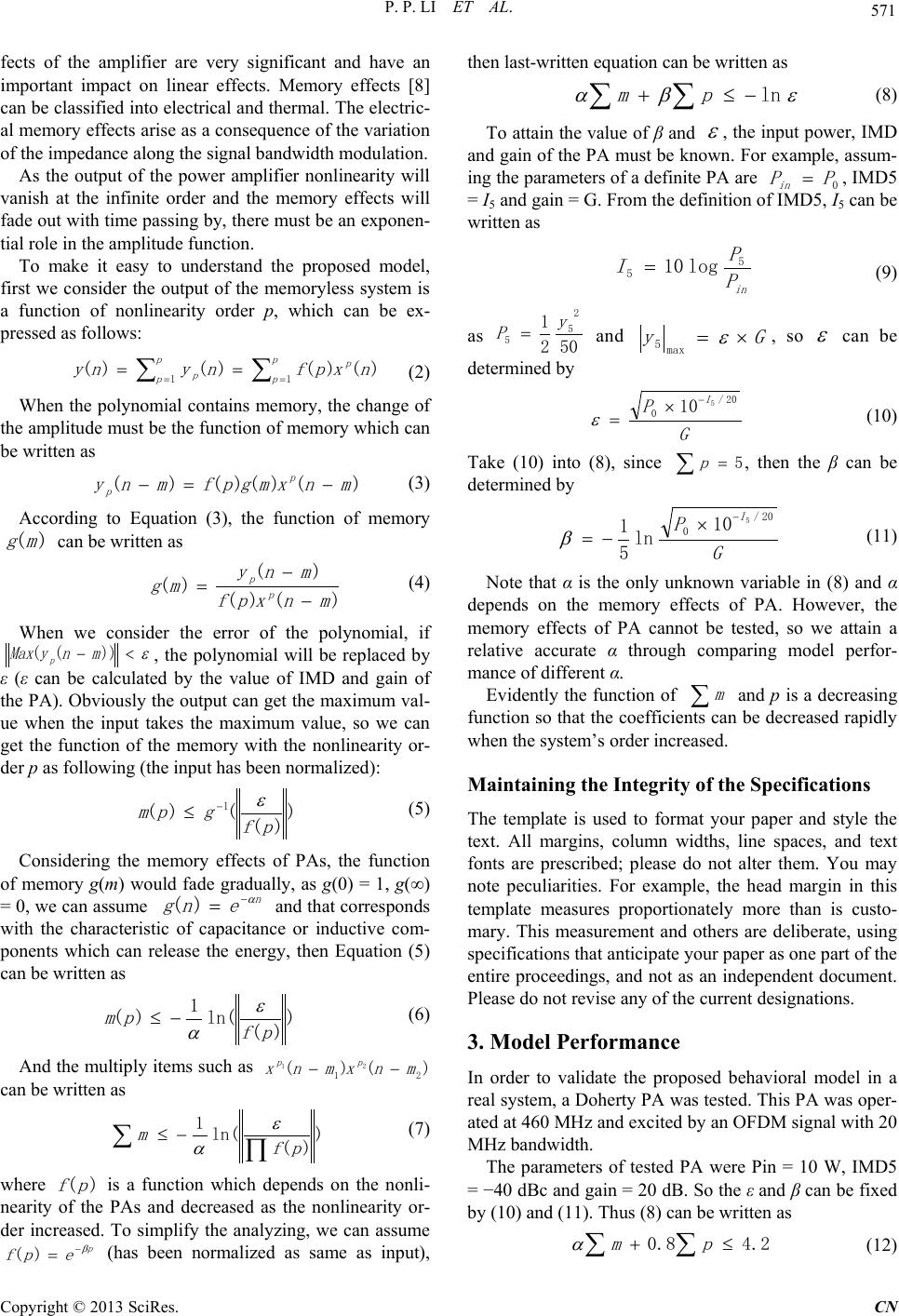 P. P. LI ET AL. Copyright © 2013 SciRes. CN 571 fects of the amplifier are very significant and have an important impact on linear effects. Memory effects [8] can be classified into electrical and thermal. The electric- al memory effects arise as a consequence of the variation of the impedance along the signal bandwidth modulation. As the output of the power amplifier nonlinearity will vanish at the infinite order and the memory effects will fade out with time passing by, there must be an exponen- tial role in the amplitude function. To make it easy to understand the proposed model, first we consider the output of the memoryless system is a function of nonlinearity order p, which can be ex- pressed as follows: (2) When the polynomial contains memory, the change of the amplitude must be the function of memory which can be written as (3) According to Equation (3), the function of memory can be written as (4) When we consider the error of the polynomial, if , the polynomial will be replaced by ε (ε can be calculated by the value of IMD and gain of the PA). Obviously the output can get the maximum val- ue when the input takes the maximum value, so we can get the function of the memory with the nonlinearity or- der p as follo w ing (the input has been norm a lized): (5) Considering the memory effects of PAs, the function of memor y g(m) would fade gradually, as g(0) = 1, g(∞) = 0 , we can assume and that corr esponds with the characteristic of capacitance or inductive com- ponents which can release the energy, then Equation (5) can be written as (6) And the multiply items such as can be written as (7) where is a function which depends on the nonli- nearity of the PAs and decreased as the nonlinearity or- der increased. To simplify the analyzing, we can assume (has been normalized as same as input), then last-written equation can be written as (8) To attain the value of β and ε , the input p ower, IMD and gain of the PA must be known. For example, assum- ing the parameters of a definite PA are , IMD5 = I5 and gain = G. From the definition of IMD5, I5 can be written as in P P I 5 5log10= (9) as and , so ε can be determined by (1 0) Take (10) into (8), since , then the β can be determined by (11) Note that α is the only unknown variable in (8) and α depends on the memory effects of PA. However, the memory effects of PA cannot be tested, so we attain a relative accurate α through comparing model perfor- mance of different α. Evidently the function of and p is a decreasing function so that the coefficients can be decreased rapidly when the system’s order increased. Maintaining the Integrity of the Specifications The template is used to format your paper and style the text. All margins, column widths, line spaces, and text fonts are prescribed; please do not alter them. You may note peculiarities. For example, the head margin in this template measures proportionately more than is custo- mary. This measurement and others are deliberate, using specifications that an ticip a te yo ur paper as one part of the entire proceedings, and not as an independent document. Please do not revis e an y of the current designations. 3. Model Performance In order to validate the proposed behavioral model in a real system, a Doherty PA was tested. This PA was oper- ated at 460 MHz and excited by an OFDM signal with 20 MHz bandwidth. The parameters of tested PA were Pin = 10 W, IMD5 = −40 dBc and gain = 20 dB. So the ε and β can be fixed by (10) and (11). Thus (8) can be written as 2.48.0 ≤+ ∑∑ pmα (12 ) ∑∑ == == p p p p pp nxpfnyny 11 )()()()( )()()()( mnxmgpfmny p p −=− )( mg )()( )( )( mnxpf mny mg p p − − = ε <− ))(( mnyMax p ) )( ()( 1 pf gpm ε − ≤ n engα − =)( ) )( ln( 1 )( pf pm ε α −≤ )()( 21 21 mnxmnx pp −− ) )( ln( 1 ∏ ∑ −≤ pf mε α )( pf p epf β − =)( εβα ln−≤+ ∑∑ pm 0 PP in = 502 12 5 5 y P = Gy ×= ε max 5 G P I 20/ 0 5 10 − × = ε 5= ∑ p G P I 20/ 0 5 10 ln 5 1 − × −= β ∑ m 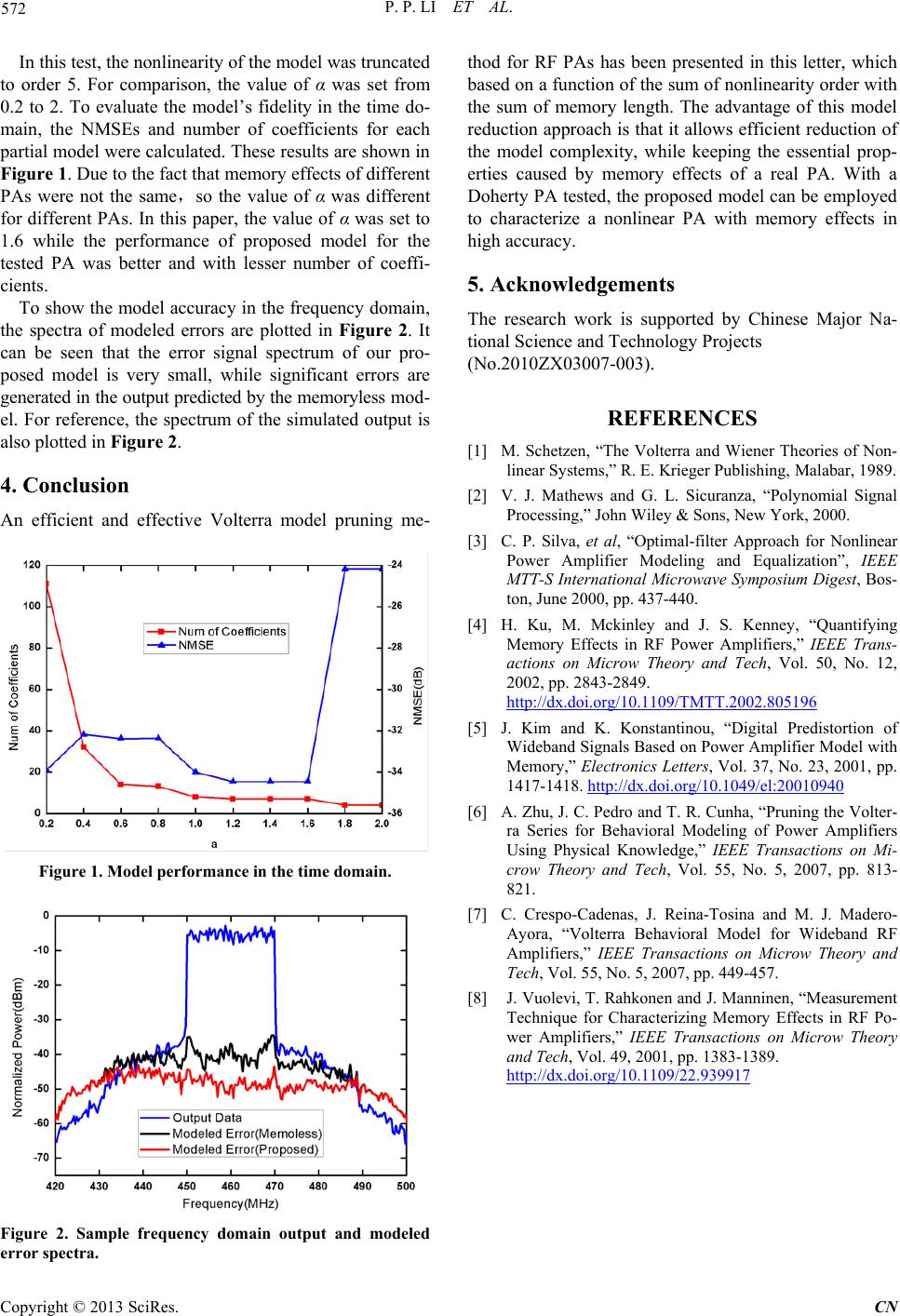 P. P. LI ET AL. Copyright © 2013 SciRes. CN 572 In this test, the nonlinearity of the model was truncated to order 5. For comparison, the value of α was set from 0.2 to 2. To evaluate the model’s fidelity in the time do- main, the NMSEs and number of coefficients for each partial model were calculated. These results are shown in Figure 1. Due to the fact that memory effects of different PAs were not the same,so the value of α was different for different PAs. In this paper, the value of α was set to 1.6 while the performance of proposed model for the tested PA was better and with lesser number of coeffi- cients. To show the model accuracy in the frequency domain, the spectra of modeled errors are plotted in Figure 2. It can be seen that the error signal spectrum of our pro- posed model is very small, while significant errors are generated in the output predicted by the memoryless mod- el. For reference, the spectrum of the simulated output is also plot t e d in Figure 2. 4. Conclusion An efficient and effective Volterra model pruning me- Figure 1. Model performance in the time domain. Figure 2. Sample frequency domain output and modeled error spectra. thod for RF PAs has been presented in this letter, which based on a function of the sum of nonlinearity order with the sum of memory length. The advantage of this model reduction approach is that it allows ef ficient reduction of the model complexity, while keeping the essential prop- erties caused by memory effects of a real PA. With a Doherty PA tested, the proposed model can be employed to characterize a nonlinear PA with memory effects in high accuracy. 5. Acknowledgements The research work is supported by Chinese Major Na- tional Science and Technology Projects (No.2010ZX03007-003). REFERENCES [1] M. Schetzen, “The Volterra and Wiener Theories of Non- linear Systems,” R. E. Krieger Publishing, Malabar, 1989. [2] V. J. Mathews and G. L. Sicuranza, “Polynomial Signal Processing,” John Wiley & Sons, New York, 2000. [3] C. P. Silva, et al, “Optimal-filter Approach for Nonlinear Power Amplifier Modeling and Equalization”, IEEE MTT-S International Microwave Symposium Digest, Bos- ton, June 2000, pp. 437-440. [4] H. Ku, M. Mckinley and J. S. Kenney, “Quantifying Memory Effects in RF Power Amplifiers,” IEEE Trans- actions on Microw Theory and Tech, Vol. 50, No. 12, 2002, pp. 2843-2849. http://dx.doi.org/10.1109/TMTT.2002.805196 [5] J. Kim and K. Konstantinou, “Digital Predistortion of Wideband Signals Based on Power Amplifier Model with Memory,” Electronics Letters, Vol. 37, No. 23, 2001, pp. 1417-1418. http://dx.doi.org/10.1049/el:20010940 [6] A. Zhu, J. C. Pedro and T. R. Cunha, “Pruning the Volter- ra Series for Behavioral Modeling of Power Amplifiers Using Physical Knowledge,” IEEE Transactions on Mi- crow Theory and Tech, Vol. 55, No. 5, 2007, pp. 813- 821. [7] C. Crespo-Cadenas, J. Reina-Tosina and M. J. Madero- Ayora, “Volterra Behavioral Model for Wideband RF Amplifiers,” IEEE Transactions on Microw Theory and Tech, Vol. 55, No. 5, 2007, pp. 449-457. [8] J. Vuolevi, T. Rahkonen and J. Manninen, “Measurement Technique for Characterizing Memory Effects in RF Po- wer Amplifiers,” IEEE Transactions on Microw Theory and Tech, Vol. 49, 2001, pp. 1383-1389. http://dx.doi.org/10.1109/22.939917 |