

Paper Menu >>
Journal Menu >>
 Communications and Network, 2013, 5, 549-553 http://dx.doi.org/10.4236/cn.2013.53B2099 Published Online September 2013 (http://www.scirp.org/journal/cn) Copyright © 2013 SciRes. CN Wireless Distributed Monitoring Terminal Used for On-Line Application Fenggui Wang, Lin Zhang, Zhongmin Wang, Yanbo Zhang Institute of Automation, Shandong Academy of Sciences, Jinan, China Email: [email protected] Received June 2013 ABSTRACT A wireless distributed monitoring terminal was designed with embedded Linux used on the basis of ARM board, and an application program was developed for data collection, processing and transmission. Data were collected from the sur- rounding environment and transmitted to a server via WLAN in the form of Extensible Markup Language (XML) stream, so the terminal had good flexibility to be compatible with different sensors, network devices and information systems from multiple manufacturers. Keywords: On-Line Monitoring; Distributed Monitoring; Extensible Markup Language (XML) Stream; Wireless Terminal 1. Introduction On-line applications are becoming more and more wide- spread along with the popularity of the Internet of Things in various fields [1], such as environmental monitoring, public safety, telemedicine, etc [2,3]. In these applica- tions, some terminals are necessary to execute data ac- quisition, processing and transmission. There may be dif- ferent sensors, network devices and information systems from multiple manufacturers even if in one application, so it is important that every terminal has good flexibility to be compatible with them. ARM platform has been very popular in the area of mobile devices such as smart phones, personal players of audio and video, GPS systems and so forth, and can also compete with desktop computers based on i386 architec- ture microprocessors in some case [4]. ARM microcon- trollers are convenient and efficient for designing and developing especially with embedded operating system used, so more and more terminals begin to adopt designs based on them nowadays. This paper deals with design of a wireless distributed monitoring terminal with embedded Linux used on the basis of ARM board, and development of an application program for data collection, processing and transmission. It collects data from the surrounding environment via RS485 or A/D convertor, carries out data analysis and processing, and transmits them to a server via Wireless Local Area Network (WLAN). The server stores these data to an oracle database and presents them through web pages. It is needed to be specially noted that these data are encapsulated into Extensible Markup Language (XML) stream by terminal before transmitting and then parsed to obtain the semantics by server after receiving [5], so as to enhance the flexibility of whole system. 2. Hardware Design The hardware of the wireless distributed monitoring ter- minal includes ARM9 board based on S3C2440A and Wi-Fi module to send and receive data wirelessly be- tween it and the server. Also, it connects temperature/ humidity sensor and illumination sensor as example for monitoring changes of the surrounding environment. The structure diagram of the terminal is shown in Figure 1. 2.1. ARM9 Board The board is based on S3C2440A microcontroller with 512 MB RAM and 512 MB flash memory. SAMSUNG’s S3C2440A is designed to provide hand-held devices and general applications with low-power, and high-perfor- mance microcontroller solution in small die size. To re- duce total system cost, the S3C2440A includes the fol- lowing components: separate 16 KB Instruction and 16 KB Data Cache, MMU to handle virtual memory man- agement, LCD Controller (STN & TFT), NAND Flash Boot Loader, System Manager (chip select logic and SDRA M Con tro ll er), 3-ch UART, 4-ch DMA, 4-ch Timers with PWM, I/O Ports, RTC, 8-ch 10-bit ADC and Touch Screen Interface, Camera interface, IIC-BUS Interface, 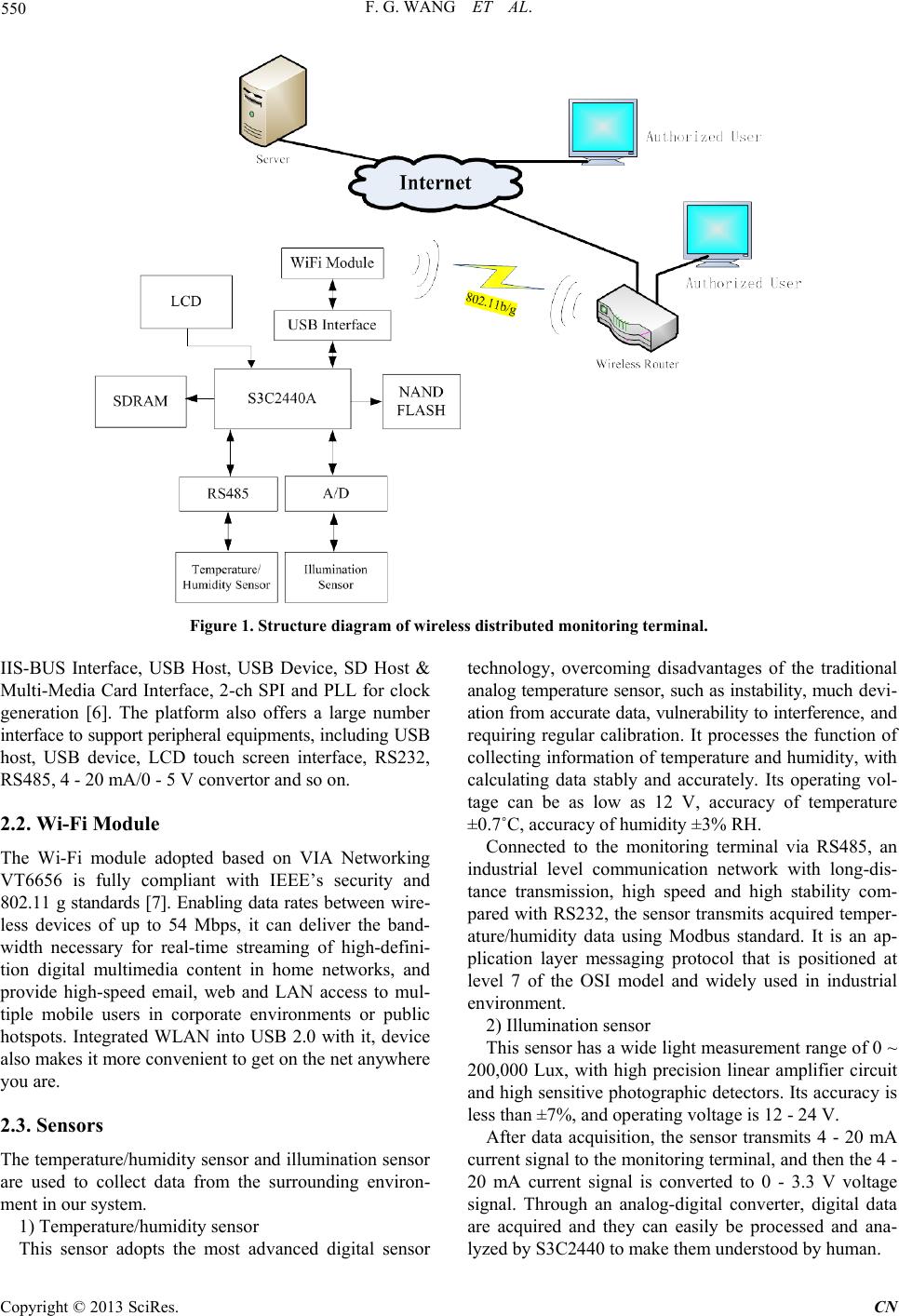 F. G. WANG ET AL. Copyright © 2013 SciRe s. CN 550 Figure 1. Structure diagram of wireless distributed monitoring terminal. IIS-BUS Interface, USB Host, USB Device, SD Host & Multi-Media Card Interface, 2-ch SPI and PLL for clock generation [6]. The platform also offers a large number interface to support peripheral equipments, including USB host, USB device, LCD touch screen interface, RS232, RS485, 4 - 20 mA/0 - 5 V convertor and so on. 2.2. Wi-Fi Module The Wi-Fi module adopted based on VIA Networking VT6656 is fully compliant with IEEE’s security and 802.11 g standards [7]. Enabling data rates between wire- less devices of up to 54 Mbps, it can deliver the band- width necessary for real-time streaming of high-defini- tion digital multimedia content in home networks, and provide high-speed email, web and LAN access to mul- tiple mobile users in corporate environments or public hotspots. Integrated WLAN into USB 2.0 with it, device also makes it more convenient to get on the net anywhere you are. 2.3. Sensors The temperature/humidity sensor and illumination sensor are used to collect data from the surrounding environ- ment in our system. 1) Temperature/humidity sensor This sensor adopts the most advanced digital sensor technology, overcoming disadvantages of the traditional analog temperature sensor, such as instability, much devi- ation from accurate data, v ulnerability to interferen ce, and requiring regular calibration. It processes the function of collecting information of temperature and humidity, w ith calculating data stably and accurately. Its operating vol- tage can be as low as 12 V, accuracy of temperature ±0.7˚C, accuracy of humidity ±3% RH. Connected to the monitoring terminal via RS485, an industrial level communication network with long-dis- tance transmission, high speed and high stability com- pared with RS232, the sensor transmits acquired temper- ature/humidity data using Modbus standard. It is an ap- plication layer messaging protocol that is positioned at level 7 of the OSI model and widely used in industrial environment. 2) Illumination sensor This sensor has a wide light measurement range of 0 ~ 200,000 Lux, with high precision linear amplifier circuit and high sensitive photographic detectors. Its accuracy is less than ±7%, and operating voltage is 12 - 24 V. After data acquisition, the sensor transmits 4 - 20 mA current signal to the monitoring terminal, and then the 4 - 20 mA current signal is converted to 0 - 3.3 V voltage signal. Through an analog-digital converter, digital data are acquired and they can easily be processed and ana- lyzed by S3C2440 to make them understood by human.  F. G. WANG ET AL. Copyright © 2013 SciRes. CN 551 3. Software Design The linux-2.6.28 distribution compiled for ARM9 plat- form is chosen as the operating system. The application program residing on the ARM platform is written in C language and compiled using the Linux GNU C compiler, which can be downloaded from the network free of charge. 3.1. Device Drivers Device drivers take on a special role in Linux kernel. They are distinct “black boxes” that make a particular piece of hardware respond to a well -defined internal pro- gramming interface, and the details of how the device works are hidde n completely by them [8]. User activ ities are performed by means of a set of standardized calls that are independent of the specific driver, mapping those calls to device-specific operations that act on real hard- ware is then the role of the device driver. This program- ming interface is such that drivers can be built separately from the rest of the kernel and “plugged in” at runtime when needed. This modularity makes Linux drivers easy to write, to the point that there are now hundreds of them available. Linux device driver belongs to the kernel part, and there are two ways of compiling and loading it into Li- nux kernel. One way is to directly compile device driver into the kernel, along with Linux starts when loading. Another way is to compile device drivers as dynamic loading and deleting modules, using the command of “insmod” to load and “rmmod” to delete. This way con- trols the size of the kernel, while the other way increases redundancy of the kernel, so it is adopted to compile USB wireless network card driver, exit key driver, A/D driver, etc. 3.2. Work Flow The monitoring terminal firstly initializes, including start- ing Linux system, loading USB wireless network card driver, exit key driver and A/D driver and setting serial port, and sends archived data, which is stored in a local file when the network is unconnected. Then real time data is frequently acquired from sensors, analyzed by classification, stored into local file, and sent in the form of XML stream. When sent successfully, the data will be deleted from the local file immediately. Due to being stored into a local file first, data will not be lost even if the terminal is powered down suddenly. Next, the ter- minal will check whether the time point set beforehand has arrived. If the time point is up, it will send archived data stored in the local file, otherwise it still conducts as before. Also, if the terminal detects the exit key has been pressed, it will ex it normally including re leasing memory closing devices, unloading drivers, etc. The work flow of the terminal is shown in Figure 2. 4. Testing There is a wireless distributed monitoring terminal tested which collects data from the surrounding environment and transmits them to a server via WLAN. These data are stored to an oracle database and presented through web pages, as shown in Figures 3 and 4. 5. Conclusion In this paper, an embedded Linux operation system com- bined with ARM9 platform is adopted to implement a Figure 2. Flow chart of wireless distributed monitoring terminal. Power on & Self-start Y Load drivers Analyze and store the data Receive successful reply? Send the data Delete the data Time point has arrived? Acquire real time data Y Three times? Send archived data Receive successful reply? Delete historical data Y Y Send archived data Receive successful reply? Delete historical data Y Exit key pressed? Y Exit Start N N N N N N  F. G. WANG ET AL. Copyright © 2013 SciRe s. CN 552 Figure 3. Data stored to oracle database. Figure 4. Data presented through web pages.  F. G. WANG ET AL. Copyright © 2013 SciRes. CN 553 wireless distributed monitoring terminal, and an applica- tion program is developed for data collection, processing and transmission. Data are sent in the form of XML stream, stored in oracle database and presented through web pages, so it’s feasible to add any sensor to the ter- minal. Future possible works based on this terminal are adding more environment sensors and improving the XML streami ng protocol . 6. Acknowledgements The paper is supported by Youth Science and Technolo- gy Star Program of Jinan City, China (Grant No. 20100105) and Youth Science Funds of Shandong Academy of Sciences, China (Grant No. 20100106). The authors would like to thank all collaborators, especially who are in the UWB & THz Innovation Team, Shandong Academy of Sciences, China. REFERENCES [1] Wikipedia Foundation, “Internet of Things,” 2013. http://en.wikipedia.org/wiki/Internet_of_Things [2] T. Qiao and L. Song, “The Design of Multi-Parameter Online Monitoring System of Water Quality Based on GPRS,” IEEE 2010 International Conference on Multi- media Technology (ICMT), 2010, pp. 1-3. [3] W. Fu and X. Meng, “Remote Monitoring System Re- search and Implementation Based on Wireless Commu- nication,” 5th International Conference on Machine Vi- sion (ICMV 12). International Society for Optics and Pho- tonics, 2013. [4] Wikipedia Foundation, “ARM architecture,” 2013. http://en.wikipedia.org/wiki/ARM_architecture. [5] F. Wang, H. Yang and D. Tian, “IM-based Communica- tion Mechanism for an On-line Monitoring System,” IEEE Proceedings of International Workshop on Intelli- gent Systems and Applications, 23-24 May 2009, Wuhan, 2009, pp. 145-148. [6] Samsung Electronics Co., Ltd., “S3C2440A 32-Bit RISC Microprocessor User’s Manual (Revision 1.2),” 2004. [7] VIA Technologies, Inc., “VIA Solomon VT6656-802.11a/b/g Wireless LAN Controller with Integrated Baseband Pro- cessor-USB 2.0 Bus Interface,” 2013. http://www.via.com.tw/en/products/networking/wireless/ vt6656. [8] J. Corbet, A. Rubini and G. Kroah-Hartman, “Linux De- vice Drivers,” 3rd Edition, O’Reilly Media, 2007. |