

Paper Menu >>
Journal Menu >>
 Communications and Network, 2013, 5, 455-460 http://dx.doi.org/10.4236/cn.2013.53B2084 Published Online September 2013 (http://www.scirp.org/journal/cn) Copyright © 2013 SciRes. CN Schedule-Aware Power Management for Energy-Efficiency Improvement in 802.11u WLAN* Di Zhang1, Qinghe Du1,2, Pinyi Ren1, L i Sun1 1School of Electronic and Information Engineering, Xi’an Jiaotong University, Xi’an, China 2National Mobile Communications Research Laboratory of Southeast University, Nanjing, China Email: [email protected], [email protected], [email protected], lisun@mail.xjtu.edu.cn Received May 2013 ABSTRACT Mobile stations supporting the 802.11u standard can access WLAN automatically when they are within the coverage of the network service provided by this WLAN. To achieve this goal, the stations need to keep “on” states including idle and active all the time. However, studies have noted that the idleness of stations often lead to considerable power con- sumption. Although the conventional power saving mode (PSM) can provide energy saving effect to some extent, its own disadvantage leads to lower energy efficiency when the number of stations accessing the target WLAN. In this paper, we propose a Schedule-Aware P SM (S -PSM), which can improve the energy efficiency in 802.11u WLAN. Par- ticularly, we use the Generic advertisement service (GAS) defined in 802.11u standard to broadcast the transmission schedule information and all stations switch off their radios based on this information accordingly. We introduce the Respond Contention Window to reduce the collision probability of competition channel. When there is no packet in the access point (AP), AP broadcasts the GAS frame and actives th e Idle Timer. All stations will turn in to sleep and AP will not send GAS frame until Idle Timer expires. Simulations have shown that our proposed scheme can significantly re- duce power consumption compared with the conventional PSM. Keywords: 802.11u Standard; Power Saving; Transmission Schedule; Generic Advertisement Service (GAS) 1. Introduction The 802.11u standard [1] is an amendment of the IEEE 802.11 medium access control (MAC), which can help users discover and select the network automatica lly. They defined the Generic advertisement service (GAS) to pro- vide functionality that enables stations to discover the availability of information related to desired network ser- vices. When a mobile station moves into a WLAN area, the station can query and exchange information with other external networks through GAS, and access the network after and information authentication. Consequently, the precondition of access is that the station’s wireless inter- face keeps “on ” all the time. But this automatica lly access may result in that mobile stations stay in idle state for a long time. As mobile station is power ed by th e batter y, in order to maximize the battery lifetime, we need an effec- tive power management scheme for the stations to im- prove energy utilization efficiency. 802.11u employs the power saving mode (PSM), which was defined by IEEE 802.11 standard [2]. The PSM lets stations can spend time in the sleep state for energy saving and switch to idle or active state periodically to listen the information or re- ceive the packets. This mechanism may solve the energy wasting problem above, but the limitation of the PSM scheme is that it doesn’t consider the impact of stations number on energy efficiency. Because in the PSM, when one station occupies the channel, others need to be in idle state u ntil the chan nel free for th e next compet ition. There- fore, most energy of each station are wasted in idle state. In the last few years much research were dedicated to improving the performance of the Power Saving Mode [3-6]. In [3], the authors proposed a new AP-centric PSM to let the AP chooses the best Beacon Interval (BI) and Listen Interval (LI) for all clients based on their traffic patterns. The authors of [4] proposed a dynamic wake up period in which each client chooses its LI according to the current round trip time of its TCP connection. The [5] presents an analysis of the effect of intermittent connec- tivity on minimizing energy consumption in PSM. Al- * The research reported in this paper was supported by the National Natural Science Foundation of China under Grant No. 61102078, the National Science and Technology Major Project under Grant No. 2013ZX03002003- 004, the Specialized Res earch Fund for the Doctor al Program of Higher Education under Grant No. 20110201120014, the Open Research Fund of National Mobile Communicat ions Research Laboratory, Southeast University (No.2011D10), and the Fundamental Research Funds for the Central University. 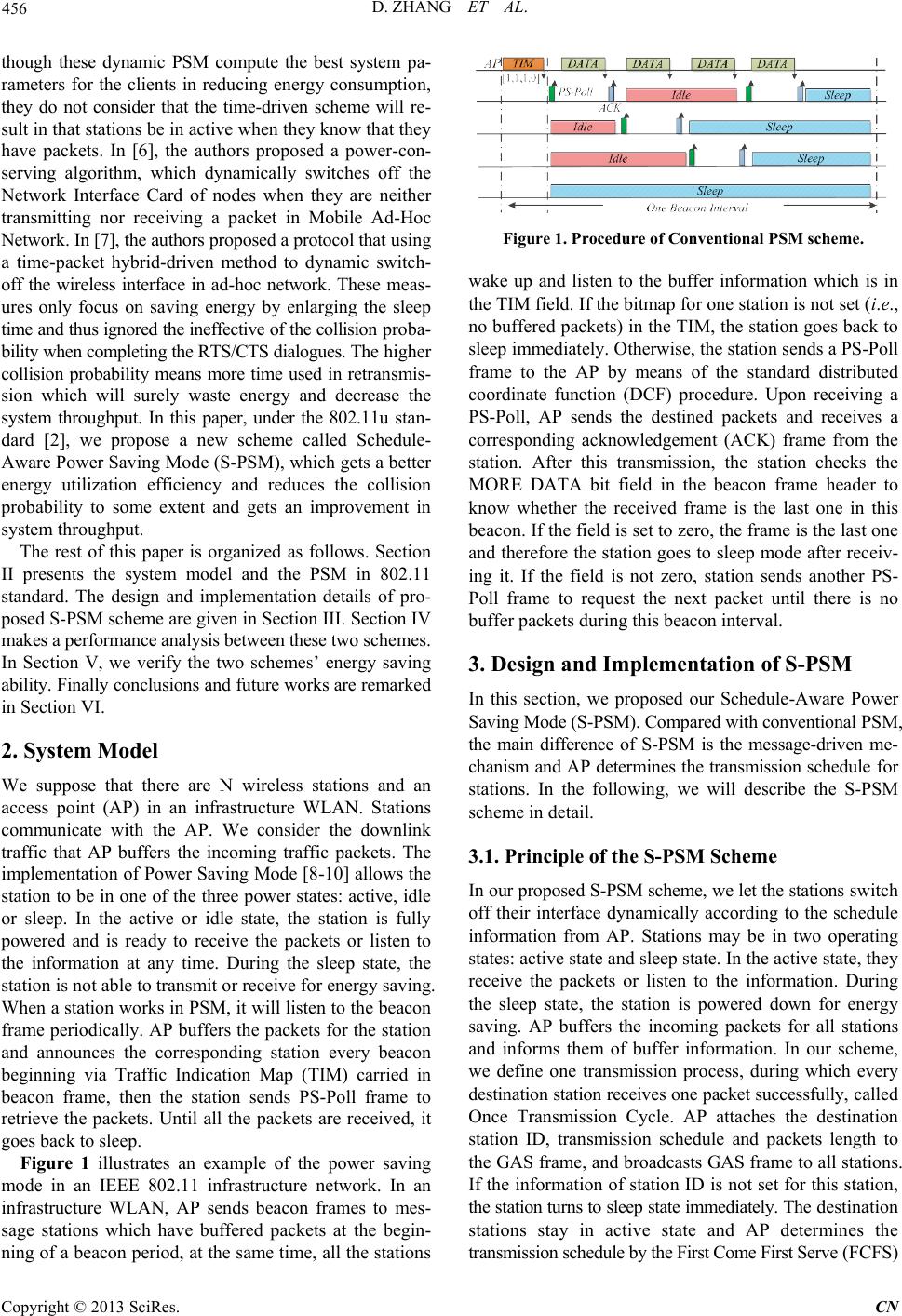 D. ZHANG ET AL. Copyright © 2013 SciRes. CN 456 though these dynamic PSM compute the best system pa- rameters for the clients in reducing energy consumption, they do not consider that the time-driven scheme will re- sult in that stations be in active when they know that they have packets. In [6], the authors proposed a power-con- serving algorithm, which dynamically switches off the Network Interface Card of nodes when they are neither transmitting nor receiving a packet in Mobile Ad-Hoc Network. In [7], the authors proposed a protocol that using a time-packet hybrid-driven method to dynamic switch- off the wireless interface in ad-hoc network. These meas- ures only focus on saving energy by enlarging the sleep time and thus ignored the ineffective of the collision proba- bility when completing the RTS/CTS dialogues. The higher collision probability means more time used in retransmis- sion which will surely waste energy and decrease the system throughput. In this paper, under the 802.11u stan- dard [2], we propose a new scheme called Schedule- Aware Power S aving Mod e (S-PSM), which gets a better energy utilization efficiency and reduces the collision probability to some extent and gets an improvement in system throughput. The rest of this paper is organized as follows. Section II presents the system model and the PSM in 802.11 standard. The design and implementation details of pro- posed S-PSM scheme are given in Section III. Section IV makes a performance analysis between these two schemes. In Section V, we verify the two schemes’ energy saving ability. Finally conclusions and future works are remarked in Section VI. 2. System Model We suppose that there are N wireless stations and an access point (AP) in an infrastructure WLAN. Stations communicate with the AP. We consider the downlink traffic that AP buffers the incoming traffic packets. The implementation of Power Saving Mode [8-10] allows the station to be in one of the three power states: active, idle or sleep. In the active or idle state, the station is fully powered and is ready to receive the packets or listen to the information at any time. During the sleep state, the station is not able to transmit or receive for energy saving. When a station works in PSM, it will listen to th e beacon frame periodically. AP buffers the packets for the station and announces the corresponding station every beacon beginning via Traffic Indication Map (TIM) carried in beacon frame, then the station sends PS-Poll frame to retrieve the packets. Until all the packets are received, it goes back to sleep. Figure 1 illustrates an example of the power saving mode in an IEEE 802.11 infrastructure network. In an infrastructure WLAN, AP sends beacon frames to mes- sage stations which have buffered packets at the begin- ning of a beacon period, at th e same time, all the stations Figure 1. Procedure of Conventional PSM scheme. wake up and listen to the buffer information which is in the TIM field. If the bitmap for one station is not set ( i.e., no buffered packe ts) in the TIM, the station goes back to sleep immediately. Otherwise, the station sends a PS-Poll frame to the AP by means of the standard distributed coordinate function (DCF) procedure. Upon receiving a PS-Poll, AP sends the destined packets and receives a corresponding acknowledgement (ACK) frame from the station. After this transmission, the station checks the MORE DATA bit field in the beacon frame header to know whether the received frame is the last one in this beacon. If the field is set to zero, the frame is the last one and therefore the station goes to sleep mode after receiv- ing it. If the field is not zero, station sends another PS- Poll frame to request the next packet until there is no buffer packets during this beacon interval. 3. Design and Implementation of S-PSM In this section, we proposed our Schedule-Aware Power Saving Mode ( S-PSM). Compared with c onve ntional PSM, the main difference of S-PSM is the message-driven me- chanism and AP determines the transmission schedule for stations. In the following, we will describe the S-PSM scheme in detail. 3.1. Principle of the S-PSM Scheme In our proposed S-PSM scheme, we let the stations switch off their interface dynamically according to the schedule information from AP. Stations may be in two operating states: active state and sleep state. In the active state, they receive the packets or listen to the information. During the sleep state, the station is powered down for energy saving. AP buffers the incoming packets for all stations and informs them of buffer information. In our scheme, we define one transmission process, during which every destination station receives one packet successfully, called Once Transmission Cycle. AP attaches the destination station ID, transmission schedule and packets length to the GAS frame, and broadcasts GAS frame to all stations. If the information of station ID is not set for this station, the station turns to sleep state immediately. The destination stations stay in active state and AP determines the trans m issi on s c hed ule by t he Fir st Com e F ir st Ser ve (FCFS) 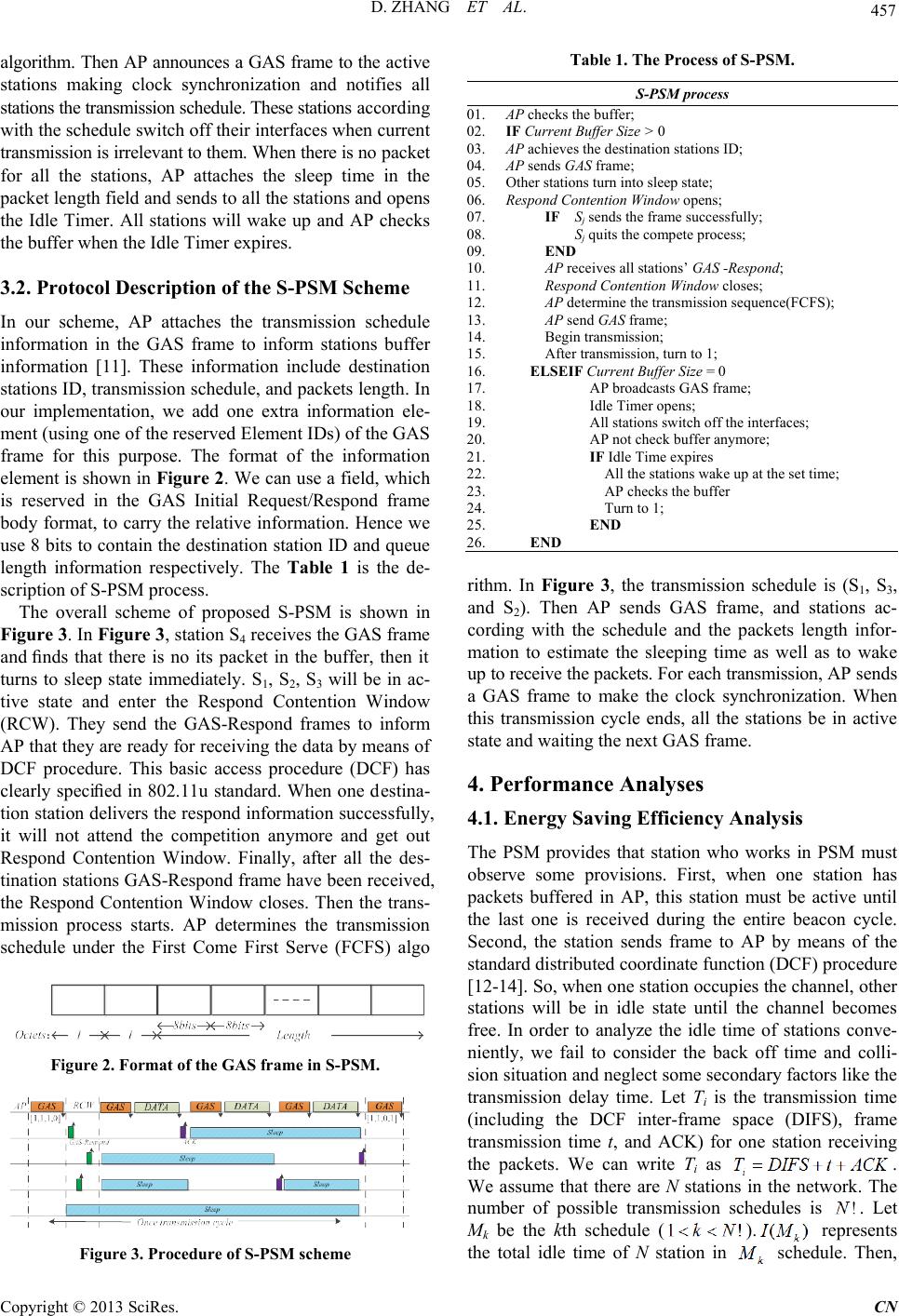 D. ZHANG ET AL. Copyright © 2013 SciRes. CN 457 algorithm. Then AP announces a GAS frame to the active stations making clock synchronization and notifies all stations the tran smission schedule. These sta tions according with the schedule switch off their interfaces when current transmission is irrelevant to them. When there is no packet for all the stations, AP attaches the sleep time in the packet length field and sends to all the stations and opens the Idle Timer. All stations will wake up and AP checks the buffer when the Idle Timer expires. 3.2. Protocol Description of the S -PSM Scheme In our scheme, AP attaches the transmission schedule information in the GAS frame to inform stations buffer information [11]. These information include destination stations ID, transmission schedule, and packets length. In our implementation, we add one extra information ele- ment (using one of the reserved Element IDs) of the GAS frame for this purpose. The format of the information element is shown in Figure 2. We can use a field, which is reserved in the GAS Initial Request/Respond frame body format, to carry the relative information. Hence we use 8 bits to contain the destination station ID and queue length information respectively. The Table 1 is the de- scription of S-PSM process. The overall scheme of proposed S-PSM is shown in Figure 3. In Figure 3, station S4 receives the GAS frame and finds that there is no its packet in the buffer, then it turns to sleep state immediately. S1, S2, S3 will be in ac- tive state and enter the Respond Contention Window (RCW). They send the GAS-Respond frames to inform AP that they are ready for receiving the data by means of DCF procedure. This basic access procedure (DCF) has clearly specified in 802.11u standard. When one destina- tion station delivers the respond information su ccessfully, it will not attend the competition anymore and get out Respond Contention Window. Finally, after all the des- tination stations GAS -Respond frame have been received, the Respond Contention Window closes. Then the trans- mission process starts. AP determines the transmission schedule under the First Come First Serve (FCFS) algo Figure 2. Format of the GAS frame in S-PSM. Figure 3. Procedure of S-PSM sch em e Table 1. The Process of S-PSM. S-PSM process 01. AP checks the buffer; 02. IF Current Buffer Size > 0 03. AP achieves the destination stations ID; 04. AP sends GAS frame; 05. Other stations turn into sleep state; 06. Respond Content ion Wi ndow opens; 07. IF Sj sends the frame successfully; 08. Sj quits the compete process; 09. END 10. AP receives all stations’ GAS -Respond; 11. Respond Contention Window closes; 12. AP determine the transmission sequence(FCFS); 13. AP send GAS fra me ; 14. Begin transmission; 15. After transmission, turn to 1; 16. ELSEIF Current Buffer Size = 0 17. AP broadcasts GAS frame; 18. Idle Timer opens; 19. All stations switch off the interfaces; 20. AP not check buffer anymore; 21. IF Idle Time expires 22. All the stations wake up at the set time; 23. AP checks the buffer 24. Turn to 1; 25. END 26. END rithm. In Figure 3, the transmission schedule is (S1, S3, and S2). Then AP sends GAS frame, and stations ac- cording with the schedule and the packets length infor- mation to estimate the sleeping time as well as to wake up to receive the pack ets. For each transmiss ion , AP sends a GAS frame to make the clock synchronization. When this transmission cycle ends, all the stations be in active state and waiting the next GAS frame. 4. Performance Analyses 4.1. Energy Saving Efficiency Analysis The PSM provides that station who works in PSM must observe some provisions. First, when one station has packets buffered in AP, this station must be active until the last one is received during the entire beacon cycle. Second, the station sends frame to AP by means of the standard distributed coordinate function (DCF) procedure [12-14]. So, when one station occupies the channel, other stations will be in idle state until the channel becomes free. In order to analyze the idle time of stations conve- niently, we fail to consider the back off time and colli- sion situation and neglect some secondary factors lik e the transmission delay time. Let Ti is the transmission time (including the DCF inter-frame space (DIFS), frame transmission time t, and ACK) for one station receiving the packets. We can write Ti as . We assume that there are N stations in the network. The number of possible transmission schedules is . Let Mk be the kth schedule (). represents the total idle time of N station in schedule. Then, 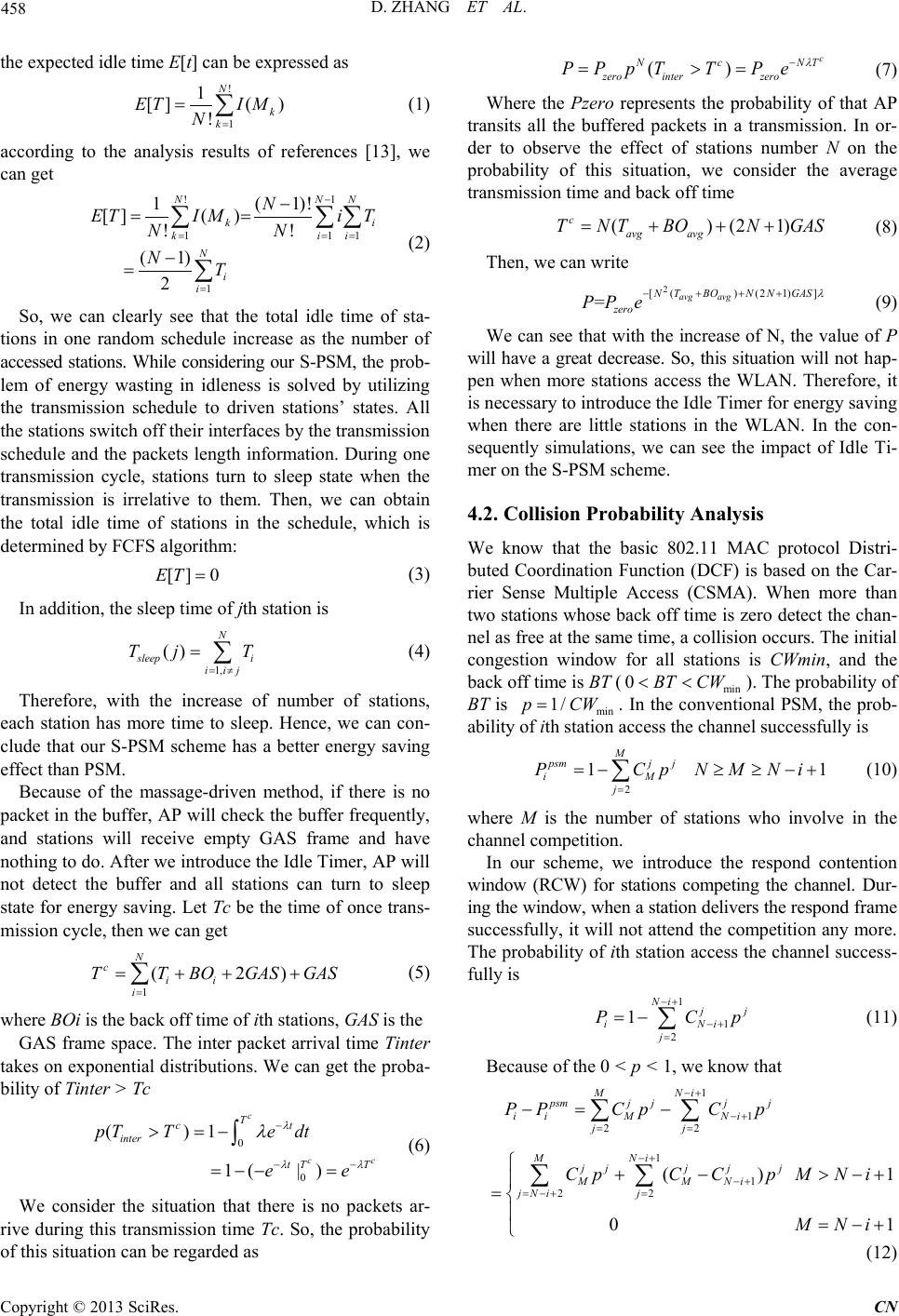 D. ZHANG ET AL. Copyright © 2013 SciRes. CN 458 the expected idle time E[t] can be expressed as ! 1 1 []( ) ! N k k ETI M N= = ∑ (1) according to the analysis results of references [13], we can get !1 1 11 1 1( 1)! []( ) !! ( 1) 2 N NN ki k ii N i i N ETI MiT NN NT − == = = − = = − = ∑ ∑∑ ∑ (2) So, we can clearly see that the total idle time of sta- tions in one random schedule increase as the number of accessed stations. While considering our S-PSM, the prob- lem of energy wasting in idleness is solved by utilizing the transmission schedule to driven stations’ states. All the stations switch off their interfaces by the transmission schedule and the packets length information. During one transmission cycle, stations turn to sleep state when the transmission is irrelative to them. Then, we can obtain the total idle time of stations in the schedule, which is determined by FCFS algorithm: [] 0ET = (3) In addition, the sleep time of jth station is 1, () N sleep i i ij Tj T = ≠ = ∑ (4) Therefore, with the increase of number of stations, each station has more time to sleep. Hence, we can con- clude that our S-PSM scheme has a better energy saving effect than PSM. Because of the massage-driven method, if there is no packet in the buffer, AP will check the buffer frequently, and stations will receive empty GAS frame and have nothing to do. After we introduce the Idle Timer, AP will not detect the buffer and all stations can turn to sleep state for energy sa ving. Let Tc be the time of once trans- mission cycle, then we can get 1 ( 2) N cii i TT BOGASGAS = = +++ ∑ (5) where BOi is the back off time of ith stations, GAS is the GAS frame space. The inter packet arrival time Tinter takes on exponential distribu tions. We can get the proba- bility of Tinter > Tc 0 0 ( )1 1( |) c cc T ct inter tT T p TTedt ee λ λλ λ − −− >=− = −−= ∫ (6) We consider the situation that there is no packets ar- rive during this transmission time Tc. So, the probability of this situation can be regarded as () c N cNT zero interzero PPpTT Pe λ − = >= (7) Where the Pzero represents the probability of that AP transits all the buffered packets in a transmission. In or- der to observe the effect of stations number N on the probability of this situation, we consider the average transmission time and back off time () (21) cavg avg TN TBONGAS= + ++ (8) Then, we can wri t e 2 [ ()(2 1)] = avg avg N TBONNGAS zero PP e λ −+ ++ (9) We can see that with the increase of N, the value of P will have a great decrease. So, this situation will not hap- pen when more stations access the WLAN. Therefore, it is necessary to introduce the Idle Timer for energy saving when there are little stations in the WLAN. In the con- sequently simulations, we can see the impact of Idle Ti- mer on the S-PSM scheme. 4.2. Collision Probability Analysis We know that the basic 802.11 MAC protocol Distri- buted Coordination Function (DCF) is based on the Car- rier Sense Multiple Access (CSMA). When more than two stations whose back off time is zero detect the chan- nel as free at the same time, a collision occurs. The initial congestion window for all stations is CWmin, and the back off time is BT ( min 0BT CW<< ). The probability of BT is min 1/p CW= . In the conventional PSM, the prob- ability of ith station access the channel successfully is 2 11 M psmj j iM j PCpN MNi = =−≥≥ −+ ∑ (10) where M is the number of stations who involve in the channel competition. In our scheme, we introduce the respond contention window (RCW) for stations competing the channel. Dur- ing the window, when a station delivers the respond frame successfully, it will not attend the competition any more. The probability of ith station access the channel success- fully is 1 1 2 1 Ni jj i Ni j P Cp −+ −+ = =− ∑ (11) Because of the 0 < p < 1, we know that 1 1 22 1 1 22 () 1 01 M Ni psmjjjj i iMNi jj M Ni jjj jj MM Ni jNi j P PCpCp CpCCp MNi M Ni −+ −+ = = −+ −+ = −+= −= − +−> −+ = = −+ ∑∑ ∑∑ (12) 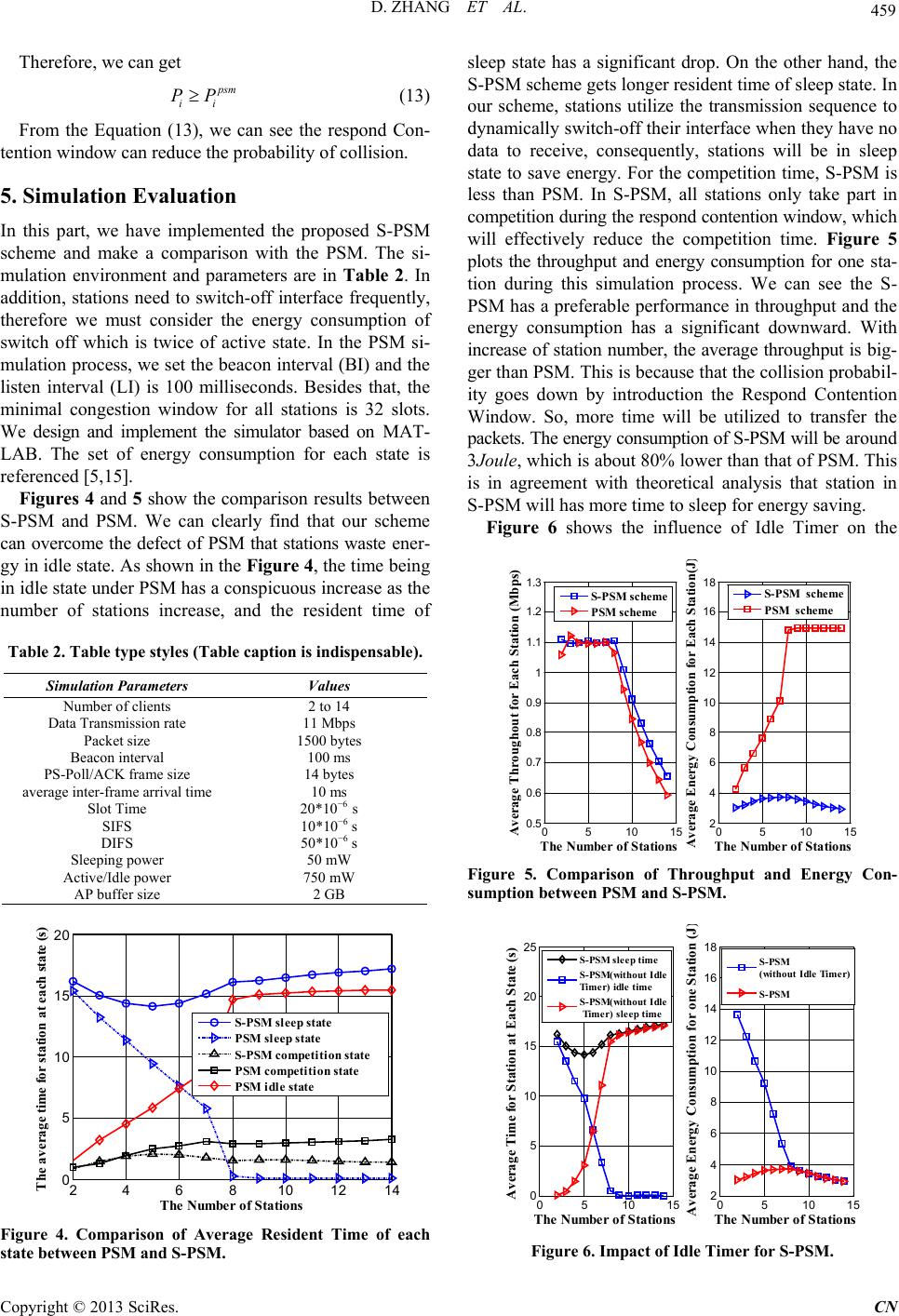 D. ZHANG ET AL. Copyright © 2013 SciRes. CN 459 Therefore, we can get psm ii PP≥ (13) From the Equation (13), we can see the respond Con- tention window can reduce the probability of collision. 5. Simulation Evaluation In this part, we have implemented the proposed S-PSM scheme and make a comparison with the PSM. The si- mulation environment and parameters are in Table 2. In addition, stations need to switch-off interface frequently, therefore we must consider the energy consumption of switch off which is twice of active state. In the PSM si- mulation process, we set the beacon interval (BI) and the listen interval (LI) is 100 milliseconds. Besides that, the minimal congestion window for all stations is 32 slots. We design and implement the simulator based on MAT- LAB. The set of energy consumption for each state is reference d [5 ,15]. Figures 4 and 5 show the comparison results between S-PSM and PSM. We can clearly find that our scheme can overcome the defect of PSM that stations waste ener- gy in idle state. As shown in the Figure 4, the time being in idle state under PSM has a conspicuous increase as the number of stations increase, and the resident time of Table 2. Table type styles (Table capt ion is indispensable). Simulation Parameters Values Number of clients Data Transmission rate Packet size Beacon interval PS-Poll/ACK frame size average inter-frame arrival time Slot Time SIFS DIFS Sleeping power Active/Idle power AP buffer size 2 to 14 11 Mbps 1500 bytes 100 ms 14 bytes 10 ms 20*10−6 s 10*10−6 s 50*10−6 s 50 mW 750 mW 2 GB Figure 4. Comparison of Average Resident Time of each state between PSM an d S-PSM. sleep state has a significant drop. On the other hand, the S-PSM scheme gets longer resident time of sleep state. In our scheme, stations utilize the transmission sequence to dynamically switch-off their interface when they have no data to receive, consequently, stations will be in sleep state to save energy. For the competition time, S-PSM is less than PSM. In S-PSM, all stations only take part in competition during the respond contention window, which will effectively reduce the competition time. Figure 5 plots the throughput and energy consumption for one sta- tion during this simulation process. We can see the S- PSM has a preferable performance in throug hput and the energy consumption has a significant downward. With increase of station number, the average throughput is big- ger than PSM. This is because that the collision probabil- ity goes down by introduction the Respond Contention Window. So, more time will be utilized to transfer the packets. The energy consumption of S-PSM will be around 3Joule, which is about 80% lower than that of PSM. This is in agreement with theoretical analysis that station in S-PSM will has more time to sleep for energy saving. Figure 6 shows the influence of Idle Timer on the Figure 5. Comparison of Throughput and Energy Con- sumption between PSM and S-PSM. Figure 6. Impact of Idle Timer for S-PSM. 2 4 6810 1214 0 5 10 15 20 The Number of St ations The average time for station at each state (s) S-PSM sleep state PSM sleep state S -PSM com petition state PSM competition state PSM idle state 05 10 15 0.5 0.6 0.7 0.8 0.9 1 1.1 1.2 1.3 T he Number of Stati ons Average Throughout for Each Station (Mbps) S-PSM scheme PS M scheme 05 10 15 2 4 6 8 10 12 14 16 18 T he Number of Stati ons Average Energy Consumption for Each Station(J) S-PSM scheme PSM scheme 05 1015 0 5 10 15 20 25 The Number of St ations Average Time for Station at Each State (s) S-PSM sle e p time S-PSM(without Idle Timer) idle tim e S-PSM(without Idle Timer) slee p time 0510 15 2 4 6 8 10 12 14 16 18 The Number of St ations Average Energy Consumption for one Station (J) S-PSM (without Idle Timer) S-PSM 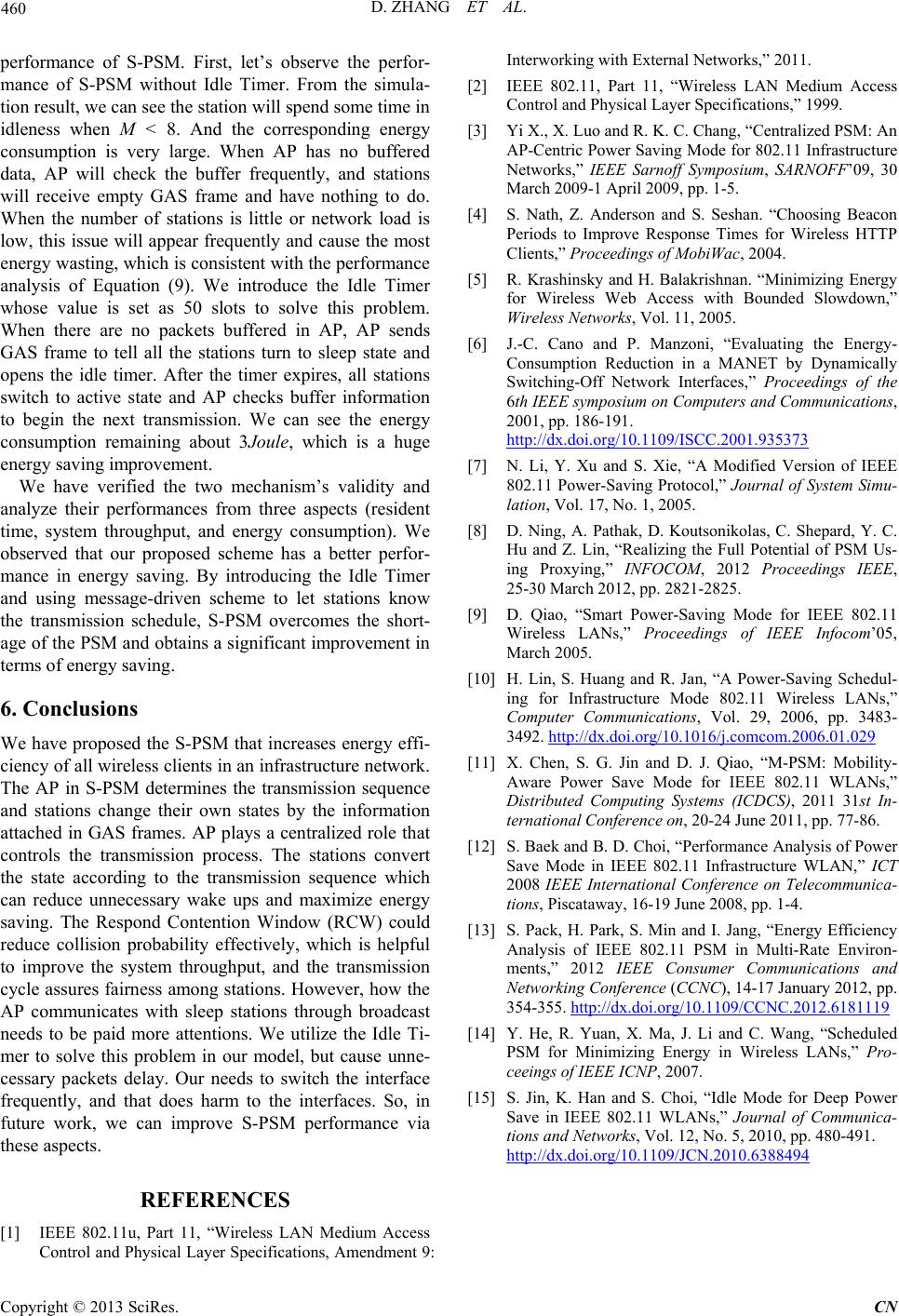 D. ZHANG ET AL. Copyright © 2013 SciRes. CN 460 performance of S-PSM. First, let’s observe the perfor- mance of S-PSM without Idle Timer. From the simula- tion result, we can see the station will spend some time in idleness when M < 8. And the corresponding energy consumption is very large. When AP has no buffered data, AP will check the buffer frequently, and stations will receive empty GAS frame and have nothing to do. When the number of stations is little or network load is low, this issue will appear frequently and cause the most energy wasting, which is consistent with the performance analysis of Equation (9). We introduce the Idle Timer whose value is set as 50 slots to solve this problem. When there are no packets buffered in AP, AP sends GAS frame to tell all the stations turn to sleep state and opens the idle timer. After the timer expires, all stations switch to active state and AP checks buffer information to begin the next transmission. We can see the energy consumption remaining about 3Joule, which is a huge energy saving improvement. We have verified the two mechanism’s validity and analyze their performances from three aspects (resident time, system throughput, and energy consumption). We observed that our proposed scheme has a better perfor- mance in energy saving. By introducing the Idle Timer and using message-driven scheme to let stations know the transmission schedule, S-PSM overcomes the short- age of the PSM and obtains a significant improvement in terms of energy saving. 6. Conclusions We have proposed the S-PSM that increases energy effi- ciency of all wireless clients in an infrastructure network. The AP in S-PSM determines the transmission sequence and stations change their own states by the information attached in GAS frames. AP plays a centralized role that controls the transmission process. The stations convert the state according to the transmission sequence which can reduce unnecessary wake ups and maximize energy saving. The Respond Contention Window (RCW) could reduce collision probability effectively, which is helpful to improve the system throughput, and the transmission cycle assures fairness among stations. However, how the AP communicates with sleep stations through broadcast needs to be paid more attentions. We utilize the Idle Ti- mer to solve this problem in our model, but cause unne- cessary packets delay. Our needs to switch the interface frequently, and that does harm to the interfaces. So, in future work, we can improve S-PSM performance via these aspects. REFERENCES [1] IEEE 802.11u, Part 11, “Wireless LAN Medium Access Control and Physical Layer Specifications, Amendment 9: Interworking with External Networks,” 2011. [2] IEEE 802.11, Part 11, “Wireless LAN Medium Access Control and Physical Layer Specifications,” 1999. [3] Yi X., X. Luo and R. K. C. Chang, “Centralized PSM: An AP-Centric Power Saving Mode for 802.11 Infrastructure Networks,” IEEE Sarnoff Symposium, SARNOFF’09, 30 March 2009-1 April 2009, pp. 1-5. [4] S. Nath, Z. Anderson and S. Seshan. “Choosing Beacon Periods to Improve Response Times for Wireless HTTP Clients,” Proceedings of MobiWac, 2004. [5] R. Krashinsky and H. Balakrishnan. “Minimizing Energy for Wireless Web Access with Bounded Slowdown,” Wireless Networks, Vol. 11, 2005. [6] J.-C. Cano and P. Manzoni, “Evaluating the Energy- Consumption Reduction in a MANET by Dynamically Switching-Off Network Interfaces,” Proceedings of the 6th IEEE symposium on Computers and Communications, 2001, pp. 186-191. http://dx.doi.org/10.1109/ISCC.2001.935373 [7] N. Li, Y. Xu and S. Xie, “A Modified Version of IEEE 802.11 Power-Saving Protocol,” Journal of System Simu- lation, Vol. 17, No. 1, 2005. [8] D. Ning, A. Pathak, D. Koutsonikolas, C. Shepard, Y. C. Hu and Z. Lin, “Realizing the Full Potential of PSM Us- ing Proxying,” INFOCOM, 2012 Proceedings IEEE, 25-30 March 2012, pp. 2821-2825. [9] D. Qiao, “Smart Power-Saving Mode for IEEE 802.11 Wireless LANs,” Proceedings of IEEE Infocom’05, March 2005. [10] H. Lin, S. Huang and R. Jan, “A Power-Saving Schedul- ing for Infrastructure Mode 802.11 Wireless LANs,” Computer Communications, Vol. 29, 2006, pp. 3483- 3492. http://dx.doi.org/10.1016/j.comcom.2006.01.029 [11] X. Chen, S. G. Jin and D. J. Qiao, “M-PSM: Mobility- Aware Power Save Mode for IEEE 802.11 WLANs,” Distributed Computing Systems (ICDCS), 2011 31st In- ternational Conference on, 20-24 June 2011, pp. 77-86. [12] S. Baek and B. D. Choi, “Performance Analysis of Power Save Mode in IEEE 802.11 Infrastructure WLAN,” ICT 2008 IEEE International Conference on Telecommunica- tions, Piscat away, 16-19 June 2008, pp. 1-4. [13] S. Pack, H. Park, S. Min and I. Jang, “Energy Efficiency Analysis of IEEE 802.11 PSM in Multi-Rate Environ- ments,” 2012 IEEE Consumer Communications and Networking Conference (CCNC), 14-17 Jan uary 2012, pp. 354-355. http://dx.doi.org/10.1109/CCNC.2012.6181119 [14] Y. He, R. Yuan, X. Ma, J. Li and C. Wang, “Scheduled PSM for Minimizing Energy in Wireless LANs,” Pro- ceeings of IEEE ICNP, 2007. [15] S. Jin, K. Han and S. Choi, “Idle Mode for Deep Power Save in IEEE 802.11 WLANs,” Journal of Communica- tions and Networks, Vol. 12, No. 5, 2010, pp. 480-491. http://dx.doi.org/10.1109/JCN.2010.6388494 |